Lenny.com
Explore
Create
ActivitiesNewMathEnglish Language ArtsScience & EngineeringSocial StudiesGlobal LanguagesHealth & Physical EducationSpecial EducationCounseling & Life SkillsArts & CreativityESL
Lenny.com
Lenny.com
Explore
Create
ActivitiesNewMathEnglish Language ArtsScience & EngineeringSocial StudiesGlobal LanguagesHealth & Physical EducationSpecial EducationCounseling & Life SkillsArts & CreativityESL
Lenny.com
Lenny.com

Solutions

Lenny for EducatorsLenny for SchoolsLenny for Districts

Product

ExploreSign inCreateSupportAbout

Resources

Getting startedMTSS Acceleration Program

Newsletters

School Funding Newsletter

© 2026 Lenny Learning Inc.

TermsPrivacyAccessibility
LinkedInInstagramX
Lenny
MathNumbers & CountingCounting ObjectsNumber NamesComparing NumbersNumber OperationsCounting SequenceNumbers 0-10Place Value Understanding and SystemAdd and Subtract Within 20Addition and Subtraction ConceptsAddition and Subtraction EquationsAddition and Subtraction ProblemsFoundations for MultiplicationMultiplication and Division PropertiesMultiply and Divide Within 100Multiplication and Division ProblemsFactors and MultiplesProperties of OperationsPatterns and RelationshipsGenerate and Analyze PatternsMulti-Digit ArithmeticPlace Value OperationsMulti-Digit and Decimal OperationsNumerical ExpressionsFour Operations and PatternsFour Operations Problem SolvingMeasurement & DataMeasurable AttributesMeasuring LengthsMeasure and Estimate Lengths in Standard UnitsRelate Addition and Subtraction to LengthClassifying and Counting ObjectsTime and MoneyArea Concepts and MeasurementPerimeter and Area MeasuresAngle Concepts and MeasurementTime, Volume, and MassMeasurement Unit ConversionsGeometryIdentifying ShapesShapes and AttributesShape Attributes and ReasoningShapes and CompositionClassifying 2D FiguresGeometric Figures and RelationshipsLines, Angles, and ShapesAngle, Area, and VolumeGeometric MeasurementVolume of 3D ShapesCoordinate Plane ApplicationsTransformations in the PlaneCongruence and SimilarityUnderstand congruence in terms of rigid motionsSimilarity and TransformationsProve Theorems Involving SimilarityPythagorean TheoremTrigonometry for General TrianglesMake Geometric ConstructionsProve Geometric TheoremsTheorems About CirclesFind Arc Lengths And Areas of Sectors of CirclesVolume FormulasRelationships Between Two-Dimensional and Three-Dimensional ObjectsProve Simple Geometric Theorems AlgebraicallyTranslate Between Geometric Description and Equation for Conic SectionApply Geometric Concepts in Modeling SituationsFractions & DecimalsFractions as NumbersBuilding FractionsFraction Equivalence and OrderingAdding and Subtracting FractionsMultiplying and Dividing FractionsDividing FractionsDecimal FractionsMulti-Digit Computation and FactorsAdd, Subtract, Multiply, and Divide Rational NumbersRational Number SystemIrrational Numbers and ApproximationsRatiosRatios and ProportionsProportional RelationshipsUnit RateAlgebraAlgebraic ExpressionsGenerate Equivalent ExpressionsQuantitative RelationshipsProportional Relationships and Linear EquationsEquations and InequalitiesEquation Solving and ReasoningLinear Equations and SystemsGraph Equations and InequalitiesSystems of EquationsReal-World Algebraic ProblemsQuantitative Reasoning with UnitsExpression StructureEquivalent Expression FormsRadicals and Integer ExponentsRational ExponentsRational and Irrational NumbersPolynomial OperationsPolynomial IdentitiesPolynomial Zeros and FactorsRational ExpressionsComplex Number OperationsComplex Numbers in PolynomialsComplex Numbers on PlaneStatistics & ProbabilityRepresent and Interpret DataData DistributionsStatistical VariabilityProbability ModelsCompound Event ProbabilitiesStatistical SamplingInterpret Categorical and Quantitative DataBivariate Data PatternsInterpret Linear ModelsComparing Two PopulationsRandom Processes in StatisticsIndependence and Conditional ProbabilityExpected ValuesProbability-Based Decision MakingStatistical Inference and ConclusionsFunctionsFunction Concepts and NotationDefine and Compare FunctionsInterpret Functions in ContextAnalyze Function RepresentationsModel Relationships with FunctionsIdentify Linear vs Exponential GrowthDistinguish Between Function TypesCompare Growth RatesInterpret Function ExpressionsBuild Functions from RelationshipsConstruct and Model FunctionsTransform and Combine FunctionsModel Comparison and SelectionSolve Exponential EquationsTrigonometryTrigonometric Ratios Involving Right TrianglesTrigonometric Functions and Unit CircleModel with Trigonometric FunctionsTrigonometric IdentitiesVectors & MatricesIntroduction to Vectors and MatricesVector QuantitiesVector OperationsMatrix OperationsCalculusLimits and ContinuityDerivative Concepts and NotationDerivative Rules and TechniquesApplications of DerivativesOptimization ProblemsRelated RatesCurve Sketching and AnalysisIntegration Concepts and NotationAntiderivatives and Indefinite IntegralsDefinite Integrals and AreaFundamental Theorem of CalculusIntegration TechniquesApplications of IntegrationDifferential EquationsSequences and SeriesParametric and Polar FunctionsVector-Valued Functions

Double Digit Multiply

A comprehensive elementary math lesson introducing 2-digit by 1-digit multiplication using the standard algorithm and place-value reasoning. Includes instructional presentation slides, scaffolded student practice sheets with generous workspace, and an annotated teacher answer key.

Llwalker

1 23 × 3

Ones & Tens

23

× 3

Show Work / Notes:

Answer: Product = ____________

2 42 × 4

Ones & Tens

42

× 4

Show Work / Notes:

Answer: Product = ____________

3 28 × 3

Regroup Ones

28

× 3

Show Work / Notes:

Answer: Product = ____________

4 46 × 2

Regroup Ones

46

× 2

Show Work / Notes:

Answer: Product = ____________

5 37 × 4

Regroup Ones

37

× 4

Show Work / Notes:

Answer: Product = ____________

Accuracy Self-Check Checklist

Did I multiply the ones column first?

Did I write carried digits in the top box?

Did I multiply tens first, then add carried?

Continue to Problems 6–10 on Page 3!

Double Digit Multiply • Independent Practice Page 2 of 3

Independent Mastery • Part B

Independent Practice: Problems 6 to 10

Name:

Directions: Complete the remaining 5 problems. Remember to multiply first and then add your regrouped tens!

6 54 × 5

Regroup Ones

54

× 5

Show Work / Notes:

Answer: Product = ____________

7 68 × 3

Regroup Ones

68

× 3

Show Work / Notes:

Answer: Product = ____________

8 75 × 6

Regroup Ones

75

× 6

Show Work / Notes:

Answer: Product = ____________

9 89 × 4

Regroup Ones

89

× 4

Show Work / Notes:

Answer: Product = ____________

10 93 × 7

Regroup Ones

93

× 7

Show Work / Notes:

Answer: Product = ____________

Bonus Word Problem Challenge

An art teacher ordered 6 boxes of colored markers for the classroom. Each box contains 24 markers. How many markers did the teacher order in all?

Total Markers: ________ markers

Double Digit Multiply • Independent Practice Complete Page 3 of 3

Ans: 148

Double Digit Multiply • Teacher Edition See Page 2 for Problems 6–10 & Diagnostic Guide Page 1 of 2

Independent Mastery • Part B

Solutions: Problems 6 to 10 & Teacher Insights

Page 3 of Student Sheet

#6 54 × 5

[+2]

54

× 5

270

5×4=20 (carry 2). (5×5)+2 = 27 tens.

Ans: 270

#7 68 × 3

[+2]

68

× 3

204

3×8=24 (carry 2). (3×6)+2 = 20 tens.

Ans: 204

#8 75 × 6

[+3]

75

× 6

450

6×5=30 (carry 3). (6×7)+3 = 45 tens.

Ans: 450

#9 89 × 4

[+3]

89

× 4

356

4×9=36 (carry 3). (4×8)+3 = 35 tens.

Ans: 356

#10 93 × 7

[+2]

93

× 7

651

7×3=21 (carry 2). (7×9)+2 = 65 tens.

Ans: 651

Bonus Word Problem Solution (Markers Problem)

Equation: 24 markers × 6 boxes = 144 markers.

Total: 144 markers

Diagnostic Error Analysis & Quick Fixes

Error 1: Adding Carried First

Symptom: On 28×3, student adds 2+2=4, then 4×3=12, writing 124 instead of 84.

Fix: Chanted rule: "Multiply bottom to top, THEN add what's hopped!"

Error 2: Forgetting to Carry

Symptom: On 37×4, student writes 1228 (placing both 28 and 12 on the bottom).

Fix: Emphasize: Only ONE digit fits in the ones place room at a time.

Error 3: Forgetting Added Value

Symptom: Student writes carry digit "+2" in the box, but forgets to add it to 4×3=12.

Fix: Train students to slash through the carried digit as soon as it's added.

Double Digit Multiply • Teacher Diagnostic & Solutions Grade 4 Standards Aligned Page 2 of 2

You might also like

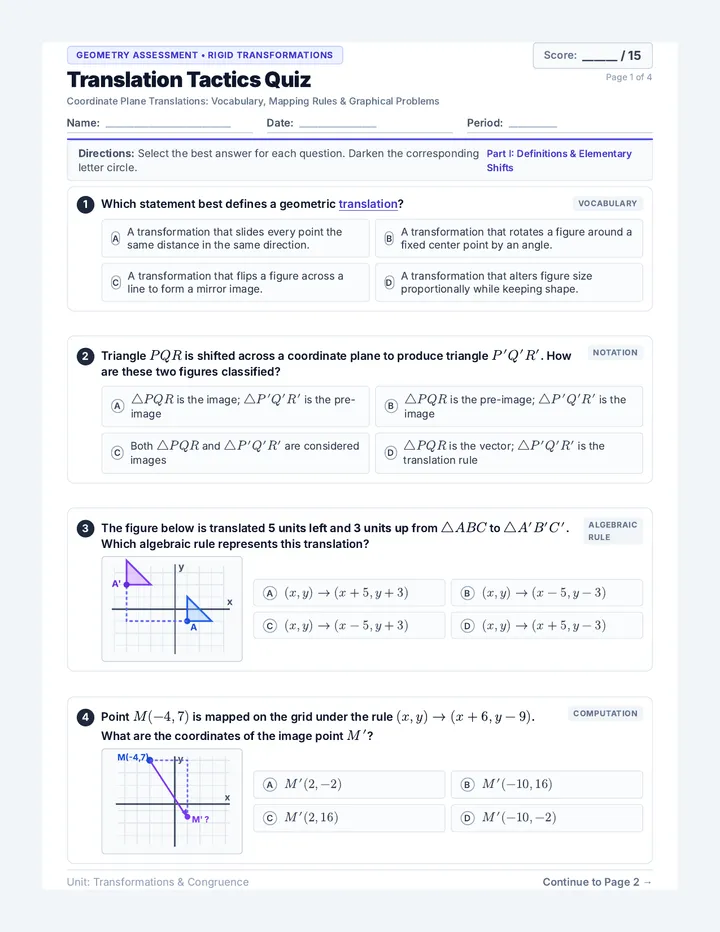
Translation Tactics Quiz

Math Mastery Units

Comprehensive secondary mathematics units covering coordinate geometry transformations and linear functions in slope-intercept form.

FM

Fernando Mancini

4
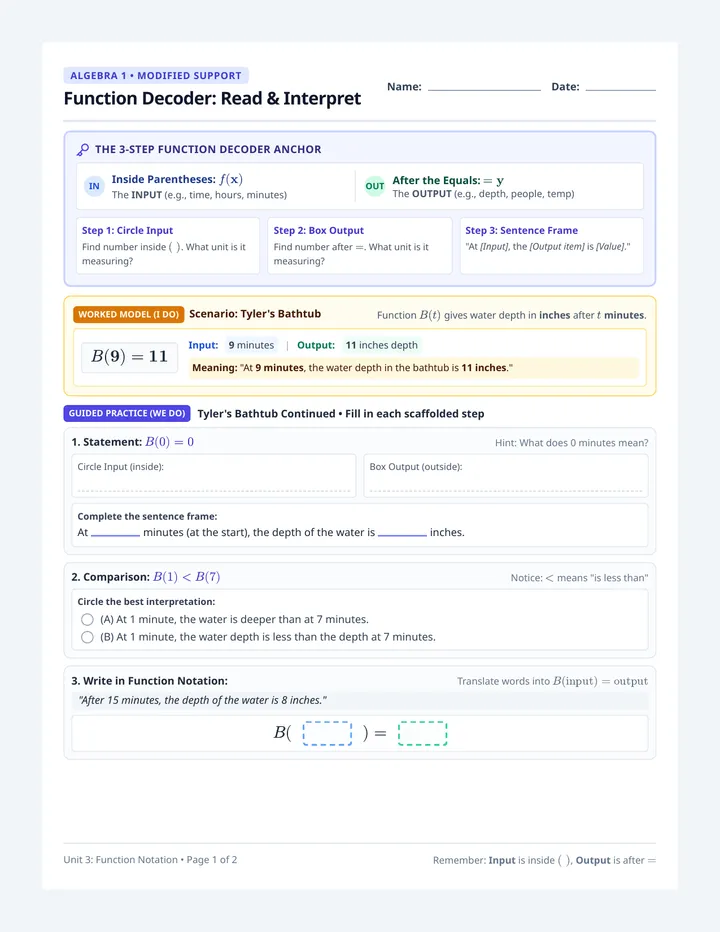
Function Decoder Practice Worksheet

Function Decoder

A specially modified Algebra 1 lesson designed for 9th-grade special education students to master interpreting function notation in real-world contexts. Features step-by-step modeling, structured visual anchors, graphic sentence starters, and gradual release practice.

R

rubaiya.ahmed

3
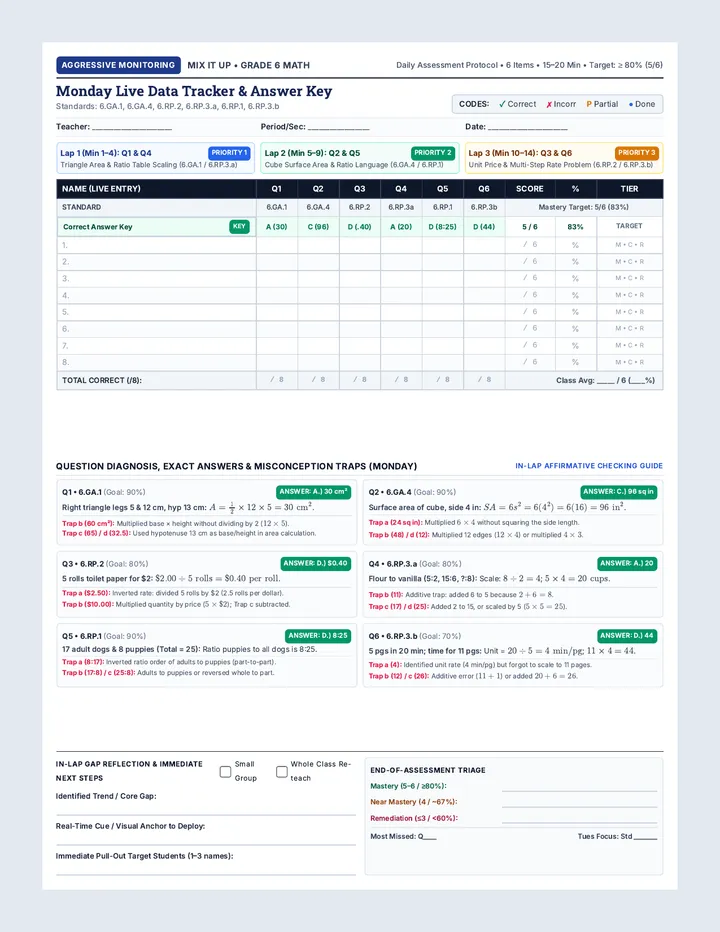
Mix It Up Monitoring Tracker

Mix It Up Monitoring Tracker

A rigorous daily aggressive monitoring system and diagnostic answer key for Grade 6 Math Mix It Up covering Monday through Thursday. Features live active monitoring tracking tables with blank spaces for real-time data collection, timed lap priorities, detailed exemplar work, multiple-choice misconception traps, and rapid instructional triage.

M

menyon.reeves

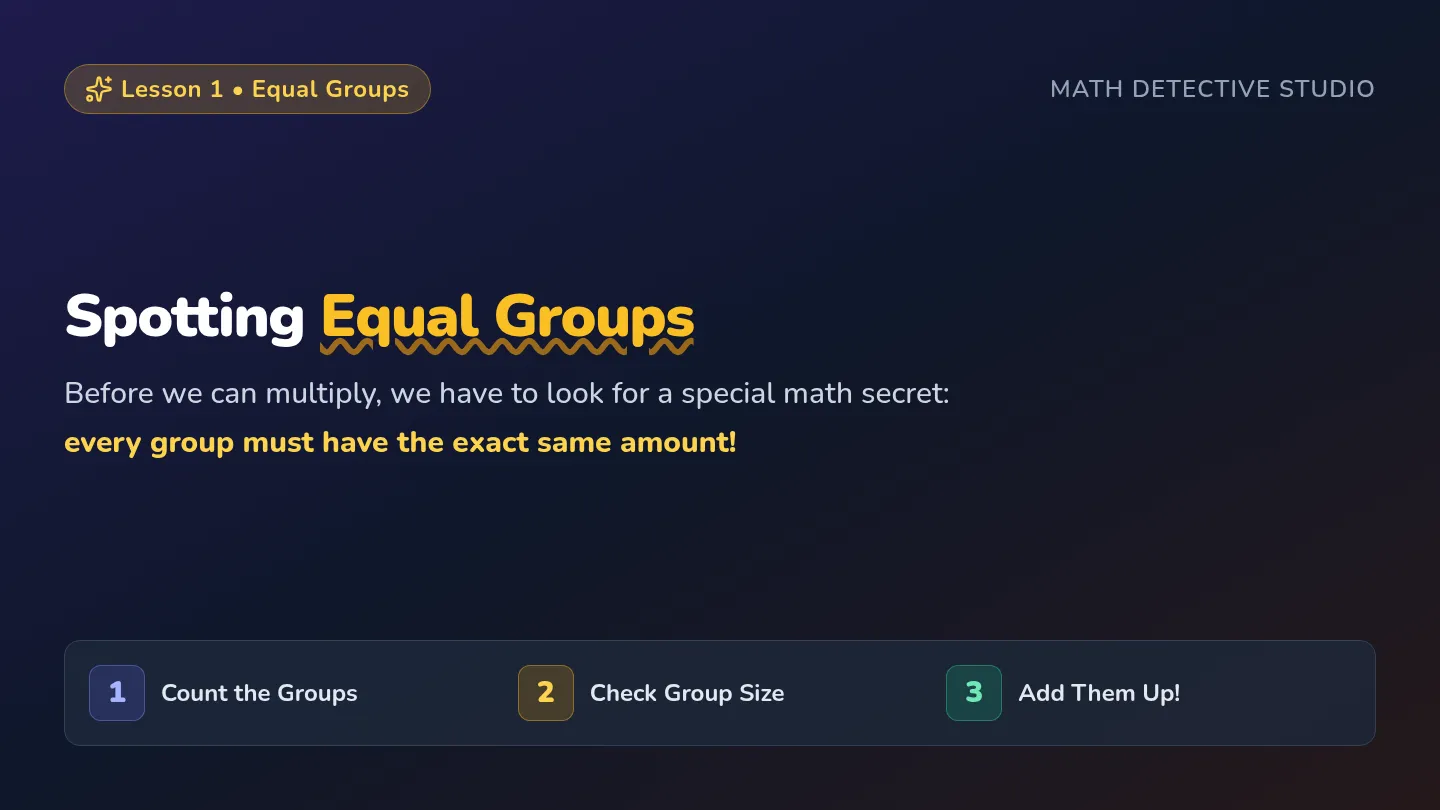
Equal Groups Slides

Equal Group Explorers

A three-part intervention sequence designed for students struggling with early multiplication concepts. The sequence methodically transitions learners from concrete equal groups to repeated addition, number line skip-counting, and formal multiplication notation.

B

bower

9
Customary Conversions Slides

Customary Unit Conversions

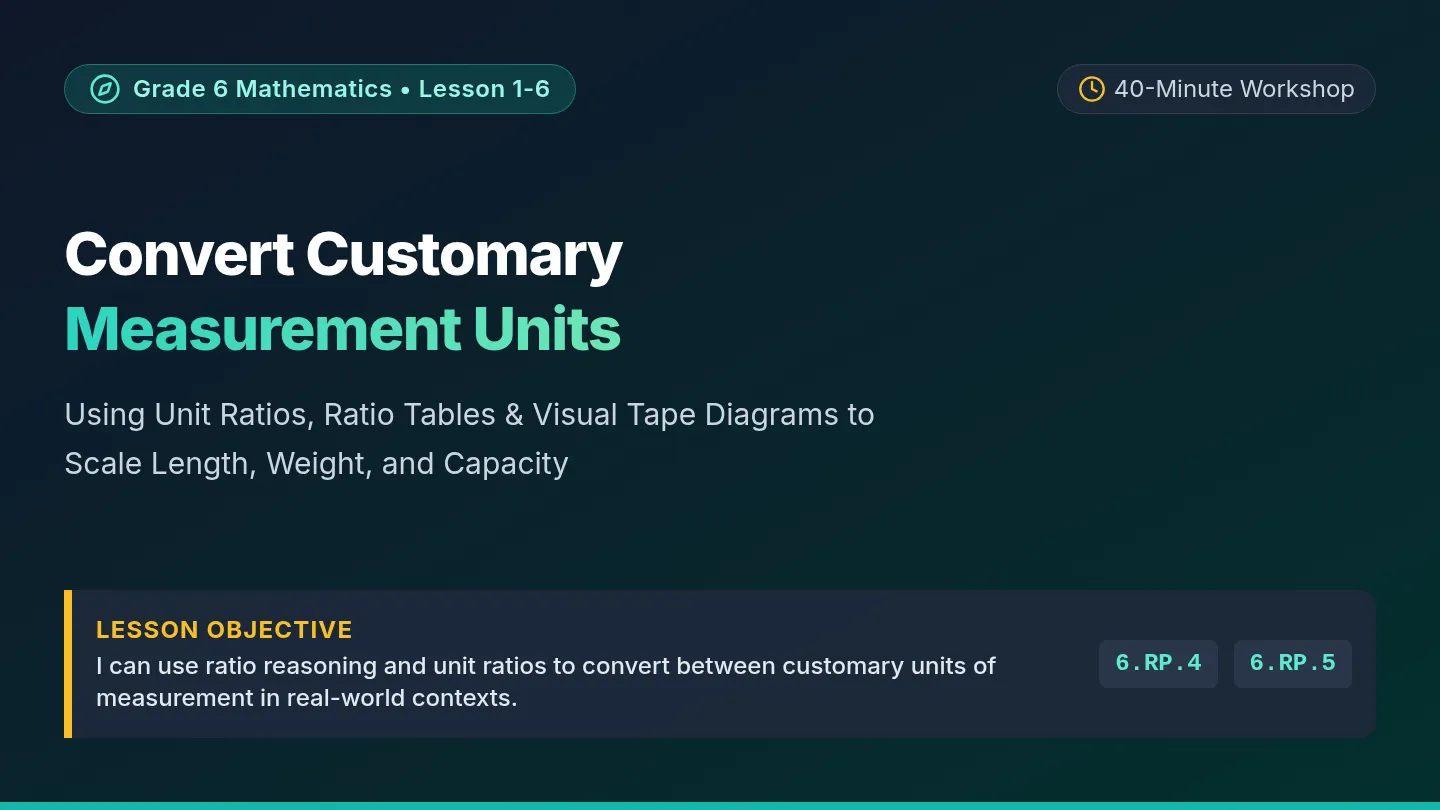
A comprehensive 40-minute grade 6 mathematics lesson on converting customary measurement units using unit ratios, equivalent ratio tables, and visual tape diagrams. Students master bidirectional conversions across length, weight, and capacity while connecting proportional reasoning to real-world problem contexts.

RG

Richard Gist

3
Function Decoder Teacher Guide

Function Decoder Teacher Guide

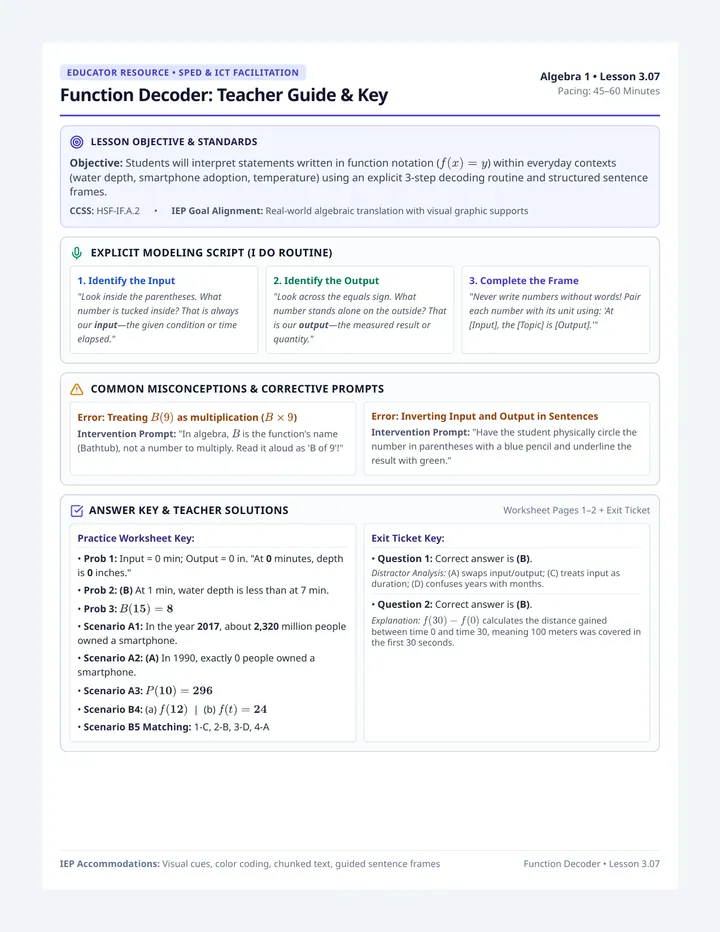
An instructional facilitation guide for special education teachers and co-teachers. Contains step-by-step teacher modeling scripts, high-leverage verbal prompts, common SPED misconceptions with corrective moves, IEP accommodation strategies, and a complete answer key.

R

rubaiya.ahmed

Parallélogramme Fiche Mémento

Secrets des Quadrilatères

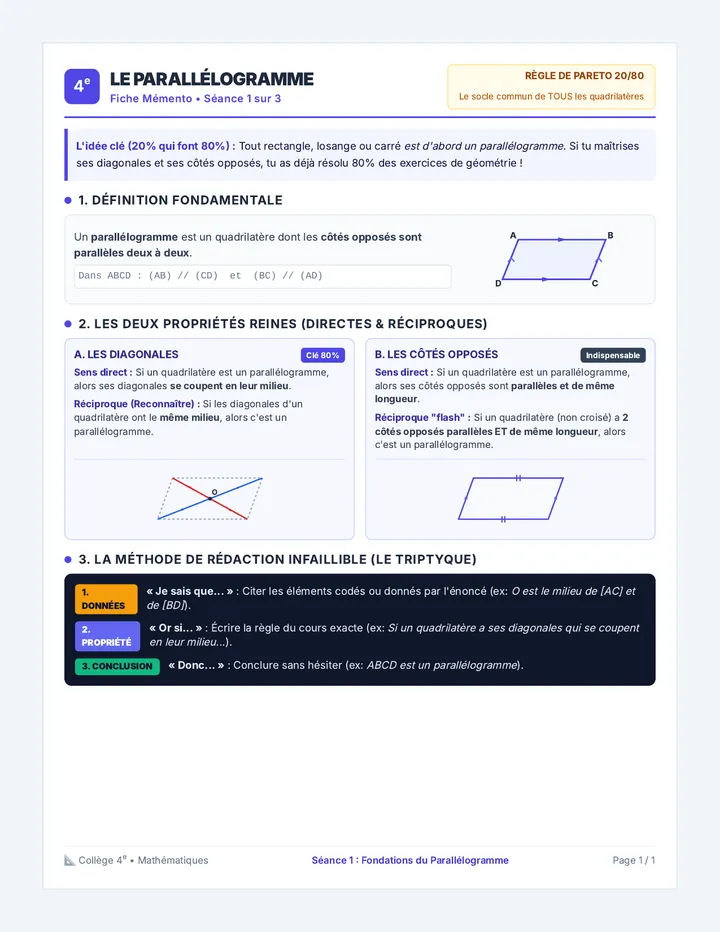
Séquence didactique complète de 3 séances de 45 minutes pour la classe de 4ème, centrée sur les propriétés essentielles (principe de Pareto) du parallélogramme, du rectangle, du losange et du carré. Elle allie fiches de cours synthétiques et feuilles d'entraînement méthodique à la démonstration.

E

Enseignante

9
Symmetry Spin Slides

Rotational Symmetry Spin

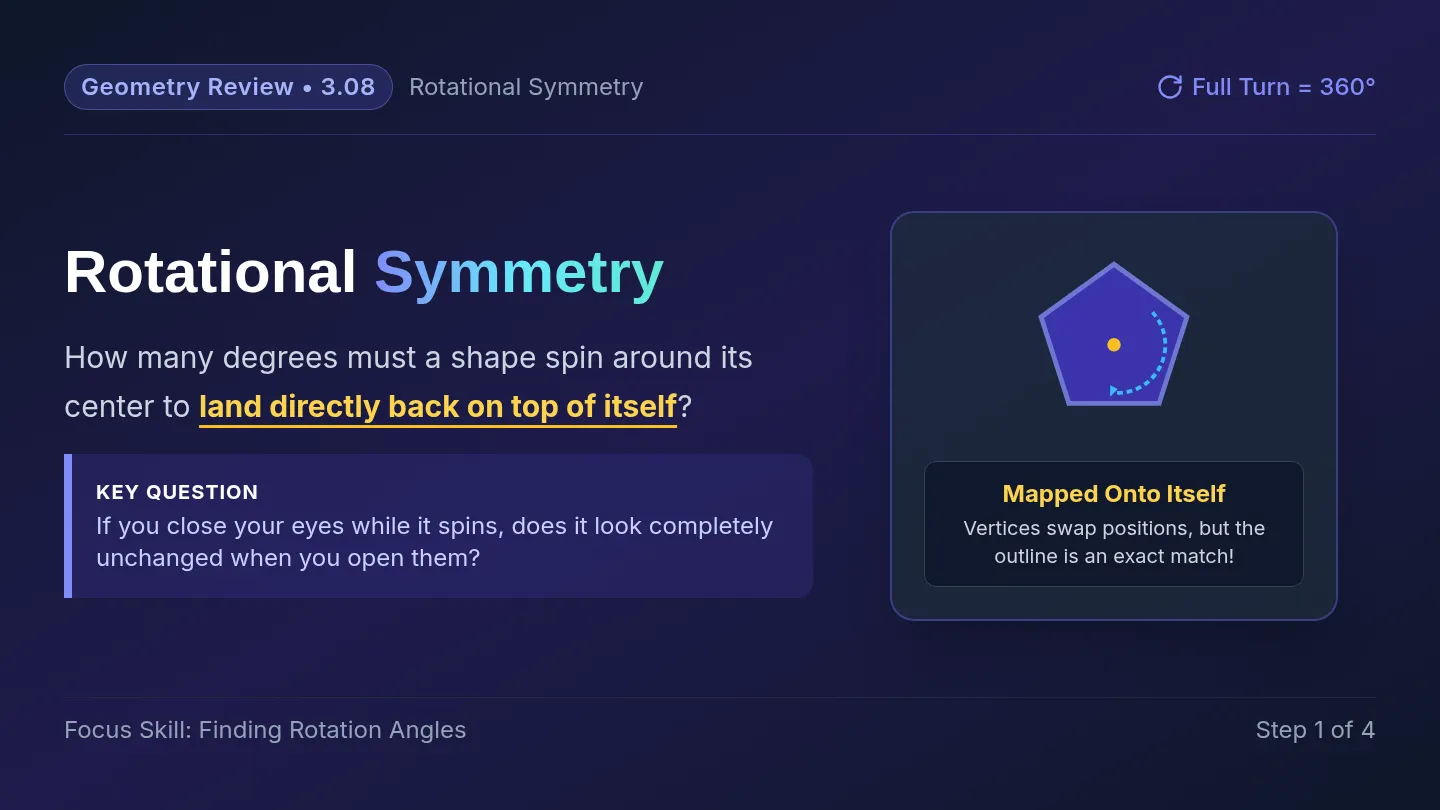
A targeted special education geometry lesson reviewing rotational symmetry, mapping regular polygons onto themselves using the 360/n formula, and analyzing coordinate rotations.

T

timothy.nixon

3
Function Decoder Exit Ticket

Function Decoder Exit Ticket

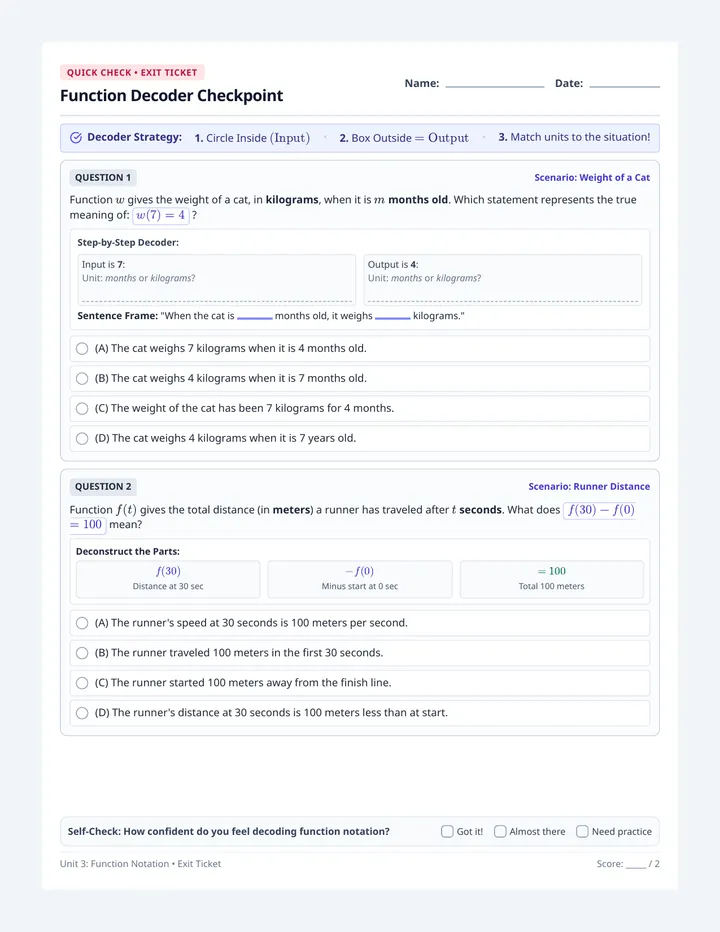
A 1-page modified exit ticket for 9th-grade special education students assessing interpretation of function notation. Includes scaffolded step-by-step decoding checklists, input/output prompts, sentence frames, and standardized multiple-choice items based directly on the cat weight and runner distance problems.

R

rubaiya.ahmed

Main Idea Detectives Worksheet

Grade Four Power Skills

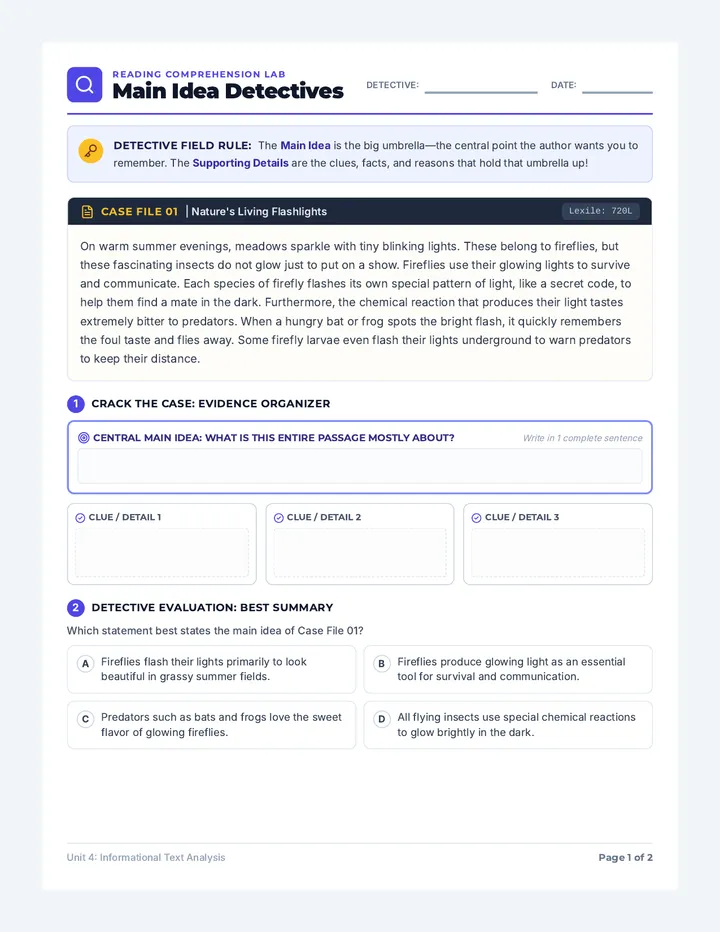
An integrated fourth-grade mastery curriculum covering core informational reading comprehension strategies and essential mathematics fluency.

C

cserrano

3
Factor Foundations Worksheet

Factor Foundations

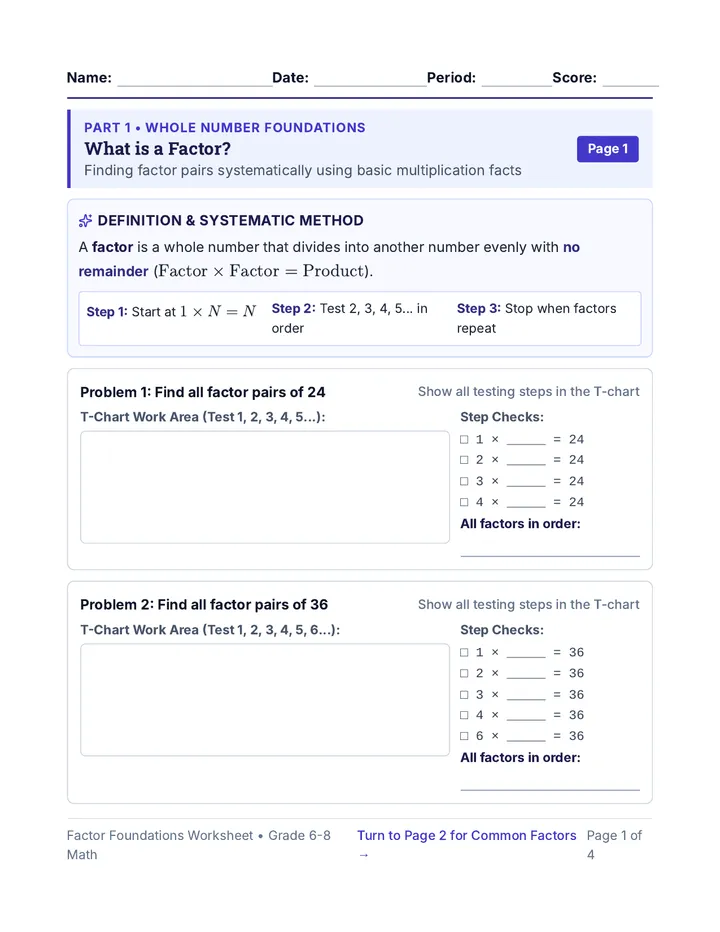
A comprehensive mathematics lesson introducing the concept of factors through basic number facts, divisibility testing, and algebraic monomial expansion with variables.

MR

Mary Roche

2
Function Decoder Practice Worksheet

Function Decoder Practice Worksheet

A 2-page scaffolded student practice worksheet for 9th-grade special education students learning to interpret function notation in real-world contexts. Features an explicit 3-step decoding anchor, side-by-side worked model, structured sentence frames, and gradual release problems adapted directly from the lesson curriculum.

R

rubaiya.ahmed