Lenny.com
Explore
Create
ActivitiesNewMathEnglish Language ArtsScience & EngineeringSocial StudiesGlobal LanguagesHealth & Physical EducationSpecial EducationCounseling & Life SkillsArts & CreativityESL
Lenny.com
Lenny.com
Explore
Create
ActivitiesNewMathEnglish Language ArtsScience & EngineeringSocial StudiesGlobal LanguagesHealth & Physical EducationSpecial EducationCounseling & Life SkillsArts & CreativityESL
Lenny.com
Lenny.com

Solutions

Lenny for EducatorsLenny for SchoolsLenny for Districts

Product

ExploreSign inCreateSupportAbout

Resources

Getting startedMTSS Acceleration Program

Newsletters

School Funding Newsletter

© 2026 Lenny Learning Inc.

TermsPrivacyAccessibility
LinkedInInstagramX
Lenny
MathNumbers & CountingCounting ObjectsNumber NamesComparing NumbersNumber OperationsCounting SequenceNumbers 0-10Place Value Understanding and SystemAdd and Subtract Within 20Addition and Subtraction ConceptsAddition and Subtraction EquationsAddition and Subtraction ProblemsFoundations for MultiplicationMultiplication and Division PropertiesMultiply and Divide Within 100Multiplication and Division ProblemsFactors and MultiplesProperties of OperationsPatterns and RelationshipsGenerate and Analyze PatternsMulti-Digit ArithmeticPlace Value OperationsMulti-Digit and Decimal OperationsNumerical ExpressionsFour Operations and PatternsFour Operations Problem SolvingMeasurement & DataMeasurable AttributesMeasuring LengthsMeasure and Estimate Lengths in Standard UnitsRelate Addition and Subtraction to LengthClassifying and Counting ObjectsTime and MoneyArea Concepts and MeasurementPerimeter and Area MeasuresAngle Concepts and MeasurementTime, Volume, and MassMeasurement Unit ConversionsGeometryIdentifying ShapesShapes and AttributesShape Attributes and ReasoningShapes and CompositionClassifying 2D FiguresGeometric Figures and RelationshipsLines, Angles, and ShapesAngle, Area, and VolumeGeometric MeasurementVolume of 3D ShapesCoordinate Plane ApplicationsTransformations in the PlaneCongruence and SimilarityUnderstand congruence in terms of rigid motionsSimilarity and TransformationsProve Theorems Involving SimilarityPythagorean TheoremTrigonometry for General TrianglesMake Geometric ConstructionsProve Geometric TheoremsTheorems About CirclesFind Arc Lengths And Areas of Sectors of CirclesVolume FormulasRelationships Between Two-Dimensional and Three-Dimensional ObjectsProve Simple Geometric Theorems AlgebraicallyTranslate Between Geometric Description and Equation for Conic SectionApply Geometric Concepts in Modeling SituationsFractions & DecimalsFractions as NumbersBuilding FractionsFraction Equivalence and OrderingAdding and Subtracting FractionsMultiplying and Dividing FractionsDividing FractionsDecimal FractionsMulti-Digit Computation and FactorsAdd, Subtract, Multiply, and Divide Rational NumbersRational Number SystemIrrational Numbers and ApproximationsRatiosRatios and ProportionsProportional RelationshipsUnit RateAlgebraAlgebraic ExpressionsGenerate Equivalent ExpressionsQuantitative RelationshipsProportional Relationships and Linear EquationsEquations and InequalitiesEquation Solving and ReasoningLinear Equations and SystemsGraph Equations and InequalitiesSystems of EquationsReal-World Algebraic ProblemsQuantitative Reasoning with UnitsExpression StructureEquivalent Expression FormsRadicals and Integer ExponentsRational ExponentsRational and Irrational NumbersPolynomial OperationsPolynomial IdentitiesPolynomial Zeros and FactorsRational ExpressionsComplex Number OperationsComplex Numbers in PolynomialsComplex Numbers on PlaneStatistics & ProbabilityRepresent and Interpret DataData DistributionsStatistical VariabilityProbability ModelsCompound Event ProbabilitiesStatistical SamplingInterpret Categorical and Quantitative DataBivariate Data PatternsInterpret Linear ModelsComparing Two PopulationsRandom Processes in StatisticsIndependence and Conditional ProbabilityExpected ValuesProbability-Based Decision MakingStatistical Inference and ConclusionsFunctionsFunction Concepts and NotationDefine and Compare FunctionsInterpret Functions in ContextAnalyze Function RepresentationsModel Relationships with FunctionsIdentify Linear vs Exponential GrowthDistinguish Between Function TypesCompare Growth RatesInterpret Function ExpressionsBuild Functions from RelationshipsConstruct and Model FunctionsTransform and Combine FunctionsModel Comparison and SelectionSolve Exponential EquationsTrigonometryTrigonometric Ratios Involving Right TrianglesTrigonometric Functions and Unit CircleModel with Trigonometric FunctionsTrigonometric IdentitiesVectors & MatricesIntroduction to Vectors and MatricesVector QuantitiesVector OperationsMatrix OperationsCalculusLimits and ContinuityDerivative Concepts and NotationDerivative Rules and TechniquesApplications of DerivativesOptimization ProblemsRelated RatesCurve Sketching and AnalysisIntegration Concepts and NotationAntiderivatives and Indefinite IntegralsDefinite Integrals and AreaFundamental Theorem of CalculusIntegration TechniquesApplications of IntegrationDifferential EquationsSequences and SeriesParametric and Polar FunctionsVector-Valued Functions

Factor Foundations

A comprehensive mathematics lesson introducing the concept of factors through basic number facts, divisibility testing, and algebraic monomial expansion with variables.

MRMary Roche

Factor Foundations

A comprehensive mathematics lesson introducing the concept of factors through basic number facts, divisibility testing, and algebraic monomial expansion with variables.

MRMary Roche

GCF: 8

Teacher Answer Key • Factor Foundations Turn to Page 3 for Numbers with Variables → Page 2 of 4

Teacher Key Monomial Factors & Complete Prime Expansion

Page 3 Key

Part 2 • Algebraic Monomials

Factors with Variables • Solutions

Prime factor decomposition and fully expanded algebraic terms

Variables

Grading Note • Monomial Factorization:

Full credit requires both the coefficient factored into prime numbers and the variable powers expanded into linear repeated factors. Any subset of these multiplied factors forms a valid monomial factor.

Problem 4: Factor \(18a^3\) completely. Show all 3 steps. Target: \(18a^3\)

Step 1: Prime factor coefficient 18:

\(18 = 2 \times 9 = \mathbf{2 \cdot 3 \cdot 3}\)
(Factor tree: 18 → 2 and 9; 9 → 3 and 3)

Step 2: Expand variable \(a^3\):

\(a^3 = \mathbf{a \cdot a \cdot a}\)

Step 3: Complete expansion & sample factors:

\(\mathbf{2 \cdot 3 \cdot 3 \cdot a \cdot a \cdot a}\) • Factors: \(3a, 6a^2, 9a, 2a^3\)

Problem 5: Factor \(24x^2y\) completely. Show all 3 steps. Target: \(24x^2y\)

Step 1: Prime factor coefficient 24:

\(24 = 4 \times 6 = \mathbf{2 \cdot 2 \cdot 2 \cdot 3}\)
(Factor tree: 24 → 4 and 6; 4 → 2,2; 6 → 2,3)

Step 2: Expand variables \(x^2y\):

\(x^2y = \mathbf{x \cdot x \cdot y}\)

Step 3: Complete expansion & sample factors:

\(\mathbf{2 \cdot 2 \cdot 2 \cdot 3 \cdot x \cdot x \cdot y}\) • Factors: \(4x, 6xy, 12x^2\)

Teacher Answer Key • Factor Foundations Turn to Page 4 for Factor Verification & GCF → Page 3 of 4

Teacher Key Monomial Factor Testing & GCF Calculations

Page 4 Key

Testing Variable Factors & GCF • Solutions

Detailed division simplification, exponent rules, and greatest common factors

Monomial Divisibility Criterion:

When dividing \(\frac{\text{Dividend}}{\text{Divisor}}\), all numerical coefficients must divide evenly, and each variable's power in the dividend must be \(\ge\) the divisor's power so no variables remain in the denominator.

Problem 6: Is \(4ab\) a factor? YES

\(\frac{20a^2b^3}{4ab} = \left(\frac{20}{4}\right)\left(\frac{a^2}{a}\right)\left(\frac{b^3}{b}\right)\)
\(= \mathbf{5 \cdot a^{2-1} \cdot b^{3-1}} = \mathbf{5ab^2}\)
• No remainder • Whole polynomial

Conclusion:

\(4ab\) IS a factor.

Other factor: \(5ab^2\)

Problem 7: Is \(6x^2\) a factor? NO

\(\frac{18xy^2}{6x^2} = \left(\frac{18}{6}\right)\left(\frac{x}{x^2}\right)\left(y^2\right)\)
\(= \mathbf{\frac{3y^2}{x}}\)  (\(x\) remains in denominator!)
• Target only has \(x^1\), need \(x^2\)

Conclusion:

\(6x^2\) IS NOT a factor.

Reason: Insufficient powers of \(x\) in target.

Problem 8: GCF of \(15m^3\) and \(25m^2\) \(\text{GCF} = 5m^2\)

Step 1: Fully expand \(15m^3\):

\(15m^3 = 3 \cdot \mathbf{5 \cdot m \cdot m} \cdot m\)

Step 2: Fully expand \(25m^2\):

\(25m^2 = 5 \cdot \mathbf{5 \cdot m \cdot m}\)

Step 3: Shared common factors: \(5 \cdot m \cdot m\)  •  Final GCF: \(\text{GCF} = 5m^2\)

Teacher Answer Key • Factor Foundations All 8 Problems Complete • Answer Key Page 4 of 4
You might also like

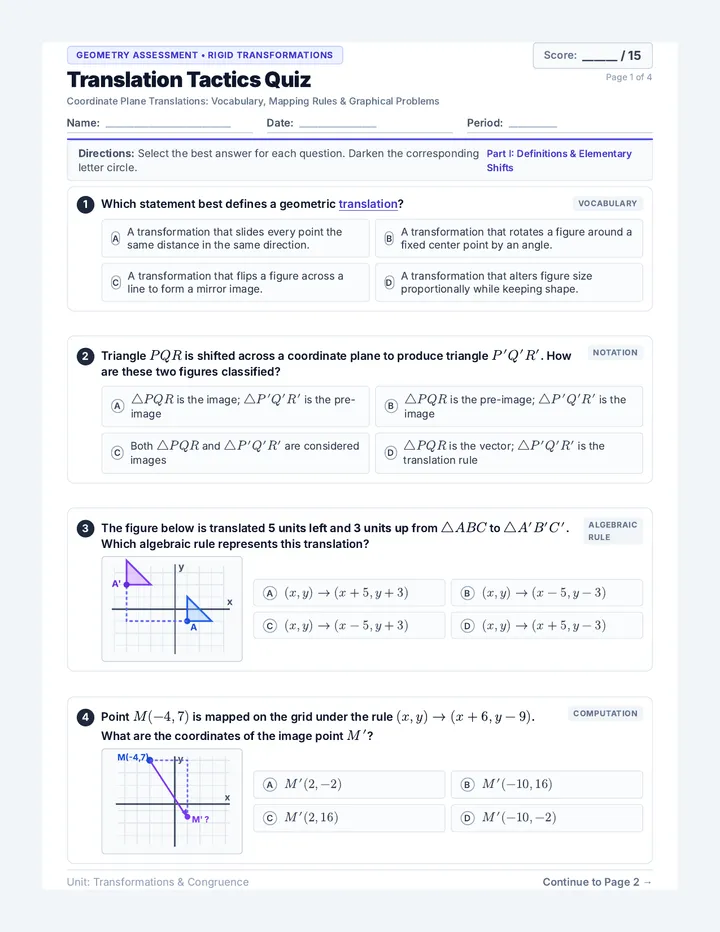
Translation Tactics Quiz

Math Mastery Units

Comprehensive secondary mathematics units covering coordinate geometry transformations and linear functions in slope-intercept form.

FM

Fernando Mancini

4
Digit Multiply Slides

Double Digit Multiply

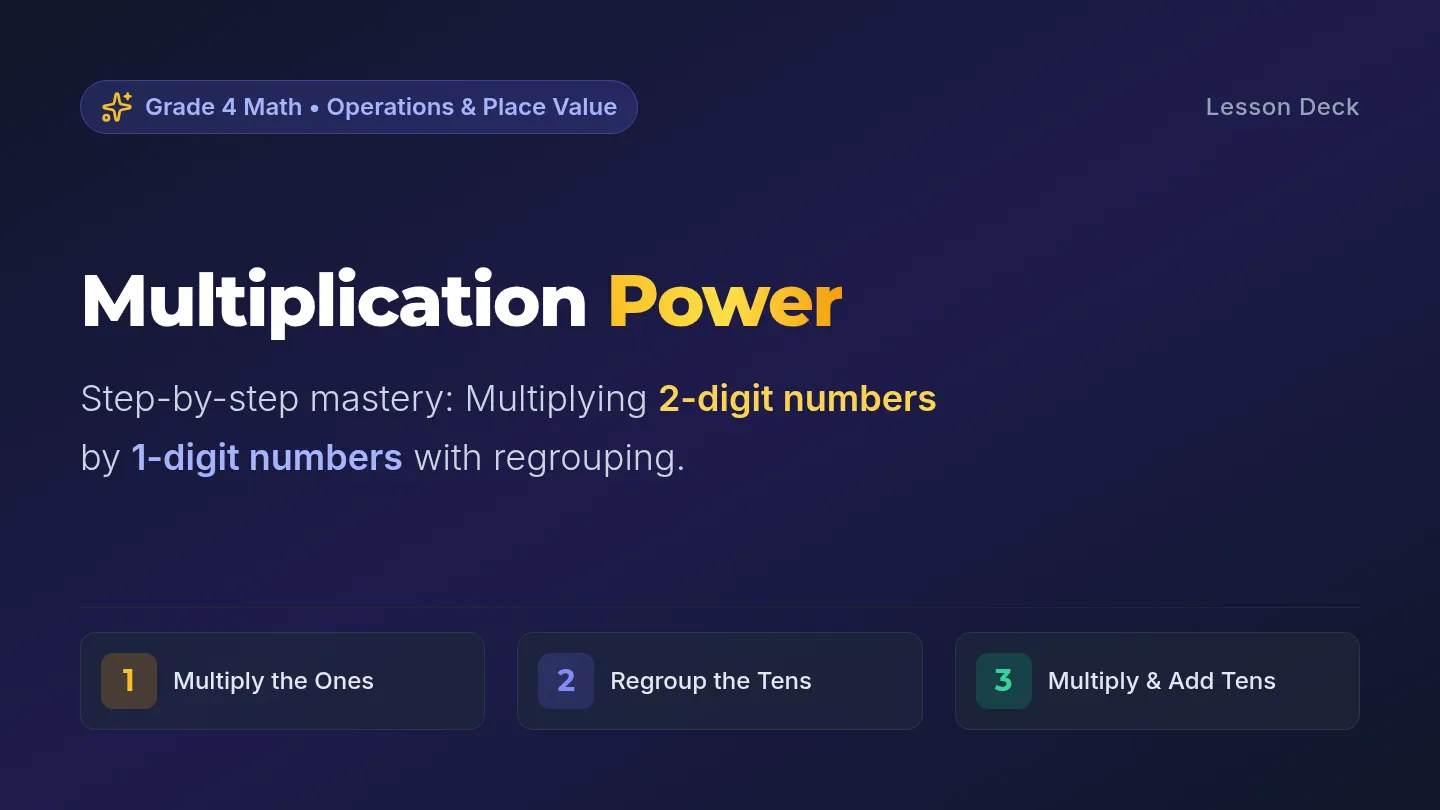
A comprehensive elementary math lesson introducing 2-digit by 1-digit multiplication using the standard algorithm and place-value reasoning. Includes instructional presentation slides, scaffolded student practice sheets with generous workspace, and an annotated teacher answer key.

L

lwalker

3
Digit Blast Answer Key

Digit Blast Answer Key

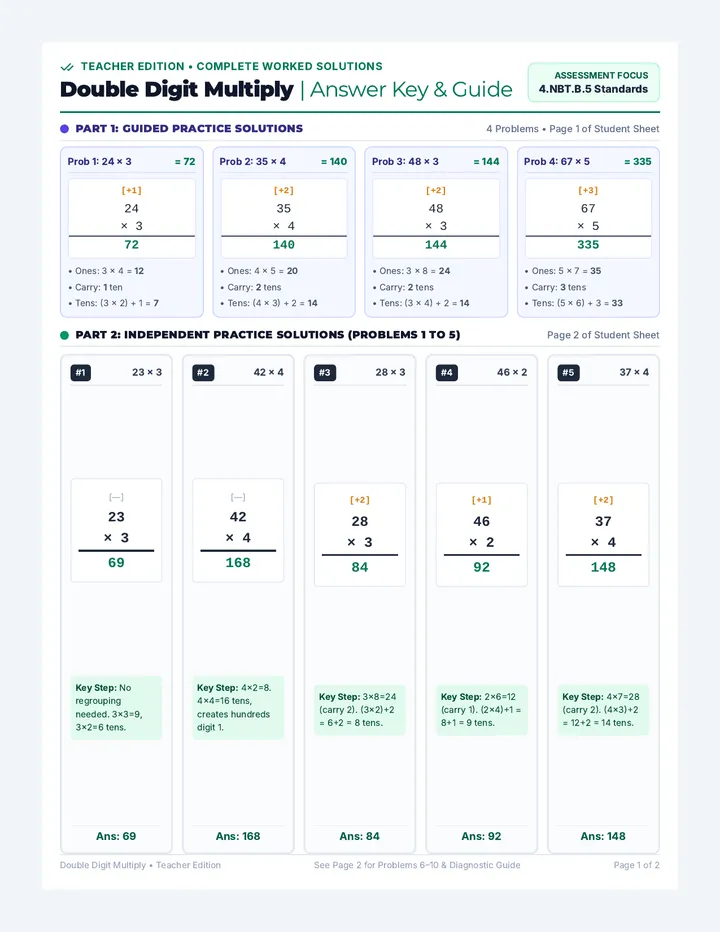
A complete 2-page teacher answer key and instructional troubleshooting guide. Contains step-by-step worked solutions for all 4 guided practice and 10 independent practice problems, plus common error diagnoses and remediation strategies.

L

lwalker

Zero Distance Slides

Distance Masters

A comprehensive middle school mathematics unit introducing absolute value through geometric distance, order of operations with magnitude, and dual-branch linear equations.

Lenny Avatar
Lenny
9
Customary Conversions Slides

Customary Unit Conversions

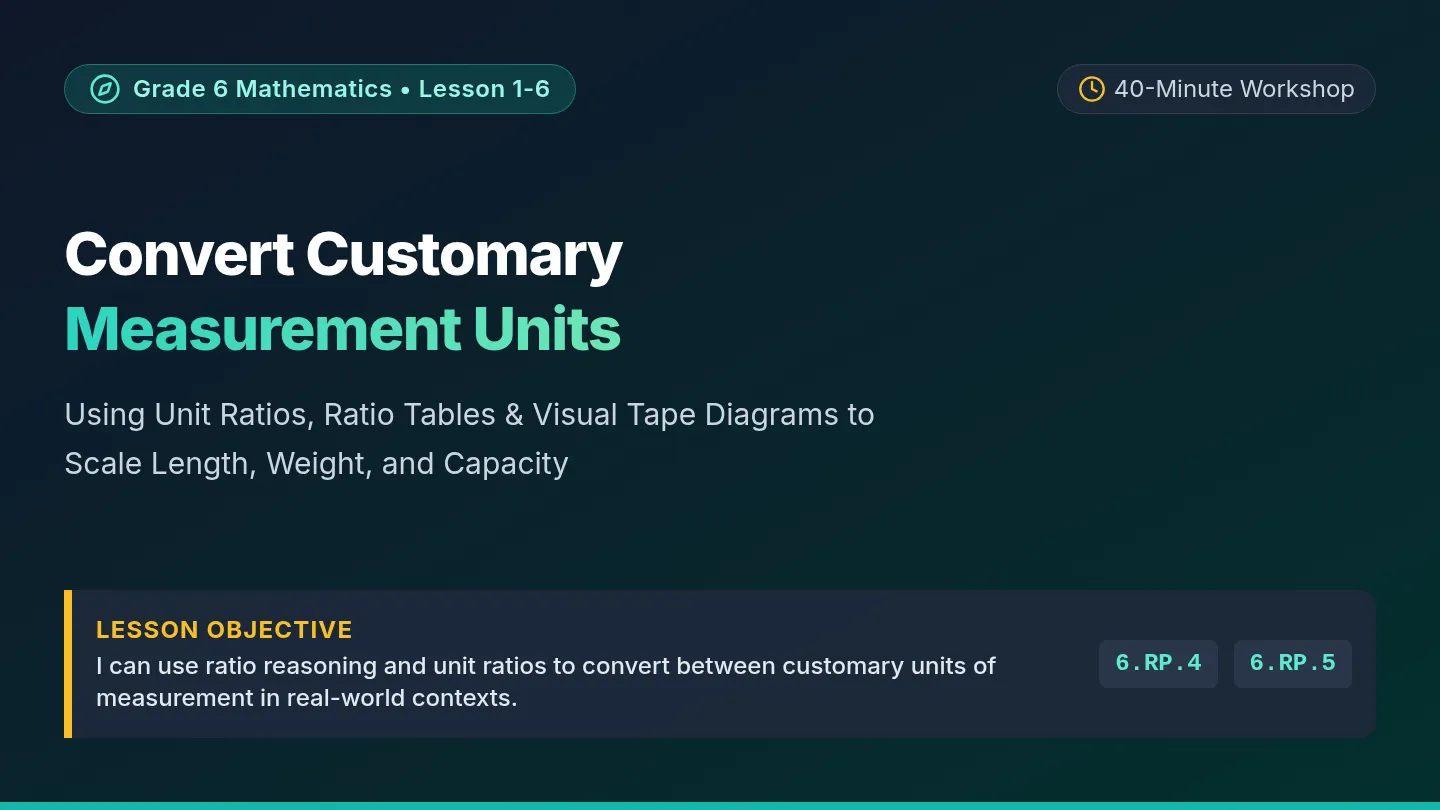
A comprehensive 40-minute grade 6 mathematics lesson on converting customary measurement units using unit ratios, equivalent ratio tables, and visual tape diagrams. Students master bidirectional conversions across length, weight, and capacity while connecting proportional reasoning to real-world problem contexts.

RG

Richard Gist

3
Digit Blast Worksheet

Digit Blast Worksheet

A 3-page comprehensive student practice packet for 2-digit by 1-digit multiplication. Page 1 features a clear visual anchor chart and 4 scaffolded guided practice walkthroughs. Pages 2 and 3 provide 10 independent practice problems (5 per page) with extra-large computation boxes, dedicated carry boxes, and generous white space to show work, plus a real-world word problem challenge.

L

lwalker

Equal Groups Slides

Equal Group Explorers

A three-part intervention sequence designed for students struggling with early multiplication concepts. The sequence methodically transitions learners from concrete equal groups to repeated addition, number line skip-counting, and formal multiplication notation.

B

bower

9
Spooky Solvers Worksheet

Spooky Equations

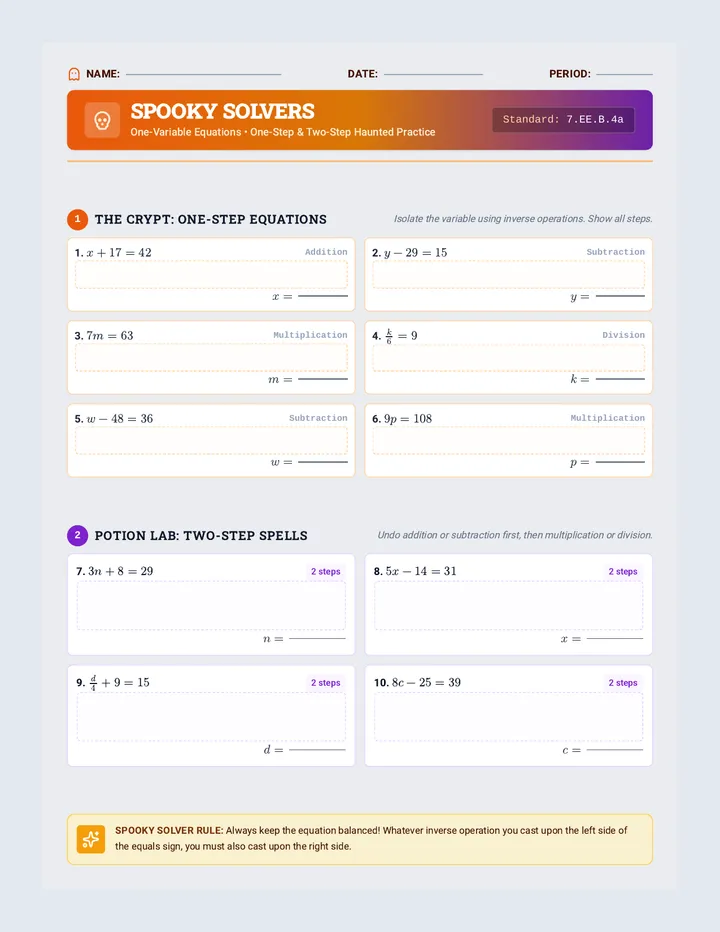
A Halloween-themed algebra lesson focusing on solving one-variable one-step and two-step equations through haunted practice problems, word problems, and an interactive cipher riddle.

SH

Stacey Hersch

3
Digit Multiply Slides

Digit Multiply Slides

An 8-slide instructional presentation detailing step-by-step procedures for 2-digit by 1-digit multiplication with regrouping. Features place-value models, standard vertical algorithm walkthroughs, guided practice checks, and key tips for avoiding common calculation errors.

L

lwalker

Scytale Spartiate Slides

Espionnes Antiques

Une séquence immersive en deux séances pour initier les élèves de 6ème à la cryptographie antique à travers la géométrie de la scytale spartiate et les symétries du chiffrement miroir Atbash.

E

Enseignante

6
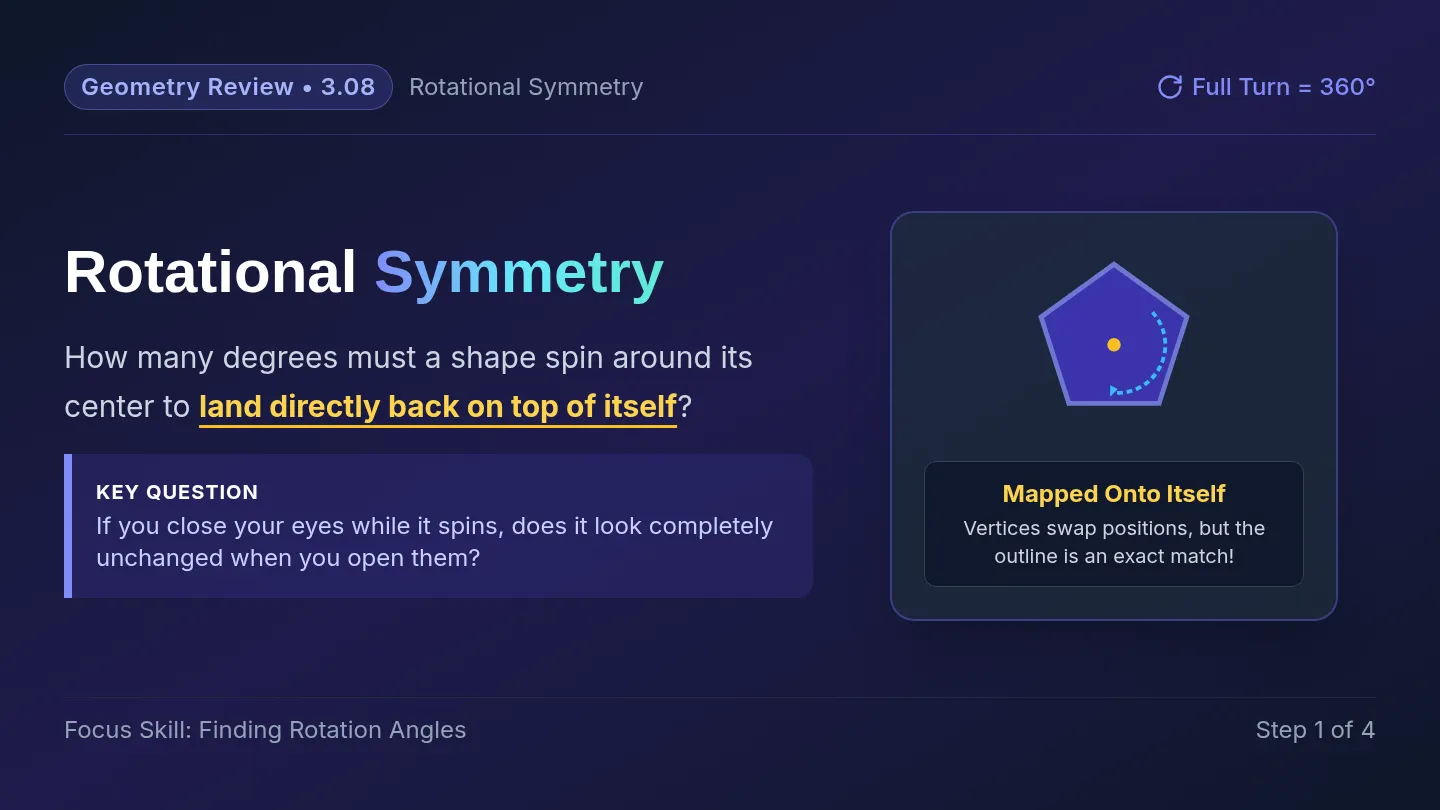
Symmetry Spin Slides

Rotational Symmetry Spin

A targeted special education geometry lesson reviewing rotational symmetry, mapping regular polygons onto themselves using the 360/n formula, and analyzing coordinate rotations.

T

timothy.nixon

3
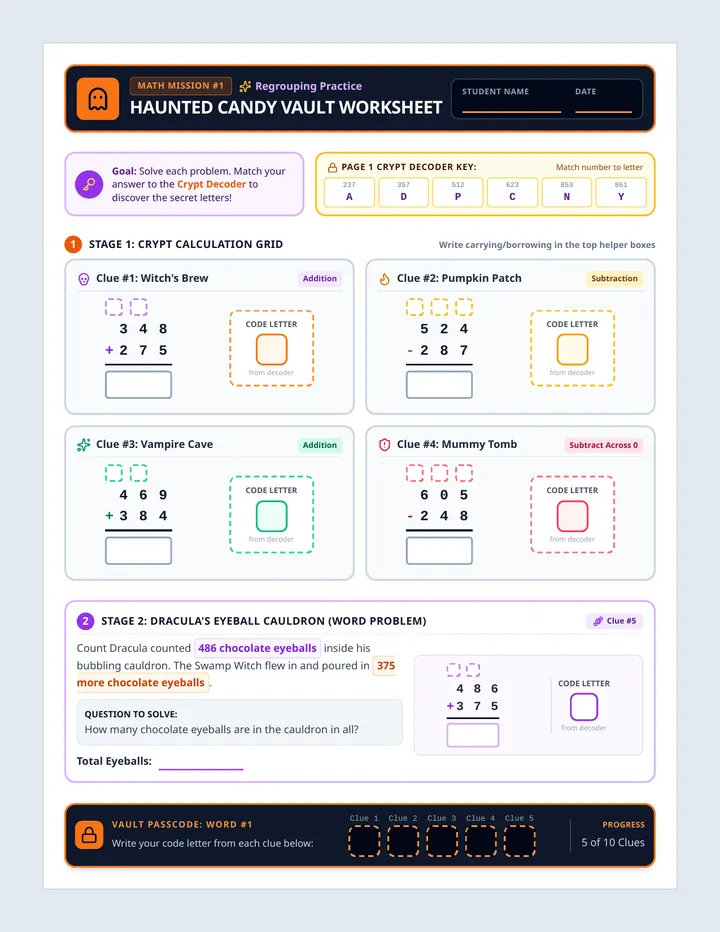
Haunted Candy Vault Worksheet

Haunted Candy Vault Worksheet

A 2-page print-ready Halloween-themed addition and subtraction regrouping worksheet for middle school special education students featuring visual place-value scaffolds, cipher puzzles, word problems, and a blank candy prize claim voucher.

AA

alicia accapezzato