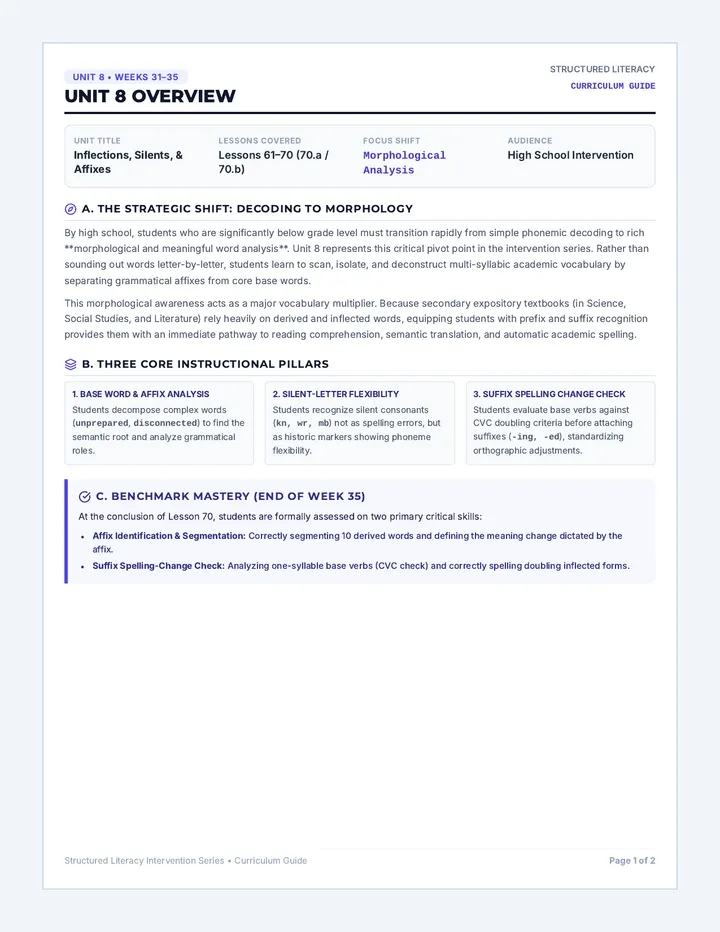
A visual exploration of number patterns and input-output tables using an architectural design theme. Students learn to identify rules and extend sequences through scaffolded building floor plans.
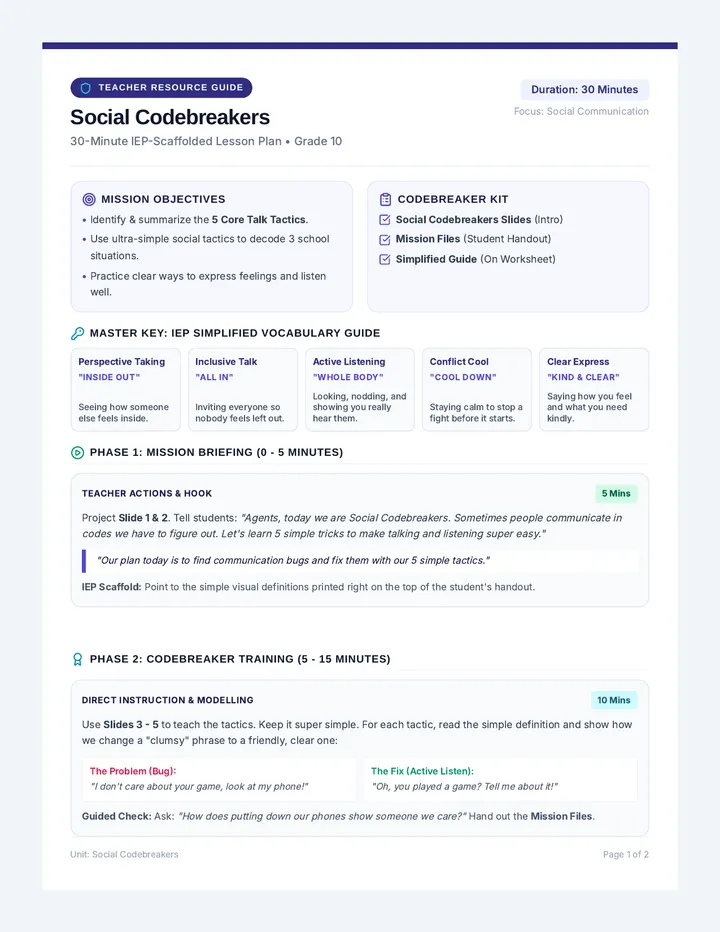
A set of visual tools and strategies designed to help students manage verbal impulses, understand conversational turn-taking, and recognize appropriate times for speaking and listening.
A vocabulary and comprehension lesson focusing on three-syllable words from Wilson Step 6.3, with an emphasis on answering 'wh' questions.
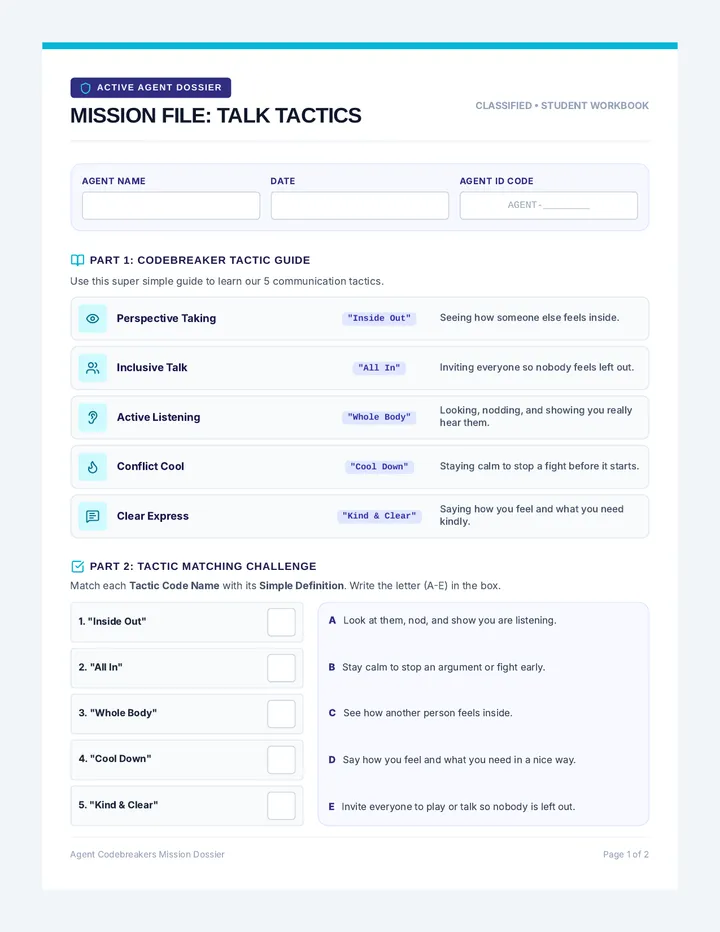
A focused lesson on identifying and applying specific coping mechanisms to manage anxiety in various social and academic scenarios.
A comprehensive toolkit designed to support a student experiencing visual hallucinations and intense emotional distress in the classroom, focusing on grounding, communication, and self-regulation.
A Tier 2 intervention lesson for 5th grade students focused on conceptually understanding equivalent fractions and renaming them to add fractions with unlike denominators. Students will explore the 'Identity Property of 1' through visual models to see why multiplying the numerator and denominator by the same number creates an equivalent fraction.
A comprehensive lesson designed to help students master multi-step directions by breaking down complex sentences and using self-monitoring strategies. Students act as 'Mission Control' operators, decoding and executing complex commands to ensure mission success.
A social story and visual aids using vehicle-themed visuals to teach students the difference between rules at home and school regarding fighting and weapons.
This lesson prepares students for the social expectations and etiquette of attending a live musical performance. It uses a social story approach to model appropriate theater behavior, such as staying in one's seat, using a 'theater voice' (silence), and clapping at the right times.
A Minecraft-themed lesson focused on mastering the /ch/ sound through production 'recipes', mining challenges, and crafting activities. Includes visual slides for instruction and printable worksheets for practice.
A comprehensive planning kit for schools to manage students who struggle with or refuse to evacuate during fire drills, focusing on communication and individualized support.
A comprehensive lesson covering addition, subtraction, multiplication, and division of integers using visual models and algorithmic rules.
A lesson focused on place value through expanded form and rounding techniques using number lines as visual aids. Students practice with four- and five-digit numbers to master precision in estimation.
Synthesizing skills through a real-world recipe task and a final summative assessment.
Understanding percent as a rate per 100 and using models to solve percent problems.
Calculating and applying unit rates in contexts like unit pricing and constant speed.
Utilizing ratio tables and double number line diagrams to visualize equivalent ratios and solve scaling problems.
A diagnostic check followed by an introduction to ratio language, various notation forms, and identifying parts-to-parts vs. parts-to-whole relationships.
Final summative assessment to measure mastery of all four decimal operations and place value concepts.
Instruction on dividing decimals by whole numbers and decimals using fair-sharing models and cost analysis.
Instruction on multiplying decimals using area models and place value shifts, focusing on scaling and measurement.
Instruction and practice on adding and subtracting decimals using place value alignment, estimation, and money contexts.
Initial diagnostic and foundational review of place value relationships from tens to hundredths to prepare for operations.
Final assessment of all unit skills to measure growth and mastery of standard 5.NF.A.1.
Application of fraction operations to real-world word problems, focusing on identifying operations and interpreting results.
Expanding skills to include adding and subtracting mixed numbers, including strategies for regrouping and simplifying.
Guided practice applying common denominators to solve addition and subtraction problems with unlike denominators.
Instruction on finding the least common multiple (LCM) and creating equivalent fractions to find common denominators.
Introduction to adding and subtracting fractions using visual area models and number lines to build conceptual understanding of unlike denominators.
Assessment of prerequisite skills including equivalent fractions and common multiples to identify specific gaps in student understanding.
A 25-minute focused lesson on multiplying 3-digit by 2-digit numbers using the standard algorithm, featuring visual breakdowns and structured practice.
A 30-minute mastery session on long division, covering the step-by-step process for problems with and without remainders through guided practice and independent challenges.
Focuses on following instructions with specific negative constraints and complex conditions. Students learn to process "except," "unless," and "only if" parameters.
Focuses on identifying ambiguous or incomplete instructions. Students learn to advocate for themselves by asking targeted questions instead of guessing when a 'mission briefing' is unclear.