MOLE Toolkit Anchor Chart and Scaffolded Guide MY MATH TOOLKIT
Smart Strategies for Big Word Problems
Step-By-Step Guide
M
MARK UP THE TEXT (Using CUBS)
C
Circle
All numbers and units in the story.
ex: 6 hats
U
Underline
The main question being asked.
How many hats?
B
Box
Action words that tell you the operation.
each
S
State
Write your final answer sentence.
"They sold 5 hats."
O
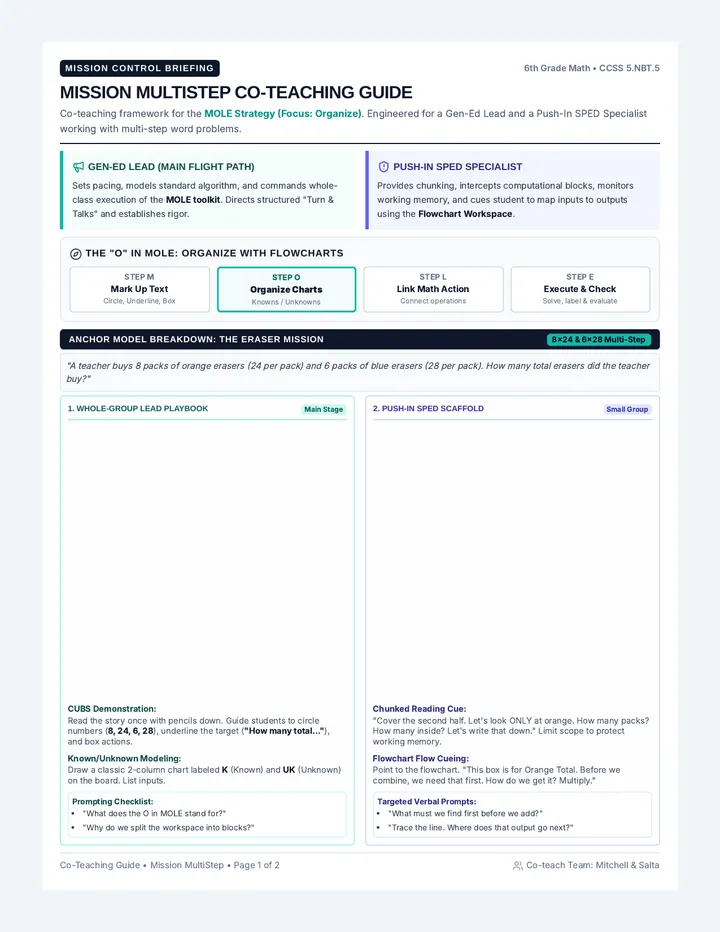
ORGANIZE YOUR WORK (Knowns & Unknowns)
KNOWNS: What is in the story?
Write down the clues, numbers, and facts the problem already gave you.
1 8 packs orange erasers
2 24 orange per pack
UNKNOWNS: What do I need to find?
List out the questions you must answer before finding the final response.
? Total orange erasers?
? Total erasers combined?
Operation Action Clues
Combine parts together
- SUBTRACT
Take away / Find difference
× MULTIPLY
Equal groups together
÷ DIVIDE
Split into equal groups
Gen Ed & SPED Visual Math Support Page 1 of 2
SCAFFOLDED PROBLEMS
Let's Break Down the Packet Problems!
Visual Guide
Problem 1: The Eraser Problem
A teacher buys 8 packs orange erasers and 6 packs blue erasers. There are 24 orange in each, and 28 blue in each. How many total erasers did the teacher buy?
Step 1 ×
Total Orange
Multiply packs × size
24 × 8
192 Orange
Step 2 ×
Total Blue
Multiply packs × size
28 × 6
168 Blue
Step 3 +
Combine
Add both totals together
192 + 168
360 Total
Problem 2: Donut Distribution
A school buys 24 boxes of donuts. Each box has 12 donuts. The donuts are split equally among 18 classes. How many donuts does each class get?
Step 1 ×
Total Donuts
Multiply boxes × size
24 × 12
288 Donuts
Step 2 ÷
Split Equally
Divide total by 18 classes
288 ÷ 18
16 per class
All Done!
Verify your answer unit matches your final sentence!
Quick Check:
Did I Circle numbers? Did I Underline the question? Did I write my unit?
Gen Ed & SPED Visual Math Support Page 2 of 2
MOLE Student Work Packet MOLE WORK PACKET
Day 2: Knowns & Unknowns
Name:
Date:
Launch: Remember CUBS?
Draw a line to match each letter of CUBS to its correct marking action!
C Circle...
U Underline...
B Box...
S State...
...the math action words (like "each" or "total").
...your final answer in a full sentence.
...all the numbers and units in the problem.
...the question you are trying to solve.
Key Vocabulary
MULTIPLICATION (×)
Adding equal groups repeatedly. Finding a total!
PRODUCT
The answer you get when you multiply numbers.
DIVISION (÷)
Splitting a big total number into equal-sized groups.
QUOTIENT
The answer you get when you divide numbers.
SPED Tip: Use your color pencils! Circle numbers in Orange, underline in Blue, and box keywords in Purple!
MOLE Problem Solvers Packet Page 1 of 3
Model & Log It
Let's Solve Together!
A teacher buys 8 packs of orange erasers and 6 packs of blue erasers. There are 24 orange erasers in each pack, and 28 blue erasers in each pack. How many total erasers did the teacher buy?
Knowns (What We Have)
• 8 packs of orange erasers (24 in each pack)
• 6 packs of blue erasers (28 in each pack)
Unknowns (What We Need)
• Total Orange erasers = ?
• Total Blue erasers = ?
• Total Erasers combined = ?
Step-By-Step Workspace
1. Total Orange
Multiply packs × size
Work:
3
2 4
× 8
1 9 2
Answer: 192 orange
2. Total Blue
Multiply packs × size
Work:
4
2 8
× 6
1 6 8
Answer: 168 blue
3. Total Combined
Add orange + blue
Work:
1 1
1 9 2
+ 1 6 8
3 6 0
Answer: 360 total
FINAL ANSWER SENTENCE:
MOLE Problem Solvers Packet Page 2 of 3
Independent Practice
Practice Time!
PROBLEM: Donut Distribution
MOLE Teacher Guide and Answer Key TEACHER GUIDE & KEY
Lesson B: Knowns/Unknowns (O in MOLE)
Teacher Resource
Objective
SWBAT master the "O" in MOLE to organize and solve multi-step whole number problems.
Pacing Guide
• Launch: 5 mins
• Model & Log: 15 mins
• Independent: 20 mins
• Debrief: 8 mins
Target Audience
Designed for standard Gen Ed classes with integrated SPED accommodations.
SPED Scaffolding Toolkit
Visual Organization
Workspace Partitioning: Always divide the physical workspace on the paper or board based on the number of unknowns. Visual borders keep steps distinct and prevent calculation mash-ups.
Language Frames
Simple Verbal Explanations: Break down operations using action words. Use "groups of" for multiplication, "combine parts" for addition, and "share equally" for division.
Pacing & Corrective Prompts
1
Misconception: Student stops after Step 1.
Prompt: "Read your final answer sentence at the bottom of the page. Does your math number match the units? Let's check how many steps we need!"
2
Misconception: Chooses incorrect operation.
Prompt: "Let's draw groups. Are we combining different amounts or are we putting together equal-sized blocks?"
Teacher Guide & Key - MOLE Framework Page 1 of 3
MODELING SCRIPT
Guided Modeling Script & Visual Models
Instructional Script
Script: The Eraser Problem (Page 2)
🗣️ Teacher Model: "Let's look at page 2 of our packet. Our hands are in our laps, pencils down. Let's visualize the story. A teacher goes to the store and buys orange and blue packs of erasers.M in MOLE. We use CUBS ! Circle the numbers: 8, 6, 24, 28. Underline the question: How many total erasers did the teacher buy?"
🗣️ Organizing with Knowns/Unknowns (O in MOLE): "Let's list what we know. We know we have 8 packs of orange erasers and 6 packs of blue erasers. We know how many are in each.Unknowns ! Before we can find the big total, we need to know the total orange erasers and the total blue erasers. Since we have 3 unknowns, we divide our paper workspace into