Step Shuffle Cards Document Step Shuffle Series
EQUATION CARD DECK / PART 1
24 Cards Total • Pages 1-2
Print & Cut Activity
Cut along the dashed lines . Mix up the cards before starting the activity.
CARDS 1–12
Step 2 Card 23
\[4x = 24\]
ALIGNMENT STEP
Original Eq 15
\[-4(x - 3) = 5x - 6\]
TARGET STATE
Final State 29
\[x = 6\]
FINAL SOLUTION
Original Eq 10
\[5x - 3(x - 2) = 2(x + 3)\]
TARGET STATE
Step 2 Card 32
\[x - 8 = 4\]
ALIGNMENT STEP
Step 1 Card 20
\[-4x + 12 = 5x - 6\]
REDUCTION STEP
Step 1 Card 25
\[2x - 3 = \frac{2}{3}x + 5\]
REDUCTION STEP
Final State 18
\[x = 12\]
FINAL SOLUTION
Original Eq 26
\[2(3x - 1) = 6x + 5\]
TARGET STATE
Step 2 Card 21
\[2x + 6 = 2x + 6\]
ALIGNMENT STEP
Original Eq 11
\[3(2x - 4) = 2(x + 6)\]
TARGET STATE
Step 1 Card 30
\[6x - 2 = 6x + 5\]
REDUCTION STEP
UNIT 2: ALGEBRAIC EQUIVALENCE STEP SHUFFLE DECK PAGE 1
Step Shuffle Series
EQUATION CARD DECK / PART 2
24 Cards Total • Pages 1-2
Print & Cut Activity
Cut along the dashed lines . Mix up the cards before starting the activity.
CARDS 13–24
Final State 12
\[x = 2\]
FINAL SOLUTION
Original Eq 22
\[\frac{3}{4}x - 2 = \frac{1}{2}x + 1\]
TARGET STATE
Final State 33
Infinitely Many Solutions
FINAL STATE
Step 1 Card 19
\[6x - 12 = 2x + 12\]
REDUCTION STEP
Step 2 Card 16
\[-2 = 5\]
ALIGNMENT STEP
Step 2 Card 28
\[18 = 9x\]
ALIGNMENT STEP
Final State 24
No Solution
FINAL STATE
Step 2 Card 13
\[\frac{4}{3}x = 8\]
ALIGNMENT STEP
Step 1 Card 27
\[5x - 3x + 6 = 2x + 6\]
REDUCTION STEP
Step 1 Card 14
\[3x - 8 = 2x + 4\]
REDUCTION STEP
Original Eq 17
\[\frac{1}{2}(4x - 6) = \frac{2}{3}x + 5\]
TARGET STATE
Final State 31
\[x = 6\]
FINAL SOLUTION
UNIT 2: ALGEBRAIC EQUIVALENCE STEP SHUFFLE DECK PAGE 2
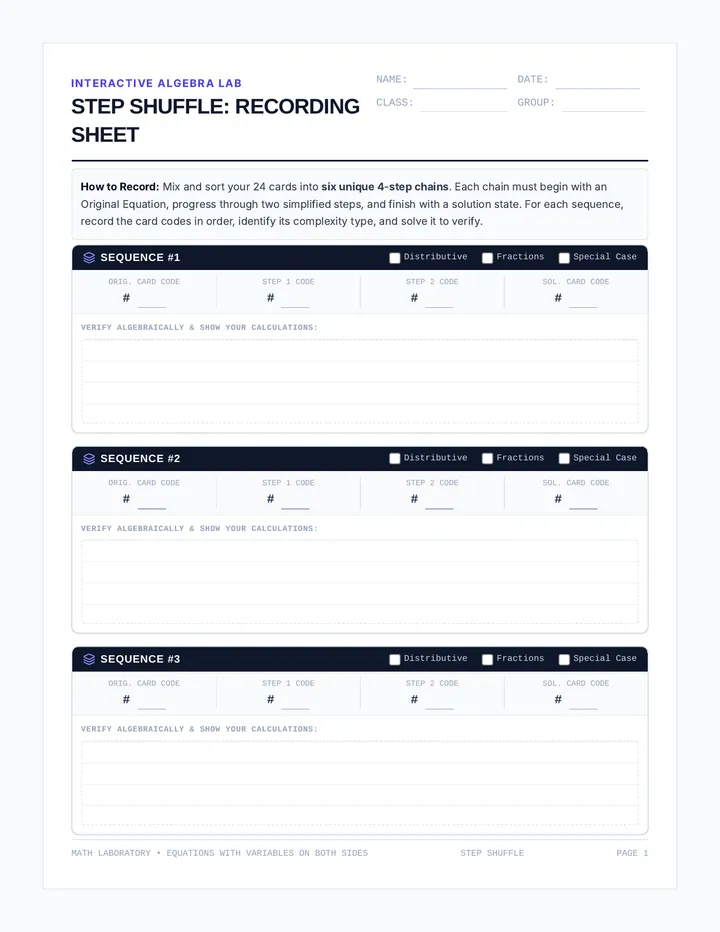
Step Shuffle Recording Sheet Interactive Algebra Lab
STEP SHUFFLE: RECORDING SHEET
NAME:
DATE:
CLASS:
GROUP:
How to Record: Mix and sort your 24 cards into six unique 4-step chains . Each chain must begin with an Original Equation, progress through two simplified steps, and finish with a solution state. For each sequence, record the card codes in order, identify its complexity type, and solve it to verify.
Sequence #1
Distributive Fractions Special Case
Orig. Card Code #
Step 1 Code #
Step 2 Code #
Sol. Card Code #
Verify algebraically & show your calculations:
Sequence #2
Distributive Fractions Special Case
Orig. Card Code #
Step 1 Code #
Step 2 Code #
Sol. Card Code #
Verify algebraically & show your calculations:
Sequence #3
Distributive Fractions Special Case
Orig. Card Code #
Step 1 Code #
Step 2 Code #
Sol. Card Code #
Verify algebraically & show your calculations:
MATH LABORATORY • EQUATIONS WITH VARIABLES ON BOTH SIDES STEP SHUFFLE PAGE 1
Interactive Algebra Lab
STEP SHUFFLE: RECORDING SHEET / CONT.
Page 2 of 2
Sequence #4
Distributive Fractions Special Case
Orig. Card Code #
Step 1 Code #
Step 2 Code #
Sol. Card Code #
Verify algebraically & show your calculations:
Sequence #5
Distributive Fractions Special Case
Orig. Card Code #
Step 1 Code #
Step 2 Code #
Sol. Card Code #
Verify algebraically & show your calculations:
Sequence #6
Distributive Fractions Special Case
Orig. Card Code #
Step 1 Code #
Step 2 Code #
Sol. Card Code #
Verify algebraically & show your calculations:
REFLECTION & SYNTHESIS
1. Identifying Special Solutions:
How can you identify whether an equation has No Solution versus Infinitely Many Solutions based on the intermediate steps?
2. Fractional Strategies:
Describe two different mathematical ways to deal with fractional coefficients (e.g., Sequence #4 versus Sequence #3).
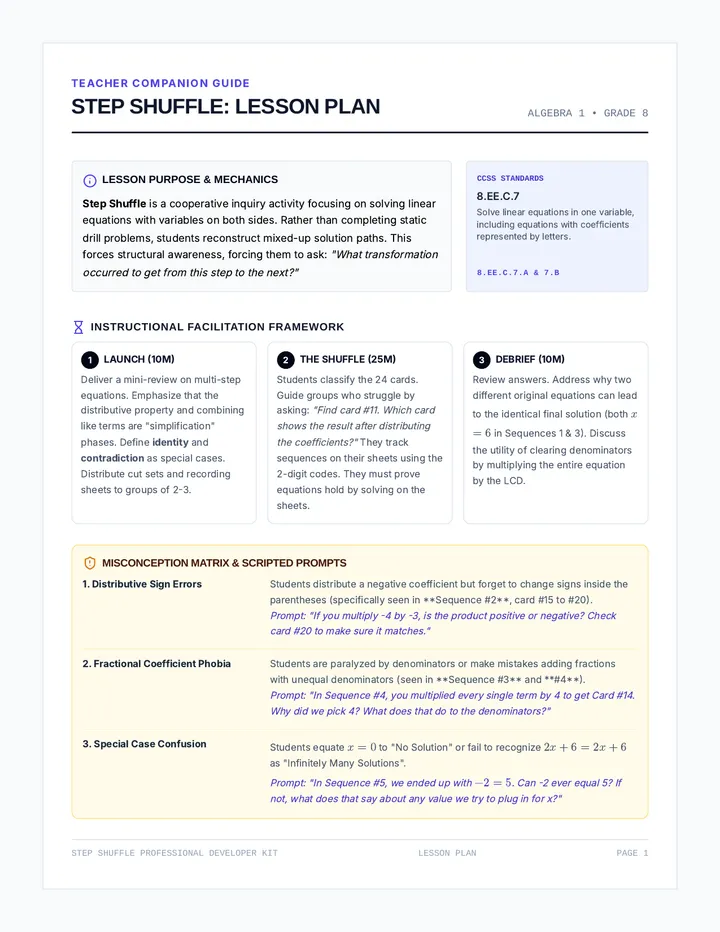
Step Shuffle Teacher Guide TEACHER COMPANION GUIDE
STEP SHUFFLE: LESSON PLAN
ALGEBRA 1 • GRADE 8
Lesson Purpose & Mechanics
Step Shuffle is a cooperative inquiry activity focusing on solving linear equations with variables on both sides. Rather than completing static drill problems, students reconstruct mixed-up solution paths. This forces structural awareness, forcing them to ask: "What transformation occurred to get from this step to the next?"
CCSS Standards
8.EE.C.7
Solve linear equations in one variable, including equations with coefficients represented by letters.
8.EE.C.7.A & 7.B
Instructional Facilitation Framework
1
Launch (10m)
Deliver a mini-review on multi-step equations. Emphasize that the distributive property and combining like terms are "simplification" phases. Define identity and contradiction as special cases. Distribute cut sets and recording sheets to groups of 2-3.
2
The Shuffle (25m)
Students classify the 24 cards. Guide groups who struggle by asking: "Find card #11. Which card shows the result after distributing the coefficients?" They track sequences on their sheets using the 2-digit codes. They must prove equations hold by solving on the sheets.
3
Debrief (10m)
Review answers. Address why two different original equations can lead to the identical final solution (both \(x=6\) in Sequences 1 & 3). Discuss the utility of clearing denominators by multiplying the entire equation by the LCD.
MISCONCEPTION MATRIX & SCRIPTED PROMPTS
1. Distributive Sign Errors
Students distribute a negative coefficient but forget to change signs inside the parentheses (specifically seen in **Sequence #2**, card #15 to #20).Prompt: "If you multiply -4 by -3, is the product positive or negative? Check card #20 to make sure it matches."
2. Fractional Coefficient Phobia
Students are paralyzed by denominators or make mistakes adding fractions with unequal denominators (seen in **Sequence #3** and **#4**).Prompt: "In Sequence #4, you multiplied every single term by 4 to get Card #14. Why did we pick 4? What does that do to the denominators?"
3. Special Case Confusion
Students equate \(x=0\) to "No Solution" or fail to recognize \(2x+6=2x+6\) as "Infinitely Many Solutions".Prompt: "In Sequence #5, we ended up with \(-2=5\). Can -2 ever equal 5? If not, what does that say about any value we try to plug in for x?"