A) 26
B) 14
C) 38
D) 224
Identify the correct step sequence
Short Response 1.4
Parentheses Placement:
Insert one pair of parentheses into:
\( 6 + 18 \div 3 - 1 = 7 \)
Write out the full evaluation showing how your parentheses produce 7.
Record in Student Packet
Order of Operations • Tri-Modal Round A Expression Crunch
CFU 1B
Exponents & Fractions
Vocal Prompt 1B
Turn to your partner: Why is \( -4^2 = -16 \) while \( (-4)^2 = +16 \)?
Turn & Vocalize: What physical rule determines what the exponent "hugs"?
30s Solo • 45s Partner Talk
Multiple Choice 1.2
Evaluate: \( \frac{48 - 4 \times 3}{2^3 + 1} \)
A) 4
B) 12
C) 15
D) 1.33
Treat fraction bar as grouping
Error Analysis 1.5
Find the Fatal Flaw:
\( -5^2 + 4(2 - 7) = 25 + (-20) = 5 \)
Identify the exponent error and calculate the true final integer value.
Record in Student Packet
Order of Operations • Tri-Modal Round B Expression Crunch
Part 2
Terms & Coefficients
Anatomy of an Algebraic Term
-7x3
Sign
Coefficient
Variable
Exponent
What makes terms "Like"?
Identical variable letters AND identical exponents.
Two Unbreakable Rules
Rule 1: The Sign Belongs to the Number
In \( 8 - 5x \), the minus sign is welded to the 5. The term is \( -5x \).
Rule 2: Add Coefficients, Never Exponents!
\( 4x + 9x = 13x \) (not \( 13x^2 \)). You count how many \( x \)'s you have!
Pro-Tip: Draw a box around each term with its sign before moving!
Combining Like Terms • Part 2 of 3 Expression Crunch
Caution
Like Terms Traps
Trap A: The Variable Merger
\( 6x^2 + 4x \)
Wrong: Combining to make \( 10x^3 \) or \( 10x^2 \)
Correct: CANNOT BE COMBINED! It is already simplified.
\( x^2 \) and \( x \) are completely different algebraic dimensions. You cannot add square units to linear units.
Trap B: The Invisible Sign Drop
\( 12 - 5x + 3 - 2x \)
Wrong: \( 5x + 2x = 7x \rightarrow 15 - 7x \)
Correct: \( -5x - 2x = -7x \); \( 12 + 3 = 15 \rightarrow 15 - 7x \)
Also beware: A naked variable like \( x \) has an invisible coefficient of 1 (\( 1x \)), and \( -x \) is \( -1x \)!
Combining Like Terms • Trap Analysis Expression Crunch
CFU 2A
Commutativity & Multi-Terms
Vocal Prompt 2A
A classmate says: "\( 4xy \) and \( 7yx \) cannot be combined because the variables are in reverse order."
Turn & Vocalize: Are they like terms or not? What arithmetic property proves it to your partner?
Commutative Property of Multiplication
Multiple Choice 2.1
Simplify: \( 8x^2 - 5x + 3 - 2x^2 - 7x - 9 \)
A) \( 6x^2 - 12x - 6 \)
B) \( 6x^2 + 2x - 6 \)
C) \( 10x^2 - 12x + 12 \)
D) \( -6x^4 - 6 \)
Track the signs with precision
Short Response 2.4
Multi-Variable Grouping:
Group matching terms with signs:
\( 14a - 9b + 3 - 6a + 2b - 11 - a \)
Combine each family and write the final expression.
Record in Student Packet
Combining Like Terms • Tri-Modal Round A Expression Crunch
CFU 2B
The Exponent Trap & Modeling
Vocal Prompt 2B
A peer claims: "\( 5x^2 + 3x \) must equal \( 8x^3 \) because you add the exponents."
Turn & Vocalize: Why are \( x^2 \) and \( x \) incompatible units that cannot be merged?
Area vs Length Dimensions
Multiple Choice 2.2
Simplify: \( -x + 4y - 8x - y + 15 \)
A) \( -9x + 3y + 15 \)
B) \( -7x + 5y + 15 \)
C) \( -9x + 5y + 15 \)
D) \( 9xy + 15 \)
Account for invisible 1s
Perimeter Model 2.6
Triangle Sides:
\( a = 3x^2 - 2x + 5 \)
\( b = x^2 + 7x - 4 \)
\( c = 5x - 3 \)
Combine all sides into one simplified perimeter.
Record in Student Packet
Combining Like Terms • Tri-Modal Round B Expression Crunch
Part 3
Full Algebraic Power
The 2-Phase Simplification Protocol
Phase 1: Clear Parentheses (Distribute) Multiply the factor outside by EVERY term inside. Watch signs strictly: \( a(b + c) = ab + ac \).
Phase 2: Group & Combine Like Terms Gather matching variable groups and constant numbers. Add coefficients. Write in standard descending order.
Worked Execution Model
\( 5 - 3(2x - 4) + 7x \)
\( = 5 - 6x + 12 + 7x \) (Distribute -3)
\( = (-6x + 7x) + (5 + 12) \) (Reorder)
\( = x + 17 \) (Fully Simplified)
Key Reminder: We do NOT set this to 0! Expressions are simplified, not solved!
Simplifying Expressions • Part 3 of 3 Expression Crunch
Caution
Distribution Traps
Trap A: The Partial Distributor
\( 4(3x - 5) \)
Wrong: \( 12x - 5 \) (Forgot the second term!)
Correct: \( 4(3x) - 4(5) = 12x - 20 \)
The factor outside multiplies EVERY resident inside the parentheses. Use double distribution arrows.
Trap B: The Phantom Negative
\( -(4x - 9) \)
Wrong: \( -4x - 9 \) (Did not flip the second sign!)
Correct: \( -1(4x) - 1(-9) = -4x + 9 \)
A negative in front of parentheses means \( -1 \). Distributing a negative flips the sign of every internal term.
Simplifying Expressions • Trap Analysis Expression Crunch
CFU 3A
Distribution & Negative Multipliers
Vocal Prompt 3A
Someone looks at \( 12 - 3(2x - 5) \) and computes \( 9(2x - 5) = 18x - 45 \).
Turn & Vocalize: What two distinct errors occurred, and what is the real simplified expression?
Explain multiplication priority
Multiple Choice 3.1
Simplify: \( 4(3x - 2) - 5(2x - 4) \)
A) \( 2x - 28 \)
B) \( 2x + 12 \)
C) \( 2x - 12 \)
D) \( 22x + 12 \)
Watch the double negative on \( -5(-4) \)
Perimeter Model 3.4
Combined Perimeters:
Rectangle: \( W = 5 \), \( L = 4x - 3 \).
Square: \( S = 2x + 1 \).
Write unsimplified sum of both perimeters and simplify completely.
Record in Student Packet
Simplifying Expressions • Tri-Modal Round A Expression Crunch
CFU 3B
Naked Negatives & Triple Chains
Vocal Prompt 3B
Look at \( -(4x - 9) \). A student writes \( -4x - 9 \).
Turn & Vocalize: What invisible factor was distributed, and what happens to \(-9\)?
Sign Inversion Rule
Multiple Choice 3.2
Simplify: \( 20 - 3(4x - 1) + 2(x + 5) \)
A) \( -10x + 33 \)
B) \( -10x + 27 \)
C) \( 14x + 33 \)
D) \( -14x + 7 \)
Anchor constants carefully
Error Analysis 3.5
Alex's Distribution:
\( -2(5x - 3) + 4 = -10x - 6 + 4 \)
Identify Alex's sign error and provide the correct simplified expression.
Record in Student Packet
Simplifying Expressions • Tri-Modal Round B Expression Crunch
Synthesis
Final Boss Problem
Simplify Completely (Show Every Operational Tier): 5 Minutes Solo
\( 18 \div 3^2 \times 4 - [\,3(2x - 5) - 2(x + 4)\,] + 7x \)
Check 1: Ops Resolve exponents, then division and multiplication left-to-right.
Check 2: Bracket Distribute 3 and -2 inside brackets before distributing the outer minus!
Check 3: Combine Combine like variable terms and constant numbers accurately.
Turn in completed 6-page Student Packet for final assessment. Final Expression = 3x + 31
Misconception Explanation:
Correct Mathematical Steps:
Part 1 Short Response: Multi-Tier Bracket Evaluation Item 1.6
Evaluate completely, showing every intermediate step clearly:
\( [\,(5 - 2)^3 + 7\,] \div 2 - 4 \times (-3) \)
Show Step-by-Step Evaluation Work:
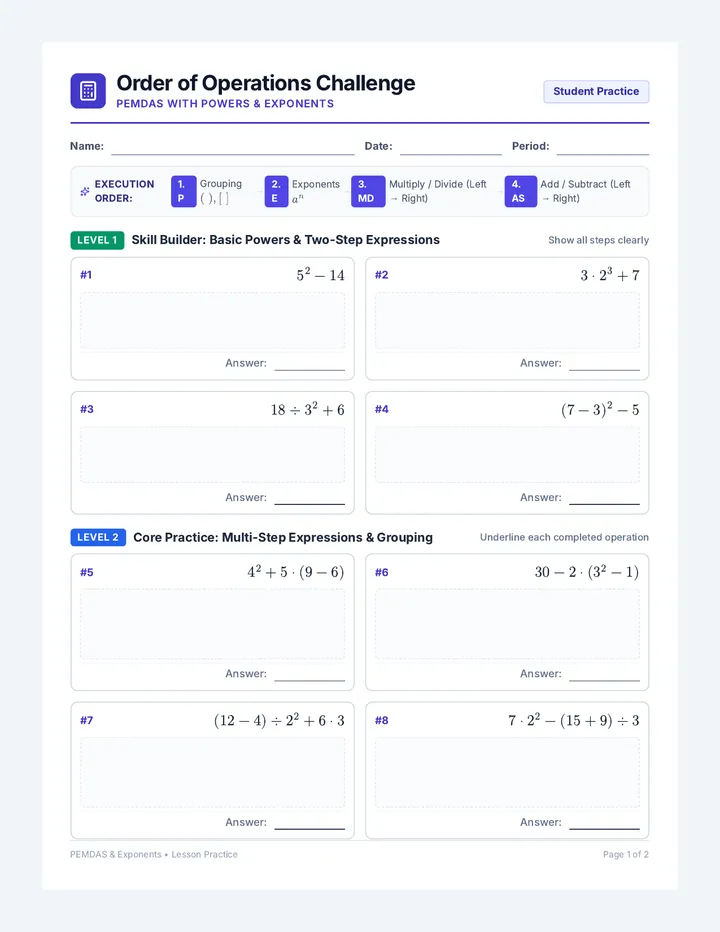
Expression Crunch Packet • Part 1: Order of Operations Page 2 of 6
Algebraic Structure
Min 28:00 - 52:00
Like Terms Definition: Terms with identical variable letters raised to the identical powers. Combine coefficients only; never change exponents when adding or subtracting! The sign preceding each term belongs permanently to that term.
Vocal Prompt 2A • Partner Talk: Variable Commutativity
30s Solo • 45s Talk
Spoken Question: Jordan states: "\( 4xy \) and \( -7yx \) are unlike terms because the variables are in reverse order." Vocalize to your partner why Jordan is wrong, citing the mathematical property that allows you to combine them.
Record your verbal synthesis below:
Part 2 Multiple Choice: Combining Multi-Term Polynomials Item 2.1
Simplify completely: \( 8x^2 - 5x + 3 - 2x^2 - 7x - 9 \)
A \( 6x^2 - 12x - 6 \)
B \( 6x^2 + 2x - 6 \)
C \( 10x^2 - 12x + 12 \)
D \( -6x^4 - 6 \)
Part 2 Multiple Choice: Invisible 1s & Sign Ownership Item 2.2
Simplify completely: \( -x + 4y - 8x - y + 15 \)
A \( -9x + 3y + 15 \)
B \( -7x + 5y + 15 \)
C \( -9x + 5y + 15 \)
D \( 9xy + 15 \)
Part 2 Short Response: Multi-Variable Grouping Item 2.4
Simplify: \( 14a - 9b + 3 - 6a + 2b - 11 - a \). Box matching terms with their signs, then write the final expression:
Show Term Grouping and Combining Work:
Expression Crunch Packet • Part 2: Combining Like Terms Page 3 of 6
Combining Like Terms Continued
Deep Practice
Vocal Prompt 2B • Partner Talk: The Exponent Wall
30s Solo • 45s Talk
Spoken Question: A classmate says: "\( 5x^2 + 3x \) must equal \( 8x^3 \) because \( 5+3=8 \) and you add exponents." Vocalize why \( x^2 \) and \( x \) are fundamentally incompatible units.
Record your verbal synthesis below:
Part 2 Multiple Choice: Mixed Variable & Exponent Terms Item 2.3
Simplify completely: \( 3a^2b + 5ab^2 - 7a^2b + 2ab^2 - ab \)
A \( -4a^2b + 7ab^2 - ab \)
B \( 2a^3b^3 - ab \)
C \( -10a^2b + 7ab^2 \)
D \( 3ab \)
Part 2 Error Analysis: Exponent Addition Misconception Item 2.5
Marcus wrote: \( 5x^3 + 3x^2 + 4x^3 - x^2 = 9x^6 + 2x^4 \). Explain the two mathematical misconceptions Marcus made regarding exponents during addition, and write the true simplified expression.
Marcus's Misconceptions:
Accurate Solution & Reasoning:
Part 2 Short Response: Triangle Perimeter Expression Item 2.6
A triangle has side lengths \( (3x^2 - 2x + 5) \), \( (x^2 + 7x - 4) \), and \( (5x - 3) \). Write the unsimplified sum of all three sides, then combine like terms completely to find the simplified perimeter:
Show Formulation & Term Combining Work:
Expression Crunch Packet • Part 2: Combining Like Terms Page 4 of 6
Expression Engine
Min 52:00 - 75:00
2-Step Engine: 1. Distribute: Multiply outer terms to every resident inside parentheses. Distributing a negative flips every internal sign! 2. Combine: Reorder and merge like terms. Remember: Do NOT set equal to zero!
Vocal Prompt 3A • Partner Talk: Subtraction vs Distribution Priority
30s Solo • 45s Talk
Spoken Question: A student attempts \( 12 - 3(2x - 5) \) by doing \( 12 - 3 = 9 \), getting \( 9(2x - 5) = 18x - 45 \). Tell your partner the two distinct rules violated and state the real simplified result.
Record your verbal synthesis below:
Part 3 Multiple Choice: Double Distribution with Negatives Item 3.1
Simplify completely: \( 4(3x - 2) - 5(2x - 4) \)
A \( 2x - 28 \)
B \( 2x + 12 \)
C \( 2x - 12 \)
D \( 22x + 12 \)
Part 3 Multiple Choice: Constant Anchoring Item 3.2
Simplify completely: \( 20 - 3(4x - 1) + 2(x + 5) \)
A \( -10x + 33 \)
B \( -10x + 27 \)
C \( 14x + 33 \)
D \( -14x + 7 \)
Part 3 Short Response: Perimeter Modeling Item 3.4
A garden has width \( 5 \) and length \( (4x - 3) \). An adjacent square patio has side length \( (2x + 1) \). Write an unsimplified expression for the sum of both perimeters, then simplify it completely:
Show Perimeter Expression & Simplification Steps:
Expression Crunch Packet • Part 3: Simplifying Expressions Page 5 of 6
Simplifying Expressions & Synthesis
Final Assessment
Vocal Prompt 3B • Partner Talk: Distributing a Naked Negative
30s Solo • 45s Talk
Spoken Question: Look at \( -(4x - 9) \). A student writes \( -4x - 9 \). Explain to your partner what invisible number was outside the parentheses and what happens to the sign of \(-9\).
Record your verbal synthesis below:
Part 3 Multiple Choice: Nested Bracket Distribution Item 3.3
Simplify completely: \( 2x - 3[\,x - 2(x - 4)\,] \)
A \( 5x - 24 \)
B \( -x + 24 \)
C \( 5x + 24 \)
D \( -x - 24 \)
Part 3 Error Analysis: Partial Distribution Misconception Item 3.5
Alex writes: \( -2(5x - 3) + 4 = -10x - 6 + 4 = -10x - 2 \). Identify both errors Alex made with signs/distribution, and provide the correct result:
Alex's Errors:
Correct Steps:
Part 3 Short Response: Triple Term Distribution Item 3.6
Simplify completely: \( 6(2x - 1) - 4(3x + 2) + 5(x - 3) \). Show all intermediate distributions and final combining:
90-Minute Capstone Exit Challenge
Minutes 75:00 - 90:00
Simplify the complete multi-tiered expression:
\( 18 \div 3^2 \times 4 - [\,3(2x - 5) - 2(x + 4)\,] + 7x \)
Complete Step-by-Step Solution:
Expression Crunch Packet • Part 3 & Capstone Assessment Page 6 of 6
Answer: \( x^2 \) and \( x \) represent different geometric dimensions (area vs length). You can only add identical powers: \( 5x^2 + 3x \) is already in simplest form.
Item 2.1 Multiple Choice: Option A (\( 6x^2 - 12x - 6 \))
\( x^2 \) terms: \( 8x^2 - 2x^2 = 6x^2 \); \( x \) terms: \( -5x - 7x = -12x \); Constants: \( 3 - 9 = -6 \).
Option B misses the negative sign on \( 7x \); Option D combines across different exponent powers.
Item 2.2 Multiple Choice: Option A (\( -9x + 3y + 15 \))
\( x \) terms: \( -1x - 8x = -9x \); \( y \) terms: \( 4y - 1y = +3y \); Constant: \( +15 \).
Emphasize that naked variables \( -x \) and \( -y \) carry invisible coefficients of \( -1 \).
Item 2.3 Multiple Choice: Option A (\( -4a^2b + 7ab^2 - ab \))
\( a^2b \) family: \( 3a^2b - 7a^2b = -4a^2b \); \( ab^2 \) family: \( 5ab^2 + 2ab^2 = 7ab^2 \); Lone \( ab \) term: \( -ab \).
\( a^2b \) and \( ab^2 \) cannot be merged because their exponents belong to different letters!
Item 2.4 Multi-Variable Grouping: \( 7a - 7b - 8 \)
\( a \)-terms: \( 14a - 6a - 1a = 7a \); \( b \)-terms: \( -9b + 2b = -7b \); Constants: \( 3 - 11 = -8 \).
Item 2.5 Error Analysis: Correct: \( 9x^3 + 2x^2 \)
Misconception: Marcus added exponents (\( 3+3=6 \) and \( 2+2=4 \)). Exponents do not change during term addition—only coefficients are added.
Item 2.6 Triangle Perimeter Modeling: Perimeter = \( 4x^2 + 10x - 2 \)
Sum: \( (3x^2 - 2x + 5) + (x^2 + 7x - 4) + (5x - 3) = (3x^2 + x^2) + (-2x + 7x + 5x) + (5 - 4 - 3) = 4x^2 + 10x - 2 \).
Expression Crunch • Master Solutions Page 2 of 3
Teacher Reference & Assessment Key
Page 3: Part 3 & Exit Ticket
Vocal Prompt 3A (Premature Subtraction):
Answer: Subtracted \( 12 - 3 \) before multiplying, violating order of operations. Also dropped sign on \( -3(-5) \). Correct: \( 12 - 6x + 15 = -6x + 27 \).
Vocal Prompt 3B (Distributing Naked Negative):
Answer: A leading negative means \( -1 \). Distributing flips all internal signs: \( -(4x - 9) = -1(4x) - 1(-9) = -4x + 9 \).
Item 3.1 Multiple Choice: Option B (\( 2x + 12 \))
\( 4(3x - 2) - 5(2x - 4) = 12x - 8 - 10x + 20 = 2x + 12 \).
Option A (\( 2x - 28 \)) is selected when students mistakenly compute \( -5(-4) = -20 \).
Item 3.2 Multiple Choice: Option A (\( -10x + 33 \))
\( 20 - 3(4x - 1) + 2(x + 5) = 20 - 12x + 3 + 2x + 10 = (-12x + 2x) + (20 + 3 + 10) = -10x + 33 \).
Item 3.3 Multiple Choice: Option A (\( 5x - 24 \))
Inside brackets: \( x - 2(x - 4) = x - 2x + 8 = -x + 8 \).
Outer distribution: \( 2x - 3(-x + 8) = 2x + 3x - 24 = 5x - 24 \).
Item 3.4 Perimeter Modeling: Sum = \( 16x + 8 \)
\( P_{\text{rec}} = 2(5) + 2(4x - 3) = 10 + 8x - 6 = 8x + 4 \). \( P_{\text{sq}} = 4(2x + 1) = 8x + 4 \). Total: \( (8x + 4) + (8x + 4) = 16x + 8 \).
Item 3.5 Error Analysis: Correct: \( -10x + 10 \)
Alex multiplied \( -2(-3) \) to get \( -6 \) instead of \( +6 \). Correct: \( -10x + 6 + 4 = -10x + 10 \).
Item 3.6 Triple Distribution: Simplified: \( 5x - 29 \)
\( 6(2x - 1) - 4(3x + 2) + 5(x - 3) = 12x - 6 - 12x - 8 + 5x - 15 = (12x - 12x + 5x) + (-6 - 8 - 15) = 5x - 29 \).
90-Minute Capstone Exit Solution: \( 3x + 31 \)
1. Arithmetic chunk: \( 18 \div 9 \times 4 = 2 \times 4 = 8 \). 2. Inside bracket: \( 6x - 15 - 2x - 8 = 4x - 23 \). 3. Outer minus: \( 8 - [\,4x - 23\,] + 7x = 8 - 4x + 23 + 7x \). 4. Combine: \( (-4x + 7x) + (8 + 23) = \mathbf{3x + 31} \).
Expression Crunch • Master Solutions Page 3 of 3