Area Split Squad Worksheet Grade 3 Math Measurement & Data
Area Split Squad: Decomposing Shapes
Find the missing side length, cut into two rectangles, and calculate total area.
Area Formula
Total = Area A + Area B
Name:
Date:
Partner:
🔍 Missing Side Rule: Opposite parallel sides must balance! Add smaller parts to find the total, or subtract from the total to find the missing part.
I DO: PROBLEM 1 (TEACHER MODEL) Find missing side, draw a cut line, then solve!
Figure 1
8 m 3 m 5 m ? m 3 m 7 m
Step 1: Find Missing Horizontal Side (?) Total − Known Part
Missing (?) = − = m
Step 2: Decompose & Write Equations Length × Width = Area
Rectangle A:
× = sq m
Rectangle B:
× = sq m
Total Area:
I DO: PROBLEM 2 (TEACHER MODEL - VERTICAL MISSING SIDE) Look at the left & right sides to find missing height!
Figure 2
7 cm 9 cm 4 cm 5 cm ? cm 4 cm
Step 1: Find Missing Vertical Side (?) Total Height − Right Side
Missing (?) = − = cm
Step 2: Decompose & Write Equations Length × Width = Area
Rectangle A:
× = sq cm
Rectangle B:
× = sq cm
Total Area:
Area Split Squad: We Do Together
Work with your teacher to discover the mystery side length and calculate total area.
Page 2 • Guided Practice
WE DO: PROBLEM 3 (GUIDED PRACTICE) Find the missing right side length!
Figure 3
10 m 4 m 6 m 5 m ? m 9 m
Step 1: Find Missing Side (?) 10 m − 6 m
Missing (?) = − = m
Step 2: Decompose & Write Equations Length × Width = Area
Rectangle A:
× = sq m
Rectangle B:
× = sq m
Total Area:
WE DO: PROBLEM 4 (GUIDED PRACTICE) Add two parts together to find the total height!
Figure 4
? in 5 in 3 in 3 in 4 in 8 in
Step 1: Find Missing Total Height (?) Part + Part
Missing (?) = + = in
Step 2: Decompose & Write Equations Length × Width = Area
Rectangle A:
× = sq in
Rectangle B:
× = sq in
Total Area:
Area Split Squad: Teamwork Practice
Finish the last teacher model, then team up with your partner!
Page 3 • Guided & Partner
WE DO: PROBLEM 5 (GUIDED PRACTICE) Find the missing total base width!
Figure 5
9 ft 4 ft 6 ft 6 ft 3 ft ? ft
Step 1: Find Missing Bottom Side (?) Top + Step
Missing (?) = + = ft
Step 2: Decompose & Write Equations Length × Width = Area
Rectangle A:
× = sq ft
Rectangle B:
× = sq ft
Total Area:
PARTNER: PROBLEM 6 (TEAM CHALLENGE) Talk it through: One partner finds ?, one checks equations!
Figure 6
8 cm 6 cm 5 cm ? cm 3 cm 10 cm
Step 1: Partner A Finds Missing Side (?) 10 cm − 6 cm
Missing (?) = − = cm
Step 2: Partner B Writes Equations Length × Width = Area
Rectangle A:
× = sq cm
Rectangle B:
× = sq cm
Total Area:
Area Split Squad: Grand Finale
Solve the last partner challenge, then review your Area Detective Toolkit!
Page 4 • Partner & Extension
PARTNER: PROBLEM 7 (SWITCH ROLES!) Switch jobs! Now Partner B finds ?, Partner A writes equations!
Figure 7
9 yd 4 yd ? yd 4 yd 3 yd 8 yd
Step 1: Partner B Finds Missing Side (?) Total Height − Right Side
Missing (?) = − = yd
Step 2: Partner A Writes Equations Length × Width = Area
Rectangle A:
× = sq yd
Rectangle B:
× = sq yd
Total Area:
✓ The 3-Step Area Detective Checklist
1. Spot the Missing Side: Check vertical with vertical, horizontal with horizontal.
2. Draw One Straight Cut: Split the shape into Rectangle A and Rectangle B (horizontal or vertical).
3. Add Both Areas: Multiply \(L \times W\) for each part, then add them together!
Partner Debrief
Did your cut choice change the total area answer?
Yes No (Same total!)
Detective Rating:
⭐⭐⭐ Master Shape Decomposer!
Area Split Squad Answer Key Teacher Edition Complete Solutions & Guide
Area Split Squad: Answer Key
Page 1 Solutions • Teacher Modeling (I Do Problems 1 & 2)
Answer Key
Total = Area A + Area B
💡 Teacher Model Note: Emphasize matching orientations: horizontal missing sides correspond only to horizontal givens; vertical missing sides correspond only to vertical givens.
I DO: PROBLEM 1 (TEACHER MODEL) — SOLVED Target Area: 36 sq m
Figure 1 (Vertical Cut Shown)
A: 24 B: 12 8 m 3 m 5 m ?=4 m 3 m 7 m
Step 1: Missing Horizontal Side (?) = Bottom − Top
Missing (?) = 7 − 3 = 4 m
Step 2: Decompose & Write Equations (Vertical Cut)
Rect A: 3 m × 8 m = 24 sq m
Rect B: 4 m × 3 m = 12 sq m
Total Area: 24 + 12 = 36 sq m
*Alt horizontal cut: (3 × 5 = 15) + (7 × 3 = 21) = 36 sq m. Both cuts are 100% valid!
I DO: PROBLEM 2 (TEACHER MODEL) — SOLVED Target Area: 48 sq cm
Figure 2 (Horizontal Cut Shown)
A: 36 B: 12 7 cm 9 cm 4 cm 5 cm ?=3 cm 4 cm
Step 1: Missing Vertical Side (?) = Left Height − Right Height
Missing (?) = 7 − 4 = 3 cm
Step 2: Decompose & Write Equations (Horizontal Cut)
Rect A: 9 cm × 4 cm = 36 sq cm
Rect B: 4 cm × 3 cm = 12 sq cm
Total Area: 36 + 12 = 48 sq cm
*Alt vertical cut: (4 × 7 = 28) + (5 × 4 = 20) = 48 sq cm. Notice the total area is identical!
Area Split Squad Answer Key: Guided Practice
Page 2 Solutions • We Do Guided Problems 3 & 4
Page 2 • Answer Key
WE DO: PROBLEM 3 — SOLVED Total Area: 60 sq m
Figure 3 (Vertical Cut)
A: 40 B: 20 10 m 4 m 6 m 5 m ?=4 m 9 m
Step 1: Missing Right Side (?) = 10 m − 6 m
Missing (?) = 10 − 6 = 4 m
Step 2: Decompose (Vertical Cut)
Rect A: 4 m × 10 m = 40 sq m
Rect B: 5 m × 4 m = 20 sq m
Total Area: 40 + 20 = 60 sq m
*Alt horizontal cut: (4 × 6 = 24) + (9 × 4 = 36) = 60 sq m.
WE DO: PROBLEM 4 — SOLVED Total Area: 47 sq in
Figure 4 (Vertical Cut)
A: 35 B: 12 ?=7 in 5 in 3 in 3 in 4 in 8 in
Step 1: Missing Total Height (?) = 3 in + 4 in
Missing (?) = 3 + 4 = 7 in
Step 2: Decompose (Vertical Cut)
Rect A: 5 in × 7 in = 35 sq in
Rect B: 3 in × 4 in = 12 sq in
Total Area: 35 + 12 = 47 sq in
*Alt horizontal cut: (5 × 3 = 15) + (8 × 4 = 32) = 47 sq in.
Area Split Squad Slides Grade 3 Math • Area Decomposing Shapes
🔍 Area Detective Mission
Area Split Squad:
The Case of the Missing Side
How to find mystery side lengths and calculate the total area of composite figures.
1. Find the Missing Side • 2. Cut into 2 Rectangles • 3. Multiply & Add
The Golden Detective Rule: Opposite Sides Balance!
Rule #1
↔
Horizontal Balance
Sides going side-to-side only balance with other side-to-side sides!
Top Part + Step Part = Total Bottom
↕
Vertical Balance
Sides going up-and-down only balance with other up-and-down sides!
Upper Drop + Lower Drop = Total Height
⚠️ Never mix a flat side with a tall side! Compare matching directions!
Our 3-Step Strategy
Step-by-Step Method
1
Find the Missing Side
Look for the parallel opposites. Add the pieces or subtract from the total!
Total − Part = Missing ?
2
Make One Straight Cut
Slice the shape into Rectangle A and Rectangle B .
Vertical or Horizontal!
3
Multiply & Add
Calculate Area A and Area B (\(L \times W\)), then add them together!
Area A + Area B = Total Area
Ready to see it in action? Let's solve Problem 1 together!
I Do • Problem 1
Teacher Model: Missing Horizontal Step
Total Area = 36 sq m
8 m 3 m 5 m ?=4 m 3 m 7 m A: 24 B: 12
Step 1: Find Missing Horizontal Side (?)
7 m − 3 m = 4 m
Step 2: Calculate Each Rectangle
Rectangle A: 3 m × 8 m = 24 sq m
Rectangle B: 4 m × 3 m = 12 sq m
Step 3: Total Area 24 + 12 = 36 sq m
💡 Notice: The bottom was 7 m. The top was 3 m. The difference gave us 4 m!
I Do • Problem 2
Teacher Model: Missing Vertical Height
Total Area = 48 sq cm
7 cm 9 cm 4 cm 5 cm ?=3 cm 4 cm A: 36 B: 12
Step 1: Compare the Vertical Sides
7 cm − 4 cm = 3 cm
Step 2: Horizontal Cut Equations
Rectangle A (Top): 9 cm × 4 cm = 36 sq cm
Rectangle B (Bottom): 4 cm × 3 cm = 12 sq cm
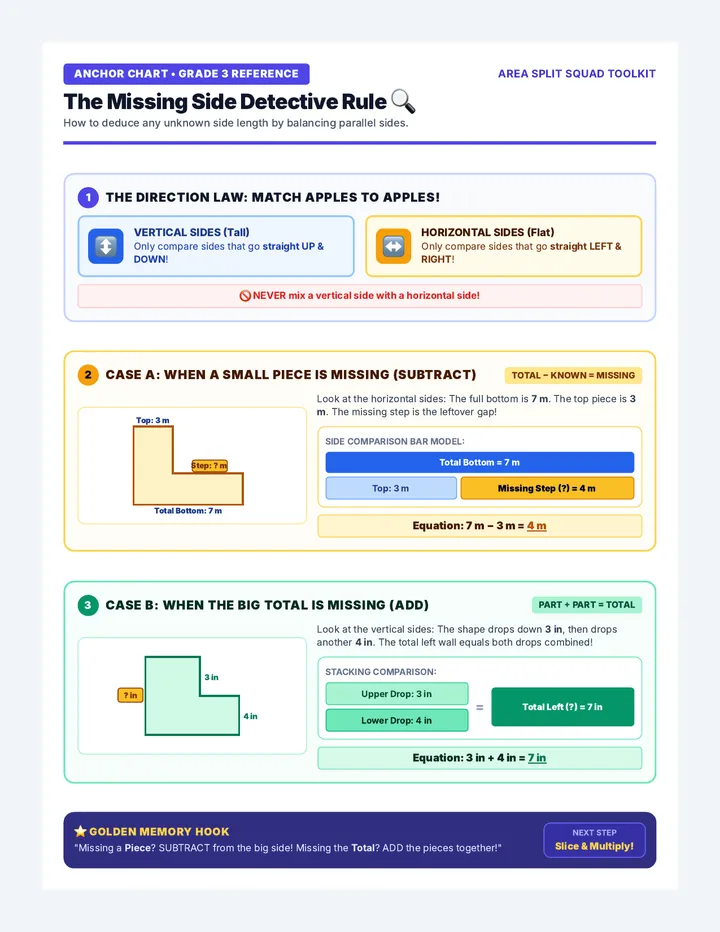
Missing Side Anchor Chart Anchor Chart • Grade 3 Reference Area Split Squad Toolkit
The Missing Side Detective Rule 🔍
How to deduce any unknown side length by balancing parallel sides.
1
The Direction Law: Match Apples to Apples!
↕
VERTICAL SIDES (Tall)
Only compare sides that go straight UP & DOWN !
↔
HORIZONTAL SIDES (Flat)
Only compare sides that go straight LEFT & RIGHT !
🚫 NEVER mix a vertical side with a horizontal side!
2
Case A: When a Small Piece is Missing (SUBTRACT)
Total − Known = Missing
Top: 3 m Step: ? m Total Bottom: 7 m
Look at the horizontal sides: The full bottom is 7 m . The top piece is 3 m . The missing step is the leftover gap!
Side Comparison Bar Model:
Total Bottom = 7 m
Top: 3 m
Missing Step (?) = 4 m
Equation: 7 m − 3 m = 4 m
3
Case B: When the Big Total is Missing (ADD)
Part + Part = Total
? in 3 in 4 in
Look at the vertical sides: The shape drops down 3 in , then drops another 4 in . The total left wall equals both drops combined!
Stacking Comparison:
Upper Drop: 3 in
Lower Drop: 4 in
=
Total Left (?) = 7 in
Equation: 3 in + 4 in = 7 in
⭐ Golden Memory Hook
"Missing a Piece ? SUBTRACT from the big side! Missing the Total ? ADD the pieces together!"
Next Step
Slice & Multiply!
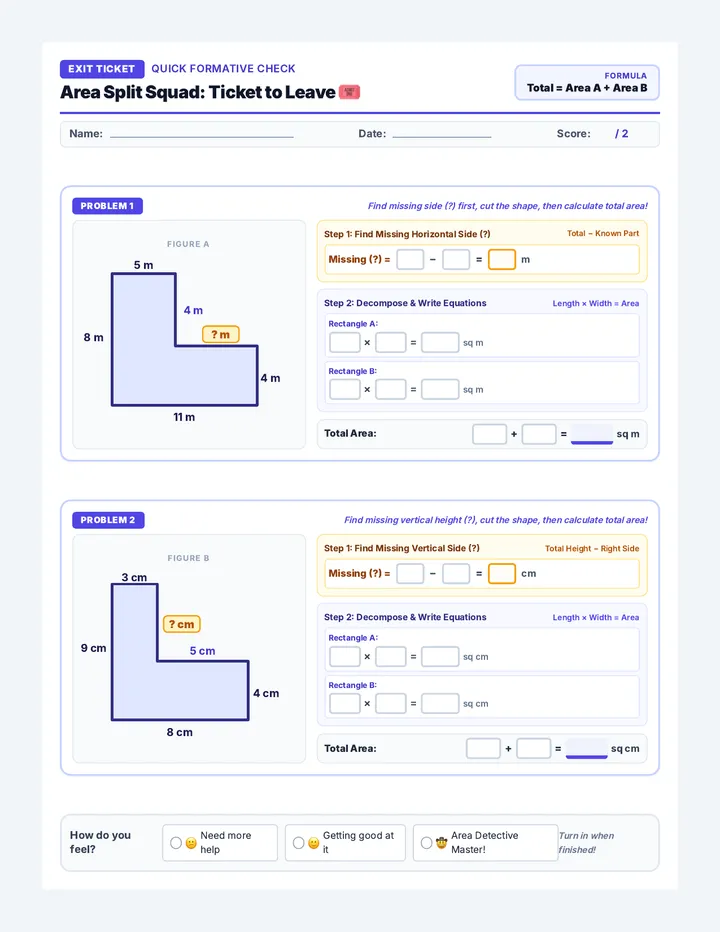
Split Squad Exit Ticket Exit Ticket Quick Formative Check
Area Split Squad: Ticket to Leave 🎟️
Formula
Total = Area A + Area B
Name:
Date:
Score: / 2
Problem 1 Find missing side (?) first, cut the shape, then calculate total area!
Figure A
8 m 5 m 4 m ? m 4 m 11 m
Step 1: Find Missing Horizontal Side (?) Total − Known Part
Missing (?) = − = m
Step 2: Decompose & Write Equations Length × Width = Area
Rectangle A:
× = sq m
Rectangle B:
× = sq m
Total Area:
Problem 2 Find missing vertical height (?), cut the shape, then calculate total area!
Figure B
9 cm 3 cm ? cm 5 cm 4 cm 8 cm
Step 1: Find Missing Vertical Side (?) Total Height − Right Side
Missing (?) = − = cm
Step 2: Decompose & Write Equations Length × Width = Area
Rectangle A:
× = sq cm
Rectangle B:
× = sq cm
Total Area:
How do you feel? 😕 Need more help 🙂 Getting good at it 🤠 Area Detective Master!
Turn in when finished!