Lenny.com
Explore
Create
ActivitiesNewMathEnglish Language ArtsScience & EngineeringSocial StudiesGlobal LanguagesHealth & Physical EducationSpecial EducationCounseling & Life SkillsArts & CreativityESL
Lenny.com
Lenny.com
Explore
Create
ActivitiesNewMathEnglish Language ArtsScience & EngineeringSocial StudiesGlobal LanguagesHealth & Physical EducationSpecial EducationCounseling & Life SkillsArts & CreativityESL
Lenny.com
Lenny.com

Solutions

Lenny for EducatorsLenny for SchoolsLenny for Districts

Product

ExploreSign inCreateSupportAbout

Resources

Getting startedMTSS Acceleration Program

© 2026 Lenny Learning Inc.

TermsPrivacyAccessibility
LinkedInInstagramX
Lenny

Measuring Lengths

Standard and non-standard units for determining length, width, and height across metric and customary systems. Develops skills in precise tool usage, estimation techniques, and unit conversions.

MathNumbers & CountingCounting ObjectsNumber NamesComparing NumbersNumber OperationsCounting SequenceNumbers 0-10Place Value Understanding and SystemAdd and Subtract Within 20Addition and Subtraction ConceptsAddition and Subtraction EquationsAddition and Subtraction ProblemsFoundations for MultiplicationMultiplication and Division PropertiesMultiply and Divide Within 100Multiplication and Division ProblemsFactors and MultiplesProperties of OperationsPatterns and RelationshipsGenerate and Analyze PatternsMulti-Digit ArithmeticPlace Value OperationsMulti-Digit and Decimal OperationsNumerical ExpressionsFour Operations and PatternsFour Operations Problem SolvingMeasurement & DataMeasurable AttributesMeasuring LengthsMeasure and Estimate Lengths in Standard UnitsRelate Addition and Subtraction to LengthClassifying and Counting ObjectsTime and MoneyArea Concepts and MeasurementPerimeter and Area MeasuresAngle Concepts and MeasurementTime, Volume, and MassMeasurement Unit ConversionsGeometryIdentifying ShapesShapes and AttributesShape Attributes and ReasoningShapes and CompositionClassifying 2D FiguresGeometric Figures and RelationshipsLines, Angles, and ShapesAngle, Area, and VolumeGeometric MeasurementVolume of 3D ShapesCoordinate Plane ApplicationsTransformations in the PlaneCongruence and SimilarityUnderstand congruence in terms of rigid motionsSimilarity and TransformationsProve Theorems Involving SimilarityPythagorean TheoremTrigonometry for General TrianglesMake Geometric ConstructionsProve Geometric TheoremsTheorems About CirclesFind Arc Lengths And Areas of Sectors of CirclesVolume FormulasRelationships Between Two-Dimensional and Three-Dimensional ObjectsProve Simple Geometric Theorems AlgebraicallyTranslate Between Geometric Description and Equation for Conic SectionApply Geometric Concepts in Modeling SituationsFractions & DecimalsFractions as NumbersBuilding FractionsFraction Equivalence and OrderingAdding and Subtracting FractionsMultiplying and Dividing FractionsDividing FractionsDecimal FractionsMulti-Digit Computation and FactorsAdd, Subtract, Multiply, and Divide Rational NumbersRational Number SystemIrrational Numbers and ApproximationsRatiosRatios and ProportionsProportional RelationshipsUnit RateAlgebraAlgebraic ExpressionsGenerate Equivalent ExpressionsQuantitative RelationshipsProportional Relationships and Linear EquationsEquations and InequalitiesEquation Solving and ReasoningLinear Equations and SystemsGraph Equations and InequalitiesSystems of EquationsReal-World Algebraic ProblemsQuantitative Reasoning with UnitsExpression StructureEquivalent Expression FormsRadicals and Integer ExponentsRational ExponentsRational and Irrational NumbersPolynomial OperationsPolynomial IdentitiesPolynomial Zeros and FactorsRational ExpressionsComplex Number OperationsComplex Numbers in PolynomialsComplex Numbers on PlaneStatistics & ProbabilityRepresent and Interpret DataData DistributionsStatistical VariabilityProbability ModelsCompound Event ProbabilitiesStatistical SamplingInterpret Categorical and Quantitative DataBivariate Data PatternsInterpret Linear ModelsComparing Two PopulationsRandom Processes in StatisticsIndependence and Conditional ProbabilityExpected ValuesProbability-Based Decision MakingStatistical Inference and ConclusionsFunctionsFunction Concepts and NotationDefine and Compare FunctionsInterpret Functions in ContextAnalyze Function RepresentationsModel Relationships with FunctionsIdentify Linear vs Exponential GrowthDistinguish Between Function TypesCompare Growth RatesInterpret Function ExpressionsBuild Functions from RelationshipsConstruct and Model FunctionsTransform and Combine FunctionsModel Comparison and SelectionSolve Exponential EquationsTrigonometryTrigonometric Ratios Involving Right TrianglesTrigonometric Functions and Unit CircleModel with Trigonometric FunctionsTrigonometric IdentitiesVectors & MatricesIntroduction to Vectors and MatricesVector QuantitiesVector OperationsMatrix OperationsCalculusLimits and ContinuityDerivative Concepts and NotationDerivative Rules and TechniquesApplications of DerivativesOptimization ProblemsRelated RatesCurve Sketching and AnalysisIntegration Concepts and NotationAntiderivatives and Indefinite IntegralsDefinite Integrals and AreaFundamental Theorem of CalculusIntegration TechniquesApplications of IntegrationDifferential EquationsSequences and SeriesParametric and Polar FunctionsVector-Valued Functions

Videos

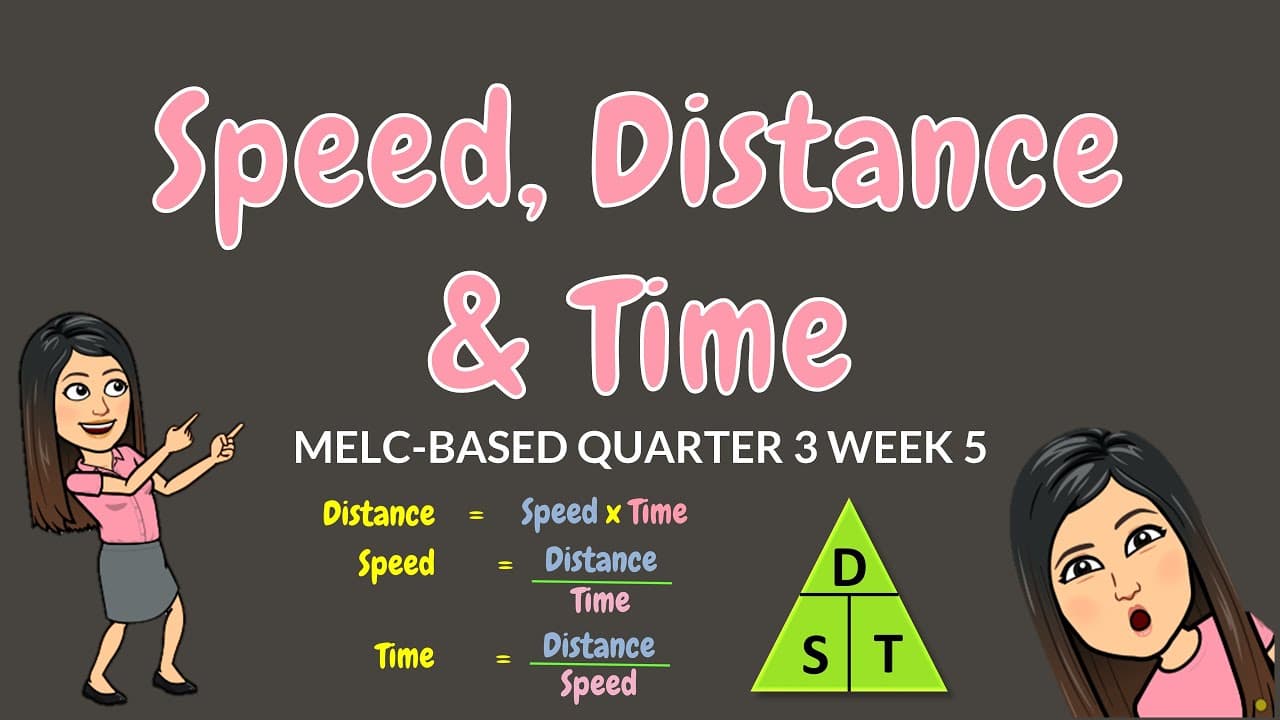
Calculating Speed, Distance, and Time

Calculating Speed, Distance, and Time

This educational video provides a clear, step-by-step guide on how to calculate the three fundamental variables of motion: speed, distance, and time. Through a series of six progressive word problems, an animated teacher guides students through the formulas for each variable, demonstrating not just the arithmetic but also the importance of unit analysis and cancellation. The video utilizes the popular "DST triangle" mnemonic to help students memorize the relationship between the variables. The content is structured into three distinct sections, with two examples provided for each concept: calculating distance (Speed × Time), calculating speed (Distance ÷ Time), and calculating time (Distance ÷ Speed). Specific attention is given to defining each term—explaining speed as a scalar quantity, distance as total length, and time as duration—and verifying the correct units of measurement for the final answers. For educators, this resource serves as an excellent direct-instruction tool for upper elementary or middle school math and science classes. It effectively models problem-solving behaviors, such as identifying given values, selecting the correct formula, substituting numbers, and checking units. The video's pacing allows for "pause-and-solve" interactivity, making it ideal for introducing the concepts or reviewing them before a test.

Sheena DoriaSheena Doria

8mins 42s

Why Do We Have Two Ways to Measure Things?

Why Do We Have Two Ways to Measure Things?

In this engaging episode of SciShow Kids, host Jessi and a special guest—a giant squid named Squipe—explore the confusing world of measurement systems. When Squipe calls to plan a visit, he is puzzled by the concept of a "mile," leading to a clear and child-friendly explanation of why the world uses different units to measure the same things. The video uses a helpful analogy comparing measurement systems to different languages, explaining that just as "Hello," "Hola," and "Bonjour" all mean the same thing, miles and kilometers are just different "languages" for distance. It specifically breaks down the differences between the Imperial System (used in the US) and the Metric System (used internationally and in science), providing concrete examples like rulers, race tracks, and soda containers. This resource is excellent for introducing early elementary students to the concept of standard units. It helps demystify why they might see "liters" on a big soda bottle but "ounces" on a small can, and sets a foundation for understanding scientific measurement. The friendly character interaction and clear visual aids make abstract concepts of distance and volume easy to grasp.

SciShow KidsSciShow Kids

3mins 6s

Comparing Lengths at the Zoo: Longer, Shorter, Longest, and Shortest

Comparing Lengths at the Zoo: Longer, Shorter, Longest, and Shortest

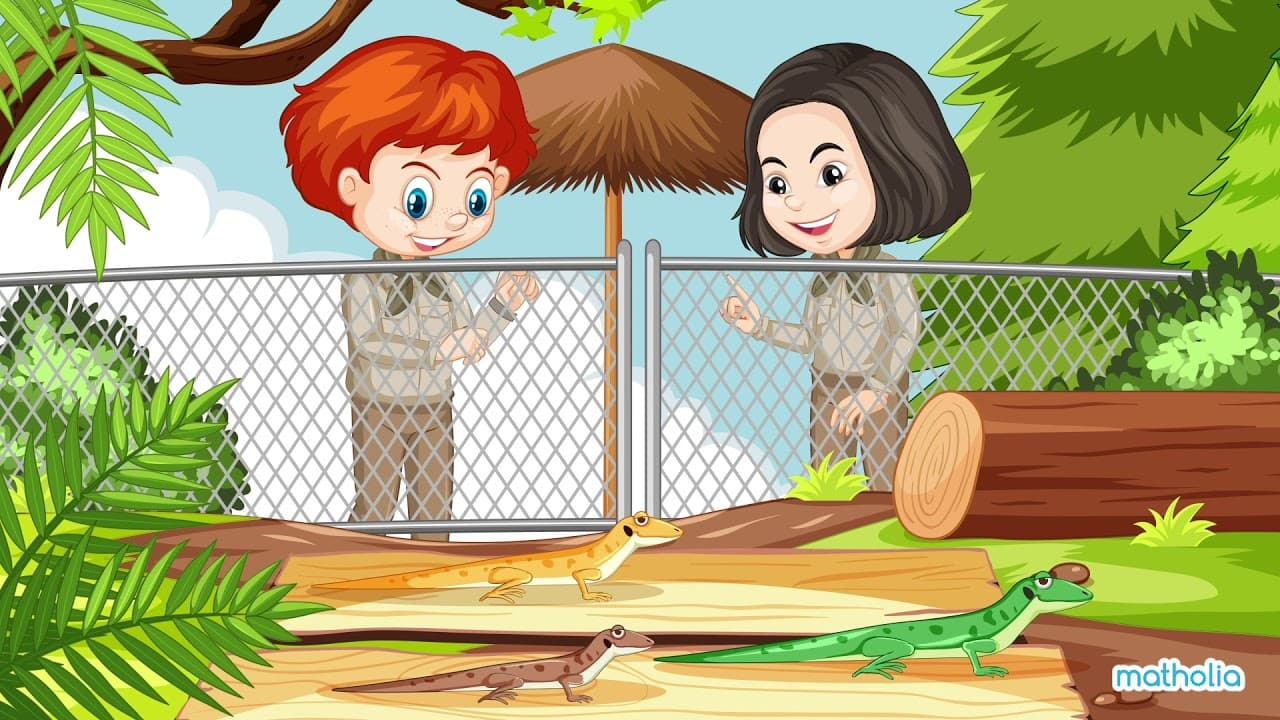
This animated math video introduces young learners to the concepts of comparing lengths through a fun visit to a zoo reptile park. Follow characters Michelle and Wyatt as they observe various reptiles—snakes, crocodiles, and lizards—and determine which animals are longer, shorter, longest, or shortest. The video uses clear visual aids, such as dotted alignment lines, to demonstrate how to properly compare objects by lining up their endpoints. The content focuses on core early measurement vocabulary, specifically comparative adjectives (longer, shorter) and superlative adjectives (longest, shortest). By progressing from comparing two items to ordering three items, the video scaffolds learning in a developmentally appropriate way for early childhood education. It visualizes abstract concepts of measurement using concrete, engaging animal examples that capture children's interest. For educators, this video serves as an excellent hook for a unit on measurement and data. It provides a visual model for direct comparison, a foundational skill that precedes using non-standard or standard units of measure. Teachers can use the pause points where questions are asked to facilitate class discussion, allowing students to predict answers before the visual proof is shown, thereby encouraging active participation and critical thinking.
MatholiaChannelMatholiaChannel

2mins 9s

How the Metric System Works and Why We Use It

How the Metric System Works and Why We Use It

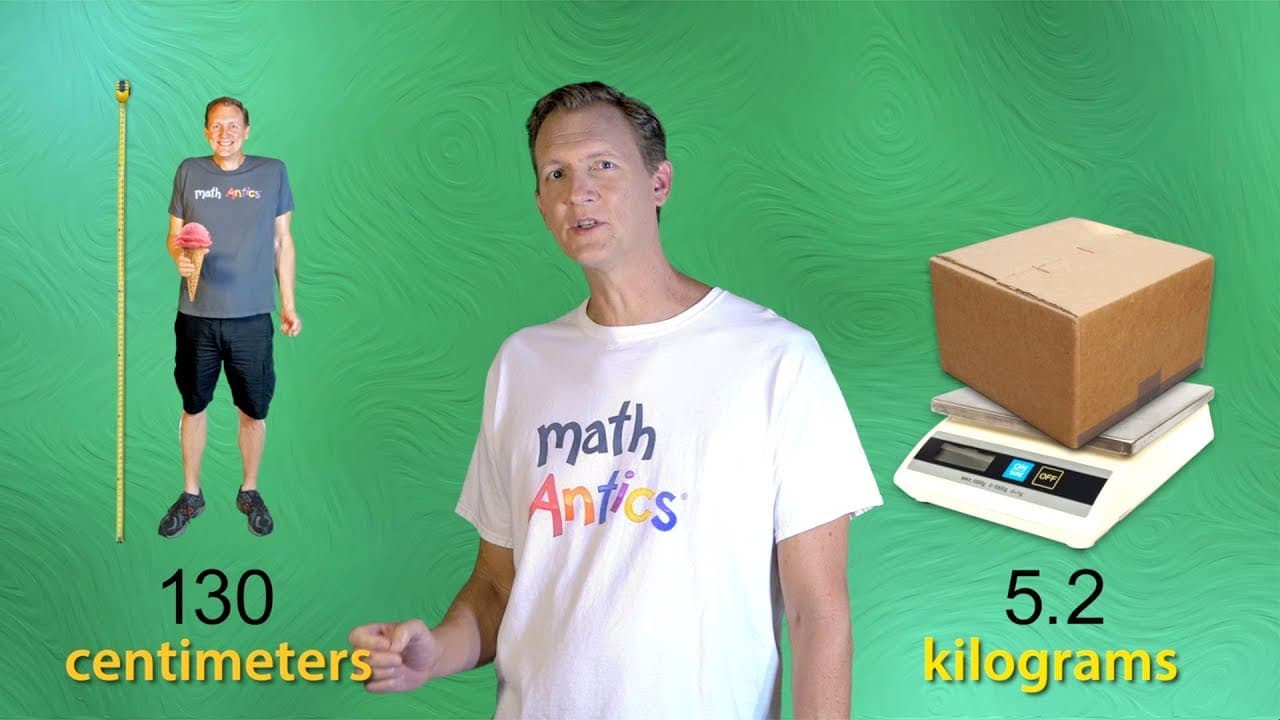
This engaging video introduces students to the fundamental concepts of measurement and the International System of Units (SI), commonly known as the Metric System. It begins by explaining why standardized measurement is necessary for accurate communication, using humorous non-standard examples like hot dogs and donuts to illustrate the chaos of subjective measurement. The host, Rob, clarifies the difference between qualitative descriptions (tall, heavy) and quantitative measurements (130 cm, 5.2 kg). The core of the video breaks down the logical structure of the Metric System, highlighting its relationship to the base-10 number system. Through clear animations and charts, it explains the standard prefixes (kilo-, hecto-, deka-, deci-, centi-, milli-) and demonstrates how to convert between units simply by moving the decimal point. Specific examples are provided for both length (meters) and mass (grams), showing the consistent application of these prefixes across different physical properties. Teachers can use this video to launch units on measurement in both math and science classrooms. It effectively demystifies unit conversion, a common pain point for students, by visualising it as a simple shift of the decimal place rather than complex multiplication or division. The video also touches briefly on time measurement and the distinction between commonly used units (like centimeters and kilometers) versus theoretical ones (like decameters), helping students focus on the most practical applications.

mathanticsmathantics

10mins 51s

Estimating Lengths Using Reference Units

Estimating Lengths Using Reference Units

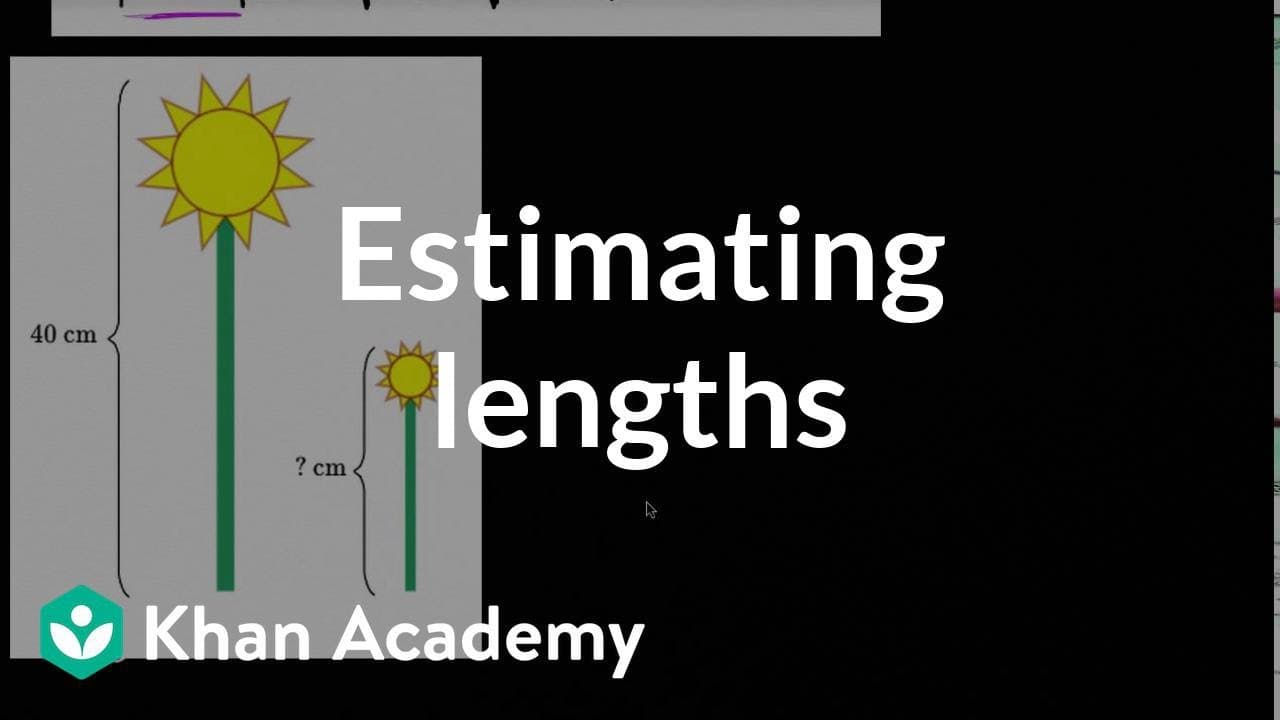
This educational video introduces young students to the concept of estimating lengths using visual reference points. The narrator demonstrates two distinct strategies for estimation: iterating a known unit (like an inch) to measure a longer object, and using proportional reasoning (identifying half-measures) to deduce the height of a smaller object based on a larger one. The video utilizes simple, colorful digital illustrations to make abstract measurement concepts concrete and accessible.

Khan AcademyKhan Academy

2mins 2s

Finding Circumference Using Diameter and Pi

Finding Circumference Using Diameter and Pi

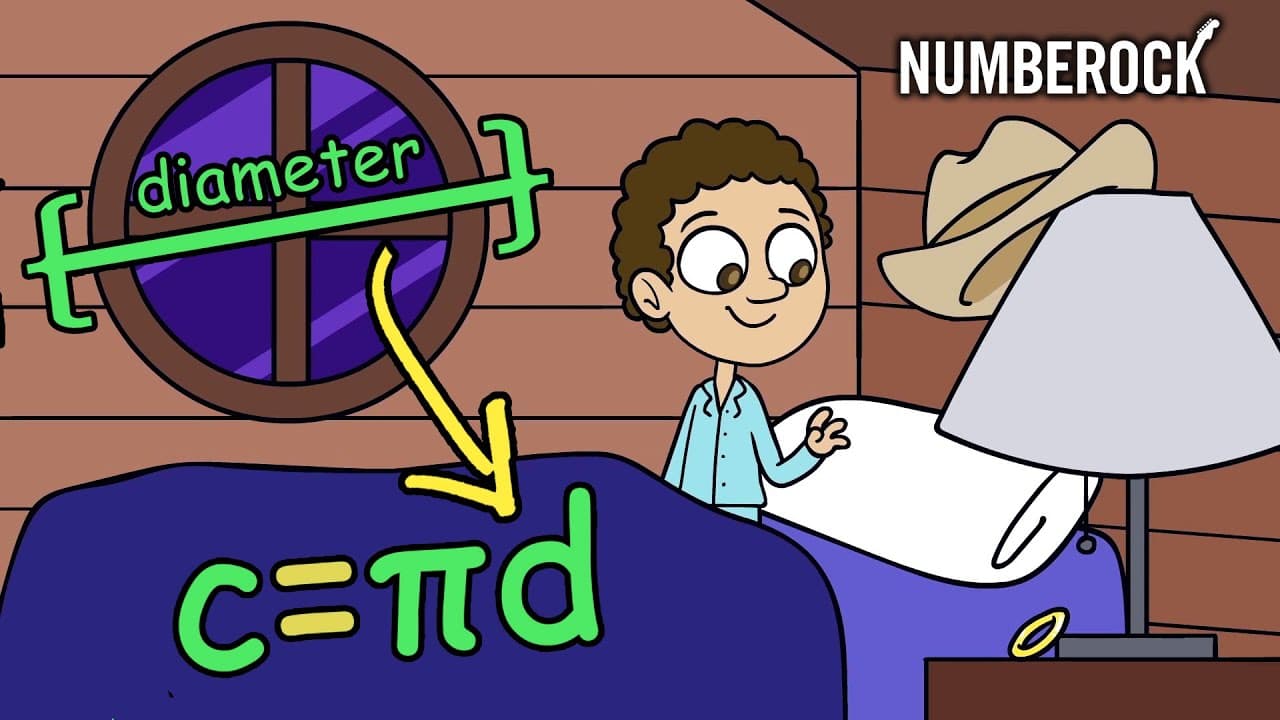
A musical animated narrative featuring a cowboy character who explores the mathematical relationship between the diameter and circumference of circles. Through a catchy country-style song, the video tells the story of the protagonist honoring a cut-down tree by creating a wreath and later fashioning a ring from a branch, using these activities to demonstrate how to calculate circumference. The content focuses specifically on the formula $C = \pi \times d$ (Circumference equals Pi times Diameter). It introduces key geometric terminology including circumference and diameter, while explaining the constant Pi ($\pi$) and reciting its digits to a rhythm. The video provides concrete examples of calculations, showing the math on-screen as the character measures real-world objects like a tree stump and a wooden ring. This resource is highly valuable for introducing or reinforcing geometry concepts in elementary and middle school classrooms. The musical mnemonic helps students memorize the formula, while the visual demonstrations provide a concrete understanding of abstract concepts. Teachers can use this to bridge the gap between measurement and calculation, showing practical applications of geometry in a fun, engaging format.

Math Songs by NUMBEROCKMath Songs by NUMBEROCK

3mins 28s

Materials

Number Line Champions Practice Pages

Number Line Champions Practice Pages

A premium, 4-page printable independent worksheet packet focused on place value, addition, subtraction, and multiplication using open number lines with a focus on feet and inches (US Customary units). It is designed around the 3rd Grade Bridges in Mathematics curriculum, utilizing an elegant blueprint-inspired visual layout with white, spacious drawing boxes for students' handwriting.

AJ

Alexander Jacinto

Math Master Anchor Charts

Math Master Anchor Charts

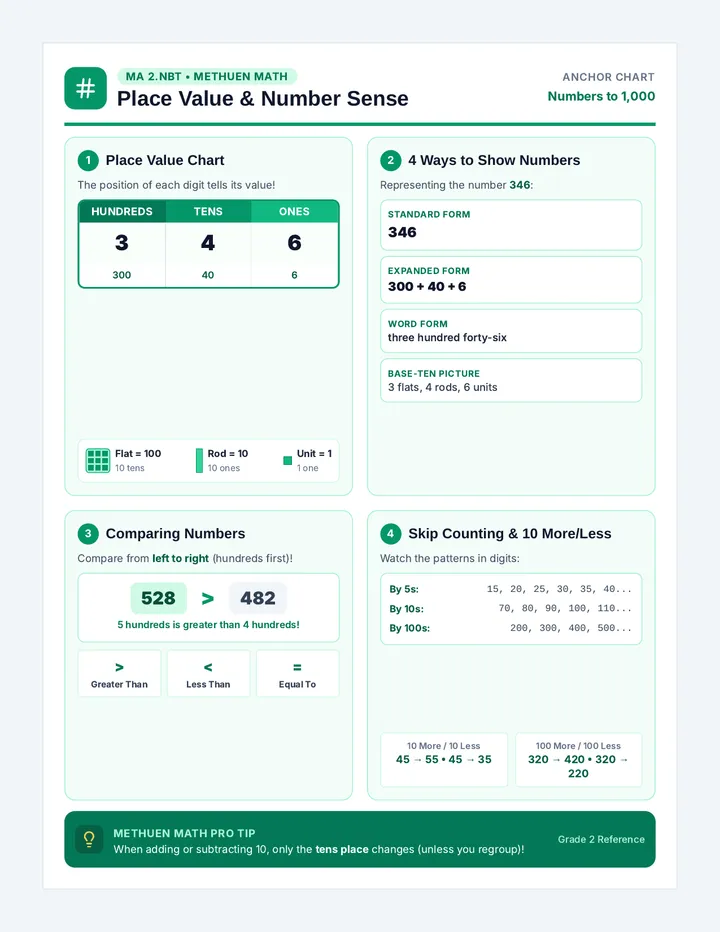
A comprehensive 4-page Grade 2 Math Anchor Chart reference collection aligned to Massachusetts standards for Methuen Public Schools, covering Number Sense (2.NBT), Operations (2.OA), Measurement and Data (2.MD), and Geometry and Fractions (2.G) for digital Google Classroom use and classroom printing.

S

snpierce

Plant Plotters Homework Upgrade

Plant Plotters Homework Upgrade

A double-sided homework worksheet for 2nd-grade students focusing on reading and creating line plots using plant height data. Includes a botanical theme with clear diagrams, a data table, and structured questions. Modified to provide more space for drawing line plots on page 2.

A

adaniels

Standards Correlation Guide

Standards Correlation Guide

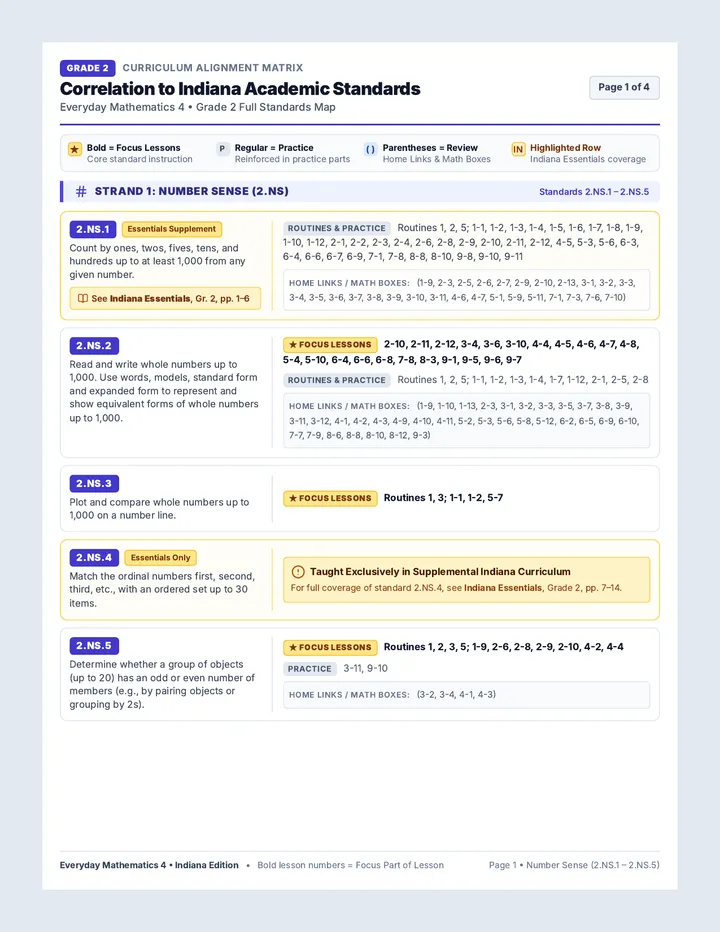
A comprehensive, easy-to-follow correlation guide mapping Grade 2 Indiana Academic Standards for Mathematics to Everyday Mathematics 4 lessons, clearly distinguishing Focus lessons, ongoing practice, Math Boxes, and Indiana Essentials supplements.

CG

Cecilia Goh

NSW Stage 1 Adapted Numeracy Program

NSW Stage 1 Adapted Numeracy Program

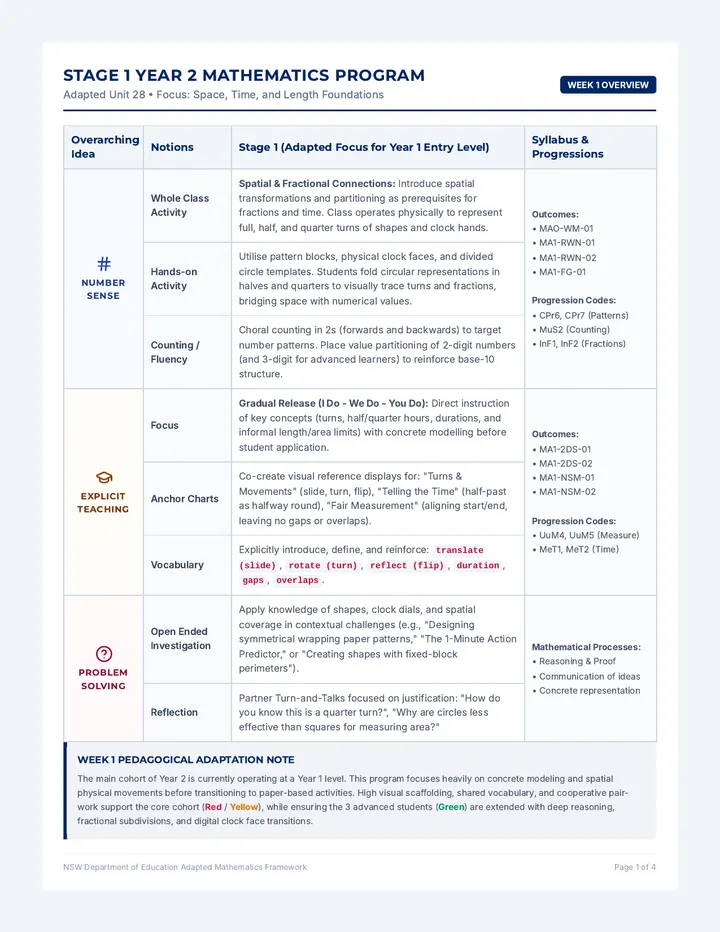
A highly detailed, 4-page NSW-aligned primary mathematics lesson program for Year 2 students performing at a Year 1 level, featuring explicit teaching strategies, gradual release of responsibility (I do, We do, You do), and differentiated pathways (Consolidate/Red, Build/Yellow, Stretch/Green) following the official blank scaffold format.

RD

Ruchelle Dawe

Measure Up Slideshow

Measure Up Slideshow

A 21-slide measurement presentation updated with 'clipart-style' graphics and perfect alignment. It includes a dashed reference line at the 'zero point' for all measurement questions to ensure students understand proper alignment for accurate results.

CG

Chelsea Guin

Sequences

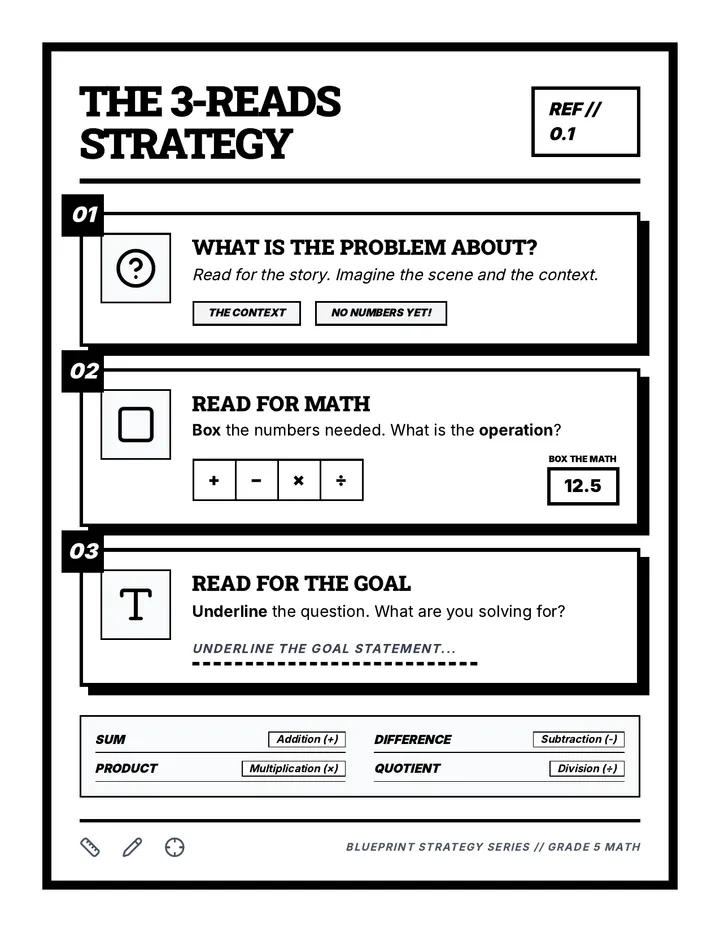
3 Reads Strategy Poster

Math Blueprints Grade 5

A comprehensive set of math supports for 5th-grade students in a co-taught environment. Each unit includes visual vocabulary, worked examples, cloze-style guided notes, and exit tickets featuring a 'Mistake of the Day' analysis.

HJ

Hope Joel

23
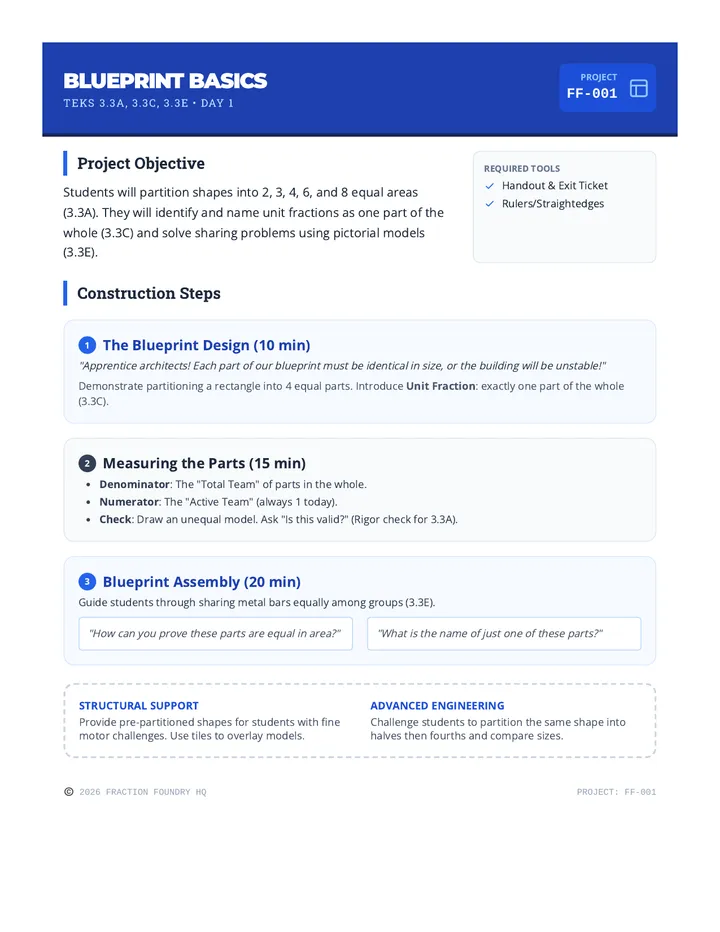
Blueprint Basics Teacher Guide

Fraction Foundry

A 5-day sequence on fraction fundamentals, including unit fractions, number lines, equivalent fractions, and comparison. Includes daily exit tickets and a final quick check.

MC

Melinda Cortez

23
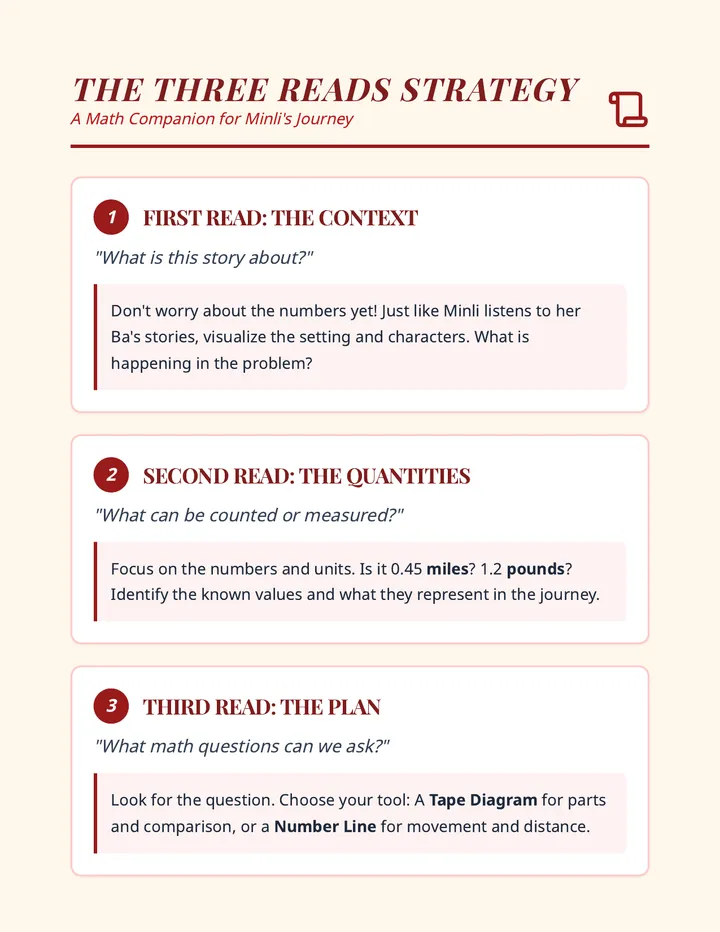
Three Reads Reference Sheet

Quest Mastery 4-Day Bridge

A 4-lesson intensive math intervention for 5th graders designed to bridge 4th-grade decimal foundations to 5th-grade mastery. Features the Three Reads strategy and mental math logic (Counting Up, Matching Units) themed around 'Where the Mountain Meets the Moon'.

K

kthompson

21
Equivalent Essentials Plan

Fraction Frontiers

A comprehensive 12-lesson Tier 2 intervention sequence for 5th-grade fractions. Following ALN High Leverage Concepts and IM methods, this unit covers equivalent fractions, addition, subtraction, multiplication, and division of fractions using visual models and conceptual strategies.

D

dfredericks

36
Customary Unit Lab Worksheet

Length Lab Masters

A comprehensive set of measurement resources for 2nd grade students to master inches, feet, centimeters, and meters. Students will practice selecting appropriate units, estimating lengths, and choosing the right tools for various objects.

A

adaniels

10
Inch Investigators Slides

Zero Hero Measurement

A two-part measuring adventure where students join the Zero Hero Academy to master measuring in inches and centimeters, with a strong focus on aligning the start of objects with the ruler's zero mark.

A

amber.sisemore

8

Lessons

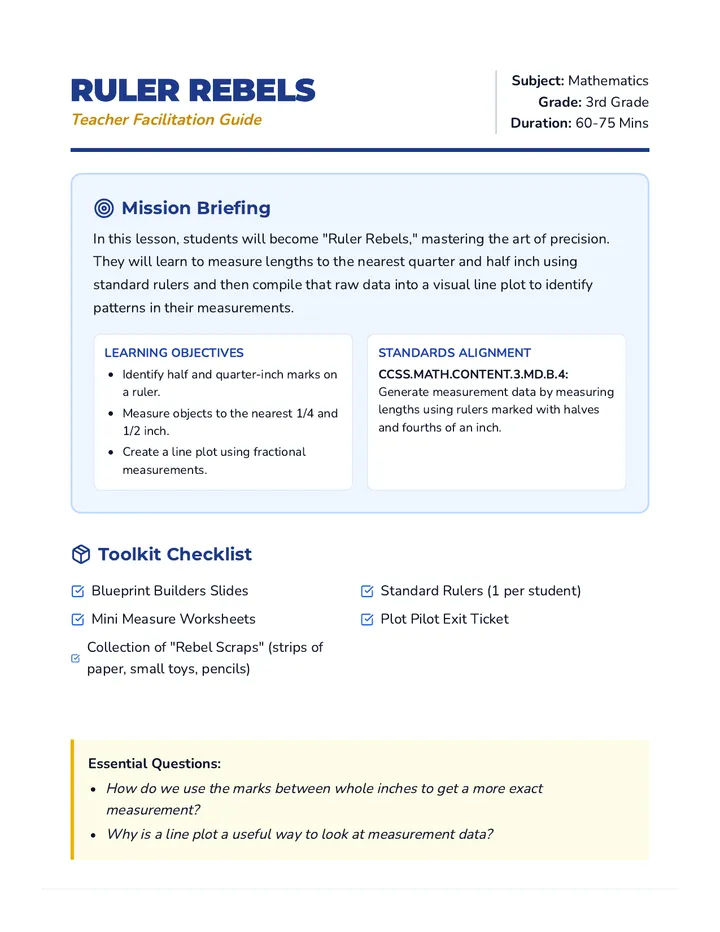
Ruler Rebels Lesson Plan

Ruler Rebels

A comprehensive lesson teaching 3rd-grade students how to measure objects to the nearest half and fourth inch and represent that data on a line plot. Students will transition from hands-on measurement to data visualization.

DP

Deana Padgett

5
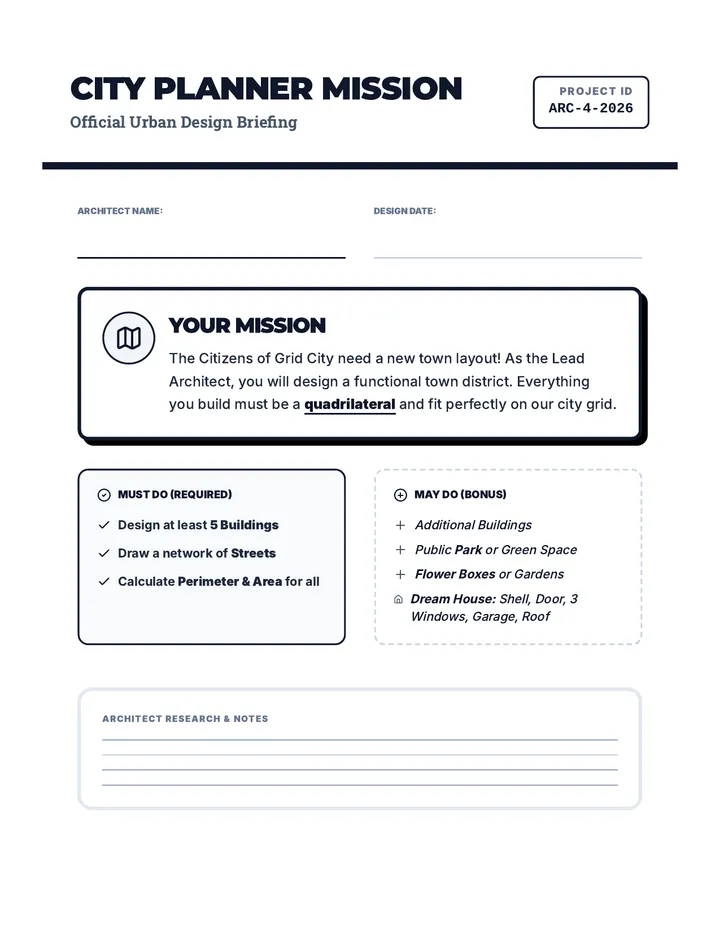
City Planner Mission Guide

Grid City Architects

Students act as urban architects to design a town using quadrilaterals on a grid, calculating perimeter and area for their structures.

TC

Tracey Craft

5
Precision Blueprint Slides

Measurement Blueprint

A comprehensive lesson on 3.MD.4 focusing on measuring to the nearest quarter inch and displaying that data on a line plot. Students measure their hand lengths to generate authentic data for analysis.

KB

Krista Bodkin

5
Bubble Lab Facilitator Guide

Bubble Math Lab

An outdoor, hands-on math and science lesson where students use bubble solution to explore measurement, geometric shapes, and counting through guided inquiry and play.

P

powellhuntr

4
Number Ninja Worksheet

Math Mastery Review Pack

A comprehensive end-of-year math review for 1st grade students, aligned with Illinois Learning Standards. The lesson covers all major domains including Operations, Base Ten, Measurement, and Geometry through minimalist, high-legibility worksheets.

C

cbradley

5
Problem Marathon Handout

Operation Math Mastery

A collection of STAAR-aligned multi-step word problems for 4th-grade math, focusing on multiplication, division, fractions, and decimals using the RDW (Read, Draw, Write) strategy.

MC

Melinda Cortez

4