NSW Stage 1 Adapted Numeracy Program
Stage 1 Year 2 Mathematics Program
Adapted Unit 28 • Focus: Space, Time, and Length Foundations
WEEK 1 OVERVIEW
| Overarching Idea | Notions | Stage 1 (Adapted Focus for Year 1 Entry Level) | Syllabus & Progressions |
|---|
| | | |
| Number Sense | | | |
| Whole Class Activity | Spatial & Fractional Connections: Introduce spatial transformations and partitioning as prerequisites for fractions and time. Class operates physically to represent full, half, and quarter turns of shapes and clock hands. | Outcomes:
• MAO-WM-01
• MA1-RWN-01
• MA1-RWN-02
• MA1-FG-01
Progression Codes:
• CPr6, CPr7 (Patterns)
• MuS2 (Counting)
• InF1, InF2 (Fractions) |
| Hands-on Activity | Utilise pattern blocks, physical clock faces, and divided circle templates. Students fold circular representations in halves and quarters to visually trace turns and fractions, bridging space with numerical values. |
| Counting / Fluency | Choral counting in 2s (forwards and backwards) to target number patterns. Place value partitioning of 2-digit numbers (and 3-digit for advanced learners) to reinforce base-10 structure. |
|
Explicit Teaching
| Focus | Gradual Release (I Do - We Do - You Do): Direct instruction of key concepts (turns, half/quarter hours, durations, and informal length/area limits) with concrete modelling before student application. | Outcomes:
• MA1-2DS-01
• MA1-2DS-02
• MA1-NSM-01
• MA1-NSM-02
Progression Codes:
• UuM4, UuM5 (Measure)
• MeT1, MeT2 (Time) |
| Anchor Charts | Co-create visual reference displays for: "Turns & Movements" (slide, turn, flip), "Telling the Time" (half-past as halfway round), "Fair Measurement" (aligning start/end, leaving no gaps or overlaps). |
| Vocabulary | Explicitly introduce, define, and reinforce: translate (slide), rotate (turn), reflect (flip), duration, gaps, overlaps. |
|
Problem Solving
| Open Ended Investigation | Apply knowledge of shapes, clock dials, and spatial coverage in contextual challenges (e.g., "Designing symmetrical wrapping paper patterns," "The 1-Minute Action Predictor," or "Creating shapes with fixed-block perimeters"). | Mathematical Processes:
• Reasoning & Proof
• Communication of ideas
• Concrete representation |
| Reflection | Partner Turn-and-Talks focused on justification: "How do you know this is a quarter turn?", "Why are circles less effective than squares for measuring area?" |
Week 1 Pedagogical Adaptation Note
The main cohort of Year 2 is currently operating at a Year 1 level. This program focuses heavily on concrete modeling and spatial physical movements before transitioning to paper-based activities. High visual scaffolding, shared vocabulary, and cooperative pair-work support the core cohort (Red / Yellow), while ensuring the 3 advanced students (Green) are extended with deep reasoning, fractional subdivisions, and digital clock face transitions.
NSW Department of Education Adapted Mathematics Framework Page 1 of 4
Week 1 Daily Mathematics Register
Gradual Release of Responsibility (GRR) Model
TERM ___ / WEEK ___
| Program Element | Lesson 1: Shape Turns | Lesson 2: Clock Fractions | Lesson 3: Event Duration | Lesson 4: How Long? | Lesson 5: Let's Cover Area |
|---|
| **Learning Intention & | | | | | |
| Success Criteria** | | | | | |
Core Concept:
How shape, space, or scale relate to standard measures. | LI: Understand position, turn and orientation.
SC: Rotate and flip shapes to build a visual pattern.
Core Concept: Turning or translating a shape changes its position, not its structure or scale. | LI: Relate turns of a circle to clock faces.
SC: Fold a circle to mark half-past and quarter-past.
Core Concept: Fractional subdivisions represent blocks of elapsed time on a clockface. | LI: Measure time duration using seconds/minutes.
SC: Sequence daily activities from short to long.
Core Concept: Seconds, minutes and hours allow us to order non-spatial events. | LI: Measure length with informal uniform units.
SC: Line up cubes end-to-end to find length.
Core Concept: Measurement units must be identical and laid end-to-end with no gaps. | LI: Measure area using square units.
SC: Cover a shape with tiles to find the total space.
Core Concept: Area requires covering a 2D surface with tessellating units. |
| Counting / Fluency
Differentiated warm-ups |
Red: Count by 2s to 20 with number line.
Yellow: Count by 2s from 6 to 30 on whiteboards.
Green: Count by 2s off-decade (e.g. 1, 3, 5...).
|
Red: Read digit cards 1-50; build with MAB blocks.
Yellow: Partition 2-digit numbers on a place-value grid.
Green: Model 3-digit cards using expanded notation.
|
Red: Count backward from 20 with number line.
Yellow: Count backward by 10s from 100 to 0.
Green: Backward 10s off-decade (e.g. 93, 83, 73...).
|
Red: Show friends to 10 on tens-frames.
Yellow: Add 1-digit numbers by counting on.
Green: Recall additions to 20; solve subtracts.
|
Red: Sort blocks into even pairs (up to 12).
Yellow: Count in 5s to 50 on hundreds grid.
Green: Build and count a 5x5 array on whiteboards.
|
| Explicit Teaching (GRR)
I Do: Direct Instruction
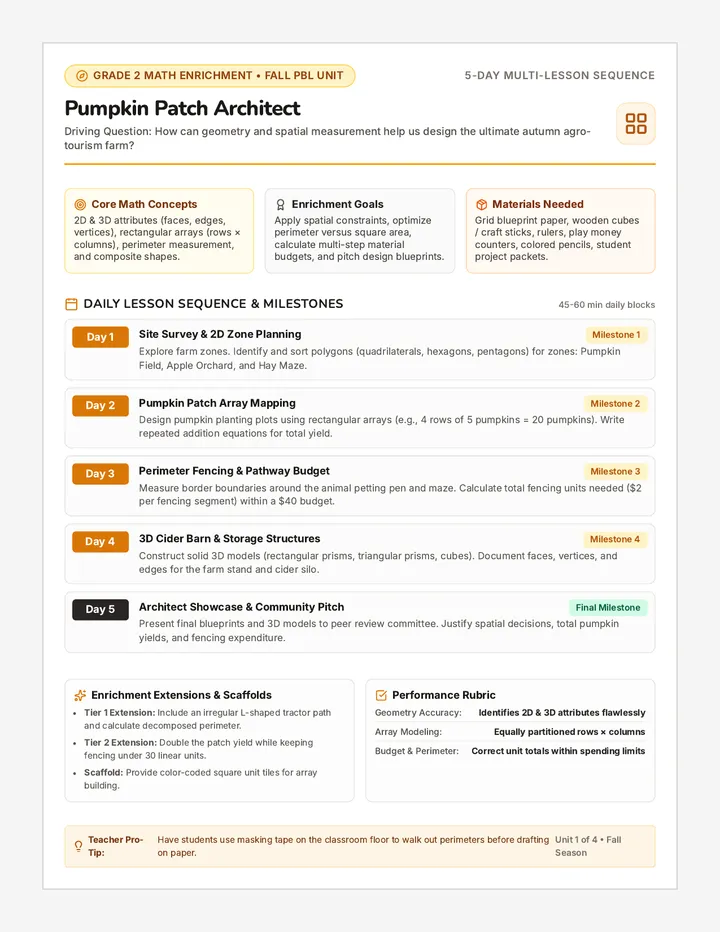
We Do: Guided Scaffold | I Do: Move a wooden triangular block. Model slide, turn (quarter/half), and flip on the board. Point out that the shape has not resized.
We Do: Hand out whiteboards. Draw a smiley face. Ask students to copy and mimic motions called out by teacher (e.g. "turn clockwise!"). | I Do: Show an analog clock. Connect a 1/2 turn to the minute hand pointing to the 6 (half-past). Connect 1/4 turn to the 3 (quarter-past).
We Do: Give clock templates. Guide students to draw a red line from 12 to 6, coloring half the circle, and a blue line to 3, coloring a quarter. | I Do: Set a timer. Clap hands for 5 seconds. Model jumping on spot for 1 minute. Define duration: "how long an event takes."
We Do: Ask students to estimate: "Which takes longer: drinking water or sleeping?" Write ideas on anchor chart under seconds vs. hours. | I Do: Model measuring a textbook. Intentionally leave gaps and overlaps. Ask: "Is this fair?" Show correct alignment from exact edge.
We Do: Distribute linking blocks. Guide student pairs to measure a pencil case together, checking alignment and counting cubes. | I Do: Try to cover a square sheet of paper with circles (pointing out gaps) and then with square tiles (no gaps). Introduce tessellate.
We Do: Guide the class to count a row of 4 square tiles on a card. Model adding a second row of 4 to introduce the basic grid layout. |
| You Do Activities
Consolidate (Red)
Build (Yellow)
Stretch (Green) |
Match wooden blocks to a pre-printed template by sliding and rotating without flipping.
Fold card in thirds; stamp sponge designs in distinct rows using slide, turn, and flip patterns.
Create a complex, turning quarter-turn sequence of geometric stamps; verify and correct a partner's path.
|
Fold a paper circle into 2 halves. Cut on fold. Glue onto clock base to show half-past.
Fold a circle into quarters. Label quarters and paste onto clock to show quarter-past and half-past.
Build analog representation of quarter-to; write digital format (:45) and describe hour hand position.
|
Sort pictures of 6 daily activities into "Fast Time" (seconds) vs "Slow Time" (hours) bins.
Complete and color stopwatch strips (Resource 5) to show activity time rounded to nearest minute.
Calculate durations and sequence complex multi-step events on a timeline showing hours and minutes.
|
Measure lines under 10cm using physical blocks; write the final count in provided empty boxes.
Measure a series of school supplies with cubes, ensuring start/end are perfectly aligned.
Use a single cube iteratively to measure long distances; estimate first and describe the leftover piece.
|
Cover a 4x4cm card with square plastic tiles; count to find the total area with close teacher supervision.
Cover a rectangle template; write down rows, columns, and area (e.g. "2 rows of 5 = 10 units").
Calculate the area of a partially tiled grid by drawing grid lines with a ruler and multiplying.
|
| Problem Solving &
Reflection | Problem: Does flipping a shape upside down change its color or size? Prove it physically.
Reflection: Which of the turns was easiest to repeat? | Problem: How many quarters can fit inside a whole circle clock? Let's check with physical pieces.
Reflection: Explain quarter-past using a circle. | Problem: If a task takes 60 seconds, did it take longer or shorter than a single minute?
Reflection: Why does our classroom need clocks? | Problem: If I use big blocks and you use small ones, who will need more blocks to measure the desk?
Reflection: What is a measurement mistake? | Problem: Can we cover a book with circular counters without leaving space? Why?
Reflection: Why do we use square tiles for area? |
NSW Department of Education Adapted Mathematics Framework Page 2 of 4
Stage 1 Year 2 Mathematics Program
Adapted Unit 28 • Focus: Advanced Length, Area, Volume, and Capacity
WEEK 2 OVERVIEW
| Overarching Idea | Notions | Stage 1 (Adapted Focus for Year 1 Entry Level) | Syllabus & Progressions |
|---|
| | | |
| Number Sense | | | |
| Whole Class Activity | Scale & Estimation: Transitioning from 2D area structures to 3D volume construction. Introduce estimation strategies as active problem solving, using benchmark quantities (e.g. towers of 10 or small cup limits). | Outcomes:
• MAO-WM-01
• MA1-RWN-01
• MA1-RWN-02
• MA1-FG-01
Progression Codes:
• CPr7 (Groups & scale)
• NPV5 (Place value)
• MuS5, MuS6 (Multiplication & division) |
| Hands-on Activity | Students manipulate wooden cubes, measuring cups, and containers of varied geometric profiles. Comparing capacities directly by transferring liquids/grains and building prisms from identical volume sets. |
| Counting / Fluency | Skip counting by 5s and 10s to find total elements in arrays and volume structures. Place value partitioning utilizing hundreds, tens, and ones blocks for 3D structures (MAB castles). |
|
Explicit Teaching
| Focus | Structure of Units: Modeling the inverse relationship between unit size and quantity needed (e.g. large cup needs fewer scoops than a small cup). Connect rows/columns to multiplicative arrays. | Outcomes:
• MA1-GM-01
• MA1-GM-02
• MA1-GM-03
• MA1-3DS-01
• MA1-3DS-02
Progression Codes:
• UuM2, UuM3 (Informal)
• NPV6 (Estimation) |
| Anchor Charts | Co-create charts for: "Volume & Capacity" (defining volume as space inside vs outside), "Array Math" (Rows & Columns skip counting), "The Unit-Size Rule" (larger units mean smaller counts). |
| Vocabulary | Target and build vocabulary: volume, capacity, rectangular prism, array, estimation, inverse scale. |
|
Problem Solving
| Open Ended Investigation | Challenges involving complex physical construction: "How many different buildings can we make with 24 blocks?", "Measuring capacity when the measurement container changes size." | Mathematical Processes:
• Physical pattern building
• Comparative reasoning
• Collaborative debate |
| Reflection | Focus questions on scaling: "Why did the mug fill the bottle faster than the tiny drinking cup?", "How can two structures look totally different but contain the same number of blocks?" |
Week 2 Pedagogical Adaptation Note
In Week 2, students move to 3D measures. Since many students struggle with abstract visual spatial reasoning, we utilize concrete 3D materials (wooden blocks, continuous media like dry rice/water). High teacher scaffolding helps build the bridge to division/multiplication concepts for the Red group, while the Green group students explore proportional reasoning, such as calculating volume with length-width-height variables.
NSW Department of Education Adapted Mathematics Framework Page 3 of 4
Week 2 Daily Mathematics Register
Gradual Release of Responsibility (GRR) Model
TERM ___ / WEEK ___
| Program Element | Lesson 6: Length Relations | Lesson 7: Area & Arrays | Lesson 8: Volume & Prisms | Lesson 9: Capacity Jars | Lesson 10: Unit Relations |
|---|
| **Learning Intention & | | | | | |
| Success Criteria** | | | | | |
Core Concept:
Using scaling, packing, and pouring to compare spaces. | LI: Represent double, triple, and half length.
SC: Build block towers to model relative lengths.
Core Concept: Lengths can be scale-multiplied (double) or partitioned (halved). | LI: Understand rows & columns in area.
SC: Build and count tile grids to find total area.
Core Concept: Grid structures help structure area count, preventing double-counting. | LI: Construct volume using 3D blocks.
SC: Build prisms and count blocks to find space.
Core Concept: Volume represents 3D space; shape can change while block-count stays fixed. | LI: Investigate capacity by filling vessels.
SC: Pour uniform material to measure bottle limits.
Core Concept: Capacity is internal volume; packing materials with no gaps is required. | LI: Relate unit size to total quantity.
SC: Compare scoops using a cup vs. a large mug.
Core Concept: Larger measuring units require fewer iterations to fill a container. |
| Counting / Fluency
Differentiated warm-ups |
Red: Find halves of shapes (visual templates).
Yellow: Share collections of up to 10 blocks into 2 groups.
Green: Show halves and quarters of 20 counters.
|
Red: Skip count by 2s to 20 using arrays.
Yellow: Skip count by 5s to 50 on classroom grid.
Green: Skip count by 3s to 30 on empty boards.
|
Red: Count to 30; read 2-digit number cards.
Yellow: Partition numbers using tens & ones blocks.
Green: 3D MAB castle values: count hundreds, tens, ones.
|
Red: Pair matching of friends to 10.
Yellow: Write number sentences adding to 10.
Green: Solve word addition/subtraction problems.
|
Red: Roll a die; count out that many counters.
Yellow: Partition collections of 12 into equal groups.
Green: Model equal divisions with remainders.
|
| Explicit Teaching (GRR)
I Do: Direct Instruction
We Do: Guided Scaffold | I Do: Hold a 4-cube tower. Show a tower that is double (8) and one that is half (2). Explain the physical scaling process.
We Do: Hand out cubes. Ask students to make a tower of 6. Have them partition it to find half. Add another 6 to show double. | I Do: Show an array drawing of 3 rows of 4 square tiles. Point out how grid lines help keep the calculation ordered.
We Do: Give students 12 counters. Help them align counters into 2 rows of 6. Practice skip counting rows together ("6, 12!"). | I Do: Build a 2x3 grid block building (height of 1). Point out volume is 6 cubes. Add another level to show volume doubles to 12.
We Do: Guide pairs to build a 3-block line, then triple it to create a flat building of 9 blocks. Count blocks to find volume. | I Do: Fill a bottle with dry marbles (gaps) vs sand (no gaps). Explain why gapless packing provides an accurate capacity measure.
We Do: Show containers A and B. Guide class to estimate which holds more. Pour water from cup to verify, counting scoops. | I Do: Fill a glass with a small coffee spoon, then with a soup ladle. Count. Show why larger scoopers need fewer repetitions.
We Do: Give student pairs a cup, a large mug, and a jar. Guide them to scoop rice and record counts, showing inverse scaling. |
| You Do Activities
Consolidate (Red)
Build (Yellow)
Stretch (Green) |
Given a 2-cube tower, build a "double" tower (4) and "half" tower (1) with close guidance.
Given a 4-cube tower, build double (8), triple (12) and half (2) towers, recording length.
Model double, triple and quadruple lengths; draw a bar-graph representation in journals.
|
Fill pre-drawn grids (Resource 7) with counters to complete simple 2x3 patterns.
Construct and count a 3x5 array; write down repeated addition sentence (5 + 5 + 5 = 15).
Draw arrays for a fixed 24-counter set on grid paper; analyze column remainders.
|
Build basic 3D rectangular columns (up to 8 blocks); count blocks to find total volume.
Build different rectangular prisms using exactly 12 blocks, drawing the designs in books.
Use 24 blocks to discover and list all possible 3D prism factor shapes (e.g. 2x3x4 vs 1x2x12).
|
Fill plastic bottles using a medicine cup; count up-to-10 scoops to determine capacity.
Measure capacity of jars with water, comparing dry marble capacity and water capacity.
Compare and order 3 complex-shaped vessels; explain why height can mislead visual capacity.
|
Compare scoops directly: discover that the big blue cup fills the jar faster than the red cup.
Formulate the rule: "The larger the unit, the fewer scoops needed." Test with cups/mugs.
State proportional rules (e.g., "If Mug is 2x larger than Cup, we need exactly half as many Mugs").
|
| Problem Solving &
Reflection | Problem: If a tower is 10 blocks tall, how tall is half a tower? Build it to check.
Reflection: When do we double lengths? | Problem: Can we build a 3x3 array using 10 counters? Why or why not?
Reflection: How do rows help us skip count? | Problem: Do two different block shapes have the same volume if they both use 12 cubes?
Reflection: Explain volume to a friend. | Problem: Why does sand fill gaps between marbles? What does this mean for accuracy?
Reflection: What unit is best for bottles? | Problem: If we use giant buckets to fill a tub, do we scoop more or fewer times?
Reflection: State the Unit-Size rule. |
NSW Department of Education Adapted Mathematics Framework Page 4 of 4