Lenny.com
Explore
Create
ActivitiesNewMathEnglish Language ArtsScience & EngineeringSocial StudiesGlobal LanguagesHealth & Physical EducationSpecial EducationCounseling & Life SkillsArts & CreativityESL
Lenny.com
Lenny.com
Explore
Create
ActivitiesNewMathEnglish Language ArtsScience & EngineeringSocial StudiesGlobal LanguagesHealth & Physical EducationSpecial EducationCounseling & Life SkillsArts & CreativityESL
Lenny.com
Lenny.com

Solutions

Lenny for EducatorsLenny for SchoolsLenny for Districts

Product

ExploreSign inCreateSupportAbout

Resources

Getting startedMTSS Acceleration Program

© 2026 Lenny Learning Inc.

TermsPrivacyAccessibility
LinkedInInstagramX
Lenny

Measurement Unit Conversions

Mathematical processes for switching between metric and customary units of length, mass, and volume. Emphasizes conversion factors, dimensional analysis, and real-world application.

MathNumbers & CountingCounting ObjectsNumber NamesComparing NumbersNumber OperationsCounting SequenceNumbers 0-10Place Value Understanding and SystemAdd and Subtract Within 20Addition and Subtraction ConceptsAddition and Subtraction EquationsAddition and Subtraction ProblemsFoundations for MultiplicationMultiplication and Division PropertiesMultiply and Divide Within 100Multiplication and Division ProblemsFactors and MultiplesProperties of OperationsPatterns and RelationshipsGenerate and Analyze PatternsMulti-Digit ArithmeticPlace Value OperationsMulti-Digit and Decimal OperationsNumerical ExpressionsFour Operations and PatternsFour Operations Problem SolvingMeasurement & DataMeasurable AttributesMeasuring LengthsMeasure and Estimate Lengths in Standard UnitsRelate Addition and Subtraction to LengthClassifying and Counting ObjectsTime and MoneyArea Concepts and MeasurementPerimeter and Area MeasuresAngle Concepts and MeasurementTime, Volume, and MassMeasurement Unit ConversionsGeometryIdentifying ShapesShapes and AttributesShape Attributes and ReasoningShapes and CompositionClassifying 2D FiguresGeometric Figures and RelationshipsLines, Angles, and ShapesAngle, Area, and VolumeGeometric MeasurementVolume of 3D ShapesCoordinate Plane ApplicationsTransformations in the PlaneCongruence and SimilarityUnderstand congruence in terms of rigid motionsSimilarity and TransformationsProve Theorems Involving SimilarityPythagorean TheoremTrigonometry for General TrianglesMake Geometric ConstructionsProve Geometric TheoremsTheorems About CirclesFind Arc Lengths And Areas of Sectors of CirclesVolume FormulasRelationships Between Two-Dimensional and Three-Dimensional ObjectsProve Simple Geometric Theorems AlgebraicallyTranslate Between Geometric Description and Equation for Conic SectionApply Geometric Concepts in Modeling SituationsFractions & DecimalsFractions as NumbersBuilding FractionsFraction Equivalence and OrderingAdding and Subtracting FractionsMultiplying and Dividing FractionsDividing FractionsDecimal FractionsMulti-Digit Computation and FactorsAdd, Subtract, Multiply, and Divide Rational NumbersRational Number SystemIrrational Numbers and ApproximationsRatiosRatios and ProportionsProportional RelationshipsUnit RateAlgebraAlgebraic ExpressionsGenerate Equivalent ExpressionsQuantitative RelationshipsProportional Relationships and Linear EquationsEquations and InequalitiesEquation Solving and ReasoningLinear Equations and SystemsGraph Equations and InequalitiesSystems of EquationsReal-World Algebraic ProblemsQuantitative Reasoning with UnitsExpression StructureEquivalent Expression FormsRadicals and Integer ExponentsRational ExponentsRational and Irrational NumbersPolynomial OperationsPolynomial IdentitiesPolynomial Zeros and FactorsRational ExpressionsComplex Number OperationsComplex Numbers in PolynomialsComplex Numbers on PlaneStatistics & ProbabilityRepresent and Interpret DataData DistributionsStatistical VariabilityProbability ModelsCompound Event ProbabilitiesStatistical SamplingInterpret Categorical and Quantitative DataBivariate Data PatternsInterpret Linear ModelsComparing Two PopulationsRandom Processes in StatisticsIndependence and Conditional ProbabilityExpected ValuesProbability-Based Decision MakingStatistical Inference and ConclusionsFunctionsFunction Concepts and NotationDefine and Compare FunctionsInterpret Functions in ContextAnalyze Function RepresentationsModel Relationships with FunctionsIdentify Linear vs Exponential GrowthDistinguish Between Function TypesCompare Growth RatesInterpret Function ExpressionsBuild Functions from RelationshipsConstruct and Model FunctionsTransform and Combine FunctionsModel Comparison and SelectionSolve Exponential EquationsTrigonometryTrigonometric Ratios Involving Right TrianglesTrigonometric Functions and Unit CircleModel with Trigonometric FunctionsTrigonometric IdentitiesVectors & MatricesIntroduction to Vectors and MatricesVector QuantitiesVector OperationsMatrix OperationsCalculusLimits and ContinuityDerivative Concepts and NotationDerivative Rules and TechniquesApplications of DerivativesOptimization ProblemsRelated RatesCurve Sketching and AnalysisIntegration Concepts and NotationAntiderivatives and Indefinite IntegralsDefinite Integrals and AreaFundamental Theorem of CalculusIntegration TechniquesApplications of IntegrationDifferential EquationsSequences and SeriesParametric and Polar FunctionsVector-Valued Functions

Videos

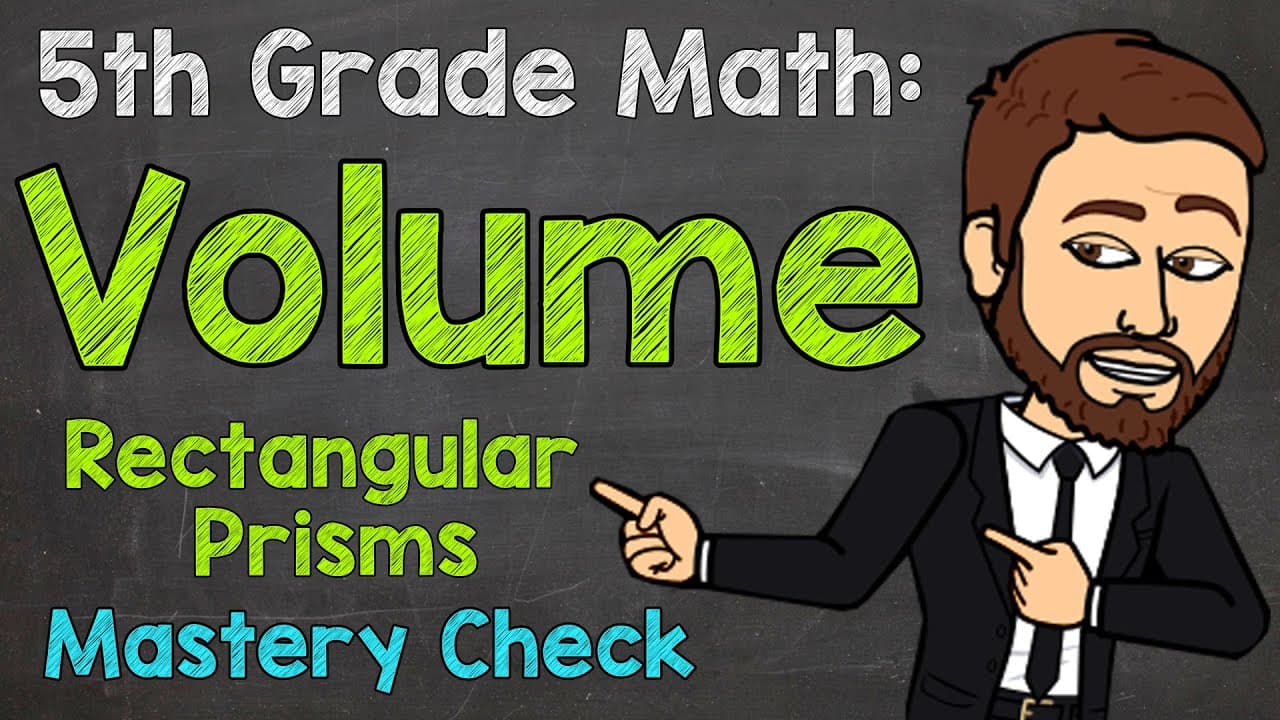
Practicing Volume of Rectangular Prisms

Practicing Volume of Rectangular Prisms

This video serves as a practical "Mastery Check" for students learning to calculate the volume of rectangular prisms. Designed as an interactive practice session, the video presents four distinct geometry problems involving 3D shapes with labeled dimensions. The narrator guides students through the process of pausing the video to solve the problems independently before revealing the step-by-step solutions for each one. The problems increase in complexity, starting with basic application of the volume formula and culminating in a challenging problem requiring unit conversion. The content focuses heavily on the application of the volume formula ($V = l \times w \times h$) and the importance of labeling answers with correct cubic units (e.g., cubic feet, cubic inches). A significant portion of the educational value lies in the fourth problem, which introduces the critical concept of dimensional consistency—teaching students that they cannot simply multiply numbers with different units (feet vs. inches) without converting them first. This addresses a common student error in measurement geometry. For teachers, this resource is an ideal formative assessment tool or independent practice station. It allows educators to quickly gauge whether students have moved beyond the initial acquisition of the volume concept and can apply it accurately. The clear, chalkboard-style visual presentation makes it easy for students to follow along, and the "pause and practice" format encourages active participation rather than passive viewing. It effectively bridges the gap between learning a formula and using it correctly in varied contexts.

Math with Mr. JMath with Mr. J

4mins 25s

Why Do We Have Two Ways to Measure Things?

Why Do We Have Two Ways to Measure Things?

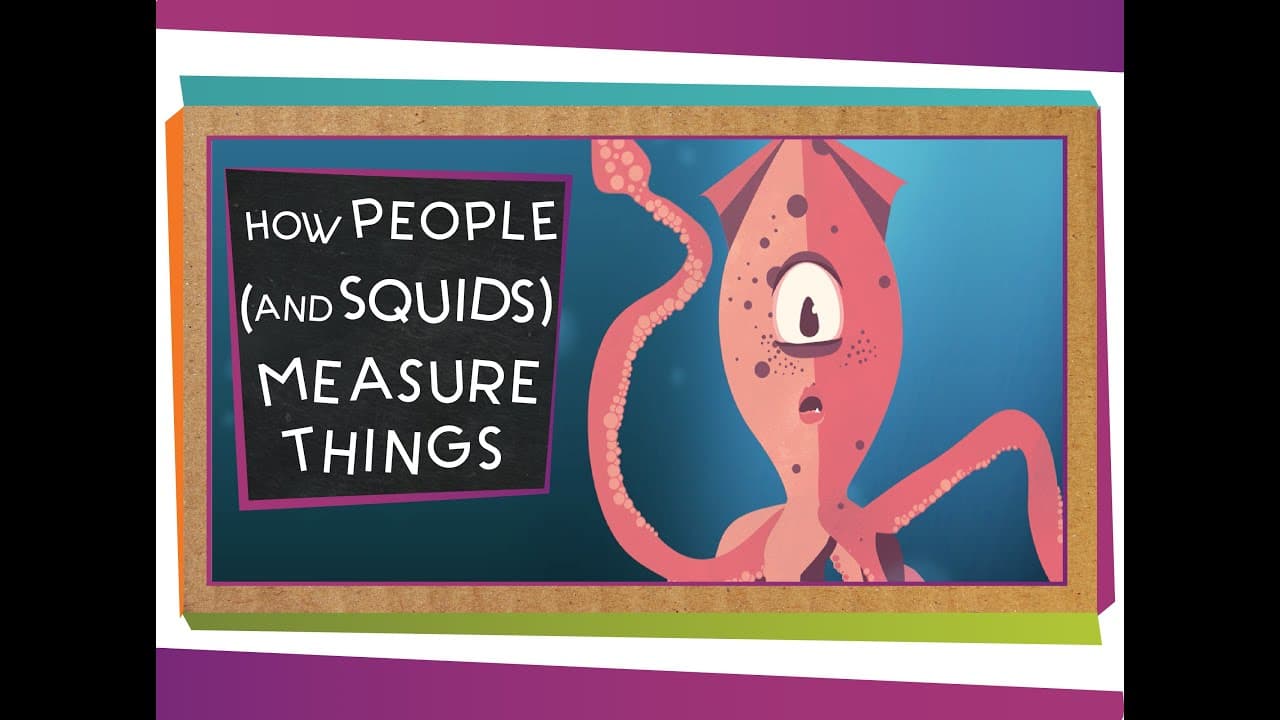
In this engaging episode of SciShow Kids, host Jessi and a special guest—a giant squid named Squipe—explore the confusing world of measurement systems. When Squipe calls to plan a visit, he is puzzled by the concept of a "mile," leading to a clear and child-friendly explanation of why the world uses different units to measure the same things. The video uses a helpful analogy comparing measurement systems to different languages, explaining that just as "Hello," "Hola," and "Bonjour" all mean the same thing, miles and kilometers are just different "languages" for distance. It specifically breaks down the differences between the Imperial System (used in the US) and the Metric System (used internationally and in science), providing concrete examples like rulers, race tracks, and soda containers. This resource is excellent for introducing early elementary students to the concept of standard units. It helps demystify why they might see "liters" on a big soda bottle but "ounces" on a small can, and sets a foundation for understanding scientific measurement. The friendly character interaction and clear visual aids make abstract concepts of distance and volume easy to grasp.

SciShow KidsSciShow Kids

3mins 6s

Converting Metric Units of Length Explained

Converting Metric Units of Length Explained

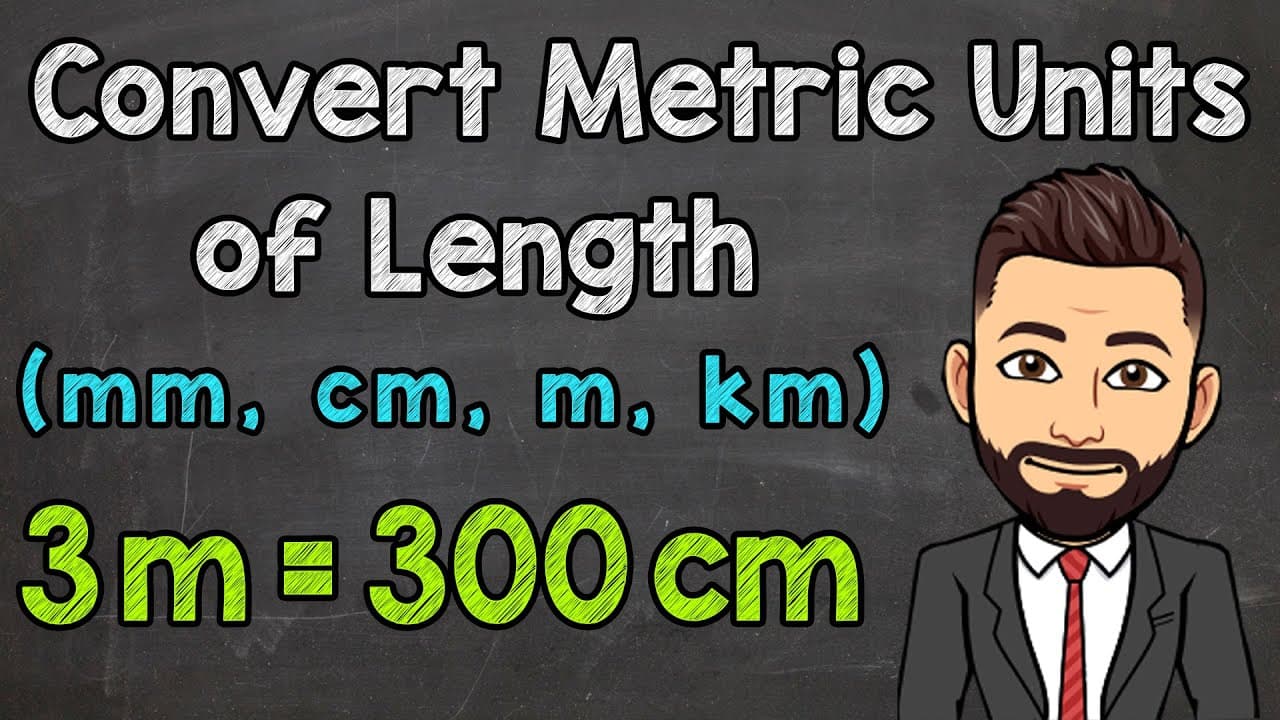
This instructional math video provides a clear and structured guide to understanding and converting metric units of length. The presenter, Mr. J, breaks down the four primary units—millimeter (mm), centimeter (cm), meter (m), and kilometer (km)—explaining the base unit of the meter and how prefixes define the relationship between them. He uses accessible real-world analogies, such as the thickness of a paperclip for a millimeter and the width of a pinky finger for a centimeter, to help students visualize these abstract measurements. The video covers key themes including the hierarchical structure of the metric system, the meaning of prefixes like "milli," "centi," and "kilo," and the mathematical processes required for conversion. It explicitly demonstrates when to multiply or divide by powers of ten (10, 100, 1000) based on whether one is converting from a larger unit to a smaller one or vice versa. The screen displays helpful reference keys that remain visible throughout the practice problems, reinforcing memorization. For educators, this video serves as an excellent tool for introducing measurement units or reinforcing conversion skills in upper elementary grades. It moves beyond simple rote memorization by connecting the math to physical benchmarks students can understand. Teachers can use this video to scaffold lessons on measurement, using the guided practice problems as a "pause and solve" activity to check for understanding before independent work.

Math with Mr. JMath with Mr. J

5mins 35s

Converting Customary Units of Length Explained

Converting Customary Units of Length Explained

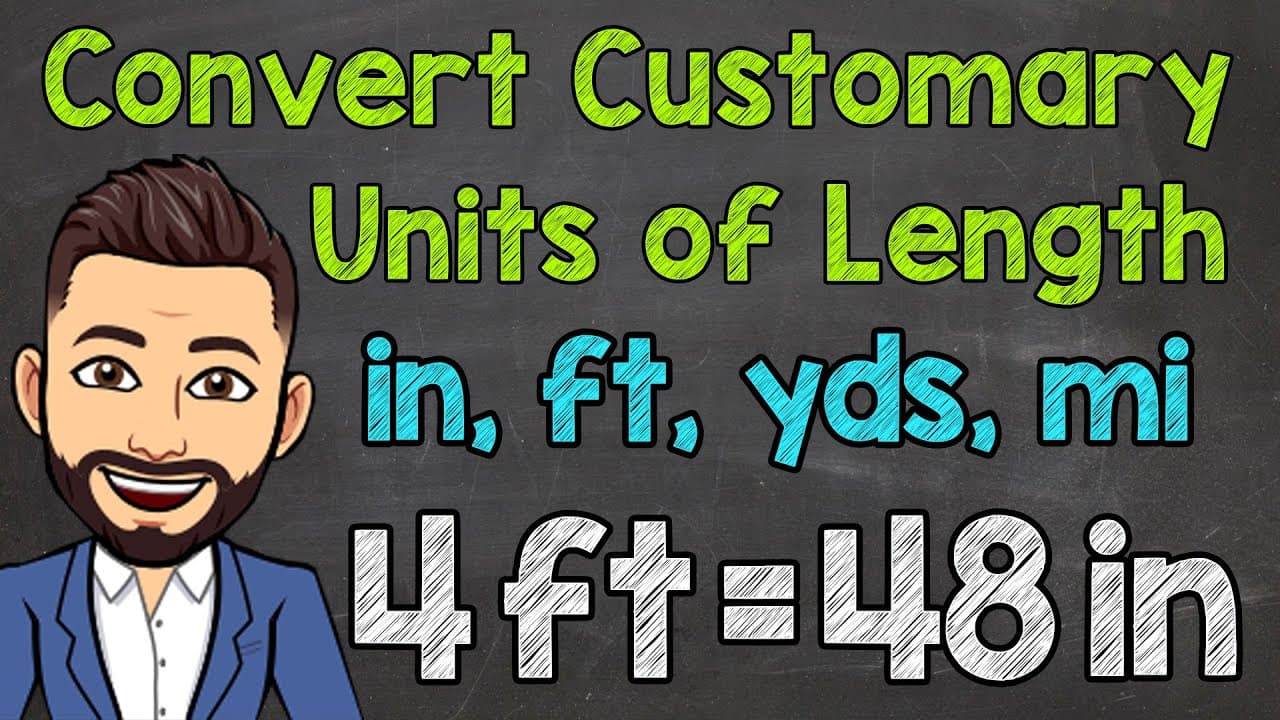
This instructional video provides a clear, step-by-step tutorial on converting customary units of length, specifically focusing on inches, feet, yards, and miles. The instructor, Mr. J, uses a digital chalkboard format to walk through eight distinct practice problems that demonstrate how to convert both from larger units to smaller units (using multiplication) and from smaller units to larger units (using division). A key feature of the video is the reference chart displayed at the top of the screen, which remains visible throughout the lesson to reinforce standard conversion factors like 12 inches in a foot and 5,280 feet in a mile. Key themes include understanding the relative size of different units and applying the correct mathematical operation based on the direction of conversion. The video explicitly teaches the logic that converting a larger unit (like a foot) to a smaller unit (like an inch) requires multiplication because you are creating more, smaller pieces. Conversely, it demonstrates using division when grouping smaller units into larger ones. Specific examples include simple calculations like 2 feet to inches, as well as larger number calculations involving miles. For educators, this video is an excellent resource for upper elementary math instruction. It serves as a strong model for how students should show their work, writing out the operation (x3 or ÷12) next to the problem. Teachers can use this video to introduce the concept of unit conversion, as a review station for students who struggle with knowing when to multiply or divide, or as a reference during a flipped classroom unit on measurement.
Math with Mr. JMath with Mr. J

6mins 1s

How to Convert Yards to Feet and Feet to Yards

How to Convert Yards to Feet and Feet to Yards

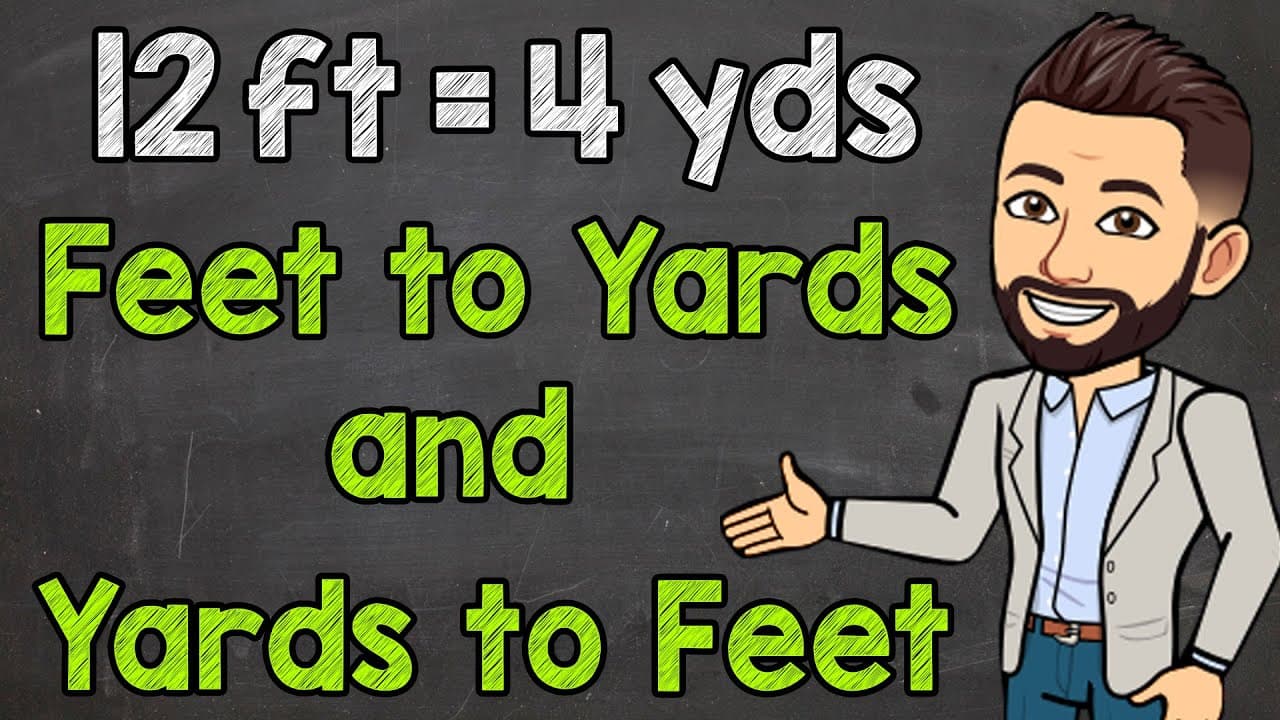
This instructional math video features Mr. J demonstrating how to convert between yards and feet using U.S. customary units of measurement. The video explicitly teaches the conversion rules: multiplying by 3 when converting from yards to feet, and dividing by 3 when converting from feet to yards. Through six guided practice problems, the narrator models the thinking process, uses visual cues on a digital chalkboard, and reinforces the relationship that one yard equals three feet. The key themes explored include unit conversion, mental math strategies, and the inverse relationship between multiplication and division in the context of measurement. The video emphasizes understanding the relative size of units (yards are larger than feet) to determine the correct operation, using the analogy of yardsticks to help students visualize the concept. For educators, this video serves as an excellent direct instruction tool or review for 4th and 5th-grade math students. It provides a clear, step-by-step procedure for solving conversion problems without clutter or distraction. Teachers can use this to introduce the topic, support struggling learners with a clear visual aid, or as a flipped classroom resource where students watch the procedure before practicing independently.

Math with Mr. JMath with Mr. J

3mins 56s

How to Convert Units Using Dimensional Analysis

How to Convert Units Using Dimensional Analysis

This educational video provides a clear and practical introduction to dimensional analysis, a mathematical method used to convert units of measurement. The narrator, Justin, breaks down the process of using known conversion rates to manipulate units, ensuring that unwanted units cancel out to reveal the desired result. Through step-by-step examples, viewers learn how to set up conversion chains for rates, such as changing miles per hour into feet per second. The video explores key themes of unit conversion, ratios, and algebraic thinking. It specifically covers two distinct types of problems: a standard rate conversion involving distance and time, and a more complex multi-variable problem involving currency exchange and mass. The visual presentation emphasizes the importance of placing units correctly in the numerator or denominator to achieve cancellation, a foundational skill for advanced math and science courses. For educators, this video serves as an excellent resource for bridging the gap between basic math skills and applied sciences like chemistry and physics. It demonstrates the "train track" or "fence post" method often used in stoichiometry. Teachers can use this video to introduce the concept of dimensional analysis, reinforce the importance of tracking units during calculation, or as a remediation tool for students struggling with multi-step word problems involving rates.

Miacademy & MiaPrep Learning ChannelMiacademy & MiaPrep Learning Channel

4mins 25s

Materials

Grade 4 Math Priority Pacing Guide

Grade 4 Math Priority Pacing Guide

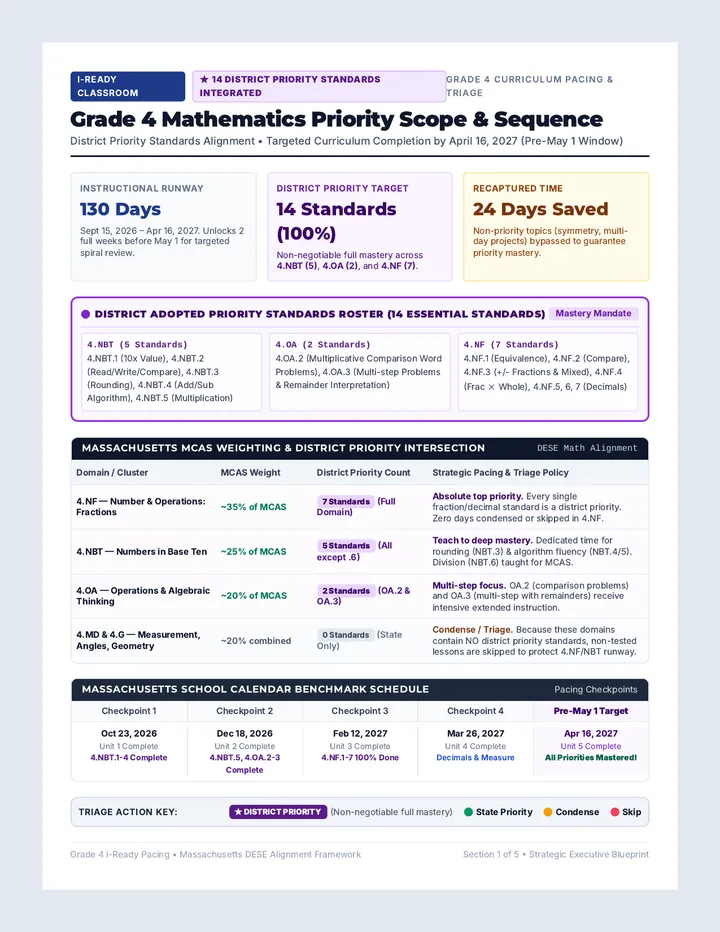
A comprehensive 5-page standards-aligned Grade 4 Mathematics curriculum pacing guide for i-Ready Classroom Mathematics, specifically incorporating the 14 designated District Priority Standards across 4.OA, 4.NBT, and 4.NF. Calibrated to the Massachusetts Curriculum Frameworks to guarantee 100% completion of all district priority standards before May 1, featuring explicit district priority badging, unit-by-unit pacing dates, strategic triage rationales for non-priority topics, and a Tier 2 prerequisite intervention bridge.

AS

Ashley Santiago

Metric Precision Worksheet

Metric Precision Worksheet

A three-page printable metric measurement resource for Grade 7 students. Page 1 provides precision ruler reading exercises with direct, offset, and pointer challenges; Page 2 features an active classroom lab measuring real items in centimeters; and Page 3 provides a comprehensive teacher answer key with worked solutions and scoring notes for Page 1.

TK

Tara Kosinski

Geometry Blueprint Reference

Geometry Blueprint Reference

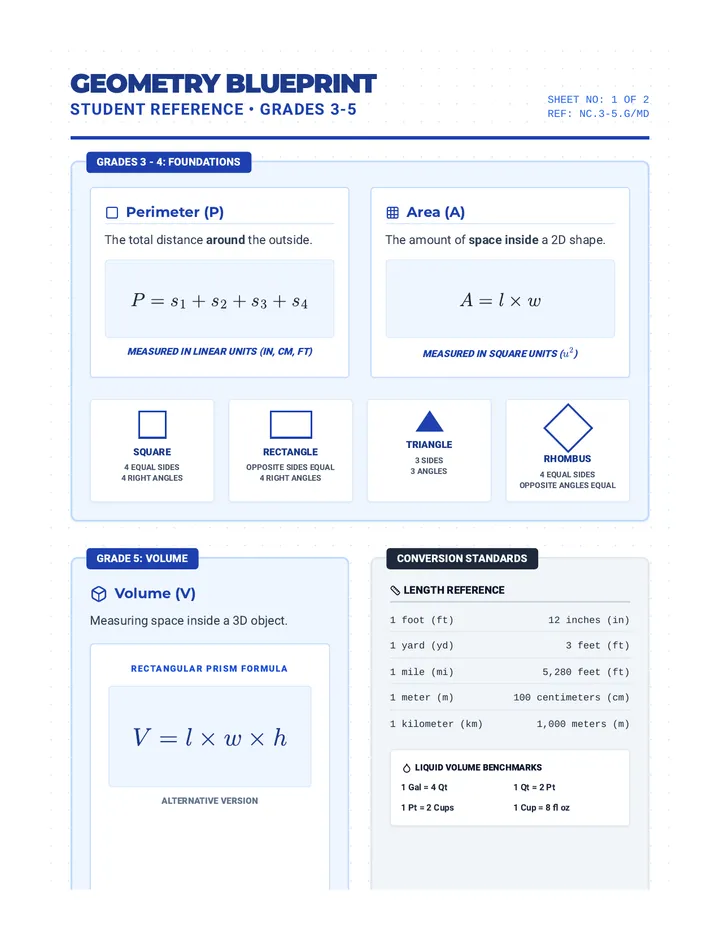
A comprehensive two-page printable geometry anchor chart for grades 3-8, themed as a technical blueprint. Features grade-banded formulas for perimeter, area, volume, surface area, and circles, including the Pythagorean theorem and common measurement conversions. Organized with MathJax for professional notation.

KB

Karen Brown

MCAS Grade Four Math Reference Chart

MCAS Grade Four Math Reference Chart

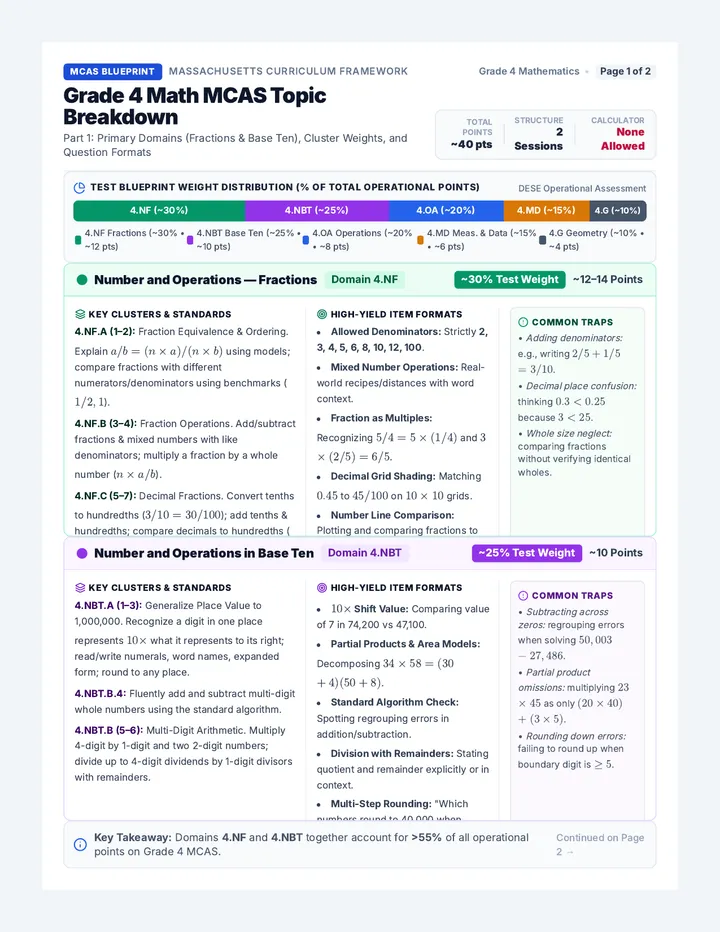
A comprehensive two-page reference chart detailing the Massachusetts MCAS Grade 4 Mathematics test blueprint, including domain weights, priority clusters, released item archetypes, common misconceptions, and constructed-response rubrics.

MS

Meaghan Smith

Rocket Math Viewing Guide

Rocket Math Viewing Guide

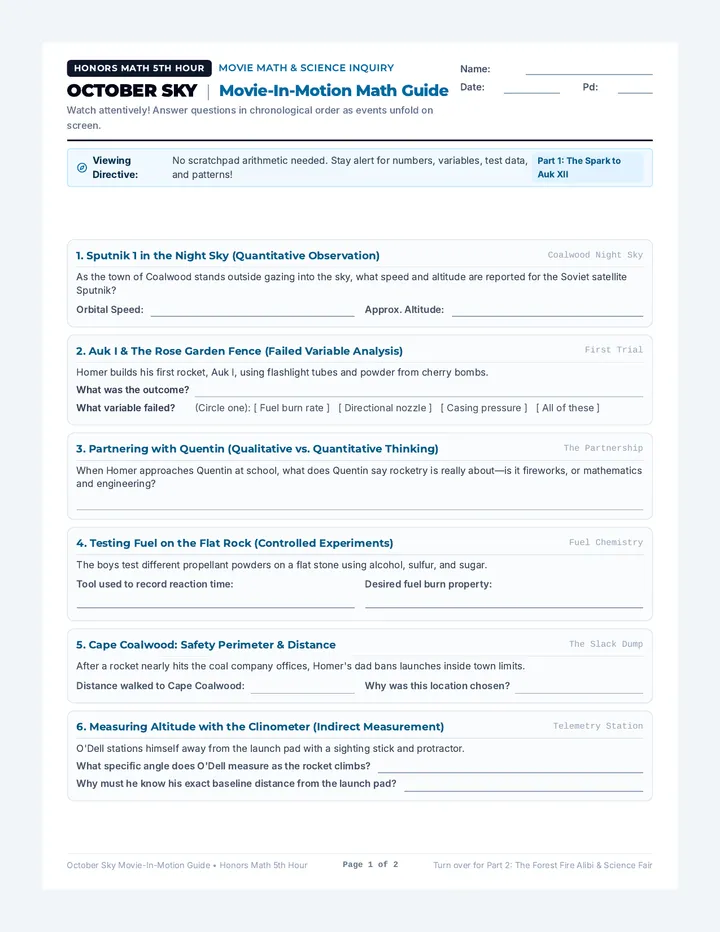
A 2-page chronological movie viewing guide for Honors Math 5th Hour students watching October Sky (1999). Focuses on movie-based quantitative observations, data tracking, independent/dependent variables, forensic trajectory reasoning, and trial-and-error problem solving without timestamps.

W

wroberg

Putting It All Together Extension Packet

Putting It All Together Extension Packet

A comprehensive 8-page extension packet for Grade 4 Unit 9 ('Putting It All Together') that contains creative, open-ended mathematical modeling and puzzle challenges for every lesson. Each lesson's student extension task is beautifully designed with ample clean, white space for work, followed by a dedicated professional teacher answer key.

N

nmack

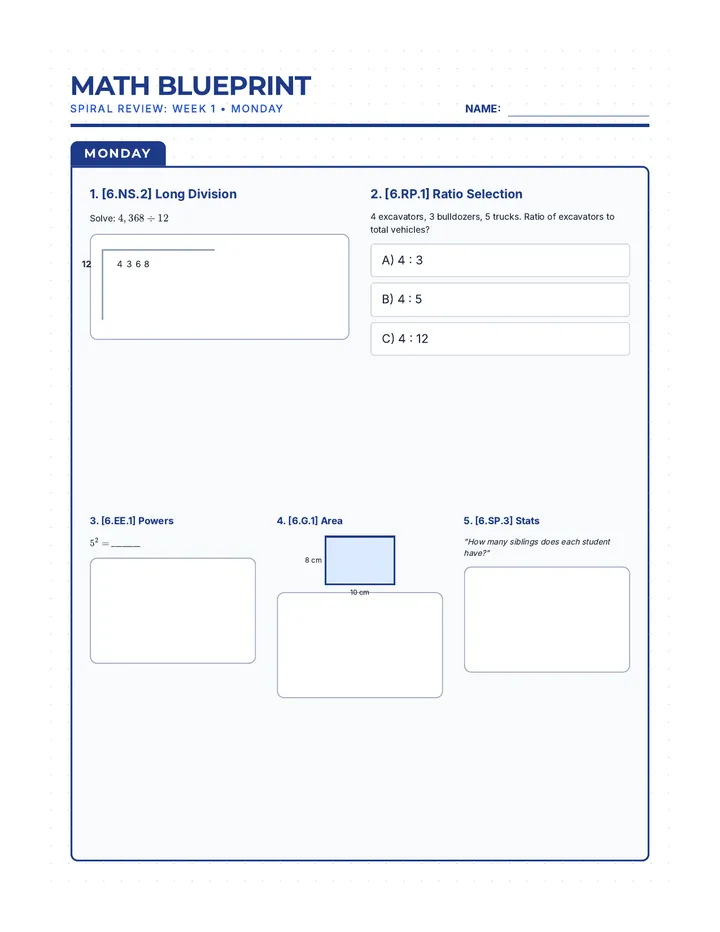
Sequences

Math Blueprint Week 1 Booklet (Definitive)

Math Blueprint Spiral

A 7-week comprehensive math review sequence designed to prepare 6th-grade students for North Carolina state testing, covering Number Systems, Ratios, Expressions, Geometry, and Statistics.

MK

Michell Kisler

27
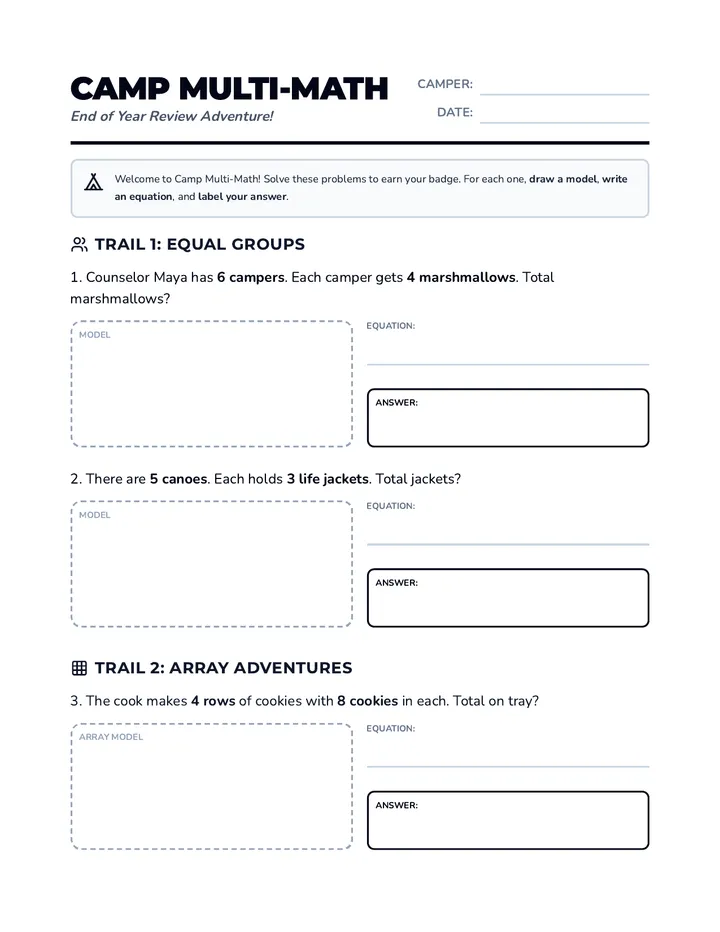
Camp Multi-Math Worksheet

Math Review Adventures

A collection of themed end-of-year math review adventures for different grade levels, focusing on spiraling key standards and problem-solving.

DB

Deborah Burton

21
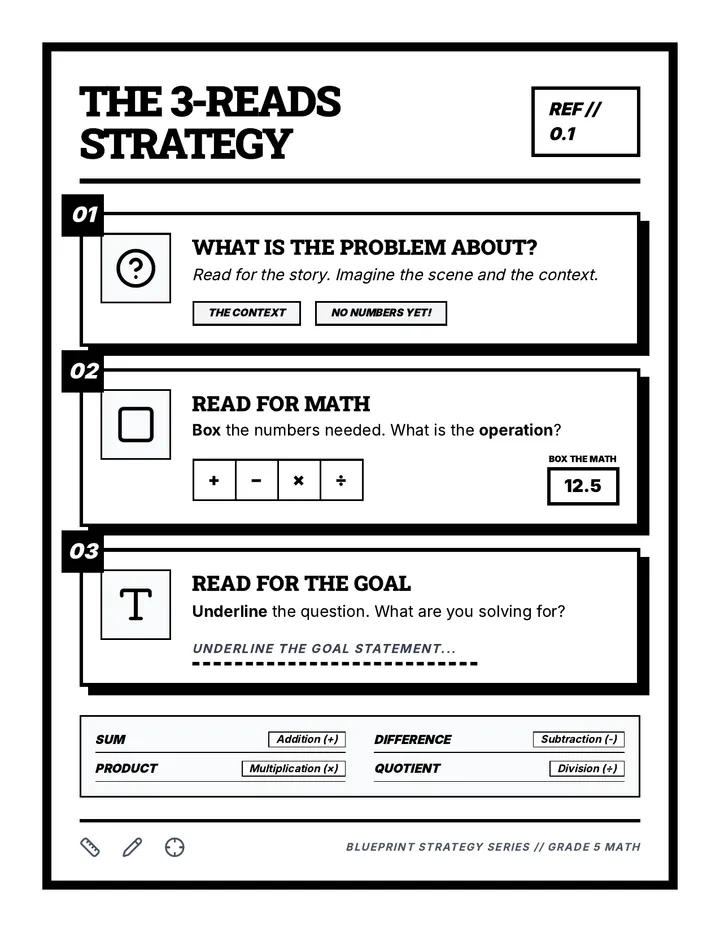
3 Reads Strategy Poster

Math Blueprints Grade 5

A comprehensive set of math supports for 5th-grade students in a co-taught environment. Each unit includes visual vocabulary, worked examples, cloze-style guided notes, and exit tickets featuring a 'Mistake of the Day' analysis.

HJ

Hope Joel

23
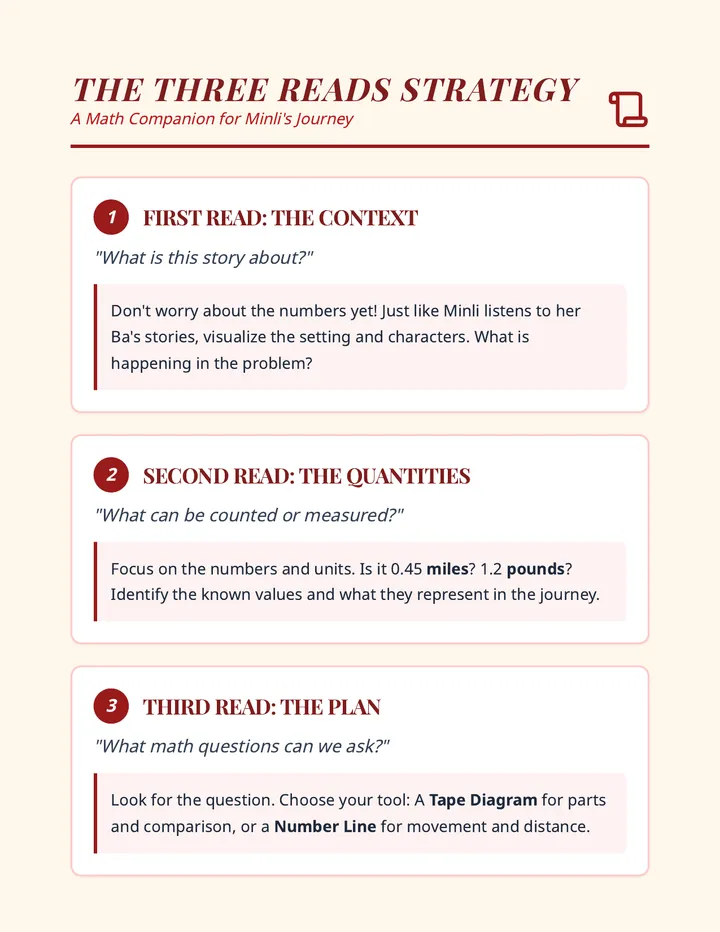
Three Reads Reference Sheet

Quest Mastery 4-Day Bridge

A 4-lesson intensive math intervention for 5th graders designed to bridge 4th-grade decimal foundations to 5th-grade mastery. Features the Three Reads strategy and mental math logic (Counting Up, Matching Units) themed around 'Where the Mountain Meets the Moon'.

K

kthompson

21
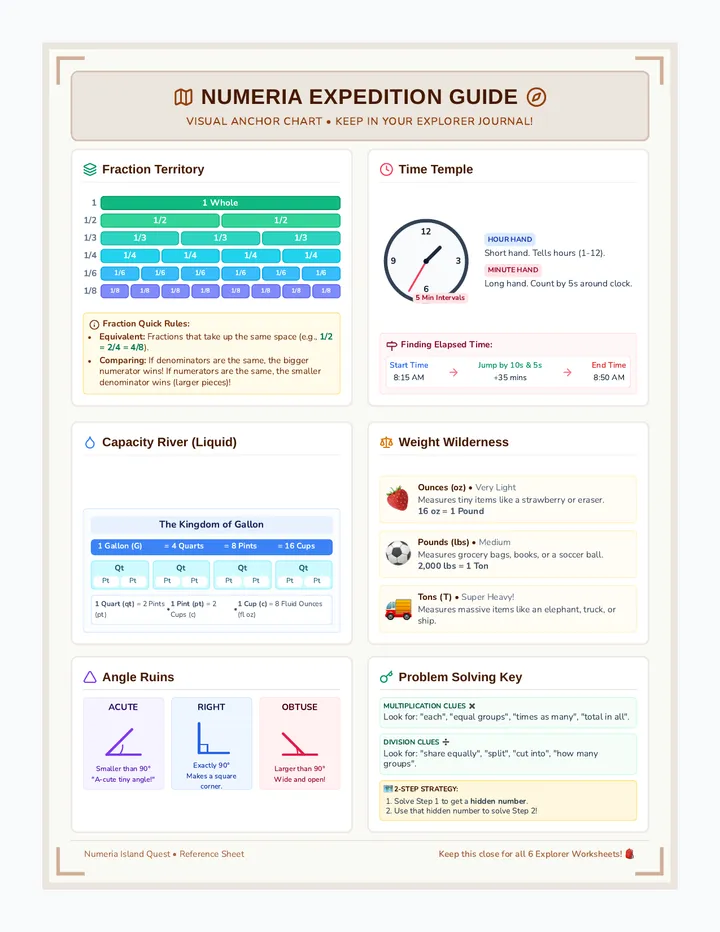
Numeria Expedition Guide Anchor Chart

Explorer Math Adventures

A series of themed explorer math quests designed to reinforce key elementary math concepts for multiple grade levels (rising 3rd and 4th graders) through storytelling, beautiful visuals, and complete self-checking resources.

JC

Jennifer Campbell

15
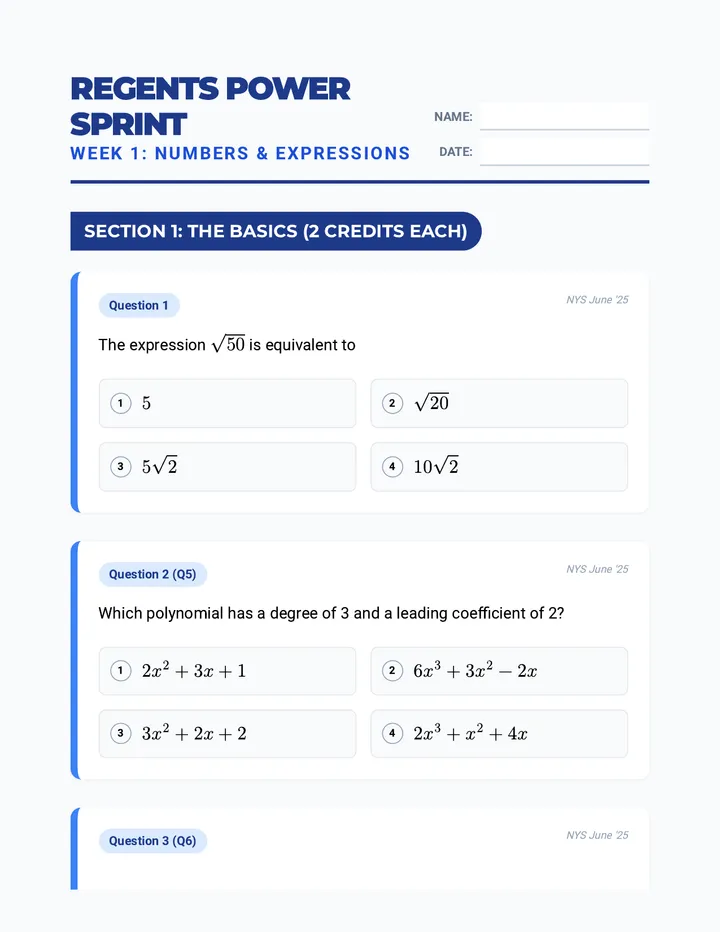
Week 1 Power Sprint Worksheet

Regents Road Map

A comprehensive 10-week preparation sequence designed to get students ready for the Algebra I Regents exam by May 15th, featuring bi-weekly 30-minute practice sessions and visual anchor charts.

L

laura.clar

31

Lessons

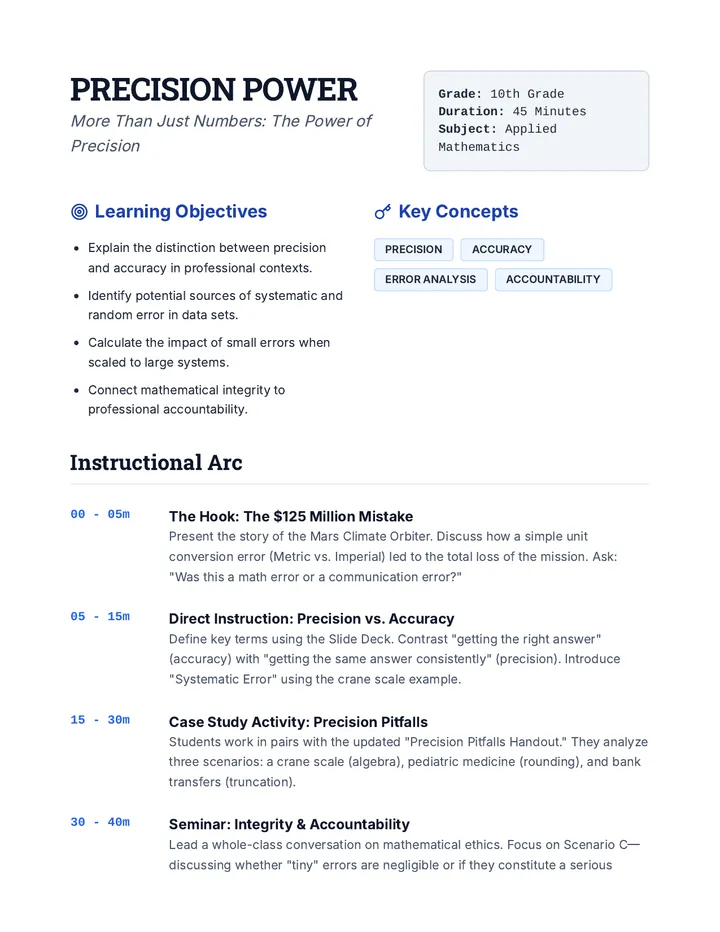
Precision Power Lesson Plan

Precision Power

A 45-minute exploration into why mathematical precision and accuracy are critical for professional success, ethical accountability, and real-world safety. Students analyze high-stakes scenarios where small errors led to significant consequences.

J

jtoomey

8
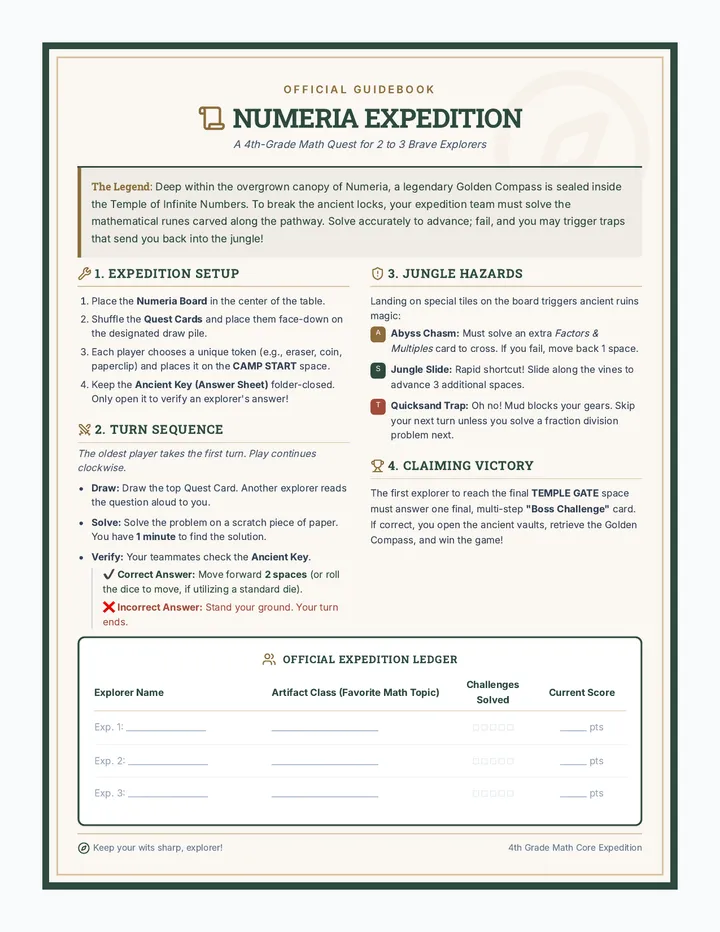
Numeria Expedition Rulebook

Numeria Expedition

A comprehensive, adventure-style 4th-grade math review board game where students solve challenges across 8 core curriculum units to escape the ruins of Numeria. Designed for 2-3 players, it features a printable game board, challenge cards, a player rulebook, and a quick-reference answer key.

N

nmack

4
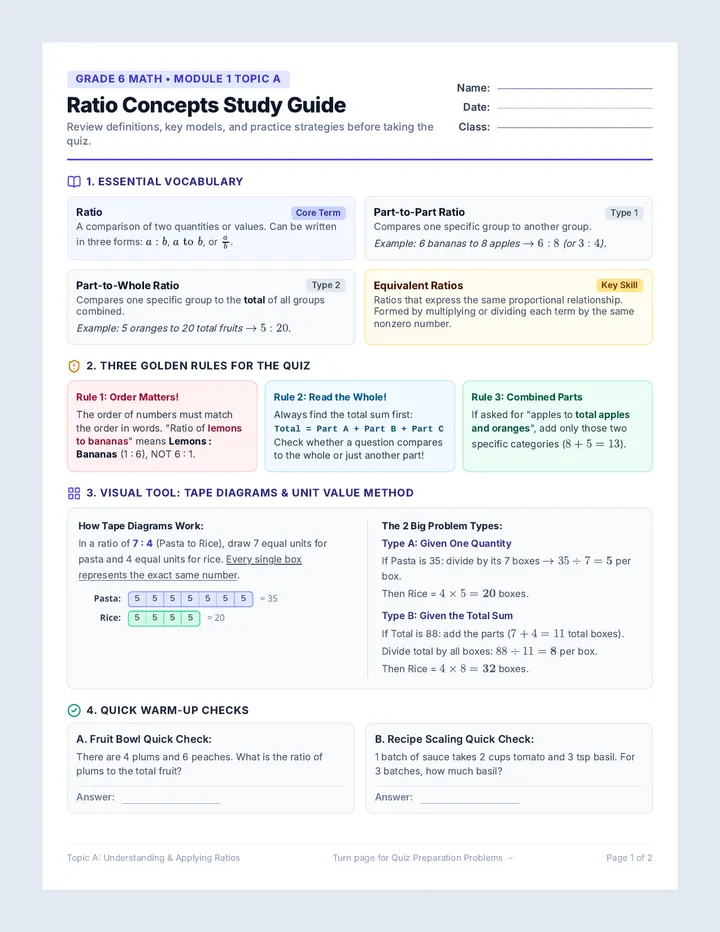
Ratio Mastery Study Guide

Ratio Relationships

Comprehensive study guides and practice resources for Grade 6 Module 1 ratio concepts, representations, tables, tape diagrams, and coordinate graphs.

JS

jerell saint phar

7
Measurement Field Guide Slides

Drafting Board Measurement & Data Review

A precision-focused drafting-themed review of 4th grade Measurement and Data (MD) standards. Covers units and conversions (MD.1), measurement word problems (MD.2), area and perimeter (MD.3), line plots (MD.4), and angle measurement and addition (MD.6-7). Division has been removed from the curriculum.

DG

Debra Golden

18
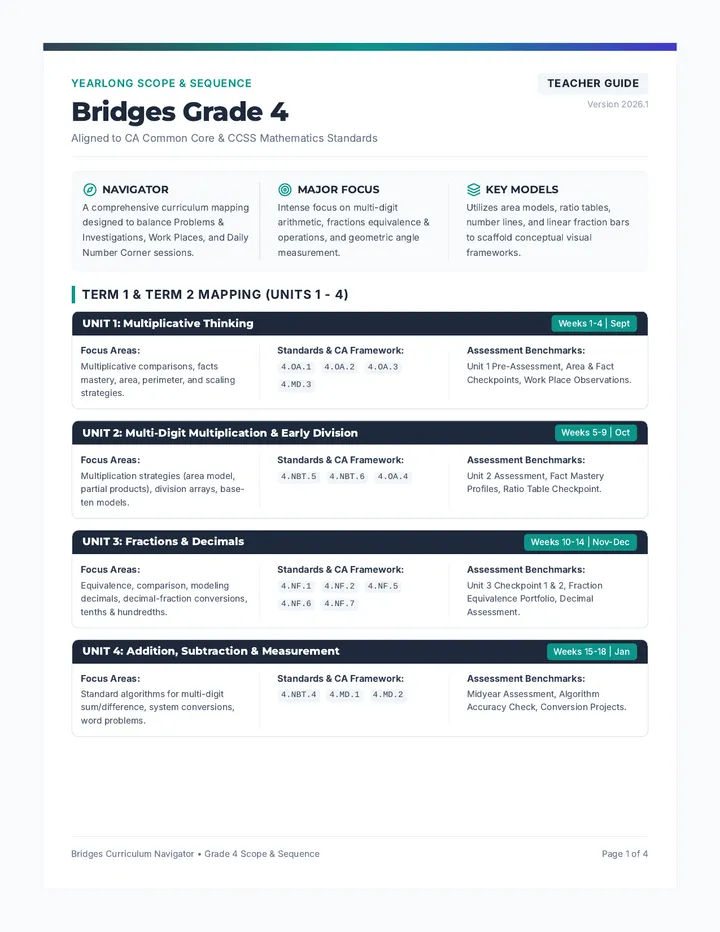
Bridges Yearlong Map Document

Bridges Curriculum Navigator

A comprehensive curriculum mapping, planning, and assessment suite for 4th Grade Bridges Math, fully aligned with Common Core and California State Standards (CCSS-M / CA Common Core). Includes a year-long scope and sequence, weekly and daily planning templates, and an assessment tracker.

AJ

Alexander Jacinto

7
Math Marathon Lap 1 Worksheet

Math Marathon Review

A comprehensive 5-day end-of-year math review for 5th grade, covering all NYS Next Generation Math Standards through daily warm-ups and test-style practice.

SM

stacy maslyn

6