Metric Precision Worksheet
Physical Science & Math Grade 7 • Lab Measurement Skills
Metric Ruler Precision Practice
Name:
Date:
Period:
Conversion Rule: 1 cm = 10 mm • Count mm ticks as tenths of a centimeter (e.g., 4.7 cm = 47 mm).
Precision: Nearest 0.1 cm (1 mm)
1
Direct Alignment: Measure Each Object from Zero
Object A: Steel Machine Pin
Length: cm Length: mm
0 1 2 3 4 5 6 7 8 9 10 cm
Object B: Copper Test Wire
Length: cm Length: mm
0 1 2 3 4 5 6 7 8 9 10 cm
2
Offset Measurement: Calculate Length When Starting Past Zero
Object C: Mineral Crystal Core
Start: cm End: cm Length: cm ( mm)
0 1 2 3 4 5 6 7 8 9 10 cm
Object D: Preserved Lab Specimen
Start: cm End: cm Length: cm ( mm)
0 1 2 3 4 5 6 7 8 9 10 cm
3
Pointer Precision: Read Specific Marks Along the Scale
P Q R S 0 1 2 3 4 5 6 7 8 9 10 11 12
Pointer P
cm:
mm:
Pointer Q
cm:
mm:
Pointer R
cm:
mm:
Pointer S
cm:
mm:
4
Lab Analysis & Measurement Thinking
4A. Plant Growth Observation
An Elodea shoot measured 4.8 cm on Day 1 and grew to 8.3 cm by Day 5.
Total Growth in cm:
Total Growth in mm:
4B. Measurement Precision
A student records a slide width as 2.548 cm using a standard metric ruler marked in millimeters.
Why is this precision invalid for this tool?
Metric Measurement • Grade 7 Lab Skills Page 1 of 3 Self-Assessment: □ Units labeled □ Subtraction checked
Hands-On Investigation Grade 7 • Metric Measurement Lab
Classroom Metric Hunt: Centimeter Precision
Lab Partner:
Tool: Standard 30 cm Metric Ruler
i Rule 1: Always align the object's edge with the 0 cm mark, not the plastic end of the ruler.
Rule 2: Estimate in cm before you measure.
Rule 3: Record to nearest 0.1 cm (e.g., 14.3 cm).
1
Classroom Object Measurement Log
Record all primary measurements in centimeters (cm) to nearest 0.1 cm
| Target Classroom Item | Dimension | Estimated (cm) | Measured (cm) | Converted (mm) | Difference (cm) |
|---|
| | | | | |
| Highlighter | | | | | |
Cap tip to base plug | Total Length |
|
|
|
|
|
Sneaker / Shoe
Outsole: back of heel to toe tip | Sole Length |
|
|
|
|
|
2-Pocket Folder
Closed folder, top to bottom edge | Height (Long edge) |
|
|
|
|
|
2-Pocket Folder
Closed folder, spine to outer edge | Width (Short edge) |
|
|
|
|
|
Choice Item 1:
Classroom item (e.g., textbook, calculator) | |
|
|
|
|
|
Choice Item 2:
Large item (e.g., student desk, chair leg) | |
|
|
|
|
2
Lab Analysis & Precision Reflection
2A. Irregular Shapes: The Sneaker Challenge Lab Technique
Unlike a ruler, a sneaker has curved edges, a cushioned sole, and an angled toe. Describe the exact method you used to measure its straight-line length accurately without bending the ruler.
2B. Exceeding Ruler Length: The Folder Offset Thinking
Standard 2-pocket folders often measure over 29 cm tall. If an object is longer than your ruler, how can you combine multiple metric measurements accurately without losing precision?
3
Mathematical Application: Folder Perimeter & Unit Synthesis
3A. Perimeter of Your 2-Pocket Folder
Using your recorded Height and Width measurements in centimeters from the table above, calculate the total perimeter of the folder:
\(\text{Perimeter} = 2 \times (\text{Height in cm} + \text{Width in cm})\)
Show substitution and addition steps inside the work box.
Calculation Work Space:
Perimeter (cm):
Perimeter (mm):
Metric Measurement • Classroom Hands-On Lab Page 2 of 3 Lab Verification: □ Partner checked □ All units in cm & mm □ Measured to 0.1 cm
Teacher Resource ANSWER KEY & GRADING GUIDE
Page 1 Worked Solutions & Analysis
Instructional Aid Grade 7 Lab Precision Standards
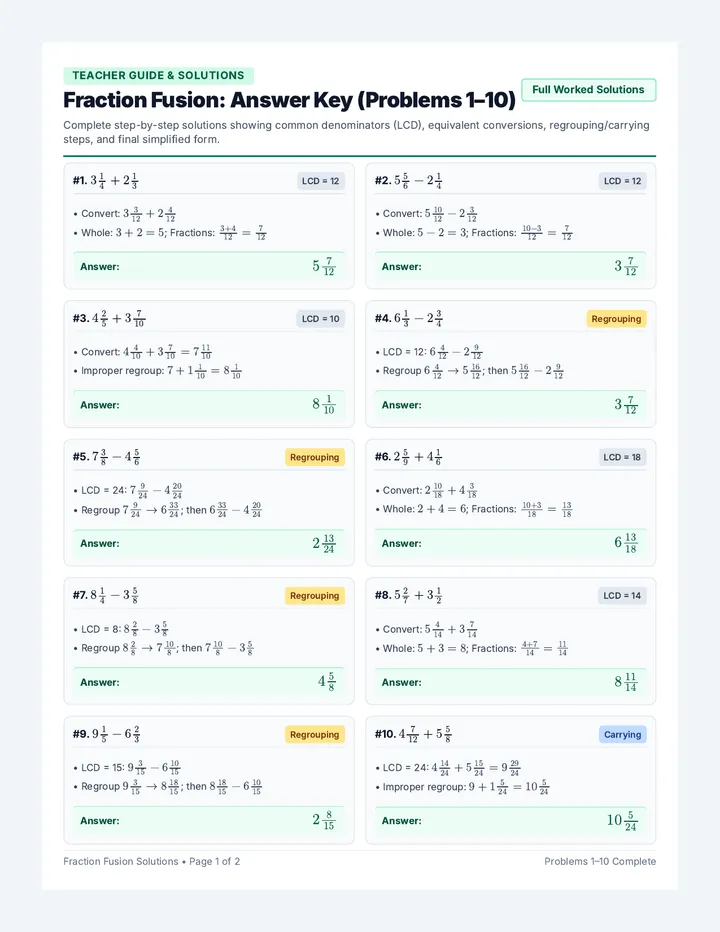
Point Value Breakdown: Part 1 (4 pts) • Part 2 (6 pts) • Part 3 (8 pts) • Part 4 (4 pts)
Total: 22 Points
1
Part 1: Direct Alignment
Object A (Steel Pin): 5.7 cm • 57 mm
Aligns at 0.0 cm; terminates 7 mm ticks past the 5.0 cm mark (\(5.0 + 0.7 = 5.7\text{ cm}\)).
Object B (Copper Wire): 8.4 cm • 84 mm
Aligns at 0.0 cm; ends exactly 4 mm ticks past the 8.0 cm mark (\(8.0 + 0.4 = 8.4\text{ cm}\)).
• Common Error: Students reading 5.6 cm or 8.5 cm due to parallax or miscounting the 5 mm midpoint marker.
2
Part 2: Offset Measurement
Object C (Crystal Core): 6.5 cm • 65 mm
Start: 2.3 cm • End: 8.8 cm
Calculation: \(8.8\text{ cm} - 2.3\text{ cm} = \mathbf{6.5\text{ cm}}\) (\(65\text{ mm}\)).
Object D (Lab Specimen): 5.5 cm • 55 mm
Start: 3.6 cm • End: 9.1 cm
Calculation: \(9.1\text{ cm} - 3.6\text{ cm} = \mathbf{5.5\text{ cm}}\) (\(55\text{ mm}\)).
• Common Error: Forgetting to subtract the start mark and reporting 8.8 cm or 9.1 cm as total length.
3
Part 3: Pointer Precision Reading Solutions
Scale: 1 cm = 10 mm (1 tick = 0.1 cm)
Pointer P 2 pts
cm: 1.8 cm
mm: 18 mm
3 ticks past the 1.5 cm line, or 2 ticks before 2.0 cm.
Pointer Q 2 pts
cm: 4.5 cm
mm: 45 mm
Exactly at the medium half-centimeter mark between 4 and 5.
Pointer R 2 pts
cm: 7.2 cm
mm: 72 mm
2 millimeters past the 7.0 cm boundary.
Pointer S 2 pts
cm: 10.9 cm
mm: 109 mm
1 millimeter tick before the 11.0 cm line.
4
Part 4: Lab Analysis & Precision Thinking
4A. Plant Growth Calculation 2 pts
Initial: 4.8 cm • Final: 8.3 cm
• Growth in cm: \(8.3 - 4.8 =\) 3.5 cm
• Growth in mm: \(3.5 \times 10 =\) 35 mm
Grading Note: Award 1 pt for correct subtraction (3.5 cm) and 1 pt for correct mm conversion (35 mm).
4B. Significant Figures & Tool Resolution 2 pts
Why is 2.548 cm invalid for a standard millimeter ruler?
Model Answer: The smallest marks on a standard metric ruler are millimeters (0.1 cm). Students can at most estimate to the half-millimeter (0.05 cm / hundredths). A three-decimal measurement (0.001 cm = 0.01 mm) claims micrometer precision that a millimeter ruler cannot physically resolve.
Accept: Any answer mentioning instrument limits, millimeter precision limit, or false significant figures.
Diagnostic Teaching & Remediation Tips
Offset Subtraction: Students who struggle with Objects C & D benefit from physically touching and counting the full centimeter intervals between start and end.
The Zero Tick: Emphasize that rulers with blank lead-ins (offset zero) require aligning to the printed "0" line, not the physical edge.
Fraction vs. Decimal: Ensure students avoid fractions like \(5\frac{7}{10}\) cm; metric scientific reporting strictly utilizes standard decimals (5.7 cm).
Metric Measurement • Teacher Solution Key Page 3 of 3 Confidential Instructional Key • Grade 7 Curriculum