Lenny.com
Explore
Create
ActivitiesNewMathEnglish Language ArtsScience & EngineeringSocial StudiesGlobal LanguagesHealth & Physical EducationSpecial EducationCounseling & Life SkillsArts & CreativityESL
Lenny.com
Lenny.com
Explore
Create
ActivitiesNewMathEnglish Language ArtsScience & EngineeringSocial StudiesGlobal LanguagesHealth & Physical EducationSpecial EducationCounseling & Life SkillsArts & CreativityESL
Lenny.com
Lenny.com

Solutions

Lenny for EducatorsLenny for SchoolsLenny for Districts

Product

ExploreSign inCreateSupportAbout

Resources

Getting startedMTSS Acceleration Program

© 2026 Lenny Learning Inc.

TermsPrivacyAccessibility
LinkedInInstagramX
Lenny

Shapes and Attributes

Properties of two-dimensional and three-dimensional geometric figures, focusing on sides, angles, and vertices. Strengthens spatial awareness through classification and construction activities.

MathNumbers & CountingCounting ObjectsNumber NamesComparing NumbersNumber OperationsCounting SequenceNumbers 0-10Place Value Understanding and SystemAdd and Subtract Within 20Addition and Subtraction ConceptsAddition and Subtraction EquationsAddition and Subtraction ProblemsFoundations for MultiplicationMultiplication and Division PropertiesMultiply and Divide Within 100Multiplication and Division ProblemsFactors and MultiplesProperties of OperationsPatterns and RelationshipsGenerate and Analyze PatternsMulti-Digit ArithmeticPlace Value OperationsMulti-Digit and Decimal OperationsNumerical ExpressionsFour Operations and PatternsFour Operations Problem SolvingMeasurement & DataMeasurable AttributesMeasuring LengthsMeasure and Estimate Lengths in Standard UnitsRelate Addition and Subtraction to LengthClassifying and Counting ObjectsTime and MoneyArea Concepts and MeasurementPerimeter and Area MeasuresAngle Concepts and MeasurementTime, Volume, and MassMeasurement Unit ConversionsGeometryIdentifying ShapesShapes and AttributesShape Attributes and ReasoningShapes and CompositionClassifying 2D FiguresGeometric Figures and RelationshipsLines, Angles, and ShapesAngle, Area, and VolumeGeometric MeasurementVolume of 3D ShapesCoordinate Plane ApplicationsTransformations in the PlaneCongruence and SimilarityUnderstand congruence in terms of rigid motionsSimilarity and TransformationsProve Theorems Involving SimilarityPythagorean TheoremTrigonometry for General TrianglesMake Geometric ConstructionsProve Geometric TheoremsTheorems About CirclesFind Arc Lengths And Areas of Sectors of CirclesVolume FormulasRelationships Between Two-Dimensional and Three-Dimensional ObjectsProve Simple Geometric Theorems AlgebraicallyTranslate Between Geometric Description and Equation for Conic SectionApply Geometric Concepts in Modeling SituationsFractions & DecimalsFractions as NumbersBuilding FractionsFraction Equivalence and OrderingAdding and Subtracting FractionsMultiplying and Dividing FractionsDividing FractionsDecimal FractionsMulti-Digit Computation and FactorsAdd, Subtract, Multiply, and Divide Rational NumbersRational Number SystemIrrational Numbers and ApproximationsRatiosRatios and ProportionsProportional RelationshipsUnit RateAlgebraAlgebraic ExpressionsGenerate Equivalent ExpressionsQuantitative RelationshipsProportional Relationships and Linear EquationsEquations and InequalitiesEquation Solving and ReasoningLinear Equations and SystemsGraph Equations and InequalitiesSystems of EquationsReal-World Algebraic ProblemsQuantitative Reasoning with UnitsExpression StructureEquivalent Expression FormsRadicals and Integer ExponentsRational ExponentsRational and Irrational NumbersPolynomial OperationsPolynomial IdentitiesPolynomial Zeros and FactorsRational ExpressionsComplex Number OperationsComplex Numbers in PolynomialsComplex Numbers on PlaneStatistics & ProbabilityRepresent and Interpret DataData DistributionsStatistical VariabilityProbability ModelsCompound Event ProbabilitiesStatistical SamplingInterpret Categorical and Quantitative DataBivariate Data PatternsInterpret Linear ModelsComparing Two PopulationsRandom Processes in StatisticsIndependence and Conditional ProbabilityExpected ValuesProbability-Based Decision MakingStatistical Inference and ConclusionsFunctionsFunction Concepts and NotationDefine and Compare FunctionsInterpret Functions in ContextAnalyze Function RepresentationsModel Relationships with FunctionsIdentify Linear vs Exponential GrowthDistinguish Between Function TypesCompare Growth RatesInterpret Function ExpressionsBuild Functions from RelationshipsConstruct and Model FunctionsTransform and Combine FunctionsModel Comparison and SelectionSolve Exponential EquationsTrigonometryTrigonometric Ratios Involving Right TrianglesTrigonometric Functions and Unit CircleModel with Trigonometric FunctionsTrigonometric IdentitiesVectors & MatricesIntroduction to Vectors and MatricesVector QuantitiesVector OperationsMatrix OperationsCalculusLimits and ContinuityDerivative Concepts and NotationDerivative Rules and TechniquesApplications of DerivativesOptimization ProblemsRelated RatesCurve Sketching and AnalysisIntegration Concepts and NotationAntiderivatives and Indefinite IntegralsDefinite Integrals and AreaFundamental Theorem of CalculusIntegration TechniquesApplications of IntegrationDifferential EquationsSequences and SeriesParametric and Polar FunctionsVector-Valued Functions

Videos

Classifying Triangles by Sides and Angles

Classifying Triangles by Sides and Angles

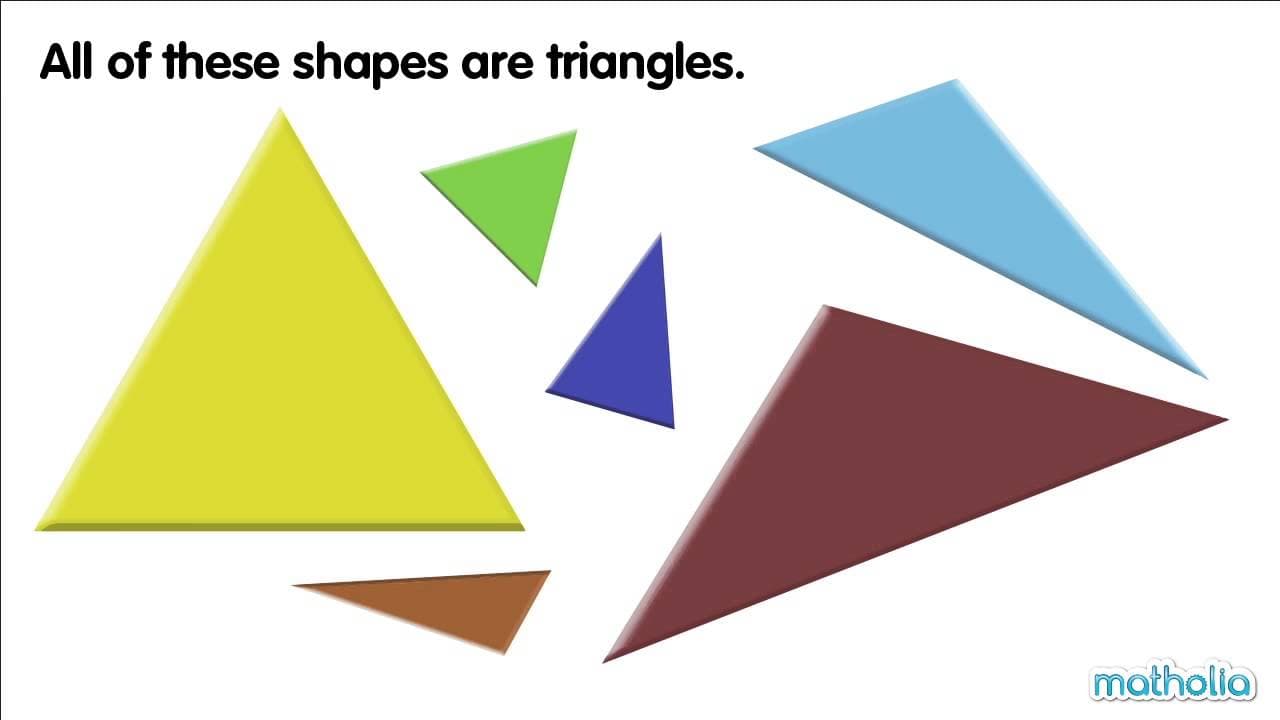
This concise educational video provides a foundational introduction to triangles and their classification within geometry. The presenter begins by defining the basic properties of a triangle as a flat, two-dimensional figure with three sides and three angles. Using a whiteboard with pre-drawn diagrams, the video visually demonstrates how to categorize triangles based on their angle measurements (acute, obtuse, right) and their side lengths (equilateral, isosceles, scalene). The key themes explore geometric vocabulary and visual literacy in mathematics. The video introduces specific terms like "acute," "obtuse," and "right" to describe angles relative to 90 degrees. It then transitions to classifying triangles by side properties, introducing "equilateral," "isosceles," and "scalene." The instructor uses standard geometric notation, such as tick marks to indicate equal side lengths and arcs for angles, helping students learn how to read mathematical diagrams. For the classroom, this video serves as an excellent visual anchor for a geometry unit. The clear, step-by-step drawing and labeling process allows teachers to pause and discuss each type of triangle. Notably, the latter portion of the video relies purely on visual demonstration without voiceover definitions, creating a unique opportunity for inquiry-based learning where students must infer the definitions of isosceles and scalene triangles based on the visual markings shown on the whiteboard.

Miacademy & MiaPrep Learning ChannelMiacademy & MiaPrep Learning Channel

1min 31s

Prefixes and Polygons: Naming Shapes by Number of Sides

Prefixes and Polygons: Naming Shapes by Number of Sides

A high-energy, animated musical lesson that teaches students how to identify and name polygons based on their number of sides. The video uses a catchy hip-hop song to introduce Greek prefixes (Tri-, Quad-, Penta-, etc.) and connects each shape to real-world objects, such as a sailboat, a door, and a stop sign. It covers shapes ranging from triangles (3 sides) to decagons (10 sides). The video reinforces the relationship between the prefix and the number of sides, helping students memorize geometric vocabulary through rhyme and repetition. It features a "call and response" quiz section where viewers are asked to identify shapes, as well as a visual counting sequence that highlights the sides of each polygon as they are counted. In addition to naming shapes, the video explicitly defines the rules of what constitutes a polygon: it must be a closed shape and must have straight sides. This resource is excellent for introducing geometry units, reviewing vocabulary, or helping students understand the linguistic roots of mathematical terms.

Math Songs by NUMBEROCKMath Songs by NUMBEROCK

3mins 41s

Finding Shapes Within Pictures

Finding Shapes Within Pictures

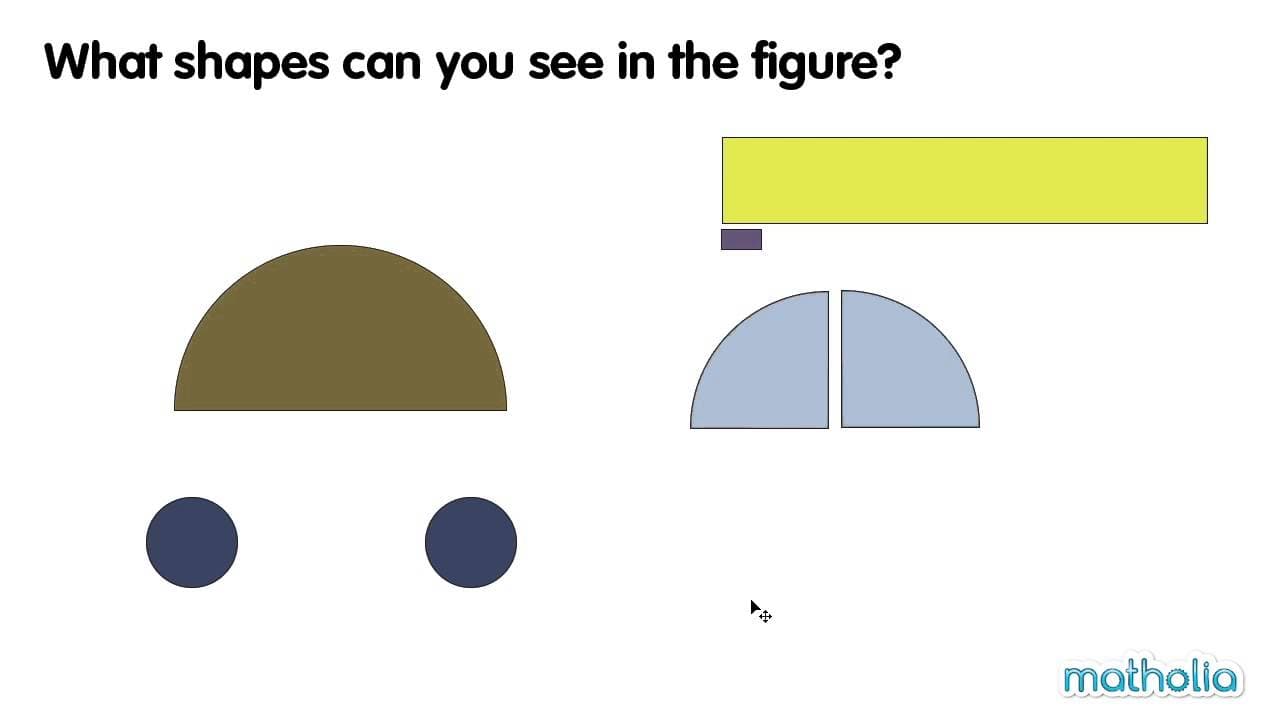
This educational video introduces young students to the concept of composite shapes—figures made up of smaller, distinct geometric shapes. Through clear, animated examples, it demonstrates how complex images like a car and a castle can be deconstructed into basic components such as rectangles, circles, semi-circles, and triangles. The video uses a slow, deliberate pace that allows students to visually track each shape as it is isolated from the main image and then returned to its place. The content focuses on key geometry topics including shape identification, spatial reasoning, and part-whole relationships. It explicitly names 2D shapes (rectangle, square, triangle, circle) and introduces more specific terms like 'semi-circle' and 'quarter circle,' helping to expand students' mathematical vocabulary beyond the basics. For the classroom, this video serves as an excellent hook for lessons on geometry or art. It encourages students to look at the world with a 'mathematical eye,' identifying geometric structures in everyday objects. Teachers can use this as a model for hands-on activities where students build their own figures using pattern blocks or paper cutouts, bridging the gap between abstract geometric concepts and tangible application.

MatholiaChannelMatholiaChannel

1min 29s

How to Identify Basic 2D Shapes

How to Identify Basic 2D Shapes

This educational video provides a clear and structured introduction to four fundamental two-dimensional shapes: the square, circle, triangle, and rectangle. Through a repetitive and paced narrative, the video guides young learners in identifying each shape by examining its defining attributes—specifically counting the number of corners and sides. The clear audio and simple visual cues help students connect the visual form with the mathematical properties and the shape's name. The content focuses on early geometry concepts, specifically the identification of 2D shapes and the vocabulary of "sides" and "corners" (vertices). For each shape, the video follows a distinct pattern: identifying the attributes, naming the shape, and then displaying a variety of examples in different colors, sizes, and orientations to reinforce that a shape's identity remains constant regardless of these variables. For educators, this video serves as an excellent foundational tool for Pre-K through 1st-grade mathematics. It allows teachers to pause and count along with the narrator, making it an interactive experience. The segment showing various examples of each shape is particularly useful for preventing the common misconception that shapes must always look a certain way (e.g., that a triangle must always have a flat bottom). The video concludes with a summary screen perfect for a quick formative assessment or review.

MatholiaChannelMatholiaChannel

3mins 17s

Exploring Properties of 3D Shapes: Faces, Edges, and Vertices

Exploring Properties of 3D Shapes: Faces, Edges, and Vertices

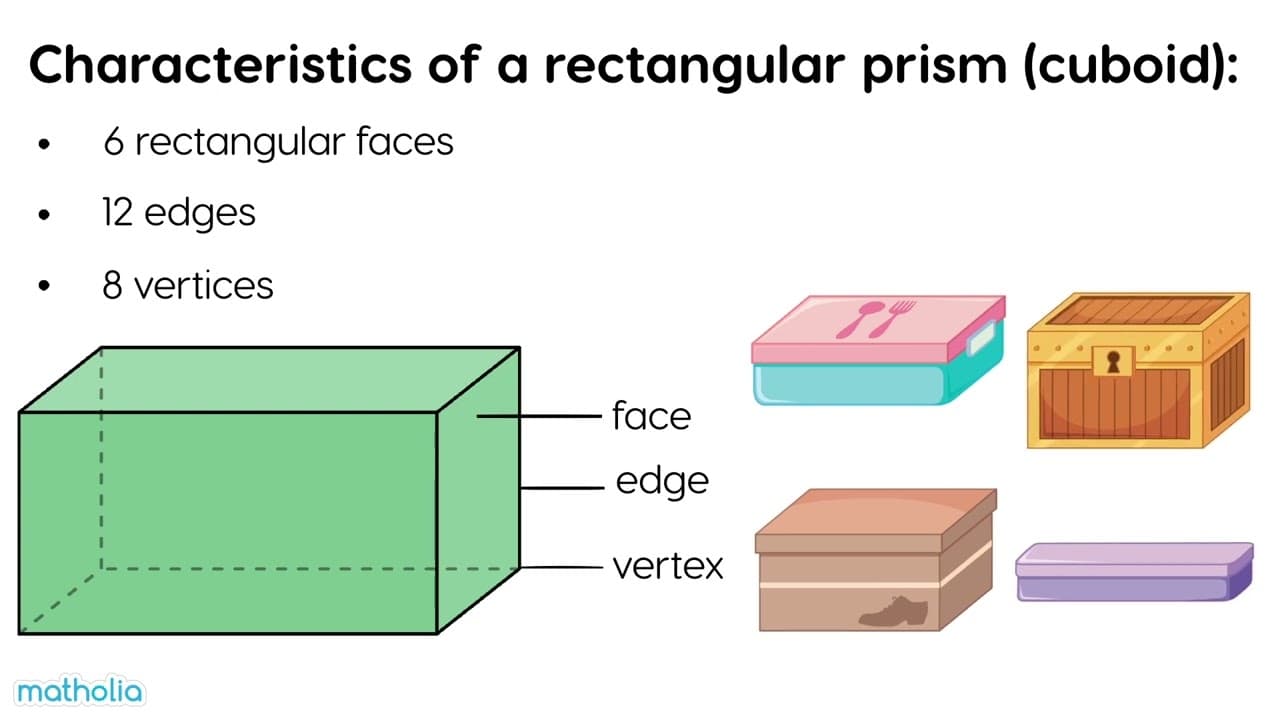
This educational video serves as a clear, step-by-step introduction to the geometric properties of five common 3D shapes: the cube, rectangular prism (cuboid), sphere, cone, and cylinder. For each shape, the narration systematically defines its structure by counting its faces, edges, and vertices. Visual animations highlight these specific parts on the geometric models as they are counted, helping students connect the abstract vocabulary to the physical attributes of the shape.

MatholiaChannelMatholiaChannel

2mins 43s

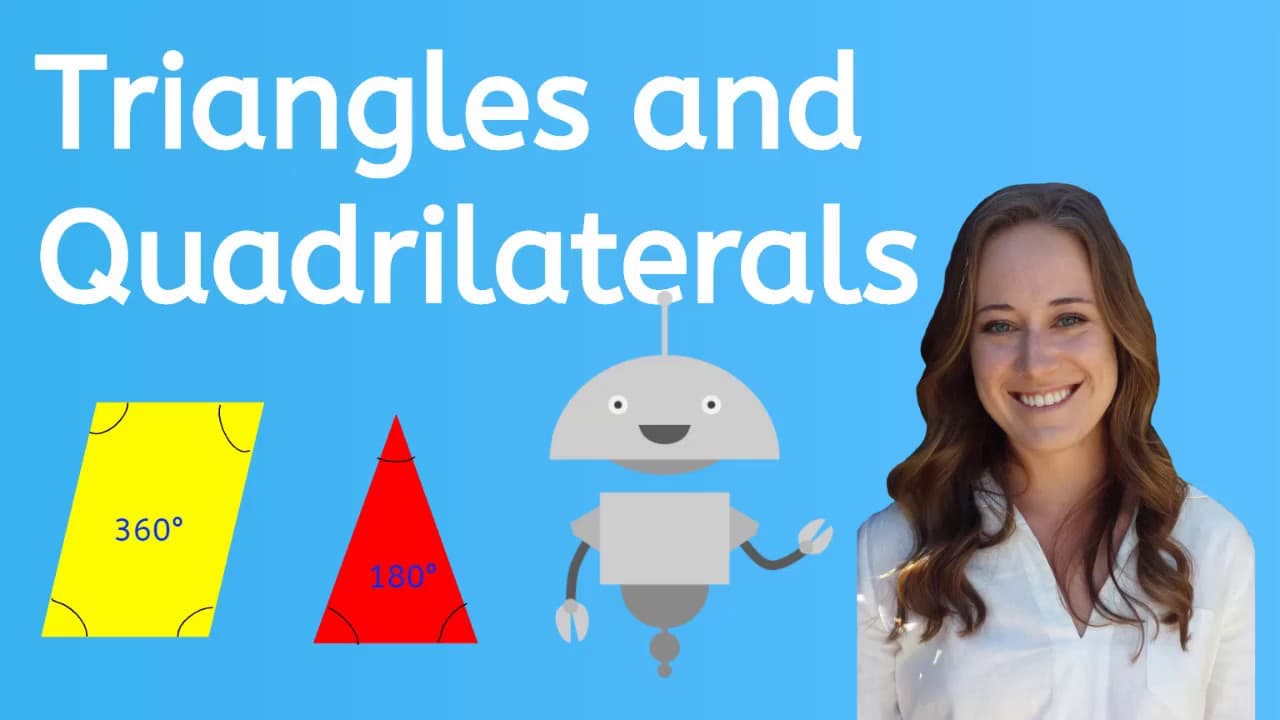
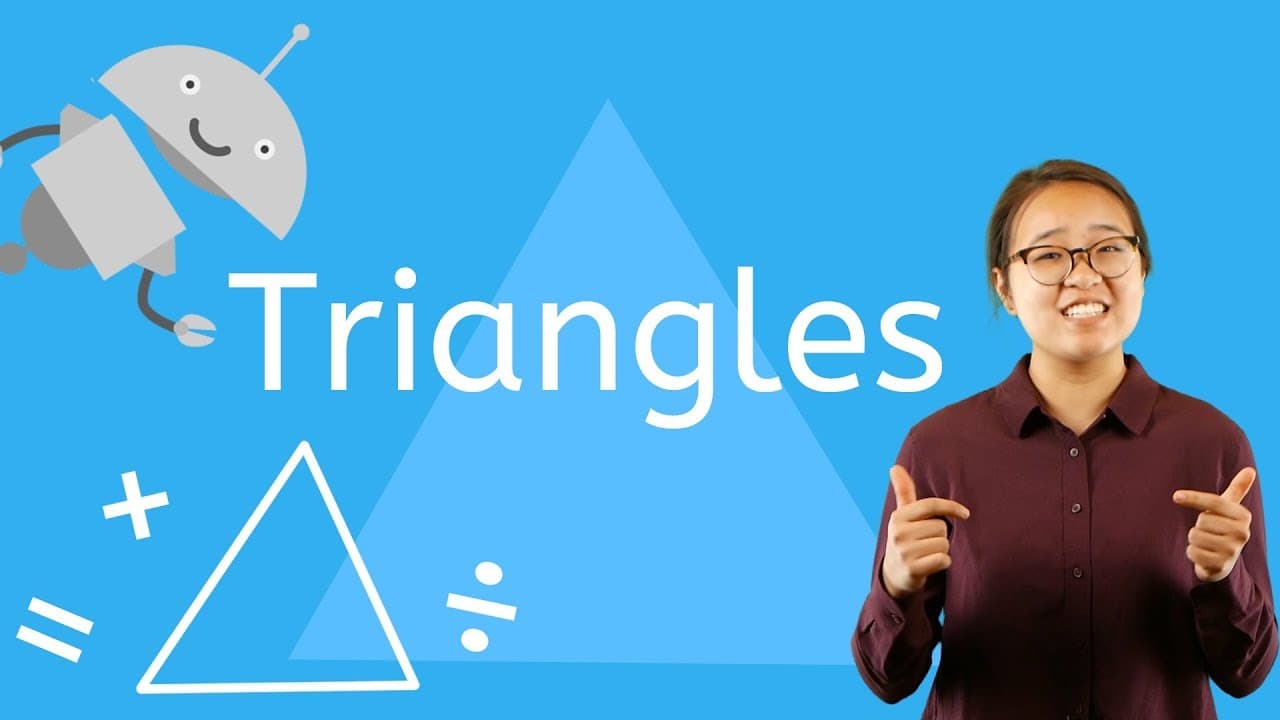
Exploring Triangles and Quadrilaterals: Types and Angles

Exploring Triangles and Quadrilaterals: Types and Angles

This comprehensive math video serves as a detailed introduction to the fundamental properties, classifications, and angle rules of triangles and quadrilaterals. The lesson begins by defining triangles, demonstrating how to name their components (sides, vertices, angles), and categorizing them by angle type (right, acute, obtuse) and side length (equilateral, isosceles, scalene). It then transitions to quadrilaterals, introducing concepts such as parallel lines and congruence through familiar shapes like squares and parallelograms, while encouraging viewers to identify these properties visually. A central theme of the video is the calculation of interior angles. The narrator explains and visually proves that the sum of interior angles in a triangle is always 180 degrees, while in a quadrilateral it is 360 degrees. This concept is reinforced through a demonstration showing how a quadrilateral can be divided into two triangles. The video moves beyond theory into application by modeling how to set up and solve basic algebraic equations to find missing angles in both types of polygons. For the classroom, this video is an excellent resource for bridging geometry and early algebra. The clear, step-by-step examples of solving for 'x' provide a model for student work, while the visual quizzes on quadrilateral properties offer built-in opportunities for formative assessment. Teachers can use the pause points during calculation segments to allow students to practice independent problem-solving before revealing the answers, making it a highly interactive tool for 4th through 6th-grade math curriculums.
Miacademy & MiaPrep Learning ChannelMiacademy & MiaPrep Learning Channel

8mins 39s

Materials

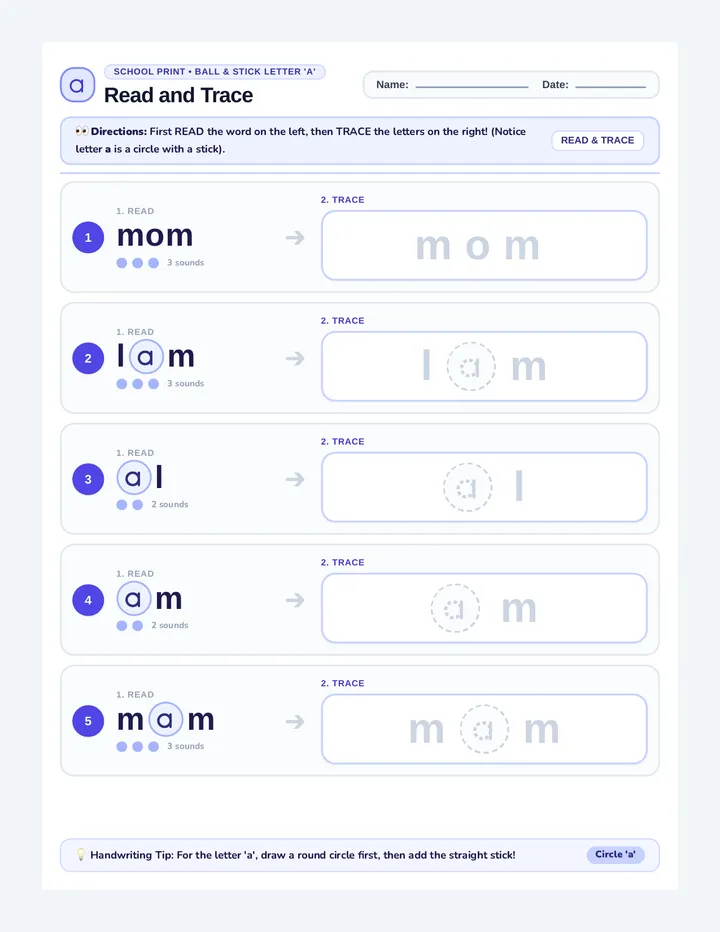
Word Spelling Practice Worksheet

Word Spelling Practice Worksheet

A large-print special education phonics worksheet for reading and tracing mom, lam, al, am, and mam with clean open tracing boxes (no triple lines), school circle-style letter a, and uniform sound dots with no yellow dots.

M

michelle.bernius

Book Jacket Studio Worksheet

Book Jacket Studio Worksheet

A comprehensive 2-page book jacket and front-matter design worksheet where students craft their own book cover illustration, back cover blurb, endorsements, dedication, table of contents, chapter names, preface, and interior illustration.

MG

MICHELLE GRIMALDI

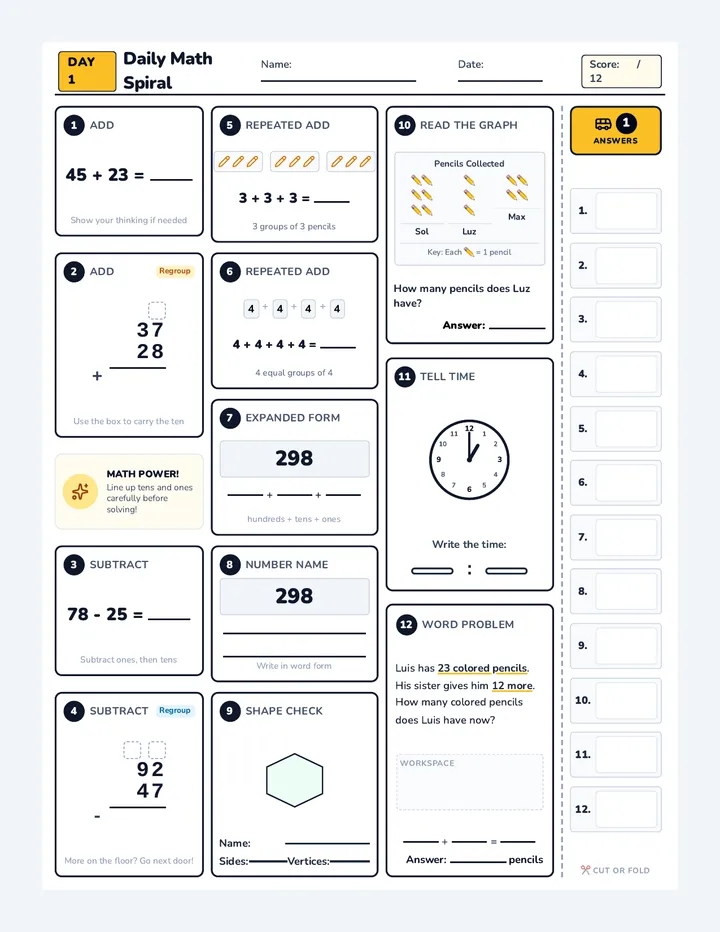
Weekly Math Spiral Packet

Weekly Math Spiral Packet

A 5-day printable weekly math spiral review packet (Monday to Friday) covering 2-digit addition and subtraction with regrouping, repeated addition, 3-digit expanded form, number names, 2D/3D geometry, graphs, analog time, and word problems, complete with a quick-grader answer strip.

DL

Damaris Lopez Valentin

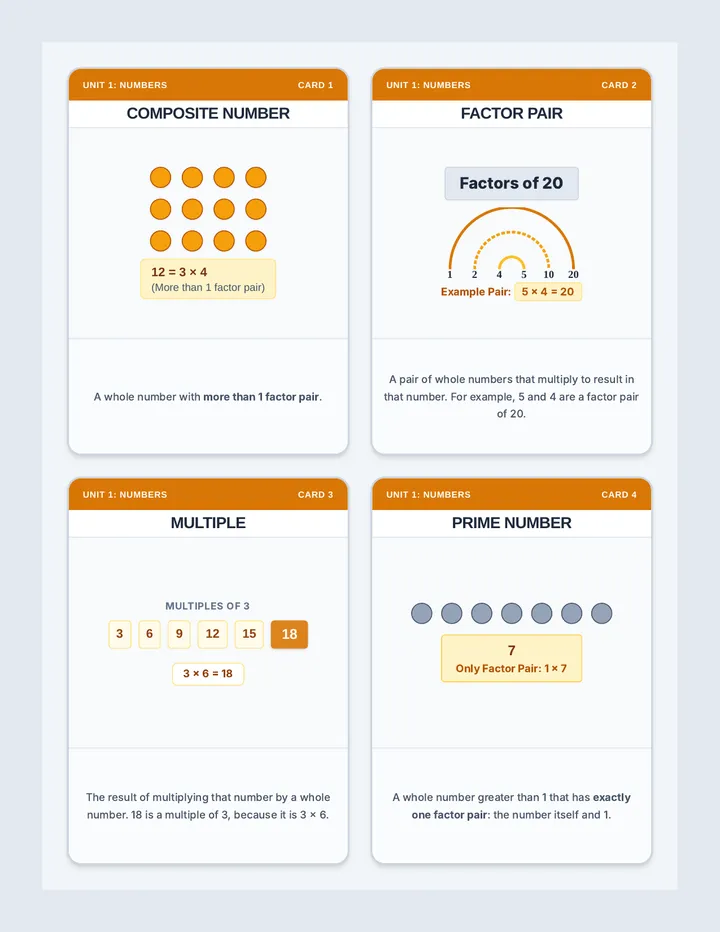
Math Vocabulary Flashcards

Math Vocabulary Flashcards

A complete, comprehensive classroom-ready set of 40 standard index-sized math vocabulary flashcards (4 per page) spanning Units 1 to 8. Includes unit fractions, mixed numbers, operations, geometry, and shape classifications with high-contrast diagrams and definitions.

N

nmack

Button Detective Exit Ticket

Button Detective Exit Ticket

A single-page exit ticket assessing student ability to classify and identify buttons by color, shape, and number of holes. Features visual button graphics and kid-friendly prompts for early elementary learners.

SB

Sondra Bell

Polygon Patrol Worksheet

Polygon Patrol Worksheet

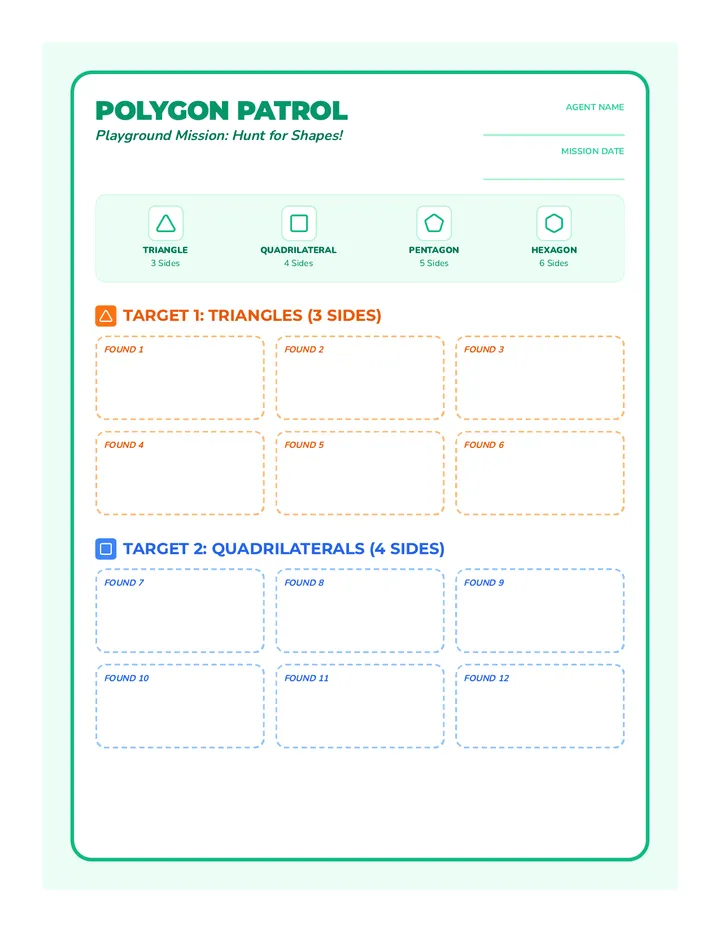
A double-sided polygon scavenger hunt worksheet for 3rd graders. It features categories for triangles, quadrilaterals, pentagons, and hexagons with drawing/writing slots for up to 24 objects found on a playground. Includes reflection questions and a visual shape key. Forced 2-page layout.

BP

Beth Phillips

Sequences

Packet Master TOC document

Unit 6 Equal Groups and Multiplication

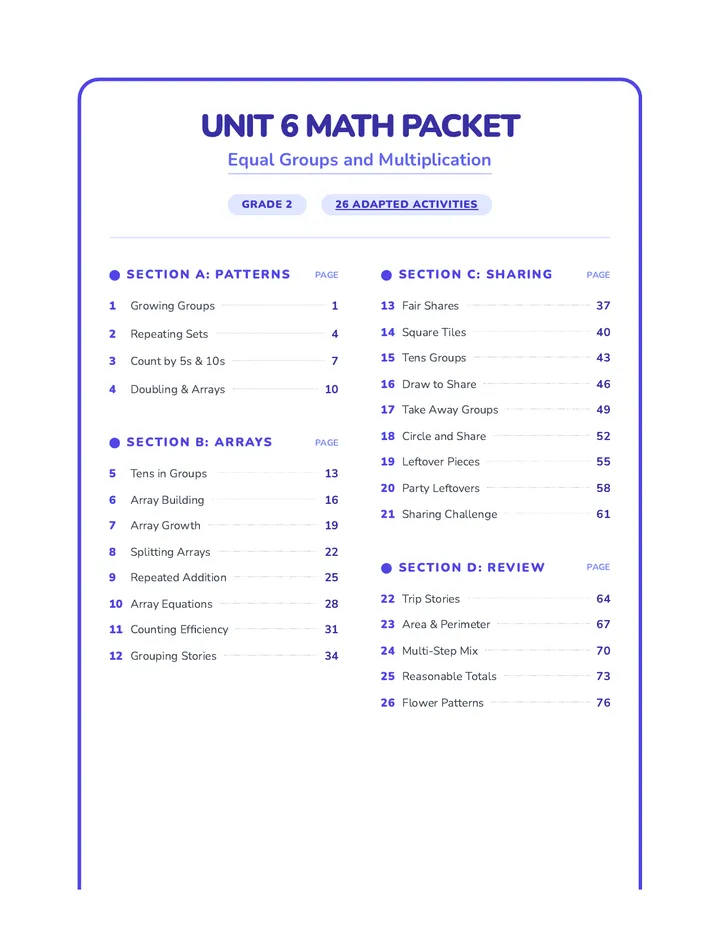
A comprehensive Grade 2 math packet focused on skip counting, repeated addition, arrays, and equal groups.

N

nmack

39
Camp Multi-Math Worksheet

Math Review Adventures

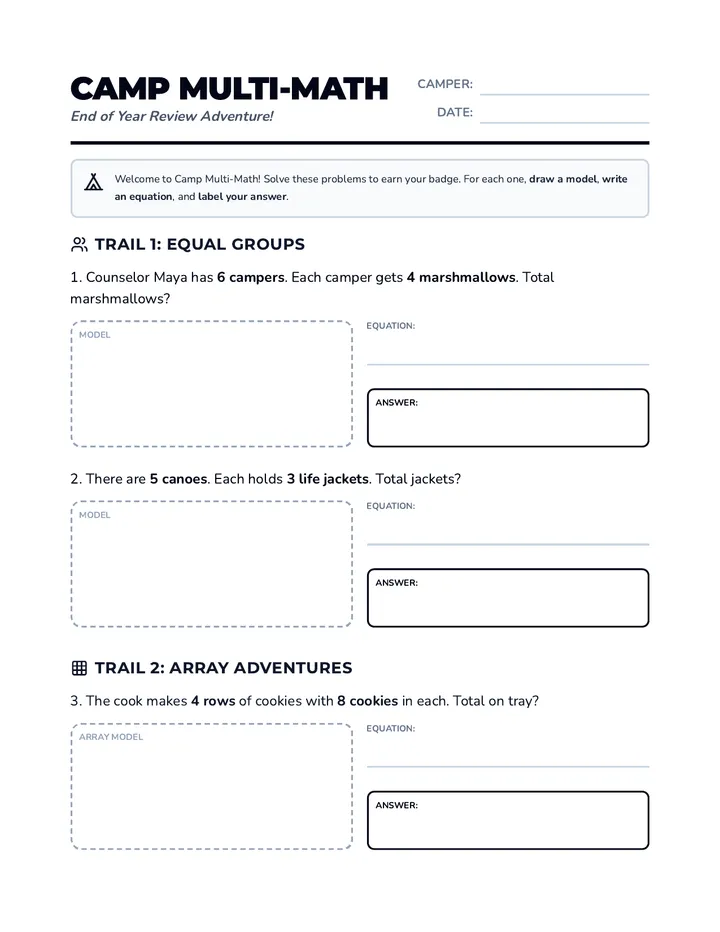
A collection of themed end-of-year math review adventures for different grade levels, focusing on spiraling key standards and problem-solving.

DB

Deborah Burton

21
3 Reads Strategy Poster

Math Blueprints Grade 5

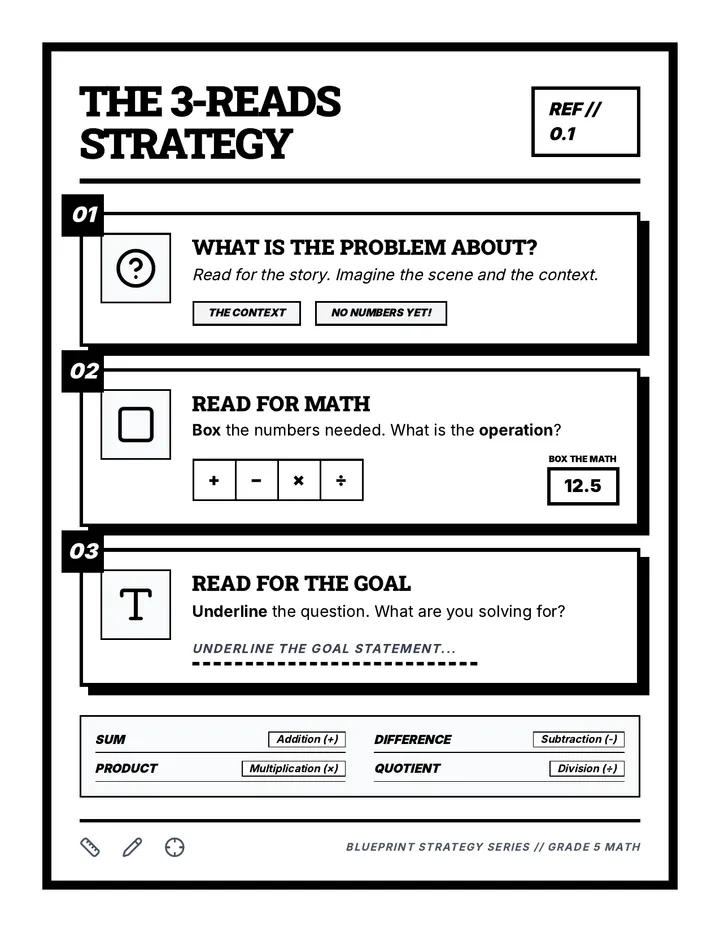
A comprehensive set of math supports for 5th-grade students in a co-taught environment. Each unit includes visual vocabulary, worked examples, cloze-style guided notes, and exit tickets featuring a 'Mistake of the Day' analysis.

HJ

Hope Joel

23
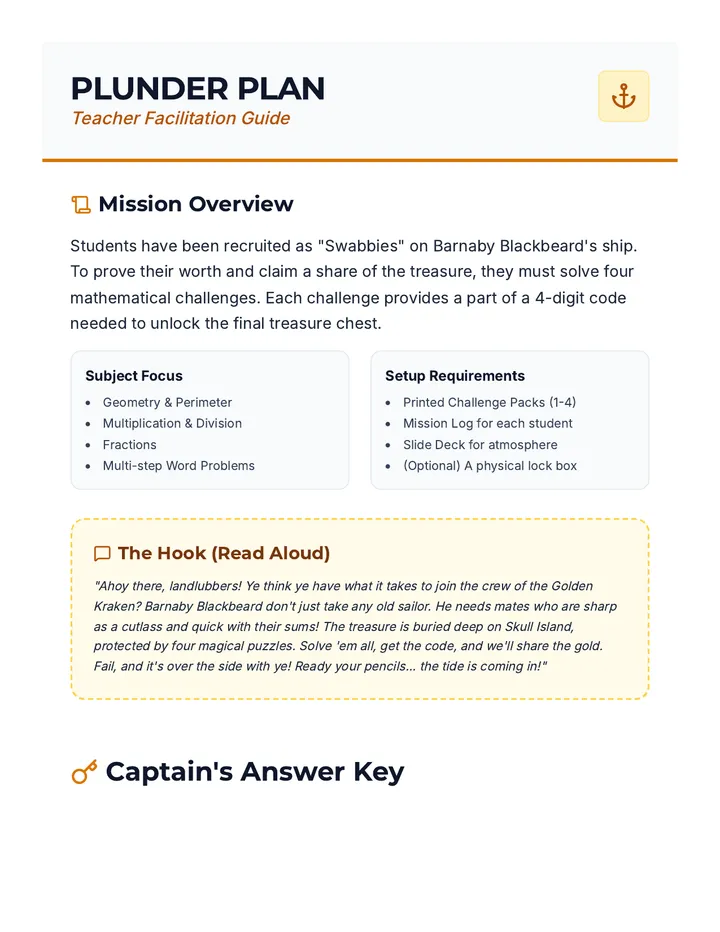
Plunder Plan Teacher Guide

Pirate Math Plunder

A pirate-themed 3rd grade math review escape room where students solve puzzles involving geometry, multiplication, division, fractions, and word problems to find the hidden treasure.

DG

Danielle Garland

12
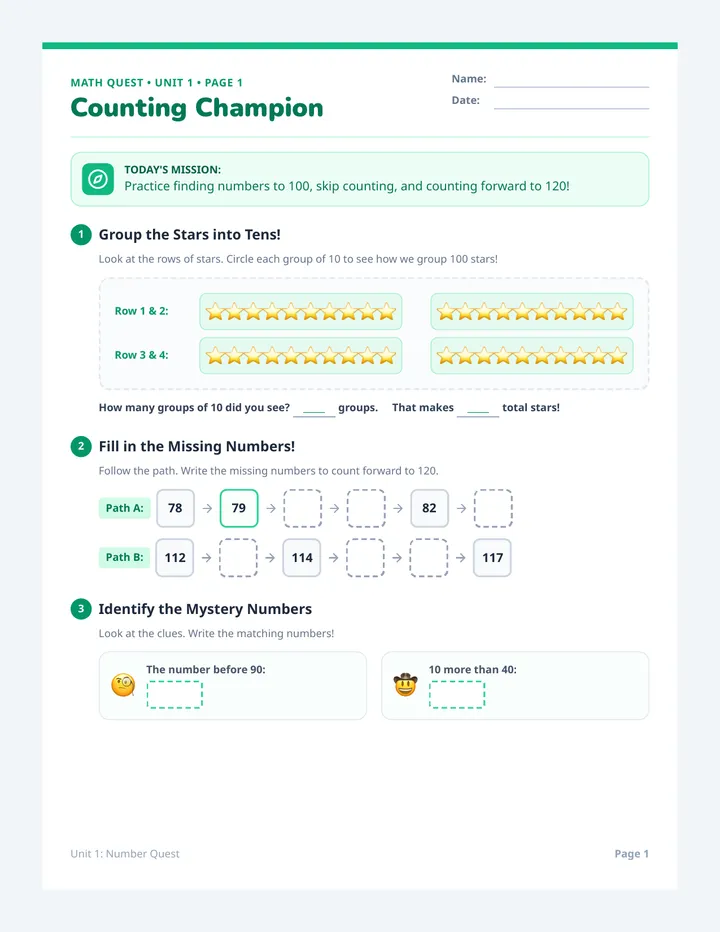
Number Quest Workbook

Math Quest Tutoring

A comprehensive 1st and 2nd-grade math tutoring sequence featuring heavily scaffolded worksheets and visual progress monitoring kits. Covers number sense, algebraic operations, geometry, and measurement.

JC

Jennifer Campbell

16
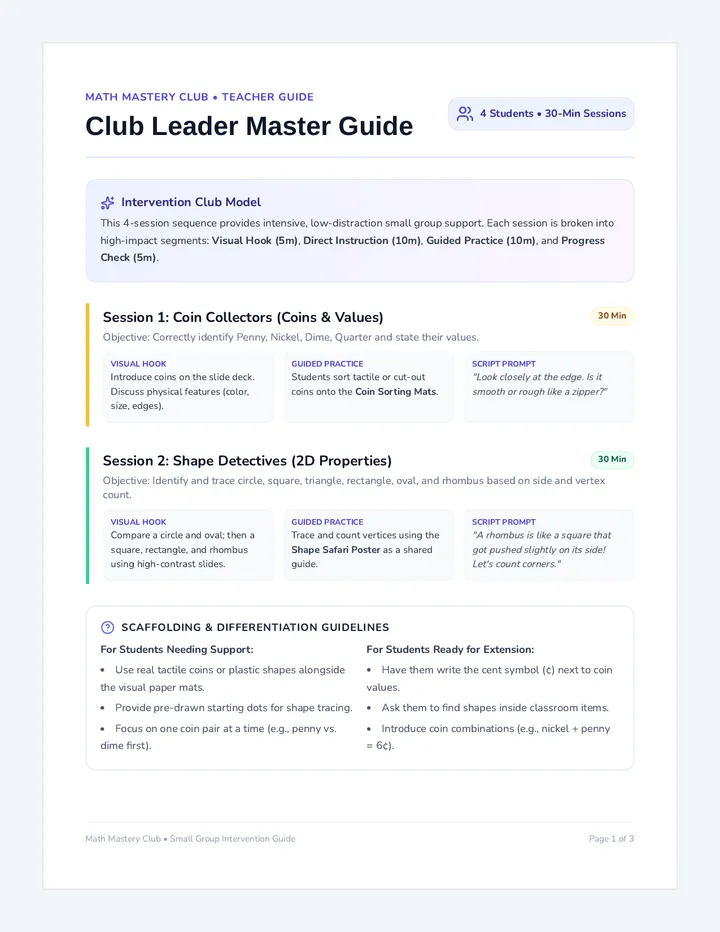
Club Leader Master Guide

Math Mastery Club

An expanded 14-session, cohesive small-group math intervention sequence for four 1st-grade students. Covers coin values (penny, nickel, dime, quarter) over 3 sessions; 2D shapes (circle, square, triangle, rectangle, oval, rhombus) over 3 sessions; and step-by-step number decomposition to make a ten for addition (3 sessions) and subtraction (3 sessions) to ensure deep student mastery.

K

kurtzm

37

Lessons

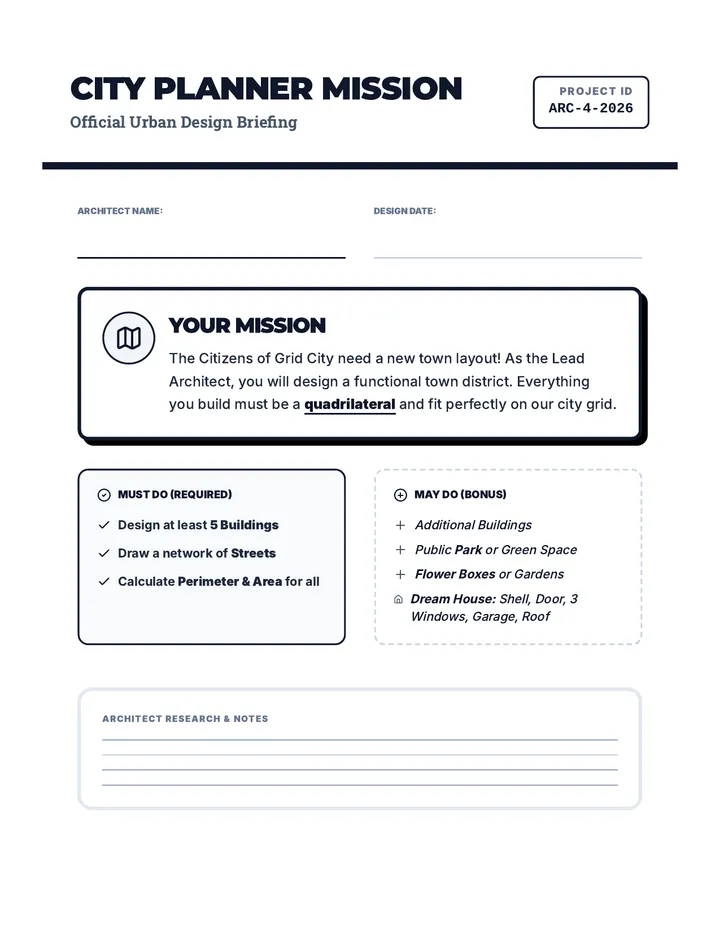
City Planner Mission Guide

Grid City Architects

Students act as urban architects to design a town using quadrilaterals on a grid, calculating perimeter and area for their structures.

TC

Tracey Craft

5
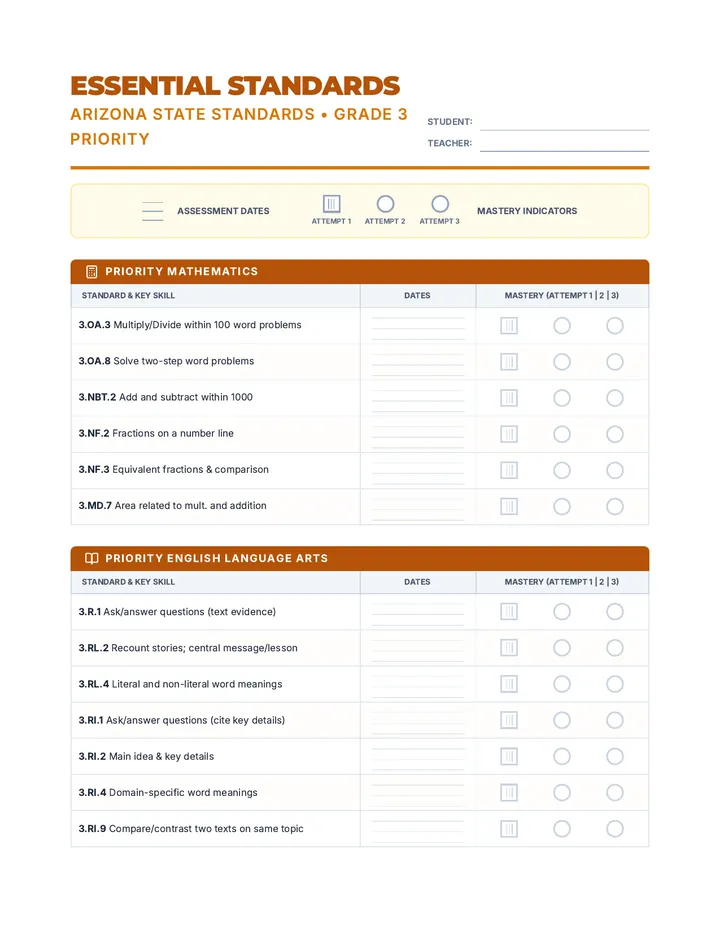
Essential Standards Tracker Document

Arizona Mastery Trackers

A collection of standards mastery tracking cards for Grade 3 Arizona students, covering Math and ELA with a consistent multi-attempt tracking system.

KB

Krista Bodkin

3
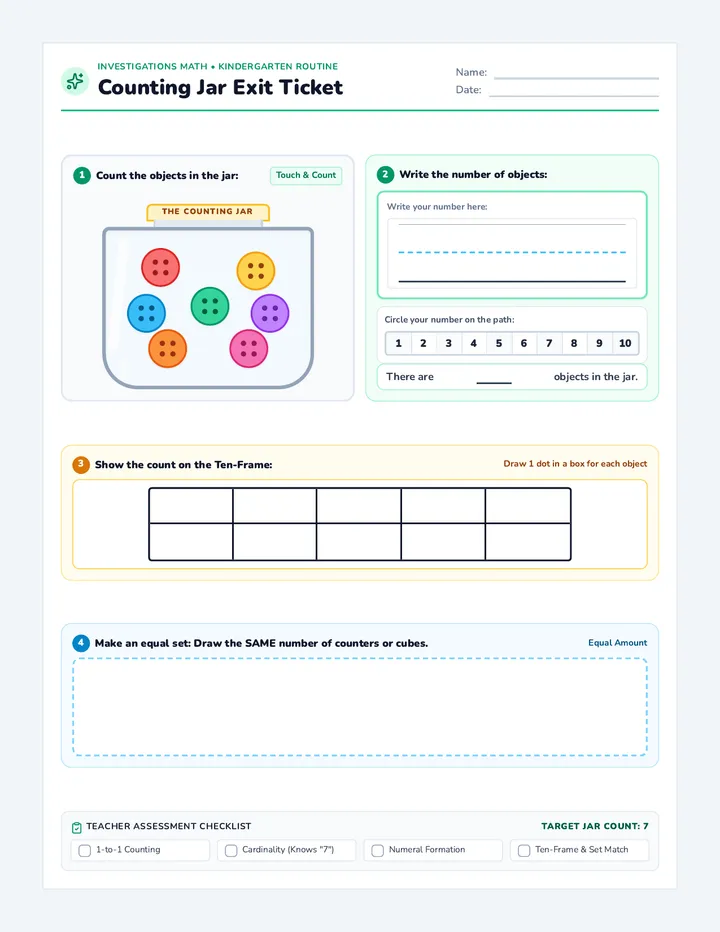
Counting Jar Exit Ticket

Number Trail Explorers

A kindergarten math lesson focused on counting routines, cardinality, and number sequence development up to 20. Students practice recording quantities, counting forwards, and identifying missing numerals in sequence.

SB

Sondra Bell

17
Shape Slicers Slides Final Polished v2

Shape Slice-Up Bakery

A comprehensive 1st-grade lesson on partitioning squares, circles, and rectangles into equal shares of halves and fourths, designed for an observation with a focus on clear learning targets and student engagement.

CC

Crystal Clapin

12
Shape Squad Slides

Shape Squad Investigations

Students explore shared attributes of shapes to understand the category of quadrilaterals, specifically identifying squares, rectangles, and rhombuses while also creating non-standard quadrilaterals.

KB

Krista Bodkin

6
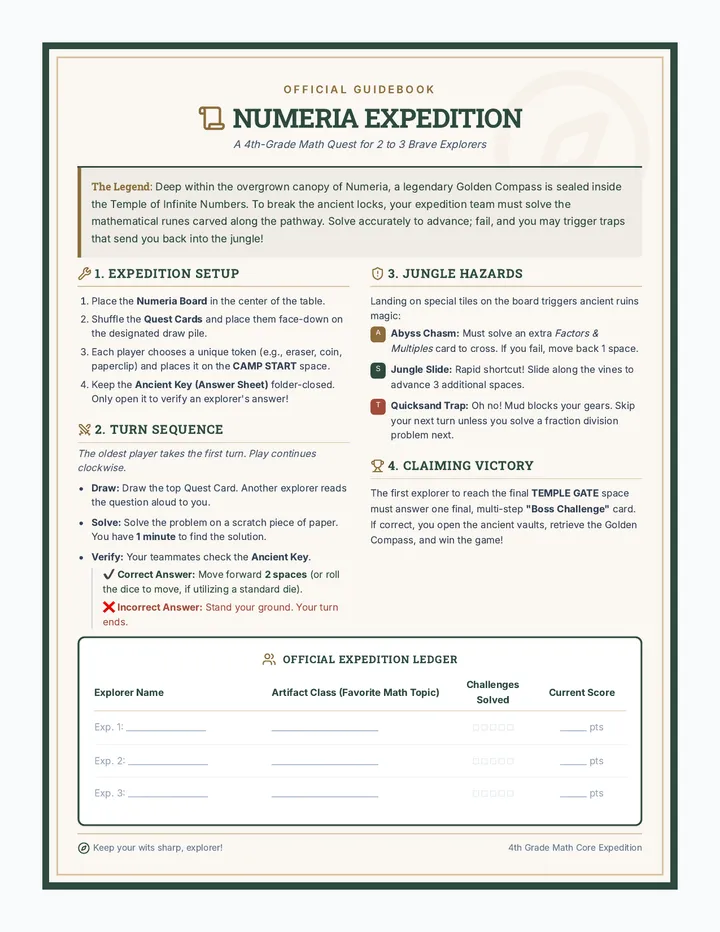
Numeria Expedition Rulebook

Numeria Expedition

A comprehensive, adventure-style 4th-grade math review board game where students solve challenges across 8 core curriculum units to escape the ruins of Numeria. Designed for 2-3 players, it features a printable game board, challenge cards, a player rulebook, and a quick-reference answer key.

N

nmack

4