Sinusoids Lesson Plan Modular Unit 1 Precalculus & Advanced Algebra
Sinusoids Lesson Plan
Instructional Framework: Graphing & Parametric Transformations of \(y = A\sin(B(x-C)) + D\)
45-90 min Flexible
Learning Target
Graph sine and cosine waves using amplitude, period, phase shift, and midline via the 5-point key frame strategy.
Core Competency
Deconstruct parametric changes \(A, B, C, D\) and extract functional equations directly from graphical cycles.
Pacing Paths
Standard: 2 × 45 min
Modular Instructional Sequence
10 Min
Phase 1: Unit Circle Projection & Harmonic Hook
Map rotating coordinates on the unit circle \((\cos\theta, \sin\theta)\) onto unwrapped horizontal axes. Contrast the natural period \(2\pi\) against frequency.
20 Min
Phase 2: Direct Instruction & Parametric Anatomy
Formulate standard form \(y = A\sin(B(x-C)) + D\). Emphasize factoring \(B\) out: \(\text{Period} = \frac{2\pi}{|B|}\), Midline \(y = D\), Amplitude \(= |A|\), Phase Shift \(= C\).
25 Min
Phase 3: The 5-Point Frame Workshop
Guided practice partitioning 1 cycle into quarter-periods: \(\Delta x = \frac{\text{Period}}{4}\). Compute \(x\)-coordinates \(C, C+\Delta x, C+2\Delta x, \dots\) and track midline/peak/trough patterns.
15 Min
Phase 4: Synthesis & Application Anchor
Pairs write sinusoid models for cyclical biological phenomena (body temperature cycle) and check using critical coordinate verification.
Critical Misconceptions
Unfactored Phase Shifts: In \(y = \sin(2x - \pi)\), students identify shift as \(\pi\) rather than factoring \(2(x - \frac{\pi}{2})\) giving shift \(\frac{\pi}{2}\).Frequency vs. Period: Confusing \(B\) with period. Reiterate \(\text{Period} = \frac{2\pi}{B}\).Negative Amplitude: Forgetting that \(A < 0\) causes reflection across the midline \(y = D\), while amplitude remains \(|A|\).
Differentiation Strategies
Tier 1 (Scaffolded): Provide coordinate grid templates with quarter-period reference tick-marks pre-labeled.Tier 2 (Core): Graph by constructing the 5-point table independently from scratch.Tier 3 (Extension): Derive both a sine AND cosine equation for the exact same curve by toggling phase shift.
Paired Materials: Sinusoids Slide Deck Sinusoids Graphing Worksheet Sinusoids Graphing Key
Wave Dynamics • Module 1
Sinusoids Slide Deck MODULE 1 • SLIDE DECK Trigonometric Transformations
Wave Dynamics
Anatomy of a Sinusoidal Wave
Any transformed wave can be written in factored standard form:
\(y = A \sin\bigl(B(x - C)\bigr) + D\)
Amplitude \(|A|\)
Vertical stretch from midline to peak. If \(A < 0\), reflect vertically across midline.
Period \(T = \frac{2\pi}{|B|}\)
Horizontal distance for one complete cycle. \(B\) is frequency coefficient.
Phase Shift \(C\)
Horizontal shift. Shift right if \(x - C\), shift left if \(x + C\). Factor \(B\) first!
Midline \(y = D\)
Vertical translation. Horizontal center line of balance: \(D = \frac{\text{Max} + \text{Min}}{2}\).
Standard Form Protocol Slide 1 of 4
TECHNIQUE Graphing Strategy
The 5-Point Frame
The 5-Point Key Frame Protocol
Every standard sine and cosine wave cycle divides into exactly 4 equal sub-intervals using quarter-periods:
Calculating \(x\)-Coordinates
Step 1: Quarter-Step: \(\Delta x = \frac{\text{Period}}{4} = \frac{2\pi}{4B} = \frac{\pi}{2B}\)
Step 2: Start Point: \(x_0 = C\) (Phase Shift)
Step 3: Add Step \(\Delta x\): \(x_1 = C+\Delta x, \; x_2 = C+2\Delta x, \dots\)
Standard Wave Cycles
Standard Sine (\(+A\)):
Midline \(\rightarrow\) Peak \(\rightarrow\) Midline \(\rightarrow\) Trough \(\rightarrow\) Midline
Standard Cosine (\(+A\)):
Peak \(\rightarrow\) Midline \(\rightarrow\) Trough \(\rightarrow\) Midline \(\rightarrow\) Peak
*If \(A < 0\), flip peaks and troughs across midline \(y = D\).
Key Frame Technique Slide 2 of 4
WORKED EXAMPLE Step-by-Step Execution
Graphing Transformed Cosine
Graph: \(y = -3\cos\bigl(2x - \pi\bigr) + 1\)
Reflected Cosine
1. Factor Frequency \(B\)
Always pull out coefficient 2:
\(y = -3\cos\left[2\left(x - \frac{\pi}{2}\right)\right] + 1\)
Notice: Phase shift is \(+\frac{\pi}{2}\) right!
2. Extract Core Parameters
Amplitude: \(|A| = |-3| = 3\)
Period: \(T = \frac{2\pi}{2} = \pi\)
Quarter-step: \(\Delta x = \frac{\pi}{4}\)
Phase Shift: \(C = \frac{\pi}{2}\) right
Midline: \(y = 1\) (Range: \([-2, 4]\))
3. The 5 Key Coordinates
Start at \(x_0 = \frac{\pi}{2}\) (Trough due to \(-A\)):
\((\frac{2\pi}{4}, -2)\) \(\rightarrow\) Trough (\(1 - 3\))
Sinusoids Graphing Worksheet Precalculus Workshop
Sinusoids Graphing Worksheet
Transformations, 5-Point Key Frames & Wave Extraction
Name: ___________________________
Date: _____________ Period: _____
1 Part 1: Parametric Decomposition Table
Deconstruct each transformed function into its standard parameters. Factor \(B\) before determining phase shift.
| Function Equation | Amplitude \(|A|\) | Period \(T\) | Phase Shift \(C\) | Midline \(y=D\) | Range \([y_{\min}, y_{\max}]\) |
| --- | --- | --- | --- | --- | --- |
| \(y = 4\cos(2x) - 3\) | | | | | |
| \(y = -2\sin(3x + \pi) + 5\) | | | | | |
| \(y = \frac{1}{2}\cos\left(\frac{\pi}{4}x - \frac{\pi}{2}\right) - 1\) | | | | | |
2 Part 2: Guided Five-Point Graphing Walkthrough
Given the equation: \(y = 3\sin\left(2x - \pi\right) - 1\)
Factored Form: ___________________
Period: ___________________
Quarter-Step \(\Delta x\): _____________
Phase Shift: _________________
5-Point Key Coordinate Table:
Point \(x\)-value Wave Feature \(y\)-value 1 Midline 2 Peak 3 Midline 4 Trough 5 Midline
Plot Exactly 1 Full Cycle (Label scale & dashed midline):
x y
Wave Dynamics • Module 1 Page 1 of 2
Sinusoids Graphing & Application
Independent Transformation & Modeling
Module 1 • Page 2
3 Part 3: Independent Graphing with Reflection
Graph one complete cycle of: \(y = -2\cos\left(\frac{1}{2}x + \frac{\pi}{4}\right) + 3\). Show all parameter calculations, construct the 5-point table, and sketch the graph.
Factored Eq: _______________
Period: ___________________
Phase Shift: _________________
Quarter \(\Delta x\): ______________
5 Critical Coordinates:
Point 1: (________ , ________)
Point 2: (________ , ________)
Point 3: (________ , ________)
Point 4: (________ , ________)
Point 5: (________ , ________)
Graph (Label axes, amplitude, & midline):
4 Part 4: Contextual Modeling — Biological Circadian Rhythms
Sinusoids Graphing Key Teacher Solutions & Scoring
Sinusoids Graphing Key
Step-by-Step Evaluated Key • Module 1
Answer Key
1 Part 1: Parametric Decomposition Solutions
| Function | Amp \(|A|\) | Period \(T\) | Phase Shift \(C\) | Midline \(y=D\) | Range |
| --- | --- | --- | --- | --- | --- |
| \(y = 4\cos(2x) - 3\) | 4 | \(\pi\) | 0 (None) | \(y = -3\) | \([-7, 1]\) |
| \(y = -2\sin(3x + \pi) + 5\) | 2 | \(\frac{2\pi}{3}\) | \(-\frac{\pi}{3}\) (Left \(\frac{\pi}{3}\)) | \(y = 5\) | \([3, 7]\) |
| \(y = \frac{1}{2}\cos\left(\frac{\pi}{4}x - \frac{\pi}{2}\right) - 1\) | \(\frac{1}{2}\) | 8 | \(2\) (Right 2) | \(y = -1\) | \([-1.5, -0.5]\) |
*Note: In row 3, factor \(\frac{\pi}{4}\): \(\frac{\pi}{4}(x - 2)\), giving period \(\frac{2\pi}{\pi/4} = 8\) and phase shift \(+2\).
2 Part 2: Guided 5-Point Graphing Solutions
Factored: \(3\sin[2(x - \frac{\pi}{2})] - 1\)
Period: \(\frac{2\pi}{2} = \pi\)
Quarter-Step: \(\Delta x = \frac{\pi}{4}\)
Phase Shift: \(\frac{\pi}{2}\) Right
5-Point Coordinate Proof:
Pt \(x\)-value Feature \(y\)-value 1 \(\pi/2\) Midline \(-1\) 2 \(3\pi/4\) Peak \(2\) 3 \(\pi\) Midline \(-1\) 4 \(5\pi/4\) Trough \(-4\) 5 \(3\pi/2\) Midline \(-1\)
Full Cycle Solution Verification:
Midline: \(y = -1\) (dashed cyan) Amplitude: \(3\) (Peak: \(2\), Min: \(-4\))
π/2 3π/4 π 5π/4 3π/2
Interval spans from \(\pi/2\) to \(3\pi/2\) (Total width \(= \pi\)).
Wave Dynamics • Module 1 Page 1 of 2
Sinusoids Independent & Modeling Key
Evaluated Curves & Real-World Synthesis
Answer Key • Page 2
3 Part 3: Independent Graphing Solutions
\(y = -2\cos\left(\frac{1}{2}x + \frac{\pi}{4}\right) + 3 = -2\cos\left[\frac{1}{2}\left(x + \frac{\pi}{2}\right)\right] + 3\)
Amp: 2 (Reflected)
Period: \(\frac{2\pi}{1/2} = 4\pi\)
Shift: \(-\frac{\pi}{2}\) (Left \(\frac{\pi}{2}\))
\(\Delta x\): \(\frac{4\pi}{4} = \pi\)
5 Point Proof Table:
Pt 1: \((-\frac{\pi}{2}, 1)\) \(\rightarrow\) Trough \((3-2)\)
Reciprocals and Inverses Slides MODULE 2 • SLIDES Reciprocal & Inverse Relations
Wave Dynamics
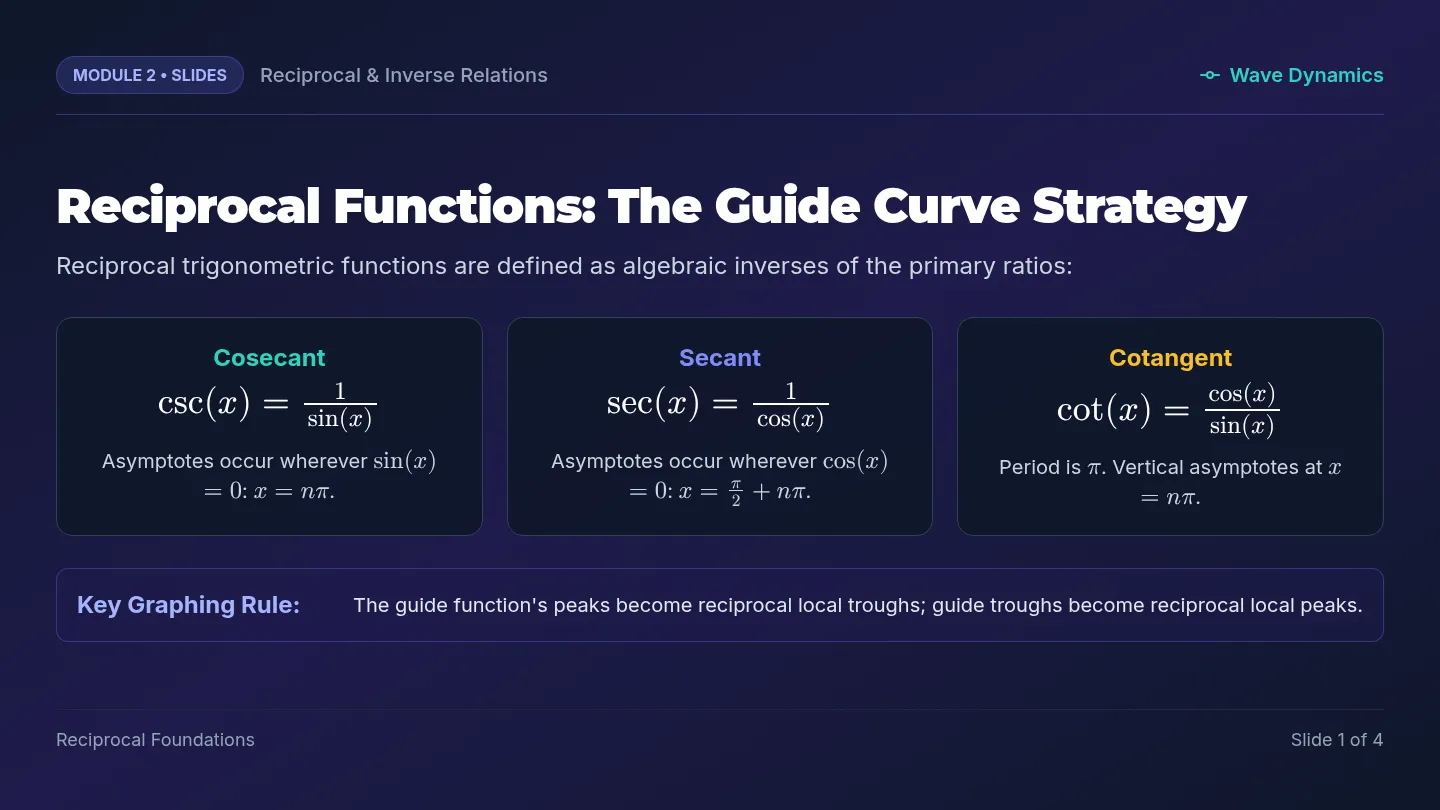
Reciprocal Functions: The Guide Curve Strategy
Reciprocal trigonometric functions are defined as algebraic inverses of the primary ratios:
Cosecant
\(\csc(x) = \frac{1}{\sin(x)}\)
Asymptotes occur wherever \(\sin(x) = 0\): \(x = n\pi\).
Secant
\(\sec(x) = \frac{1}{\cos(x)}\)
Asymptotes occur wherever \(\cos(x) = 0\): \(x = \frac{\pi}{2} + n\pi\).
Cotangent
\(\cot(x) = \frac{\cos(x)}{\sin(x)}\)
Period is \(\pi\). Vertical asymptotes at \(x = n\pi\).
Key Graphing Rule: The guide function's peaks become reciprocal local troughs; guide troughs become reciprocal local peaks.
Reciprocal Foundations Slide 1 of 4
TECHNIQUE Guide Curve Graphing
Graphing Transformed Reciprocals
Graphing Protocol for \(y = A\sec(B(x-C)) + D\)
Follow the 3-step guide wave transformation protocol:
1 Light Guide Curve
Lightly sketch the companion sinusoidal curve:
\(y = A\cos(B(x-C)) + D\)
Find 5 key points and sketch dashed.
2 Vertical Asymptotes
Draw vertical dashed asymptotes where the guide wave crosses its midline \(y = D\):
\(\text{Guide} = D \implies \text{Reciprocal} = \pm \infty\)
Division by zero generates asymptotes.
3 Invert The Branches
At each peak, open a U-branch upward toward asymptotes.
At each trough, open a U-branch downward toward asymptotes.
The curves share vertices with the guide.
Guide Wave Protocol Slide 2 of 4
THEORY Domain Restrictions
Inverse Functions
Inverse Trigonometric Restricted Domains
Periodic functions fail the Horizontal Line Test. We restrict the domain to create true, one-to-one inverse functions:
\(\arcsin(x)\) or \(\sin^{-1}(x)\)
Domain: \([-1, 1]\)
Range: \([-\frac{\pi}{2}, \frac{\pi}{2}]\)
Quadrants I & IV
Outputs negative angles in Q4, e.g. \(-\frac{\pi}{6}\), NOT \(\frac{11\pi}{6}\).
\(\arccos(x)\) or \(\cos^{-1}(x)\)
Domain: \([-1, 1]\)
Range: \([0, \pi]\)
Quadrants I & II
Outputs obtuse angles in Q2 for negative inputs, e.g. \(\arccos(-\frac{1}{2}) = \frac{2\pi}{3}\).
\(\arctan(x)\) or \(\tan^{-1}(x)\)
Domain: \((-\infty, \infty)\)
Reciprocals and Inverses Worksheet Precalculus Workshop
Reciprocals and Inverses Worksheet
Guide Wave Graphing, Asymptotes & Inverse Relations
Name: ___________________________
Date: _____________ Period: _____
1 Part 1: Reciprocal Function Characteristic Analysis
State the guide function equation, period, and general equation for vertical asymptotes:
Given Function Companion Guide Function Period Vertical Asymptotes (\(k \in \mathbb{Z}\)) \(y = 3\csc(2x)\) \(x = \) \(y = -2\sec\left(x - \frac{\pi}{3}\right)\) \(x = \) \(y = \cot\left(\frac{1}{2}x\right)\) \(x = \)
2 Part 2: Guided Reciprocal Graphing with Guide Waves
Graph one full period of: \(y = 2\sec\left(x - \frac{\pi}{4}\right) + 1\)
Guide Cosine: \(y = 2\cos(x - \frac{\pi}{4}) + 1\)
Midline: \(y = 1\) (Asymptote line)
Range: \((-\infty, -1] \cup [3, \infty)\)
Guide Wave 5 Key Coordinates:
Peak 1: \((\frac{\pi}{4}, 3)\)
Midline 1: \((\frac{3\pi}{4}, 1) \rightarrow\) Asymptote
Trough: \((\frac{5\pi}{4}, -1)\)
Midline 2: \((\frac{7\pi}{4}, 1) \rightarrow\) Asymptote
Peak 2: \((\frac{9\pi}{4}, 3)\)
Execution Note: Lightly sketch the dashed guide curve first. Draw dashed vertical asymptote lines through midlines. Then construct the U-shaped secant branches outward.
Graph Guide & Secant Branches (Label scale & asymptotes):
x y
Wave Dynamics • Module 2 Page 1 of 2
Inverse Trigonometric Analysis
Principal Branches, Exact Triangle Models & Navigation
Module 2 • Page 2
3 Part 3: Exact Evaluation & Principal Branches
Evaluate each exact expression in radians. Respect the principal branch intervals for each function.
Expression Permissible Branch Quadrant Exact Radian Value \(a) \; \arcsin\left(-\frac{\sqrt{3}}{2}\right)\) [-\pi/2, \pi/2] \(b) \; \arccos\left(-\frac{\sqrt{2}}{2}\right)\) [0, \pi] \(c) \; \arctan(-\sqrt{3})\)
Reciprocals and Inverses Key Teacher Solutions & Scoring
Reciprocals and Inverses Key
Step-by-Step Analytical Solutions • Module 2
Answer Key
1 Part 1: Reciprocal Analysis Solutions
Function Guide Companion Period Vertical Asymptotes (\(k \in \mathbb{Z}\)) \(y = 3\csc(2x)\) \(y = 3\sin(2x)\) \(\pi\) \(x = \frac{k\pi}{2}\) \(y = -2\sec\left(x - \frac{\pi}{3}\right)\) \(y = -2\cos(x - \frac{\pi}{3})\) \(2\pi\) \(x = \frac{5\pi}{6} + k\pi\) \(y = \cot\left(\frac{1}{2}x\right)\) \(y = \tan(\frac{1}{2}x)\) \(2\pi\) \(x = 2k\pi\)
*Derivation note: Row 2 asymptotes satisfy \(x - \frac{\pi}{3} = \frac{\pi}{2} + k\pi \implies x = \frac{5\pi}{6} + k\pi\).
2 Part 2: Guided Secant Graphing Solutions
Guide Wave: \(2\cos(x - \frac{\pi}{4}) + 1\)
Asymptote Lines: \(x = \frac{3\pi}{4}, \; x = \frac{7\pi}{4}\)
Branch Vertices: \((\frac{\pi}{4}, 3), \; (\frac{5\pi}{4}, -1)\)
Graphing Sequence:
1. Plot dashed midline at \(y = 1\).
2. Plot guide crests at \((\frac{\pi}{4}, 3)\) & \((\frac{9\pi}{4}, 3)\).
3. Plot guide trough at \((\frac{5\pi}{4}, -1)\).
4. Draw vertical dashed asymptotes at midline zeros \(x = \frac{3\pi}{4}\) and \(x = \frac{7\pi}{4}\).
5. Branch upward from crests; branch downward from trough.
Guide: Dashed Gray Secant Branches: Solid Cyan
x=3π/4 x=7π/4
Vertical Range: \((-\infty, -1] \cup [3, \infty)\).
Wave Dynamics • Module 2 Page 1 of 2
Inverse Functions & Navigation Key
Exact Triangle Proofs & Line-of-Sight Trigonometry
Answer Key • Page 2
3 Part 3: Exact Inverse Evaluation Solutions
Expression Permissible Branch Quadrant Exact Radian Value \(a) \; \arcsin\left(-\frac{\sqrt{3}}{2}\right)\) [-\pi/2, \pi/2] IV \(-\frac{\pi}{3}\) \(b) \; \arccos\left(-\frac{\sqrt{2}}{2}\right)\) [0, \pi] II \(\frac{3\pi}{4}\) \(c) \; \arctan(-\sqrt{3})\) (-\pi/2, \pi/2)
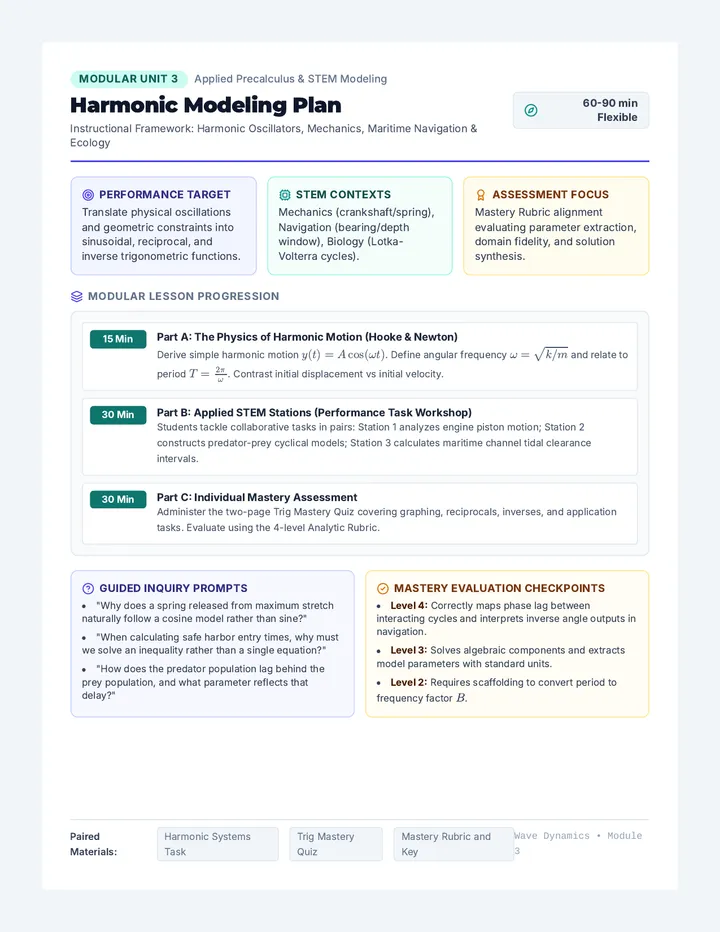
Harmonic Modeling Plan Modular Unit 3 Applied Precalculus & STEM Modeling
Harmonic Modeling Plan
Instructional Framework: Harmonic Oscillators, Mechanics, Maritime Navigation & Ecology
60-90 min Flexible
Performance Target
Translate physical oscillations and geometric constraints into sinusoidal, reciprocal, and inverse trigonometric functions.
STEM Contexts
Mechanics (crankshaft/spring), Navigation (bearing/depth window), Biology (Lotka-Volterra cycles).
Assessment Focus
Mastery Rubric alignment evaluating parameter extraction, domain fidelity, and solution synthesis.
Modular Lesson Progression
15 Min
Part A: The Physics of Harmonic Motion (Hooke & Newton)
Derive simple harmonic motion \(y(t) = A\cos(\omega t)\). Define angular frequency \(\omega = \sqrt{k/m}\) and relate to period \(T = \frac{2\pi}{\omega}\). Contrast initial displacement vs initial velocity.
30 Min
Part B: Applied STEM Stations (Performance Task Workshop)
Students tackle collaborative tasks in pairs: Station 1 analyzes engine piston motion; Station 2 constructs predator-prey cyclical models; Station 3 calculates maritime channel tidal clearance intervals.
30 Min
Part C: Individual Mastery Assessment
Administer the two-page Trig Mastery Quiz covering graphing, reciprocals, inverses, and application tasks. Evaluate using the 4-level Analytic Rubric.
Guided Inquiry Prompts
"Why does a spring released from maximum stretch naturally follow a cosine model rather than sine?"
"When calculating safe harbor entry times, why must we solve an inequality rather than a single equation?"
"How does the predator population lag behind the prey population, and what parameter reflects that delay?"
Mastery Evaluation Checkpoints
Level 4: Correctly maps phase lag between interacting cycles and interprets inverse angle outputs in navigation.Level 3: Solves algebraic components and extracts model parameters with standard units.Level 2: Requires scaffolding to convert period to frequency factor \(B\).
Paired Materials: Harmonic Systems Task Trig Mastery Quiz Mastery Rubric and Key
Wave Dynamics • Module 3
Harmonic Systems Task STEM Performance Task
Harmonic Systems Task
Real-World Mathematical Modeling in Mechanics, Biology & Navigation
Name: ___________________________
Date: _____________ Period: _____
1 Context 1: Automotive Mechanics — Engine Piston Displacement
In a high-performance 4-cylinder engine, a piston travels in vertical harmonic motion between Top Dead Center (TDC at \(y = 12\text{ cm}\)) and Bottom Dead Center (BDC at \(y = 2\text{ cm}\)). The total stroke is \(10\text{ cm}\). The engine operates at a steady crankshaft speed of 3,000 RPM (revolutions per minute). At \(t = 0\text{ seconds}\), the piston is at TDC.
(a) Frequency \(f\) & Period \(T\):
(b) Amplitude \(A\) & Midline \(D\):
(c) Frequency Parameter \(B\):
(d) Write the functional model \(y(t) = A\cos(Bt) + D\) and calculate piston position at \(t = 0.005\text{ s}\):
2 Context 2: Physics — Spring-Mass Harmonic Oscillator
A calibrated 500-gram brass mass is suspended from a coil spring in a physics lab. The mass is pulled down 8 cm below equilibrium (\(y = -8\text{ cm}\)) and released from rest at \(t = 0\text{ s}\). A motion sensor records that the mass completes 5 full oscillation cycles every 2 seconds with negligible damping.
(a) Period \(T\), frequency factor \(B\), and equation \(y(t)\):
(b) Times \(t \in [0, 1]\) where mass passes equilibrium moving UP:
Wave Dynamics • Module 3 Page 1 of 2
Ecosystems & Maritime Navigation
Multivariable Oscillations & Safe Operating Intervals
Module 3 • Page 2
3 Context 3: Ecology — Predator-Prey Population Dynamics
Historical Hudson's Bay trapping records show a 10-year cyclical boom-and-bust cycle between snowshoe hares (prey) and Canada lynx (predators).
Hares \(H(t)\): Minimum of 10,000 animals; maximum of 90,000 animals. Period is 10 years. A peak occurs at \(t = 2\text{ years}\).Lynx \(L(t)\): Minimum of 2,000 animals; maximum of 10,000 animals. Period is 10 years. The lynx peak lags 2.5 years behind the hare peak due to reproductive gestation.
(a) Construct the hare model \(H(t) = A\cos(B(t-C)) + D\):
(b) Construct the lagged lynx model \(L(t)\):
(c) Calculate the hare population at \(t = 4.5\text{ years}\) (when lynx reach peak):
4 Context 4: Maritime Engineering — Channel Tidal Safety Window
A deep-draft container ship requires a minimum channel depth of 12.0 meters to navigate without touching bottom. The water depth in meters at time \(t\) hours after midnight is governed by:
\(D(t) = 4\cos\left(\frac{\pi}{6}(t - 3)\right) + 10\)
Trig Mastery Quiz Summative Assessment
Trig Mastery Quiz
Transformations, Reciprocals, Inverses & Harmonic Modeling
Name: ___________________________
Date: _____________ Score: _____ / 40
1 Section 1: Sinusoidal Transformations & 5-Point Graphing (15 Pts)
15 Points
Given the sinusoidal function: \(f(x) = -3\sin(2x - \pi) + 2\)
Factored Eq: _______________
Amplitude: _______________
Period: ___________________
Phase Shift: _______________
5-Point Key Coordinate Table:
Pt \(x\)-value \(y\)-value 1 2 3 4 5
Plot 1 Cycle (Label 5 points & midline):
2 Section 2: Reciprocal Function Analysis (10 Pts)
10 Points
Consider the transformed reciprocal function: \(g(x) = 2\sec(3x) - 1\)
(a) Write the companion guide function and state its period:
(b) Derive the general equation for all vertical asymptotes (\(k \in \mathbb{Z}\)):
(c) State the exact range of \(g(x)\) in interval notation:
Wave Dynamics • Mastery Assessment Page 1 of 2
Trig Mastery Quiz: Part II
Inverses, Algebraic Models & Harmonic Systems
Quiz • Page 2
3 Section 3: Inverses & Triangle Compositions (10 Pts)
10 Points
Q3: Exact Values in Radians (4 pts):
(a) \(\arcsin\left(-\frac{1}{2}\right) = \)
(b) \(\arccos\left(-\frac{\sqrt{3}}{2}\right) = \)
Q4: Reference Triangle Composition (6 pts):
Find an algebraic expression for \(\csc\left(\arccos(2x)\right)\) in terms of \(x\) for \(0 < x < \frac{1}{2}\). Draw and label a reference right triangle.
4 Section 4: Acoustic Harmonic Motion Modeling (5 Pts)
5 Points
An acoustic subwoofer cone produces a pure continuous concert pitch. The displacement of the cone surface in millimeters at time \(t\) seconds is given by:
\(d(t) = 2.4\cos(440\pi t)\)
(a) Amplitude \(A\) & Period \(T\):
(b) Acoustic Frequency in Hz:
(c) Displacement at \(t = \frac{1}{880}\text{ s}\):
I certify that all work presented on this assessment is entirely my own. Signature: ___________________________________
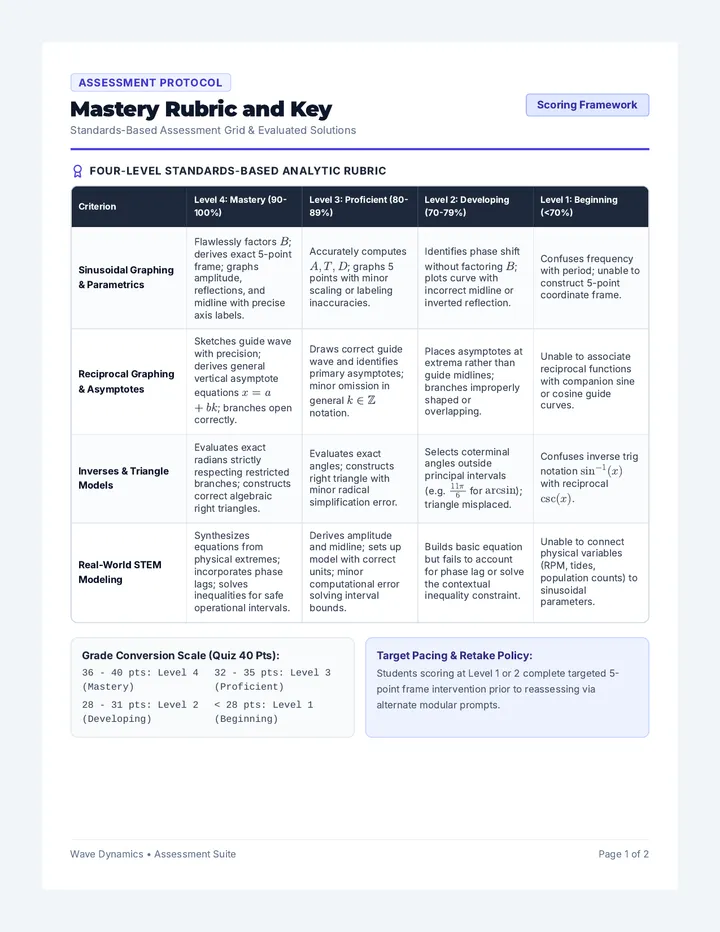
Mastery Rubric and Key Assessment Protocol
Mastery Rubric and Key
Standards-Based Assessment Grid & Evaluated Solutions
Scoring Framework
Four-Level Standards-Based Analytic Rubric
Criterion Level 4: Mastery (90-100%) Level 3: Proficient (80-89%) Level 2: Developing (70-79%) Level 1: Beginning (<70%) Sinusoidal Graphing & Parametrics Flawlessly factors \(B\); derives exact 5-point frame; graphs amplitude, reflections, and midline with precise axis labels. Accurately computes \(A, T, D\); graphs 5 points with minor scaling or labeling inaccuracies. Identifies phase shift without factoring \(B\); plots curve with incorrect midline or inverted reflection. Confuses frequency with period; unable to construct 5-point coordinate frame. Reciprocal Graphing & Asymptotes Sketches guide wave with precision; derives general vertical asymptote equations \(x = a + bk\); branches open correctly. Draws correct guide wave and identifies primary asymptotes; minor omission in general \(k \in \mathbb{Z}\) notation. Places asymptotes at extrema rather than guide midlines; branches improperly shaped or overlapping. Unable to associate reciprocal functions with companion sine or cosine guide curves. Inverses & Triangle Models Evaluates exact radians strictly respecting restricted branches; constructs correct algebraic right triangles. Evaluates exact angles; constructs right triangle with minor radical simplification error. Selects coterminal angles outside principal intervals (e.g. \(\frac{11\pi}{6}\) for \(\arcsin\)); triangle misplaced. Confuses inverse trig notation \(\sin^{-1}(x)\) with reciprocal \(\csc(x)\). Real-World STEM Modeling Synthesizes equations from physical extremes; incorporates phase lags; solves inequalities for safe operational intervals. Derives amplitude and midline; sets up model with correct units; minor computational error solving interval bounds. Builds basic equation but fails to account for phase lag or solve the contextual inequality constraint. Unable to connect physical variables (RPM, tides, population counts) to sinusoidal parameters.
Grade Conversion Scale (Quiz 40 Pts):
36 - 40 pts: Level 4 (Mastery)
32 - 35 pts: Level 3 (Proficient)
28 - 31 pts: Level 2 (Developing)
< 28 pts: Level 1 (Beginning)
Target Pacing & Retake Policy: