Quarterly Roadmap Guide Arizona High School Standards
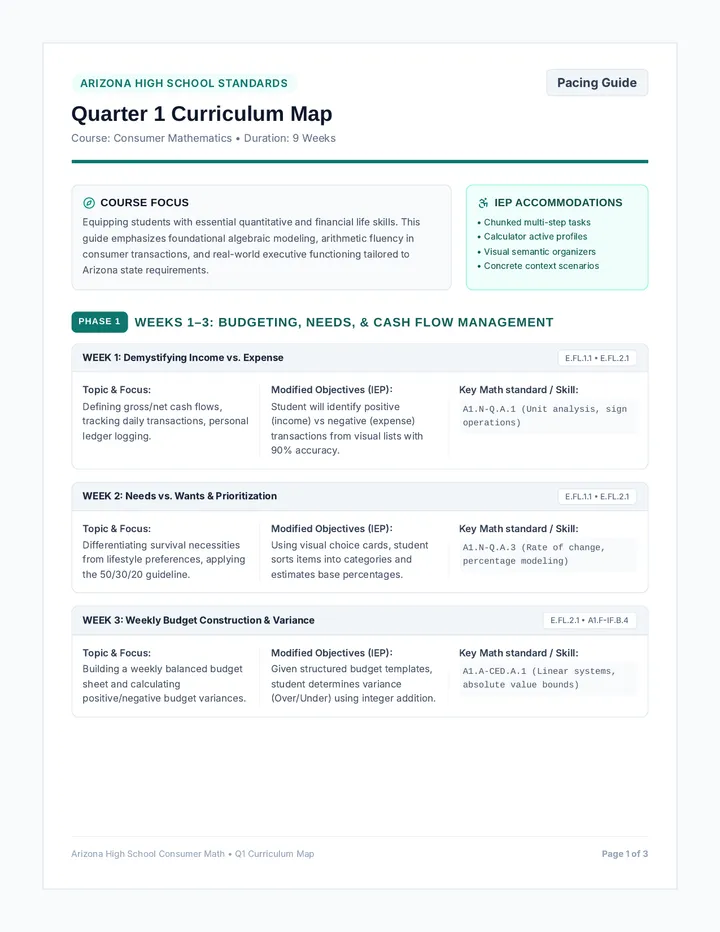
Quarter 1 Curriculum Map
Course: Consumer Mathematics • Duration: 9 Weeks
Pacing Guide
Course Focus
Equipping students with essential quantitative and financial life skills. This guide emphasizes foundational algebraic modeling, arithmetic fluency in consumer transactions, and real-world executive functioning tailored to Arizona state requirements.
IEP Accommodations
• Chunked multi-step tasks
Phase 1 Weeks 1–3: Budgeting, Needs, & Cash Flow Management
WEEK 1: Demystifying Income vs. Expense E.FL.1.1 • E.FL.2.1
Topic & Focus:
Defining gross/net cash flows, tracking daily transactions, personal ledger logging.
Modified Objectives (IEP):
Student will identify positive (income) vs negative (expense) transactions from visual lists with 90% accuracy.
Key Math standard / Skill:
A1.N-Q.A.1 (Unit analysis, sign operations)
WEEK 2: Needs vs. Wants & Prioritization E.FL.1.1 • E.FL.2.1
Topic & Focus:
Differentiating survival necessities from lifestyle preferences, applying the 50/30/20 guideline.
Modified Objectives (IEP):
Using visual choice cards, student sorts items into categories and estimates base percentages.
Key Math standard / Skill:
A1.N-Q.A.3 (Rate of change, percentage modeling)
WEEK 3: Weekly Budget Construction & Variance E.FL.2.1 • A1.F-IF.B.4
Topic & Focus:
Building a weekly balanced budget sheet and calculating positive/negative budget variances.
Modified Objectives (IEP):
Given structured budget templates, student determines variance (Over/Under) using integer addition.
Key Math standard / Skill:
A1.A-CED.A.1 (Linear systems, absolute value bounds)
Arizona High School Consumer Math • Q1 Curriculum Map Page 1 of 3
Arizona High School Standards
Quarter 1 Curriculum Map
Course: Consumer Mathematics • Duration: 9 Weeks
Pacing Guide
Phase 2 Weeks 4–6: Earning Power, Paychecks, & Tax Withholdings
WEEK 4: Hourly Wages, Tips, & Commissions E.FL.1.2 • A1.N-Q.A.1
Topic & Focus:
Calculating gross wages for hourly shifts, tracking tips, and basic commissions math.
Modified Objectives (IEP):
Multiplies single-digit/double-digit hours by standard wage rates using a personal visual reference card.
Key Math standard / Skill:
A1.F-LE.A.1 (Linear earning functions, ratios)
WEEK 5: Overtime & Timecard Calculations E.FL.1.2 • A1.A-CED.A.1
Topic & Focus:
Using decimal hours for clock times; multiplying hours over 40 by time-and-a-half (1.5x).
Modified Objectives (IEP):
Solves scaffolded timecard entries utilizing visual color blocks indicating regular vs overtime blocks.
Key Math standard / Skill:
A1.A-REI.B.3 (Piecewise wages, linear inequalities)
WEEK 6: Gross Pay vs. Net Pay Deductions E.FL.1.2 • A1.N-Q.A.1
Topic & Focus:
Analyzing physical pay stubs, calculating deductions: FICA, federal, state taxes, health benefits.
Modified Objectives (IEP):
Identifies gross pay vs net pay on real mock-up pay stubs and highlights deduction amounts.
Key Math standard / Skill:
A1.N-Q.A.2 (Variable percentages and net formulas)
Arizona High School Consumer Math • Q1 Curriculum Map Page 2 of 3
Arizona High School Standards
Quarter 1 Curriculum Map
Course: Consumer Mathematics • Duration: 9 Weeks
Pacing Guide
Phase 3 Weeks 7–9: Retail Math, Sales Tax, & Checking Accounts
WEEK 7: Unit Pricing & Comparative Shopping E.FL.1.1 • A1.N-Q.A.1
Topic & Focus:
Calculating cost per ounce/unit to determine absolute best bargains at grocery stores.
Modified Objectives (IEP):
With 1-to-1 calculator guidance, finds unit cost for 2 clean comparative options.
Key Math standard / Skill:
A1.N-Q.A.1 (Ratios, unit division conversions)
WEEK 8: Discounts, Coupons, & Arizona Sales Tax E.FL.1.1 • A1.N-Q.A.3
Topic & Focus:
Calculating percentage discounts; applying Arizona state & county taxes (~8.1% average).
Modified Objectives (IEP):
Estimates sales tax using structured rounding rules (e.g. 10 cents per dollar).
Key Math standard / Skill:
A1.F-LE.A.1 (Linear percentage modifications)
WEEK 9: Checking Accounts & Debit Ledgers E.FL.2.1 • A1.F-IF.B.4
Topic & Focus:
Reconciling statements, tracking debit transactions, preventing overdraft fees.
Modified Objectives (IEP):
Balances a simplified ledger using physical mock checks and colored deposit chips.
Key Math standard / Skill:
A1.N-Q.A.1 (Integer operations, multi-step balance)
Arizona Standardized Math Blueprint Alignment
State testing focuses heavily on quantitative reasoning (A1.N-Q.A.1-3). In order to prepare students on IEPs, daily tasks include translation of complex text scenarios into linear operations. Weekly formative math check-ins replace high-stakes block exams, providing structured feedback without processing bottlenecks.
Arizona High School Consumer Math • Q1 Curriculum Map Page 3 of 3
Cash Flow Slides Consumer Math 101
Unit 1: Budgeting
Cash Flow Bootcamp
Mastering the simple math behind real-world survival, spending, and planning.
Arizona Standard E.FL.2.1
Slide 1 of 5
Needs vs. Wants
The Baseline Split
Survival Needs
Essential expenses required for health, shelter, basic nutrition, and work/school travel.
Examples: Rent, Water, Groceries, Bus Pass
Comfort Wants
Non-essential expenses that enhance style, enjoyment, convenience, or leisure.
Examples: Concerts, Coffee Shops, Gaming, Uber Eats
Can a "Want" become a "Need" based on context?
Slide 2 of 5
The 50/30/20 Guide
The Standard Blueprint
A structured mathematical strategy to balance your income across crucial lifestyle buckets:
50% Survival Needs
Paying for things you cannot survive without.
30% Lifestyle Wants
Spending on hobbies, gadgets, and hanging out.
20% Savings / Debt
Building safety cash for future emergencies.
Formula: \(\text{Income} = \text{Needs} + \text{Wants} + \text{Savings}\)
Slide 3 of 5
Marcus's Cash Flow Math
Step-by-Step Scenario
The Real Scenario:
Marcus works a part-time job and earns $120 every week. He lists his mandatory weekly costs:
• Bus Fare (To Job): -$35
• School Lunch Prep: -$40
• Savings Transfer: -$20
The Calculation:
Step 1: Total all expenses:
Step 2: Calculate Cash Flow (Variance):
Result: Marcus has \(+\$25\) in "Wants" cash left for the week!
Can Marcus buy a $30 video game this week without touching savings?
Slide 4 of 5
Cash Flow Detective Challenge
Interactive Prompt
Investigate & Discuss:
Let's say Marcus has an emergency: his bicycle tire pops, and a replacement tube costs $30. He absolutely needs his bike to commute to his part-time work shifts.
Option A
Skip the tire replacement and walk 6 miles each way to work.
Option B
Tap his $20 savings bucket and use $10 from his weekly wants fund.
Identify which option maintains healthy cash flow and financial safety.
Slide 5 of 5
Cash Flow Guided Notes Unit 1: Personal Budgeting
Cash Flow Guided Notes
Student Worksheet • Fill in the blanks as you follow the slides
Name: ______________________
Date: ______________________
Part 1: Key Vocabulary Definitions
1. Budget
A spending plan that estimates your (money coming in) and your (money going out) over a specific timeframe.
2. Cash Flow (Net Cash Flow)
The mathematical difference between total income and total expenses. The formula is:
3. The 50/30/20 Guideline
A standard financial guideline that divides net monthly or weekly income into three buckets:
Part 2: Real-World Scenario Categorization
Read the following 8 items. Place a checkmark (✓) in either the **Need** or **Want** column. Remember context matters!
Expense Item Description Need Want 1. Fresh fruits, vegetables, and milk from the local grocery store 2. A monthly premium subscription to watch ad-free videos online 3. A bus ticket to travel to and from your part-time after-school job 4. An energy drink and bag of chips from the gas station after school 5. Rent payment for an apartment to live close to your workplace 6. High-end designer athletic shoes for walking around town
Arizona High School Consumer Math • Personal Budgeting Page 1 of 2
Unit 1: Personal Budgeting
Cash Flow Guided Notes
Student Worksheet • Guided practice & reflections
Name: ______________________
Date: ______________________
Part 3: Guided Cash Flow Calculations
Review Slide 4: Marcus's Weekly Budget
Step 1: Calculate Total Weekly Outflow (Expenses) Add all expenses together
Mathematical Expression: \(35 + 40 + 20 = \) __________________
Step 2: Calculate Weekly Net Cash Flow (Variance) Income minus Total Expenses
Cash Flow Tiered Worksheet Unit 1: Personal Budgeting
Cash Flow Tiered Worksheet
Multi-Level Practice • IEP Tiered Framework
Name: ______________________
Date: ______________________
Tier 1 & 2 Practice
Tier 1: Scaffolded Cash Flow Calculations
For each scenario below, identify the total Income (+) and total Expenses (−). Then, perform the subtraction to find the Net Cash Flow. Show your calculation.
Scenario A: Maya's Dog Walking Gig Level: Easy
Maya earns $60 from walking neighbor dogs. She spends $15 on dog treats and $10 on a movie ticket.
Total Income $60
Total Expenses $15 + $10 = $25
Calculation & Net Flow $60 − $25 = +$35
Scenario B: Toby's Graphic Design Shop Level: Scaffolded
Toby designs gaming logos and earns $95. He pays $20 for design software subscription, $12 on bus fare, and puts $15 in a piggy bank.
Total Income
Total Expenses
Net Cash Flow
Show Calculation: __________________________________________________________________
Scenario C: Jordan's Pizza Delivery Shift Level: Scaffolded
Jordan earns $110 delivering pizza. He spends $30 on delivery gas, $10 on phone bills, and $5 for a delivery jacket badge.
Total Income
Total Expenses
Net Cash Flow
Show Calculation: __________________________________________________________________
Arizona High School Consumer Math • Budgeting Worksheet Page 1 of 2
Unit 1: Personal Budgeting
Cash Flow Tiered Worksheet
Multi-Level Practice • IEP Tiered Framework
Name: ______________________
Date: ______________________
Tier 3 Practice
Tier 2: Real-World Multi-Step Transactions
The Summer Lifeguard Budget
Alex works as a summer lifeguard and earns $240 per week. Alex’s list of transactions: car insurance payment ($25), gas station refill ($40), snacks and lunch ($60), weekly automated bank savings transfer ($50), and online streaming memberships ($15).
1. Sum Alex’s total expenses for the week:
Calculation: __________________________________________________________________
2. Calculate Alex’s weekly net cash flow (Income − Expenses):
Calculation: __________________________________________________________________
Tier 3: Budget Modification & Strategy Scenario
The Concert Ticket Dilemma: Alex desperately wants to buy a ticket to a popular summer music festival in Phoenix. The ticket costs exactly $85 and must be paid in full by next week.
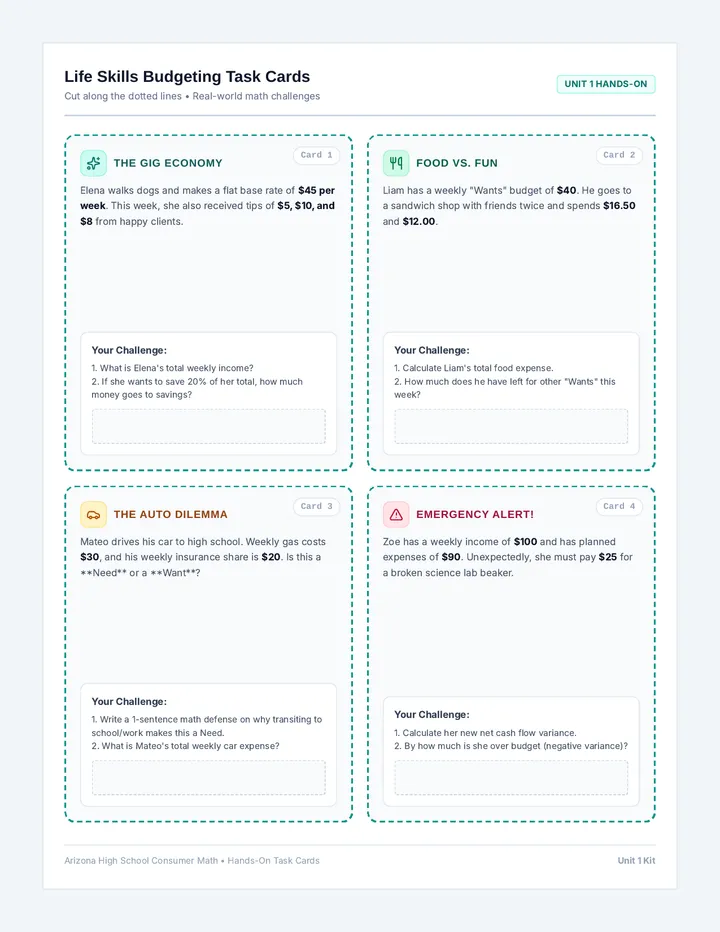
Cash Flow Task Cards Life Skills Budgeting Task Cards
Cut along the dotted lines • Real-world math challenges
Unit 1 Hands-On
Card 1
The Gig Economy
Elena walks dogs and makes a flat base rate of $45 per week. This week, she also received tips of $5, $10, and $8 from happy clients.
Your Challenge:
1. What is Elena's total weekly income?
Card 2
Food vs. Fun
Liam has a weekly "Wants" budget of $40. He goes to a sandwich shop with friends twice and spends $16.50 and $12.00.
Your Challenge:
1. Calculate Liam's total food expense.
Card 3
The Auto Dilemma
Mateo drives his car to high school. Weekly gas costs $30, and his weekly insurance share is $20. Is this a **Need** or a **Want**?
Your Challenge:
1. Write a 1-sentence math defense on why transiting to school/work makes this a Need.
Card 4
Emergency Alert!
Zoe has a weekly income of $100 and has planned expenses of $90. Unexpectedly, she must pay $25 for a broken science lab beaker.
Your Challenge:
1. Calculate her new net cash flow variance.
Arizona High School Consumer Math • Hands-On Task Cards Unit 1 Kit