Teacher Blueprint Guide Teacher Facilitation Guide
DIMENSION ARCHITECTS
HS.GEO.CO.A.1
Target Audience High School Geometry (Gr. 9-10)
Duration 2 Days (50 min each)
Primary Focus Rigorous Notation & Modeling
Day 1: The Undefined Trio
0D, 1D, 2D Space
Focuses on the three undefined terms: point, line, and plane . Students conceptualize physical models in the classroom, analyze how dimensions scale, and understand why these mathematical objects are fundamentally undefined.
Day 2: Slices of Space
Segments & Rays
Focuses on line segments, rays, and opposite rays . Heavy focus on notation-level precision (e.g., ray naming rules, directionality of arrows, segment lengths) and robust student error-analysis.
Deep Mathematical Internalizations
Why Undefined?
If we define a point as "that which has no part", we rely on the word "part". Defining "part" requires other words, creating infinite circular definitions. Geometry circumvents this by declaring points, lines, and planes as fundamental, intuitive building blocks with no formal definition.
The Notation Paradigm
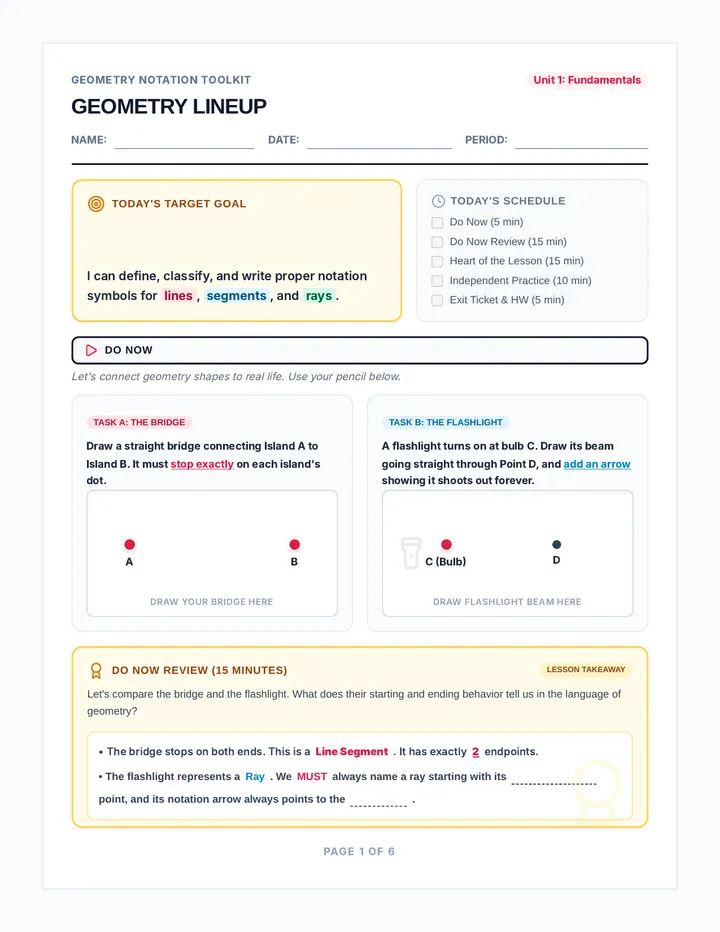
Symbols aren't arbitrary labels; they represent physical properties. A ray symbol \(\overrightarrow{AB}\) dictates directionality (starting at \(A\), traveling through \(B\)). Students must realize \(\overrightarrow{AB}\) and \(\overrightarrow{BA}\) represent entirely distinct sets of points .
Critical Student Misconceptions
The "End of the Draw" Fallacy
Students believe a drawn line segment represents a line because they view the paper's margins or the ink's end as terminal. Teachers must reinforce that lines and planes extend infinitely , and drawings are merely finite windows.
Reversing Ray Arrows
Students try to write \(\overleftarrow{AB}\) when a ray points left on the diagram. They must internalize that standard geometric notation always points the arrow rightward , with the left letter strictly indicating the starting endpoint.
Recommended Daily Pacing
Day Pacing Activity Details & Focus Day 1: Trio 10m / 20m / 15m / 5m Hook & Dimensions / Guided Notes & Drawing / Classroom Scavenger Hunt / Exit Ticket Day 2: Slices 10m / 15m / 20m / 5m Warmup & Ray Rules / Guided Blueprint Notes / Notation Showdown Cards / Exit Quiz
DIMENSION ARCHITECTS TEACHER GUIDE PAGE 1 OF 2
Rigorous Assessment Keys
MASTER ANSWER KEYS
Quick Reference Guide
Day 1: Blueprint Notes Key
Undefined terms: Point (0D), Line (1D), Plane (2D).Defining criteria: Uniquely named, zero length, infinite expansion.Notation Rules:
Point: Named by single capital letter (e.g., \(A\)).
Line: Named by any two points on the line with double arrow above (e.g., \(\overleftrightarrow{AB}\)) or a lowercase cursive letter (e.g., \(l\)).
Plane: Named by three non-collinear points (e.g., \(\text{Plane } ABC\)) or a capital script letter (e.g., \(\mathcal{P}\)).
Collinear vs Coplanar: Collinear points lie on the same line. Coplanar points lie on the same plane (any 3 points are always coplanar).Classroom Models:
Point: Corner of a desk, pencil tip, intersection of grid lines.
Line: Ceiling edge, structural corner seam, laser level.
Plane: Smartboard face, floor tile, desk surface.
Day 2: Slices Notes Key
Line Segment: Part of a line with two endpoints. Notation: \(\overline{CD}\) or \(\overline{DC}\).Ray: Starts at one endpoint and extends infinitely in one direction. Notation: Start point ALWAYS first: \(\overrightarrow{EF}\) (starts at \(E\), through \(F\)).Opposite Rays: Collinear rays sharing a common endpoint and traveling in opposite directions (forming a straight line). E.g., \(\overrightarrow{BA}\) and \(\overrightarrow{BC}\) with endpoint \(B\).Notation Showdown Correct Answers:
Card A: Invalid ray notation \(\overleftarrow{AB}\). Correction: \(\overrightarrow{BA}\).
Card B: \(\overline{XY} \neq XY\). First is segment object; second is numerical length.
Card C: Ray \(\overrightarrow{PQ}\) and \(\overrightarrow{QP}\) are not equal; distinct endpoints.
Card D: Opposite rays must be collinear. If \(\angle ABC\) is 120°, \(\overrightarrow{BA}\) and \(\overrightarrow{BC}\) are NOT opposite.
Complete Quiz Mastery Key (Day 2 Assessment)
Q1: Multiple Choice (Dimensions)
Correct: B . A line has exactly 1 dimension (length, no width) and is defined by any two points.
Q2: Multiple Choice (Ray Naming)
Correct: C . \(\overrightarrow{ZX}\) represents a ray starting at \(Z\) and going infinitely through \(X\).
Q3: Opposite Rays Condition
Correct: D . They must share an endpoint, lie on the same line (collinear), and point in opposite directions.
Q4: Error Correction (The Diagram Problem)
The student wrote \(\overrightarrow{QP}\) and \(\overrightarrow{QR}\) are opposite rays because they have the same endpoint \(Q\). Fatal flaw: Points \(P\), \(Q\), and \(R\) are not collinear. They form a bent angle, not a straight 180° line.
Q5: Notation Matching Challenge
1. \(\overleftrightarrow{JK}\) = Double arrow line (infinite both ways)
High-Impact Classroom Routines
When students perform the Day 1 Classroom Scavenger Hunt , make sure they physically use sticky notes (not included) to label planes (e.g. wall) vs lines (e.g. board borders). On Day 2 Error Analysis , have them trade sheets and grade each other using red ink to mimic geometric "compliance checks" as real draft engineers.
DIMENSION ARCHITECTS TEACHER GUIDE PAGE 2 OF 2
Day 1 Architect Slides DIMENSION ARCHITECTS
DAY 1 LESSON
UNIT 1: SPATIAL FOUNDATIONS
The Undefined Trio
Decoding the fundamental building blocks of geometry: Points, Lines, and Planes.
TOPIC: 0D, 1D, AND 2D SPACE HIGH SCHOOL GEOMETRY
Spatial Dimensions
SLIDE 2 / 5
How Does Space Scale?
0D
Zero Dimensions
Points have no physical size, width, depth, or length. They represent a pure, exact location in space.
No Size • Pure Location
1D
One Dimension
Lines have infinite length but zero width or thickness. They are straight paths constructed of infinite points.
Length Only • Infinite Path
2D
Two Dimensions
Planes are flat infinite surfaces. They have length and width, but zero height or thickness.
Flat Surface • Infinite Area
REFLECT: Can we truly see a 0D point in our physical world? DIMENSION ARCHITECTS
The Foundations
SLIDE 3 / 5
Why Are They "Undefined"?
In mathematics, we define terms using simpler words. But we have to start somewhere. If we defined everything, we would go around in endless circular loops.
Circular Definition Trap
If a Point is "a spot on a line", and a Line is "a path of points", neither term is truly defined!
Geometry avoids this trap by defining **Points, Lines, and Planes** strictly through their relationships and how they behave, rather than formal dictionary definitions.
The Building Block Hierarchy
1
Points build Lines
An infinite set of collinear points extending in opposite directions creates a 1D line.
2
Lines build Planes
An infinite grid of intersecting lines lying on a flat coordinate surface creates a 2D plane.
3
Planes build Space
An infinite stack of parallel planes stacked on top of each other forms our 3D physical world.
RULE: You can construct any geometric figure out of these three ingredients! DIMENSION ARCHITECTS
Rigorous Notation
SLIDE 4 / 5
Architectural Blueprint Naming Rules
Precision in naming is non-negotiable. Builders can't construct space with sloppy symbols. Study the notation criteria below.
Object POINT
Single Capital Letter
Always name a point using exactly one capital print letter.
Day 1 Blueprint Notes GEOMETRY ARCHITECT BLUEPRINT
Day 1 Guided Notes
NAME: ____________________________
DATE: _________________ PERIOD: ___
Your Challenge: Today you are a Spatial Architect. Space is built from three fundamentally undefined terms . Use this blueprint sheet to record notes and draw pristine figures using rigorous geometric symbols.
Part 1: Core Definitions & Symbols
Undefined Term Dim. Geometric Description Rigorous Notation 1. POINT 0D A location in space with ______ physical size. It has no dimensions. Capital letter only. Example: A 2. LINE 1D A straight path extending infinitely in ______ opposite directions. Any 2 points: \(\overleftrightarrow{BC}\) or lowercase cursive: line \(l\) 3. PLANE 2D A flat surface extending infinitely in ______ directions. 3 non-collinear points: Plane \(XYZ\)
Part 2: Blueprint Drafting (Priscilla Sketching)
Draw clean geometric representations for each prompt. Label all points with capital letters.
1. Sketch line \(\overleftrightarrow{MN}\) containing point \(P\)
Are points M, N, and P collinear? ____________
2. Sketch Plane \(\mathcal{P}\) with points \(X, Y, Z\)
Add point \(W\) that lies off Plane \(\mathcal{P}\).
Part 3: Collinear & Coplanar Checkups
Collinear Points lie on the same ________________.
Conceptual Inquiry:
Are any two points in the universe always collinear? Explain.
Coplanar Points lie on the same ________________.
Spatial Inquiry:
Are any three points in the universe always coplanar? Explain.
Architect Compliance Question
Suppose a builder uses points \(A\), \(B\), and \(C\) on a straight steel beam to name a construction plane. Explain why this notation is a non-compliance error.
DIMENSION ARCHITECTS BLUEPRINTS PAGE 1 OF 1
Classroom Scavenger Hunt Active Classroom Exploration
Dimension Hunt Checklist
NAME: ____________________________
DATE: _________________ PERIOD: ___
Objective: Find physical objects in your classroom that serve as local models for points, lines, and planes. For each clue, identify the object, **assign it arbitrary capital letters as endpoints or markers**, and write its **rigorous notation name**.
Field Checklist & Notation Log
Item 1: A Physical Point 0D Location
Find a corner, vertex, or tiny intersection.
1. Object Found:
e.g., Corner of the Smartboard
2. Assigned Notation Name:
e.g., Point S
Item 2: A Physical Line 1D Straight Edge
Find an edge where surfaces meet.
1. Object Found:
e.g., Edge of student desk
2. Assigned Notation Name:
e.g., \(\overleftrightarrow{DE}\)
Item 3: A Physical Plane 2D Flat Surface
Find a flat wall, ceiling, or window pane.
1. Object Found:
e.g., Classroom floor tiles
2. Assigned Notation Name:
e.g., Plane F
Item 4: Intersecting Planes Planes Meeting
Find two flat surfaces meeting.
1. Object Found:
e.g., Front wall and side wall
2. What do they form? (Notate it):
e.g., Line of intersection \(\overleftrightarrow{AB}\)
Spatial Synthesis Questions
1. The "Physical Constraint" Dilemma:
A line is mathematically infinite. Your classroom wall seam stops at the ceiling. Explain why a classroom wall edge is only a model of a line and not a literal geometric line.
2. The "Three-Plane Intersection" Challenge:
Look at where two walls meet the ceiling. These are three flat planes intersecting simultaneously. What geometric object is formed at this intersection? Write down how you would name it.
DIMENSION ARCHITECTS BLUEPRINTS PAGE 1 OF 1
Day 1 Exit Ticket Formative Assessment
Day 1 Exit Ticket
NAME: ____________________________
DATE: _________________ PERIOD: ___
Instructions: Solve each of the questions below independently. Be careful with your notation. Remember, in geometry, capital letters, lowercase cursives, and symbol symbols are treated like architectural code. Mislabeling can cause errors!
Question 1: The Dimension Scale
For each undefined term below, write down its mathematical dimension (0D, 1D, or 2D) and its naming standard.
Point
Dimension: ________
Notation Example: ________
Line
Dimension: ________
Notation Example: ________
Plane
Dimension: ________
Notation Example: ________
Question 2: Architectural Truth Statements
Determine whether each statement is Always True (T) or Sometimes True (S) . Provide a brief sentence explaining your choice.
T / S
"Any two distinct points are collinear."
Explain:
T / S
"Any three distinct points are coplanar."
Explain:
Question 3: Notation Compliance Check
A fellow student named a plane on their blueprint using the notation \(\text{Plane } PQR\) . However, upon inspection, points \(P\), \(Q\), and \(R\) all lie in a straight row along the classroom whiteboard. Explain why their notation does not comply with the standards of geometry.
Write your analysis here:
DIMENSION ARCHITECTS BLUEPRINTS PAGE 1 OF 1
Day 2 Slices Slides DIMENSION ARCHITECTS
DAY 2 LESSON
UNIT 1: SPATIAL FOUNDATIONS
Slices of Space
Mastering finite structures and directional paths: Line Segments, Rays, and Opposite Rays.
TOPIC: FINITE GEOMETRIC STRUCTURES HIGH SCHOOL GEOMETRY
Line Segments
SLIDE 2 / 5
What is a Line Segment?
Unlike infinite lines, a line segment is a measurable piece of a line. It consists of two endpoints and all the points between them.
The Notation Rule:
Write the two endpoints under a clean horizontal bar with no arrows : \(\overline{AB}\) or \(\overline{BA}\).
Segment vs. Length
Do not confuse the geometric shape with its numerical measurement. In technical blueprints, they are written differently:
Geometric Object \(\overline{CD}\)
The physical line segment containing endpoints \(C\) and \(D\).
Numerical Length \(CD = 5\text{ cm}\)
The distance between points \(C\) and \(D\). No bar!
CRITICAL: Writing \(\overline{CD} = 5\text{ cm}\) is technically incorrect. The shape is not equal to a number! DIMENSION ARCHITECTS
Geometric Rays
SLIDE 3 / 5
Mapping a Ray
Consider a ray starting at point \(E\), passing through point \(F\):
\(E \bullet\) ————————————————\(\rightarrow F\)
Rigorous Notation: \(\overrightarrow{EF}\)
What is a Ray?
A ray is a part of a line that begins at one exact endpoint and extends infinitely in one direction.
Rule 1: Endpoint ALWAYS First
The letter listed first in the notation must be the starting point of the ray.
Rule 2: Arrows Must Point Right
The arrow in the notation always points right, regardless of which way the ray points on screen.
REASONING: Is \(\overrightarrow{EF}\) the same ray as \(\overrightarrow{FE}\)? (No! They have different starting endpoints!) DIMENSION ARCHITECTS
Opposite Rays
SLIDE 4 / 5
What are Opposite Rays?
Opposite rays are two collinear rays that share a common endpoint and extend infinitely in opposite directions.
\(\leftarrow\)————— \(A\) ————— \(B\) ————— \(C\) —————\(\rightarrow\)
On the straight line above, \(\overrightarrow{BA}\) and \(\overrightarrow{BC}\) are opposite rays. They share endpoint \(B\) and form a 180° straight line.
Condition 1
Day 2 Slices Notes GEOMETRY ARCHITECT BLUEPRINT
Day 2 Guided Notes
NAME: ____________________________
DATE: _________________ PERIOD: ___
Your Challenge: Today you slice space. Infinite lines are carved into measurable segments and directed rays. Record notes and complete the notation checkups below with exact compliance.
Part 1: Slicing Definitions & Symbols
Geometric Object Structural Properties Rigorous Notation 1. LINE SEGMENT A measurable path with ______ endpoints. It includes all collinear points between them. Endpoints only with solid bar above. Example: \(\overline{AB}\) or \(\overline{BA}\) 2. RAY A part of a line starting at ______ endpoint and extending infinitely in one direction. Endpoint listed first. Right arrow above. Example: \(\overrightarrow{XY}\) 3. OPPOSITE RAYS Two collinear rays sharing a ______ endpoint and traveling in opposite directions. Form a 180° straight line. Example: \(\overrightarrow{BA}\) and \(\overrightarrow{BC}\)
Part 2: Blueprint Drafting (Slices of Space)
Draw clean geometric representations for each prompt. Label all endpoints with capital letters.
1. Sketch ray \(\overrightarrow{CD}\) pointing leftward
Where must endpoint C go on the sketch? _________
2. Sketch opposite rays \(\overrightarrow{JK}\) and \(\overrightarrow{JL}\)
What is the common shared endpoint? __________
Part 3: Segment vs. Length & Ray Equivalence
Segment vs Length:
Explain why writing \(\overline{AB} = 4\text{ cm}\) violates geometric compliance. How should length be properly written?
___________________________________________
Ray Reversibility:
Explain why \(\overrightarrow{XY}\) is NOT the same geometric object as \(\overrightarrow{YX}\). What points do they fail to share?
___________________________________________
Opposite Ray Compliance Check
Suppose rays \(\overrightarrow{BA}\) and \(\overrightarrow{BC}\) share endpoint \(B\), but \(\angle ABC = 175^\circ\). Explain why these rays are NOT opposite rays, and what criteria they fail to meet.
Notation Showdown Activity Pair & Group Error Analysis
Notation Showdown
TEAM MEMBERS: ________________________
DATE: _________________ PERIOD: ___
The Scenario: You are a Principal Compliance Officer at Dimension Architects. A junior draftsman submitted four construction blueprint labels with severe notation violations. Your Mission: Cut out or examine the four cards below. Identify the exact compliance failure on each card, cite the geometric rule violated, and write down the corrected, compliant notation.
CARD A
1. Leftward Ray Problem
The draftsman labeled a ray pointing left as:
\(\overleftarrow{AB}\)
Compliance Failure:
Write failure here...
Corrected:
e.g., \(\overrightarrow{BA}\)
CARD B
2. Segment vs. Length Problem
The draftsman wrote a line segment dimension as:
\(\overline{XY} = 12\text{ cm}\)
Compliance Failure:
Write failure here...
Corrected:
e.g., \(XY = 12\text{ cm}\)
CARD C
3. Ray Equivalence Fallacy
The draftsman wrote on the blueprint schema:
\(\overrightarrow{PQ}\) and \(\overrightarrow{QP}\) are identical objects
Compliance Failure:
Write failure here...
Corrected:
Explain difference...
CARD D
4. Opposite Ray Bent Defect
Draftsman labeled \(\overrightarrow{BA}\) and \(\overrightarrow{BC}\) as opposite rays:
(Angle \(\angle ABC\) measures 140 degrees on layout)
Compliance Failure:
Write failure here...
Corrected:
Explain requirement...
Engineer Compliance Certificate
Sum up the golden rule of Ray Naming in one clear, rigorous sentence that your junior draftsmen can hang above their desks to avoid these four structural notation errors.
DIMENSION ARCHITECTS BLUEPRINTS PAGE 1 OF 1
Comprehensive Quiz Summative Unit Assessment
Spatial Foundations Quiz
NAME: ____________________________
DATE: _________________ PERIOD: ___
Exam Standard: Complete all questions independently. Make sure your lines, rays, segments, and planes are written using exact, mathematically rigorous notation symbols.
Part 1: Multiple Choice Compliance
1. Which is true about a geometric line?
[ ] A. It has exactly zero dimensions.
[ ] B. It has exactly 1 dimension and is infinite.
[ ] C. It has 2 dimensions and endpoints.
[ ] D. Named by 3 collinear points.
2. Which describes a ray starting at Z?
[ ] A. \(\overline{ZX}\)
[ ] B. \(\overleftrightarrow{ZX}\)
[ ] C. \(\overrightarrow{ZX}\)
[ ] D. \(\overleftarrow{XZ}\)
Part 2: Opposite Ray Critical Conditions
3. Which criteria are BOTH necessary and sufficient for two rays to be opposite rays?
[ ] A. Share endpoint & point away.
[ ] B. Lie on same line & have arrow heads.
[ ] C. Share endpoint & form a bent angle.
[ ] D. Share endpoint, collinear, & opposite.
Part 3: Notation Decoding Challenge
Match each mathematical symbol with its correct physical blueprint description.
1. \(\overleftrightarrow{JK}\) : ______
2. \(\overline{JK}\) : ______
3. \(\overrightarrow{JK}\) : ______
4. \(JK\) : ______
A. Physical line segment with endpoints \(J\) and \(K\).
B. Infinite straight line passing through points \(J\) and \(K\).
C. Scalar numerical distance (length) between \(J\) and \(K\).
D. Ray starting at endpoint \(J\), extending past \(K\).
Part 4: Blueprinter Error Analysis
5. A junior blueprinter states: "Rays \(\overrightarrow{QP}\) and \(\overrightarrow{QR}\) are opposite rays because they share endpoint \(Q\) and point away from each other." However, points \(P\), \(Q\), and \(R\) are bent in a corner (\(\angle PQR = 90^\circ\)). Explain the fatal geometric error in their claim.
DIMENSION ARCHITECTS BLUEPRINTS PAGE 1 OF 1