Wealth Equations Slides
Money Mechanics
Wealth Equations
The mathematical mechanics of interest, compounding, and the time value of money.
Finance & Advanced Mathematics Swipe or press Space to proceed
The Core Dilemma
01. Time Value of Money
Option A
$10,000 Today
Zero uncertainty or delay
Immediate buying power
Option B
$10,000 in 10 Years
Risk of inflation / reduced value
Lost investment opportunity
The Financial Axiom: Money in hand today is worth more than the identical sum in the future, because today's money has the unique mathematical power to earn interest.
Formula Anatomy
02. Compound Future Value
The Future Value Equation
\[ FV = PV(1 + r)^t \]
Calculates capital accumulation over time.
FV Output
Future Value
The projected balance after earning compound interest over time.
PV Input
Present Value
The initial principal sum invested or borrowed at start.
r Rate
Annual Rate
The nominal interest rate per period (expressed as a decimal).
t Exponent
Time Periods
The total number of compounding intervals (usually years).
Notice: The time variable t is an exponent, yielding exponential growth instead of linear growth. Classroom Math Guide
Step-by-Step Mechanics
03. The Compound Cycle
Scenario Parameters
Let's compound $10,000 at a high-yield rate of 10%
Watch how interest starts earning interest. Each period's base becomes larger than the previous period's base.
Year 1: $10,000 × 1.10 = $11,000
Year 2: $11,000 × 1.10 = $12,100
Year 3: $12,100 × 1.10 = $13,310
| Year (t) | Formula Breakdown | Ending Balance |
|---|
| Year 0 | Initial Principal (PV) | $10,000.00 |
| Year 1 | $10,000.00 × (1.10)¹ | $11,000.00 |
| Year 2 | $10,000.00 × (1.10)² | $12,100.00 |
| Year 3 | $10,000.00 × (1.10)³ | $13,310.00 |
| Year 4 | $10,000.00 × (1.10)⁴ | $14,641.00 |
Notice how the absolute dollar amount gained increases each single year. Yearly growth acceleration
Simple vs. Compound Interest
04. Linear vs. Exponential
Simple Interest Linear
The Straight Line
Interest is calculated only on the original principal sum. You earn the exact same dollar amount every single period.
Formula: \[ I = PV \cdot r \cdot t \]
Growth Curve: Fixed, Arithmetic
Compound Interest Exponential
The Snowball Effect
Interest is calculated on the initial principal plus all accumulated interest from previous periods.
Formula: \[ FV = PV(1 + r)^t \]
Growth Curve: Accelerated, Geometric
💡 Over long periods, compounding will dramatically outpace simple interest. Time is the multiplier
Present Value & Discounting
05. Looking Backward in Time
What is a future dollar worth to you today?
If someone promises you $10,000 in 10 years, how much should you pay them for it right now? Discounting answers this critical business question.
- PV tells you the fundamental intrinsic fair price of any asset or future financial cash flow.
- Higher discount rates reduce the current value of future cash payouts.
Discounting Formula
\[ PV = \frac{FV}{(1 + r)^t} \]
Dividing by (1+r)ᵗ strips interest out of the future sum.
This is the basis of corporate valuation and investment evaluation. Valuation Mechanics
The Rule of 72
06. Mental Mathematics Shortcut
Estimated Doubling Time
\[ \text{Years to Double} \approx \frac{72}{R} \]
Where R is the nominal interest rate as a whole percentage number (e.g. 8 for 8%).
Calculate doubling periods instantly:
At 6% interest: 72 / 6 = 12 Years to double
At 8% interest: 72 / 8 = 9 Years to double
At 12% interest: 72 / 12 = 6 Years to double
This provides an incredibly accurate mental model without needing logarithmic calculators. Mental math heuristic
Critical Thinking: The Advisor's Dilemma
07. Practical Application Challenge
Scenario 1
The Aggressive Option
Invest $5,000 for 12 years in an index fund yielding 8% compound annual return.
Doubling Periods: ~1.33 doublings
Scenario 2
The Safe Base
Invest $6,500 at 5% simple annual interest for a fixed term of 12 years.
Return mechanism: Linear linear accumulation
Scenario 3
The Long Compounder
Invest $4,000 for 16 years compounding at 9% annual return.
Doubling Periods: ~2 full doublings
👉 Classroom Challenge: Which scenario yields the largest future ending balance? Complete the formulas to verify your hypothesis!
Wealth Equations Worksheet
Student Practice Sheet
Money Mechanics
Topic Compound Interest & TVM
Student Name
Date
Class Period
Equation Quick-Reference
Future Value (FV) \[ FV = PV(1 + r)^t \]
Present Value (PV) \[ PV = \frac{FV}{(1 + r)^t} \]
PART 1
Variables & Vocabulary
1.1 Why is an exponent used for time (t) in compound interest, whereas multiplication is used for simple interest?
1.2 If you compounding monthly instead of annually, how does the accrued Future Value change and why?
PART 2
Step-by-Step Future Value
Problem Statement: Invest $5,000 compounding annually at an interest rate of 6% (\(r = 0.06\)). Find the ending balance after 3 years.
Step A: Identify & Substitute
Write the formula, then plug in the known numbers:
Step B: Solve exponent
Calculate the value of \( (1 + r)^t \):
Step C: Compute Final Future Value
Multiply the initial principal by your Step B value. State your final balance with units:
Money Mechanics Unit • Student Handout Page 1 of 2
Student Practice Sheet Money Mechanics
PART 3
Present Value Discounting
The Problem: A business partner promises to pay you $20,000 exactly 5 years from today. If you can invest money elsewhere at a steady 8% annual interest, what is the maximum amount you should pay for this promise today?
Mathematical Setup & Calculation
State your formula, plug in values, and show the step-by-step reduction:
Critical Interpretation
If the partner offered to sell this promise to you today for $14,000, is it a logically sound deal? Explain:
PART 4
Mental Shortcuts (Rule of 72)
Using the heuristic Doubling Time ≈ 72 / R, solve the following without an exponential calculator:
4.1 If a college fund of $8,000 grows at 9% compounding annually, how many years will it take to reach $16,000? How many years to reach $32,000?
4.2 You want to double your investment capital in exactly 6 years. What nominal annual compounding rate must you achieve?
💡 Advanced Challenge
Why does the "Rule of 72" become less accurate at extremely high interest rates (e.g. 50% interest)? (Hint: Think about linear vs. exponential approximation).
Money Mechanics Unit • Student Handout Page 2 of 2
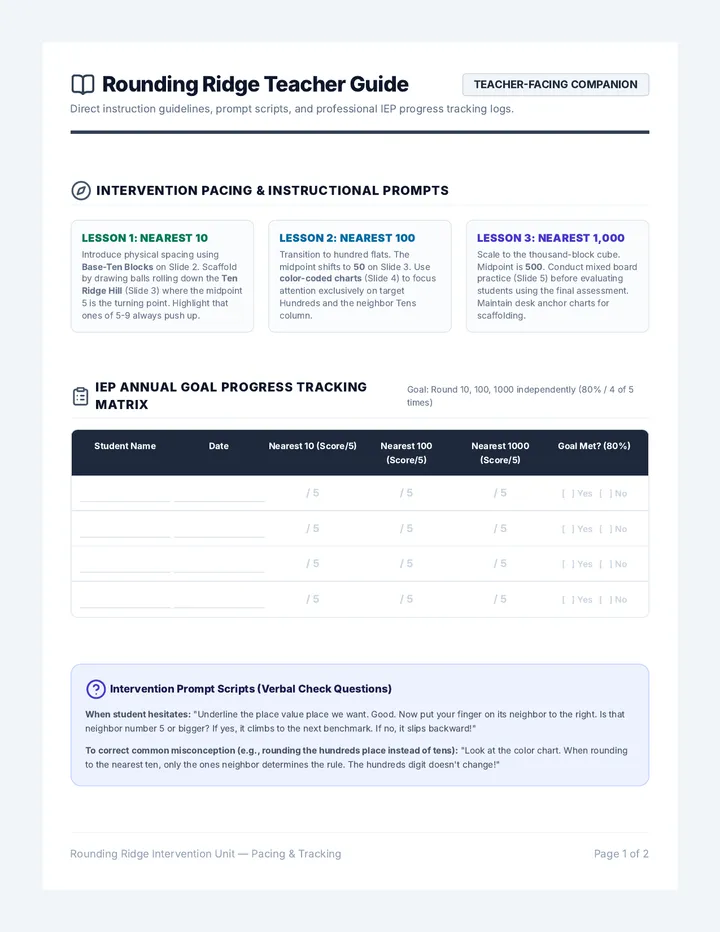
Money Mechanics Teacher Guide
Teacher Resources
Money Mechanics Guide
Grade Level Grade 9+ & Adults
Pedagogical Approach
This lesson bridges algebraic exponents with real-world financial strategy. The goal is not just mechanical formula application, but logical reasoning. By looking at compound growth through various representation channels (formulas, tables, and heuristics like the Rule of 72), students build a robust mental map of exponential acceleration.
Learning Targets
- ✔ Identify and break down TVM variables.
- ✔ Distinguish simple from compound interest.
- ✔ Apply Rule of 72 for rapid estimates.
TIMELINE
Recommended 50-Minute Lesson Pacing
| Time | Phase | Instructional Focus & Teacher Strategies |
|---|
| 00-08 min | The Dilemma | Deliver Slide 2. Facilitate the choice: $10,000 today vs. $10k later. Introduce inflation and opportunity cost concepts. |
| 08-20 min | Formula Anatomy | Deconstruct Future Value formula. Highlight how "t" as an exponent leads directly to exponential compounding curves. |
| 20-35 min | Guided Practice | Distribute worksheets. Guide students through Step-by-Step modeling (Part 2 of worksheet). Monitor calculations. |
| 35-45 min | Mental Math | Present Rule of 72 (Slide 7). Allow students to try mental problems in pairs to build rapid estimation intuition. |
| 45-50 min | Group Debrief | Collect reflections. Address the advanced challenge question. Close with a key takeaway on long-term investing. |
TERMINOLOGY
Key Vocabulary Framework
1. Present Value (Discounting)
The current fair value of a future stream of cash flows, discounted at a specific rate to account for risk, opportunity cost, and time.
2. Compound Interest
Interest calculated on the initial principal plus all previously accumulated interest, leading to exponential geometric growth.
Money Mechanics • Teacher Facilitation Manual Page 1 of 2
Teacher Resources Money Mechanics Master Key
TIPS
Common Student Misconceptions
The "Addition Error" in Compounding
Misconception: Students often calculate 10% interest on $1,000 as $100 per year, and simply add $100 annually (Simple Interest model, yielding $1,300 in 3 years instead of compound $1,331).