Tuesday Tile Lab Lesson Plan Area Architects • Tuesday Lesson Plan
Tuesday Tile Lab
Grade 3 • 60 Min
3.MD.5 • 3.MD.6 • 3.MD.7a–b
Learning Objectives
Understand area as covering a flat surface with unit squares with no gaps or overlaps (3.MD.5).
Measure area by counting unit squares in square cm, in, ft, or m (3.MD.6).
Connect tiling rectangles to multiplying side lengths (\(\text{Area} = \text{length} \times \text{width}\)) (3.MD.7a–b).
Materials & Vocabulary
Materials: Tuesday Area Packet (6 pages, 15 problems), Area Basics Support Sheet, square color tiles (optional), pencils.
Key Terms: area, unit square, square unit, gap, overlap, row, column, length, width .
60-Minute Pacing & Gradual Release Flow
Time
Segment
Teacher & Student Actions
0–8 min
Launch & Support Sheet
Distribute Area Basics Support Sheet . Contrast a properly tiled rectangle with one showing gaps/overlaps.
8–18 min
Cluster 1: Counting Squares (P1–P3)
I Do: Model P1 (count & label each square). We Do: P2 together. You Do: P3 independently.
18–30 min
Cluster 2: Tiling Rectangles (P4–P7)
I Do: Model P4 (draw missing grid lines). We Do: P5. You Do: P6–P7 independently.
30–44 min
Cluster 3: Multiply Sides (P8–P11)
I Do: Model P8 (\(\text{rows} \times \text{columns}\)). We Do: P9. You Do: P10–P11 independently.
44–56 min
Cluster 4: Word Problems (P12–P15)
I Do: Model P12 (sketch & label). We Do: P13. You Do: P14–P15 independently.
56–60 min
Wrap-Up Check
Review P15 together. Ask: "Why must we label our answers in square units?"
Cluster 1 Facilitation: Unit Squares & Counting Area (Page 1 • P1–P3)
Model (P1): Think aloud while numbering each unit square \(1, 2, 3\dots\) inside the figure so you never double-count or skip a square. Emphasize that every square touches edge-to-edge with no gaps or overlaps.
Guided (P2) & Independent (P3): Have students touch and number each square in P2 before writing the total. Circulate during P3 to verify students write square units .
Cluster 2 Facilitation: Tiling & Array Structure (Pages 2–3 • P4–P7)
Model (P4): Show how a partially tiled rectangle still reveals the number of rows and columns. Extend the row and column lines straight across to complete the grid, then count by rows.
Guided (P5) & Independent (P6–P7): Prompt students: "How many squares fit in one row? How many rows are there?" Encourage skip-counting by row size before multiplying.
Area Architects • Tuesday Tile Lab Page 1 of 2
Tuesday Tile Lab — Facilitation & Supports
3.MD.5 • 3.MD.6 • 3.MD.7a–b
Cluster 3 Facilitation: Multiplying Side Lengths (Pages 4–5 • P8–P11)
Model (P8): Point out that when a rectangle has no inner grid lines, the side lengths tell us the exact number of rows and columns. Write \(\text{Area} = \text{length} \times \text{width}\), substitute \(4 \times 6 = 24\), and circle the unit (square inches ).
Guided (P9) & Independent (P10–P11): Ask students to trace the length with one finger and the width with another before writing the multiplication equation. Remind them that \(3 \times 8\) and \(8 \times 3\) give the same area.
Cluster 4 Facilitation: Real-World Area Word Problems (Pages 5–6 • P12–P15)
Model (P12): Read the problem twice. Underline the two dimensions and the unit (feet). Draw a quick rectangle sketch in the workspace, label both sides, write the equation, and write a complete unit label.
Guided (P13) & Independent (P14–P15): Have students sketch and label the rectangle on every word problem before multiplying. On P15, check that students read carefully to identify both dimensions.
Common Misconceptions & Quick Fixes
1. Confusing Area with Perimeter (Adding Side Lengths)
Fix: Have the student draw 1-inch tiles inside a \(3 \times 5\) rectangle. Ask: "Are we walking around the outside fence, or covering the whole floor?"
2. Counting Grid Lines Instead of Squares
Fix: Instruct students to put a dot or number inside each square space rather than on the corner intersections.
3. Dropping "Square" from the Unit Label
Fix: Remind students that length is measured in flat lines (cm, in, ft), while area is measured in flat squares (sq cm, sq in, sq ft).
Differentiation & Mixed Supports
Scaffolded Support (Struggling Learners)
Keep the Area Basics Support Sheet on desks throughout independent work.
Provide physical 1-inch square tiles to build P4–P7 before drawing.
Use color coding: highlight rows in blue and columns in yellow.
Extension Challenge (Early Finishers)
On the back of Page 6, draw two different rectangles that both have an area of 24 square units.
Write a real-world area word problem for a partner to solve using \(6 \times 9\).
Area Architects • Tuesday Tile Lab Page 2 of 2
Area Basics Support Sheet Student Reference Guide • Tuesday
Area Basics Support Sheet
3.MD.5 • 3.MD.6 • 3.MD.7
1 unit square
What Is Area?
Area is the amount of flat space inside a shape. We measure area by covering the shape with unit squares and labeling the answer in square units (sq cm, sq in, sq ft).
Rule #1: Cover Completely — No Gaps, No Overlaps!
JUST RIGHT
Edges touch neatly
NO GAPS
Empty spaces left
NO OVERLAPS
Tiles stack on top
Strategy 1: Count Squares
1 2 3 4 5
Touch & number each square inside the shape.Check that no square was skipped or counted twice.
Write the total with square units (5 sq units).
Strategy 2: Multiply Sides
length = 5 in 3 in 3 × 5 = 15 sq in
Find the length (columns) and width (rows).
Multiply: \(\text{Area} = \text{length} \times \text{width}\).
Label with square + unit (e.g., 15 sq in).
Word Problem Blueprint Steps
Step 1: Read
Circle both side lengths and underline the unit.
Step 2: Sketch
Draw a quick rectangle and label both sides.
Step 3: Multiply
Write \(\text{length} \times \text{width}\) and solve.
Step 4: Label
Always write square before the unit!
Area Architects • Tuesday Support Sheet Keep on desk during practice
Tuesday Area Packet Tuesday Tile Lab • 3.MD.5 & 3.MD.6
Tuesday Area Packet
Name: _______________________
Date: _____________
Part 1: Count Unit Squares (No Gaps, No Overlaps)
Steps: 1. Number each square • 2. Write total in square units
1. Find the area of the rectangle by counting unit squares.
MODEL (I Do)
Step 1: Number each square inside the shape (1, 2, 3...).
Step 2: Area = __________ square units
2. Count the unit squares to find the area of this figure.
GUIDED (We Do)
Top row: _____ squares • Middle: _____ • Bottom: _____
Total Area = __________ square units
3. Find the area of the shaded figure. Label your answer.
INDEPENDENT (You Do)
Area = ________________________
Area Architects • Tuesday Area Packet Page 1 of 6
Part 2: Finish Tiling Rectangles (3.MD.5 & 3.MD.7a)
Steps: 1. Draw missing tile lines • 2. Count rows & columns • 3. Multiply
4. Finish tiling the rectangle. Then find the total area.
MODEL (I Do)
Each square = 1 square centimeter (sq cm). Extend the lines straight across and down.
1. Number of rows: ________
2. Squares in each row: ________
3. Equation: _____ × _____ = _____
Area = ____________ sq cm
5. Finish tiling the rectangle. Write an equation to find the area.
GUIDED (We Do)
Each square = 1 square inch (sq in).
1. Number of rows: ________
2. Squares in each row: ________
3. Equation: _____ × _____ = _____
Area = ____________ sq in
Area Architects • Tuesday Area Packet Page 2 of 6
Part 2 Continued: Tiling Practice (3.MD.5 & 3.MD.7a)
Show your tiling and multiplication equation!
6. Finish tiling the rectangle. Write an equation and find the area.
INDEPENDENT (You Do)
Each square = 1 square foot (sq ft).
Equation: ________________________
Area = ________________________
7. A rectangle has 3 rows with 7 tiles in each row. Draw and find the area.
INDEPENDENT (You Do)
Each tile = 1 square meter (sq m). Draw the tiled rectangle in the workspace below.
Equation: ________________________
Area = ________________________
Area Architects • Tuesday Area Packet Page 3 of 6
Part 3: Multiply Side Lengths (3.MD.7a–b)
Formula: Area = length × width
8. Multiply the side lengths to find the area of the rectangle.
MODEL (I Do)
6 in 4 in
Step 1: Identify sides → length = ____ in, width = ____ in
Step 2: Multiply → _____ × _____ = _____
Area = ____________ sq in
9. Find the area of the rectangle using multiplication.
GUIDED (We Do)
7 cm 5 cm
Step 1: length = ____ cm, width = ____ cm
Step 2: _____ × _____ = _____
Area = ____________ sq cm
10. Calculate the area of the rectangle. Include the correct unit.
INDEPENDENT (You Do)
8 ft 3 ft
Equation: ______________________
Area = ______________________
Area Architects • Tuesday Area Packet Page 4 of 6
11. Calculate the area of the rectangle. Include the correct unit.
INDEPENDENT (You Do)
9 m 6 m
Equation: ______________________
Area = ______________________
Part 4: Real-World Area Word Problems (3.MD.7b)
Steps: 1. Sketch & label • 2. Multiply • 3. Label sq units
12. Maya is laying carpet in a bedroom that is 8 feet long and 7 feet wide. What is the area?
MODEL (I Do)
Sketch & label the rectangle:
Equation: _____ × _____ = _____
Answer: ____________ sq ft
13. A rectangular garden is 9 meters long and 4 meters wide. How many square meters is the garden?
GUIDED (We Do)
Sketch & label the rectangle:
Equation: _____ × _____ = _____
Answer: ____________ sq m
Area Architects • Tuesday Area Packet Page 5 of 6
Part 4 Continued: Independent Word Problems (3.MD.7b)
Sketch, write an equation, and label with square units!
14. Leo paints a rectangular poster that is 10 inches long and 6 inches wide. What is the area of the poster?
INDEPENDENT (You Do)
Equation: ________________________
Area = ________________________
15. A square patio has sides that are 7 feet long. What is the area of the patio?
INDEPENDENT (You Do)
Hint: All 4 sides of a square are equal!
Equation: ________________________
Area = ________________________
Area Architects • Tuesday Area Packet Page 6 of 6
Tuesday Area Answer Key Teacher Resource • Tuesday Tile Lab
Tuesday Area Answer Key
Problems 1–15
Part 1: Count Unit Squares (Page 1 • 3.MD.5, 3.MD.6)
1. (Model) 3 rows of 4 squares numbered 1–12.
12 square units
2. (Guided) Top row: 2, Middle row: 4, Bottom row: 4 (2 + 4 + 4).
10 square units
3. (Independent) Top row: 3, Middle row: 4, Bottom row: 4 (3 + 4 + 4).
11 square units
Part 2: Finish Tiling Rectangles (Pages 2–3 • 3.MD.5, 3.MD.7a)
4. (Model) 3 rows, 5 squares per row. Equation: \(3 \times 5 = 15\).
15 sq cm
5. (Guided) 4 rows, 6 squares per row. Equation: \(4 \times 6 = 24\).
24 sq in
6. (Independent) 4 rows, 4 squares per row. Equation: \(4 \times 4 = 16\).
16 sq ft
7. (Independent) Student draws a \(3 \times 7\) tiled rectangle (no gaps/overlaps). Equation: \(3 \times 7 = 21\).
21 sq m
Part 3: Multiply Side Lengths (Pages 4–5 • 3.MD.7a–b)
8. (Model) length = 6 in, width = 4 in. Equation: \(6 \times 4 = 24\).
24 sq in
Area Architects • Tuesday Answer Key Page 1 of 2
Tuesday Area Answer Key (Continued)
Problems 9–15
Part 3 Continued: Multiply Side Lengths (Pages 4–5)
9. (Guided) length = 7 cm, width = 5 cm. Equation: \(7 \times 5 = 35\).
35 sq cm
10. (Independent) Equation: \(8 \times 3 = 24\) (or \(3 \times 8 = 24\)).
24 sq ft
11. (Independent) Equation: \(9 \times 6 = 54\) (or \(6 \times 9 = 54\)).
54 sq m
Part 4: Real-World Area Word Problems (Pages 5–6 • 3.MD.7b)
12. (Model) Maya's Bedroom 56 sq ft
Sketch: rectangle labeled 8 ft by 7 ft. Equation: \(8 \times 7 = 56\).
13. (Guided) Rectangular Garden 36 sq m
Sketch: rectangle labeled 9 m by 4 m. Equation: \(9 \times 4 = 36\).
14. (Independent) Leo's Poster 60 sq in
Sketch: rectangle labeled 10 in by 6 in. Equation: \(10 \times 6 = 60\).
15. (Independent) Square Patio 49 sq ft
Sketch: square with all sides 7 ft. Equation: \(7 \times 7 = 49\). Watch for students multiplying \(7 \times 4 = 28\) (perimeter error).
Area Architects • Tuesday Answer Key Page 2 of 2
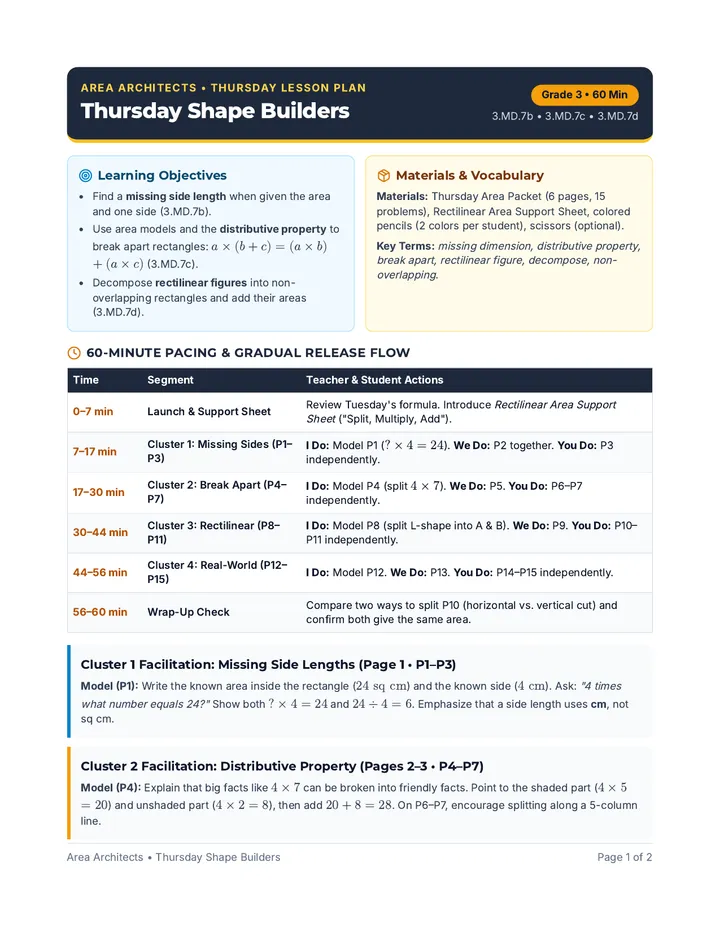
Thursday Shape Builders Lesson Plan Area Architects • Thursday Lesson Plan
Thursday Shape Builders
Grade 3 • 60 Min
3.MD.7b • 3.MD.7c • 3.MD.7d
Learning Objectives
Find a missing side length when given the area and one side (3.MD.7b).
Use area models and the distributive property to break apart rectangles: \(a \times (b + c) = (a \times b) + (a \times c)\) (3.MD.7c).
Decompose rectilinear figures into non-overlapping rectangles and add their areas (3.MD.7d).
Materials & Vocabulary
Materials: Thursday Area Packet (6 pages, 15 problems), Rectilinear Area Support Sheet, colored pencils (2 colors per student), scissors (optional).
Key Terms: missing dimension, distributive property, break apart, rectilinear figure, decompose, non-overlapping .
60-Minute Pacing & Gradual Release Flow
Time
Segment
Teacher & Student Actions
0–7 min
Launch & Support Sheet
Review Tuesday's formula. Introduce Rectilinear Area Support Sheet ("Split, Multiply, Add").
7–17 min
Cluster 1: Missing Sides (P1–P3)
I Do: Model P1 (\(? \times 4 = 24\)). We Do: P2 together. You Do: P3 independently.
17–30 min
Cluster 2: Break Apart (P4–P7)
I Do: Model P4 (split \(4 \times 7\)). We Do: P5. You Do: P6–P7 independently.
30–44 min
Cluster 3: Rectilinear (P8–P11)
I Do: Model P8 (split L-shape into A & B). We Do: P9. You Do: P10–P11 independently.
44–56 min
Cluster 4: Real-World (P12–P15)
I Do: Model P12. We Do: P13. You Do: P14–P15 independently.
56–60 min
Wrap-Up Check
Compare two ways to split P10 (horizontal vs. vertical cut) and confirm both give the same area.
Cluster 1 Facilitation: Missing Side Lengths (Page 1 • P1–P3)
Model (P1): Write the known area inside the rectangle (\(24\text{ sq cm}\)) and the known side (\(4\text{ cm}\)). Ask: "4 times what number equals 24?" Show both \(\text{?} \times 4 = 24\) and \(24 \div 4 = 6\). Emphasize that a side length uses cm , not sq cm.
Cluster 2 Facilitation: Distributive Property (Pages 2–3 • P4–P7)
Model (P4): Explain that big facts like \(4 \times 7\) can be broken into friendly facts. Point to the shaded part (\(4 \times 5 = 20\)) and unshaded part (\(4 \times 2 = 8\)), then add \(20 + 8 = 28\). On P6–P7, encourage splitting along a 5-column line.
Area Architects • Thursday Shape Builders Page 1 of 2
Thursday Shape Builders — Facilitation & Supports
3.MD.7b • 3.MD.7c • 3.MD.7d
Cluster 3 Facilitation: Rectilinear Figures (Pages 4–5 • P8–P11)
Model (P8): Trace the dashed split line to show two non-overlapping rectangles: A and B . Highlight the length and width of A only (covering B with a hand so extra numbers don't distract), multiply, then repeat for B, and add \(\text{Area A} + \text{Area B}\).
Guided (P9) & Independent (P10–P11): On P10–P11, students draw their own split line. Remind them to check which side lengths belong to each new rectangle before multiplying.
Cluster 4 Facilitation: Real-World Rectilinear Problems (Pages 5–6 • P12–P15)
Model (P12): Connect the L-shaped floor plan to a real room. Color-code Patio A and Patio B, compute each area, and add. On P14–P15, circulate to verify students don't multiply two sides that don't form a rectangle together.
Common Misconceptions & Quick Fixes
1. Using the Full Outer Side Length After Splitting an L-Shape
Fix: Have students lightly shade Rectangle A in blue and Rectangle B in yellow, then trace only the blue edges to pick A's dimensions.
2. Multiplying Area × Side Length on Missing-Side Problems
Fix: Rewrite the problem as a missing-factor sentence: \(4 \times \underline{\hspace{1.2em}} = 24\). Ask: "Is the missing side bigger or smaller than the total area?"
3. Splitting Both Dimensions in Distributive Property
Fix: Show with the grid that one straight cut only splits one side (e.g., 7 becomes \(5 + 2\)), while the other side (4 rows) stays the same for both parts.
Differentiation & Mixed Supports
Scaffolded Support (Struggling Learners)
Keep the Rectilinear Area Support Sheet visible on desks.
Use two colored highlighters to separate Rectangle A and Rectangle B.
Offer a multiplication chart for P1–P3 missing-factor checks.
Extension Challenge (Early Finishers)
Solve P10 a second way by cutting horizontally instead of vertically.
Design an L-shaped bedroom on grid paper with a total area of 32 sq ft.
Area Architects • Thursday Shape Builders Page 2 of 2
Rectilinear Area Support Sheet Student Reference Guide • Thursday
Rectilinear Area Support Sheet
3.MD.7b • 3.MD.7c • 3.MD.7d
Tool 1 Find a Missing Side Length
3.MD.7b
? cm 4 cm Area = 24 sq cm
Write a missing-factor equation: \(4 \times \underline{\hspace{1.2em}} = 24\) (or \(24 \div 4\)).
Think: "4 times what number equals 24?" → 6 .
Label a side length with the plain unit: 6 cm (not sq cm!).
Tool 2 Break Apart a Rectangle (Distributive Property)
3.MD.7c
3 5 2 3 × 5 = 15 3 × 2 = 6
Split the long side into friendly numbers (e.g., \(7 = 5 + 2\)).Multiply each part: \((3 \times 5) = 15\) and \((3 \times 2) = 6\).Add both areas together: \(15 + 6 = 21\text{ sq units}\).
Tool 3 Split & Add Rectilinear Shapes (L-Shapes)
3.MD.7d
A B 3 ft 4 ft 3 ft 7 ft
Remember: SPLIT → MULTIPLY → ADD!
Split: Draw one straight line to make two rectangles (A and B ) with no overlaps.Multiply A: \(3 \times 4 = 12\text{ sq ft}\).Multiply B: \(7 \times 3 = 21\text{ sq ft}\).Add: \(12 + 21 = \mathbf{33\text{ sq ft}}\).
Architect Check: Did I use ONLY the sides that touch each rectangle? Did I label in square units?
Area Architects • Thursday Support Sheet Keep on desk during practice
Thursday Area Packet Thursday Shape Builders • 3.MD.7b–d
Thursday Area Packet
Name: _______________________
Date: _____________
Part 1: Find the Missing Side Length (3.MD.7b)
Steps: 1. Write ? × side = Area • 2. Solve • 3. Label plain unit
1. The area of the rectangle is 24 sq cm. Find the missing length.
MODEL (I Do)
? cm 4 cm Area = 24 sq cm
1. Equation: 4 × ______ = 24 (or 24 ÷ 4 = ______)
Missing length = ____________ cm
2. The area of the rectangle is 35 sq in. Find the missing width.
GUIDED (We Do)
7 in ? in Area = 35 sq in
1. Equation: ______ × 7 = 35
Missing width = ____________ in
3. The area of the rectangle is 48 sq ft. Find the missing length.
INDEPENDENT (You Do)
? ft 6 ft Area = 48 sq ft
Equation: ________________________
Missing length = ___________________
Area Architects • Thursday Area Packet Page 1 of 6
Part 2: Break Apart Rectangles (3.MD.7c)
Steps: 1. Split • 2. Multiply both parts • 3. Add
4. Use the split rectangle to find the area of \(4 \times 7\).
MODEL (I Do)
4 5 2
Shaded part: 4 × 5 = ________
White part: 4 × 2 = ________
Add: ______ + ______ = ______
Total Area = ____________ sq units
5. Break apart \(6 \times 8\) into two smaller rectangles to find the area.
GUIDED (We Do)
6 5 3
Shaded part: _____ × _____ = _____
White part: _____ × _____ = _____
Add: ______ + ______ = ______
Total Area = ____________ sq units
Area Architects • Thursday Area Packet Page 2 of 6
Part 2 Continued: Break Apart Practice (3.MD.7c)
Draw your own split line, multiply both parts, and add!
6. Draw a line to break apart the \(5 \times 9\) rectangle. Find the total area.
INDEPENDENT (You Do)
5 9
(___ × ___) + (___ × ___) = _____ + _____
Total Area = ______________________
7. Draw a line to break apart the \(7 \times 6\) rectangle. Find the total area.
INDEPENDENT (You Do)
7 6
(___ × ___) + (___ × ___) = _____ + _____
Total Area = ______________________
Area Architects • Thursday Area Packet Page 3 of 6
Part 3: Rectilinear Figures — Split & Add (3.MD.7d)
Steps: 1. Split into A & B • 2. Multiply each • 3. Add
8. Find the total area of the figure using the dashed split line.
MODEL (I Do)
A B 3 cm 4 cm 3 cm 7 cm
Area A = _____ × _____ = _____ sq cm
Area B = _____ × _____ = _____ sq cm
Total Area = _____ + _____ = _______ sq cm
9. Find the total area of the figure using the dashed split line.
GUIDED (We Do)
A B 3 in 6 in 5 in 3 in
Area A = _____ × _____ = _____ sq in
Area B = _____ × _____ = _____ sq in
Total Area = _____ + _____ = _______ sq in
10. Draw a split line to make two rectangles (A & B). Find the total area.
INDEPENDENT (You Do)
4 ft 5 ft 5 ft 2 ft 9 ft 3 ft
Area A: ____________ Area B: ____________
Total Area = ______________________
Area Architects • Thursday Area Packet Page 4 of 6
11. Draw a split line to make two rectangles. Find the total area.
INDEPENDENT (You Do)
8 m 3 m 7 m 3 m 4 m 5 m
Area A: ____________ Area B: ____________
Total Area = ______________________
Part 4: Real-World Rectilinear Problems (3.MD.7b & 3.MD.7d)
Split, multiply both rooms, and add!
12. Noah is tiling an L-shaped patio shown below. How many square feet of tile does he need?
MODEL (I Do)
A B 5 ft 4 ft 3 ft 8 ft
Patio A = _____ × _____ = _____ sq ft
Patio B = _____ × _____ = _____ sq ft
Total = _____ + _____ = _______ sq ft
13. A school hallway has the shape below. What is the total area in square meters?
GUIDED (We Do)
A B 6 m 2 m 3 m 4 m
Hall A = _____ × _____ = _____ sq m
Hall B = _____ × _____ = _____ sq m
Total = _____ + _____ = _______ sq m
Area Architects • Thursday Area Packet Page 5 of 6
Part 4 Continued: Independent Real-World Problems (3.MD.7b & 3.MD.7d)
Show all equations and label in square units!
14. Elena plants a flower garden shaped like the figure below. Split it into two rectangles to find the total area.
INDEPENDENT (You Do)
4 ft 4 ft 5 ft 3 ft 9 ft
Part A: ___________________ Part B: ___________________
Total Area = ________________________
15. A classroom has a Reading Corner (5 ft by 6 ft) and an Art Zone (4 ft by 7 ft) side by side without overlapping. What is the combined area of both spaces?
INDEPENDENT (You Do)
Work: _____________________________ + _____________________________
Total Area = ______________________
Area Architects • Thursday Area Packet Page 6 of 6
Thursday Area Answer Key Teacher Resource • Thursday Shape Builders
Thursday Area Answer Key
Problems 1–15
Part 1: Find the Missing Side Length (Page 1 • 3.MD.7b)
1. (Model) \(4 \times 6 = 24\) (or \(24 \div 4 = 6\)). Note: side length uses cm, not sq cm.
6 cm
2. (Guided) \(5 \times 7 = 35\) (or \(35 \div 7 = 5\)).
5 in
3. (Independent) \(8 \times 6 = 48\) (or \(48 \div 6 = 8\)).
8 ft
Part 2: Break Apart Rectangles (Pages 2–3 • 3.MD.7c)
4. (Model) \(4 \times 7\) 28 sq units
Shaded: \(4 \times 5 = 20\). White: \(4 \times 2 = 8\). Add: \(20 + 8 = 28\).
5. (Guided) \(6 \times 8\) 48 sq units
Shaded: \(6 \times 5 = 30\). White: \(6 \times 3 = 18\). Add: \(30 + 18 = 48\).
6. (Independent) \(5 \times 9\) 45 sq units
Sample split: \((5 \times 5) + (5 \times 4) = 25 + 20 = 45\). (Accept any valid single straight split.)
7. (Independent) \(7 \times 6\) 42 sq units
Sample split: \((7 \times 5) + (7 \times 1) = 35 + 7 = 42\) or \((5 \times 6) + (2 \times 6) = 30 + 12 = 42\).
Area Architects • Thursday Answer Key Page 1 of 2
Thursday Area Answer Key (Continued)
Problems 8–15
Part 3: Rectilinear Figures (Pages 4–5 • 3.MD.7d)
8. (Model) 33 sq cm
Area A = \(3 \times 4 = 12\text{ sq cm}\). Area B = \(7 \times 3 = 21\text{ sq cm}\). Total = \(12 + 21 = 33\text{ sq cm}\).
9. (Guided) 33 sq in
Area A = \(3 \times 6 = 18\text{ sq in}\). Area B = \(5 \times 3 = 15\text{ sq in}\). Total = \(18 + 15 = 33\text{ sq in}\).
10. (Independent) 30 sq ft
Horizontal split: \((4 \times 3) + (9 \times 2) = 12 + 18 = 30\). Vertical split: \((4 \times 5) + (5 \times 2) = 20 + 10 = 30\).
11. (Independent) 36 sq m
Horizontal split: \((8 \times 3) + (3 \times 4) = 24 + 12 = 36\). Vertical split: \((5 \times 3) + (3 \times 7) = 15 + 21 = 36\).
Part 4: Real-World Rectilinear Problems (Pages 5–6 • 3.MD.7b, 3.MD.7d)
12. (Model) Noah's Patio 44 sq ft
Patio A = \(5 \times 4 = 20\text{ sq ft}\). Patio B = \(8 \times 3 = 24\text{ sq ft}\). Total = \(20 + 24 = 44\text{ sq ft}\).
13. (Guided) School Hallway 24 sq m
Hall A = \(6 \times 2 = 12\text{ sq m}\). Hall B = \(4 \times 3 = 12\text{ sq m}\). Total = \(12 + 12 = 24\text{ sq m}\).
14. (Independent) Elena's Garden 43 sq ft
Horizontal split: \((4 \times 4) + (9 \times 3) = 16 + 27 = 43\). Vertical split: \((4 \times 7) + (5 \times 3) = 28 + 15 = 43\).
15. (Independent) Classroom Spaces 58 sq ft
Reading Corner: \(5 \times 6 = 30\text{ sq ft}\). Art Zone: \(4 \times 7 = 28\text{ sq ft}\). Combined: \(30 + 28 = 58\text{ sq ft}\).
Area Architects • Thursday Answer Key Page 2 of 2