Grouping and Splitting Quiz
Grouping & Splitting Quiz
Grade 3 Math • Multiplication Properties
Total: 8 Questions
Name:
Date:
Directions: Read each question carefully. Show your thinking clearly in the white work boxes.
Part 1: Associative Property (Grouping Factors)
1. Which expression has the same value as \((3 \times 2) \times 5\)?
A. \(3 \times (2 + 5)\)
B. \(3 \times (2 \times 5)\)
C. \((3 + 2) \times 5\)
D. \((3 \times 2) + 5\)
2. Fill in the missing number to make the equation true.
\((4 \times 2) \times 3 = 4 \times (\) \(\times 3)\)
3. Fill in the missing number to make the equation true.
\((\) \(\times 5) \times 2 = 6 \times (5 \times 2)\)
4. Find the product of \(3 \times 2 \times 5\).
Use parentheses to show which two numbers you grouped first, then solve.
Part 2: Distributive Property (Break It Apart)
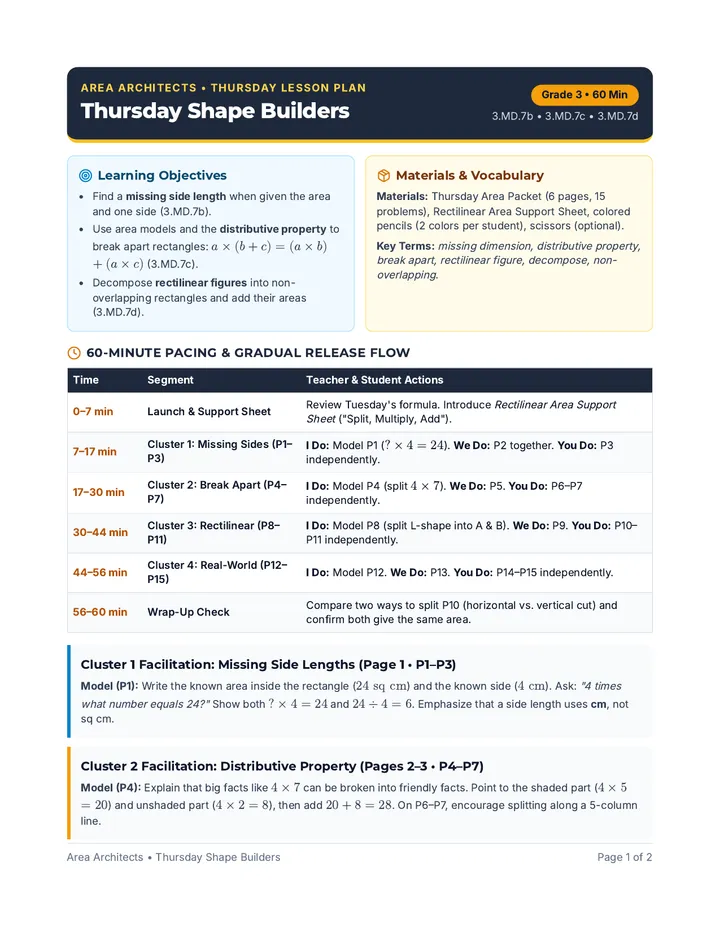
5. Look at the \(6 \times 7\) array split into two smaller parts. Complete the equation below.
5 columns
2 columns
(6 rows)
\(6 \times 7 = (6 \times\) \() + (6 \times\) \() =\)
6. Which shows how to use the distributive property to find \(8 \times 6\)?
A. \((8 \times 5) + (8 \times 1)\)
B. \((8 + 5) \times (8 + 1)\)
C. \((8 \times 5) \times (8 \times 1)\)
D. \((8 \times 3) + (8 \times 2)\)
7. Break apart one factor to solve \(7 \times 4\).
Write your break-apart equation and find the final product.
Part 3: Real-World Challenge
8. Maya has 4 boxes of markers. Each box has 2 packs, and each pack has 5 markers.
Write a multiplication equation with parentheses to find how many markers Maya has in all.
Answer: markers
Grouping and Splitting Answer Key
Grouping & Splitting Answer Key
Teacher Guide • Grade 3 Multiplication Properties
8 Points Total
Part 1: Associative Property (1 pt each)
B. \(3 \times (2 \times 5)\) — Factors stay the same; only parentheses move. Watch for students choosing A or C (mixing \(+\) and \(\times\)).
\(2\) — \((4 \times 2) \times 3 = 4 \times (\mathbf{2} \times 3)\). Both sides equal \(24\).
\(6\) — \((\mathbf{6} \times 5) \times 2 = 6 \times (5 \times 2)\). Both sides equal \(60\).
Product: \(30\)
Sample smart grouping: \(3 \times (2 \times 5) = 3 \times 10 = 30\). Also accept \((3 \times 2) \times 5 = 6 \times 5 = 30\). Look for clear parentheses around two factors.
Part 2: Distributive Property (1 pt each)
\(6 \times 7 = (6 \times \mathbf{5}) + (6 \times \mathbf{2}) = \mathbf{42}\) — \(30 + 12 = 42\).
A. \((8 \times 5) + (8 \times 1)\) — \(6\) splits into \(5 + 1\). Note: D equals \(8 \times 5\), not \(8 \times 6\).
Product: \(28\)
Sample equations: \((5 \times 4) + (2 \times 4) = 20 + 8 = 28\) or \((7 \times 2) + (7 \times 2) = 14 + 14 = 28\). Accept any valid break-apart of \(7\) or \(4\).
Part 3: Real-World Challenge (1 pt)
\(40\) markers
Sample equations: \(4 \times (2 \times 5) = 4 \times 10 = 40\) or \((4 \times 2) \times 5 = 8 \times 5 = 40\). Highlight how grouping \(2 \times 5 = 10\) makes mental math fast!
Quick Reteach Guide (CCSS 3.OA.B.5)
If students miss Part 1: Use 3D cubes or three-factor cards so they physically move parentheses without changing the factors. If students miss Part 2: Have them draw a rectangle, slice it with a colored line, and label the two smaller arrays before writing the addition of products.