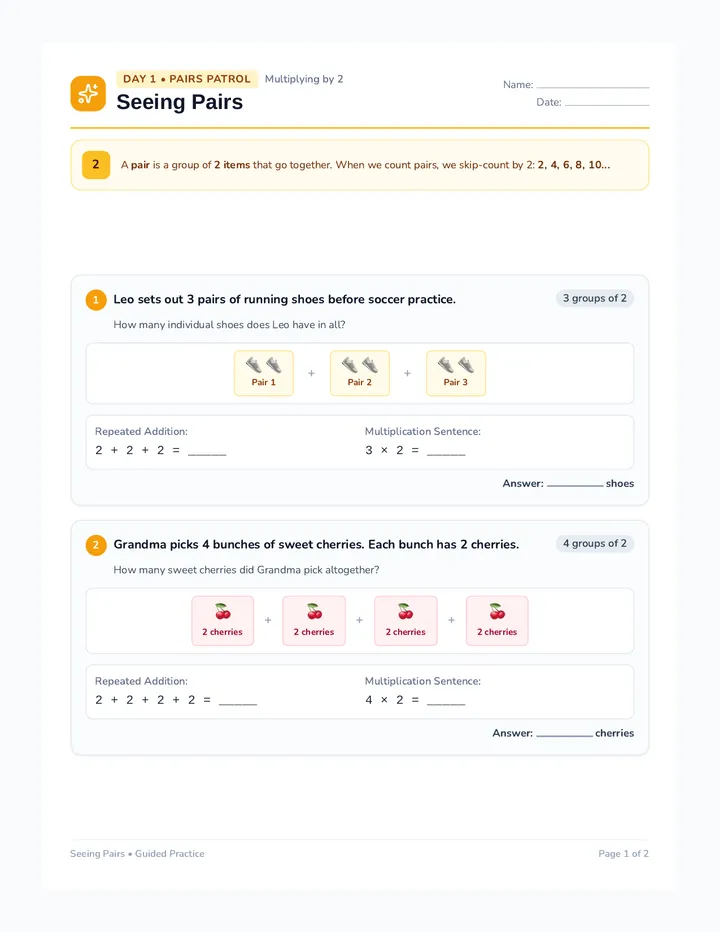
Seeing Pairs Worksheet Day 1 • Pairs Patrol Multiplying by 2
Seeing Pairs
Name:
Date:
2
A pair is a group of 2 items that go together. When we count pairs, we skip-count by 2: 2, 4, 6, 8, 10...
1
Leo sets out 3 pairs of running shoes before soccer practice.
3 groups of 2
How many individual shoes does Leo have in all?
👟 👟
Pair 1
👟 👟
Pair 2
👟 👟
Pair 3
Repeated Addition:
2 + 2 + 2 = _____
Multiplication Sentence:
3 × 2 = _____
Answer: shoes
2
Grandma picks 4 bunches of sweet cherries. Each bunch has 2 cherries.
4 groups of 2
How many sweet cherries did Grandma pick altogether?
🍒
2 cherries
🍒
2 cherries
🍒
2 cherries
🍒
2 cherries
Repeated Addition:
2 + 2 + 2 + 2 = _____
Multiplication Sentence:
4 × 2 = _____
Answer: cherries
Seeing Pairs • Guided Practice Page 1 of 2
Day 1 • Your Turn Skip-Count & Multiply
Pair Practice
Name:
3
There are 5 bicycles parked outside the library. Each bicycle has 2 wheels.
How many wheels are parked outside the library in total?
🚲
2 wheels
🚲
2 wheels
🚲
2 wheels
🚲
2 wheels
🚲
2 wheels
Repeated Addition:
__ + __ + __ + __ + __ = ____
Multiplication Sentence:
_____ × 2 = _____
Answer: wheels
4
Maya hangs 6 pairs of fuzzy winter socks on the laundry line.
How many individual socks are on the line?
🧦🧦
Pair 1
🧦🧦
Pair 2
🧦🧦
Pair 3
🧦🧦
Pair 4
🧦🧦
Pair 5
🧦🧦
Pair 6
Skip-Count by 2s:
2, 4, 6, ___, ___, ___
Multiplication Sentence:
6 × 2 = _____
Answer: socks
5
2 birds are sitting in a tree. Each bird has 2 wings.
Draw the 2 birds with their wings, then write the multiplication sentence:
Multiplication: _____ × 2 = _____
Total wings:
Seeing Pairs • Independent Practice Page 2 of 2
Seeing Pairs Teacher Guide Teacher Resource • Day 1 Pairs Patrol Sequence
Seeing Pairs Teacher Guide
Target: Groups of 2 Basics
Learning Objective
Students identify equal groups of 2, represent them with repeated addition, and translate them into multiplication sentences of the form \(a \times 2 = b\).
Essential Vocabulary
Pair: exactly two items that match or function together.Equal Groups: groups containing the exact same quantity.
Guided Lesson Walkthrough (15–20 mins)
1
Concrete Hook: Have the student look at their own shoes, ears, or eyes. Ask: "How many do you have? Why do we call them a pair?"
2
Connecting Addition to Multiplication: Emphasize that adding \(2 + 2 + 2\) is the same as counting "3 groups of 2", which we write as \(3 \times 2\). The \(\times\) symbol means "groups of".
3
Skip-Counting Rhythms: Chant or tap out \(2, 4, 6, 8, 10\) with fingers or counters so the pattern becomes automatic before moving to writing equations.
Common Misconception Alert
Swapping parts vs. total: When reading "3 pairs of shoes," students may mistakenly write \(3 + 2 = 5\). Direct them to point at each picture and physically count the 2 items in each group: "How many groups? 3. How many in each? 2. So it's 2, three times!"
Worksheet Answer Key Seeing Pairs Worksheet (Day 1)
Problem 1 (Shoes)
Addition: 2 + 2 + 2 = 6
Multiplication: 3 × 2 = 6
Answer: 6 shoes
Problem 2 (Cherries)
Addition: 2 + 2 + 2 + 2 = 8
Multiplication: 4 × 2 = 8
Answer: 8 cherries
Problem 3 (Bicycles)
Addition: 2 + 2 + 2 + 2 + 2 = 10
Multiplication: 5 × 2 = 10
Answer: 10 wheels
Problem 4 (Socks) & 5 (Birds)
Prob 4: Skip count: 8, 10, 12; 6 × 2 = 12 (12 socks )
Prob 5: 2 × 2 = 4 wings (4 wings )
Seeing Pairs • Instructional Plan & Solution Key Pairs Patrol • Day 1
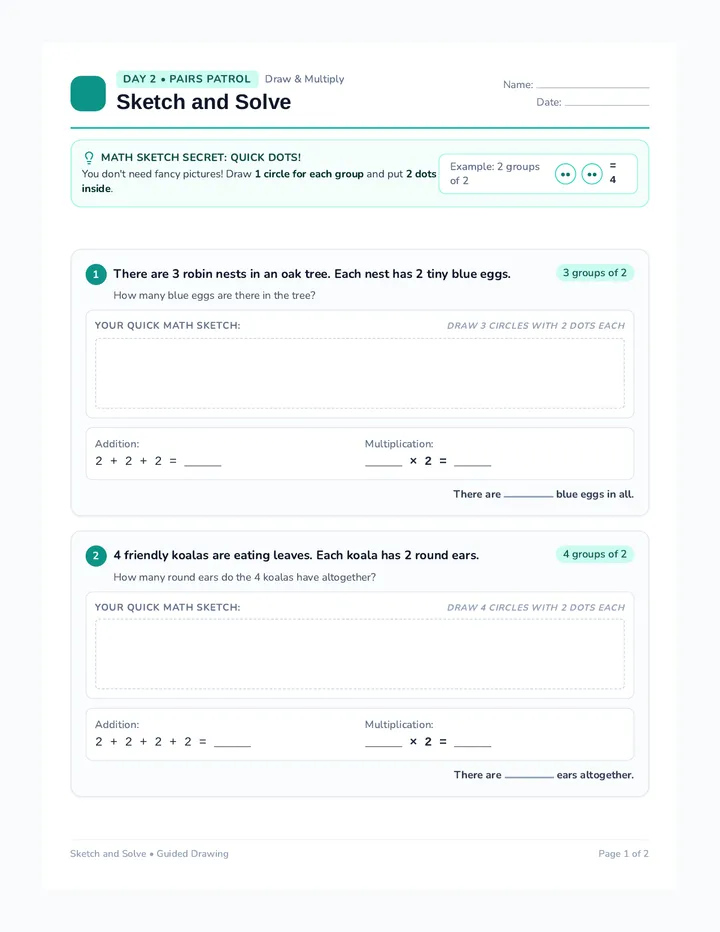
Sketch and Solve Worksheet Day 2 • Pairs Patrol Draw & Multiply
Sketch and Solve
Name:
Date:
Math Sketch Secret: Quick Dots!
You don't need fancy pictures! Draw 1 circle for each group and put 2 dots inside .
Example: 2 groups of 2
•• ••
= 4
1
There are 3 robin nests in an oak tree. Each nest has 2 tiny blue eggs.
3 groups of 2
How many blue eggs are there in the tree?
Your Quick Math Sketch: Draw 3 circles with 2 dots each
Addition:
2 + 2 + 2 = _____
Multiplication:
_____ × 2 = _____
There are blue eggs in all.
2
4 friendly koalas are eating leaves. Each koala has 2 round ears.
4 groups of 2
How many round ears do the 4 koalas have altogether?
Your Quick Math Sketch: Draw 4 circles with 2 dots each
Addition:
2 + 2 + 2 + 2 = _____
Multiplication:
_____ × 2 = _____
There are ears altogether.
Sketch and Solve • Guided Drawing Page 1 of 2
Day 2 • Your Turn Sketching Groups of 2
Draw, Model & Solve
Name:
3
Dad stacks 5 plates for breakfast. He puts 2 blueberry pancakes on each plate.
How many blueberry pancakes did Dad make in all?
Math Sketch:
Equation:
___ × 2 = ___
Total pancakes:
4
Maya has 6 thank-you cards. She sticks 2 gold star stickers on every card.
How many star stickers did Maya use in total?
Math Sketch:
Equation:
___ × 2 = ___
Total stickers:
5
7 kids walk inside after playing in the snow. Each child takes off 2 warm boots.
How many boots are sitting by the front door?
Math Sketch:
Equation:
___ × 2 = ___
Total boots:
Sketch and Solve • Independent Practice Page 2 of 2
Sketch and Solve Teacher Guide Teacher Resource • Day 2 Pairs Patrol Sequence
Sketch & Solve Teacher Guide
Target: Pictorial Modeling of \(\times 2\)
Day 2 Transition
Transitioning from pre-printed pictures to student-drawn representations (pictorial stage). Students sketch equal groups of 2 to unpack story problems efficiently.
Math Sketch Rule
Teach the "30-second rule": Math sketches use simple geometric shapes (circles and dots or tallies), not detailed illustrations. This preserves cognitive energy for arithmetic.
The "Group Detective" Routine
Step 1: Find the Groups
Ask: "What are the holding containers?" (nests, koalas, plates, cards, kids). That's your first factor.
Step 2: Draw the Twos
Draw that many circles. Put 2 dots in each. Touch and skip-count: "2, 4, 6..."
Step 3: Equation & Unit
Write \([\text{groups}] \times 2 = [\text{total}]\). Always label the answer with the object noun.
Prompting Questions for Struggling Learners
If a student is stuck on Problem 5 (7 kids, 2 boots each): "Pretend 7 kids are standing in front of you. How many boots does kid #1 have? (2). Kid #2? (2). Draw 7 circles for the 7 kids, then put 2 dots in each."
Worksheet Answer Key Sketch and Solve (Day 2)
Problem 1 (Robin Eggs)
Model: 3 circles with 2 dots each
Equation: 3 × 2 = 6
Answer: 6 blue eggs
Problem 2 (Koala Ears)
Model: 4 circles with 2 dots each
Equation: 4 × 2 = 8
Answer: 8 ears
Problem 3 (Pancakes)
Model: 5 circles with 2 dots each
Equation: 5 × 2 = 10
Answer: 10 pancakes
Problem 4 (Stickers) & 5 (Boots)
Prob 4: 6 × 2 = 12 (12 star stickers )
Prob 5: 7 × 2 = 14 (14 boots )
Sketch and Solve • Instructional Plan & Solution Key Pairs Patrol • Day 2
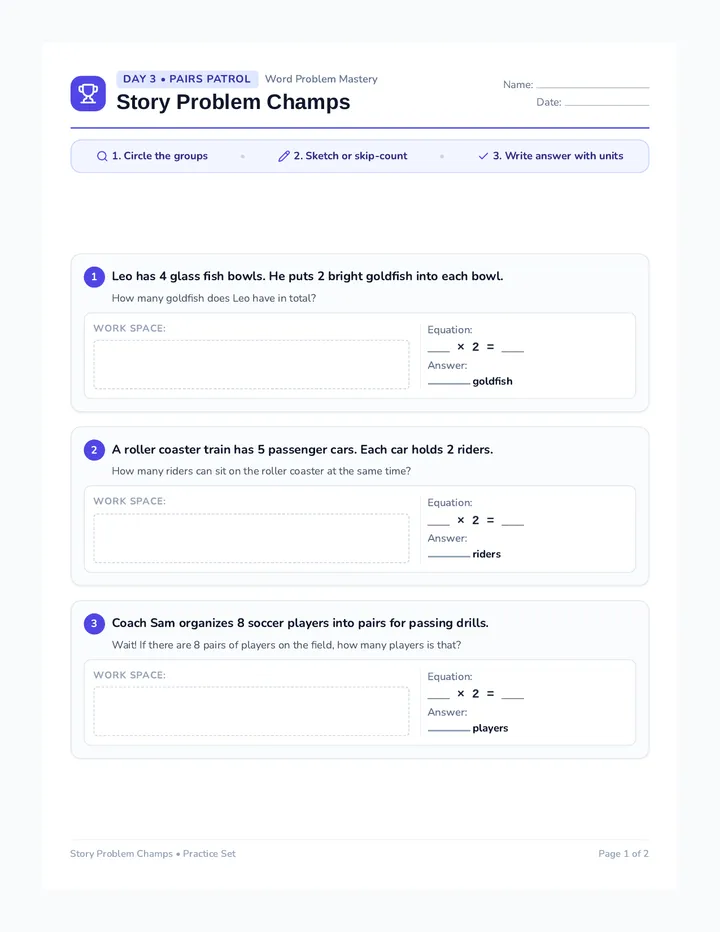
Story Problem Champs Worksheet Day 3 • Pairs Patrol Word Problem Mastery
Story Problem Champs
Name:
Date:
1. Circle the groups • 2. Sketch or skip-count • 3. Write answer with units
1
Leo has 4 glass fish bowls. He puts 2 bright goldfish into each bowl.
How many goldfish does Leo have in total?
Work Space:
Equation:
___ × 2 = ___
Answer:
goldfish
2
A roller coaster train has 5 passenger cars. Each car holds 2 riders.
How many riders can sit on the roller coaster at the same time?
Work Space:
Equation:
___ × 2 = ___
Answer:
riders
3
Coach Sam organizes 8 soccer players into pairs for passing drills.
Wait! If there are 8 pairs of players on the field, how many players is that?
Work Space:
Equation:
___ × 2 = ___
Answer:
players
Story Problem Champs • Practice Set Page 1 of 2
Day 3 • Challenge Round High Groups & Problem Author
Story Problem Masters
Name:
4
9 happy puppies are at the park. The dog walker gives each puppy 2 treats.
How many dog treats were handed out in total?
Work Space (draw or skip-count):
Equation:
___ × 2 = ___
Answer:
treats
5
Noah has 10 pairs of clean socks in his laundry basket.
How many individual socks does Noah have in the basket?
Work Space:
Equation:
___ × 2 = ___
Answer:
socks
6
You Be the Math Story Author!
Write your own story problem using groups of 2 :
I have groups of .
Each group has 2 inside.
How many do I have in all?
My Multiplication Equation:
_____ × 2 = _____
My Final Answer with Unit:
There are .
Story Problem Champs • Challenge Set Page 2 of 2
Pair Champs Exit Ticket Quick Check • Day 3 Pairs Patrol Capstone
Pair Champs Exit Ticket
Name:
Date:
Show your thinking for each story problem. Write your multiplication sentence and your final answer with its unit label!
1
Oliver brings 4 pairs of sunglasses to summer camp.
How many individual sunglasses does Oliver have in all?
Show Your Work (draw dots or skip-count):
Multiplication Equation:
___ × 2 = ___
Final Answer:
sunglasses
2
7 bicycles are parked at the park bike rack. Each bicycle has 2 pedals.
How many pedals are on all 7 bicycles combined?
Show Your Work (draw dots or skip-count):
Multiplication Equation:
___ × 2 = ___
Final Answer:
pedals
How do you feel about multiplying by 2?
🌟 Super Ready! I can do it fast
👍 Got It! I sketch to solve
🌱 Keep Practicing I like help
Teacher Check
Score: ___ / 2
[ ] Mastered \(\times 2\)
[ ] Needs Practice
Pairs Patrol • Sequence Assessment Exit Ticket
Story Problem Champs Answer Key Teacher Resource • Day 3 Pairs Patrol Sequence
Champs Key & Rubric
Complete Day 3 Solutions
Story Problem Champs Worksheet Solutions
Problem 1: Goldfish
4 groups of 2
4 × 2 = 8
8 goldfish
Problem 2: Coaster
5 groups of 2
5 × 2 = 10
10 riders
Problem 3: Soccer
8 groups of 2
8 × 2 = 16
16 players
Problem 4: Treats
9 groups of 2
9 × 2 = 18
18 treats
Problem 5: Socks
10 groups of 2
10 × 2 = 20
20 socks
Problem 6: Student Author
Accept any context with equal groups of 2 (e.g. \(6 \text{ bicycles} \times 2 = 12 \text{ wheels}\)). Verify group and item consistency.
Pair Champs Exit Ticket Solutions Quick Check Key
Question 1: Sunglasses 1 pt
Oliver brings 4 pairs of sunglasses.
Equation: 4 × 2 = 8
Final Answer: 8 sunglasses
Question 2: Bike Pedals 1 pt
7 bicycles with 2 pedals each.
Equation: 7 × 2 = 14
Final Answer: 14 pedals
Sequence Mastery Rubric
Mastered (Level 3)
Accurately extracts the number of groups, writes the multiplication sentence \(a \times 2 = b\), computes the product, and states the answer with the correct unit label.
Developing (Level 2)
Understands groups of 2 and can skip-count or draw models, but occasionally omits units or makes minor counting errors above \(5 \times 2\).
Needs Support (Level 1)
Adds the two numbers found in the text (e.g. \(4 + 2 = 6\)). Recommend returning to Day 1 visual pairs with concrete counters.
Story Problem Champs • Answer Key & Rubric Pairs Patrol • Day 3