A high-contrast visual presentation teaching common environmental and safety signs, including Stop, Caution, Exit, and Prohibitory signs, with discussion prompts for group learning.
A word building mat featuring structured boxes for students to physically assemble CVC words (Cat, Fan, Map, Hop) using letter tiles. Includes a sentence-building challenge at the bottom to progress from words to simple sentence structure.
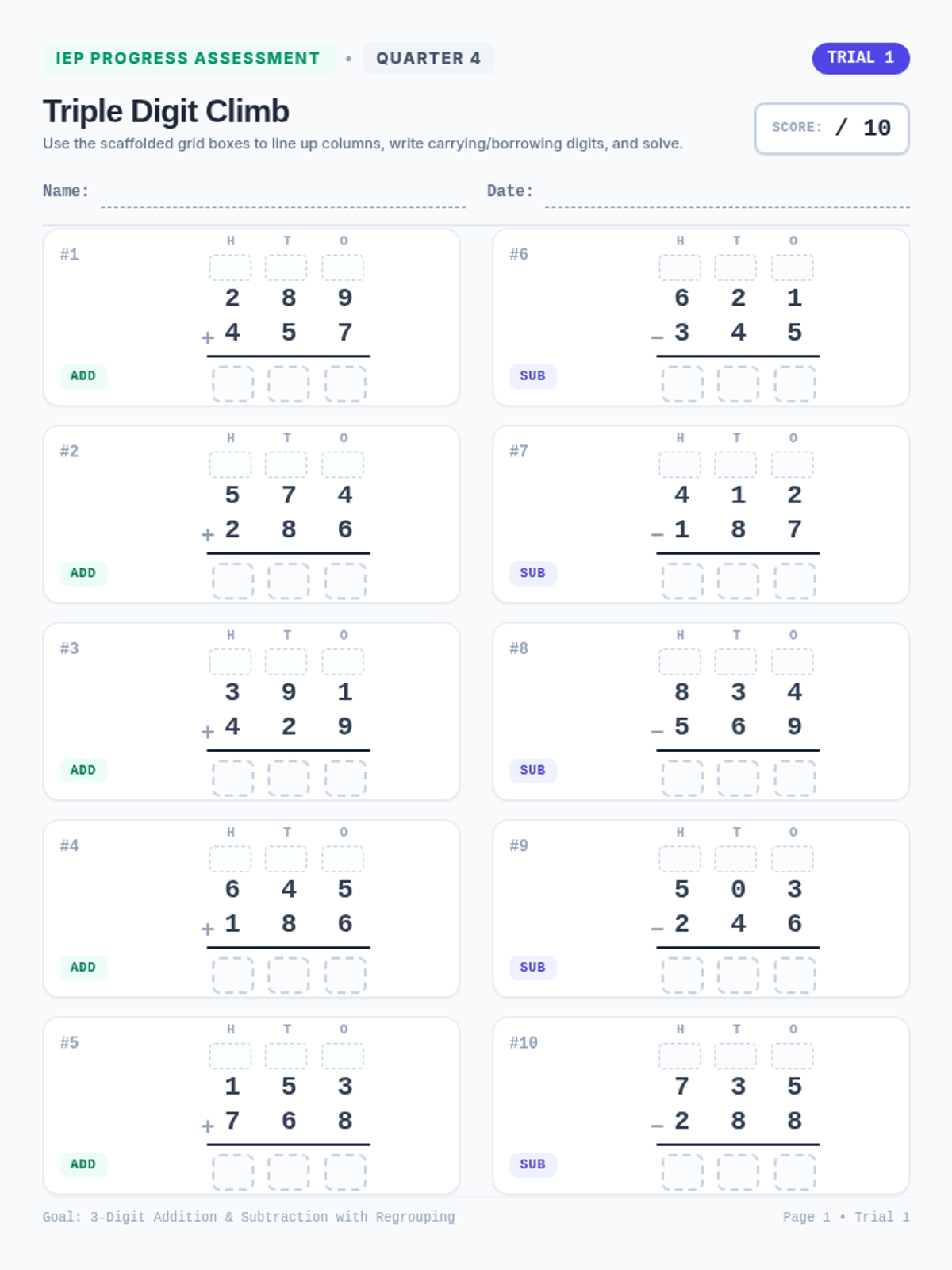
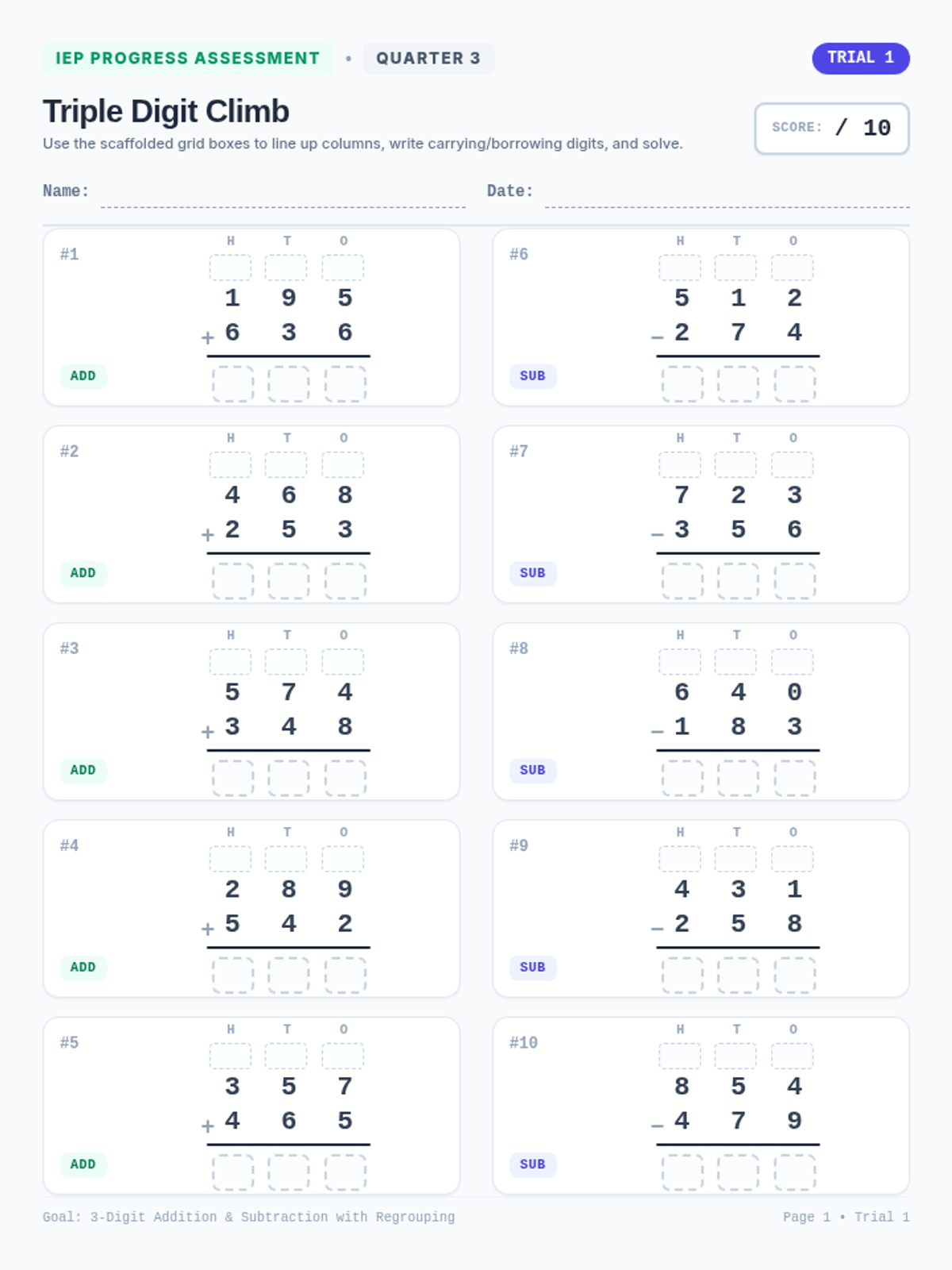
A 3-page math workbook for addition and subtraction within 20, specifically designed for a first grader with Down syndrome. Features large fonts, high-contrast visual supports (10-frames, number lines, icons), and a progressive daily structure.
A visual behavior aid that defines five levels of volume, ranging from silent to outside voice. It emphasizes 'Level 1: Quiet Voice' as the target for the program and includes a 5-day tracker for reinforcement during work sessions.
Updated Word House Sorting Mats now including 2 pages to accommodate the -at, -an, -ap, and -op word families. Each house provides a clear visual placeholder for sorting CVC word cards.
Updated CVC word cards now including 'Map' and 'Hop' (total 8 cards). Features 2 pages of high-contrast cards and extra letter tiles for 'm', 'p', and 'o'.
A scissor skills worksheet with four distinct cutting paths: straight, zigzag, curvy, and steps. Designed for progressive difficulty, each path starts from the bottom and ends at a visual goal (star), helping students develop bilateral coordination and line-tracking skills.
A high-contrast letter tracing worksheet for the letters s, a, r, and h. It features large, clear fonts, directional starting points (stars), and corresponding animal/object icons for sound association. Provides graduated support from guided tracing to independent formation.
Expanded Teacher Guide including math integration (addition/subtraction within 20), sentence building challenges, and a daily instructional breakdown for phonics, math, and fine motor skills.
A comprehensive facilitator guide for teachers in sub-separate settings to deliver modified EL Education bird lessons. Includes standard-specific teaching strategies and differentiation tips.
A structured bird report template for kindergarten students to demonstrate informative writing through drawing, dictation, and fill-in-the-blank sentences. Designed with high visual support and clear sections.
A visual matching activity for kindergarten students to identify how different bird beaks function as tools. Uses large icons and high-contrast visuals suitable for sub-separate settings.
A simplified research slide deck exploring how beak shapes function as tools for eating. Uses clear analogies and high-contrast visuals for sub-separate learners.
A printer-friendly labeling worksheet for sub-separate kindergarten students. Includes a clear diagram area, a large-print word bank, and self-check boxes for basic bird body parts.
A visual slide deck introducing kindergarten students to the basic body parts of a bird. Designed with high contrast, clear icons, and simplified text for sub-separate learning environments.
High-contrast visual vocabulary flashcards for 3D shapes including sphere, cube, cone, cylinder, and properties like face and solid.
A portable visual aid card for the student to keep at their desk. It displays common frustration indicators and replacement 'Power Words'. It includes a specific reminder about the Art Lab rule.
A high-contrast, large-print trace-and-color booklet for 3D shapes including sphere, cube, cone, and cylinder, featuring solid shape property identification.
A teacher-facing guide providing specific strategies for managing swearing and threats, including pre-correction techniques, the '3-Step Reset' for redirections, and specific protocols for handling inappropriate writing on art projects.
A worksheet for the student to practice identifying physical signs of frustration and matching specific 'Power Words' to common triggers like redirection or difficult work. It includes a positive reinforcement drawing area for art time.
A visual slide deck designed as a social story to teach a 4th-grade student with autism about 'Power Words' (replacement communication) versus 'Hurting Words' (swearing/threats). It includes visual cues for frustration and specific phrases to use during redirection.
A large-format sorting activity where students cut out different 2D shapes and paste them into designated high-contrast category boxes. Revised for better motor-skill accessibility. Now includes two sorting boards and 16 cutout shapes.
A comprehensive teacher facilitation guide for delivering the modified geometry lesson, including step-by-step instructions and adaptation tips. Expanded to cover 3D shapes.
High-contrast visual vocabulary flashcards for side, corner, polygon, and quadrilateral, featuring large text and simple illustrations. Expanded to include Pentagon, Hexagon, Oval, and Rhombus.
An expanded high-contrast anchor chart featuring 2D and 3D shapes (circle, square, sphere, cube, etc.) alongside real-world object emojis for visual support.
An expanded high-contrast trace-and-color booklet adding Oval, Pentagon, Hexagon, and Rhombus to the original set of 2D shapes.
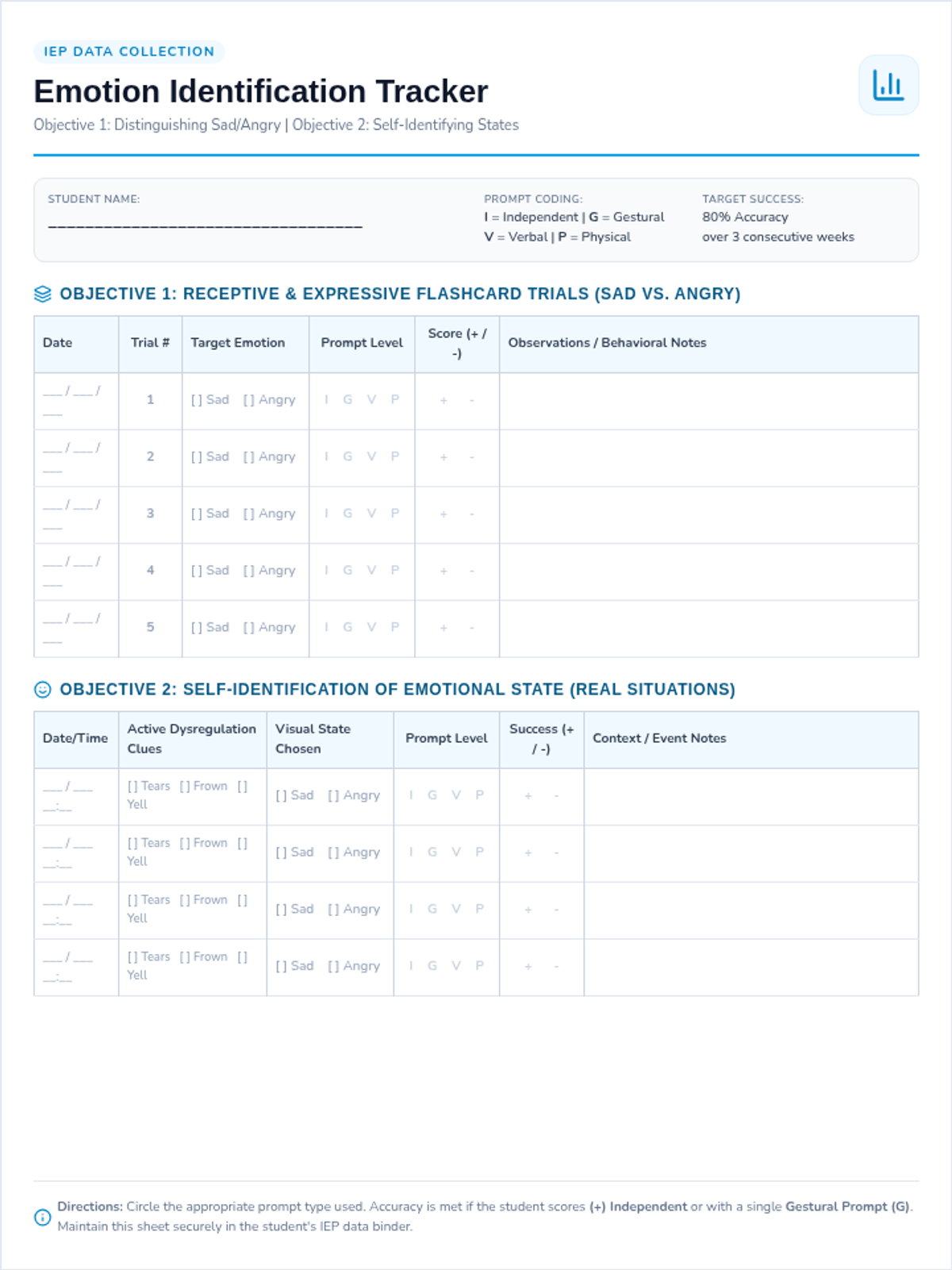
A daily "quick-capture" data sheet for tracking up to three specific IEP goals with a prompting hierarchy key and dedicated tally sections.
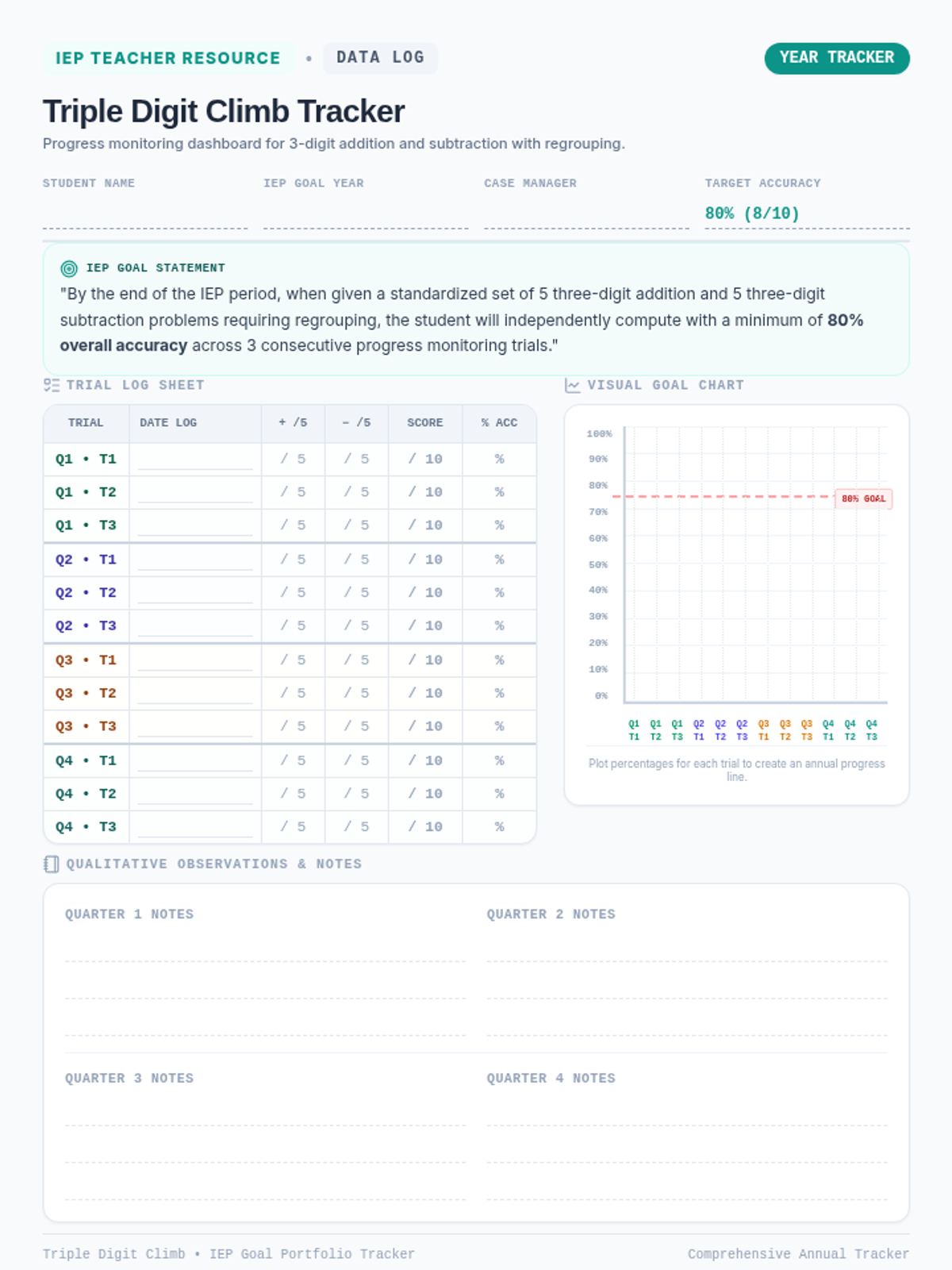
A visual data analysis sheet featuring a 10-trial graphing grid, designed for plotting progress toward specific IEP goal mastery criteria.
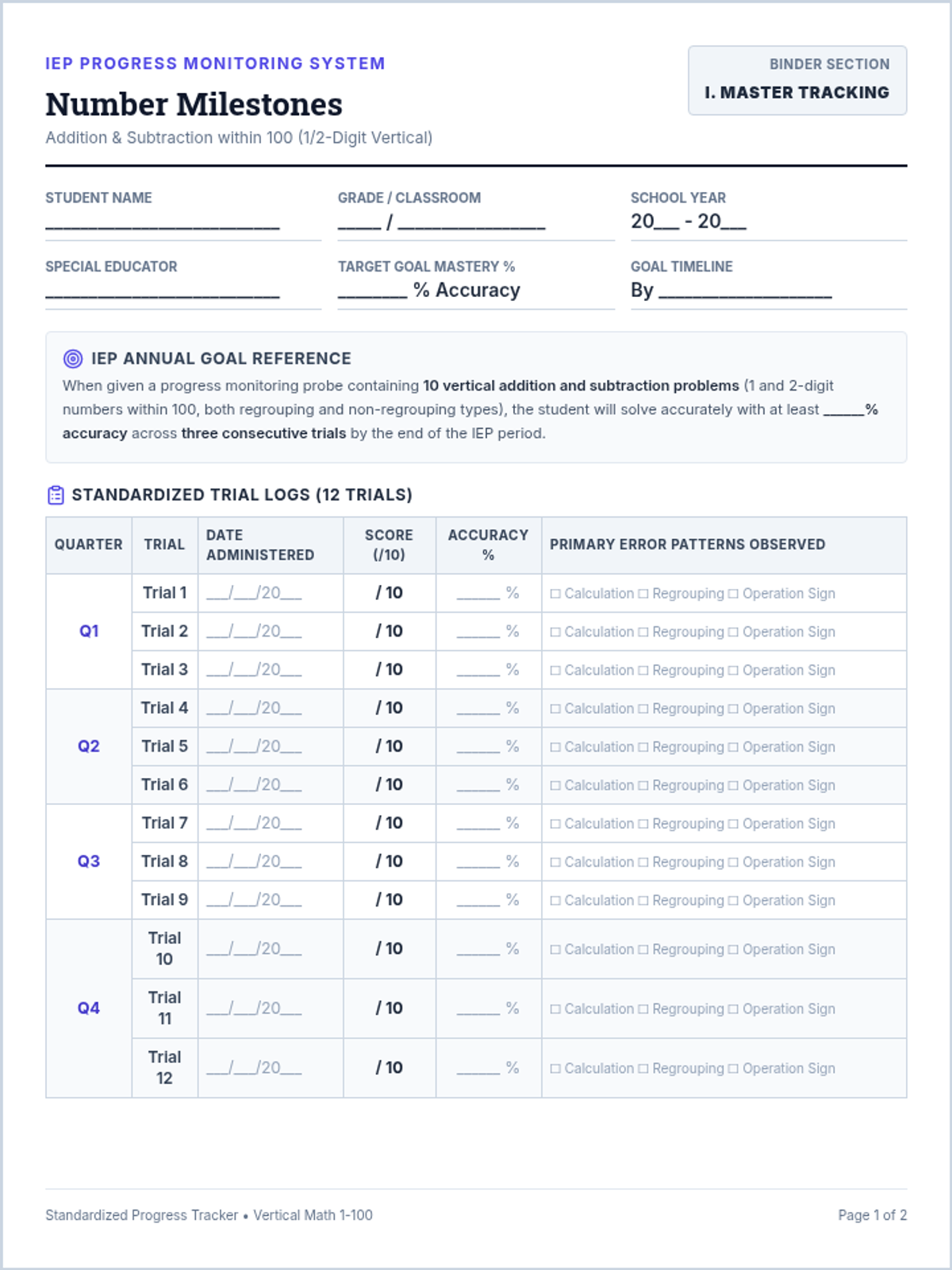
A two-page comprehensive master tracking template for individual student IEP goals, featuring dedicated space for academic, functional, and behavioral data.
A concise answer key for the Orpheus and Eurydice Packet, providing correct answers for all 30 questions, including sample responses for the long-answer planning and writing sections.
A six-page independent work packet about Orpheus and Eurydice, featuring four simplified texts, 30 comprehension questions (multiple choice and short answer), and a multi-step long answer planning and writing section. The layout uses blue, Greek-inspired visual elements and a 2nd-grade reading level to ensure accessibility.
An engaging reading passage titled "The Campfire Quest" designed for vocalic R "IRE" sound practice. Includes high-interest narrative and a post-reading checklist.
A sentence-level worksheet for practicing "IRE" vocalic R words, including fill-in-the-blank exercises, a word bank, and space for original sentence creation.
A set of 12 printable flashcards featuring "IRE" vocalic R words with engaging emojis and bold text, organized in a 2x3 grid across two pages.
Teacher's answer key for the Rescue Run reading assignments, including skill explanations.
A second set of three-level reading comprehension assignments (Rescue Run) featuring short high-interest passages and 4 multiple-choice questions focusing on sequencing, main idea, and inference. Each level fits on its own page.
A teacher guide for the Robot Reboot lesson. It includes instructional objectives, casting advice for different reading levels, step-by-step implementation notes, and an answer key for the Prefix Patrol worksheet.
An expanded student worksheet to accompany the longer Robot Reboot script. It provides practice with Wilson Step 5.2 concepts, including marking up words with open syllable prefixes, word construction, and sentence writing.
An expanded 4-character Readers Theater script for Wilson Reading Step 5.2. It features two Grade 2 parts and two Grade 3 parts, significantly lengthened with more dialogue and a wider range of open syllable prefix words (re-, de-, pro-, pre-, be-).
Teacher's answer key for the three levels of Action Ace reading assignments, including explanations for skill targeting.
A three-level reading comprehension document featuring short high-interest passages and multiple-choice questions focusing on sequencing, main idea, and inference. Each assignment fits strictly on its own page.
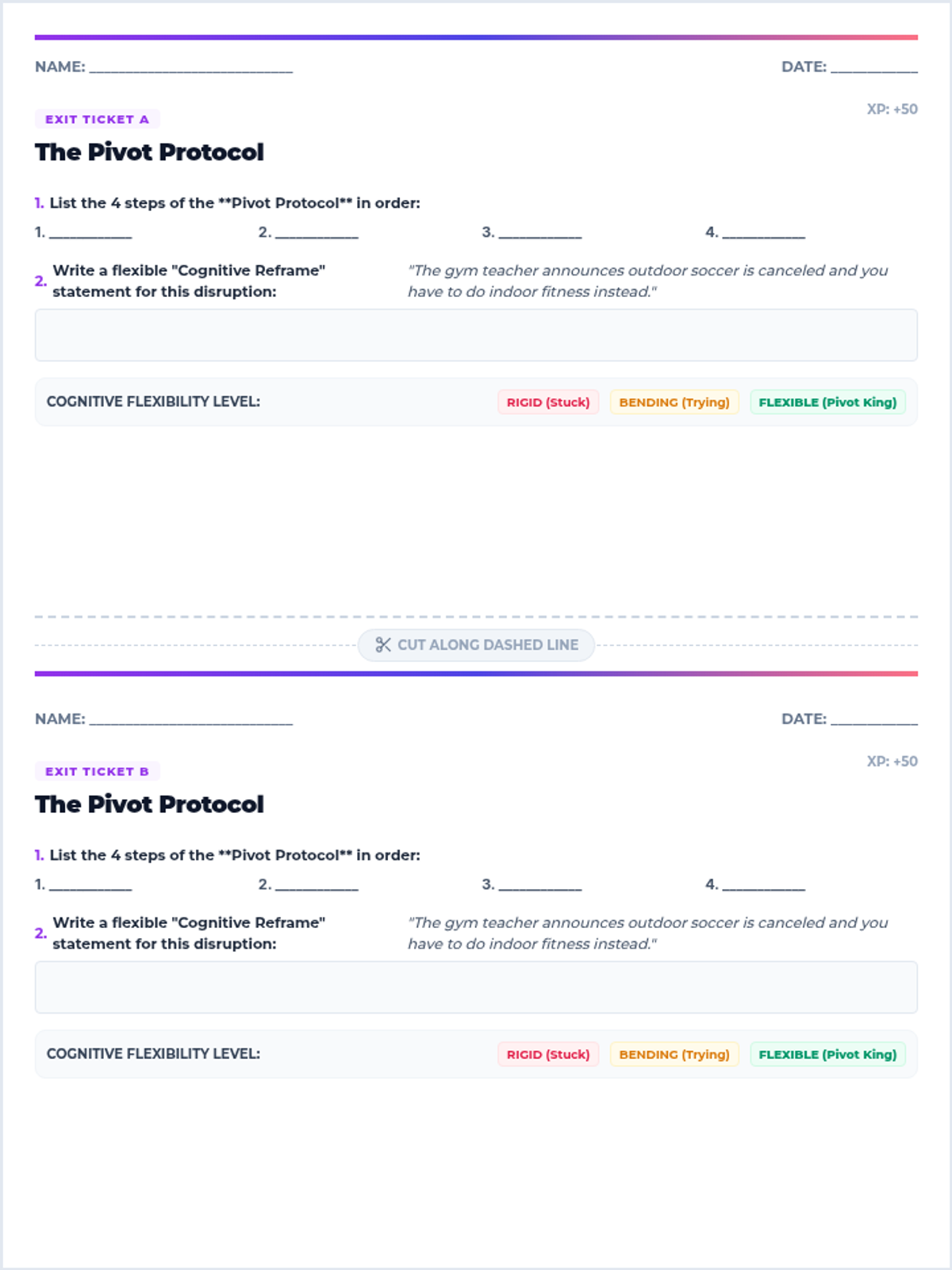
A quick assessment tool with two slips per page, featuring identification and repair tasks alongside a visual self-reflection section for students.
A high-contrast visual anchor chart for students to reference while writing, summarizing the three essential parts of a complete sentence using the construction theme.
An answer key for the Sentence Lab Worksheet, providing correct classifications and example repairs for grammar exercises.
A visual graphic organizer designed to help students build complete sentences by connecting subjects and predicates in a color-coded "construction" layout.