Online Transition Evaluation Report
Instructional Design Report NSQ Standards Evaluation
August 2026
Transitioning Primary Math to Online Spaces
An instructional design evaluation of a 2nd-grade unit on double-digit addition and subtraction, utilizing the National Standards for Quality Online Courses.
Part A: Unit of Instruction
Unit Topic
Addition & Subtraction Strategies
Focusing on two-digit regrouping and one- and two-step word problems.
Target Learners
Mathematics | Grade 2
Designed for K-12 primary students developing early operational fluency.
Unit Purpose & Educational Goal
The fundamental purpose of this unit is to guide second-grade students from concrete, manipulative-based representations of place value to abstract algorithmic processing of addition and subtraction with regrouping (composing and decomposing tens). By integrating standard regrouping procedures with contextual, multi-step word problems, students learn not just how to compute, but when and why to apply specific arithmetic operations to solve real-world problems.
Current In-Person Instructional Delivery
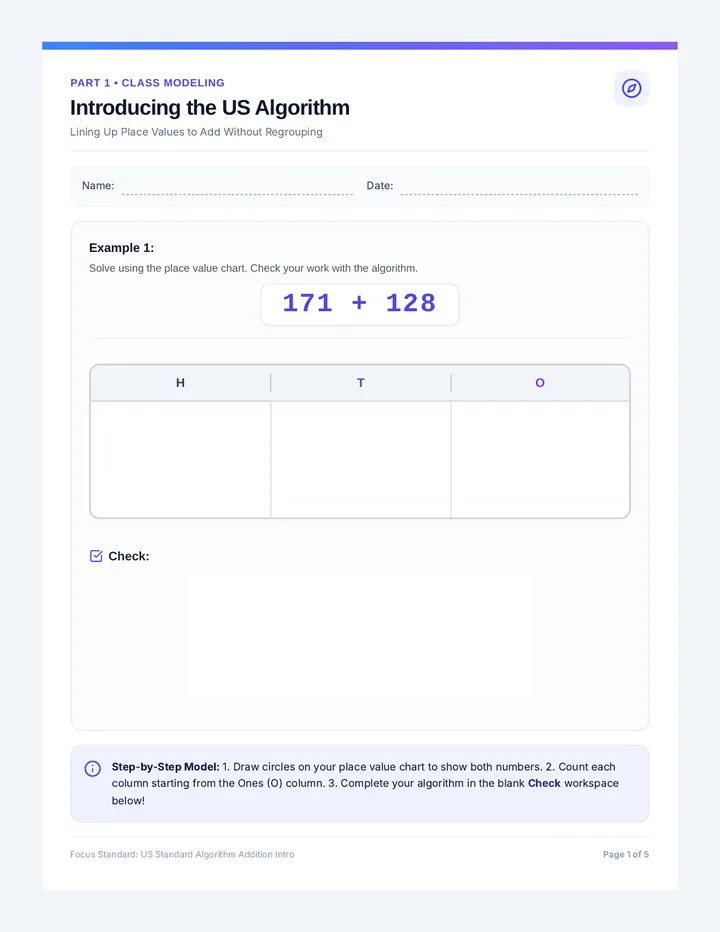
In the traditional physical classroom, this 4-week unit is delivered through a high-touch, station-based workshop model. Daily lessons begin with a 10-minute whole-group direct instruction session where the teacher demonstrates place value mechanics on a magnetic board using physical plastic base-ten blocks.
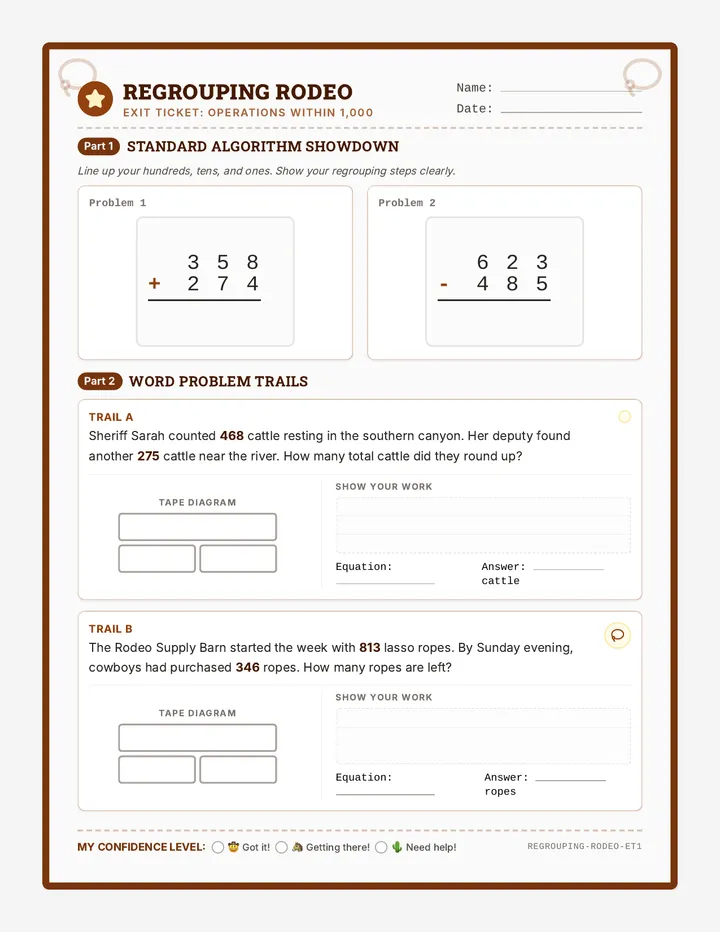
Following the mini-lesson, students rotate through three 15-minute stations: (1) Teacher Table for targeted guided practice with individual place-value mats, (2) Independent Work consisting of paper-and-pencil worksheets focusing on operational drills, and (3) Math Centers where pairs play tactile card games (e.g., "Roll, Build, and Regroup"). Formative assessment occurs via physical paper exit tickets handed in at the end of each class.
Unit Transition Evaluation Report — 2nd Grade Mathematics Page 1 of 4
National Standards Evaluation Course Design & Content
Part B: Evaluation & Repurposing
B3 Standard B: Content — Indicator B3 (Bias & Representation)
a. Current In-Person Alignment Analysis
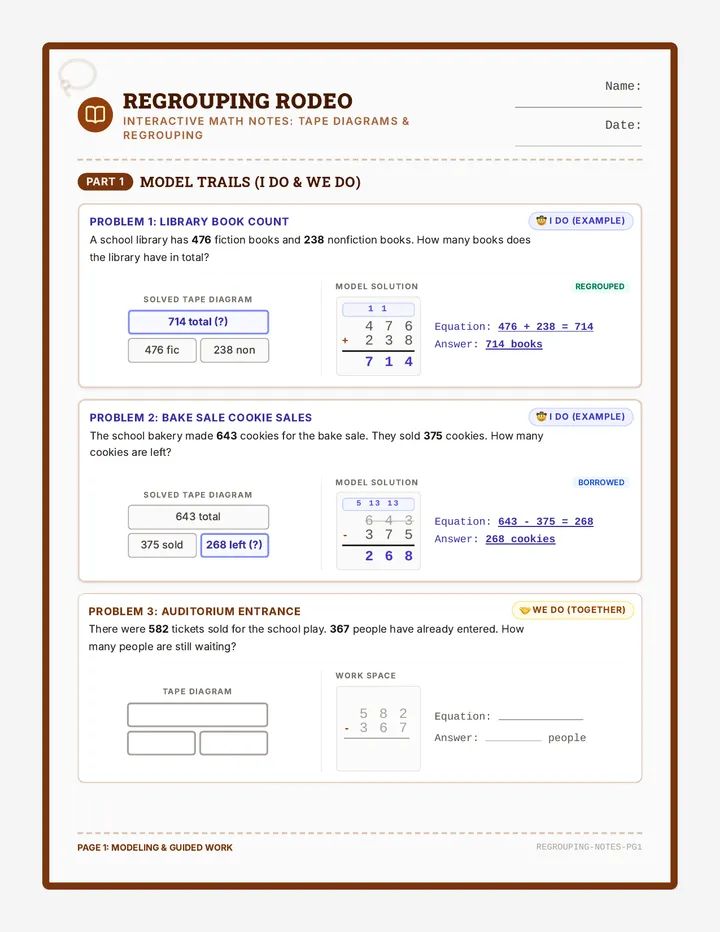
The current unit partially aligns with Indicator B3. While the mathematical equations themselves are objective and accurate, the word problems on paper worksheets rely heavily on homogeneous names (e.g., "Sam", "Amy") and outdated contexts (e.g., buying glass marbles or counting white picket fences). This lacks representation of our diverse contemporary society, potentially introducing subtle cultural biases.
b. Online Improvement & Adaptation Strategy
In the digital transition, we can leverage dynamic, variables-driven web modules that instantly customize word problems to feature diverse, gender-inclusive characters engaged in relatable activities (e.g., collecting recycled plastic, earning points on a family coding platform, or dividing community garden plots). This ensures the content is free of socioeconomic stereotypes and culturally relevant to all learners.
c. Supporting Learning Technology Tool
Desmos Activity Builder: This platform allows the integration of dynamic, randomized student text inputs and variable fields. Teachers can build interactive screens where math story problems are dynamically generated with diverse character profiles and illustrative cartoon vector graphics, ensuring culturally rich representation on every screen.
C8 Standard C: Instructional Design — Indicator C8 (Interaction)
a. Current In-Person Alignment Analysis
The unit partially aligns. In the physical classroom, student-to-student and student-to-teacher interactions are highly active during station rotations. However, student-to-content interaction is quite passive when students complete isolated, static paper worksheets, limiting opportunities for students to dynamically manipulate mathematical structures.
b. Online Improvement & Adaptation Strategy
To meet Standard C8 online, we must replace passive worksheets with structured, synchronous digital collaborative spaces. Students can work in peer-pairs in breakout rooms utilizing real-time digital whiteboards where they can cooperatively solve regrouping problems, manipulate digital assets simultaneously, and record verbal explanations of their mathematical processes for the teacher to review.
c. Supporting Learning Technology Tool
Seesaw Interactive Whiteboards: Seesaw's multi-page collaborative canvas allows two-digit numbers to be built cooperatively. One student can represent the tens using digital "base-ten stampers" while their partner acts as the "decomposer," dragging individual unit blocks across the digital screen, while using the built-in microphone tool to talk through the steps.
Unit Transition Evaluation Report — 2nd Grade Mathematics Page 2 of 4
National Standards Evaluation Assessment & Technology
D3 Standard D: Learner Assessment — Indicator D3 (Feedback Loops)
a. Current In-Person Alignment Analysis
The unit currently fails to align with Indicator D3. In the traditional physical classroom, formative exit tickets are turned in physically and graded after school, resulting in a 24-hour delay. For second graders, this delay is too late; a child who incorrectly subtracts \(42 - 17\) as \(35\) (by taking the smaller digit from the larger: \(7 - 2 = 5\)) will continue practicing this incorrect mental model for an entire day before receiving feedback.
b. Online Improvement & Adaptation Strategy
Transitioning this assessment online allows us to build real-time diagnostic checks that evaluate student answers and offer immediate, adaptive visual feedback. If a student attempts to subtract without decomposing a ten, the interface can dynamically split a digital ten-rod into ten individual units on the screen, showing the error and allowing the student to self-correct during the active learning process.
c. Supporting Learning Technology Tool
Formative (goformative.com): This digital platform allows the teacher to design auto-graded mathematical items that trigger real-time, personalized hints. If a student inputs a common error (e.g., \(42 - 17 = 35\)), the system triggers a pre-programmed, student-friendly visual hint video demonstrating how to break a ten-rod on a place-value chart.
F3 Standard F: Technology — Indicator F3 (Accessibility & Usability)
a. Current In-Person Alignment Analysis
This standard is not applicable in the fully offline, paper-based model. However, a superficial transfer (e.g., scanning paper worksheets into PDFs for students to annotate with a computer mouse) would represent a critical failure of F3, as drawing numbers with a mouse or trackpad creates immense cognitive and physical fine motor frustration for 7-year-olds.
b. Online Improvement & Adaptation Strategy
An online transition must utilize a highly intuitive, child-friendly user interface. We must incorporate virtual manipulatives designed for easy drag-and-drop actions on touchscreen tablets, featuring large contact targets and built-in screen readers to read math word problems aloud to emerging readers who would otherwise struggle to access the math content.
c. Supporting Learning Technology Tool
Mathigon Polypad: Polypad is an outstanding, intuitive, and accessible digital manipulative workspace. It features high-contrast base-ten blocks that "snap" together to form tens and "break apart" into ones with a single click. It supports full touchscreen interactions, keyboard accessibility, screen-reader text, and eliminates mechanical fine-motor hurdles for young children.
Unit Transition Evaluation Report — 2nd Grade Mathematics Page 3 of 4
National Standards Evaluation Student Academic Support
E2 Standard E: Learner Support — Indicator E2 (Academic Support Access)
a. Current In-Person Alignment Analysis
The current unit partially aligns. Academic support is highly dependent on classroom presence, relying on the physical presence of the teacher, the co-teacher, or classroom-bound anchors/posters on the wall. For students completing homework at home or struggling after hours, there are no immediate support resources, placing an unsustainable instructional burden on parents.
b. Online Improvement & Adaptation Strategy
The online course design should integrate an intuitive, asynchronous "Math Help Desk" panel. This portal will offer student-friendly, on-demand video tutorials, visual anchor charts with step-by-step regrouping guides, and direct, safe links to student-to-teacher support channels or virtual help-desk hours.
c. Supporting Learning Technology Tool
Loom micro-videos embedded in a Canvas LMS Portal: By embedding 2-minute "how-to" screen-captures within the Learning Management System, students and parents can securely access visual demonstrations of the standard algorithm and the break-apart strategy at any time, directly bridging the home-school instruction gap.
Online Transition Feasibility Summary
Repurposing this second-grade math unit for an online environment is highly feasible and instructionally beneficial, provided the transition focuses on interactive, visual-tactile software rather than passive text-based slides. Utilizing Mathigon Polypad to simulate concrete manipulation of place-value, Loom to host 24/7 student-parent instructional videos, and Formative to deliver immediate feedback loops will yield a learning experience that matches, and in some aspects exceeds, traditional face-to-face primary instruction.
Polypad Concrete Models
Formative Immediate Feedback
Loom Parent Support
Unit Transition Evaluation Report — 2nd Grade Mathematics Page 4 of 4