Initial sound safari worksheets for letters K through O, designed to practice phonetic awareness and mouth positioning through engaging picture cues. Enhanced with high-contrast drawing areas and individual name fields.
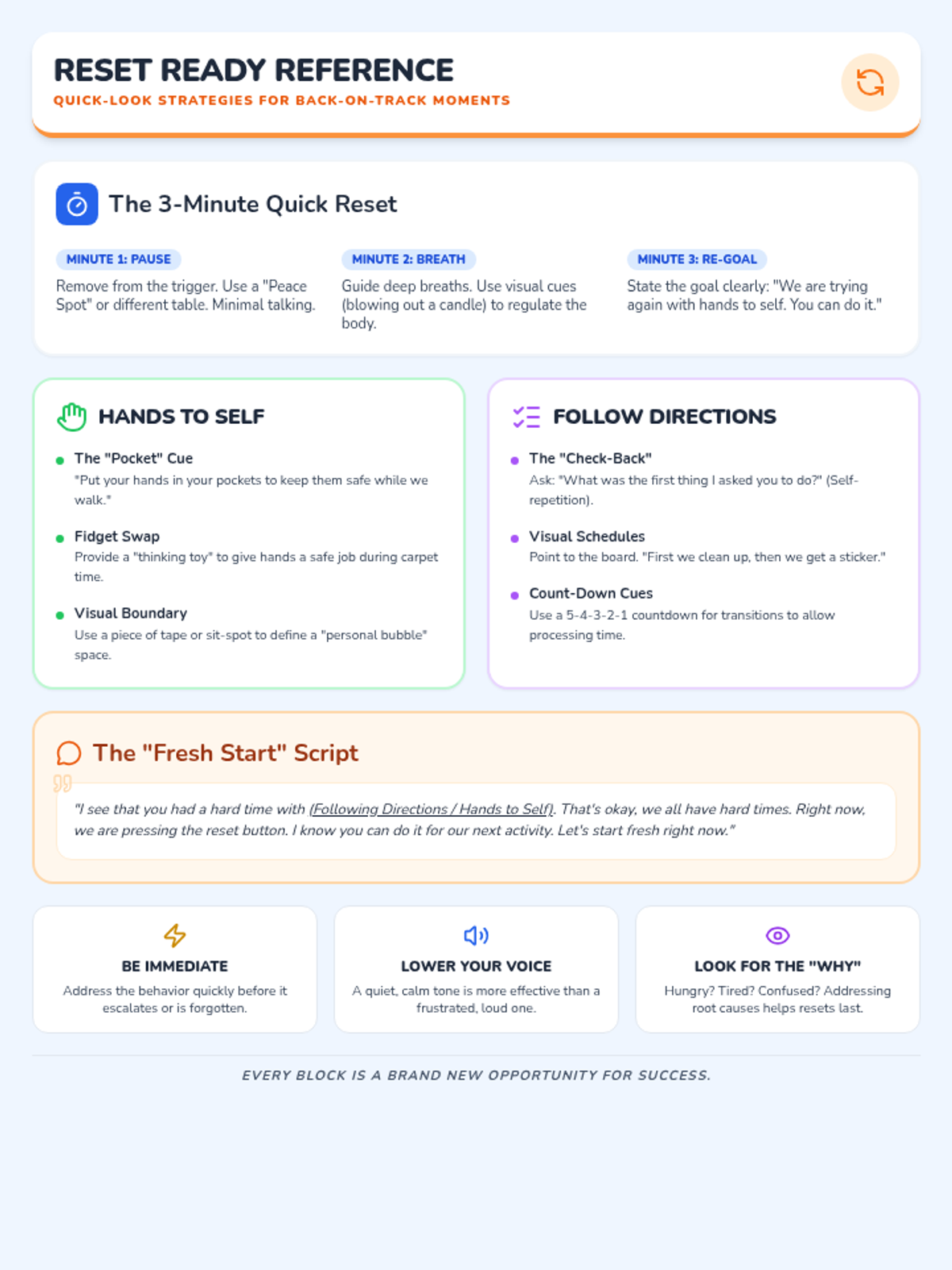
A quick-reference teacher one-pager providing immediate strategies, verbal scripts, and reset techniques for Kindergarten students struggling to meet behavior goals.
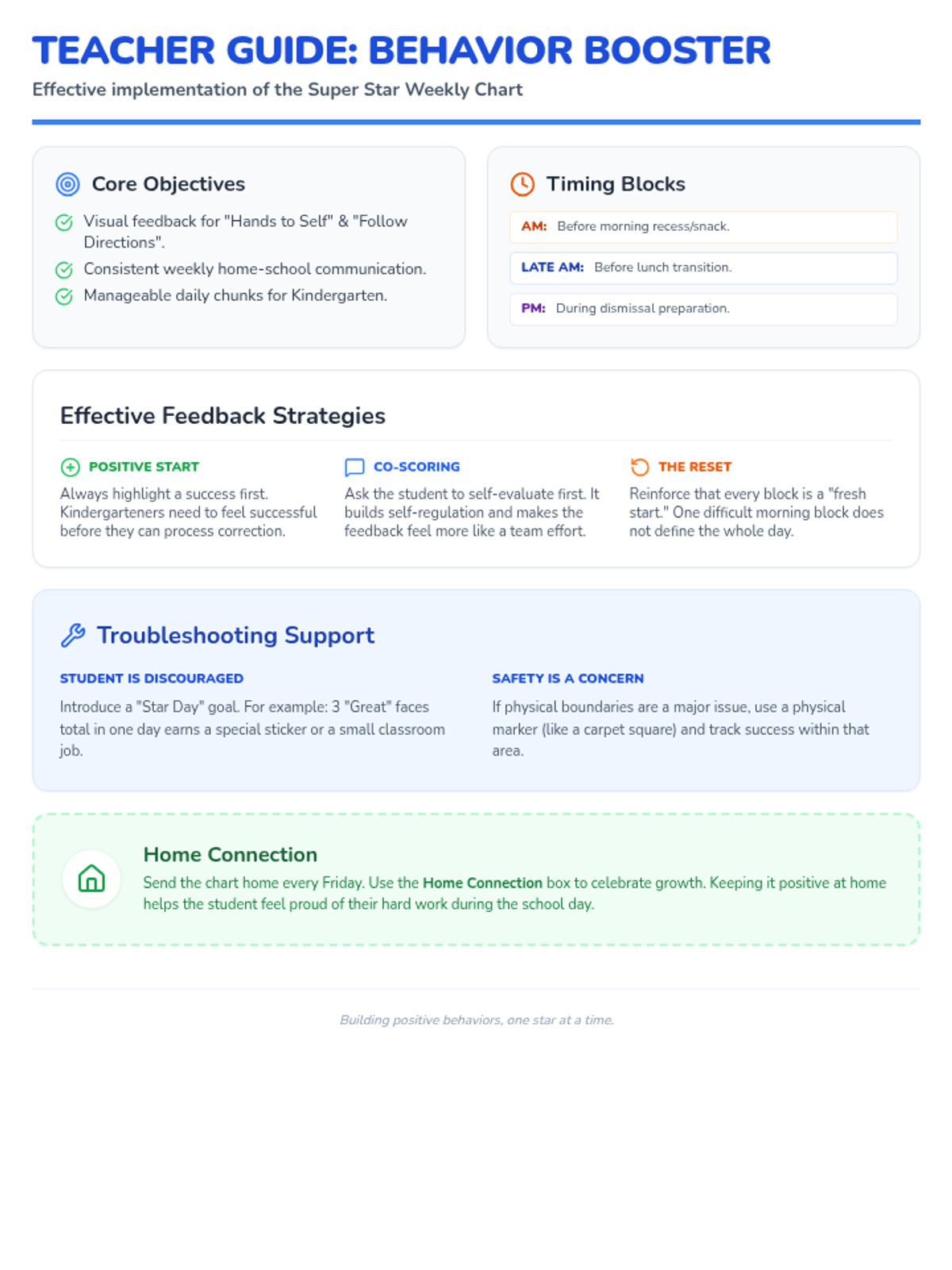
A teacher-facing implementation guide for the Behavior Booster Chart, providing strategies for effective feedback, timing, and troubleshooting for Kindergarten students.
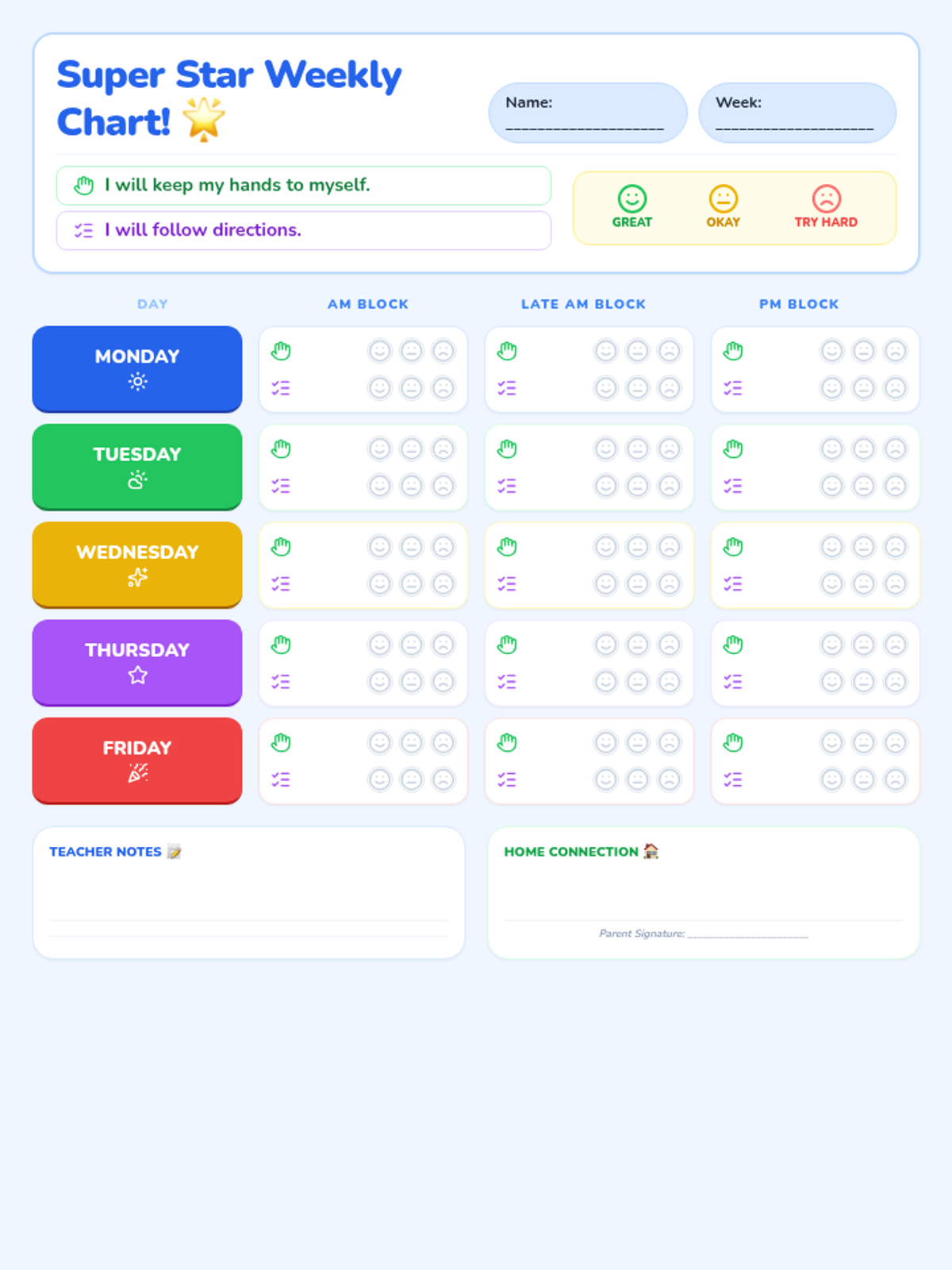
A colorful, Kindergarten-friendly weekly behavior chart designed to track "Hands to Self" and "Following Directions" across three daily time blocks (AM, Late AM, PM) using simple smiley face icons.
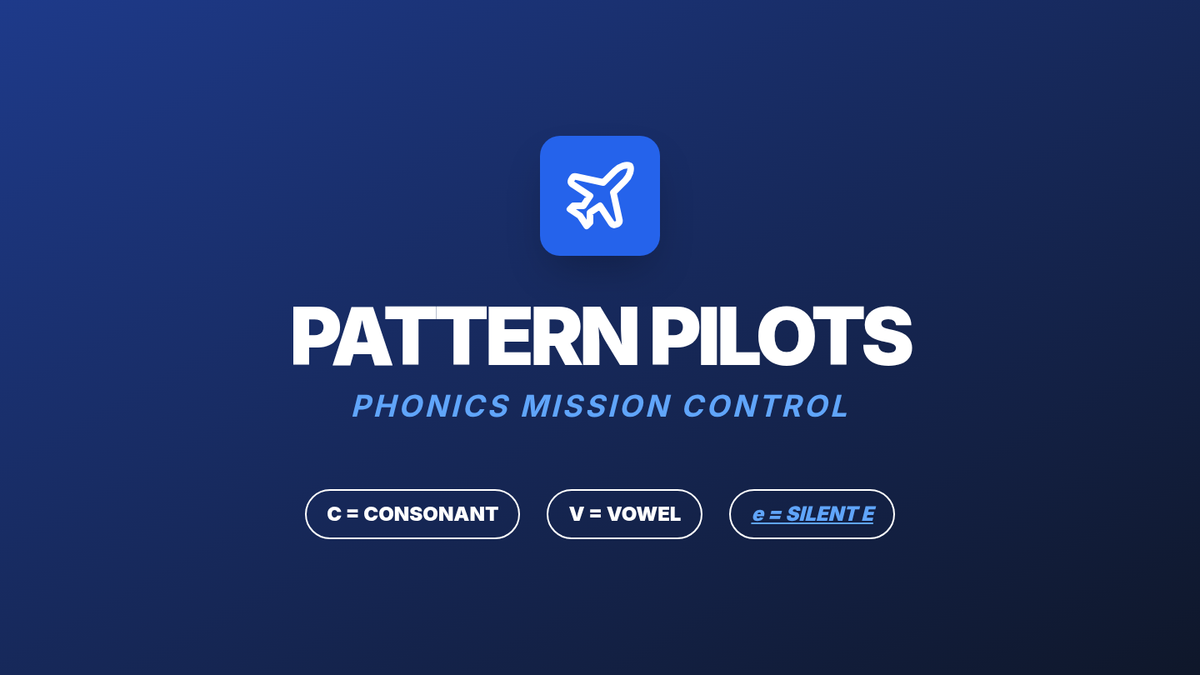
An instructional slide deck for classroom use, introducing phonics patterns (CVC, CCVC, CVCe, etc.) with ILEARN-style practice examples. Includes large, clear text and visual aids. All slides include color-coded boxes for C, V, and e keys, including separate boxes for silent and magic e. All e's in keys are lowercase. Patterns are highlighted in bold green.
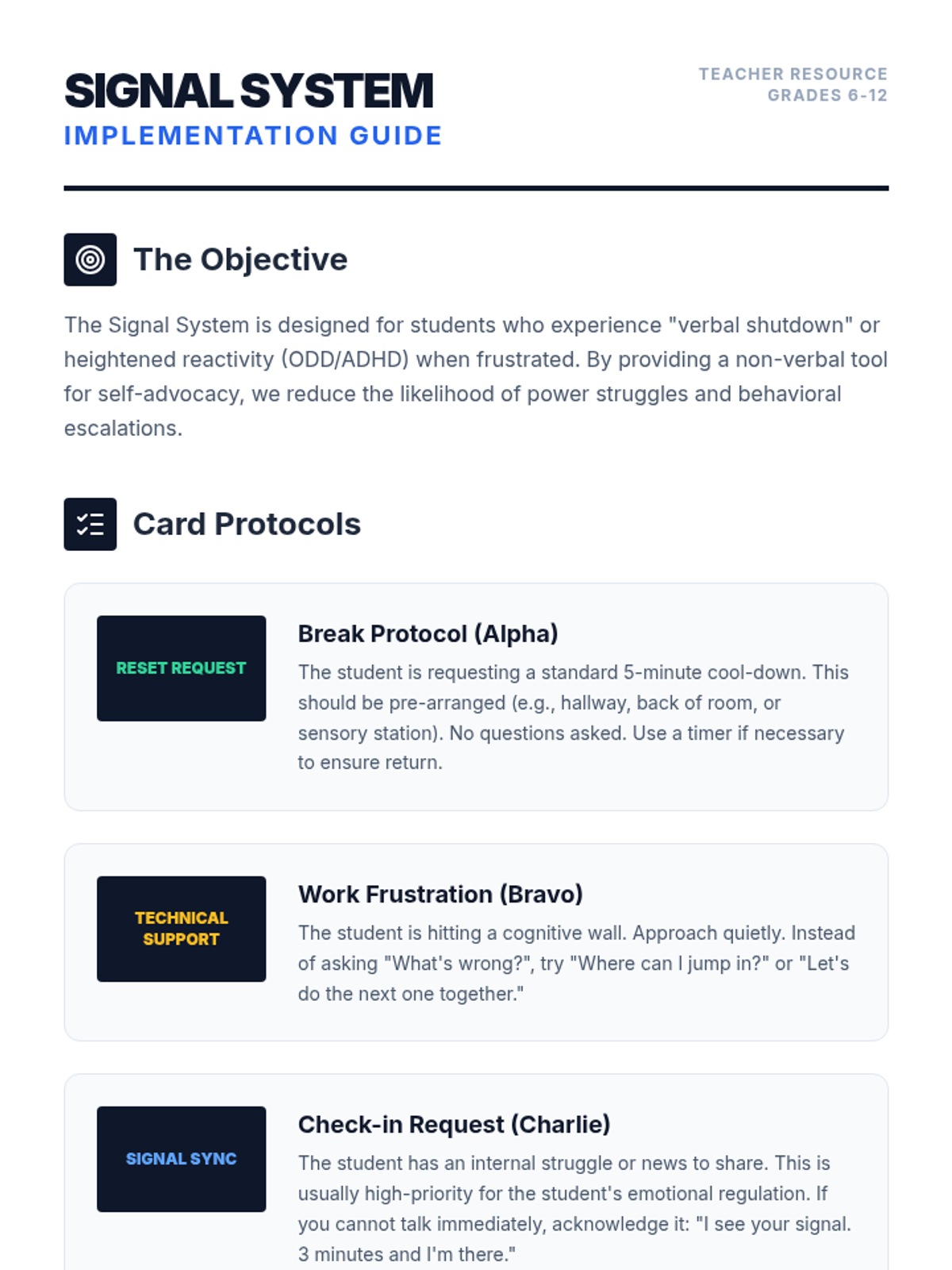
A teacher-facing implementation guide for the Signal System. This guide provides specific protocols for each card, explains the psychological rationale behind the system, and offers best practices for maintaining student dignity and classroom stability.
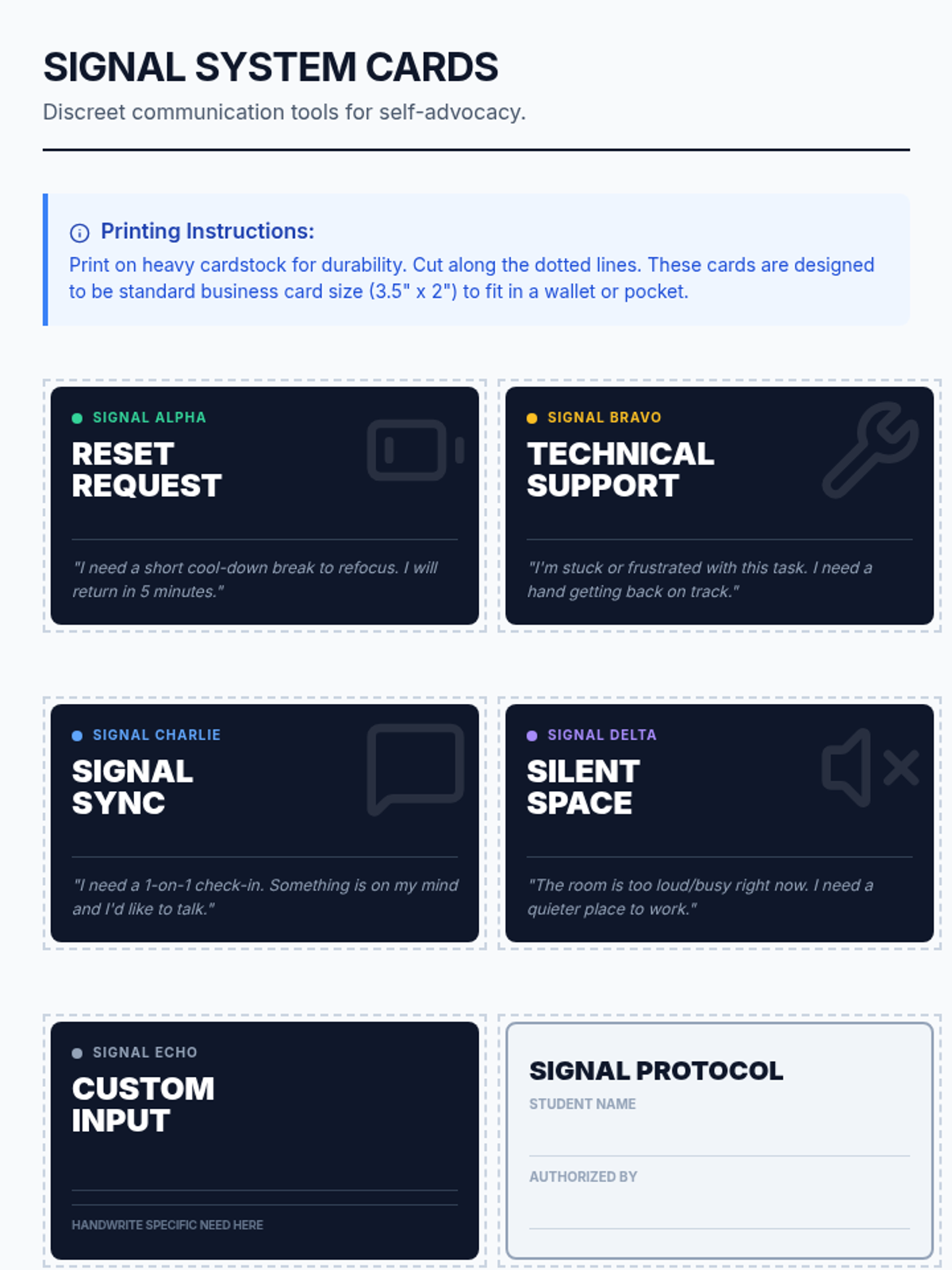
A set of discreet, wallet-sized communication cards designed for an 8th-grade student. The cards use a modern, minimalist 'Signal' aesthetic to help the student advocate for breaks, work assistance, and sensory needs without the pressure of verbal communication.
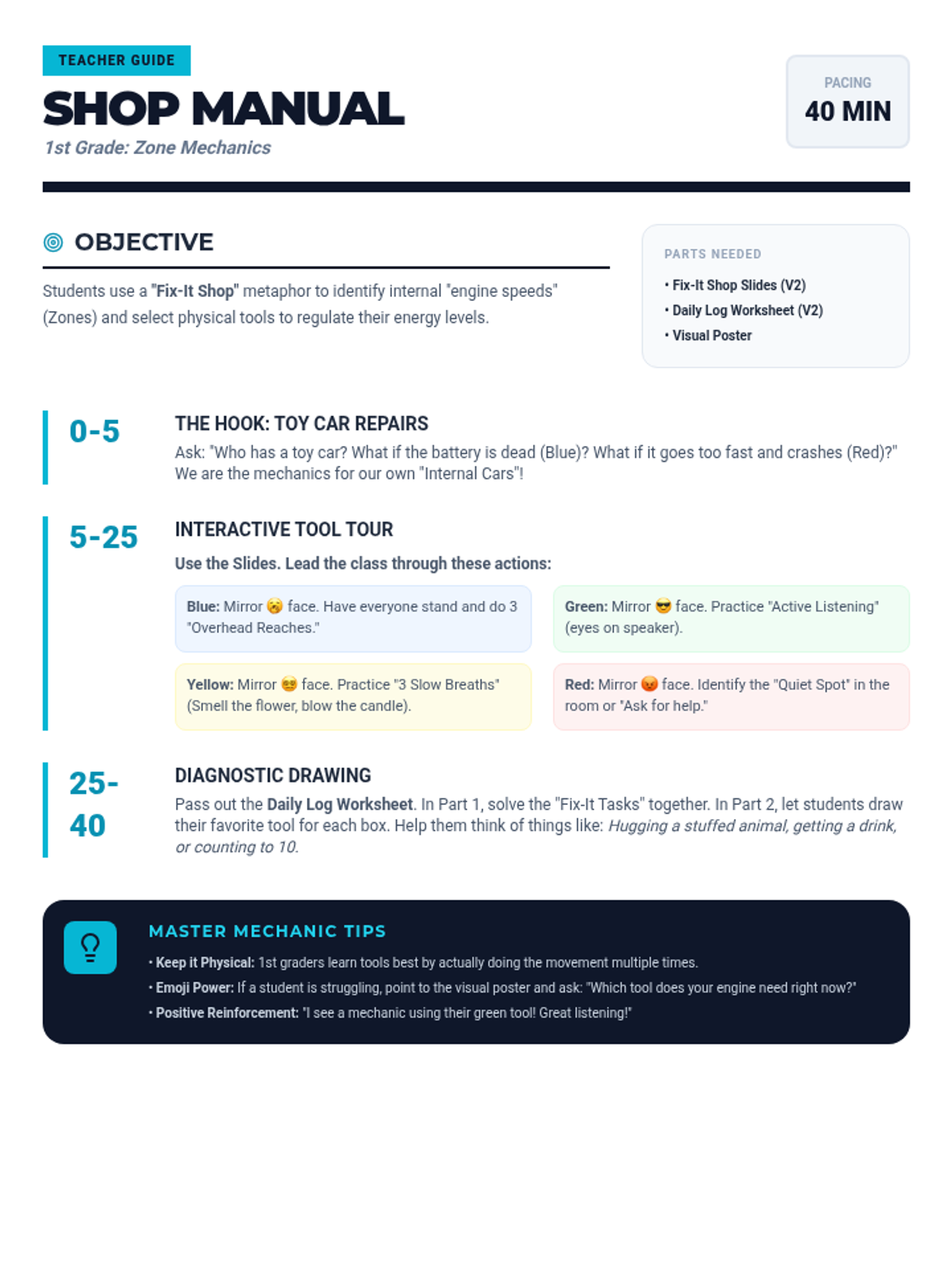
A comprehensive teacher facilitation guide for the Zone Mechanics lesson, featuring a pacing guide, inventory list, step-by-step instructions, and discussion prompts. Updated with more details for Step 2 and better page flow.
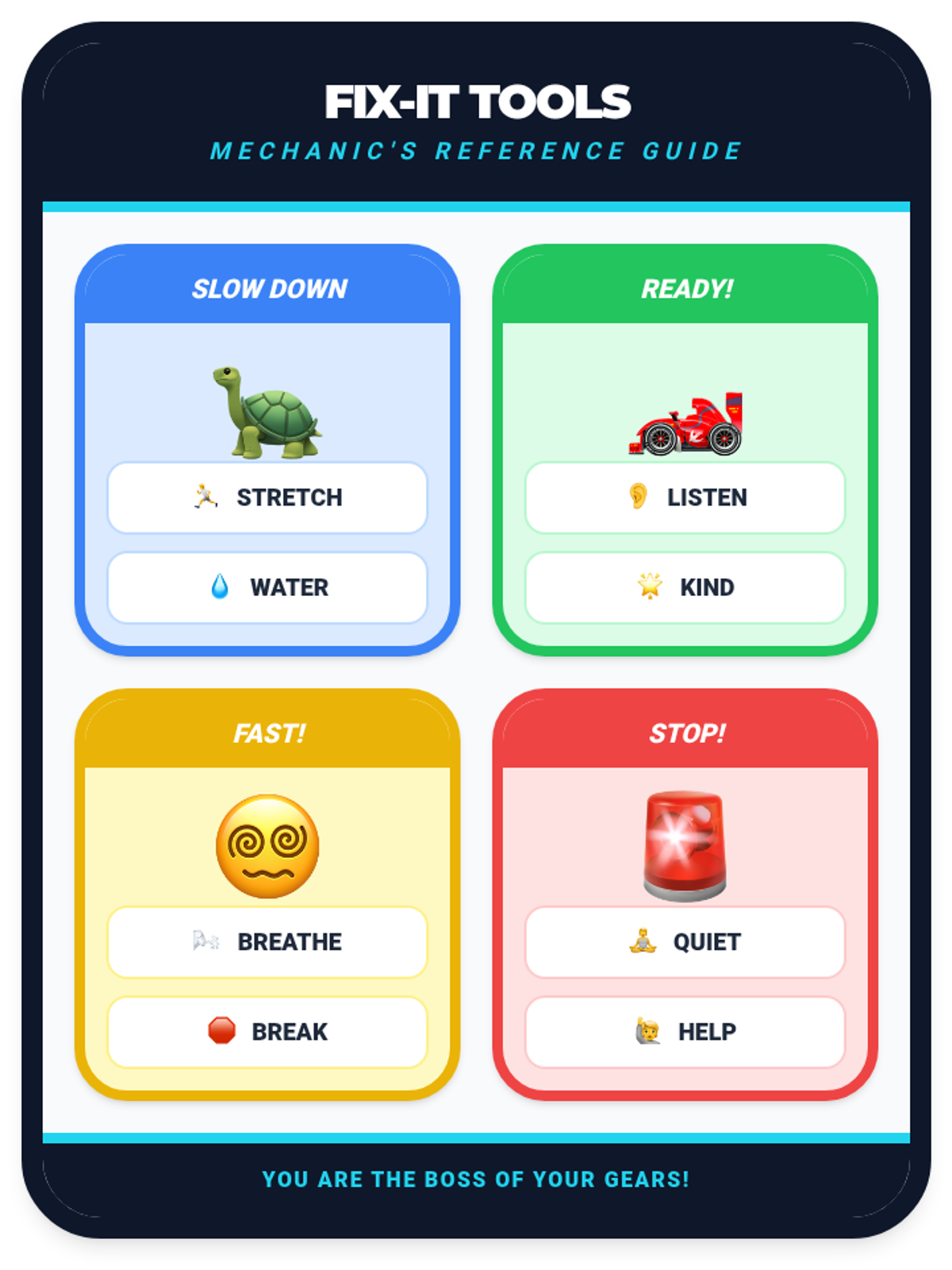
A visual quick-reference sheet that categorizes regulation tools by zone, designed as a classroom poster or student handout. Uses the 'Engine Maintenance' theme. Updated with better scaling and legibility.
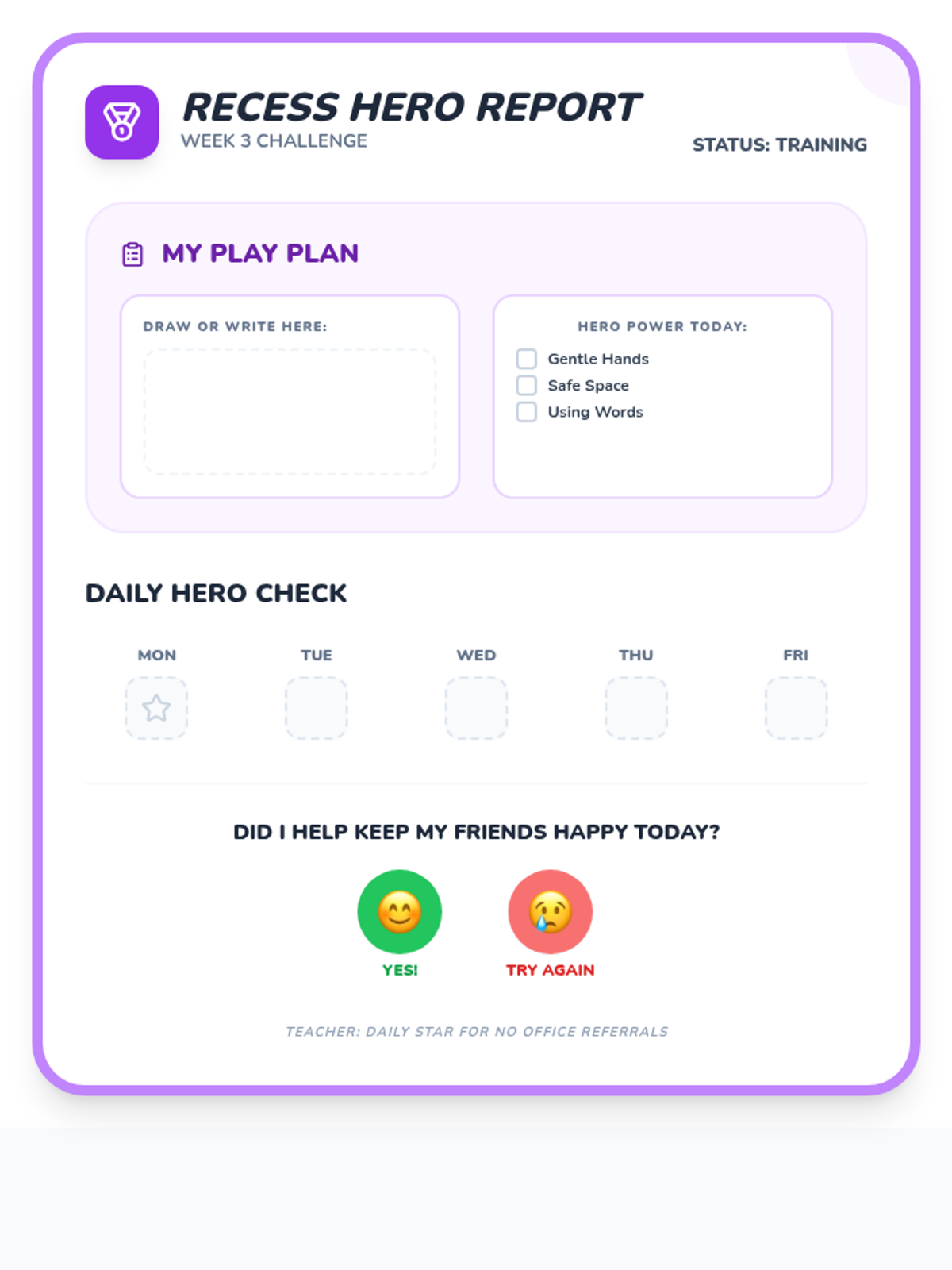
A goal-setting and reflection worksheet specifically for recess, helping the student pre-plan safe activities and review their success in maintaining 'Hero Status' on the playground.
A social story for the final week of intervention, focusing on applying safety rules and emotional regulation to the playground environment, emphasizing the reward of staying with peers.
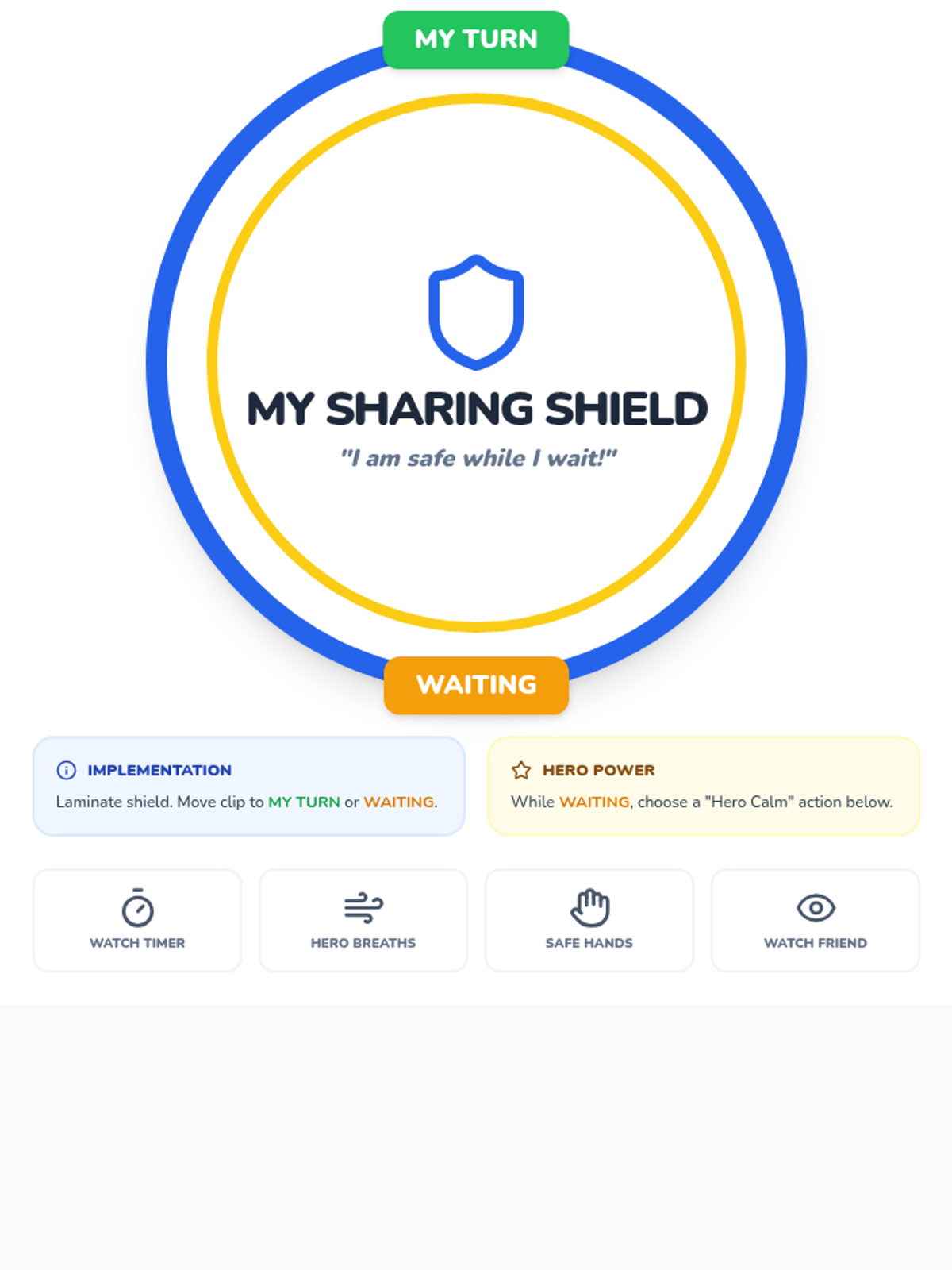
A visual 'Sharing Shield' tool designed to be laminated and used with a clothespin to help the student visually navigate the transition between having a turn and waiting, reducing impulsivity during play.
A social story focused on sharing and waiting for turns, teaching specific social scripts and emotional regulation strategies for a kindergarten student.
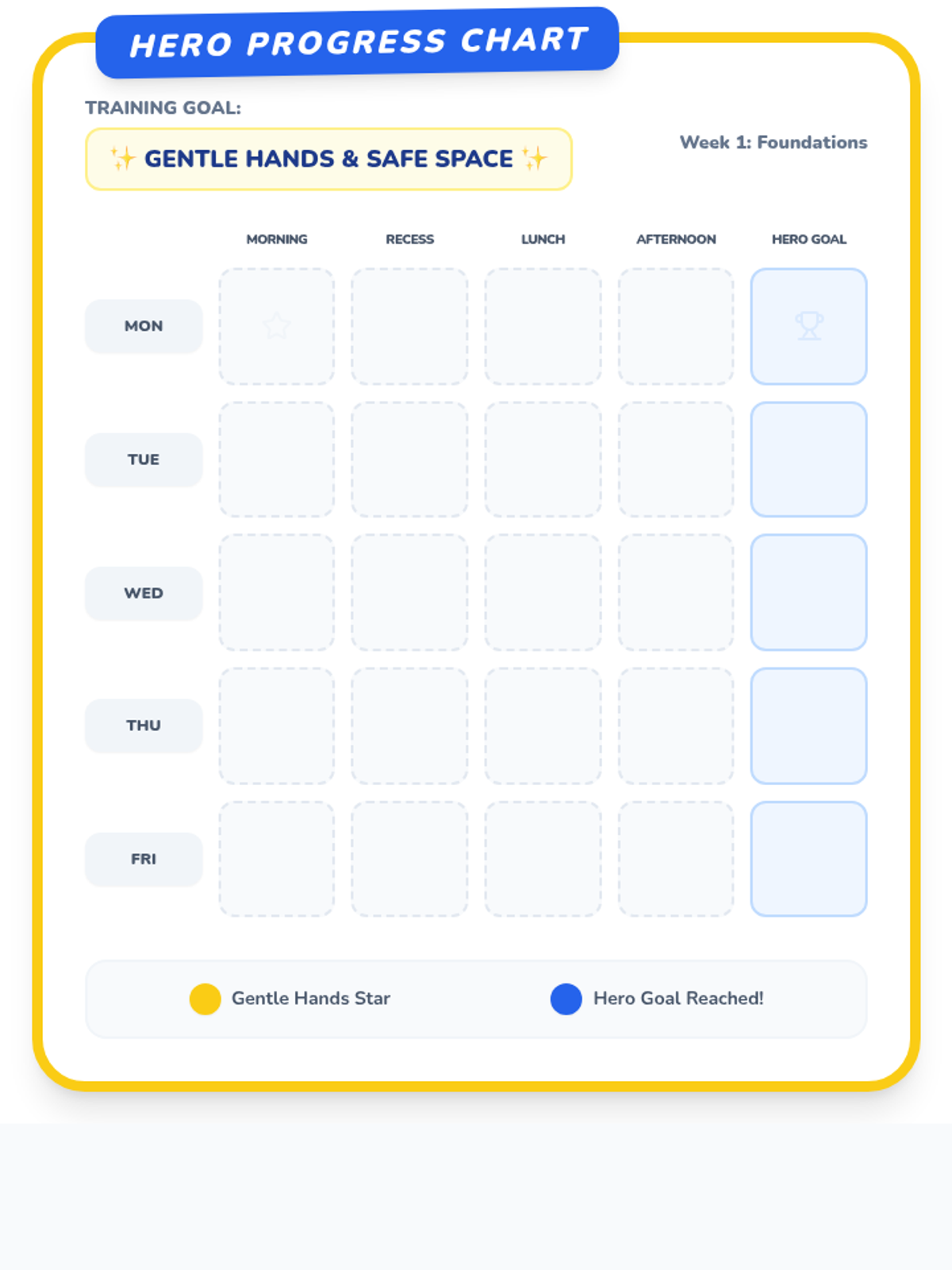
A daily visual progress chart for the student to track 'Gentle Hands' behavior across various parts of the school day, utilizing a positive 'Hero Training' reinforcement system.
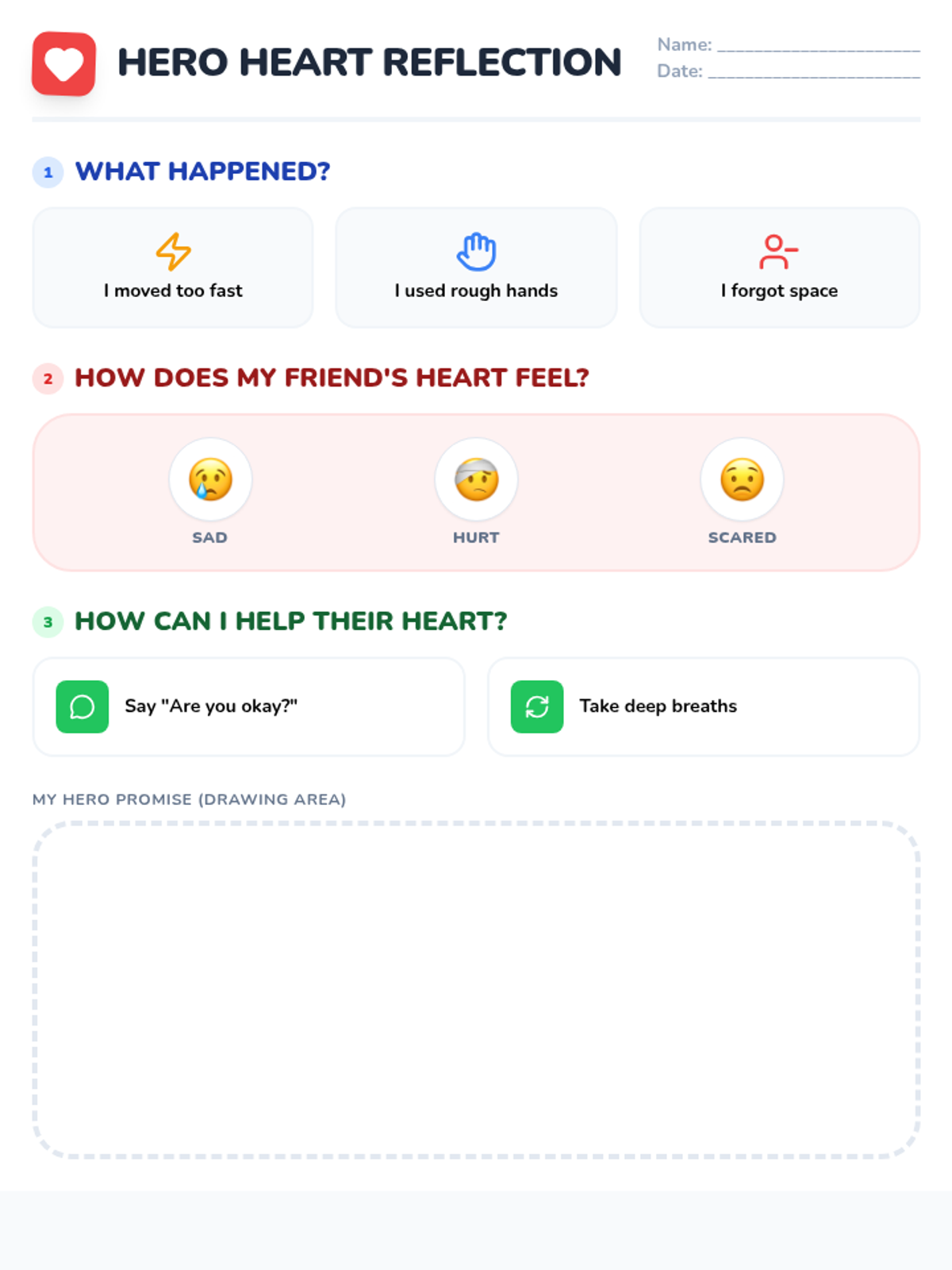
A visual reflection worksheet for post-incident use, focusing on identifying behaviors, understanding the victim's feelings (empathy building), and choosing a restorative action.
A visually engaging social story for a kindergarten student that teaches the concept of 'Gentle Hands' and 'Hero Space,' emphasizing safety and the emotional impact of physical actions on others.
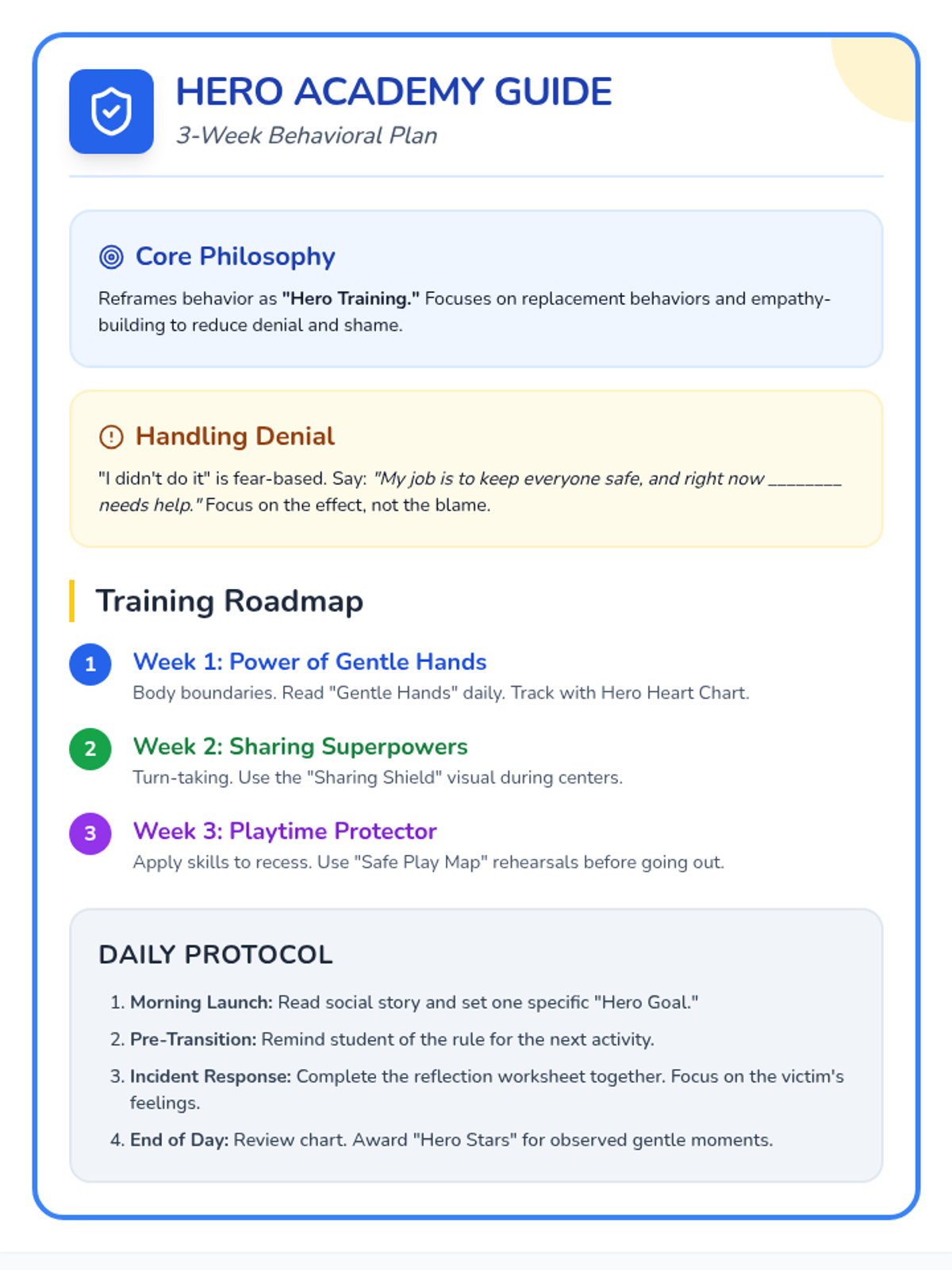
A comprehensive implementation guide for teachers, outlining the 3-week 'Hero Training' behavioral plan, strategies for handling denial, and daily protocols for a kindergarten student.
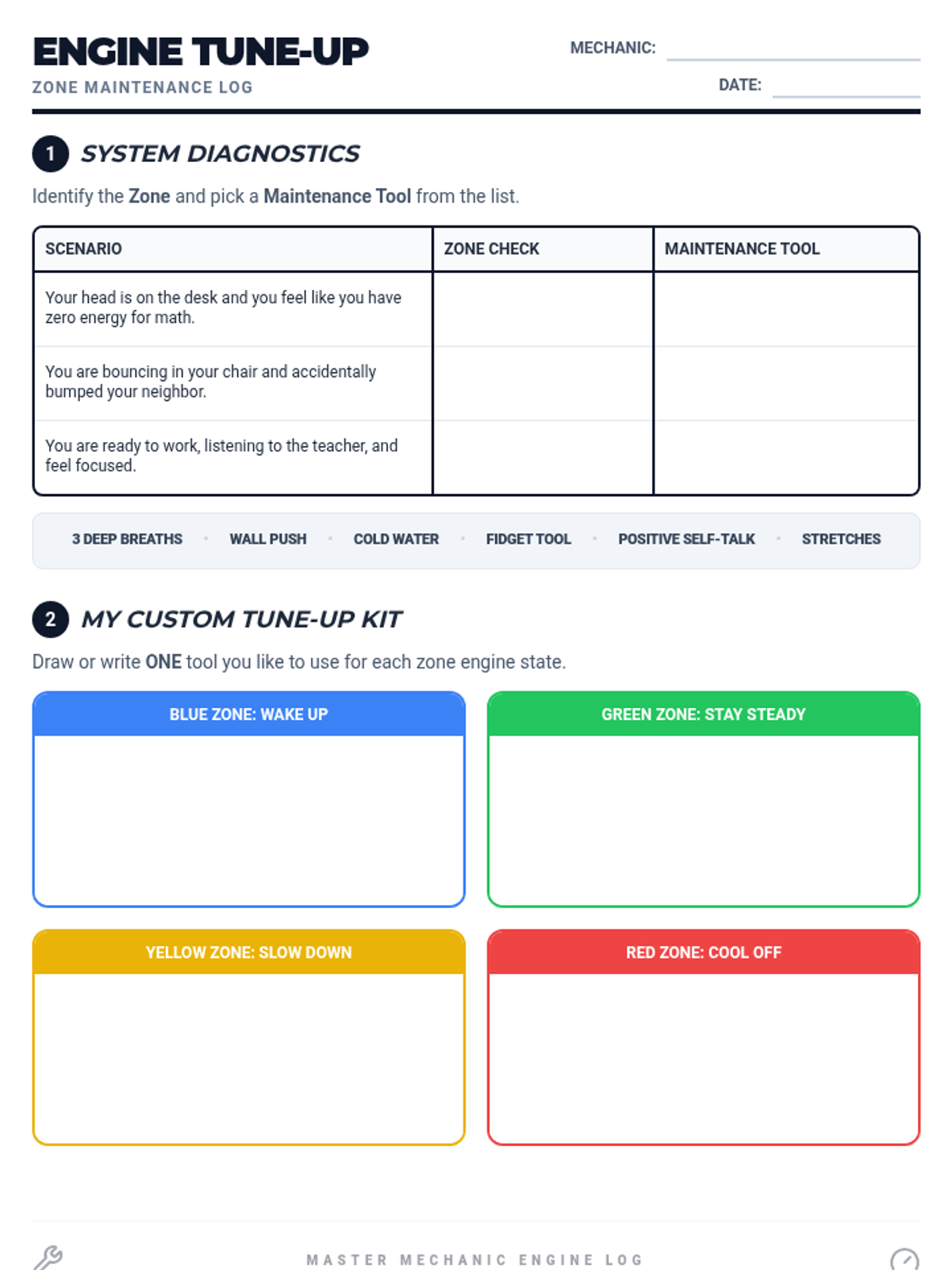
A student activity sheet where they diagnose emotional states as 'engine issues' and prescribe specific regulation tools to fix them. Features scenarios and a personal 'Tune-Up Kit' drawing section. Updated with better spacing and legibility.
A visually engaging slide deck designed for 1st graders using simple language and large emojis to teach regulation tools through a 'Fix-It Shop' metaphor. Updated with better legibility and icons.
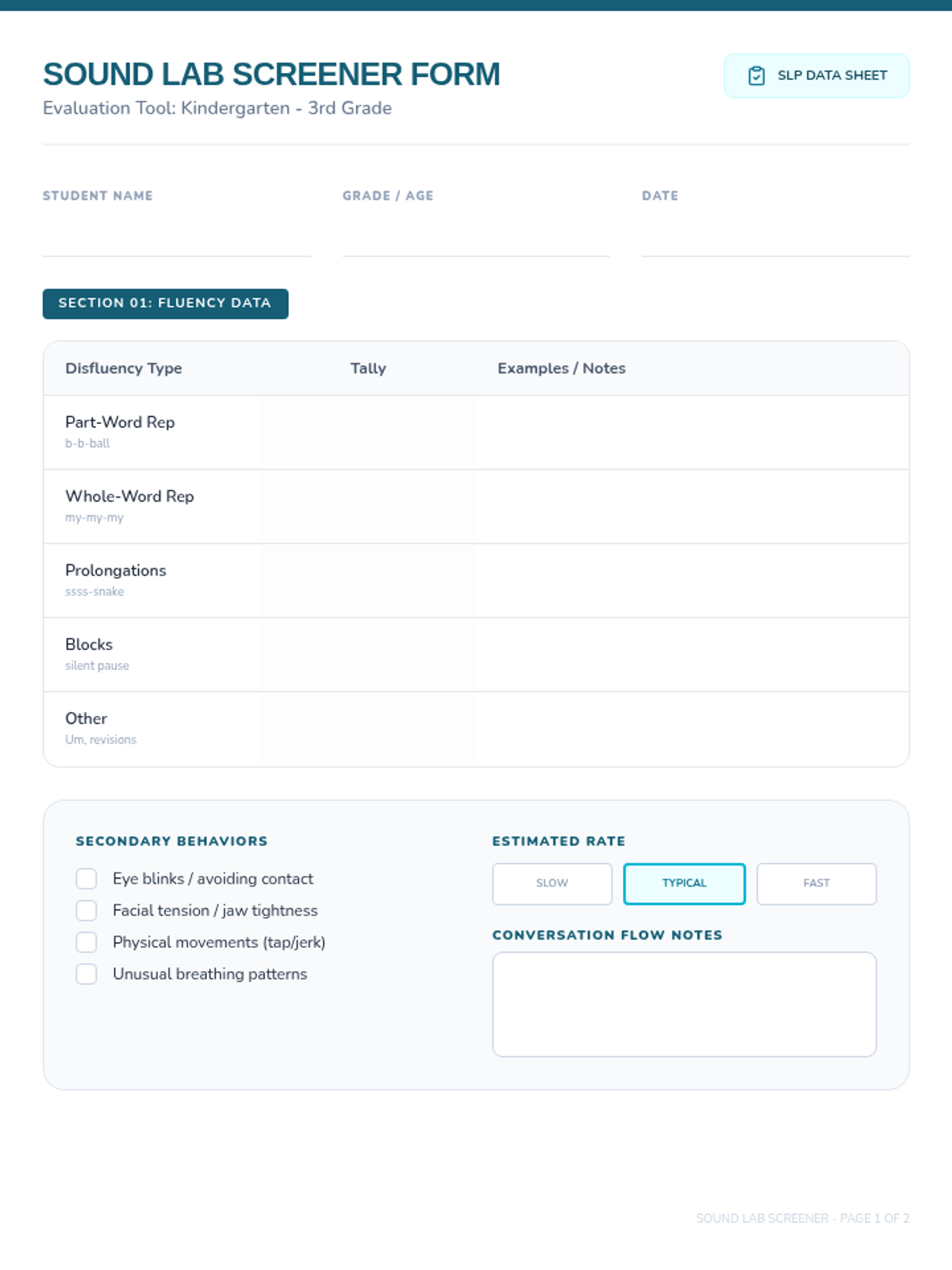
A comprehensive recording form for SLPs to document observations during a fluency and voice screening. Includes structured tables for disfluency types, voice quality scales, phonation time trials, and final referral outcomes. Revised to ensure all sections fit logically on two pages without orphans.
A set of student-facing stimulus cards for a speech-language screener. Includes visual prompts for picture description, pitch glides, volume control, and sentence repetition to assess fluency and voice quality. Each task is clearly separated on its own page for better focus and navigation. Revised to ensure high text contrast and stable page breaks.
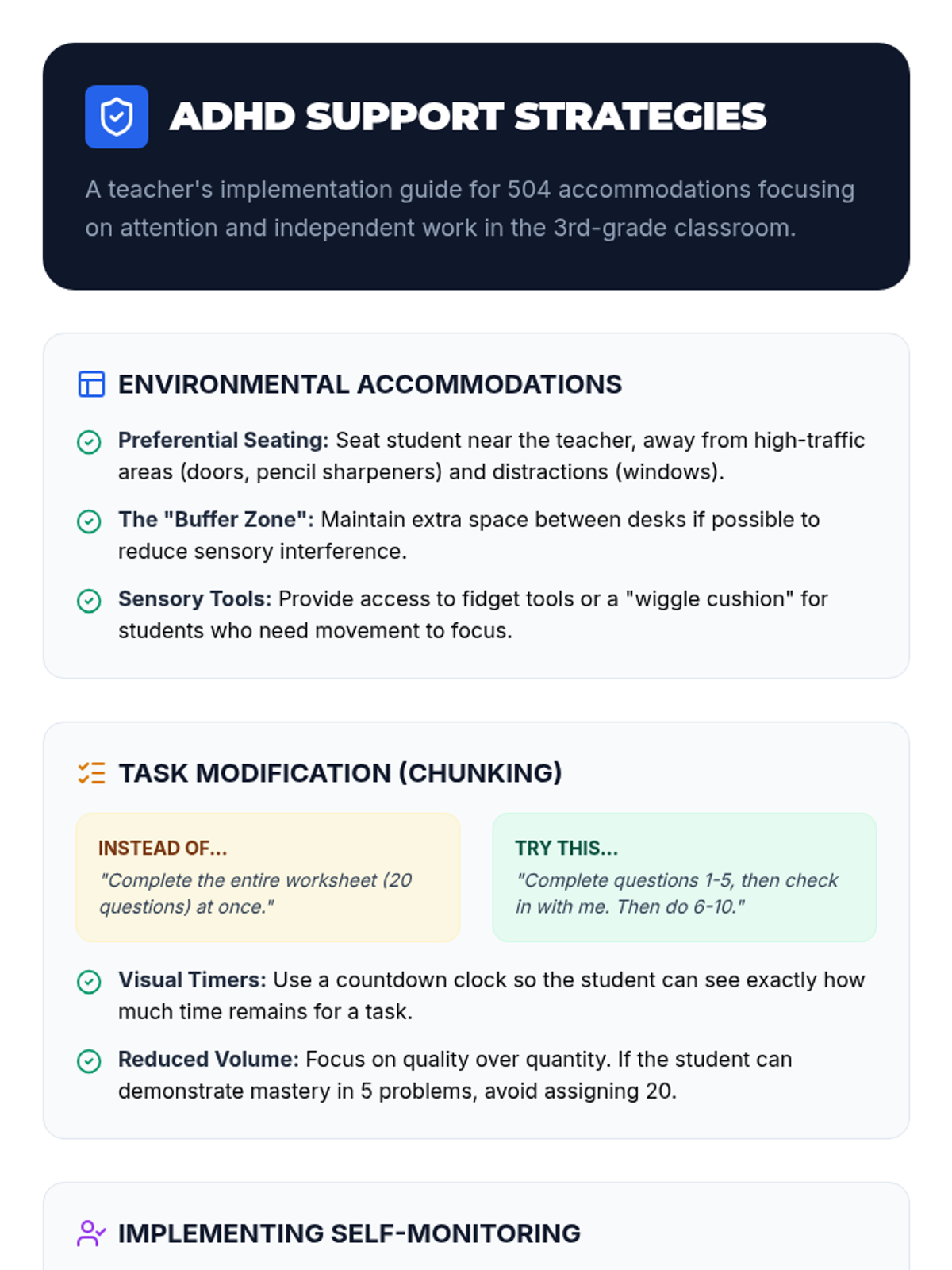
A teacher-facing guide outlining classroom accommodations, task modification strategies (chunking), and implementation tips for 504 plans for students with ADHD.
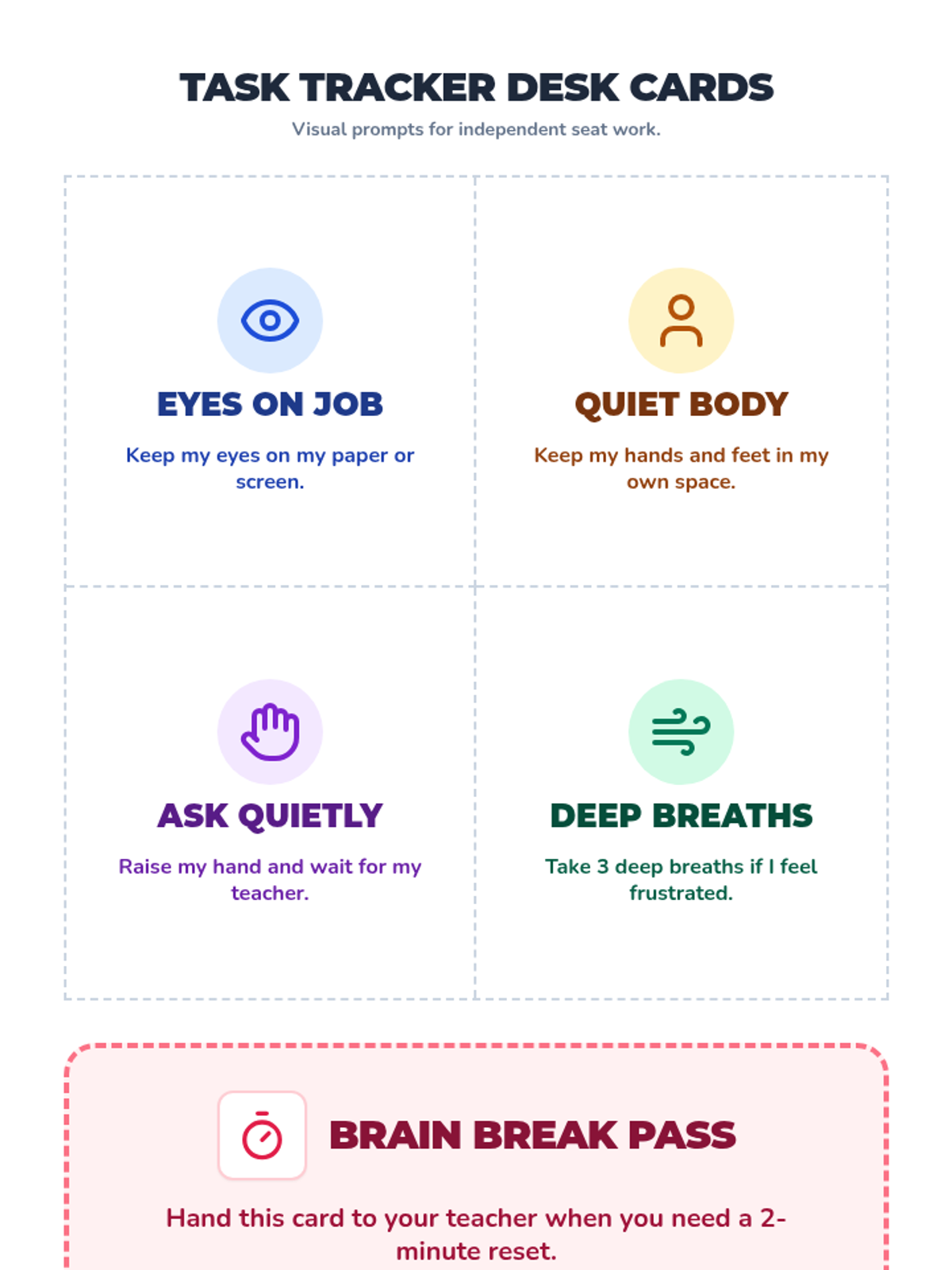
Visual desk prompt cards for 3rd grade students with ADHD, providing immediate visual cues for focus, body awareness, and self-regulation during seat work.
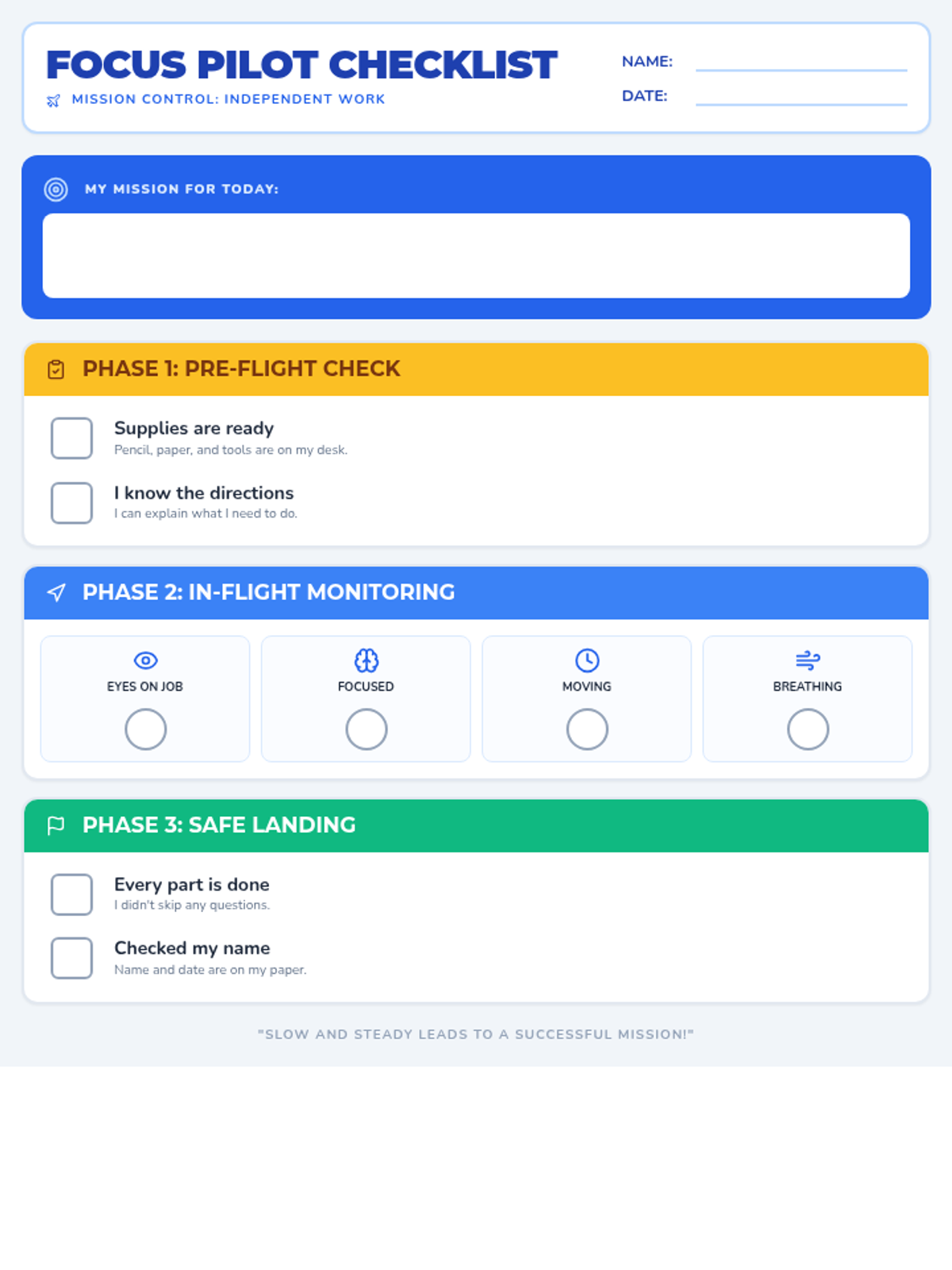
A student self-monitoring checklist for 3rd graders with ADHD, using a 'Focus Pilot' theme to guide them through independent work phases (preparation, execution, and review).
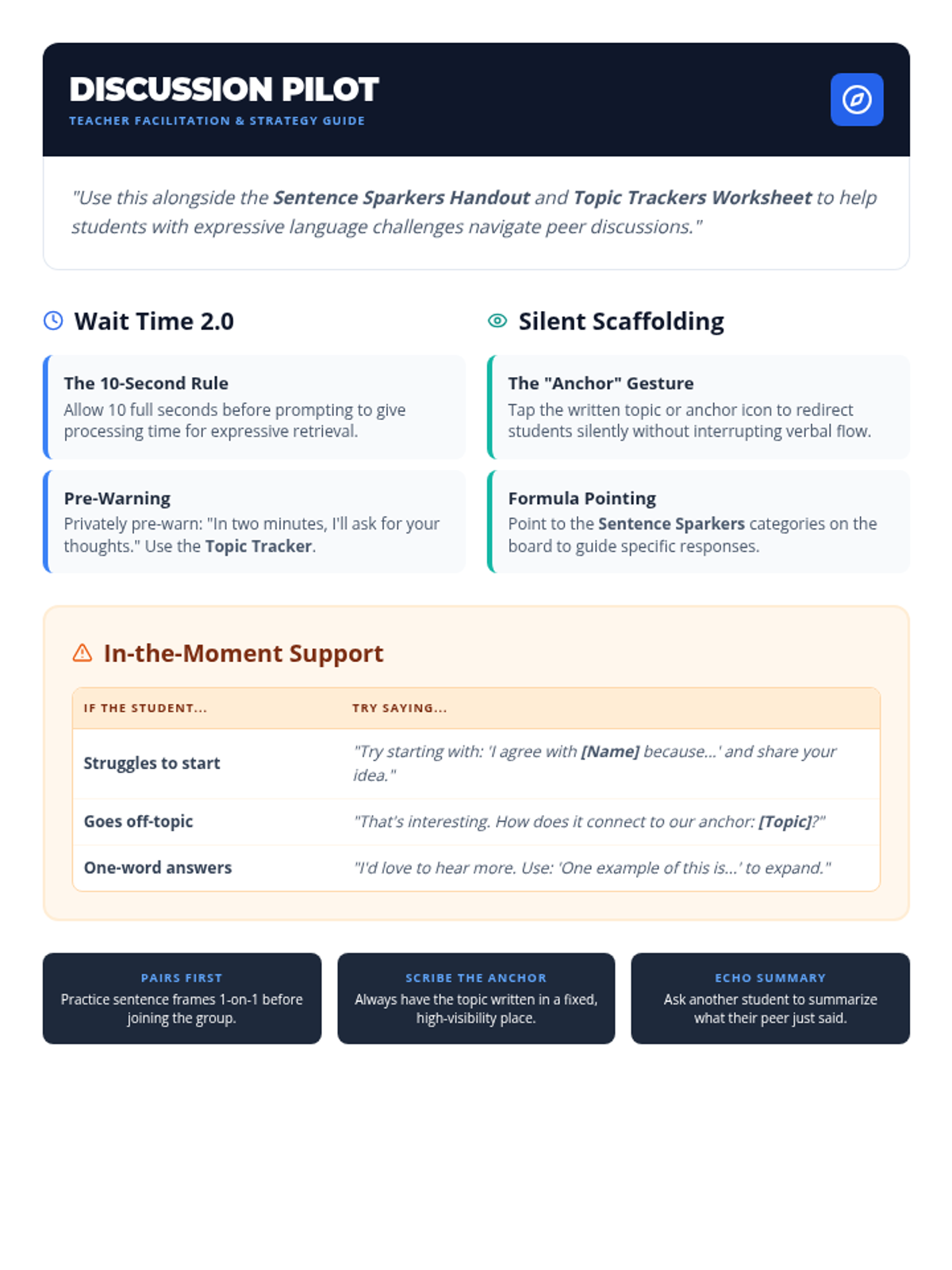
A teacher-facing guide providing specific pedagogical strategies, troubleshooting tips, and facilitation techniques to support students with expressive language and focus needs during discussions.
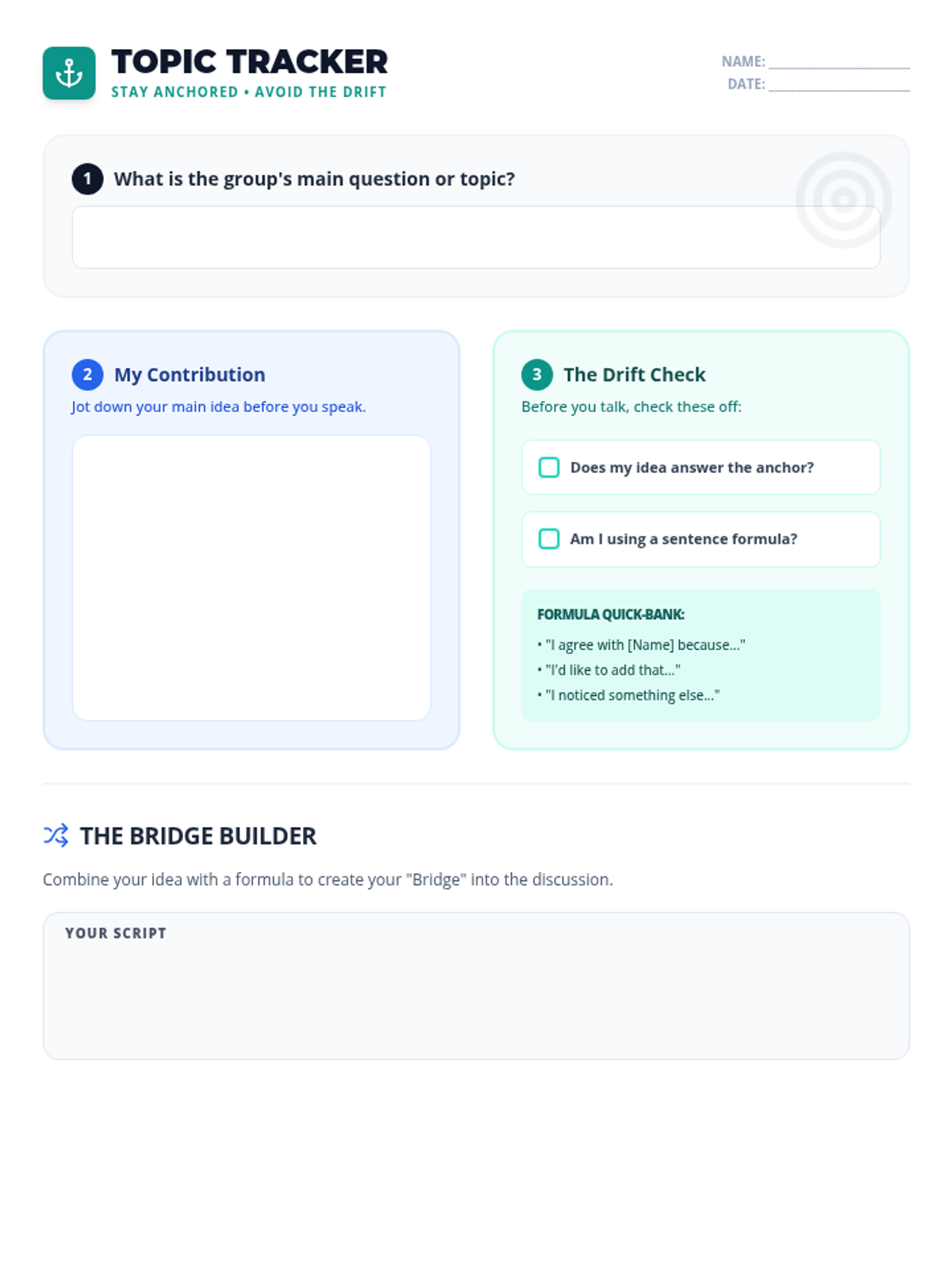
A graphic organizer to help students map out their thoughts before contributing to a discussion, ensuring they stay on topic and have a prepared 'bridge' into the conversation.
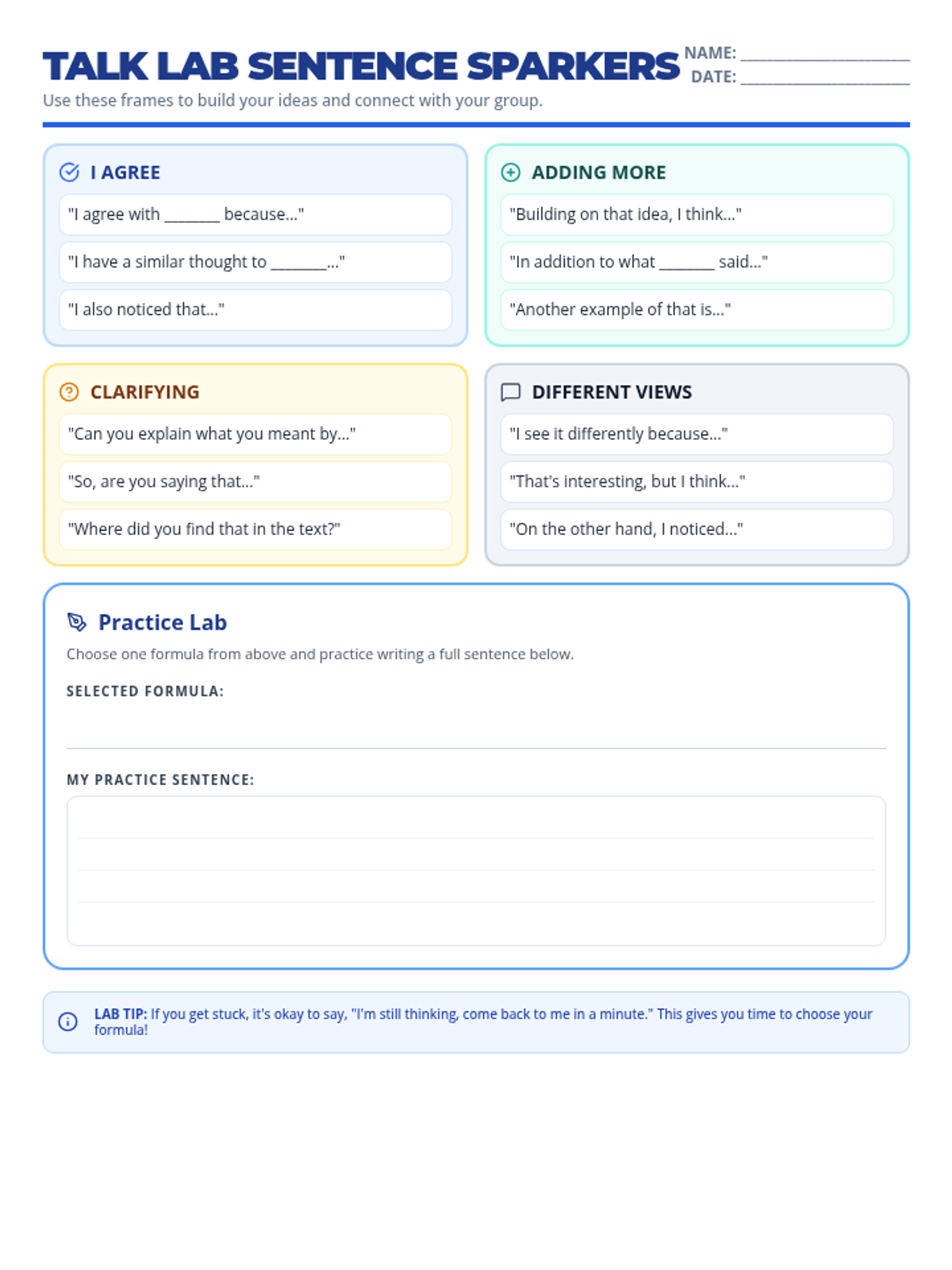
A printable reference sheet containing sentence stems and frames to support students with limited expressive language during peer discussions.
A visual presentation introducing the 'Talk Lab' concept, focusing on sentence formulas for expressive language and 'topic anchors' to help students stay on track during group discussions.
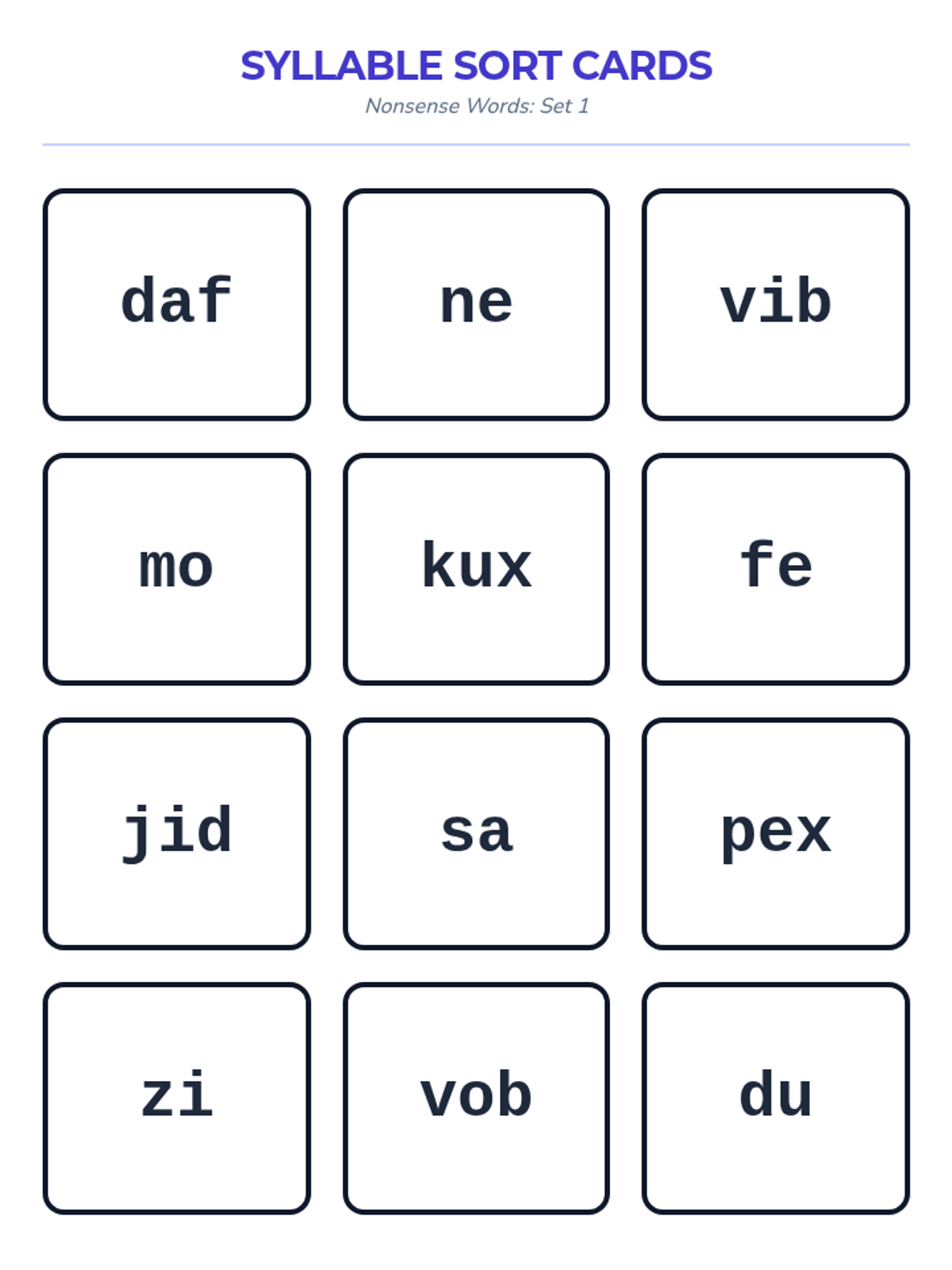
A printable set of 24 syllable sort cards featuring nonsense words with open and closed syllable patterns. Includes large font for easy reading and heavy borders for easy cutting and lamination. Contains "Open" and "Closed" header cards for sorting activities. Optimized for printing with clear page breaks.
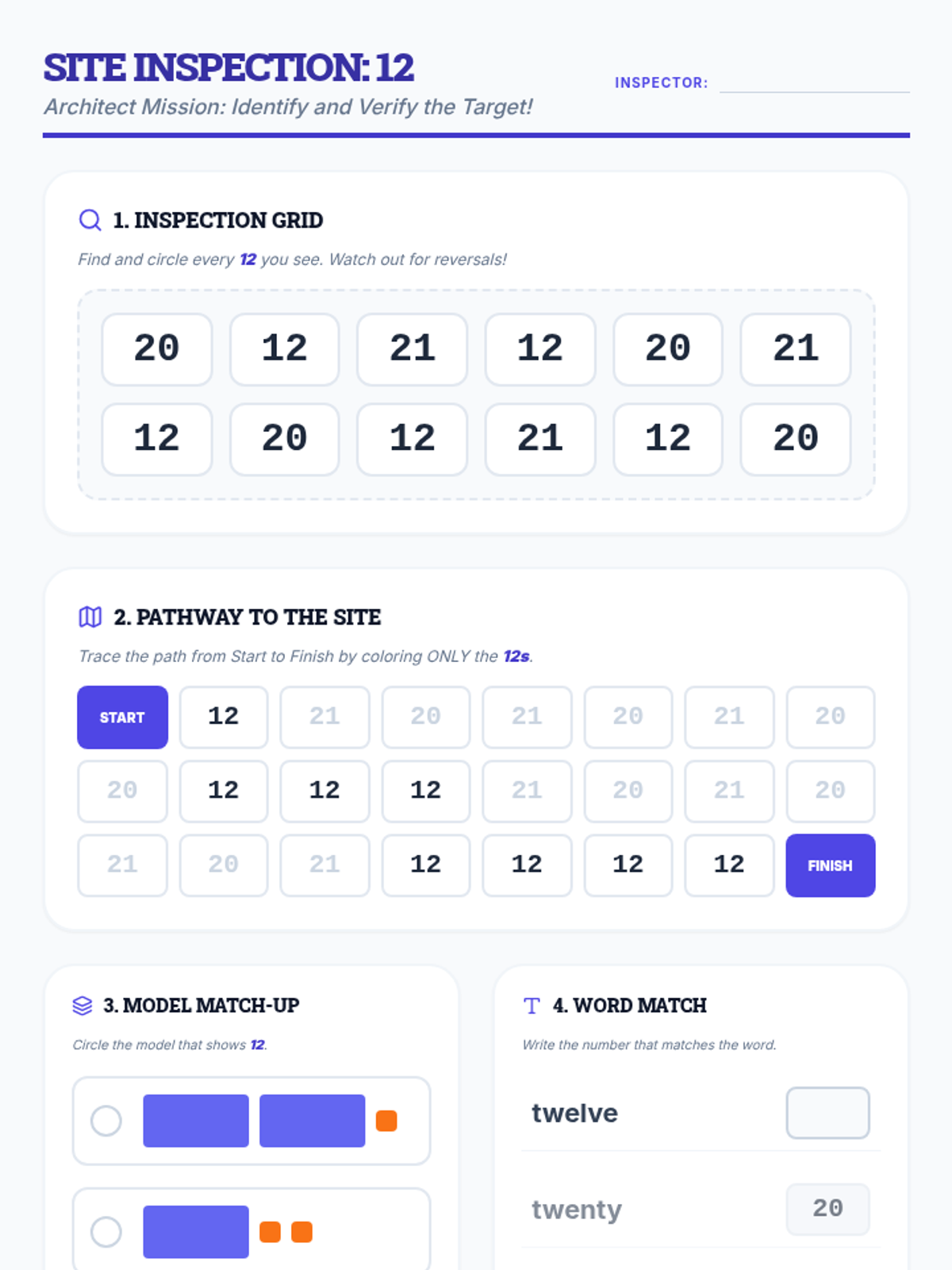
A student worksheet for identifying and distinguishing the number 12 from 20 and 21. Tasks include visual identification in a grid, a path maze of 12s, choosing the correct base-ten model, writing practice, and matching the word 'twelve' to its digits. Now with improved contrast, non-telegraphed practice, and inclusion of other teen numbers.
Instructional slides for identifying the number 12 and distinguishing it from 20 and 21. Includes a new practice slide for quick visual discrimination and clearer place value models. Now with improved text spacing and non-telegraphed practice.
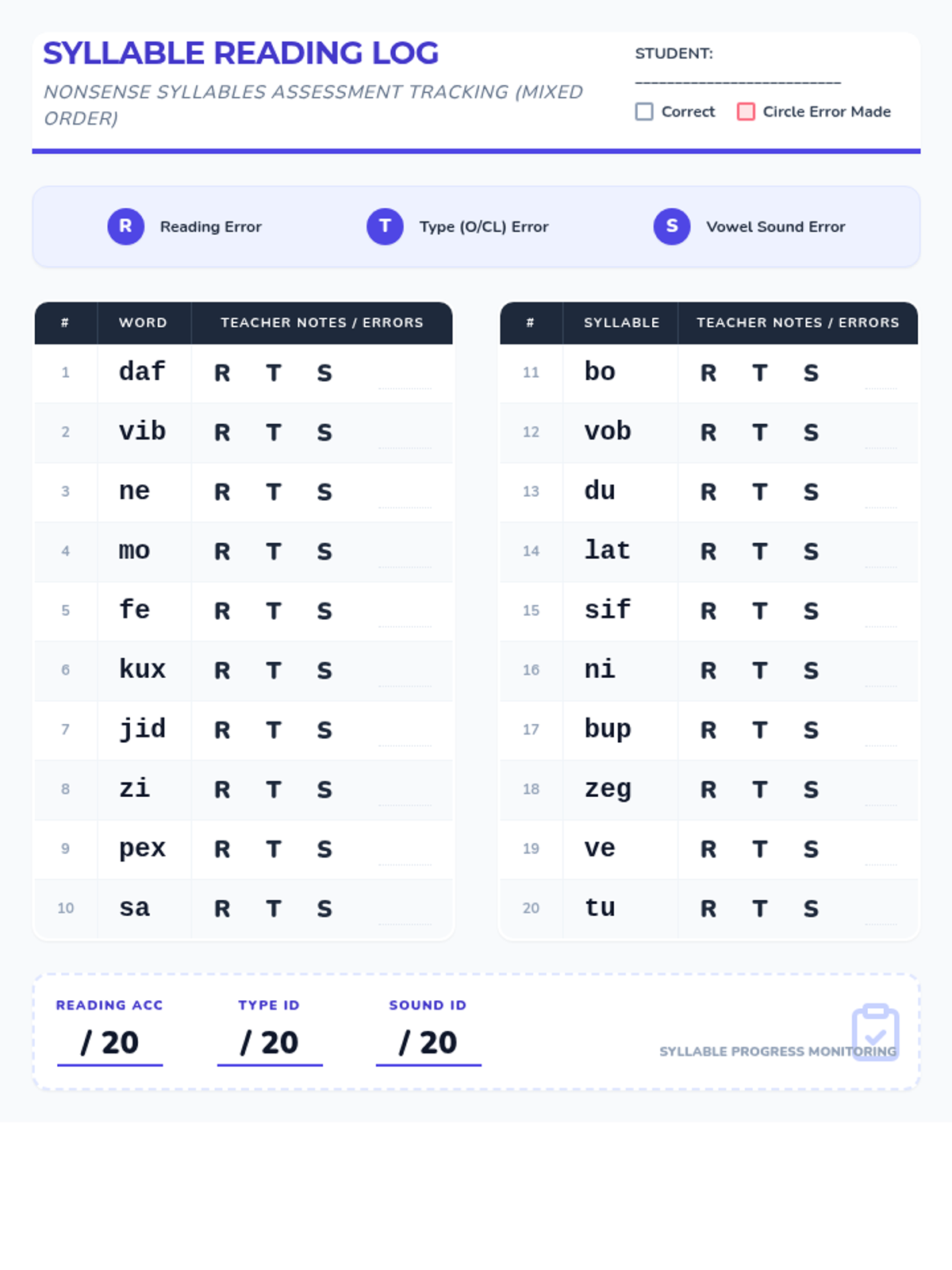
A teacher-facing recording sheet to track student performance on reading, classifying, and sounding out 20 nonsense open and closed syllables. Mixed order prevents predictable patterns. Includes error codes (R, T, S) for quick circling and space for notes. Now uses the primary-friendly Poppins font for syllables and the friendly Nunito font for instructions.
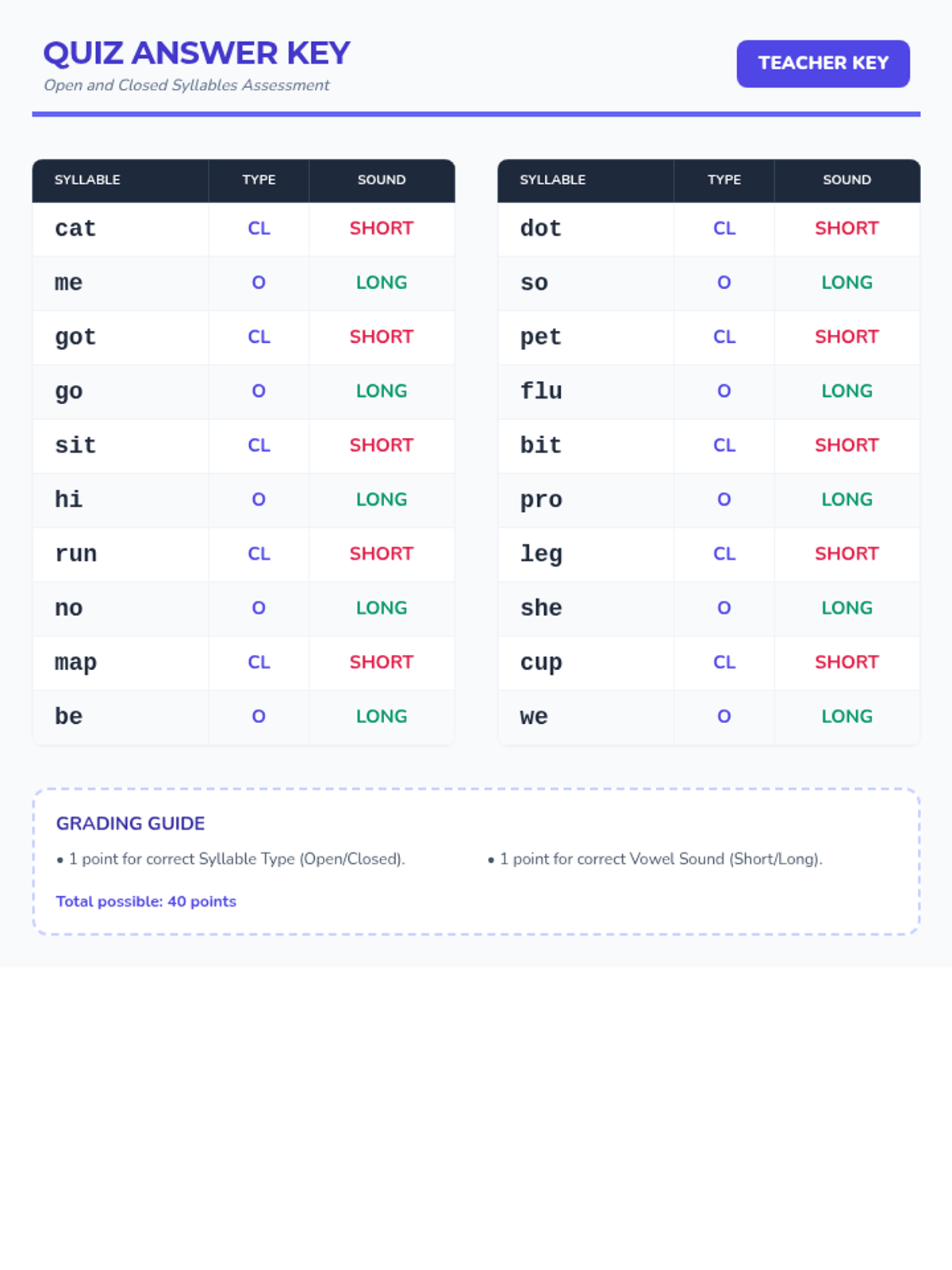
An answer key for the 20-item Open and Closed Syllable Quiz using nonsense words. Mixed order prevents predictable patterns. Syllables use the primary-friendly Poppins font. General text uses the friendly Nunito font.
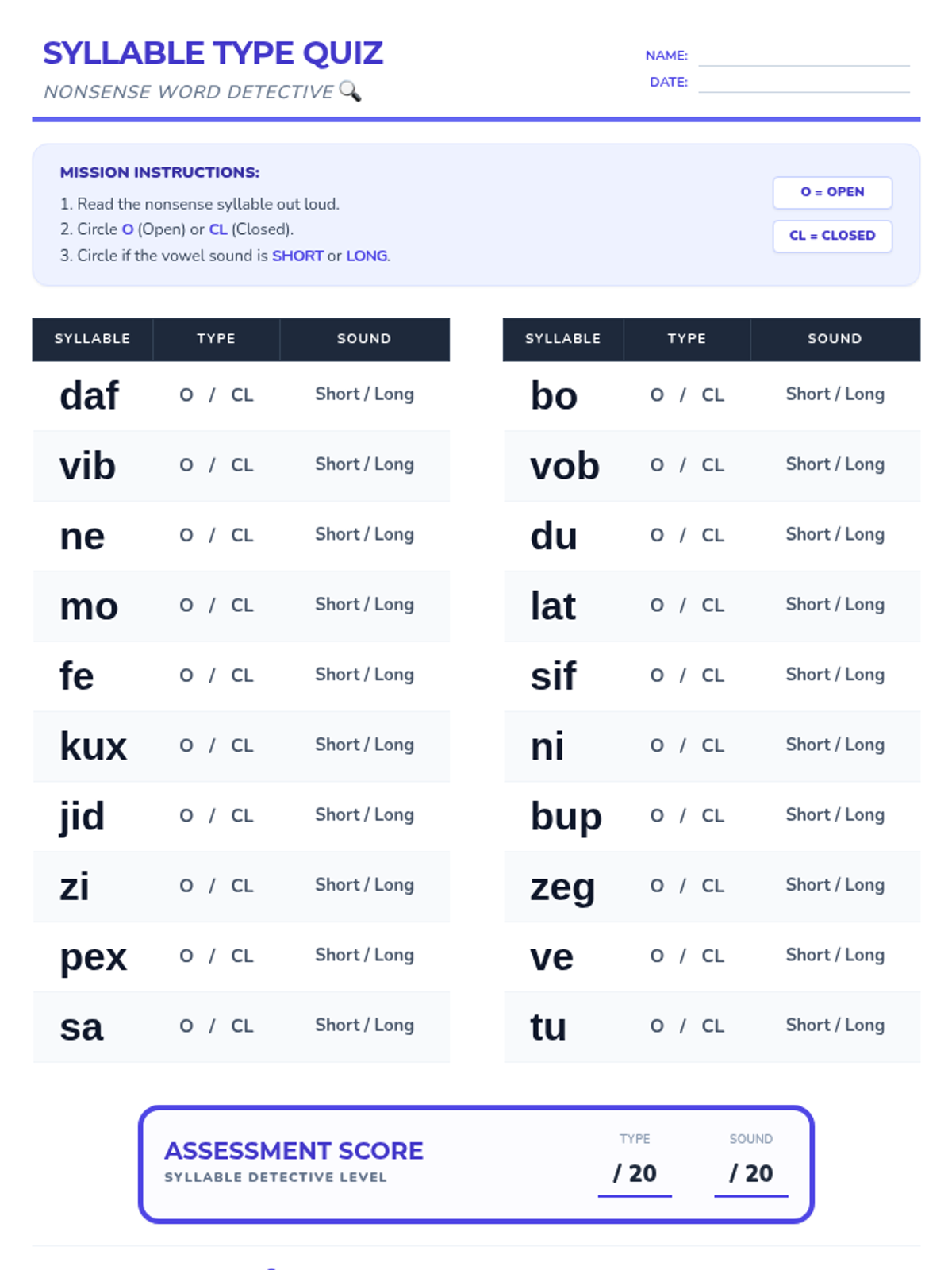
A 20-item assessment quiz for nonsense single syllables. Students must identify if the syllable is Open or Closed and determine if the vowel sound is Short or Long. Mixed order prevents predictable patterns. Syllables use a primary-friendly font for better character recognition. General text uses the friendly Nunito font.
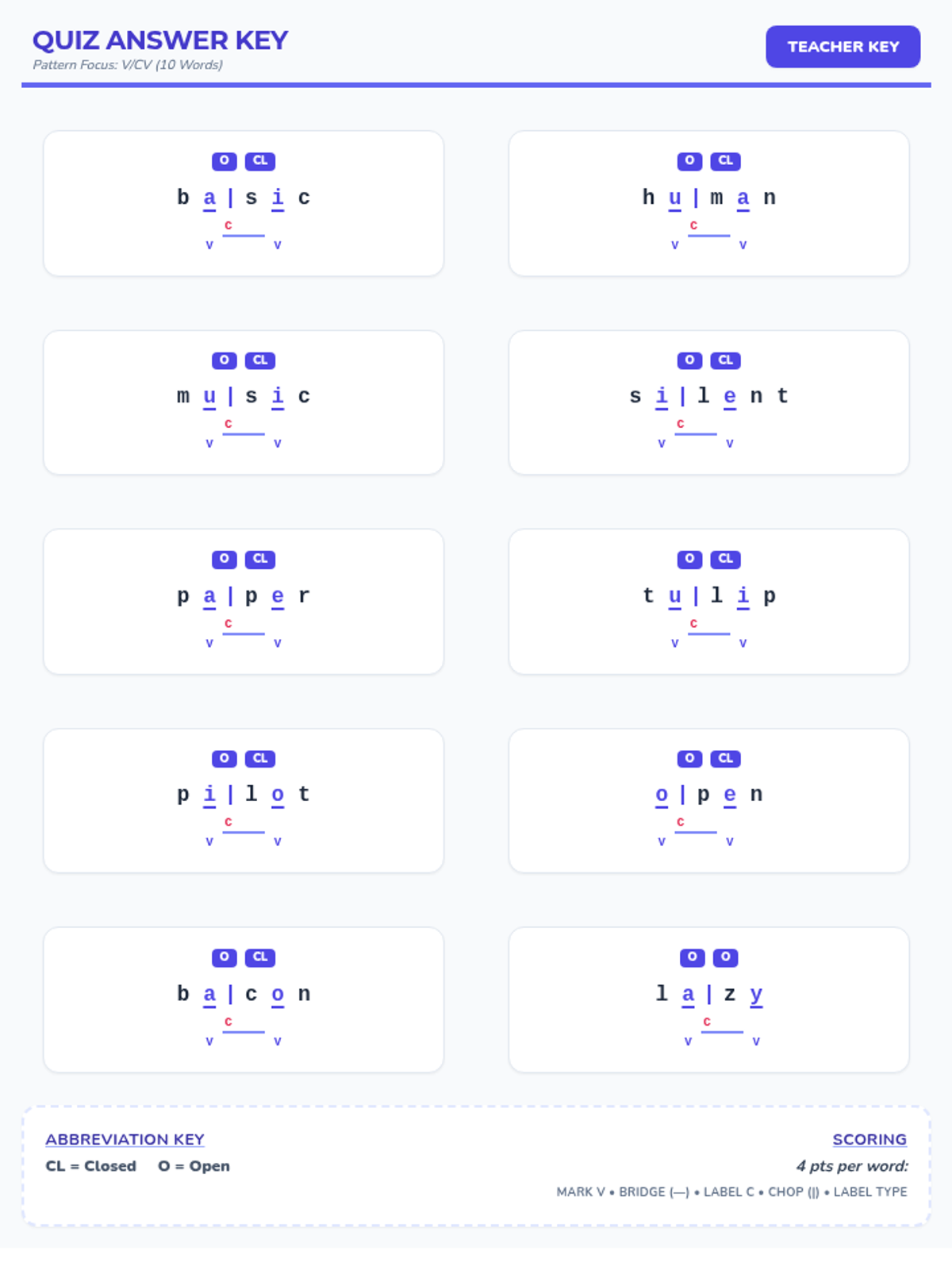
An answer key for the Syllable Division V/CV Quiz. It provides the correctly marked, bridged, labeled, and divided versions of the 10 target words (basic, human, music, silent, paper, tulip, pilot, open, bacon, lazy), along with a suggested scoring guide for teachers.