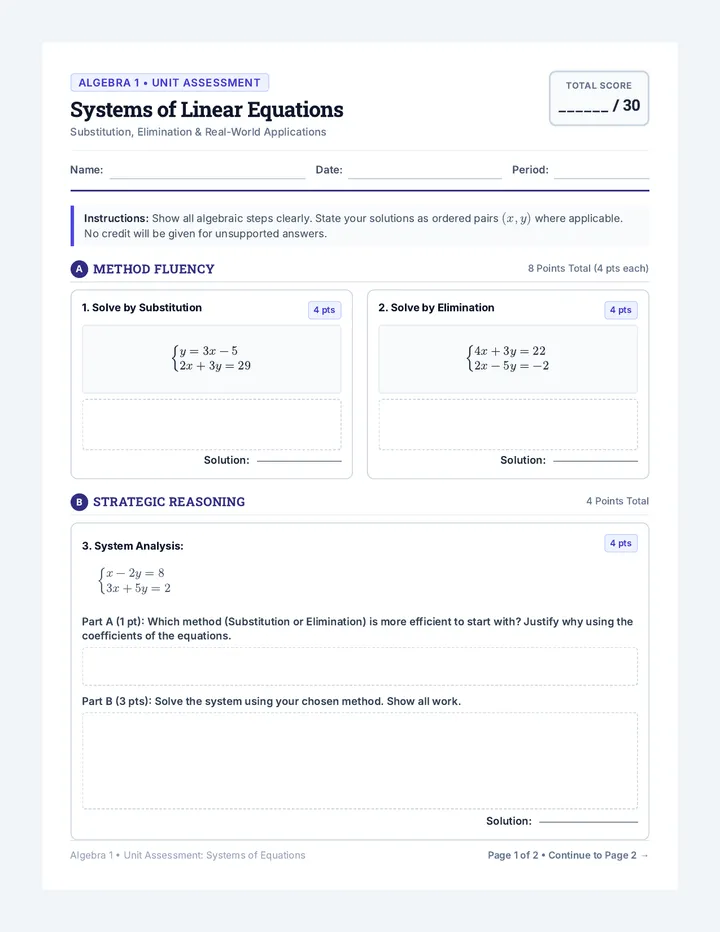
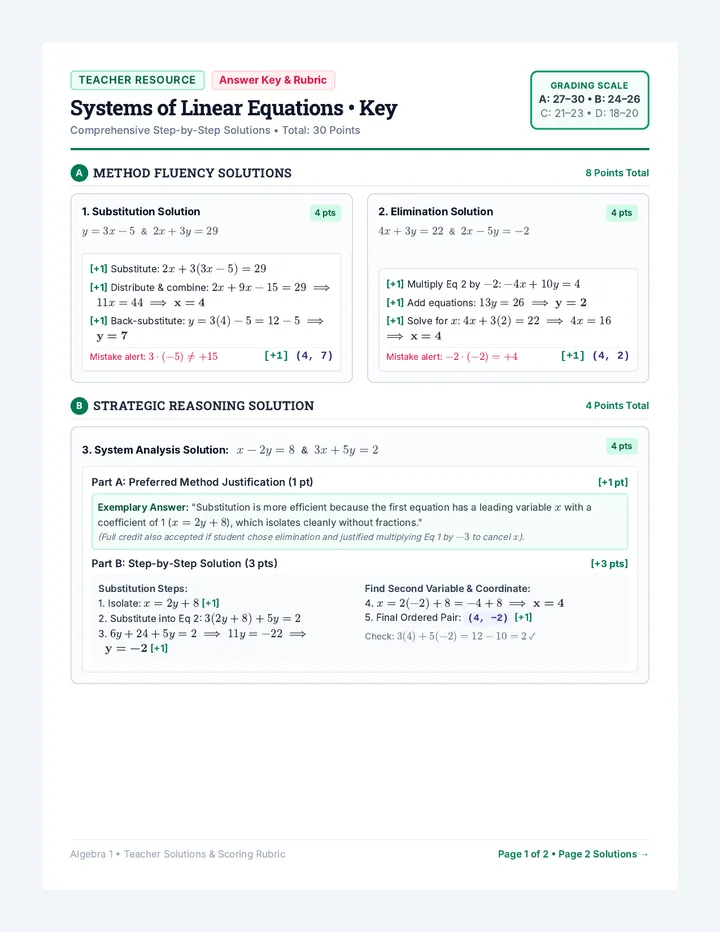
Variable Vault Slides
Mission: Intro to Algebra
60-Minute Direct Instruction
Foundational Unit • Lesson 1
Cracking the Variable Vault
Demystifying algebra by decoding unknowns, mapping expressions, and mastering numerical substitution.
Teacher Launch Prompt:
"Algebra is simply the language of puzzles. When numbers wear disguises, we call them variables."
01
Why Did Letters Invade Math?
Concept Activation
Elementary Math Style
You've actually been doing algebra since 1st grade:
5 + = 12
The empty box holds a secret value waiting to be revealed.
Missing value: 7
Algebraic Thinking Style
Now, we swap that clunky empty box for a sleek letter:
5 + \( x \) = 12
\( x \) is just a container holding that exact same mystery number!
Letters are simply placeholders for numbers.
Teacher Prompt: "Ask students: How is \( 5 + x = 12 \) identical to the box problem you solved in elementary school?"
02
Anatomy of an Algebraic Expression
Core Vocabulary
7 \( x \) + 9
Coefficient: 7
The number glued directly to the variable multiplying it.
Variable: \( x \)
A symbol (usually a letter) that represents an unknown or changing value.
Constant: 9
A standalone number with a fixed value that never changes.
Pro-Tip to Emphasize: "If a variable has no number written in front, like \( x \), the invisible coefficient is always 1!"
03
Algebraic Shorthand: The Hidden Operations
Syntax Rules
Algebraic shorthand saves ink! Mathematicians eliminate symbols when the meaning is obvious:
Multiplication Without \( \times \)
We retire the multiplication symbol "\( \times \)" so it never gets confused with the variable \( x \).
\( 4 \times x \implies 4(x) \implies \mathbf{4x} \)
"Touching means multiplying!"
Division as Fractions
The traditional division sign "\( \div \)" is replaced by a clean fraction bar.
\( x \div 5 \implies \mathbf{\frac{x}{5}} \)
"The top divided by the bottom."
Quick Check: "What operation is happening between the 8 and \( y \) in \( 8y \)? Ask class for choral response: Multiplication!"
04
Evaluating Expressions: The Plug & Play Protocol
Core Procedure
STEP 1
Copy & Parentheses
Rewrite the expression, replacing the variable with empty parentheses.
\( 3x + 4 \implies 3( \quad ) + 4 \)
Why? Prevents multiplying digit confusion!
STEP 2
Substitute Value
Drop the designated value directly into the parentheses.
If \( x = 6 \):
\( 3(\mathbf{6}) + 4 \)
Notice \( 3(6) \) is \( 18 \), not thirty-six!
STEP 3
Calculate (PEMDAS)
Multiply first, then complete the addition.
\( 18 + 4 \)
\( = 22 \)
Final single numerical answer!
Common Misconception Alert: "If students write \( 36 + 4 = 40 \), they forgot that touching means multiplying, not concatenating digits!"
05
Class Checkpoints: Live Solving
Guided Practice
Mission A Let \( m = 8 \)
Evaluate: \( 5m - 12 \)
1. Parentheses: \( 5(\quad) - 12 \)
2. Substitute: \( 5(8) - 12 \)
3. Multiply: \( 40 - 12 \)
4. Final: 28
Have students hold up fingers or mini-whiteboards with their final answer.
Mission B (Two Variables) \( a = 4, \; b = 7 \)
Evaluate: \( 3a + 2b \)
1. Substitute: \( 3(4) + 2(7) \)
2. Multiply both: \( 12 + 14 \)
3. Add results together:
4. Final: 26
Remind students: Perform all multiplications before doing any additions!
Turn & Talk: "Give partners 45 seconds to explain to each other why the answer to Mission B is 26 and not 43."
06
Real-World Code: The Laser Tag Arena
Application Modeling
Pricing The Arcade Event
Laser Tag Kingdom charges a flat private room rental fee of $50, plus $12 for every player ticket sold.
Algebraic Expression for Total Cost:
\( 12p + 50 \)
where \( p \) represents the number of players.
What if 15 players attend?
\( 12(\mathbf{15}) + 50 \)
\( = 180 + 50 \)
Total Cost: $230
If 20 players attend instead, what changes? Only the variable \( p \); the room fee ($50) stays constant!
Discussion Question: "Why is 50 called the constant and \( 12 \) called the coefficient in this real-life scenario?"
07
Independent Mission: Variable Vault Worksheet
Practice Phase
1
Part 1: Code Anatomy
Identify coefficients, variables, and constants in 4 target expressions.
2
Part 2: The Vault Cracker
Evaluate expressions with one and two variables using substitution parentheses.
3
Part 3: Secret Mission
Apply formulas to real-world gaming and streaming scenarios, plus the Exit Ticket.
Target Pacing: 25 Minutes Independent Work
Raise your hand for Level 2 hints or check answers with the teacher station.
Ready... Set... Decode!
Variable Vault Worksheet
Variable Vault Worksheet
MISSION 01: INTRODUCTION TO ALGEBRA
Name:
Date:
Period:
Score: / 25
Target Expression: 6x + 11
Coefficient: 6 (multiplies) Variable: x (unknown) Constant: 11 (fixed value)
PART 1
Decoding Expression Anatomy
(Identify each component accurately)
| Given Expression | Variable(s) | Coefficient(s) | Constant Term(s) |
|---|
| 4m + 7 | Example: m | Example: 4 | Example: 7 |
| 9y - 15 | | | |
| w + 8 | | | |
| 5a + 3b - 2 | | | |
*Agent Secret Tip: When a variable has no number written in front (like w), remember the invisible coefficient is 1!
PART 2
Shorthand Translation
(Write the algebraic expression)
1. 8 times a number \( n \)
2. 5 more than the product of 3 and \( x \)
3. A number \( k \) divided by 6
4. 10 decreased by twice \( y \)
PART 3
Single-Variable Vault Cracking
Rule: Always use parentheses when substituting!
5. Evaluate: \( 4x + 9 \) for \( x = 5 \)
Step 1: Write with parentheses
Step 2: Multiply, then add
Answer:
6. Evaluate: \( 7p - 8 \) for \( p = 6 \)
Step 1: Write with parentheses
Step 2: Multiply, then subtract
Answer:
7. Evaluate: \( \frac{24}{d} + 13 \) for \( d = 4 \)
Step 1: Substitute into denominator
Step 2: Divide, then add
Answer:
8. Evaluate: \( 100 - 3c \) for \( c = 12 \)
Step 1: Multiply 3 by \( c \)
Step 2: Subtract from 100
Answer:
Variable Vault Worksheet • Page 2
Advanced Decoding & Application
PART 4
Multi-Variable Codebreaking
Show all substitution steps clearly
9. Evaluate: \( 2a + 5b \) \( a = 6, \; b = 3 \)
Answer:
10. Evaluate: \( \frac{x + y}{4} \) \( x = 15, \; y = 17 \)
Variable Vault Answer Key
Variable Vault Answer Key
TEACHER GUIDE
STEP-BY-STEP SOLUTIONS & MISCONCEPTION ALERTS
60-Minute Intro Lesson Algebra Foundations
LESSON PACING:
0-10m: Hook & Vocab 10-25m: Direct Modeling 25-50m: Worksheet 50-60m: Exit Ticket
PART 1 SOLUTIONS
Expression Anatomy (4 pts total)
| Expression | Variable(s) | Coefficient(s) | Constant Term(s) |
|---|
| 4m + 7 | m | 4 | 7 |
| 9y - 15 | y | 9 | -15 (or 15) |
| w + 8 | w | 1 (invisible 1) | 8 |
| 5a + 3b - 2 | a, b | 5 and 3 | -2 (or 2) |
Teaching Note: Many students write "0" for the coefficient of \( w \). Highlight that \( 0w = 0 \), which would make the variable disappear!
PART 2 SOLUTIONS
Shorthand Translation (4 pts)
1. 8 times a number \( n \) 8n Accept \( 8(n) \); discourage \( 8 \times n \) to avoid variable confusion.
2. 5 more than product of 3 and \( x \) 3x + 5 Also accept \( 5 + 3x \) due to commutative property.
3. A number \( k \) divided by 6 \(\frac{k}{6}\) Fraction form is preferred standard over \( k \div 6 \).
4. 10 decreased by twice \( y \) 10 - 2y Common Trap: Do NOT accept \( 2y - 10 \) (reversed subtraction order).
PART 3 SOLUTIONS
Single-Variable Substitution (8 pts)
5. \( 4x + 9 \) for \( x = 5 \) Ans: 29
Step 1: \( 4(5) + 9 \)
Step 2: \( 20 + 9 = \mathbf{29} \)
Misconception: writing \( 45 + 9 = 54 \) (concatenating digits).
6. \( 7p - 8 \) for \( p = 6 \) Ans: 34
Step 1: \( 7(6) - 8 \)
Step 2: \( 42 - 8 = \mathbf{34} \)
Check basic subtraction accuracy: \( 42 - 8 = 34 \).
7. \( \frac{24}{d} + 13 \) for \( d = 4 \) Ans: 19
Step 1: \( \frac{24}{4} + 13 \)
Step 2: \( 6 + 13 = \mathbf{19} \)
Reminder: division bar takes precedence before addition.
8. \( 100 - 3c \) for \( c = 12 \) Ans: 64
Step 1: \( 100 - 3(12) \)