TSIA2 Practice Test
Texas College Readiness TSIA2 Mathematics
Diagnostic Practice Assessment
College Readiness Benchmark CRC Score 950+
Student Name:
Date:
Period/Class:
General Test Directions Standard TSIA2 Diagnostic
Questions 1–12 sample Quantitative, Algebraic, Geometric, and Statistical reasoning. Multiple-choice questions offer choices (A)–(D). Numeric-entry questions require you to write your final numeric answer in the box provided.
Slope: \(m = \frac{y_2 - y_1}{x_2 - x_1}\)
Quadratic: \(x = \frac{-b \pm \sqrt{b^2-4ac}}{2a}\)
Pythagorean: \(a^2 + b^2 = c^2\)
Cylinder Vol: \(V = \pi r^2 h\)
1 Quantitative Reasoning
Multiple Choice
A regional municipal water filtration facility operates at a constant rate, filtering \(450\) gallons of reservoir water in \(3\text{ hours and }45\text{ minutes}\). At this exact rate, how many gallons of water can the facility filter during a continuous \(8\text{-hour}\) operating shift?
A \(920\text{ gallons}\)
B \(960\text{ gallons}\)
C \(1,000\text{ gallons}\)
D \(1,125\text{ gallons}\)
2 Quantitative Reasoning
Numeric Entry
A retail electronics supplier acquired a tablet computer at a wholesale cost of \(\$160\). The store marked up the wholesale cost by \(35\%\) to establish the regular retail price. During an annual promotional event, the store discounted the retail price by \(20\%\). What was the final promotional sale price, in dollars, before sales tax?
Final Price: \(\$\)
3 Algebraic Reasoning
Multiple Choice
A university performing arts auditorium sold student tickets for \(\$8\) each and general admission adult tickets for \(\$14\) each. For opening night, a total of \(240\) tickets were purchased, generating exactly \(\$2,460\) in revenue. Exactly how many adult tickets were sold?
A \(85\text{ adult tickets}\)
B \(90\text{ adult tickets}\)
C \(130\text{ adult tickets}\)
D \(150\text{ adult tickets}\)
TSIA2 Mathematics Diagnostic Form A Page 1 of 4
TSIA2 Practice Assessment
Section II: Algebraic Reasoning & Functions
Questions 4–6
4 Quadratic Models
Numeric Entry
The vertical height \(h(t)\), in feet above ground level, of a model rocket launched vertically into the air is modeled by the quadratic function:
\(h(t) = -16t^2 + 96t + 4\)
where \(t\) represents the elapsed time in seconds after launch. What is the maximum height, in feet, attained by the rocket?
Maximum Height:
feet
5 Rational Expressions
Multiple Choice
Which of the following expressions is mathematically equivalent to \(\dfrac{2x^2 - 8}{x^2 + 5x + 6}\) for all real values of \(x\) such that \(x \ne -2\) and \(x \ne -3\)?
A \(\dfrac{2(x-2)}{x+3}\)
B \(\dfrac{2(x+2)}{x+3}\)
C \(\dfrac{2(x-4)}{x+6}\)
D \(\dfrac{x-2}{x+3}\)
6 Absolute Value Inequalities
Multiple Choice
What is the complete set of all real values of \(x\) that satisfy the absolute value inequality:
\(|3x - 7| \le 14\)
A \(\{x \mid -\frac{7}{3} \le x \le 7\}\)
B \(\{x \mid x \le -\frac{7}{3}\text{ or }x \ge 7\}\)
C \(\{x \mid -7 \le x \le 7\}\)
D \(\{x \mid -\frac{14}{3} \le x \le \frac{14}{3}\}\)
TSIA2 Mathematics Diagnostic Form A Page 2 of 4
TSIA2 Practice Assessment
Section III: Geometric & Spatial Reasoning
Questions 7–9
7 Pythagorean Relationships
Multiple Choice
A straight ladder of length \(25\text{ feet}\) leans securely against a vertical exterior wall with its base positioned \(7\text{ feet}\) away from the base of the wall. If the top of the ladder slips downward exactly \(4\text{ feet}\) along the wall, how many feet does the bottom of the ladder slide outward from its starting point?
A \(4\text{ feet}\)
B \(8\text{ feet}\)
C \(11\text{ feet}\)
D \(15\text{ feet}\)
8 Volume & Flow Rates
Numeric Entry
A community swimming pool has a rectangular prism design measuring \(30\text{ feet}\) in length, \(15\text{ feet}\) in width, and a uniform depth of \(6\text{ feet}\). If the pool is completely empty and a high-capacity pump fills it at a constant rate of \(45\text{ cubic feet per minute}\), how many minutes will it take to fill the pool completely to its brim?
Fill Time:
minutes
9 Coordinate Geometry
Multiple Choice
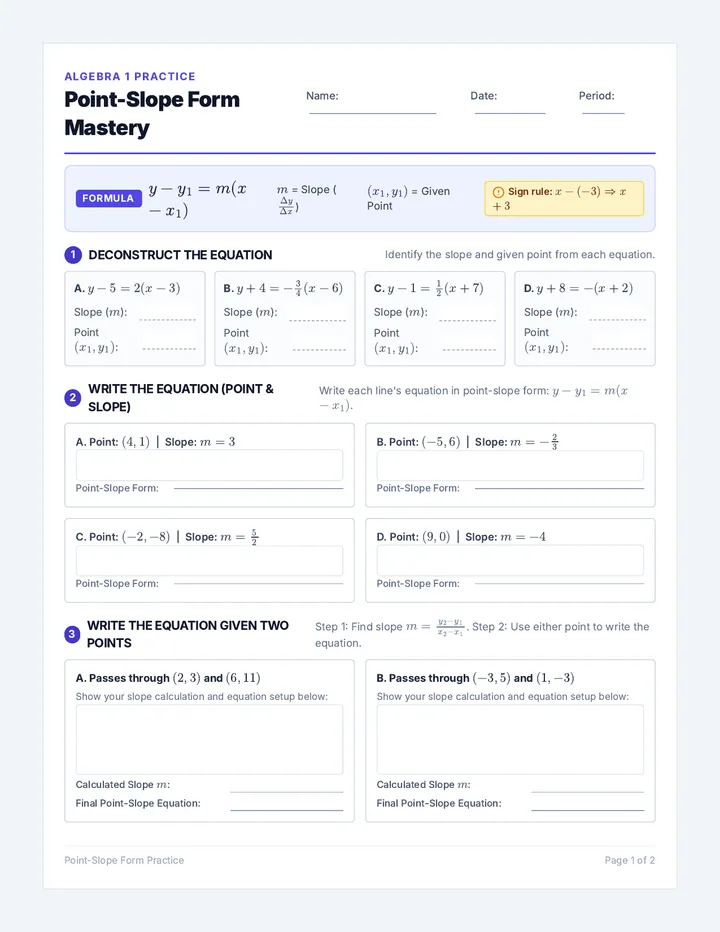
In the standard \(xy\)-coordinate plane, line \(k\) passes through the points \((-3, 4)\) and \((5, -2)\). Line \(m\) is perpendicular to line \(k\) and passes through the point \((2, 1)\). What is the \(y\)-intercept of line \(m\)?
A \(-\dfrac{5}{3}\)
B \(-\dfrac{3}{4}\)
C \(\dfrac{7}{4}\)
D \(\dfrac{11}{3}\)
TSIA2 Mathematics Diagnostic Form A Page 3 of 4
TSIA2 Practice Assessment
Section IV: Probabilistic & Statistical Reasoning
Questions 10–12
10 Two-Way Contingency Tables
Multiple Choice
A university surveyed \(120\) upper-division students regarding their internship status:
| Major Field |
Internship Completed |
No Internship |
Total |
| Business Administration |
\(32\) |
\(18\) |
\(50\) |
| Engineering & Technology |
\(42\) |
\(28\) |
\(70\) |
| Total |
\(74\) |
\(46\) |
\(120\) |
Given that a randomly selected student is an Engineering & Technology major, what is the probability that the student has completed an internship?
A \(\dfrac{7}{20}\)
B \(\dfrac{21}{37}\)
C \(\dfrac{3}{5}\)
D \(\dfrac{7}{12}\)
11 Mean & Data Sets
Numeric Entry
A college statistics student has recorded scores of \(78\), \(84\), \(88\), \(92\), and \(86\) on the first five unit quizzes of the semester. What exact integer score must the student earn on the sixth quiz so that the mean score across all six quizzes is exactly \(88\)?
Required 6th Score:
12 Bivariate Data & Regression
Multiple Choice
A researcher investigated the association between average weekly study time in hours (\(x\)) and final course exam score (\(y\)). The linear regression model is given by \(\hat{y} = 4.2x + 58.5\). Which of the following statements provides the best statistical interpretation of the slope, \(4.2\), in the context of this model?
A A student who studies zero hours per week is predicted to earn an exam score of \(4.2\) points.
B For each additional hour of weekly study time, the predicted exam score increases by approximately \(4.2\) points.
C For each increase of \(1\) point on the exam score, the student must study exactly \(4.2\) additional hours each week.
D The maximum score increase a student can achieve regardless of study hours is \(4.2\) points.
Completion Check: 12 total items completed
Total Correct: _____ / 12
Time Taken: _____ min
TSIA2 Mathematics Diagnostic Form A Page 4 of 4
TSIA2 Solutions Teacher Guide
Teacher Resource TSIA2 Mathematics
Solutions & Diagnostic Guide
College Ready Benchmark CRC \(\ge 950\) or Diagnostic Level 6
Master Answer Key 12 Items • 8 Multiple Choice • 4 Numeric Entry
Q1B
Q2**$172.80**
Q3B
Q4148
Q5A
Q6A
Q7B
Q860
Q9A
Q10C
Q11100
Q12B
1 Municipal Filtration Rate Quantitative Reasoning
Correct: (B) 960 gallons
Step 1: Convert time into decimal hours. \(3\text{ hr }45\text{ min} = 3 + \frac{45}{60} = 3.75\text{ hours}\).
Step 2: Calculate the unit filtration rate. \(\text{Rate} = \frac{450\text{ gallons}}{3.75\text{ hours}} = 120\text{ gallons per hour}\).
Step 3: Compute output for an 8-hour shift. \(\text{Output} = 120\text{ gal/hr} \times 8\text{ hr} = 960\text{ gallons}\).
Distractor Rationale: (A) \(920\) comes from treating \(3.75\) hr as \(3.9\) hr or rounding down. (C) \(1,000\) results from confusing \(45\) minutes as \(0.45\) hours (\(\frac{450}{3.45} \approx 130 \times 8 \approx 1040\)). (D) \(1,125\) reflects \(450 \times 2.5\) without accounting for fractional time.
2 Wholesale Markup & Promotional Discount Quantitative Reasoning
Correct: $172.80 (or 172.8)
Step 1: Calculate the retail price after 35% markup.
\(\text{Retail Price} = \$160 \times (1 + 0.35) = \$160 \times 1.35 = \$216.00\).
Step 2: Apply the 20% promotional discount to the retail price.
\(\text{Final Price} = \$216.00 \times (1 - 0.20) = \$216.00 \times 0.80 = \$172.80\).
Common Misconceptions: The most frequent error is simply adding and subtracting percentages: \(35\% - 20\% = +15\%\), yielding \(\$160 \times 1.15 = \$184.00\). Students must understand that sequential percentages apply to updated intermediate values.
TSIA2 Mathematics Solutions & Diagnostic Guide Page 1 of 4
TSIA2 Solutions Manual
Section II: Algebraic Reasoning Solutions
Items 3–5
3 Linear System: Auditorium Ticket Sales Algebraic Reasoning
Correct: (B) 90 adult tickets
Step 1: Set up the system of linear equations. Let \(s =\) student tickets and \(a =\) adult tickets.
(1) \(s + a = 240\) and (2) \(8s + 14a = 2,460\).
Step 2: Solve by substitution or elimination. Multiply equation (1) by \(8\):
\(8s + 8a = 1,920\). Subtract this from equation (2):
\((8s + 14a) - (8s + 8a) = 2,460 - 1,920 \implies 6a = 540 \implies a = 90\).
Step 3: Verification. \(s = 240 - 90 = 150\). Revenue: \(8(150) + 14(90) = 1,200 + 1,260 = \$2,460\).
Distractor Rationale: Option (D) \(150\) is the number of student tickets. Forgetting to solve for the target variable (\(a\)) is the most common TSIA2 trap on linear systems.
4 Quadratic Vertex & Maximum Projectile Height Algebraic Reasoning
Correct: 148
Step 1: Identify the time \(t\) at which the vertex occurs.
For a parabola \(h(t) = at^2 + bt + c\) with \(a = -16\), \(b = 96\), \(c = 4\):
\(t_{\text{vertex}} = -\dfrac{b}{2a} = -\dfrac{96}{2(-16)} = \dfrac{-96}{-32} = 3\text{ seconds}\).
Step 2: Evaluate \(h(3)\) to determine the maximum height.
\(h(3) = -16(3)^2 + 96(3) + 4 = -16(9) + 288 + 4 = -144 + 288 + 4 = 148\text{ feet}\).
Common Misconceptions: Students often report the time \(t = 3\) instead of the height \(h(3) = 148\), or omit the initial constant height \(+4\), giving \(144\).
5 Rational Expression Simplification Algebraic Reasoning
Correct: (A) \(\frac{2(x-2)}{x+3}\)
Step 1: Factor the numerator completely.
\(2x^2 - 8 = 2(x^2 - 4) = 2(x - 2)(x + 2)\) (difference of squares).
Step 2: Factor the quadratic denominator.
\(x^2 + 5x + 6 = (x + 2)(x + 3)\) (find factors of \(6\) that sum to \(5\)).
Step 3: Cancel identical factors in numerator and denominator.
\(\dfrac{2(x - 2)(x + 2)}{(x + 2)(x + 3)} = \dfrac{2(x - 2)}{x + 3}\).
Distractor Rationale: (B) retains \((x+2)\) by misidentifying which binomial cancels. (C) incorrectly cancels individual terms (\(x^2\) with \(x^2\)). (D) omits the factored constant \(2\).
TSIA2 Mathematics Solutions & Diagnostic Guide Page 2 of 4
TSIA2 Solutions Manual
Section III: Inequalities & Geometric Reasoning
Items 6–8
6 Absolute Value Inequality Algebraic Reasoning
Correct: (A) \(\{x \mid -\frac{7}{3} \le x \le 7\}\)
Step 1: Set up the double inequality for a "less than or equal to" condition.
\(|3x - 7| \le 14 \iff -14 \le 3x - 7 \le 14\).
Step 2: Isolate the variable term by adding \(7\) across all three parts.
\(-14 + 7 \le 3x \le 14 + 7 \implies -7 \le 3x \le 21\).
Step 3: Divide all three parts by \(3\).
\(-\dfrac{7}{3} \le x \le \dfrac{21}{3} \implies -\dfrac{7}{3} \le x \le 7\).
Distractor Rationale: (B) uses disjoint "or" intervals typical of \(|u| \ge c\). (C) forgets to divide by \(3\). (D) mistakenly sets \(-14 \le 3x \le 14\) while dropping \(-7\).
7 Dynamic Pythagorean Ladder Model Geometric Reasoning
Correct: (B) 8 feet
Step 1: Find the initial height \(h_1\) on the wall.
\(7^2 + h_1^2 = 25^2 \implies 49 + h_1^2 = 625 \implies h_1^2 = 576 \implies h_1 = 24\text{ ft}\) (7-24-25 triple).
Step 2: Find the new height after slipping down \(4\text{ ft}\).
\(h_2 = 24 - 4 = 20\text{ ft}\).
Step 3: Solve for the new base distance \(b_2\).
\(b_2^2 + 20^2 = 25^2 \implies b_2^2 + 400 = 625 \implies b_2^2 = 225 \implies b_2 = 15\text{ ft}\) (15-20-25 triple).
Step 4: Determine the distance the bottom slid outward.
\(\Delta b = b_2 - b_1 = 15 - 7 = 8\text{ feet}\).
Distractor Rationale: (A) \(4\) assumes 1:1 motion (if top moves 4, bottom moves 4). (D) \(15\) is the new base distance, not the slide displacement.
8 Prism Volume & Pumping Flow Rate Geometric Reasoning
Correct: 60
Step 1: Calculate the total internal capacity/volume of the pool.
\(V = \text{length} \times \text{width} \times \text{depth} = 30\text{ ft} \times 15\text{ ft} \times 6\text{ ft} = 2,700\text{ ft}^3\).
Step 2: Divide total volume by the pump flow rate.
\(\text{Time} = \dfrac{2,700\text{ ft}^3}{45\text{ ft}^3/\text{min}} = 60\text{ minutes}\).
Common Misconceptions: Students calculating surface area instead of volume: \(2(30 \cdot 15) + 2(30 \cdot 6) + 2(15 \cdot 6) = 900 + 360 + 180 = 1,440\), which yields \(1,440 / 45 = 32\) minutes.
TSIA2 Mathematics Solutions & Diagnostic Guide Page 3 of 4
TSIA2 Solutions Manual
Section IV: Coordinate & Statistical Reasoning
Items 9–12
9 Perpendicular Line & \(y\)-Intercept Correct: (A) \(-\frac{5}{3}\)
Slope of line \(k\): \(m_k = \frac{-2 - 4}{5 - (-3)} = \frac{-6}{8} = -\frac{3}{4}\). Perpendicular slope of line \(m\) is opposite reciprocal: \(m_m = \frac{4}{3}\).
Using point-slope with \((2, 1)\): \(y - 1 = \frac{4}{3}(x - 2) \implies y = \frac{4}{3}x - \frac{8}{3} + 1 = \frac{4}{3}x - \frac{5}{3}\). The \(y\)-intercept is \(-\frac{5}{3}\).
10 Two-Way Conditional Probability Correct: (C) \(\frac{3}{5}\)
Condition: "Given that the student is an Engineering & Technology major" restricts denominator to that row's subtotal (\(70\)).
Numerator is Engineering students who completed an internship (\(42\)): \(P(\text{Intern} \mid \text{Eng}) = \frac{42}{70} = \frac{3}{5}\).
Trap: Using grand total \(120\) gives \(\frac{42}{120} = \frac{7}{20}\) (Option A), which is marginal joint probability, not conditional.
11 Arithmetic Mean & Data Sets Correct: 100
Sum of the first 5 quizzes: \(78 + 84 + 88 + 92 + 86 = 428\).
For the average of 6 quizzes to be \(88\), total points required: \(6 \times 88 = 528\).
Required 6th score: \(528 - 428 = 100\).
12 Linear Regression Slope Interpretation Correct: (B)
Model: \(\hat{y} = 4.2x + 58.5\). In \(\hat{y} = mx + b\), the slope \(m = 4.2\) denotes \(\frac{\Delta \hat{y}}{\Delta x}\): for each \(1\)-unit increase in weekly study hours (\(x\)), predicted exam score (\(\hat{y}\)) increases by \(4.2\) points.
Trap: Confusing slope with intercept (Option A: \(58.5\) is the zero-hour prediction, not \(4.2\)) or reversing variables (Option C).
TSIA2 Diagnostic Remediation Mapping
Quantitative & Spatial Reasoning (Q1, 2, 7, 8)
Focus on multi-step rate conversion, sequential percentages, Pythagorean 3D contexts, and geometric volume applications.
Algebraic & Statistical Reasoning (Q3–6, 9–12)
Focus on systems modeling, quadratic vertices, rational factoring, conditional probability restrictions, and regression slope language.
TSIA2 Mathematics Solutions & Diagnostic Guide Page 4 of 4