Expression Unfolded Lesson Plan Grade 7 • Mathematics
Expression Unfolded Lesson Plan
Focus: Expanding & Factoring Linear Expressions with Variables • Duration: 60 Minutes
CCSS: 7.EE.A.1
Algebraic Reasoning
Lesson Focus & Core Idea
Students conceptualize the distributive property as an area model to expand linear expressions of the form \(a(bx + c)\), then discover factoring as the exact inverse operation: extracting the Greatest Common Factor (GCF) to write equivalent factored forms.
Essential Questions
How is factoring related to expanding?
How does an area model prove two expressions are equivalent?
Learning Objectives
• Expand: Apply the distributive property with positive & negative rational numbers: \( -3(4x - 5) = -12x + 15 \).
• Factor: Identify the GCF of algebraic terms to rewrite sums/differences as products: \( 18x - 24 = 6(3x - 4) \).
Materials & Prep
Expression Unfolded Slide Deck (Projector)
Student Practice Worksheets (1 per student)
Exit Ticket (1 per student)
Whiteboards & dry erase markers for partner checks
60-Min Pacing:
00-08m: Hook & Area Model 08-25m: Direct Instruction 25-42m: Guided Practice 42-53m: Solo Work 53-60m: Exit Ticket
1 Phase 1: Hook & Visual Discovery (8 Mins)
Slides 1–2
Project Slide 2 showing a divided rectangle with width \(4\) and sub-lengths \(2x\) and \(5\). Ask: "How could two different architects express the total floor area of this room?"
Key Teaching Move: Architect A writes \(\text{Length} \times \text{Width} = 4(2x + 5)\). Architect B adds individual rooms: \(8x + 20\). Conclude: Both equal the same total area!
2 Phase 2: Expanding Expressions & Handling Negatives (17 Mins)
Slides 3–4
Model how the distributive property distributes the outer factor to every internal term. Introduce the "Rainbow Arcs" notation alongside the area model.
Example 1 (Positive): \( 5(3y + 4) \)
Example 2 (Negative Outside): \( -2(4w - 7) \)
Grade 7 Expressions & Equations • 7.EE.A.1 Page 1 of 2
Instructional Sequence (Continued) & Pedagogical Supports
Expression Unfolded Lesson Plan
3 Phase 3: Factoring as "Un-Multiplying" via GCF (17 Mins)
Slides 5–6
Frame factoring as "finding the dimensions when given the total room area." If an expression is \(12x + 18\), how wide could the room be?
3-Step Factoring Protocol:
Find GCF: List factors of coefficients & constants. For \(12x\) and \(18\), \(\text{GCF}(12, 18) = 6\).Pull Outside: Write the GCF outside parentheses: \(6(\quad)\).Divide Each Term: \(\frac{12x}{6} = 2x\) and \(\frac{18}{6} = 3\), resulting in \(6(2x + 3)\).Verify: Mentally expand to check: \(6 \cdot 2x + 6 \cdot 3 = 12x + 18\) ✓.
4 Phase 4: Practice (11 Mins)
Students work through Part 1 & 2 of the student worksheet. Pair-share for items 4 and 8. Circulate to check sign handling.
5 Phase 5: Exit Check (7 Mins)
Administer the 4-question Exit Ticket independently without peer assistance to evaluate mastery of expanding, factoring, and sign awareness.
Frequent Misconceptions & Direct Interventions
The "Half-Distribute"
Student writes \(3(x + 4) = 3x + 4\).
Fix: Use the 2-room area model box; every room must have width \(3\).
Negative Sign Drop
Student writes \(-4(2x - 3) = -8x - 12\).
Fix: Circle the negative sign with the factor: \((-4) \times (-3) = +12\).
Partial Factoring
Student writes \(24x + 36 = 6(4x + 6)\).
Fix: Inspect inside terms; if \(4x\) & \(6\) still share factor \(2\), it's not the GCF.
Differentiation Strategies
Support / Tier 2
Provide pre-drawn area model boxes for all problems. Use color-coded pencils (e.g., blue for outside factor, green for terms).
English Learners
Anchor chart pairing the visual arrows with cognates/definitions: Expand = unfold/multiply ; Factor = group/un-multiply .
Extension / Tier 3
Factor fractional coefficients, e.g., \(\frac{1}{2}x + \frac{3}{4} = \frac{1}{4}(2x + 3)\), or trinomials such as \(6x + 9y - 15\).
Grade 7 Expressions & Equations • 7.EE.A.1 Page 2 of 2
Expression Unfolded Slides Grade 7 Math • Expressions & Equations CCSS 7.EE.A.1
Expression Unfolded
Mastering the art of expanding and factoring linear expressions using the distributive property and area models.
Expand (Multiply Out) • Factor (Pull Out GCF)
Visual Discovery
Two Ways to Measure One Room
Room Floor Plan
4
width = \(2x\) Area: \(8x\)
width = \(5\) Area: \(20\)
Method 1: Total Dimensions
\( \text{Width} \times \text{Length} = 4(2x + 5) \)
Method 2: Sum of Sub-Rooms
\( \text{Room A} + \text{Room B} = 8x + 20 \)
Both describe the exact same space! Therefore: \( 4(2x + 5) = 8x + 20 \)
Notice: Expanding multiplies the outside across each inside term.
The Distributive Property
Expanding: Multiplying to Every Term
\( a(bx + c) = (a \cdot bx) + (a \cdot c) = abx + ac \)
The outside multiplier must visit every single term inside the parentheses!
Example 1: Positive Terms
\( 3(4x + 7) \)
1. Multiply first: \( 3 \times 4x = 12x \)
2. Multiply second: \( 3 \times 7 = 21 \)
\( = 12x + 21 \)
Example 2: Multiple Terms
\( 6(2m - 3n + 5) \)
1. \( 6 \times 2m = 12m \)
2. \( 6 \times (-3n) = -18n \)
\( = 12m - 18n + 30 \)
Key Rule: Never stop after distributing to just the first term!
Danger Zone: Signs!
Distributing with Negative Factors
The Golden Sign Rule
When the number outside is negative, it flips the sign of every term inside!
\( (-) \times (+) = (-) \)
\( (-) \times (-) = (+) \)
Worked Step-by-Step:
\( -5(3x - 8) \)
1
Rewrite subtraction:
2
Multiply first term:
3
Multiply second term:
Final: \( -15x + 40 \)
Common Pitfall: Writing \(-15x - 40\) drops the double negative! Remember: \((-)\times(-) = (+)\).
The Reverse Move
Factoring: Pulling Out the GCF
Factoring is un-multiplying . We look for the Greatest Common Factor of all terms.
Problem: Factor the expression \( 18x - 24 \) completely.
Step 1: Find GCF
Factors of 18: 1, 2, 3, 6 , 9, 18
Factors of 24: 1, 2, 3, 4, 6 , 8, 12, 24
\( \text{GCF} = 6 \)
Step 2: Divide Each
\( \frac{18x}{6} = 3x \)
\( \frac{-24}{6} = -4 \)
Inside: \( (3x - 4) \)
Step 3: Combine
Place GCF outside:
\( 6(3x - 4) \)
Check: \( 6 \cdot 3x - 6 \cdot 4 = 18x - 24 \) ✓
Pro Tip: If you factor out \(2\) to get \(2(9x - 12)\), you haven't factored completely because \(9\) and \(12\) still share \(3\)!
Big Picture Connection
Expanding and Factoring are Inverses
Factored Form (Product) \( 7(2x - 3) \)
EXPAND (Multiply)
FACTOR (Divide GCF)
Expanded Form (Sum) \( 14x - 21 \)
Use distribution to prove your factored answer is correct.
Both expressions yield the exact same value for any variable input \(x\).
Remember: Factoring rewrites a sum as a product; expanding rewrites a product as a sum.
Active Practice
Whiteboard Partner Showdown
Partner A: Expand 60 Seconds
\( -4(5k - 6) \)
• Multiply \(-4\) by both terms.
• Watch the double negative!
Partner B: Factor 60 Seconds
\( 36y + 48 \)
• Find the Greatest Common Factor.
• Check that inside terms share no factors.
Ready? Compare answers with your partner, then transition to your practice worksheet! Answers: \(-20k + 24\) & \(12(3y + 4)\)
Expression Unfolded Worksheet Grade 7 Mathematics • Expressions & Equations
Expression Unfolded Worksheet
Name:
Date:
Period:
Core Strategy: Multiply the outside term across every term inside: \(a(bx + c) = abx + ac\). Watch negative signs: \((-)\times(-) = (+)\).
1 Part 1: Expanding Expressions (Use Area Model or Rainbow Method)
Show all intermediate work steps
1. Expand: \( 4(3x + 5) \) Area Model Guide
4
\(3x\)
\(+5\)
Expanded Form:
2. Expand: \( 6(2y - 7) \) Area Model Guide
6
\(2y\)
\(-7\)
Expanded Form:
3. Expand: \( -3(4a + 9) \)
Notice the outside negative factor. Show sign steps:
Expanded Form:
4. Expand: \( -5(2b - 6) \)
Pay close attention to multiplying two negative numbers:
Expanded Form:
5. Expand: \( 0.5(8m + 14) \)
Multiplying by \(0.5\) is equivalent to taking half:
Expanded Form:
6. Expand: \( 7(2x - 3y + 4) \)
Distribute across all three terms in the expression:
Expanded Form:
Expression Unfolded • CCSS 7.EE.A.1 Page 1 of 2
Expression Unfolded: Factoring & Reasoning
Name: Period:
2 Part 2: Factoring Expressions Completely (Identify GCF)
8 Practice Items: Extract the Greatest Common Factor
7. Factor: \( 15x + 25 \) GCF: ___
Factored:
8. Factor: \( 18y - 42 \) GCF: ___
Factored:
9. Factor: \( 28m + 35 \) GCF: ___
Factored:
10. Factor: \( -12k - 30 \) Factor out \((-)\)
Factored:
11. Factor completely: \( 36p - 48 \) Find largest GCF
Factored:
12. Factor: \( 16a + 24b \) Two variables
Factored:
13. Factor: \( 45c - 20 \) GCF: ___
Factored:
14. Factor: \( 9x + 27y - 18 \) 3-term expression
Factored:
3 Part 3: Spot the Error & Critique Reasoning
15. Maya's Work Incorrect
Maya expands: \( -4(3x - 5) = -12x - 20 \)
Explain Maya's mistake:
Correct:
16. Jordan's Work Incomplete
Jordan factors: \( 24w + 32 = 4(6w + 8) \)
Why is this not completely factored?
Factored:
4 Part 4: Real-World Modeling • The Community Garden
17. A rectangular community garden has an area modeled by the expression \( 18x + 27 \) \(\text{m}^2\).
a) If width is \(9\) m, write factored dimensions:
b) What binomial represents the length?
c) If \(x = 5\) m, what is the total area?
Expression Unfolded • CCSS 7.EE.A.1 Page 2 of 2
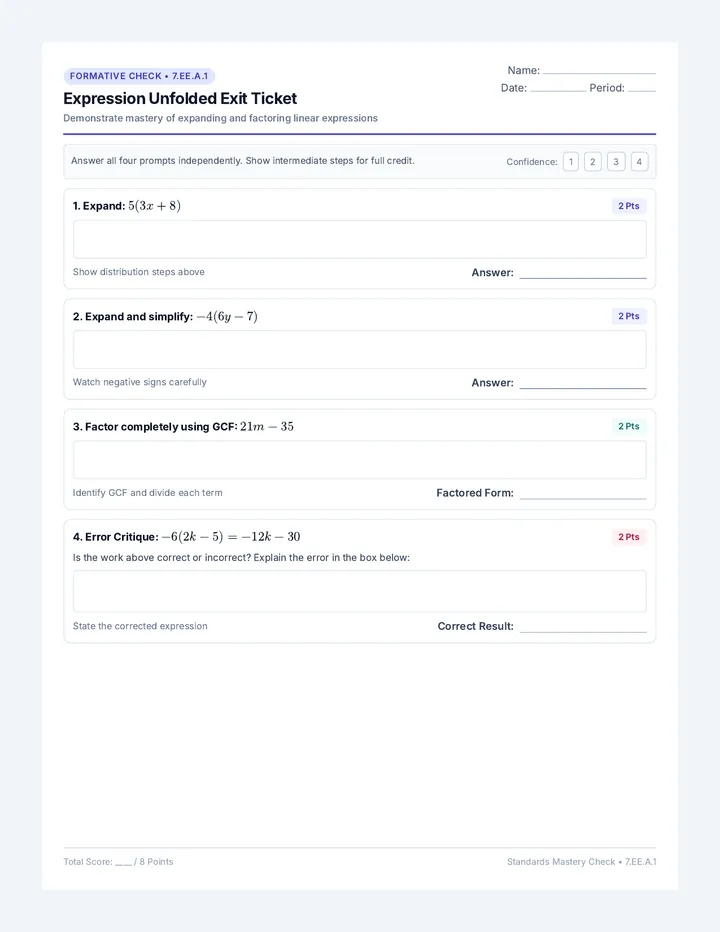
Expression Unfolded Exit Ticket Formative Check • 7.EE.A.1
Expression Unfolded Exit Ticket
Demonstrate mastery of expanding and factoring linear expressions
Name:
Date: Period:
Answer all four prompts independently. Show intermediate steps for full credit.
Confidence: 1 2 3 4
1. Expand: \( 5(3x + 8) \) 2 Pts
Show distribution steps above
Answer:
2. Expand and simplify: \( -4(6y - 7) \) 2 Pts
Watch negative signs carefully
Answer:
3. Factor completely using GCF: \( 21m - 35 \) 2 Pts
Identify GCF and divide each term
Factored Form:
4. Error Critique: \( -6(2k - 5) = -12k - 30 \) 2 Pts
Is the work above correct or incorrect? Explain the error in the box below:
State the corrected expression
Correct Result:
Total Score: ____ / 8 Points Standards Mastery Check • 7.EE.A.1
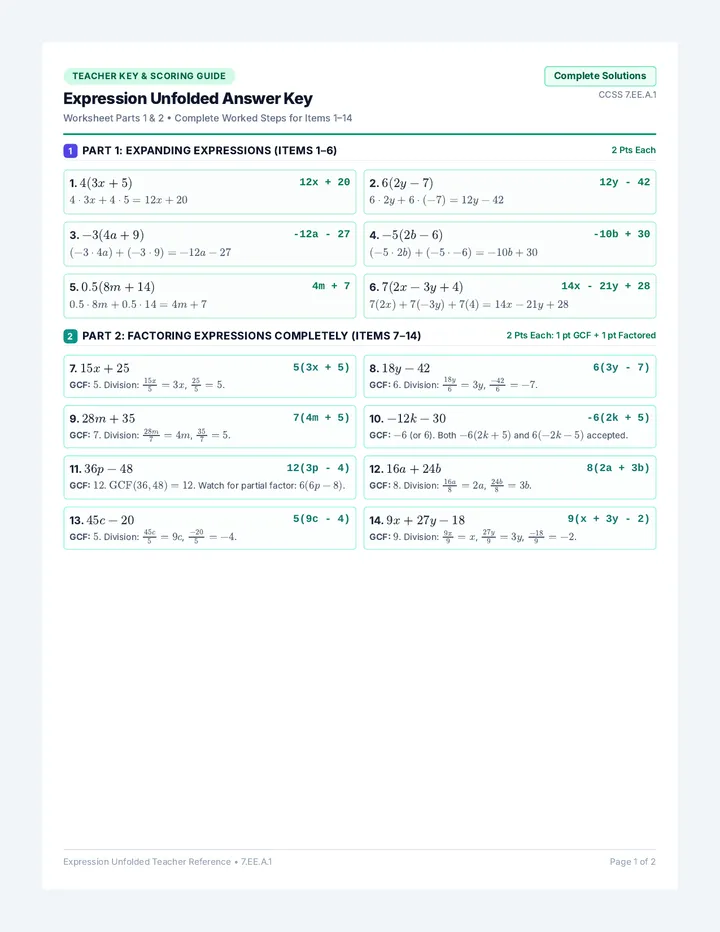
Expression Unfolded Answer Key Teacher Key & Scoring Guide
Expression Unfolded Answer Key
Worksheet Parts 1 & 2 • Complete Worked Steps for Items 1–14
Complete Solutions
CCSS 7.EE.A.1
1 Part 1: Expanding Expressions (Items 1–6)
2 Pts Each
1. \( 4(3x + 5) \) 12x + 20
\( 4 \cdot 3x + 4 \cdot 5 = 12x + 20 \)
2. \( 6(2y - 7) \) 12y - 42
\( 6 \cdot 2y + 6 \cdot (-7) = 12y - 42 \)
3. \( -3(4a + 9) \) -12a - 27
\( (-3 \cdot 4a) + (-3 \cdot 9) = -12a - 27 \)
4. \( -5(2b - 6) \) -10b + 30
\( (-5 \cdot 2b) + (-5 \cdot -6) = -10b + 30 \)
5. \( 0.5(8m + 14) \) 4m + 7
\( 0.5 \cdot 8m + 0.5 \cdot 14 = 4m + 7 \)
6. \( 7(2x - 3y + 4) \) 14x - 21y + 28
\( 7(2x) + 7(-3y) + 7(4) = 14x - 21y + 28 \)
2 Part 2: Factoring Expressions Completely (Items 7–14)
2 Pts Each: 1 pt GCF + 1 pt Factored
7. \( 15x + 25 \) 5(3x + 5)
GCF: \(5\). Division: \(\frac{15x}{5} = 3x\), \(\frac{25}{5} = 5\).
8. \( 18y - 42 \) 6(3y - 7)
GCF: \(6\). Division: \(\frac{18y}{6} = 3y\), \(\frac{-42}{6} = -7\).
9. \( 28m + 35 \) 7(4m + 5)
GCF: \(7\). Division: \(\frac{28m}{7} = 4m\), \(\frac{35}{7} = 5\).
10. \( -12k - 30 \) -6(2k + 5)
GCF: \(-6\) (or \(6\)). Both \(-6(2k+5)\) and \(6(-2k-5)\) accepted.
11. \( 36p - 48 \) 12(3p - 4)
GCF: \(12\). \(\text{GCF}(36,48)=12\). Watch for partial factor: \(6(6p-8)\).
12. \( 16a + 24b \) 8(2a + 3b)
GCF: \(8\). Division: \(\frac{16a}{8} = 2a\), \(\frac{24b}{8} = 3b\).
13. \( 45c - 20 \) 5(9c - 4)
GCF: \(5\). Division: \(\frac{45c}{5} = 9c\), \(\frac{-20}{5} = -4\).
14. \( 9x + 27y - 18 \) 9(x + 3y - 2)
GCF: \(9\). Division: \(\frac{9x}{9}=x\), \(\frac{27y}{9}=3y\), \(\frac{-18}{9}=-2\).
Expression Unfolded Teacher Reference • 7.EE.A.1 Page 1 of 2
Answer Key: Worksheet Parts 3 & 4 + Exit Ticket Rubric Scoring Standards
3 Worksheet Part 3: Error Analysis & Part 4: Community Garden
15. Maya's Error: \( -4(3x - 5) \)
Critique: Sign error on second term: \((-4) \times (-5) = \mathbf{+20}\), not \(-20\).
Correct Answer: \( -12x + 20 \)
16. Jordan's Incomplete Factoring: \( 24w + 32 \)
Critique: \(4\) is not the GCF; \((6w + 8)\) still shares factor \(2\). \(\text{GCF}(24, 32) = 8\).
Completely Factored: \( 8(3w + 4) \)
17. Real-World Community Garden: Total Area \( = 18x + 27 \)
a) Dimensions: \( 9(2x + 3) \)
b) Length Binomial: \( 2x + 3 \) meters
c) Area when \(x = 5\): \( 18(5) + 27 = 117 \text{ m}^2 \)
Exit Ticket Master Solutions & 8-Point Rubric
8 Total Points (2 pts each)
ET 1: Expand \( 5(3x + 8) \) 15x + 40
Step: \( 5 \cdot 3x + 5 \cdot 8 \). 1 pt work, 1 pt final binomial.
ET 2: Expand \( -4(6y - 7) \) -24y + 28
Step: \((-4 \cdot 6y) + (-4 \cdot -7)\). Award 1 pt if sign missed on 28.
ET 3: Factor \( 21m - 35 \) 7(3m - 5)
\(\text{GCF} = 7\). Inside terms: \(\frac{21m}{7} = 3m\), \(\frac{-35}{7} = -5\).
ET 4: Error Analysis -12k + 30
Incorrect. Negative times negative is positive: \((-6) \times (-5) = +30\).
Post-Lesson Diagnostic Action Plan:
7-8 Pts (Mastery): Ready for multi-step expressions & fractions.
5-6 Pts (Approaching): Review negative distribution with color counters.
0-4 Pts (Intervention): Re-anchor with physical 2-room area model tiles.
Expression Unfolded Teacher Reference • 7.EE.A.1 Page 2 of 2