Balance Scale Slides Equation Decoders • Lesson 1
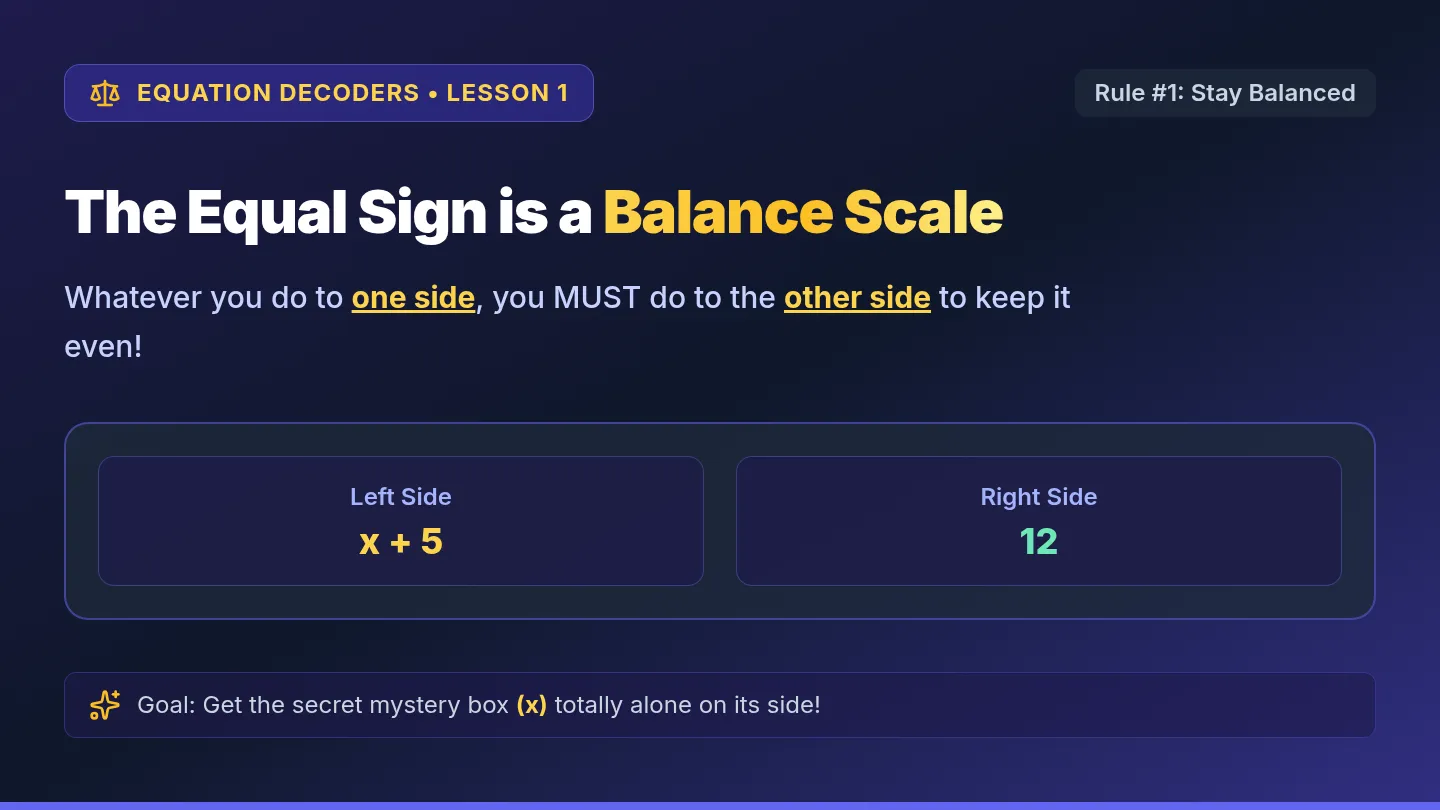
Rule #1: Stay Balanced
The Equal Sign is a Balance Scale
Whatever you do to one side, you MUST do to the other side to keep it even!
Left Side x + 5
Right Side 12
Goal: Get the secret mystery box (x) totally alone on its side!
Superpower Tools
Inverse Operations
Opposites Cancel Out!
To undo a number attached to your variable, use its exact opposite operation.
Addition (+)
Undo with: Subtraction (−)
±
Subtraction (−)
Undo with: Addition (+)
Multiplication (×)
Undo with: Division (÷)
÷
Division (÷ or fraction)
Undo with: Multiplication (×)
×
Memory Trick: Think of inverse operations as hitting the "Undo" button on your computer!
Step-by-Step Blueprint
Example: Solve x + 7 = 15
1
Draw the Wall
Draw a vertical dotted line straight down through the = sign to separate sides.
x + 7 | 15
2
Spot & Undo
See + 7? The opposite is − 7. Do it to BOTH sides!
− 7 | − 7
3
Celebrate & Check
x is isolated! Calculate the right side: 15 − 7 = 8.
x = 8 ✓
Self-Check: Replace x with 8 → 8 + 7 = 15. It balances! 100% Guaranteed
Quick Practice Showdown
Whiteboard / Verbal Check
What's the Undo Move?
Call out or point to the inverse operation before solving.
Equation A Subtraction Trap
x − 9 = 14
1. What is happening to x? It's subtracting 9.
2. Inverse Move: Add 9 to both sides!
Solution: x = 23
Equation B Multiplication Trap
4x = 24
1. What does 4x mean? 4 multiplied by x.
2. Inverse Move: Divide both sides by 4!
Solution: x = 6
Remember: When a number is glued right next to a letter like 4x, they are multiplying!
Inverse Operations Worksheet Equation Decoders • Lesson 1
Inverse Operations Worksheet
Name: ___________________________
Date: ______________ Period: _____
The Balance Scale Rule: An equation is a balanced scale. Whatever operation you do to one side of the equal sign, you MUST do to the other side!
1 Part 1: Match the Operation to its Inverse (Opposite)
Draw a line connecting the operation on the left to its inverse undo tool on the right.
A. Adding 8 (+ 8)
B. Subtracting 12 (− 12)
C. Multiplying by 4 (× 4)
D. Dividing by 5 (÷ 5)
1. Divide by 4 (÷ 4)
2. Multiply by 5 (× 5)
3. Subtract 8 (− 8)
4. Add 12 (+ 12)
2 Part 2: The 3-Step Solve Routine (Model & Try)
Teacher Example: x + 6 = 14 Watch the 3 steps
Step 1: Draw the Wall
x + 6 | 14
Step 2: Undo to Both Sides
− 6 | − 6
Step 3: Solve & Check
x = 8 ✓ (8 + 6 = 14)
Practice 1: x + 9 = 21 Undo (+) with (−)
Draw the wall at the equal sign, show your undo move on both sides:
Final Answer:
x = _______
Practice 2: x − 4 = 15 Undo (−) with (+)
Draw the wall at the equal sign, show your undo move on both sides:
Final Answer:
x = _______
Equation Decoders • Scaffolded Math Resource Page 1 of 2
Part 3: Operation Undo Practice
Solve each equation by balancing both sides
#1) x + 11 = 25 Operation: + 11
Inverse operation: _________________
Answer: x = ______
#2) x − 8 = 13 Operation: − 8
Inverse operation: _________________
Answer: x = ______
#3) 5x = 35 Operation: × 5
Inverse operation: _________________
Answer: x = ______
#4) \(\frac{x}{3} = 7\) Operation: ÷ 3
Inverse operation: _________________
Answer: x = ______
#5) x − 15 = 20 Operation: − 15
Inverse operation: _________________
Answer: x = ______
#6) 6x = 54 Operation: × 6
Inverse operation: _________________
Answer: x = ______
Part 4: Self-Check & Reflection
🟢
I got this! Ready to level up
🟡
Almost there Need a little help
🔴
Still tricky Let's review together
One inverse pair I will remember tomorrow is: Opposite of ___________________ is ___________________.
Equation Decoders • Scaffolded Math Resource Page 2 of 2
Inverse Operations Answer Key Teacher Reference • Answer Key
Inverse Operations Answer Key
Lesson 1 Solution Guide
Scoring & IEP Support: Look for the inverse move on both sides of the wall line before evaluating the final number answer.
1 Part 1: Match Inverse Pairs (Solutions)
A. Adding 8 (+ 8) Pairs with 3
B. Subtracting 12 (− 12) Pairs with 4
C. Multiplying by 4 (× 4) Pairs with 1
D. Dividing by 5 (÷ 5) Pairs with 2
1. Divide by 4 (÷ 4) Undoes C
2. Multiply by 5 (× 5) Undoes D
3. Subtract 8 (− 8) Undoes A
4. Add 12 (+ 12) Undoes B
2 Part 2: Guided Practice Model & Solutions
Practice 1: x + 9 = 21 Key
x + 9 | 21
− 9 | − 9 (Undo +9)
x | 12
Check: Replace x with 12 → 12 + 9 = 21 ✓
Answer: x = 12
Practice 2: x − 4 = 15 Key
x − 4 | 15
+ 4 | + 4 (Undo −4)
x | 19
Check: Replace x with 19 → 19 − 4 = 15 ✓
Answer: x = 19
Equation Decoders • Answer Key & Guide Page 1 of 2
Part 3: Operation Undo Practice (Solutions & Checks)
All 6 Problems Fully Solved
#1) x + 11 = 25 x = 14
Inverse move: Subtract 11 from both sides
x + 11 − 11 = 25 − 11
x = 14
Check: 14 + 11 = 25 ✓
#2) x − 8 = 13 x = 21
Inverse move: Add 8 to both sides
x − 8 + 8 = 13 + 8
x = 21
Check: 21 − 8 = 13 ✓
#3) 5x = 35 x = 7
Inverse move: Divide both sides by 5
5x ÷ 5 = 35 ÷ 5
x = 7
Check: 5(7) = 35 ✓
#4) \(\frac{x}{3} = 7\) x = 21
Inverse move: Multiply both sides by 3
(\(\frac{x}{3}\)) × 3 = 7 × 3
x = 21
Check: 21 ÷ 3 = 7 ✓
#5) x − 15 = 20 x = 35
Inverse move: Add 15 to both sides
x − 15 + 15 = 20 + 15
x = 35
Check: 35 − 15 = 20 ✓
#6) 6x = 54 x = 9
Inverse move: Divide both sides by 6
6x ÷ 6 = 54 ÷ 6
x = 9
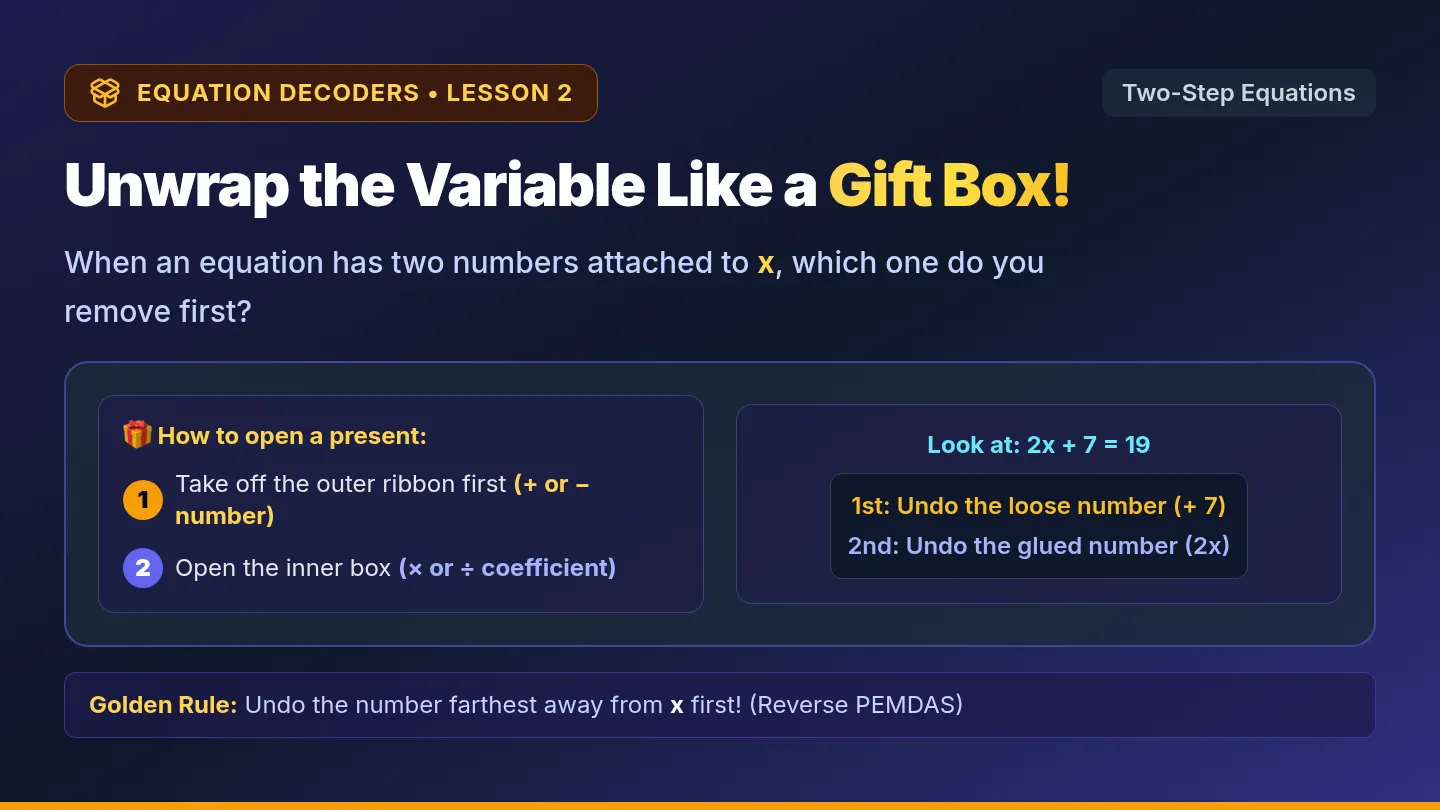
Two Step Peeler Slides Equation Decoders • Lesson 2
Two-Step Equations
Unwrap the Variable Like a Gift Box!
When an equation has two numbers attached to x, which one do you remove first?
🎁 How to open a present:
1 Take off the outer ribbon first (+ or − number)
2 Open the inner box (× or ÷ coefficient)
Look at: 2x + 7 = 19
1st: Undo the loose number (+ 7)
2nd: Undo the glued number (2x)
Golden Rule: Undo the number farthest away from x first! (Reverse PEMDAS)
The Universal Blueprint
Always 2 Easy Moves
The 2 Moves to Victory
Follow the same two questions every single time you solve.
MOVE 1 First
Undo Addition or Subtraction
Find the loose constant sitting next to your variable term. Use its inverse to cancel it on BOTH sides.
If you see + 5 → Do − 5 on both sides!
MOVE 2 Second
Undo Multiplication or Division
Now x is almost alone! Divide by the coefficient glued to x on BOTH sides.
If you see 3x → Divide both sides by 3!
Quick Reminder: Don't touch the number glued to x until the loose number is gone!
Worked Example
Solve: 3x + 5 = 26
1
Draw the Equal Sign Wall Keeps both sides completely balanced
3x + 5 | 26
2
Move 1: Undo + 5 Subtract 5 from both sides
− 5 | − 5 → 3x = 21
3
Move 2: Undo × 3 Divide both sides by 3
x = 7 ✓
Double Check: 3(7) + 5 = 21 + 5 = 26. It works! Verified
Equation Detective
Can You Spot the Mistake?
Find Alex's Mistake!
Alex solved this equation, but made one common trap error. What went wrong?
Alex's Paper:
5x − 4 = 16
− 4 − 4
5x = 12
The Fix:
Mistake: The equation had − 4, but Alex subtracted 4 instead of doing the inverse!
Correct Move: ADD 4 to both sides!
5x = 20 → x = 4 ✓
Always double check the sign in front of the loose number before you choose your inverse move!
Two Step Blueprint Worksheet Equation Decoders • Lesson 2
Two Step Blueprint Worksheet
Name: ___________________________
Date: ______________ Period: _____
The 2-Step Routine (Unwrap the Present)
Step 1: Undo the loose constant (+ or − number) on both sides.
Step 2: Undo the coefficient (× or ÷ number glued to x) on both sides.
2x + 6 = 16
− 6 − 6
2x = 10 → x = 5
1 Guided Equation Blueprints (Follow the Steps)
2x + 4 = 18 Step 1: − 4
Draw the wall at = Undo + 4, then undo × 2
Solution: x = ______
3x − 5 = 16 Step 1: + 5
Draw the wall at = Undo − 5, then undo × 3
Solution: x = ______
4x + 7 = 31 Step 1: − 7
Draw the wall at = Undo + 7, then undo × 4
Solution: x = ______
\(\frac{x}{3} + 2 = 8\) Step 1: − 2
Draw the wall at = Undo + 2, then undo ÷ 3
Solution: x = ______
Equation Decoders • Lesson 2: Two-Step Equations Page 1 of 2
Part 2: Independent Practice & Error Detective
Solve carefully • Check your signs
#5) 5x − 9 = 26 2-Step Equation
Answer: x = ______
#6) 6x + 8 = 50 2-Step Equation
Answer: x = ______
#7) \(\frac{x}{4} − 2 = 6\) 2-Step Equation
Answer: x = ______
#8) 2x − 11 = 15 2-Step Equation
Answer: x = ______
Part 3: Equation Detective (Spot & Correct the Mistake)
Detective Case: Jordan's Work
4x + 8 = 24
4x = 32 (added 8 to 24)
x = 8
What mistake did Jordan make?
Write what Jordan should have done:
Correct x = ______
Detective Case: Sam's Work
3x − 6 = 18
x − 6 = 6 (divided by 3 first!)
x = 12
Which step should come first?
Write what Sam should have done:
Correct x = ______
Equation Decoders • Lesson 2: Two-Step Equations Page 2 of 2
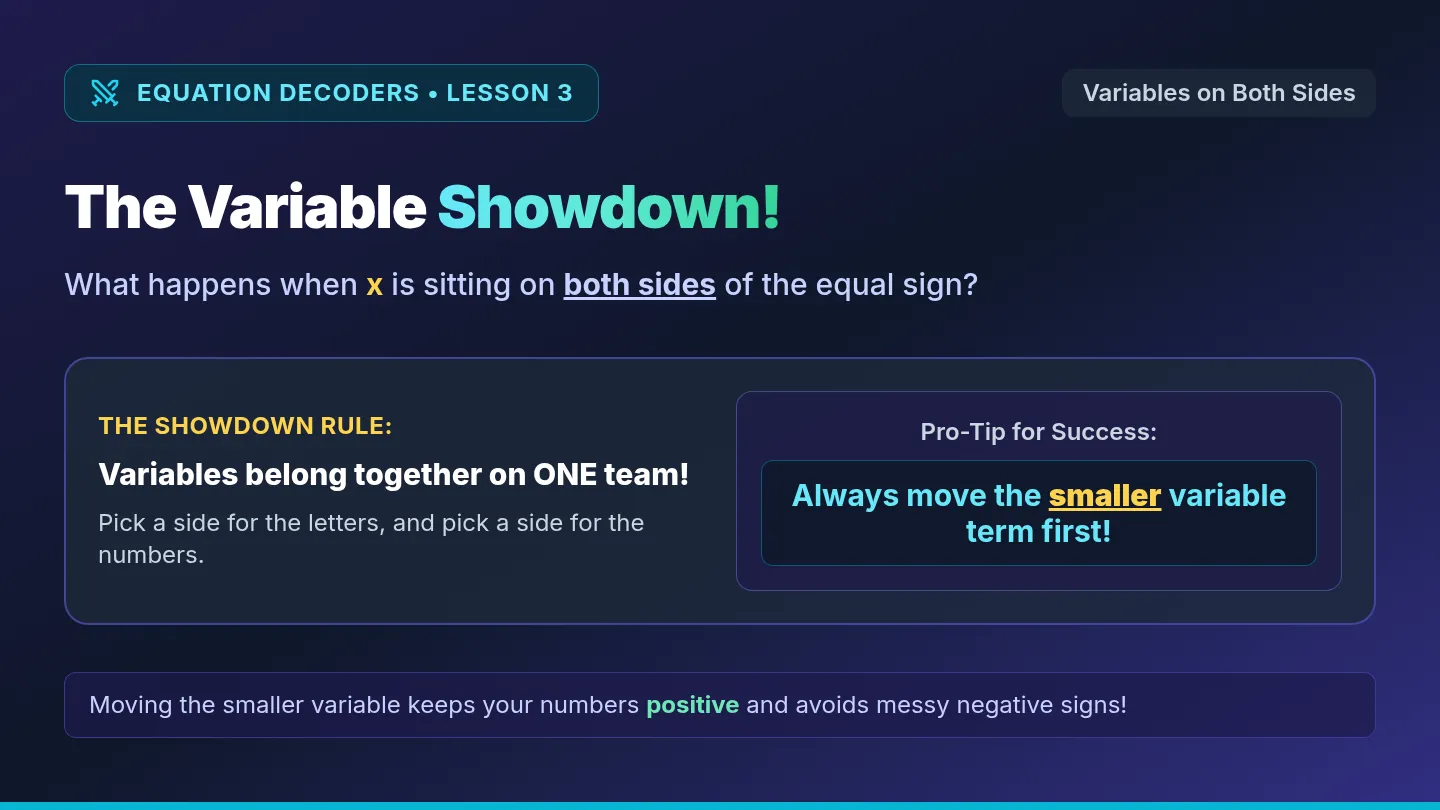
Variable Showdown Slides Equation Decoders • Lesson 3
Variables on Both Sides
The Variable Showdown!
What happens when x is sitting on both sides of the equal sign?
The Showdown Rule:
Variables belong together on ONE team!
Pick a side for the letters, and pick a side for the numbers.
Pro-Tip for Success:
Always move the smaller variable term first!
Moving the smaller variable keeps your numbers positive and avoids messy negative signs!
Visual Code Strategy
Circles vs. Squares
Sort into Families with Shapes
Before moving anything, code each family so you never combine the wrong parts.
CIRCLE FAMILY
x
Variable Terms (with letters)
Put a circle around every term with an x. Include the sign in front!
Examples: (5x) , (+2x) , (−3x)
BOX FAMILY
Constant Numbers (plain numbers)
Put a square box around every plain regular number. Include the sign!
Examples: [+7] , [−4] , [+15]
Math Law: You can NEVER combine a circle term with a box term! They speak different languages.
Worked Walkthrough
Solve: 5x + 4 = 2x + 19
1 Compare Variables
We have 5x and 2x. Which is smaller? 2x is smaller!
2 Move 2x Across Wall
Subtract 2x from both sides:
5x − 2x + 4 = 19 → 3x + 4 = 19
3 Undo Loose Number (+ 4)
Subtract 4 from both sides:
3x = 19 − 4 → 3x = 15
4 Divide to Finish!
Divide both sides by 3:
x = 5 ✓
Check: 5(5) + 4 = 29 | 2(5) + 19 = 29. Both sides equal 29! Perfect Balance
Master Checklist
Your Pocket Strategy
The Equation Decoder Path
Keep this 4-step checklist in your mind for any linear equation.
1
Draw the Wall & Code Shapes Put circles around variable terms and squares around plain numbers.
2
Move the Smaller Variable Use inverse operation to shift it across the wall so x is on only one side.
3
Undo the Loose Constant (+ or −) Clear the number standing next to your variable term on both sides.
4
Divide by the Coefficient Divide both sides by the glued number. You've isolated x!
You started with one-step equations and now you can solve multi-step linear equations like a champion!
Mastery Ladder Worksheet Equation Decoders • Lesson 3
Mastery Ladder Worksheet
Name: ___________________________
Date: ______________ Period: _____
Showdown Protocol (Variables on Both Sides)
1. Shapes: Circle the x terms, box the plain numbers.
2. Move Smallest Variable: Use inverse operation to move the smaller variable across the equal sign wall!
4x + 3 = 2x + 11
−2x −2x
2x + 3 = 11 → x = 4
1 Guided Showdowns: Move the Smaller Variable First
#1) 4x + 6 = 2x + 18 Smaller variable: 2x (Subtract 2x)
Step 1: Subtract 2x from both sides Step 2: Solve the 2-step equation
Showdown Solution: x = ______
#2) 5x − 4 = 2x + 14 Smaller variable: 2x (Subtract 2x)
Step 1: Subtract 2x from both sides Step 2: Add 4 to both sides, then divide
Showdown Solution: x = ______
#3) 6x + 2 = 3x + 23 Smaller variable: 3x (Subtract 3x)
Step 1: Subtract 3x from both sides Step 2: Subtract 2, then divide
Showdown Solution: x = ______
Equation Decoders • Lesson 3: Variables on Both Sides Page 1 of 2
Part 2: The Equation Mastery Ladder
Climb level by level from warm-up to Boss Mode!
LEVEL 1: BRONZE One-Step Warmup x + 13 = 35
x = _____
LEVEL 2: SILVER Two-Step Blueprint 4x − 7 = 21
x = _____
LEVEL 3: GOLD Variable Showdown 7x + 4 = 3x + 28
x = _____
LEVEL 4: BOSS Combine Like Terms First! 2x + 3x + 5 = 35
x = _____
Self-Reflection & Confidence Tracker
1. I can name the inverse operation to undo addition or multiplication. [ ] Yes! [ ] Still learning
2. I can solve a two-step equation by undoing addition/subtraction first. [ ] Yes! [ ] Still learning
3. I can move the smaller variable across the equal sign fence. [ ] Yes! [ ] Still learning
My top equation superpower trick: Drawing the wall / Using shapes / Inverse undo button (circle one).
Equation Decoders • Lesson 3: Variables on Both Sides Page 2 of 2