Critter Vision Lesson Plan Lesson Plan • Grades 3–5 Math & Life Science Integration
Duration: 60 mins
Critter Vision Clues: Algebraic Thinking
Discovering patterns, unknown values, and balance equations through the miraculous eyes of eagles, chameleons, and geckos.
Learning Objectives
Identify arithmetic patterns in visual acuity sequences and input-output rules.
Use shapes and letter unknowns to represent missing eye measurements.
Model and balance equal expressions using animal vision data sets.
Math Standards & Concepts
CCSS.MATH.OA.A.1-4: Use operations to find unknowns.CCSS.MATH.OA.C.5: Generate and analyze number patterns.Vocabulary: Unknown, variable symbol, rule, equation balance.
Materials & Teacher Preparation
One copy of the 2-page Critter Vision Math Worksheet per student; document camera or display screen; balance scale manipulative or digital visual scale; animal eye cards (optional extension).
Instructional Sequence & Pacing
1 Engage & Hook: The Eagle Zoom Secret 10 Mins
Show students how far an eagle can spot a mouse (up to 3,000 meters!). Introduce the core question: "If a human sees clearly at 20 feet, and an eagle sees 4 times better, how do we write that mathematically without knowing the secret number right away?"
2 Guided Exploration: From Patterns to Mystery Symbols 15 Mins
Model finding missing rules in input-output tables (e.g., Chameleon eye scan angles). Transition from empty boxes [ ] to eye mystery symbols ▲ and finally letters like n. Emphasize that an equals sign is a balanced scale, not just an answer command.
3 Independent & Paired Practice: The Worksheet Hunt 25 Mins
Students progress through Levels 1 through 4 on the worksheet. Circulate to prompt struggling students with balance pan analogies. Pair students for Level 4 "Vision Detective Challenge."
4 Debrief & Exit Reflection 10 Mins
Review Level 3 balance scales as a class. Have two students act as scale pans holding number cards. Ask: "Why does subtracting the same number from both sides keep our vision formula true?"
Animal Eyes Algebra • Elementary Unit Page 1 of 2
Instructional Coaching
Pedagogical Strategies & Differentiation
Grades 3–5
Common Student Misconceptions & How to Address Them
Misconception 1: "The equal sign means 'here comes the answer'."
Students often see \(12 + \Box = 20\) and add \(12 + 20 = 32\). Strategy: Use a physical balance scale or arms spread out horizontally. Emphasize that the equal sign is a fulcrum where the total weight on the left must equal the total weight on the right.
Misconception 2: Confusing pattern step sizes with multiplication factors.
In pattern sequences like Owl focal steps (\(6, 12, 18, 24\)), students may try to square or apply erratic jumps. Strategy: Have them write the jump value with a small curve arrow (\(+6\)) above each successive pair.
Misconception 3: Letters in math stand for initials or words rather than quantities.
Students might think \(e\) in an equation about eagles stands for "eagle" rather than "distance spotted." Strategy: Explicitly define the unknown: "Let \(d\) stand for the number of meters the hawk can see."
Support & Intervention
Provide physical snap cubes or counters to represent unknown eye ommatidia units.
Highlight the operation sign and equal sign in contrasting colors.
Begin Level 3 balance scales with bar models (tape diagrams) before abstract numerals.
Extension & Challenge
Ask early finishers to invent their own alien critter vision rule with two operations (e.g., \(2 \times x + 5\)).
Challenge students to represent owl night vision in an algebraic function table up to an input of 25.
Write a multi-step riddle where two different animals' sight limits add to 100.
Curious Animal Vision Facts (For Class Discussion)
Bald Eagle Sees 4 to 5 times sharper than a human; can spot a rabbit from 2 miles away.
Chameleon Eyes pivot independently up to 180 degrees each, creating a full 360-degree field!
Tokay Gecko Eyes are 350 times more light-sensitive than humans, seeing colors in near darkness!
Animal Eyes Algebra • Elementary Unit Page 2 of 2
Critter Vision Math Worksheet Animal Eyes Algebra • Grades 3–5 Worksheet 1
Critter Vision Clues
Name:
Date:
Animals use extraordinary eyes to hunt, hide, and navigate. Use your algebraic detective skills to uncover the missing numbers!
1 Level 1: Eye-Spotting Patterns (Input & Output) Find the Rule & Missing Numbers
1. Eagle Vision Jump: An eagle spots a field mouse at different altitudes. Discover the pattern rule, then fill in the missing distance.
Height (m)
10
20
30
40
Sight Range (m)
50
100
150
?
Pattern Rule: Multiply Height by
Range at 40m: meters
2. Gecko Night Light Sequence: A Tokay gecko's pupil opens wider as dusk settles. Find the missing values in this number sequence:
8 → 15 → 22 → A = ? → 36 → B = ?
What number is added each step?
2 Level 2: Mystery Eye Unknowns (Find the Mystery Symbol) Whole Number Equations
Each animal eye symbol stands for an unknown number. Solve for each symbol and show your calculation.
3. Chameleon Turret Swivel:
A chameleon rotates its left eye 75°. The total rotation of both eyes is 180°.
75 + ▲ = 180
Show your work:
Mystery eye ▲ =
4. Owl Night Vision Power:
An owl has 6 clusters of low-light cells. Each cluster has an equal number of cells, totaling 54 cells.
6 × ★ = 54
Show your work:
Mystery cluster ★ =
5. Dragonfly High-Speed Tracking:
A dragonfly spots 40 gnats. After catching some, 17 gnats remain.
40 − ◆ = 17
Gnats caught (◆) =
Show your work:
Turn page for Levels 3 & 4: Balance Scales and The Detective Challenge → Page 1 of 2
Part II: Advanced Algebraic Thinking
Equal Balances & Multi-Step Mysteries
Student:
3 Level 3: Balance the Vision Scales (Equations on Both Sides) Equal Value Reasoning
Both pans of the balance scale must have the exact same total value. Find the value of the unknown letter.
6. Honeybee Compound Lens Scale:
Left Pan Δ Fulcrum Δ Right Pan
w + w + 14 = 30
Step 1: Subtract 14 from both sides • Step 2: Divide by 2
Value of w =
7. Mantis Strike Distance Scale:
Critter Vision Answer Key Teacher Reference • Grades 3–5
Critter Vision Answer Key & Scoring Guide
Official Key
Level 1: Eye-Spotting Patterns (Input & Output) 4 Points Total
1. Eagle Vision Jump
• Pattern Rule: Multiply Height by 5 (or \(h \times 5\)).
• Sight Range at 40m: \(40 \times 5 =\) 200 meters.
Scoring note: Accept "+50 each step" if height increases by 10m.
2. Gecko Night Light Sequence
• Rule: Add 7 each step (\(+7\)).
• Missing value A: \(22 + 7 =\) 29.
• Missing value B: \(36 + 7 =\) 43.
Level 2: Mystery Eye Unknowns 6 Points Total
3. Chameleon Turret
75 + ▲ = 180
\(▲ = 180 - 75\)
▲ = 105°
4. Owl Night Vision
6 × ★ = 54
\(★ = 54 \div 6\)
★ = 9 cells
5. Dragonfly Tracking
40 − ◆ = 17
\(◆ = 40 - 17\)
◆ = 23 gnats
Level 3: Balance the Vision Scales 6 Points Total
6. Honeybee Compound Lens Scale
w + w + 14 = 30 → 2w + 14 = 30
• Subtract 14 from both sides: \(2w = 16\)
• Divide by 2: w = 8
7. Mantis Strike Distance Scale
3k = k + 24
• Subtract 1k from both sides: \(2k = 24\)
• Divide by 2: k = 12
Level 4: Wildlife Sanctuary Mystery 6 Points Total
Part A: Cheetah Distance (C) C = (2 × 400) + 200 = 800 + 200 = 1,000 meters
Part B: Hawk Distance (H) H − 500 = 2(1,000) → H − 500 = 2,000 → H = 2,500 meters
Challenge Comparison: Ratio of Hawk to Wolf 2,500 ÷ 400 = 6.25 times farther (or 6¼x)
Scoring Guidelines: Total = 22 Points (19–22: Advanced Master • 15–18: Proficient • Below 15: Review Balance Concept)
Critter Vision Clues
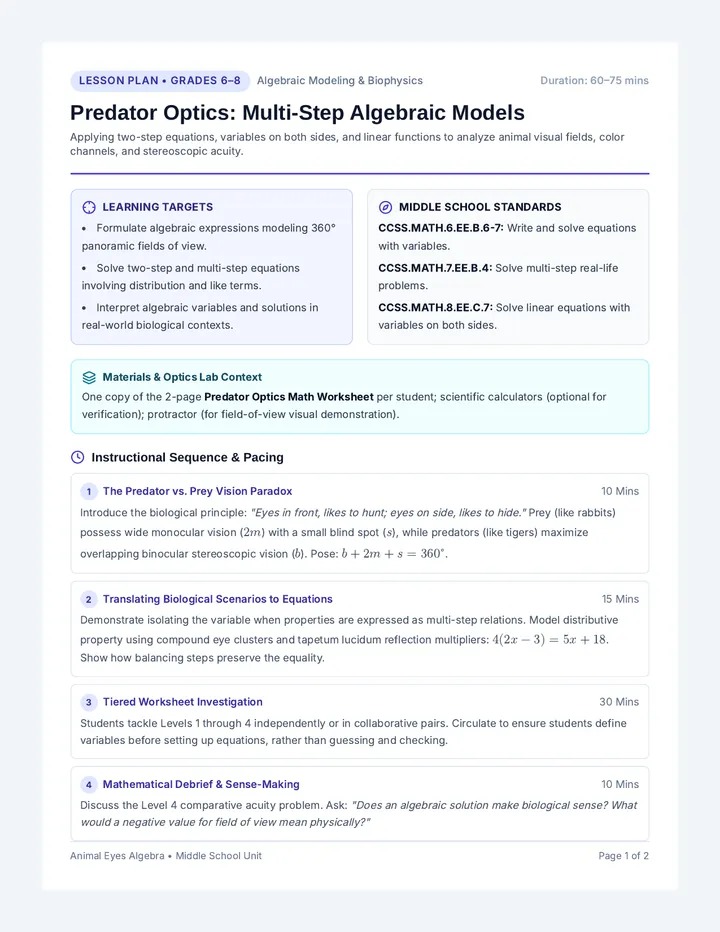
Predator Optics Lesson Plan Lesson Plan • Grades 6–8 Algebraic Modeling & Biophysics
Duration: 60–75 mins
Predator Optics: Multi-Step Algebraic Models
Applying two-step equations, variables on both sides, and linear functions to analyze animal visual fields, color channels, and stereoscopic acuity.
Learning Targets
Formulate algebraic expressions modeling 360° panoramic fields of view.
Solve two-step and multi-step equations involving distribution and like terms.
Interpret algebraic variables and solutions in real-world biological contexts.
Middle School Standards
CCSS.MATH.6.EE.B.6-7: Write and solve equations with variables.CCSS.MATH.7.EE.B.4: Solve multi-step real-life problems.CCSS.MATH.8.EE.C.7: Solve linear equations with variables on both sides.
Materials & Optics Lab Context
One copy of the 2-page Predator Optics Math Worksheet per student; scientific calculators (optional for verification); protractor (for field-of-view visual demonstration).
Instructional Sequence & Pacing
1 The Predator vs. Prey Vision Paradox 10 Mins
Introduce the biological principle: "Eyes in front, likes to hunt; eyes on side, likes to hide." Prey (like rabbits) possess wide monocular vision (\(2m\)) with a small blind spot (\(s\)), while predators (like tigers) maximize overlapping binocular stereoscopic vision (\(b\)). Pose: \(b + 2m + s = 360^\circ\).
2 Translating Biological Scenarios to Equations 15 Mins
Demonstrate isolating the variable when properties are expressed as multi-step relations. Model distributive property using compound eye clusters and tapetum lucidum reflection multipliers: \(4(2x - 3) = 5x + 18\). Show how balancing steps preserve the equality.
3 Tiered Worksheet Investigation 30 Mins
Students tackle Levels 1 through 4 independently or in collaborative pairs. Circulate to ensure students define variables before setting up equations, rather than guessing and checking.
4 Mathematical Debrief & Sense-Making 10 Mins
Discuss the Level 4 comparative acuity problem. Ask: "Does an algebraic solution make biological sense? What would a negative value for field of view mean physically?"
Animal Eyes Algebra • Middle School Unit Page 1 of 2
Instructional Coaching
Scaffolding, Pitfalls & Extensions
Grades 6–8
Middle School Algebraic Misconceptions
Misconception 1: Errors with the Distributive Property across subtraction.
Predator Optics Math Worksheet Animal Eyes Algebra • Grades 6–8 Worksheet 2
Predator Optics: Algebraic Models
Name:
Date:
Investigate the physics of predator and prey vision by translating biological optics into algebraic expressions and linear equations.
1 Level 1: Algebraic Expressions • Panoramic Fields of View Expressions & Substitution
An animal's total \(360^\circ\) visual circumference is divided into: binocular overlap (\(b\)), two monocular side zones (\(2m\)), and a posterior blind spot (\(s\)): b + 2m + s = 360
1. European Hare (Prey Optics): A hare's monocular vision spans \(m = 170^\circ\) on each side, with a rear blind spot of \(s = 10^\circ\). Write an equation and solve for its frontal binocular overlap (\(b\)).
Write Equation:
Solve for \(b\) (degrees):
Binocular Overlap (\(b\)) = °
2. Red Fox (Predator Optics): A fox has a binocular overlap of \(b = 80^\circ\) and equal side fields \(m\). Its rear blind spot is \(s = 120^\circ\). Write the simplified linear equation and solve for each side's monocular angle (\(m\)).
Algebraic Setup:
Step-by-Step Solution:
Monocular Angle (\(m\)) = °
2 Level 2: Two-Step Equations • Photoreceptor Sensitivity Isolating Variables
3. Tapetum Lucidum Reflection Boost:
A feline's reflective eye layer triples incoming photons (\(3r\)) plus a baseline twilight gain of 45 lux to reach 180 lux:
3r + 45 = 180
Show inverse operations:
Incoming light (\(r\)) =
4. Eagle Visual Acuity Index:
A golden eagle's foveal cone density formula is modeled by five times its acuity rating (\(a\)) reduced by 12 calibration units:
5a − 12 = 68
Show inverse operations:
Acuity rating (\(a\)) =
Turn page for Levels 3 & 4: Multi-Step & Advanced Biophysical Models → Page 1 of 2
Part II: Multi-Step & Advanced Models
Compound Equations & Visual Biophysics
Student:
3 Level 3: Multi-Step Equations • Variables on Both Sides Distribute & Collect Like Terms
5. Mantis Shrimp Spectral Channels:
The mantis shrimp has 4 optical bands, each processing \((2x - 3)\) light frequencies, equating to \(5x + 18\).
4(2x − 3) = 5x + 18
Step 1: Distribute 4
Step 2: Collect \(x\) terms
Step 3: Isolate \(x\)
Value of \(x\) =
6. Dragonfly High-Speed Interception Tracking:
Predator Optics Answer Key Teacher Reference • Grades 6–8
Predator Optics Answer Key & Solutions Guide
Official Key
Level 1: Panoramic Fields of View 4 Points
1. European Hare (Prey Optics)
b + 2(170) + 10 = 360 → b + 340 + 10 = 360
\(b + 350 = 360 \implies\) b = 10°
Biophysical note: A narrow binocular overlap gives panoramic safety at the cost of shallow depth perception.
2. Red Fox (Predator Optics)
80 + 2m + 120 = 360 → 2m + 200 = 360
\(2m = 160 \implies\) m = 80° each side
Biophysical note: Large binocular overlap enables accurate pouncing calculations.
Level 2: Two-Step Equations (Photoreceptor Sensitivity) 6 Points
3. Tapetum Lucidum Reflection
3r + 45 = 180
• Subtract 45: \(3r = 135\)
• Divide by 3: r = 45 lux
4. Eagle Visual Acuity Index
5a − 12 = 68
• Add 12: \(5a = 80\)
• Divide by 5: a = 16 acuity rating
Level 3: Multi-Step • Variables on Both Sides 6 Points
5. Mantis Shrimp Spectral Channels
4(2x − 3) = 5x + 18
• Distribute 4: \(8x - 12 = 5x + 18\)
• Subtract \(5x\): \(3x - 12 = 18\)
• Add 12: \(3x = 30 \implies\) x = 10
6. Dragonfly Interception Tracking
3(3y + 4) − 2y = 54
• Distribute 3: \(9y + 12 - 2y = 54\)
• Combine like terms: \(7y + 12 = 54\)
• Subtract 12 & divide: \(7y = 42 \implies\) y = 6 μs
Level 4: Apex Predator Acuity Showdown 6 Points
A. Solve for equal tracking time (\(t\)):
600 + 45t = 150 + 75t → 600 − 150 = 75t − 45t → 450 = 30t → t = 15 seconds
B. Calculate matching range:
F(15) = 600 + 45(15) = 600 + 675 = 1,275 meters (Check: O(15) = 150 + 75(15) = 150 + 1,125 = 1,275 m)
Biophysical Check (\(t = 20\text{ s}\)):
Falcon: \(600 + 45(20) = 1,500\text{ m}\). Owl: \(150 + 75(20) = 1,650\text{ m}\). → The Owl achieves the greater range by 150 meters (1,650 − 1,500 = 150 m).
Scoring Guidelines: Total = 22 Points (19–22: Exemplary • 15–18: Proficient • Below 15: Target multi-step distribution)
Predator Optics Algebra