Lenny.com
Explore
Create
ActivitiesNewMathEnglish Language ArtsScience & EngineeringSocial StudiesGlobal LanguagesHealth & Physical EducationSpecial EducationCounseling & Life SkillsArts & CreativityESL
Lenny.com
Lenny.com
Explore
Create
ActivitiesNewMathEnglish Language ArtsScience & EngineeringSocial StudiesGlobal LanguagesHealth & Physical EducationSpecial EducationCounseling & Life SkillsArts & CreativityESL
Lenny.com
Lenny.com

Solutions

Lenny for EducatorsLenny for SchoolsLenny for Districts

Product

ExploreSign inCreateSupportAbout

Resources

Getting startedMTSS Acceleration Program

Newsletters

School Funding Newsletter

© 2026 Lenny Learning Inc.

TermsPrivacyAccessibility
LinkedInInstagramX
Lenny
MathNumbers & CountingCounting ObjectsNumber NamesComparing NumbersNumber OperationsCounting SequenceNumbers 0-10Place Value Understanding and SystemAdd and Subtract Within 20Addition and Subtraction ConceptsAddition and Subtraction EquationsAddition and Subtraction ProblemsFoundations for MultiplicationMultiplication and Division PropertiesMultiply and Divide Within 100Multiplication and Division ProblemsFactors and MultiplesProperties of OperationsPatterns and RelationshipsGenerate and Analyze PatternsMulti-Digit ArithmeticPlace Value OperationsMulti-Digit and Decimal OperationsNumerical ExpressionsFour Operations and PatternsFour Operations Problem SolvingMeasurement & DataMeasurable AttributesMeasuring LengthsMeasure and Estimate Lengths in Standard UnitsRelate Addition and Subtraction to LengthClassifying and Counting ObjectsTime and MoneyArea Concepts and MeasurementPerimeter and Area MeasuresAngle Concepts and MeasurementTime, Volume, and MassMeasurement Unit ConversionsGeometryIdentifying ShapesShapes and AttributesShape Attributes and ReasoningShapes and CompositionClassifying 2D FiguresGeometric Figures and RelationshipsLines, Angles, and ShapesAngle, Area, and VolumeGeometric MeasurementVolume of 3D ShapesCoordinate Plane ApplicationsTransformations in the PlaneCongruence and SimilarityUnderstand congruence in terms of rigid motionsSimilarity and TransformationsProve Theorems Involving SimilarityPythagorean TheoremTrigonometry for General TrianglesMake Geometric ConstructionsProve Geometric TheoremsTheorems About CirclesFind Arc Lengths And Areas of Sectors of CirclesVolume FormulasRelationships Between Two-Dimensional and Three-Dimensional ObjectsProve Simple Geometric Theorems AlgebraicallyTranslate Between Geometric Description and Equation for Conic SectionApply Geometric Concepts in Modeling SituationsFractions & DecimalsFractions as NumbersBuilding FractionsFraction Equivalence and OrderingAdding and Subtracting FractionsMultiplying and Dividing FractionsDividing FractionsDecimal FractionsMulti-Digit Computation and FactorsAdd, Subtract, Multiply, and Divide Rational NumbersRational Number SystemIrrational Numbers and ApproximationsRatiosRatios and ProportionsProportional RelationshipsUnit RateAlgebraAlgebraic ExpressionsGenerate Equivalent ExpressionsQuantitative RelationshipsProportional Relationships and Linear EquationsEquations and InequalitiesEquation Solving and ReasoningLinear Equations and SystemsGraph Equations and InequalitiesSystems of EquationsReal-World Algebraic ProblemsQuantitative Reasoning with UnitsExpression StructureEquivalent Expression FormsRadicals and Integer ExponentsRational ExponentsRational and Irrational NumbersPolynomial OperationsPolynomial IdentitiesPolynomial Zeros and FactorsRational ExpressionsComplex Number OperationsComplex Numbers in PolynomialsComplex Numbers on PlaneStatistics & ProbabilityRepresent and Interpret DataData DistributionsStatistical VariabilityProbability ModelsCompound Event ProbabilitiesStatistical SamplingInterpret Categorical and Quantitative DataBivariate Data PatternsInterpret Linear ModelsComparing Two PopulationsRandom Processes in StatisticsIndependence and Conditional ProbabilityExpected ValuesProbability-Based Decision MakingStatistical Inference and ConclusionsFunctionsFunction Concepts and NotationDefine and Compare FunctionsInterpret Functions in ContextAnalyze Function RepresentationsModel Relationships with FunctionsIdentify Linear vs Exponential GrowthDistinguish Between Function TypesCompare Growth RatesInterpret Function ExpressionsBuild Functions from RelationshipsConstruct and Model FunctionsTransform and Combine FunctionsModel Comparison and SelectionSolve Exponential EquationsTrigonometryTrigonometric Ratios Involving Right TrianglesTrigonometric Functions and Unit CircleModel with Trigonometric FunctionsTrigonometric IdentitiesVectors & MatricesIntroduction to Vectors and MatricesVector QuantitiesVector OperationsMatrix OperationsCalculusLimits and ContinuityDerivative Concepts and NotationDerivative Rules and TechniquesApplications of DerivativesOptimization ProblemsRelated RatesCurve Sketching and AnalysisIntegration Concepts and NotationAntiderivatives and Indefinite IntegralsDefinite Integrals and AreaFundamental Theorem of CalculusIntegration TechniquesApplications of IntegrationDifferential EquationsSequences and SeriesParametric and Polar FunctionsVector-Valued Functions

Touch Math Mastery

A multisensory mathematics lesson introducing foundational TouchMath strategies. Students explore numeral TouchPoints to connect quantities to numbers, practice counting on to solve addition equations, and count backward to master single-digit subtraction.

KGKaterina Ganshaw

Touch Math Mastery

A multisensory mathematics lesson introducing foundational TouchMath strategies. Students explore numeral TouchPoints to connect quantities to numbers, practice counting on to solve addition equations, and count backward to master single-digit subtraction.

KGKaterina Ganshaw

You might also like

Monday Morning Spark Slides

Morning Spark Routine

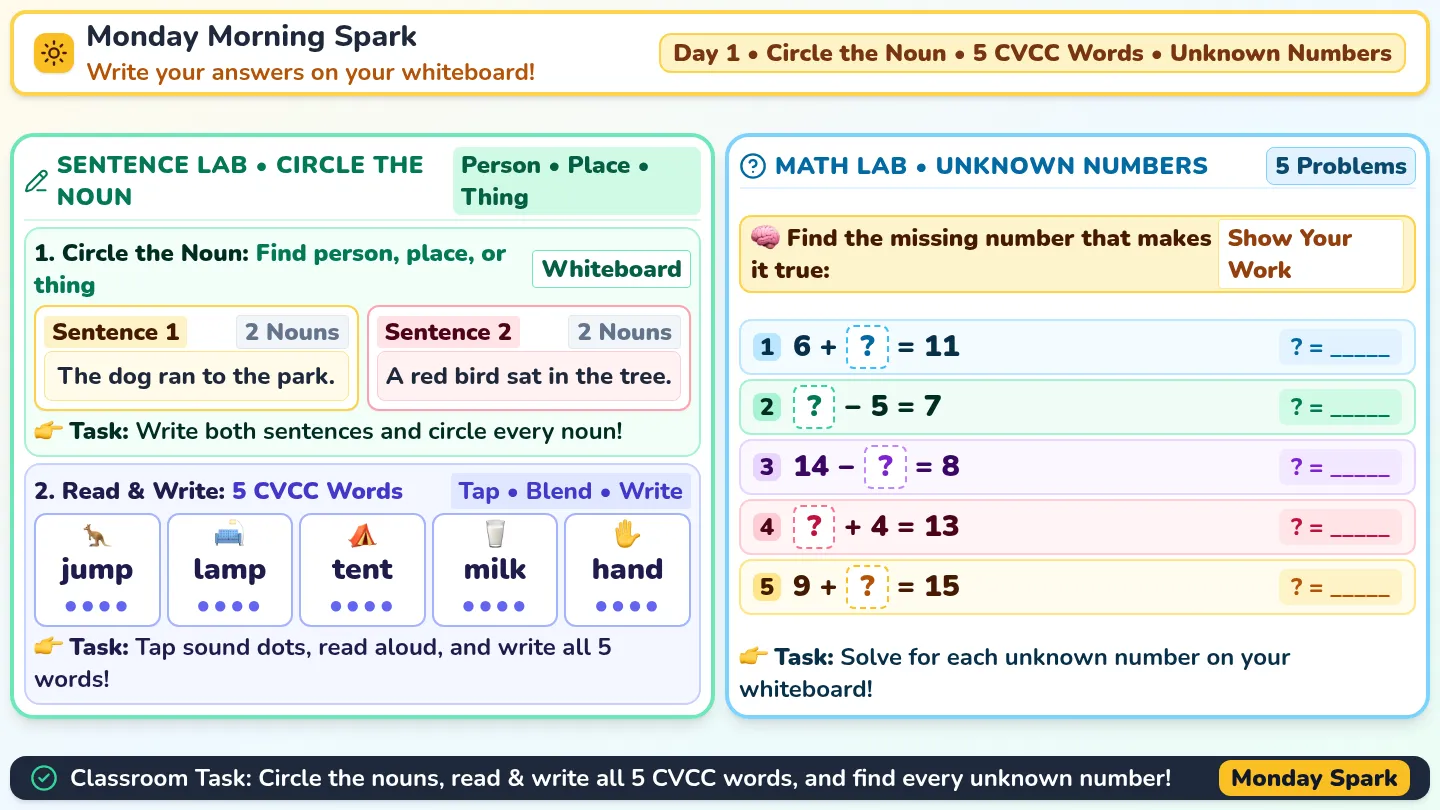
A 3-week Grade 1 morning routine sequence featuring daily Circle the Noun sentence challenges, Read and Write with 5 decodable CVCC words, and Math Lab with solving for unknown numbers up to 15.

CJ

Creesha Jones-Stone

15
Double Duty Digits Lesson Plan

Tens and Ones Remix

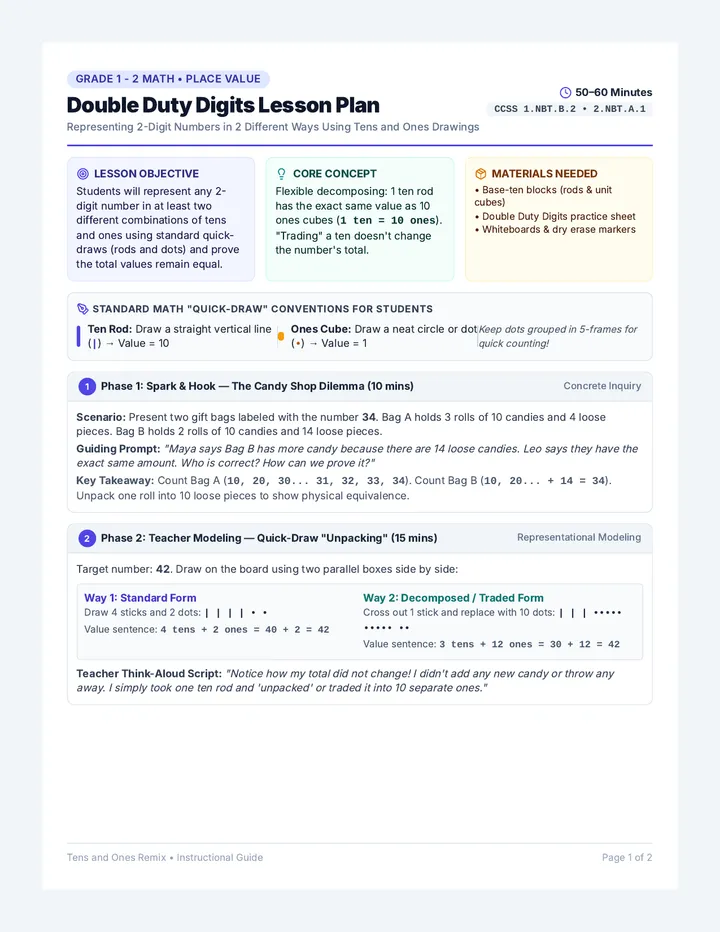
A foundational math lesson where students build flexible place value understanding by representing two-digit numbers in multiple ways using base-ten drawings. Learners model standard forms and decomposed forms by trading a ten rod for ten ones cubes.

A

awarner1

3
Touch Back Subtraction Worksheet

Touch Back Subtraction Worksheet

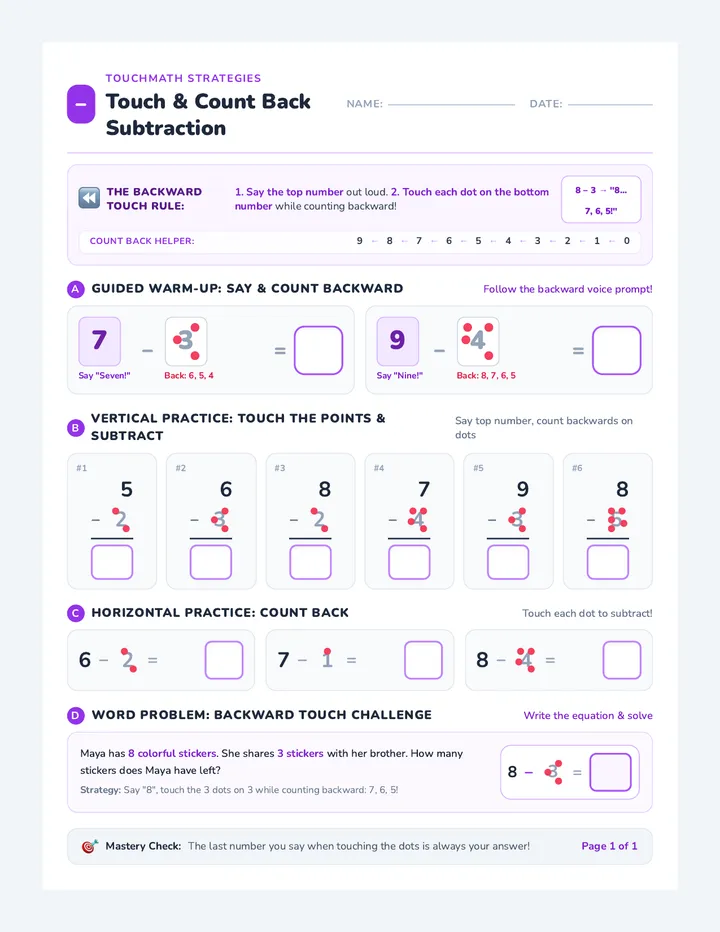
A guided TouchMath subtraction worksheet teaching the backward-counting strategy. Students say the top number and touch the TouchPoints on the subtrahend to count backward and solve vertical, horizontal, and word-based subtraction problems.

KG

Katerina Ganshaw

Sixteen Discovery Slides

Teen Number Expedition

A comprehensive kindergarten and first-grade unit exploring teen numbers 16 to 20 through double ten-frames, counting collections, numeral handwriting, and decomposition.

TG

Tyonna Gunter

15
Frog Pond Lesson Plan

Frog Pond Addition

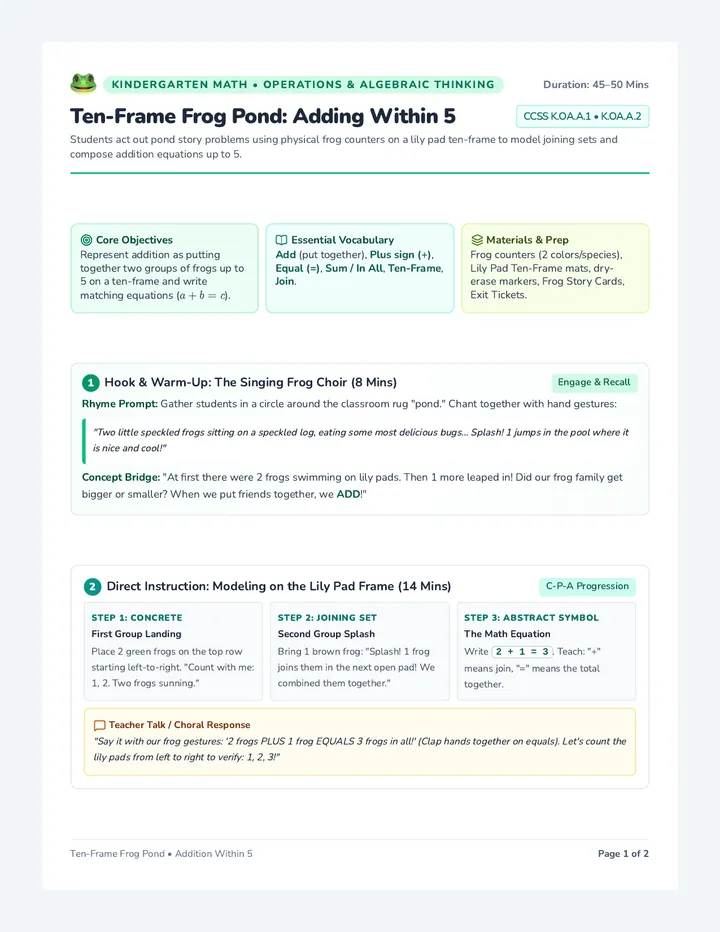
Students discover addition within five by acting out pond stories with lily pad ten-frames and counters. They manipulate frog manipulatives, combine groups, and write corresponding number sentences through guided play and hands-on partner activities.

AW

Alicia Winarski

3
Touch Add Addition Worksheet

Touch Add Addition Worksheet

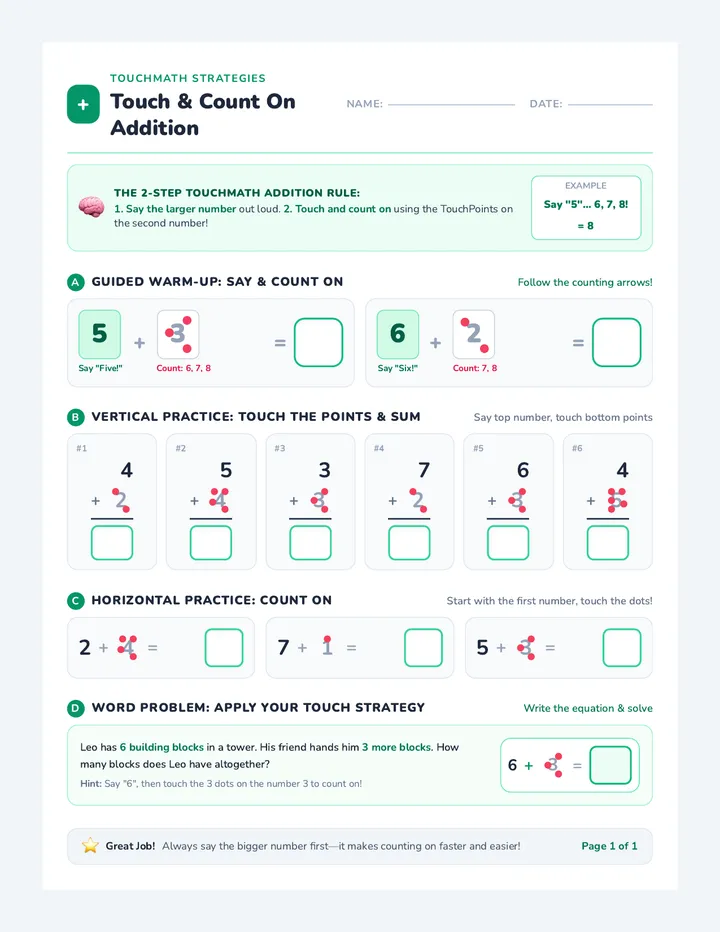
A guided TouchMath addition worksheet teaching the counting-on strategy. Students say the greatest number and touch the TouchPoints on the second addend to solve vertical, horizontal, and word-based addition problems.

KG

Katerina Ganshaw

Ten Hop Week One Teacher Guide

Ten Leap Intervention

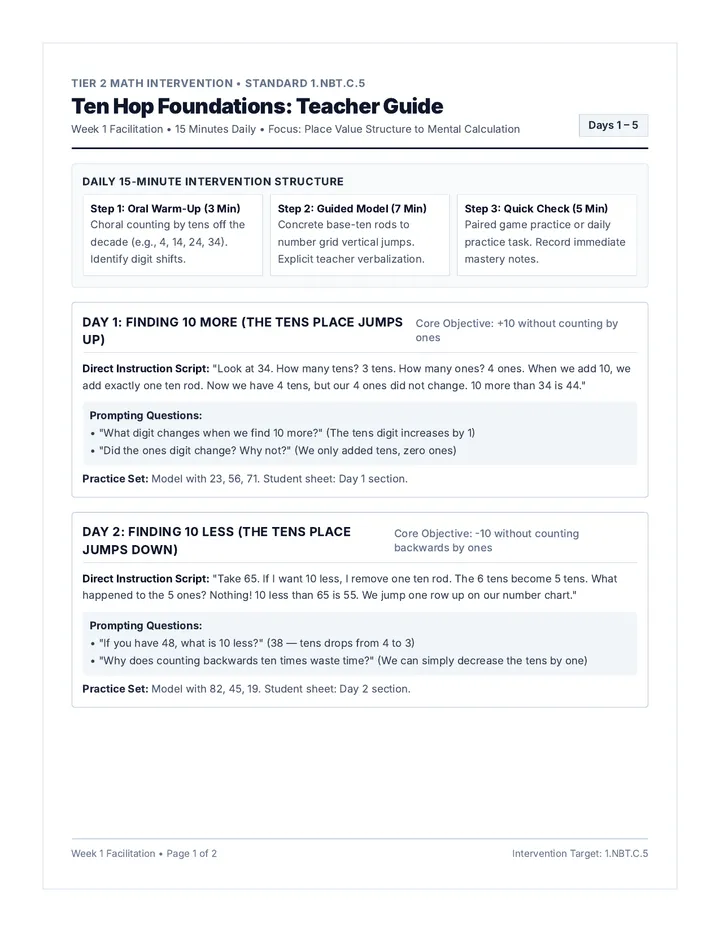
A targeted two-week Tier 2 mathematics intervention focusing on standard 1.NBT.C.5. Students develop conceptual understanding and mental fluency finding ten more and ten less than any two-digit number.

K

kkipperman

7
Cube Perimeter Worksheet

Cube Perimeter

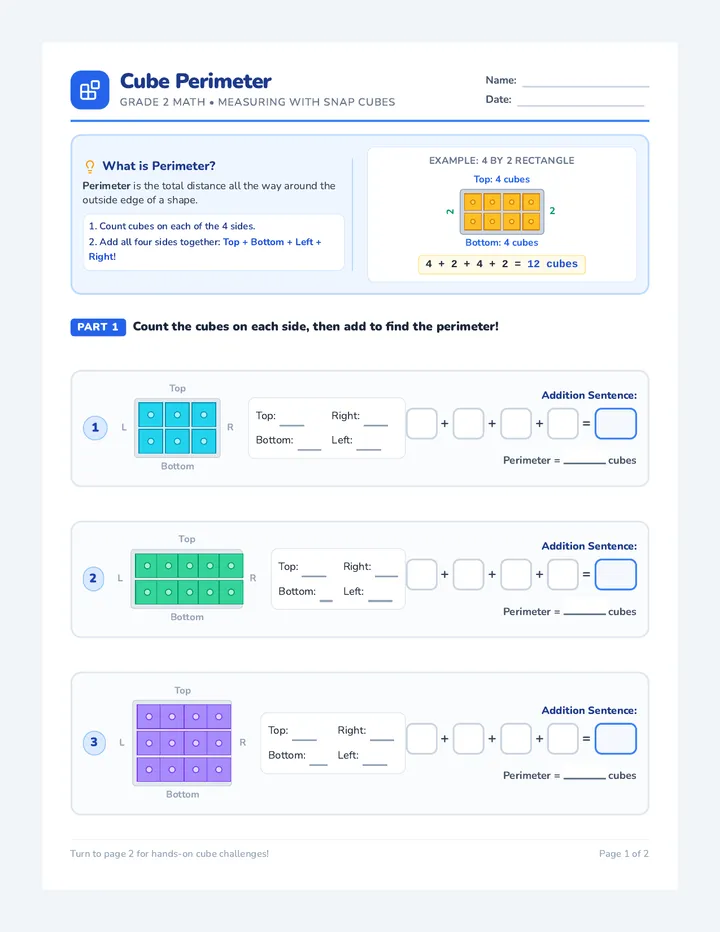
A hands-on second-grade measurement lesson where students explore and calculate the perimeter of rectangles using Unifix cubes and repeated addition. Includes student practice worksheets and complete teacher answer keys.

M

mmoiseeva

2
Pumpkin Patch Unit Plan

Seasonal Math Quests

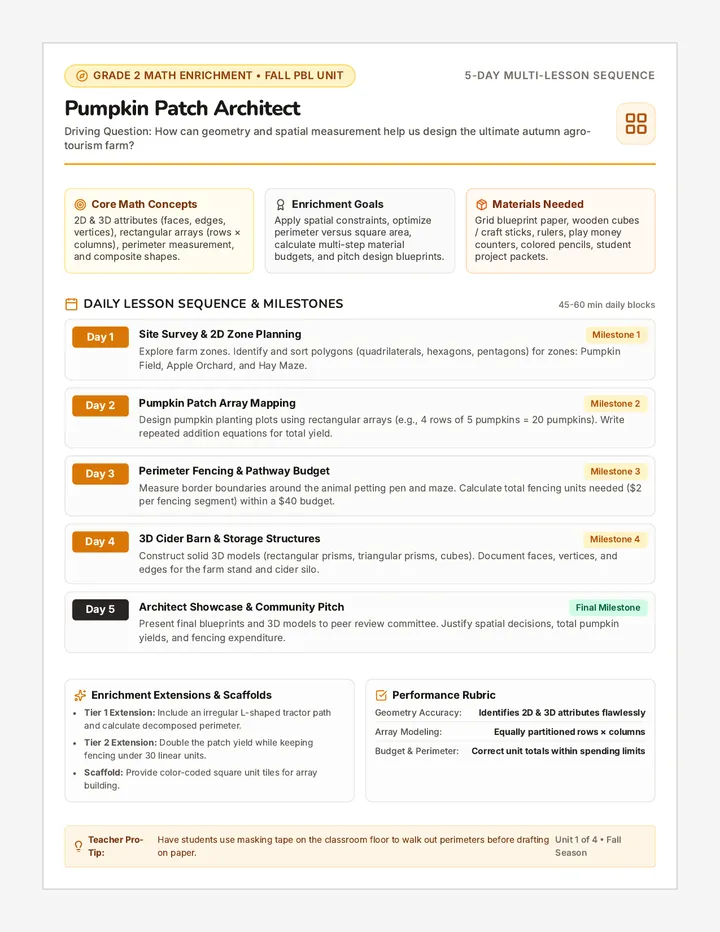
A collection of four seasonal project-based learning units for Grade 2 math enrichment featuring autumn harvest and winter wonderland design missions. Students apply advanced geometry, multi-digit money math, precision measurement, and elapsed time to solve authentic real-world challenges.

K

kkipperman

8
Place Value Power Slides

Place Value Power

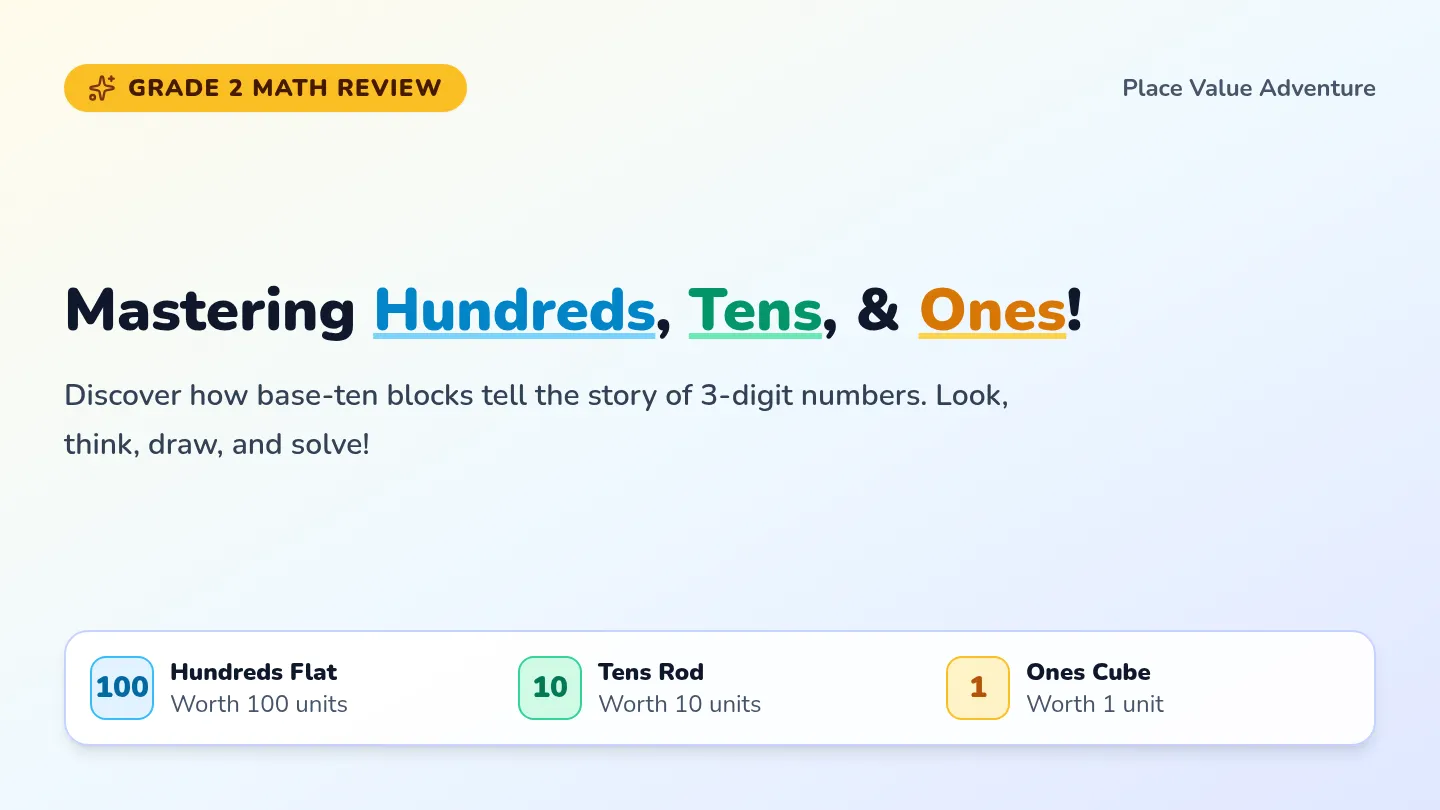
A 2nd grade place value lesson focused on understanding hundreds, tens, and ones using base-ten block models, expanded form, and interactive problem solving.

M

mrosendo

2
Shape Detective Slides

Shape Detectives

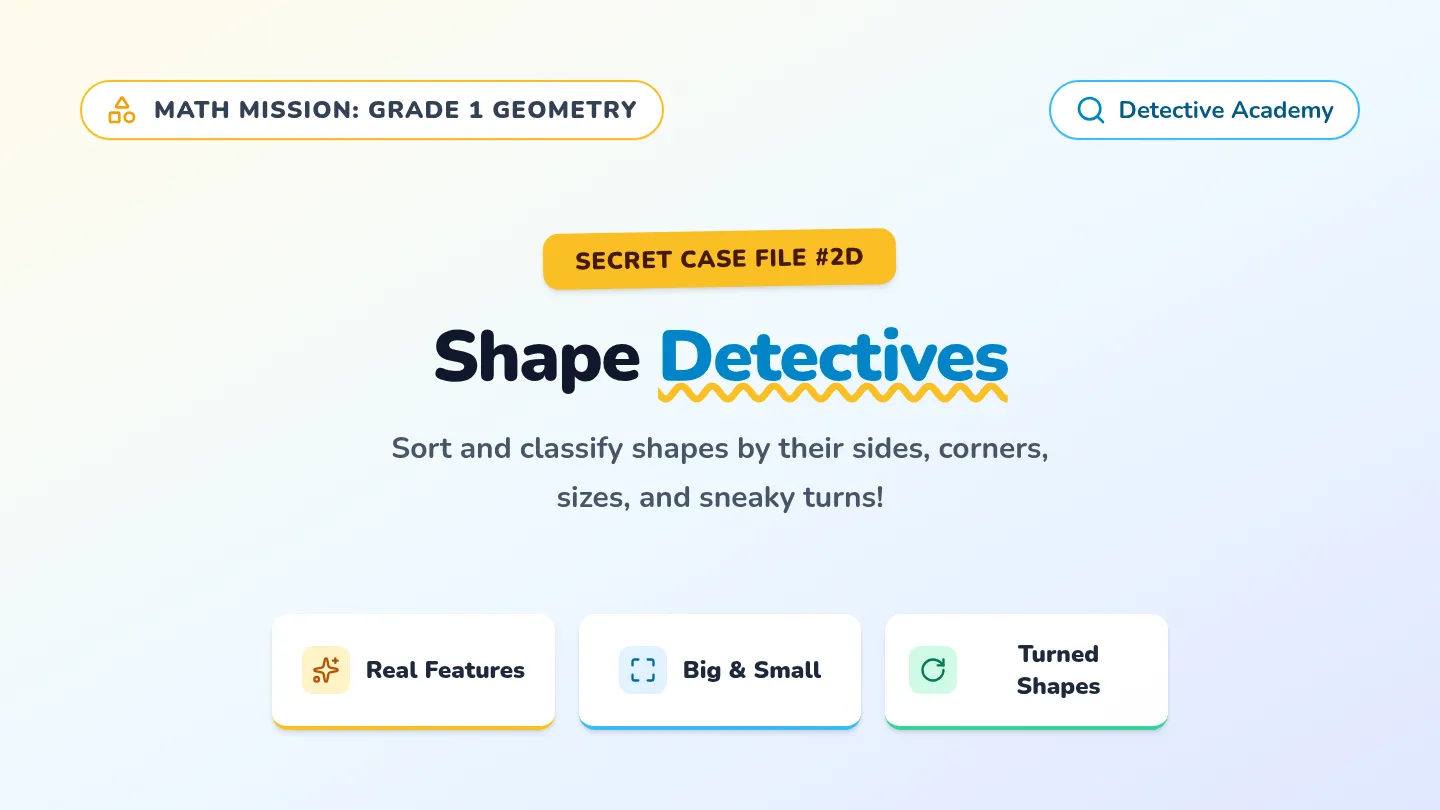
A hands-on first-grade geometry lesson where young mathematicians explore 2D shapes, differentiate defining attributes like sides and vertices from non-defining features like size and orientation, and master sorting shapes into categories.

L

Laura

4
Tower Showdown Lesson Plan

Cube Tower Showdown

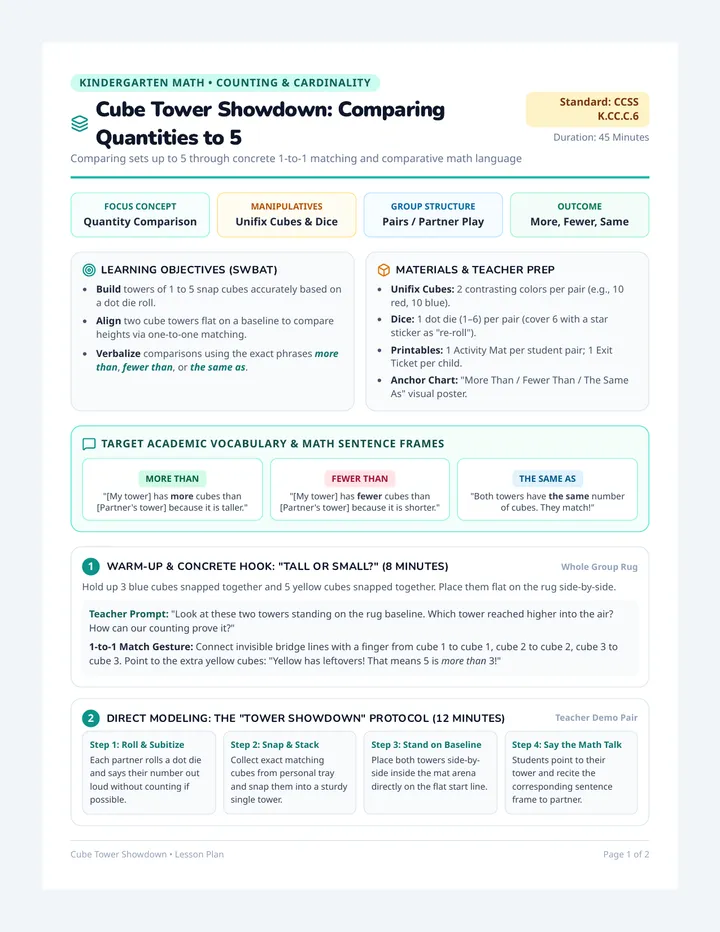
A hands-on kindergarten math lesson where students roll dice to build unifix cube towers up to 5, compare heights using one-to-one correspondence, and express comparative relationships using 'more than,' 'fewer than,' and 'the same as.'

JW

Julie Whitehead

3