Lenny.com
Explore
Create
ActivitiesNewMathEnglish Language ArtsScience & EngineeringSocial StudiesGlobal LanguagesHealth & Physical EducationSpecial EducationCounseling & Life SkillsArts & CreativityESL
Lenny.com
Lenny.com
Explore
Create
ActivitiesNewMathEnglish Language ArtsScience & EngineeringSocial StudiesGlobal LanguagesHealth & Physical EducationSpecial EducationCounseling & Life SkillsArts & CreativityESL
Lenny.com
Lenny.com

Solutions

Lenny for EducatorsLenny for SchoolsLenny for Districts

Product

ExploreSign inCreateSupportAbout

Resources

Getting startedMTSS Acceleration Program

Newsletters

School Funding Newsletter

© 2026 Lenny Learning Inc.

TermsPrivacyAccessibility
LinkedInInstagramX
Lenny
MathNumbers & CountingCounting ObjectsNumber NamesComparing NumbersNumber OperationsCounting SequenceNumbers 0-10Place Value Understanding and SystemAdd and Subtract Within 20Addition and Subtraction ConceptsAddition and Subtraction EquationsAddition and Subtraction ProblemsFoundations for MultiplicationMultiplication and Division PropertiesMultiply and Divide Within 100Multiplication and Division ProblemsFactors and MultiplesProperties of OperationsPatterns and RelationshipsGenerate and Analyze PatternsMulti-Digit ArithmeticPlace Value OperationsMulti-Digit and Decimal OperationsNumerical ExpressionsFour Operations and PatternsFour Operations Problem SolvingMeasurement & DataMeasurable AttributesMeasuring LengthsMeasure and Estimate Lengths in Standard UnitsRelate Addition and Subtraction to LengthClassifying and Counting ObjectsTime and MoneyArea Concepts and MeasurementPerimeter and Area MeasuresAngle Concepts and MeasurementTime, Volume, and MassMeasurement Unit ConversionsGeometryIdentifying ShapesShapes and AttributesShape Attributes and ReasoningShapes and CompositionClassifying 2D FiguresGeometric Figures and RelationshipsLines, Angles, and ShapesAngle, Area, and VolumeGeometric MeasurementVolume of 3D ShapesCoordinate Plane ApplicationsTransformations in the PlaneCongruence and SimilarityUnderstand congruence in terms of rigid motionsSimilarity and TransformationsProve Theorems Involving SimilarityPythagorean TheoremTrigonometry for General TrianglesMake Geometric ConstructionsProve Geometric TheoremsTheorems About CirclesFind Arc Lengths And Areas of Sectors of CirclesVolume FormulasRelationships Between Two-Dimensional and Three-Dimensional ObjectsProve Simple Geometric Theorems AlgebraicallyTranslate Between Geometric Description and Equation for Conic SectionApply Geometric Concepts in Modeling SituationsFractions & DecimalsFractions as NumbersBuilding FractionsFraction Equivalence and OrderingAdding and Subtracting FractionsMultiplying and Dividing FractionsDividing FractionsDecimal FractionsMulti-Digit Computation and FactorsAdd, Subtract, Multiply, and Divide Rational NumbersRational Number SystemIrrational Numbers and ApproximationsRatiosRatios and ProportionsProportional RelationshipsUnit RateAlgebraAlgebraic ExpressionsGenerate Equivalent ExpressionsQuantitative RelationshipsProportional Relationships and Linear EquationsEquations and InequalitiesEquation Solving and ReasoningLinear Equations and SystemsGraph Equations and InequalitiesSystems of EquationsReal-World Algebraic ProblemsQuantitative Reasoning with UnitsExpression StructureEquivalent Expression FormsRadicals and Integer ExponentsRational ExponentsRational and Irrational NumbersPolynomial OperationsPolynomial IdentitiesPolynomial Zeros and FactorsRational ExpressionsComplex Number OperationsComplex Numbers in PolynomialsComplex Numbers on PlaneStatistics & ProbabilityRepresent and Interpret DataData DistributionsStatistical VariabilityProbability ModelsCompound Event ProbabilitiesStatistical SamplingInterpret Categorical and Quantitative DataBivariate Data PatternsInterpret Linear ModelsComparing Two PopulationsRandom Processes in StatisticsIndependence and Conditional ProbabilityExpected ValuesProbability-Based Decision MakingStatistical Inference and ConclusionsFunctionsFunction Concepts and NotationDefine and Compare FunctionsInterpret Functions in ContextAnalyze Function RepresentationsModel Relationships with FunctionsIdentify Linear vs Exponential GrowthDistinguish Between Function TypesCompare Growth RatesInterpret Function ExpressionsBuild Functions from RelationshipsConstruct and Model FunctionsTransform and Combine FunctionsModel Comparison and SelectionSolve Exponential EquationsTrigonometryTrigonometric Ratios Involving Right TrianglesTrigonometric Functions and Unit CircleModel with Trigonometric FunctionsTrigonometric IdentitiesVectors & MatricesIntroduction to Vectors and MatricesVector QuantitiesVector OperationsMatrix OperationsCalculusLimits and ContinuityDerivative Concepts and NotationDerivative Rules and TechniquesApplications of DerivativesOptimization ProblemsRelated RatesCurve Sketching and AnalysisIntegration Concepts and NotationAntiderivatives and Indefinite IntegralsDefinite Integrals and AreaFundamental Theorem of CalculusIntegration TechniquesApplications of IntegrationDifferential EquationsSequences and SeriesParametric and Polar FunctionsVector-Valued Functions

Strategy Vault

A comprehensive multi-digit addition lesson focused on mastering addition with regrouping across 3-, 4-, and 5-digit numbers using four core mathematical representations: standard algorithm, place value expanded addition, open number lines, and base-ten models.

AAalicia accapezzato

Strategy Vault

A comprehensive multi-digit addition lesson focused on mastering addition with regrouping across 3-, 4-, and 5-digit numbers using four core mathematical representations: standard algorithm, place value expanded addition, open number lines, and base-ten models.

AAalicia accapezzato

Name:  

Page: 3 of 3

5 Solve: 38,647 + 25,876

5-digit multi-column regrouping

1. Standard Algorithm TTh | Th | H | T | O

TTh

Th

H

T

O

2. Place Value (Expanded) Decompose & Sum

3. Open Number Line Long Workspace • Record jumps above, landmarks below

Start → +Ten-Th → +Th → +H → +T → +O

4. Place Value Disks / Chips Draw disks & show trades across columns

Disks: [10k] • [1k] • [100] • [10] • [1]

6 Solve: 54,789 + 36,548

5-digit multi-column regrouping

1. Standard Algorithm TTh | Th | H | T | O

TTh

Th

H

T

O

2. Place Value (Expanded) Decompose & Sum

3. Open Number Line Long Workspace • Record jumps above, landmarks below

Start → +Ten-Th → +Th → +H → +T → +O

4. Place Value Disks / Chips Draw disks & show trades across columns

Disks: [10k] • [1k] • [100] • [10] • [1]

Instructional Scripts & Misconception Alerts

Pedagogical scaffolds for guiding students through the 6 practice problems

Page 2 of 2

Lesson Flow & Recommended Pacing (60 Min)

10 Min: Warmup & Model

Walk through 4,678 + 3,854 using Slide Deck / Anchor Chart.

15 Min: Guided Practice

Solve Q1 & Q2 (3-digit) together or with partner checks.

25 Min: Independent/Pairs

Students complete Q3–Q6 (4-digit & 5-digit) on worksheet.

10 Min: Exit Ticket

Individual exit ticket check to assess strategy flexibility.

Scripted Teacher Think-Alouds

Modeling the Regrouping Moment:

“Look at my ones column: 8 plus 4 gives me 12 ones. Can 12 fit in the single-digit ones column? No! Only values 0 through 9 can live there. So I break 12 into 1 ten and 2 ones. I record 2 in the ones spot, and I carry the 1 ten up to the tens family.”

Connecting Place Value to Standard Algorithm:

“Notice how in Strategy 2, our hundreds gave us 1,400. In Strategy 1, we wrote down a 5 and carried a 1. Where did that 1 go? It went to the thousands place—representing exactly 1,000, just like the 1,400 in expanded form!”

Common Misconceptions & Diagnostic Fixes

1. Forgetting the Carried Unit

Adds addends but forgets the ‘1’ on top of the next column.

“Circle carried digits in red or add them first before the addends.”

2. Misaligned Columns (5-Digit)

Aligning from the left instead of right, causing tens to add with hundreds.

“Use the vertical grid lines to verify ones align with ones.”

3. Number Line Jump Arithmetic

Miscalculating landmark landing spots when jumping across thousands.

“Check that each jump only changes the specific place value digit.”

Differentiation & Scaffolding

Support (Struggling Learners)

  • Provide physical base-ten plastic blocks for Q1 and Q2.
  • Color-code place values: Blue=Ones, Red=Tens, Green=Hundreds.
  • Allow solving Strategy 4 first before Standard Algorithm.

Extension (Advanced Learners)

  • Challenge students to do the Open Number Line in fewest jumps (friendly compensation: +4,000 then -146).
  • Create a 6-digit problem and demonstrate standard vs. expanded.

Strategy Vault Instructional Guide • Alignment: CCSS.MATH.CONTENT.4.NBT.B.4


9,253

3. Number Line

Start: 5,489
+3,000 → 8,489
+700 → 9,189 | +60 → 9,249
+4 → 9,253

4. Base Blocks

8 cubes, 11 flats, 14 rods, 13 units
Bundle to: 9 cubes, 2 flats, 5 rods, 3 units
= 9,253

Strategy Vault Answer Key • Questions 1 through 4

Answer Key

Strategy Vault: Solutions (Q5, Q6 & Exit Ticket)

Teacher Reference • Page 2 of 2

Q5 (5-Digit): 38,647 + 25,876 = 64,523 4-Column Regrouping

1. Standard

¹ ¹ ¹ ¹
 3 8 , 6 4 7
+2 5 , 8 7 6
-----------
 6 4 , 5 2 3

2. Place Value

30k+20k = 50,000
8k+5k = 13,000
600+800 = 1,400
40+70 = 110 | 7+6 = 13
Sum = 64,523

3. Number Line

Start: 38,647
+20k → 58,647
+5k → 63,647
+800 → 64,447
+70 → 64,517 | +6 → 64,523

4. Place Value Disks

Bundles 13 ones → 1 ten
Bundles 12 tens → 1 hundred
Bundles 15 hundreds → 1 thousand
Bundles 14 thousands → 1 ten-th.
= 64,523

Q6 (5-Digit): 54,789 + 36,548 = 91,337 4-Column Regrouping

1. Standard

¹ ¹ ¹ ¹
 5 4 , 7 8 9
+3 6 , 5 4 8
-----------
 9 1 , 3 3 7

2. Place Value

50k+30k = 80,000
4k+6k = 10,000
700+500 = 1,200
80+40 = 120 | 9+8 = 17
Sum = 91,337

3. Number Line

Start: 54,789
+30k → 84,789
+6k → 90,789
+500 → 91,289
+40 → 91,329 | +8 → 91,337

4. Place Value Disks

Bundles 17 ones → 1 ten
Bundles 13 tens → 1 hundred
Bundles 13 hundreds → 1 thousand
Bundles 11 thousands → 1 ten-th.
= 91,337

Exit Ticket Challenge: 4,586 + 2,749 = 7,335 Scoring: 4 Points (1 pt per strategy)

1. Standard

¹ ¹ ¹
 4 , 5 8 6
+2 , 7 4 9
---------
 7 , 3 3 5

2. Place Value

4,000+2,000 = 6,000
500+700 = 1,200
80+40 = 120 | 6+9 = 15
Sum = 7,335

3. Number Line

Start: 4,586
+2,000 → 6,586
+700 → 7,286
+40 → 7,326 | +9 → 7,335

4. Base Blocks / Disks

6 cubes, 12 flats, 12 rods, 15 units
Bundles to:
7 cubes, 3 flats, 3 rods, 5 units
= 7,335

Exit Ticket Scoring Rubric:

4 Points: All 4 strategies correctly modeled with accurate regrouping and correct sum (7,335).

3 Points: 3 strategies modeled accurately; minor regrouping calculation error in one.

2 Points: 2 strategies completed accurately; struggles with visual representations (blocks/line).

1 Point: Only 1 strategy attempted or significant regrouping misconceptions across representations.

Strategy Vault Master Answer Key • Complete Lesson Solutions
You might also like

Checkpoint Prep Review Booklet

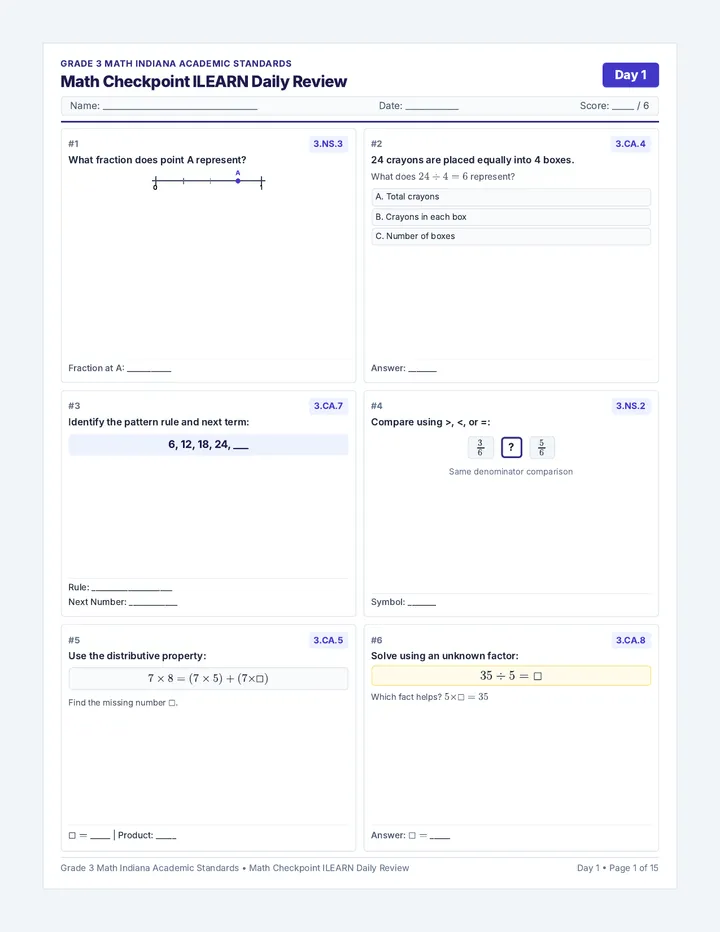
ILEARN Checkpoint Mastery

A multi-part Indiana Academic Standards Grade 3 Math ILEARN checkpoint preparation sequence featuring comprehensive 15-day daily spiral reviews and teacher answer keys for Checkpoints 2 and 3.

JQ

Janelle Quinn

4
Strand Mastery Worksheet

ILEARN Target Practice

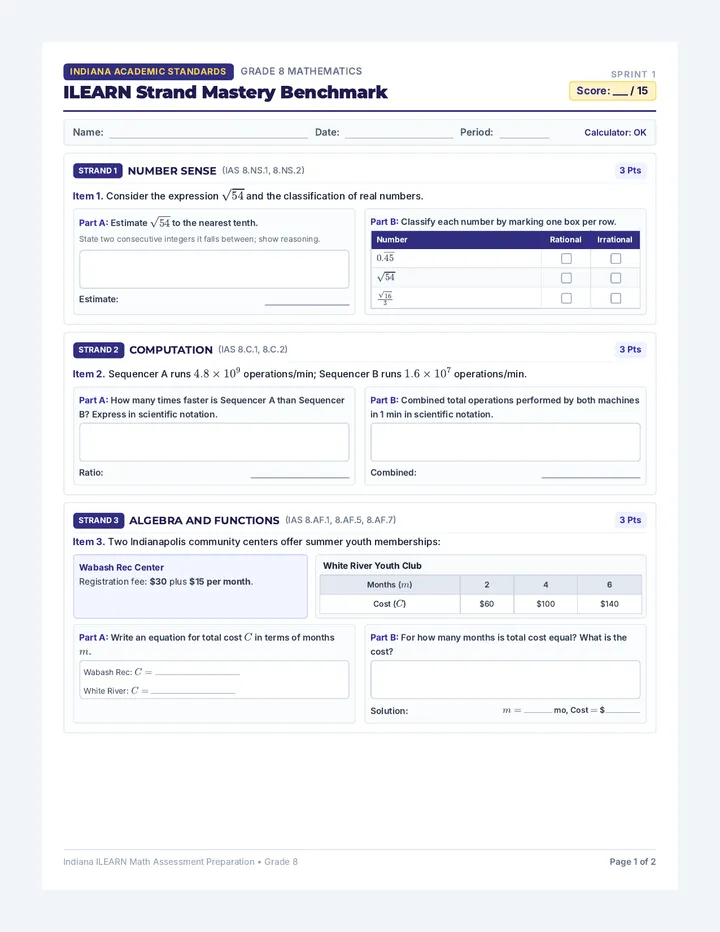
A comprehensive Indiana 8th-grade math assessment sprint aligned to the Indiana Academic Standards (IAS) and modeled after ILEARN items. Covers all five state strands: Number Sense, Computation, Algebra & Functions, Geometry & Measurement, and Data Analysis & Statistics.

T

thall

2
Mix It Up Monitoring Tracker

Mix It Up Monitoring Tracker

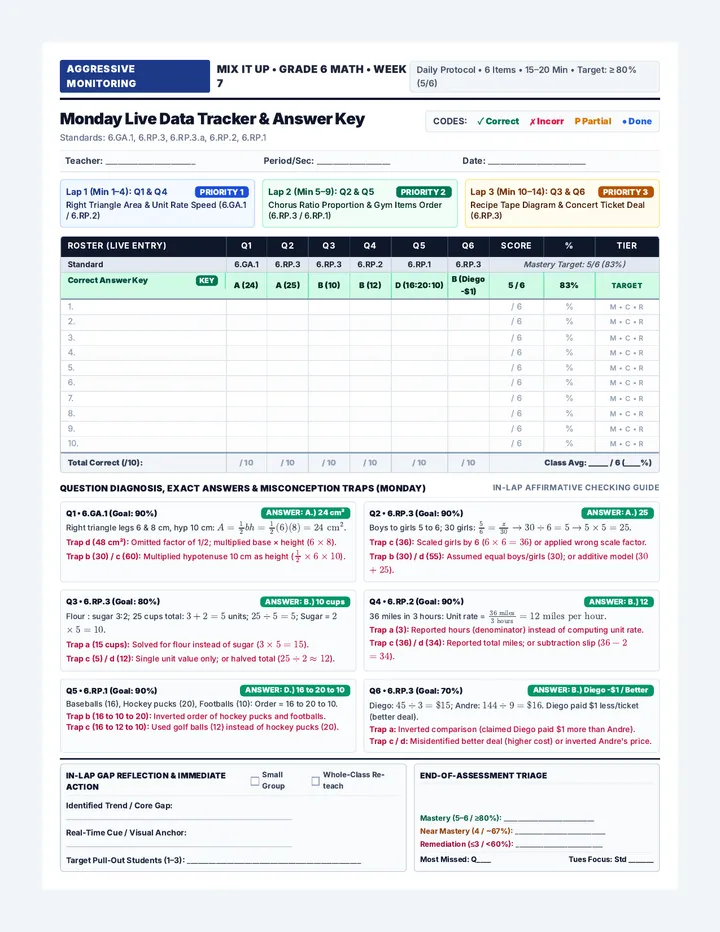
Comprehensive 4-day aggressive monitoring data tracker and affirmative checking answer key for Grade 6 Math Week 7 assessments (Monday through Thursday). Includes lap-by-lap priority targets, blank live active data entry roster, question-by-question misconception traps, and in-lap triage frameworks.

M

menyon.reeves

Groups and Arrays Teacher Guide

Multiplication Strategy Lab

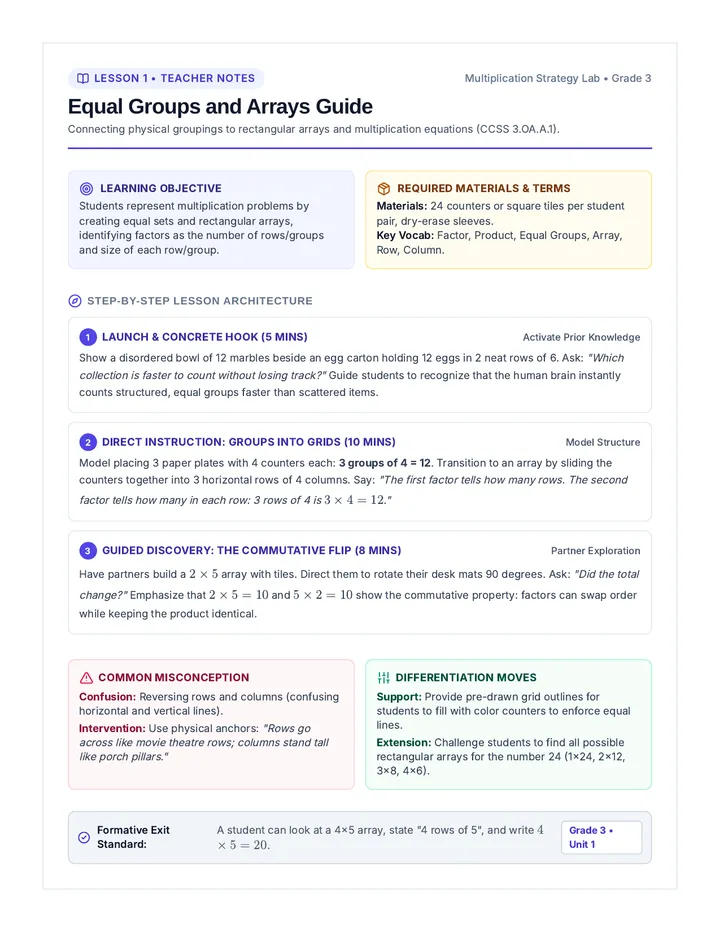
A comprehensive third-grade instructional sequence focusing on four foundational multiplication strategies: equal groups and arrays, repeated addition, skip counting patterns, and breaking apart factors. Each lesson pairs an actionable teacher guide with a targeted student practice worksheet.

JS

Jami Sharp

8
Secret Nines Worksheet

Secret Nines

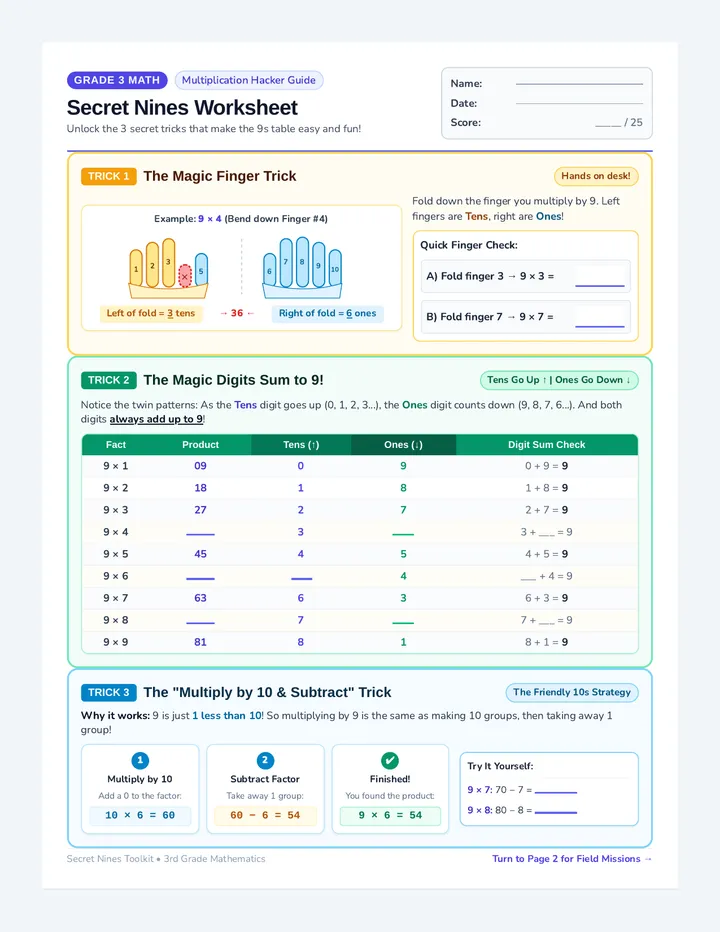
A high-impact 3rd-grade math lesson that equips students with three intuitive mental-math tricks to master the 9 times table, pairing conceptual pattern discovery with hands-on practice.

K

kebushey

2
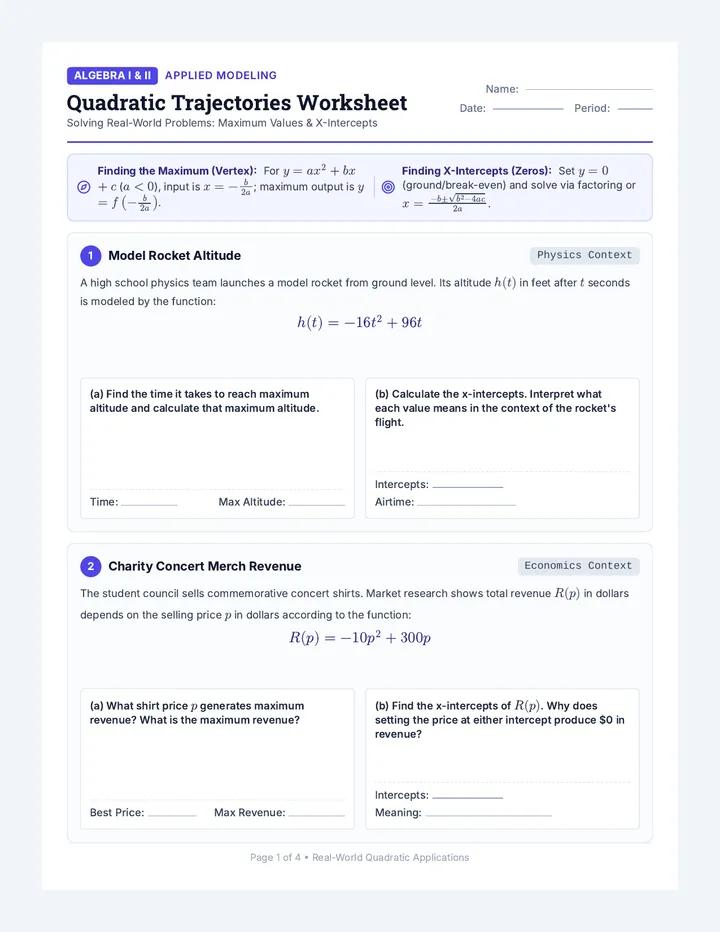
Quadratic Trajectories Worksheet

Quadratic Trajectories Worksheet

A comprehensive 10-question real-world quadratic word problems worksheet focusing on calculating maximum values and finding x-intercepts in contexts like projectile motion, revenue optimization, and architectural arches.

CK

Cheydon Krysl

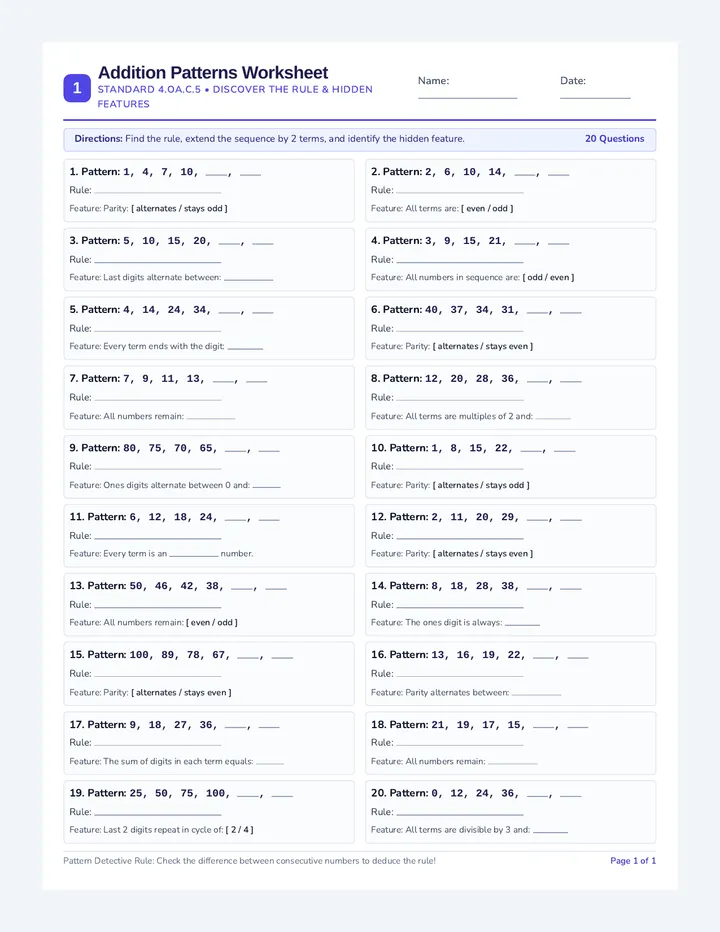
Addition Patterns Worksheet

Pattern Sleuth Academy

A comprehensive fourth-grade unit exploring number and shape patterns, uncovering unstated mathematical features, and informally explaining patterns under standard 4.OA.C.5.

Lenny Avatar
Lenny
8
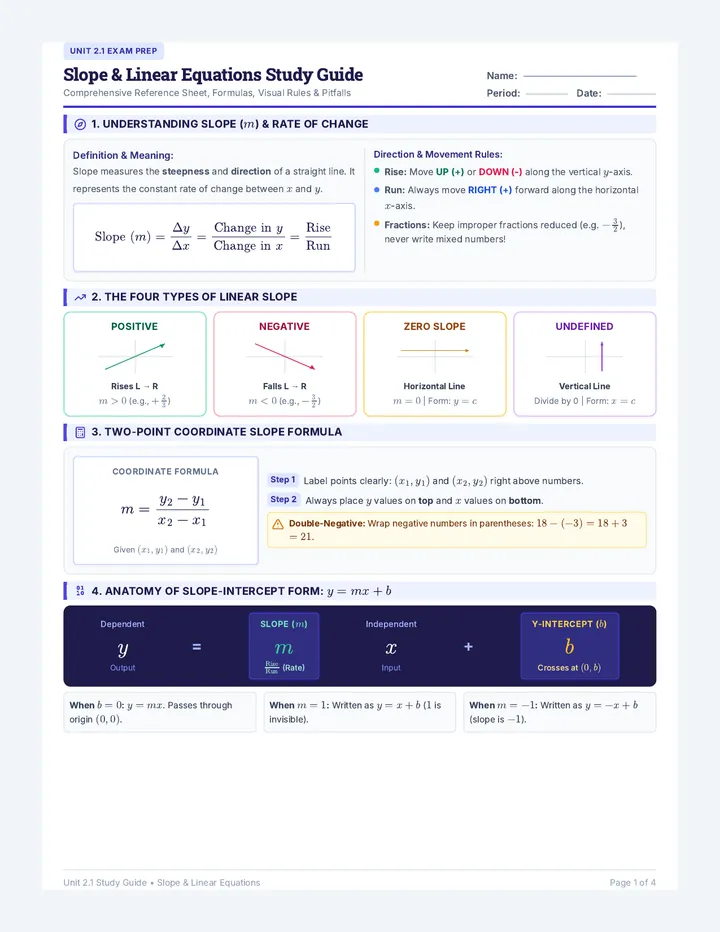
Slope and Lines Study Guide

Slope and Lines Mastery

A comprehensive unit study guide and solutions packet mastering linear equations, calculating slope from graphs and coordinates, graphing lines in slope-intercept form, and writing equations from linear graphs.

FM

Fernando Mancini

2
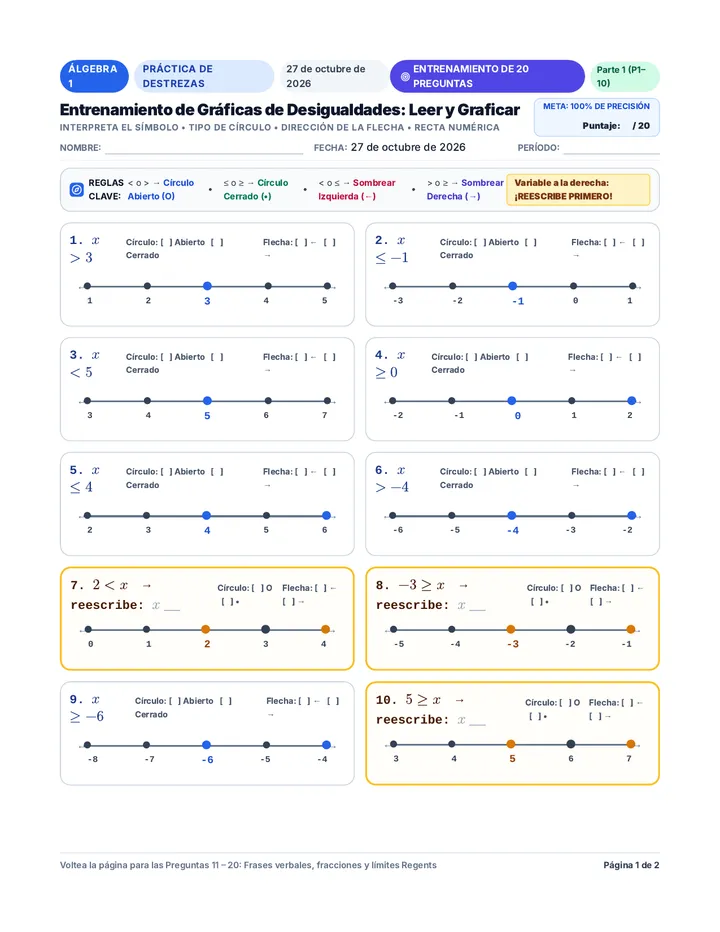
Inequality Graphing Drill Spanish Handout

Inequality Graphing Drill Spanish Handout

A two-page Spanish skill drill handout with 20 inequality graphing exercises featuring number lines, symbol interpretation, verbal translations, and variable rewriting reminders.

H

Harlston

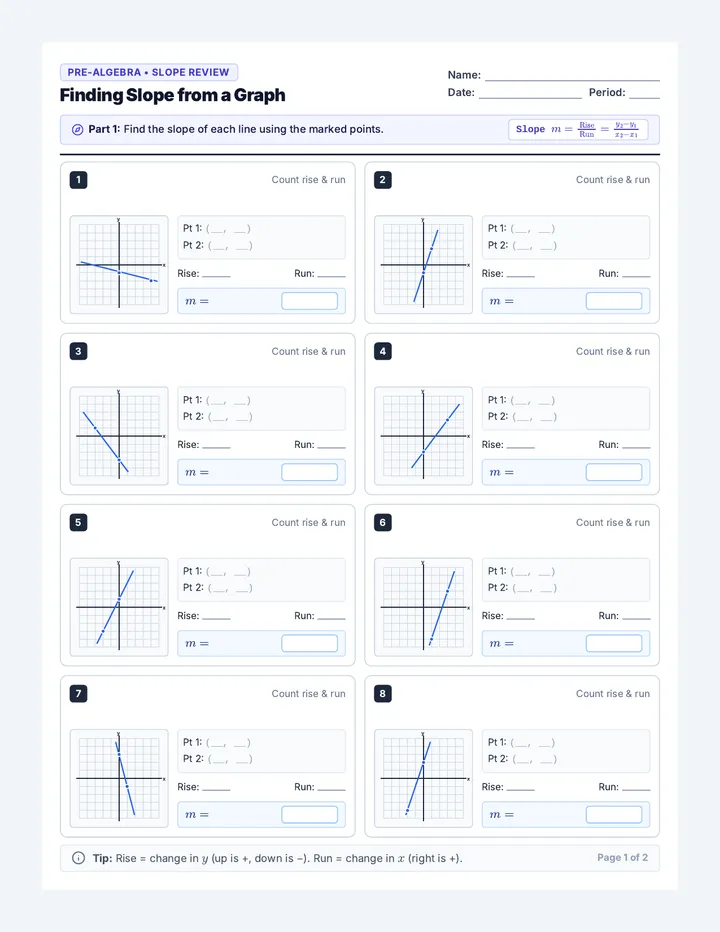
Slope Review Practice Worksheet

Pre-Algebra Concepts

A comprehensive pre-algebra and introductory geometry sequence covering linear equations, slope analysis, and coordinate plane transformations.

FM

Fernando Mancini

10
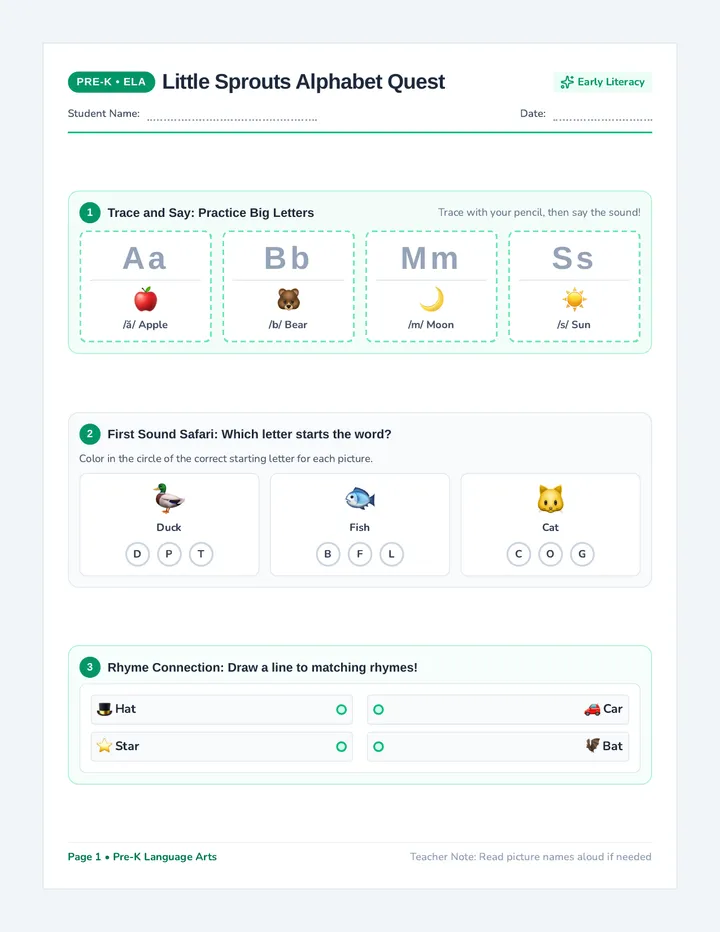
Little Sprouts Packet

Brain Boost Packets

A differentiated collection of printable Math and ELA practice packets spanning Pre-K through Grade 4. Each packet features targeted, age-appropriate literacy and numeracy activities designed for independent or guided practice.

CP

Christian Page

5
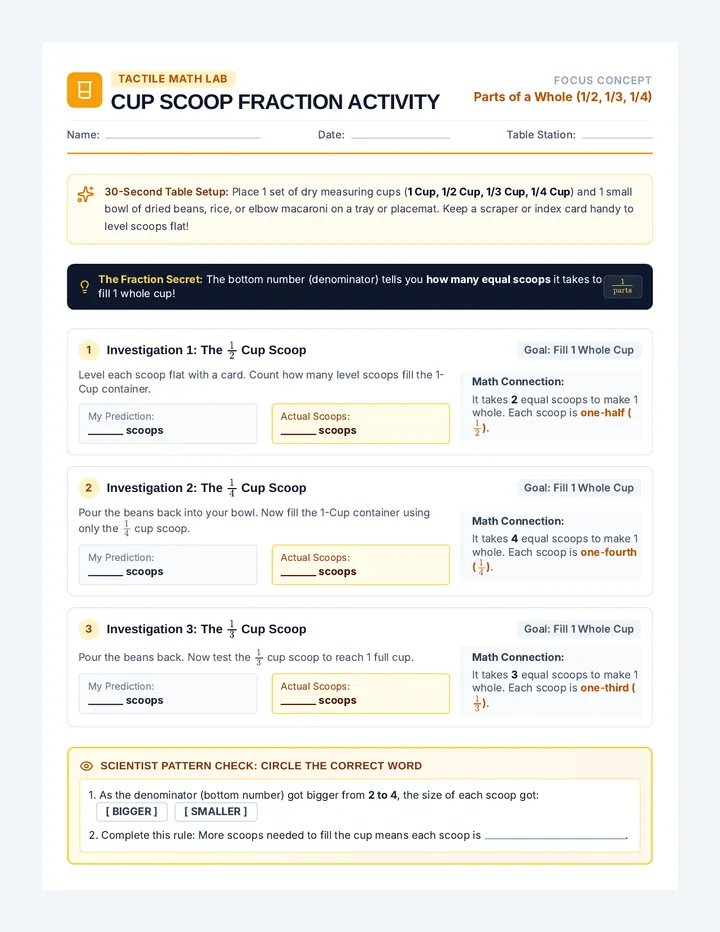
Cup Scoop Fraction Activity

Cup Scoop Fraction Activity

A 2-page hands-on math activity using dry measuring cups and beans to build intuitive understanding of unit fractions. Students predict, scoop, and compare parts of a whole with quick tabletop setup and cleanup.

RH

Rachel Haydon