Slope and Lines Study Guide
Unit 2.1 Exam Prep
Slope & Linear Equations Study Guide
Essential Formulas, Concept Reference, Visual Rules & Traps
Name:
Period: Date:
1. What is Slope? (Constant Rate of Change)
Definition & Purpose:
Slope measures the steepness and slant direction of a line. It quantifies how many units \(y\) changes for every single 1-unit increase in \(x\).
\[ \text{Slope } (m) = \frac{\Delta y}{\Delta x} = \frac{\text{Change in } y}{\text{Change in } x} = \frac{\text{Rise}}{\text{Run}} \]
Direction & Movement Guidelines:
- Rise (Top): Move UP (+) for positive, or DOWN (-) for negative along the \(y\)-axis.
- Run (Bottom): Always move RIGHT (+) forward along the horizontal \(x\)-axis.
- Improper Fractions: Keep slopes as simplified improper fractions (e.g. \(-\frac{3}{2}\)), never mixed numbers!
2. The Four Types of Linear Slope
Positive
Rises L → R \(m > 0\) (e.g. \(+\frac{2}{3}\))
Negative
Falls L → R \(m < 0\) (e.g. \(-\frac{3}{2}\))
Zero Slope
Horizontal Line \(m = 0\) | Form: \(y = c\)
Undefined
Vertical Line Divide by 0 | Form: \(x = c\)
3. The Two-Point Coordinate Slope Formula
Two-Point Formula
\[ m = \frac{y_2 - y_1}{x_2 - x_1} \]
For \((x_1, y_1)\) and \((x_2, y_2)\)
Step 1 Label coordinates explicitly: write \(x_1, y_1\) and \(x_2, y_2\) directly above the problem.
Step 2 Always place \(y\) values on top (numerator) and \(x\) values on bottom (denominator).
Parentheses Rule: Wrap negative coordinates in parentheses! \(18 - (-3) = 18 + 3 = 21\). Never lose double negatives!
4. Anatomy of Slope-Intercept Form: \(y = mx + b\)
Dependent Var
\(y\)
Output value
=
Slope (\(m\))
\(m\)
\(\frac{\text{Rise}}{\text{Run}}\) (Rate of Change)
Independent Var
\(x\)
Input value
y-Intercept (\(b\))
\(b\)
Point \((0, b)\) on \(y\)-axis
When \(b = 0\): \(y = mx\). The line crosses directly through the origin \((0,0)\).
When \(m = 1\): Written as \(y = x + b\) (coefficient 1 is invisible).
When \(m = -1\): Written as \(y = -x + b\) (slope is negative 1).
Unit 2.1 Study Guide • Slope & Linear Equations Page 1 of 4
Worked Examples & Step-by-Step Strategies
Mastering the 4 core exam problem types with detailed step-by-step models
Model Solutions
A
Model 1: Finding Slope from a Graph
run = +3 rise = +2
Goal: Determine the slope of the line shown on the grid.
1. Identify 2 clean lattice points: Crosshairs at \((-3, -1)\) and \((0, 1)\).
2. Count Rise & Run: From \((-3, -1)\), count up \(2\) units (\(\text{rise} = +2\)), then right \(3\) units (\(\text{run} = +3\)).
3. Write slope: \(\text{Slope } m = \frac{\text{rise}}{\text{run}} = \mathbf{\frac{2}{3}}\). (Line rises left-to-right → confirms positive!).
B
Model 2: Finding Slope between Two Coordinate Points
Points Given:
\((19, -3)\) and \((-9, 18)\)
Label: \((x_1, y_1)\) & \((x_2, y_2)\)
Substitute: \[ m = \frac{y_2 - y_1}{x_2 - x_1} = \frac{18 - (-3)}{-9 - 19} \]
Simplify Signs: \[ m = \frac{18 + 3}{-28} = \frac{21}{-28} = \mathbf{-\frac{3}{4}} \]
Rule: Divide top and bottom by GCF \(7\). Never lose the negative sign!
C
Model 3: Graphing an Equation in Slope-Intercept Form
(0,-2) Start
Equation: \(y = -\frac{3}{2}x - 2\)
1. Identify \(b\) & \(m\): \(y\)-intercept \(b = -2 \to (0, -2)\); Slope \(m = -\frac{3}{2} = \frac{-3}{+2}\).
2. Plot start: Place dot on \(y\)-axis at \((0, -2)\).
3. Use slope staircase: Move down 3, right 2 (or reverse: up 3, left 2 to \((-2, 1)\)). Draw straight line with arrows!
D
Model 4: Writing the Equation of a Line from a Graph
b = 4
1. Read \(y\)-intercept (\(b\)): Crosses vertical axis at \((0, 4) \to \mathbf{b = 4}\).
2. Pick second point: Crosses at \((-2, 1)\). Count: up \(3\), right \(2 \to \mathbf{m = \frac{3}{2}}\).
3. Assemble equation: Substitute into \(y = mx + b \to \mathbf{y = \frac{3}{2}x + 4}\).
Unit 2.1 Study Guide • Slope & Linear Equations Page 2 of 4
Part 1 Practice
Finding Slope from Graphs & Coordinate Pairs
8 Questions • Maximized Workspace
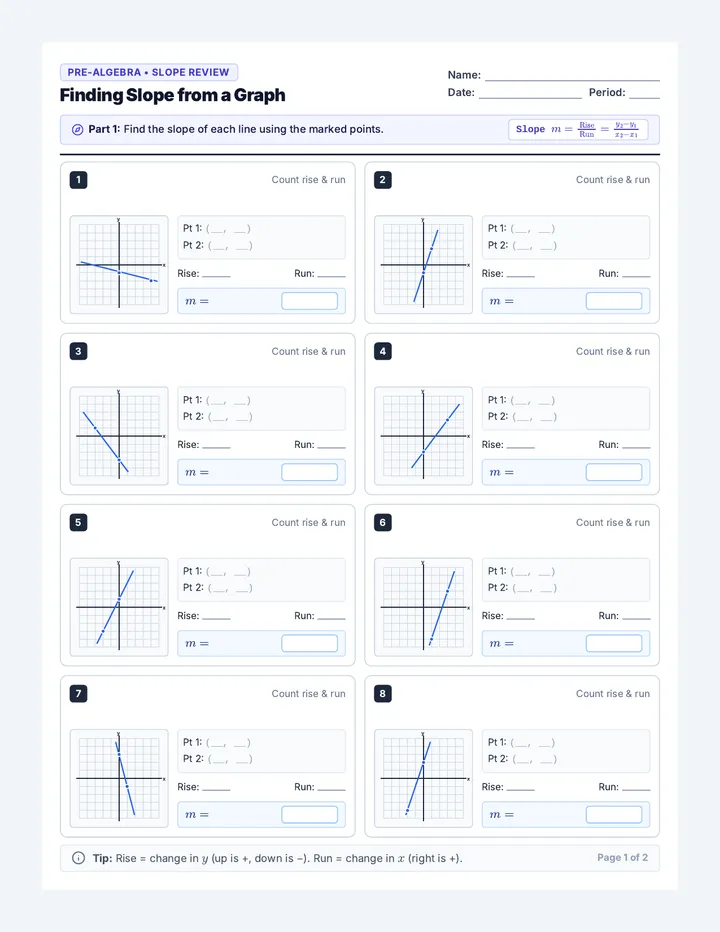
Section A: Find the slope of each line from its graph.
x y
Problem 1
Points: \((-4, 2)\) & \((0, -1)\)
A) \(1\) B) \(-\frac{3}{4}\) C) \(\frac{3}{4}\) D) \(-1\)
Slope \(m =\)
x y
Problem 2
Points: \((-3, -1)\) & \((0, 1)\)
A) \(-\frac{2}{3}\) B) \(\frac{2}{3}\) C) \(\frac{3}{2}\) D) \(-\frac{3}{2}\)
Slope \(m =\)
x y
Problem 3
Points: \((-2, -1)\) & \((0, 1)\)
A) \(1\) B) \(5\) C) \(-1\) D) \(-5\)
Slope \(m =\)
x y
Problem 4
Points: \((-2, 2)\) & \((0, -1)\)
A) \(-\frac{3}{2}\) B) \(\frac{2}{3}\) C) \(-\frac{2}{3}\) D) \(\frac{3}{2}\)
Slope \(m =\)
Section B: Find the slope of the line through each pair of points using \(m = \frac{y_2 - y_1}{x_2 - x_1}\).
- \((19, -3)\) and \((-9, 18)\) Show All Steps
1. Formula Setup: \(m = \frac{(\qquad) - (\qquad)}{(\qquad) - (\qquad)}\)
2. Simplify Signs: \(m = \frac{\qquad}{\qquad}\)
Final Reduced Slope \(m =\)
- \((5, -3)\) and \((18, -8)\) Show All Steps
1. Formula Setup: \(m = \frac{(\qquad) - (\qquad)}{(\qquad) - (\qquad)}\)
2. Simplify Signs: \(m = \frac{\qquad}{\qquad}\)
Final Reduced Slope \(m =\)
- \((-7, -2)\) and \((9, -8)\) Show All Steps
1. Formula Setup: \(m = \frac{(\qquad) - (\qquad)}{(\qquad) - (\qquad)}\)
2. Simplify Signs: \(m = \frac{\qquad}{\qquad}\)
Final Reduced Slope \(m =\)
- \((-4, 6)\) and \((8, 6)\) Show All Steps
1. Formula Setup: \(m = \frac{(\qquad) - (\qquad)}{(\qquad) - (\qquad)}\)
2. Simplify Signs: \(m = \frac{\qquad}{\qquad}\)
Final Reduced Slope \(m =\)
Unit 2.1 Study Guide • Slope & Linear Equations Page 3 of 4
Part 2 Practice
Graphing & Writing Linear Equations
8 Questions • Maximized Workspace
Section C: Identify slope and y-intercept, then sketch each linear graph.
x y
- \(y = -\frac{3}{2}x - 2\)
• \(y\)-intercept: \(b =\)
• Start point: \((0, \_\_\_\_)\)
• Slope \(m =\)
• Staircase: Down 3, Right 2
x y
- \(y = x - 2\)
• \(y\)-intercept: \(b =\)
• Start point: \((0, \_\_\_\_)\)
• Slope \(m =\)
• Staircase: Up 1, Right 1
x y
- \(y = -\frac{1}{2}x\)
• \(y\)-intercept: \(b =\)
• Start point: \((0, \_\_\_\_)\)
• Slope \(m =\)
• Staircase: Down 1, Right 2
x y
- \(y = x + 2\)
• \(y\)-intercept: \(b =\)
• Start point: \((0, \_\_\_\_)\)
• Slope \(m =\)
• Staircase: Up 1, Right 1
Section D: Write the slope-intercept form equation (\(y = mx + b\)) of each line.
Problem 13
1. \(y\)-intercept: \(b =\)
2. Rise/Run: \(\frac{\Delta y}{\Delta x} =\)
3. Slope: \(m =\)
Equation:
Problem 14
1. \(y\)-intercept: \(b =\)
2. Rise/Run: \(\frac{\Delta y}{\Delta x} =\)
3. Slope: \(m =\)
Equation:
Problem 15
1. \(y\)-intercept: \(b =\)
2. Rise/Run: \(\frac{\Delta y}{\Delta x} =\)
3. Slope: \(m =\)
Equation:
Problem 16
1. \(y\)-intercept: \(b =\)
2. Rise/Run: \(\frac{\Delta y}{\Delta x} =\)
3. Slope: \(m =\)
Equation:
Self-Assessment & Exam Readiness
Check off competencies you feel confident solving independently:
Finding slope from graphs Two-point formula Graphing & writing equations
Unit 2.1 Study Guide • Slope & Linear Equations Page 4 of 4
Slope and Lines Answer Key
Teacher & Student Solutions
Slope & Linear Equations Answer Key
Comprehensive Solutions & Common Pitfall Analysis • Part 1
ANSWER KEY
Section A Solutions: Slopes from Graphs (Problems 1–4)
Problem 1 Choice B
• Lattice Points: \((-4, 2)\) & \((0, -1)\)
• Rise / Run: \(\frac{-1 - 2}{0 - (-4)} = \frac{-3}{4}\)
Falls left to right → negative slope confirms!
\(m = -\frac{3}{4}\)
Problem 2 Choice B
• Lattice Points: \((-3, -1)\) & \((0, 1)\)
• Rise / Run: \(\frac{1 - (-1)}{0 - (-3)} = \frac{2}{3}\)
Rises left to right → positive slope confirms!
\(m = \frac{2}{3}\)
Problem 3 Choice A
• Lattice Points: \((-2, -1)\) & \((0, 1)\)
• Rise / Run: \(\frac{1 - (-1)}{0 - (-2)} = \frac{2}{2} = 1\)
Standard 45-degree diagonal line.
\(m = 1\)
Problem 4 Choice A
• Lattice Points: \((-2, 2)\) & \((0, -1)\)
• Rise / Run: \(\frac{-1 - 2}{0 - (-2)} = \frac{-3}{2}\)
Steep downhill line.
\(m = -\frac{3}{2}\)
Section B Solutions: Two-Point Coordinate Slope Formula
- \((19, -3)\) and \((-9, 18)\) Slope = \(-\frac{3}{4}\)
1. Formula: \(m = \frac{y_2 - y_1}{x_2 - x_1}\)
2. Substitute: \(m = \frac{18 - (-3)}{-9 - 19}\)
3. Simplify signs: \(m = \frac{18 + 3}{-28} = \frac{21}{-28}\)
4. Divide GCF (7): \(\mathbf{m = -\frac{3}{4}}\)
- \((5, -3)\) and \((18, -8)\) Slope = \(-\frac{5}{13}\)
1. Formula: \(m = \frac{y_2 - y_1}{x_2 - x_1}\)
2. Substitute: \(m = \frac{-8 - (-3)}{18 - 5}\)
3. Simplify signs: \(m = \frac{-8 + 3}{13} = \frac{-5}{13}\)
4. Already reduced: \(\mathbf{m = -\frac{5}{13}}\)
- \((-7, -2)\) and \((9, -8)\) Slope = \(-\frac{3}{8}\)
1. Formula: \(m = \frac{y_2 - y_1}{x_2 - x_1}\)
2. Substitute: \(m = \frac{-8 - (-2)}{9 - (-7)}\)
3. Simplify signs: \(m = \frac{-8 + 2}{9 + 7} = \frac{-6}{16}\)
4. Divide GCF (2): \(\mathbf{m = -\frac{3}{8}}\)
- \((-4, 6)\) and \((8, 6)\) Slope = \(0\)
1. Formula: \(m = \frac{y_2 - y_1}{x_2 - x_1}\)
2. Substitute: \(m = \frac{6 - 6}{8 - (-4)}\)