Addition Patterns Worksheet 1
Addition Patterns Worksheet
Standard 4.OA.C.5 • Discover the Rule & Hidden Features
Name:
Date:
Directions: Find the rule, extend the sequence by 2 terms, and identify the hidden feature. 20 Questions
1. Pattern: 1, 4, 7, 10, ,
Rule:
Feature: Parity: [ alternates / stays odd ]
2. Pattern: 2, 6, 10, 14, ,
Rule:
Feature: All terms are: [ even / odd ]
3. Pattern: 5, 10, 15, 20, ,
Rule:
Feature: Last digits alternate between:
4. Pattern: 3, 9, 15, 21, ,
Rule:
Feature: All numbers in sequence are: [ odd / even ]
5. Pattern: 4, 14, 24, 34, ,
Rule:
Feature: Every term ends with the digit:
6. Pattern: 40, 37, 34, 31, ,
Rule:
Feature: Parity: [ alternates / stays even ]
7. Pattern: 7, 9, 11, 13, ,
Rule:
Feature: All numbers remain:
8. Pattern: 12, 20, 28, 36, ,
Rule:
Feature: All terms are multiples of 2 and:
9. Pattern: 80, 75, 70, 65, ,
Rule:
Feature: Ones digits alternate between 0 and:
10. Pattern: 1, 8, 15, 22, ,
Rule:
Feature: Parity: [ alternates / stays odd ]
11. Pattern: 6, 12, 18, 24, ,
Rule:
Feature: Every term is an number.
12. Pattern: 2, 11, 20, 29, ,
Rule:
Feature: Parity: [ alternates / stays even ]
13. Pattern: 50, 46, 42, 38, ,
Rule:
Feature: All numbers remain: [ even / odd ]
14. Pattern: 8, 18, 28, 38, ,
Rule:
Feature: The ones digit is always:
15. Pattern: 100, 89, 78, 67, ,
Rule:
Feature: Parity: [ alternates / stays even ]
16. Pattern: 13, 16, 19, 22, ,
Rule:
Feature: Parity alternates between:
17. Pattern: 9, 18, 27, 36, ,
Rule:
Feature: The sum of digits in each term equals:
18. Pattern: 21, 19, 17, 15, ,
Rule:
Feature: All numbers remain:
19. Pattern: 25, 50, 75, 100, ,
Rule:
Feature: Last 2 digits repeat in cycle of: [ 2 / 4 ]
20. Pattern: 0, 12, 24, 36, ,
Rule:
Feature: All terms are divisible by 3 and:
Pattern Detective Rule: Check the difference between consecutive numbers to deduce the rule! Page 1 of 1
Addition Rules Homework Sheet H1
Addition Rules Homework Sheet
Standard 4.OA.C.5 • Deduce the Rule, Discover Features & Explain
Name:
Date:
Directions: Examine each number pattern. (a) Determine and write the rule, (b) calculate Terms 5 and 6, (c) identify an apparent feature not in the rule, and (d) informally explain why it continues.
Question 1 • Given Sequence Pattern Investigation
Term 11
Term 24
Term 37
Term 410
Term 5
Term 6
1. What is the rule?
2. Identify Apparent Feature: What do you notice about whether the terms are odd or even?
3. Informal Explanation: Why will this alternating pattern continue forever?
Question 2 • Given Sequence Pattern Investigation
Term 12
Term 26
Term 310
Term 414
Term 5
Term 6
1. What is the rule?
2. Identify Apparent Feature: Notice the parity. Are there any odd numbers in this sequence?
3. Informal Explanation: Why can an odd number never appear based on this rule?
Question 3 • Given Sequence Pattern Investigation
Term 15
Term 215
Term 325
Term 435
Term 5
Term 6
1. What is the rule?
2. Identify Apparent Feature: Examine the ones place of each number in the sequence.
3. Informal Explanation: Why does this operation never change the digit in the ones place?
Question 4 • Given Sequence Pattern Investigation
Term 160
Term 255
Term 350
Term 445
Term 5
Term 6
1. What is the rule?
2. Identify Apparent Feature: What repeats in the last digit and parity of the numbers?
3. Informal Explanation: Why do the units digits alternate between 0 and 5?
Pattern Detective Tip: Test your rule with the first two pairs before writing it down! Homework Page 1 of 4
Multiplication Patterns Worksheet 2
Multiplication Patterns Worksheet
Standard 4.OA.C.5 • Discover the Rule & Factor Properties
Name:
Date:
Directions: Find the rule, extend the sequence by 2 terms, and identify the hidden feature. 20 Questions
1. Pattern: 2, 4, 8, 16, ,
Rule:
Feature: Every term is an [ even / odd ] number.
2. Pattern: 1, 3, 9, 27, ,
Rule:
Feature: Multiplying odd by odd results in:
3. Pattern: 3, 6, 12, 24, ,
Rule:
Feature: After term 1, all terms are: [ even / odd ]
4. Pattern: 5, 10, 20, 40, ,
Rule:
Feature: After 5, all terms end in digit:
5. Pattern: 1, 4, 16, 64, ,
Rule:
Feature: Last digits cycle between 4 and:
6. Pattern: 1, 10, 100, 1000, ,
Rule:
Feature: Each step adds one more: [ zero / tens ]
7. Pattern: 2, 10, 50, 250, ,
Rule:
Feature: Every term after 2 ends in:
8. Pattern: 64, 32, 16, 8, ,
Rule:
Feature: All terms remain: [ even / odd ] until 1.
9. Pattern: 7, 14, 28, 56, ,
Rule:
Feature: After term 1, all terms are:
10. Pattern: 4, 12, 36, 108, ,
Rule:
Feature: All terms are divisible by:
11. Pattern: 3, 9, 27, 81, ,
Rule:
Feature: Units digit repeats: [ 3, 9, 7, 1 ]
12. Pattern: 5, 25, 125, 625, ,
Rule:
Feature: Every term ends in the digit:
13. Pattern: 6, 12, 24, 48, ,
Rule:
Feature: All terms are multiples of 6 and:
14. Pattern: 81, 27, 9, 3, ,
Rule:
Feature: All numbers in sequence are:
15. Pattern: 10, 30, 90, 270, ,
Rule:
Feature: The ones digit is always:
16. Pattern: 1, 6, 36, 216, ,
Rule:
Feature: Starting with 6, every term ends in:
17. Pattern: 8, 16, 32, 64, ,
Rule:
Feature: Last digits cycle: [ 8, 6, 2, 4 ]
18. Pattern: 100, 50, 25, ,
Rule:
Feature: Parity switches from even to:
19. Pattern: 2, 20, 200, 2000, ,
Rule:
Feature: The leading digit is always:
20. Pattern: 9, 18, 36, 72, ,
Multiplication Rules Homework Sheet H2
Multiplication Rules Homework Sheet
Standard 4.OA.C.5 • Deduce Multiplication Rules & Explain Features
Name:
Date:
Directions: Examine each number pattern. (a) Determine and write the rule, (b) calculate Terms 5 and 6, (c) identify an apparent feature not in the rule, and (d) informally explain why it continues.
Question 1 • Given Sequence Pattern Investigation
Term 12
Term 26
Term 318
Term 454
Term 5
Term 6
1. What is the rule?
2. Identify Apparent Feature: What parity (even or odd) do all terms in this sequence share?
3. Informal Explanation: Why does multiplying an even number by 3 always result in an even number?
Question 2 • Given Sequence Pattern Investigation
Term 15
Term 225
Term 3125
Term 4625
Term 5
Term 6
1. What is the rule?
2. Identify Apparent Feature: What do you notice about the digit in the ones place of every term?
3. Informal Explanation: Why will any product of a number ending in 5 multiplied by 5 always end in 5?
Question 3 • Given Sequence Pattern Investigation
Term 11
Term 22
Term 34
Term 48
Term 516
Term 632
1. What is the rule?
2. Identify Apparent Feature: List the ones digits after 1: 2, 4, 8, 6, 2... What repeating cycle appears?
3. Informal Explanation: Why does doubling 6 give 12 (ends in 2) and restart the same digit pattern?
Question 4 • Given Sequence Pattern Investigation
Term 13
Term 212
Term 348
Term 4192
Term 5
Term 6
1. What is the rule?
2. Identify Apparent Feature: Starting with 12, what common factor do all numbers share?
3. Informal Explanation: Why must every future term in this sequence remain a multiple of 12?
Pattern Detective Tip: Divide any term by the previous term to find the multiplication factor! Homework Page 2 of 4
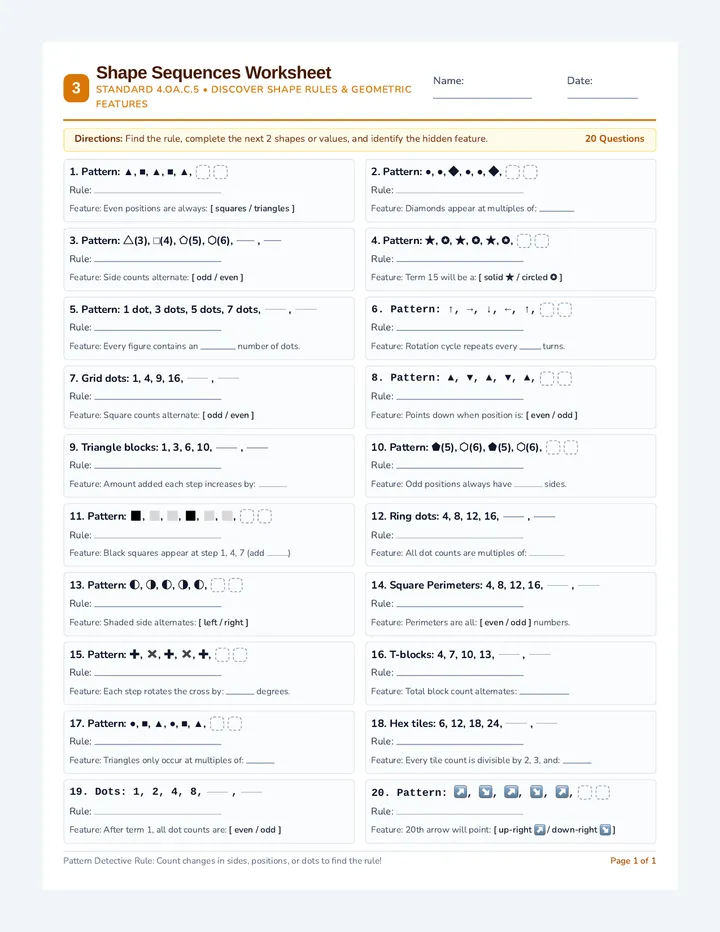
Shape Sequences Worksheet 3
Shape Sequences Worksheet
Standard 4.OA.C.5 • Discover Shape Rules & Geometric Features
Name:
Date:
Directions: Find the rule, complete the next 2 shapes or values, and identify the hidden feature. 20 Questions
1. Pattern: ▲, ■, ▲, ■, ▲,
Rule:
Feature: Even positions are always: [ squares / triangles ]
2. Pattern: ●, ●, ◆, ●, ●, ◆,
Rule:
Feature: Diamonds appear at multiples of:
3. Pattern: △(3), □(4), ⬠(5), ⬡(6), ,
Rule:
Feature: Side counts alternate: [ odd / even ]
4. Pattern: ★, ✪, ★, ✪, ★, ✪,
Rule:
Feature: Term 15 will be a: [ solid ★ / circled ✪ ]
5. Pattern: 1 dot, 3 dots, 5 dots, 7 dots, ,
Rule:
Feature: Every figure contains an number of dots.
6. Pattern: ↑, →, ↓, ←, ↑,
Rule:
Feature: Rotation cycle repeats every turns.
7. Grid dots: 1, 4, 9, 16, ,
Rule:
Feature: Square counts alternate: [ odd / even ]
8. Pattern: ▲, ▼, ▲, ▼, ▲,
Rule:
Feature: Points down when position is: [ even / odd ]
9. Triangle blocks: 1, 3, 6, 10, ,
Rule:
Feature: Amount added each step increases by:
10. Pattern: ⬟(5), ⬡(6), ⬟(5), ⬡(6),
Rule:
Feature: Odd positions always have sides.
11. Pattern: ◼, ◻, ◻, ◼, ◻, ◻,
Rule:
Feature: Black squares appear at step 1, 4, 7 (add )
12. Ring dots: 4, 8, 12, 16, ,
Rule:
Feature: All dot counts are multiples of:
13. Pattern: ◐, ◑, ◐, ◑, ◐,
Rule:
Feature: Shaded side alternates: [ left / right ]
14. Square Perimeters: 4, 8, 12, 16, ,
Rule:
Feature: Perimeters are all: [ even / odd ] numbers.
15. Pattern: ✚, ✖, ✚, ✖, ✚,
Rule:
Feature: Each step rotates the cross by: degrees.
16. T-blocks: 4, 7, 10, 13, ,
Rule:
Feature: Total block count alternates:
17. Pattern: ●, ■, ▲, ●, ■, ▲,
Rule:
Feature: Triangles only occur at multiples of:
18. Hex tiles: 6, 12, 18, 24, ,
Rule:
Feature: Every tile count is divisible by 2, 3, and:
19. Dots: 1, 2, 4, 8, ,
Shape Growth Homework Sheet H3
Shape Growth Homework Sheet
Standard 4.OA.C.5 • Deduce Shape Rules, Perimeters & Explain Features
Name:
Date:
Directions: Examine each geometric pattern. (a) Determine and write the rule of growth, (b) calculate Terms 5 and 6, (c) identify an apparent feature not in the rule, and (d) informally explain why it continues.
Question 1 • Growing Block Tower Pattern Investigation
Fig 11 block
Fig 23 blocks
Fig 35 blocks
Fig 47 blocks
Fig 5
Fig 6
1. What is the rule of growth?
2. Identify Apparent Feature: Examine the total block count. Are any figures even?
3. Informal Explanation: Why does starting with 1 and continually adding 2 always produce odd numbers?
Question 2 • Square Tile Perimeters (Side 1, 2, 3...) Pattern Investigation
Side 1P = 4
Side 2P = 8
Side 3P = 12
Side 4P = 16
Side 5
Side 6
1. What is the rule for finding perimeter?
2. Identify Apparent Feature: What number do all perimeters divide by evenly, and what is their parity?
3. Informal Explanation: Why can a square with whole-number sides never have an odd perimeter?
Question 3 • Rotating Arrow Sequence Pattern Investigation
Step 1↑ Up
Step 2→ Right
Step 3↓ Down
Step 4← Left
Step 5
Step 6
1. What is the rotation rule?
2. Identify Apparent Feature: Which position numbers (odd or even) contain horizontal arrows (→ or ←)?
3. Informal Explanation: Why does rotating by a quarter-turn alternate between vertical and horizontal?
Question 4 • Triangular Dot Clusters Pattern Investigation
Fig 13 dots
Fig 26 dots
Fig 39 dots
Fig 412 dots
Fig 5
Fig 6
1. What is the dot rule?
2. Identify Apparent Feature: Notice the parity of total dots. What alternating pattern appears?
3. Informal Explanation: Why does adding 3 dots each step cause the total dot parity to alternate?
Pattern Detective Tip: Count the sides, dots, or rows of each figure to find the rule of change! Homework Page 3 of 4
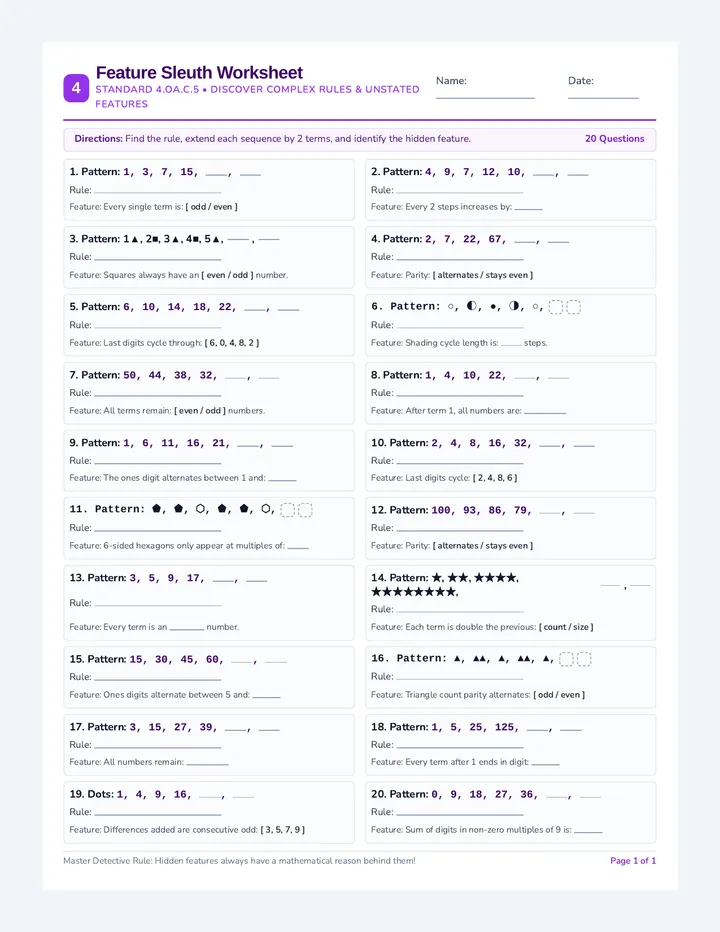
Feature Sleuth Worksheet 4
Feature Sleuth Worksheet
Standard 4.OA.C.5 • Discover Complex Rules & Unstated Features
Name:
Date:
Directions: Find the rule, extend each sequence by 2 terms, and identify the hidden feature. 20 Questions
1. Pattern: 1, 3, 7, 15, ,
Rule:
Feature: Every single term is: [ odd / even ]
2. Pattern: 4, 9, 7, 12, 10, ,
Rule:
Feature: Every 2 steps increases by:
3. Pattern: 1▲, 2■, 3▲, 4■, 5▲, ,
Rule:
Feature: Squares always have an [ even / odd ] number.
4. Pattern: 2, 7, 22, 67, ,
Rule:
Feature: Parity: [ alternates / stays even ]
5. Pattern: 6, 10, 14, 18, 22, ,
Rule:
Feature: Last digits cycle through: [ 6, 0, 4, 8, 2 ]
6. Pattern: ○, ◐, ●, ◑, ○,
Rule:
Feature: Shading cycle length is: steps.
7. Pattern: 50, 44, 38, 32, ,
Rule:
Feature: All terms remain: [ even / odd ] numbers.
8. Pattern: 1, 4, 10, 22, ,
Rule:
Feature: After term 1, all numbers are:
9. Pattern: 1, 6, 11, 16, 21, ,
Rule:
Feature: The ones digit alternates between 1 and:
10. Pattern: 2, 4, 8, 16, 32, ,
Rule:
Feature: Last digits cycle: [ 2, 4, 8, 6 ]
11. Pattern: ⬟, ⬟, ⬡, ⬟, ⬟, ⬡,
Rule:
Feature: 6-sided hexagons only appear at multiples of:
12. Pattern: 100, 93, 86, 79, ,
Rule:
Feature: Parity: [ alternates / stays even ]
13. Pattern: 3, 5, 9, 17, ,
Rule:
Feature: Every term is an number.
14. Pattern: ★, ★★, ★★★★, ★★★★★★★★, ,
Rule:
Feature: Each term is double the previous: [ count / size ]
15. Pattern: 15, 30, 45, 60, ,
Rule:
Feature: Ones digits alternate between 5 and:
16. Pattern: ▲, ▲▲, ▲, ▲▲, ▲,
Rule:
Feature: Triangle count parity alternates: [ odd / even ]
17. Pattern: 3, 15, 27, 39, ,
Rule:
Feature: All numbers remain:
18. Pattern: 1, 5, 25, 125, ,
Rule:
Feature: Every term after 1 ends in digit:
19. Dots: 1, 4, 9, 16, ,
Rule:
Feature: Differences added are consecutive odd: [ 3, 5, 7, 9 ]
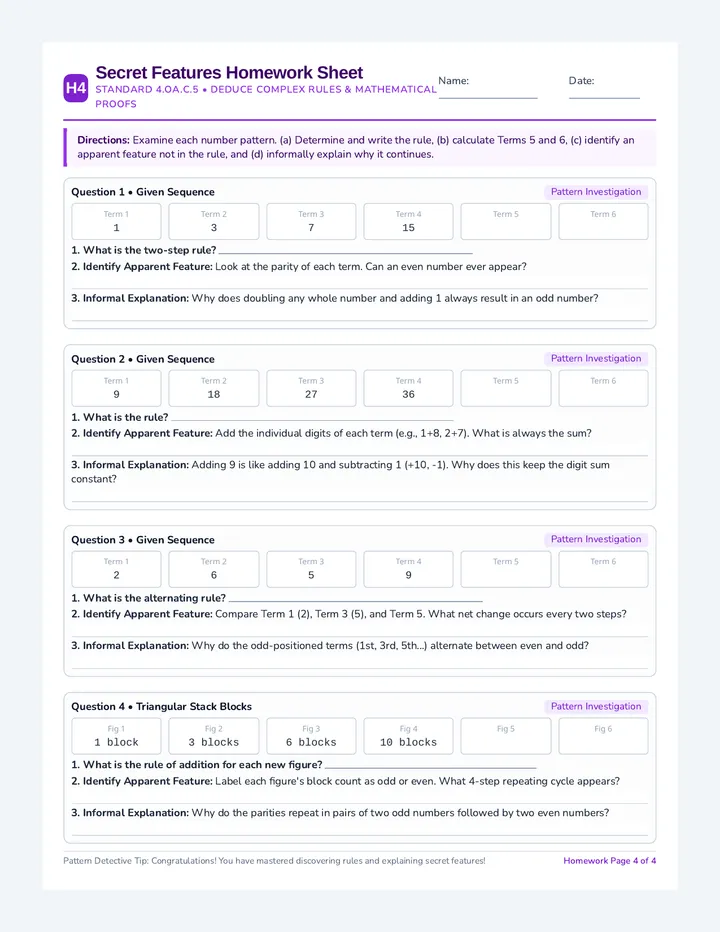
Secret Features Homework Sheet H4
Secret Features Homework Sheet
Standard 4.OA.C.5 • Deduce Complex Rules & Mathematical Proofs
Name:
Date:
Directions: Examine each number pattern. (a) Determine and write the rule, (b) calculate Terms 5 and 6, (c) identify an apparent feature not in the rule, and (d) informally explain why it continues.
Question 1 • Given Sequence Pattern Investigation
Term 11
Term 23
Term 37
Term 415
Term 5
Term 6
1. What is the two-step rule?
2. Identify Apparent Feature: Look at the parity of each term. Can an even number ever appear?
3. Informal Explanation: Why does doubling any whole number and adding 1 always result in an odd number?
Question 2 • Given Sequence Pattern Investigation
Term 19
Term 218
Term 327
Term 436
Term 5
Term 6
1. What is the rule?
2. Identify Apparent Feature: Add the individual digits of each term (e.g., 1+8, 2+7). What is always the sum?
3. Informal Explanation: Adding 9 is like adding 10 and subtracting 1 (+10, -1). Why does this keep the digit sum constant?
Question 3 • Given Sequence Pattern Investigation
Term 12
Term 26
Term 35
Term 49
Term 5
Term 6
1. What is the alternating rule?
2. Identify Apparent Feature: Compare Term 1 (2), Term 3 (5), and Term 5. What net change occurs every two steps?
3. Informal Explanation: Why do the odd-positioned terms (1st, 3rd, 5th...) alternate between even and odd?
Question 4 • Triangular Stack Blocks Pattern Investigation
Fig 11 block
Fig 23 blocks
Fig 36 blocks
Fig 410 blocks
Fig 5
Fig 6
1. What is the rule of addition for each new figure?
2. Identify Apparent Feature: Label each figure's block count as odd or even. What 4-step repeating cycle appears?
3. Informal Explanation: Why do the parities repeat in pairs of two odd numbers followed by two even numbers?
Pattern Detective Tip: Congratulations! You have mastered discovering rules and explaining secret features! Homework Page 4 of 4