Lenny.com
Explore
Create
ActivitiesNewMathEnglish Language ArtsScience & EngineeringSocial StudiesGlobal LanguagesHealth & Physical EducationSpecial EducationCounseling & Life SkillsArts & CreativityESL
Lenny.com
Lenny.com
Explore
Create
ActivitiesNewMathEnglish Language ArtsScience & EngineeringSocial StudiesGlobal LanguagesHealth & Physical EducationSpecial EducationCounseling & Life SkillsArts & CreativityESL
Lenny.com
Lenny.com

Solutions

Lenny for EducatorsLenny for SchoolsLenny for Districts

Product

ExploreSign inCreateSupportAbout

Resources

Getting startedMTSS Acceleration Program

Newsletters

School Funding Newsletter

© 2026 Lenny Learning Inc.

TermsPrivacyAccessibility
LinkedInInstagramX
Lenny
MathNumbers & CountingCounting ObjectsNumber NamesComparing NumbersNumber OperationsCounting SequenceNumbers 0-10Place Value Understanding and SystemAdd and Subtract Within 20Addition and Subtraction ConceptsAddition and Subtraction EquationsAddition and Subtraction ProblemsFoundations for MultiplicationMultiplication and Division PropertiesMultiply and Divide Within 100Multiplication and Division ProblemsFactors and MultiplesProperties of OperationsPatterns and RelationshipsGenerate and Analyze PatternsMulti-Digit ArithmeticPlace Value OperationsMulti-Digit and Decimal OperationsNumerical ExpressionsFour Operations and PatternsFour Operations Problem SolvingMeasurement & DataMeasurable AttributesMeasuring LengthsMeasure and Estimate Lengths in Standard UnitsRelate Addition and Subtraction to LengthClassifying and Counting ObjectsTime and MoneyArea Concepts and MeasurementPerimeter and Area MeasuresAngle Concepts and MeasurementTime, Volume, and MassMeasurement Unit ConversionsGeometryIdentifying ShapesShapes and AttributesShape Attributes and ReasoningShapes and CompositionClassifying 2D FiguresGeometric Figures and RelationshipsLines, Angles, and ShapesAngle, Area, and VolumeGeometric MeasurementVolume of 3D ShapesCoordinate Plane ApplicationsTransformations in the PlaneCongruence and SimilarityUnderstand congruence in terms of rigid motionsSimilarity and TransformationsProve Theorems Involving SimilarityPythagorean TheoremTrigonometry for General TrianglesMake Geometric ConstructionsProve Geometric TheoremsTheorems About CirclesFind Arc Lengths And Areas of Sectors of CirclesVolume FormulasRelationships Between Two-Dimensional and Three-Dimensional ObjectsProve Simple Geometric Theorems AlgebraicallyTranslate Between Geometric Description and Equation for Conic SectionApply Geometric Concepts in Modeling SituationsFractions & DecimalsFractions as NumbersBuilding FractionsFraction Equivalence and OrderingAdding and Subtracting FractionsMultiplying and Dividing FractionsDividing FractionsDecimal FractionsMulti-Digit Computation and FactorsAdd, Subtract, Multiply, and Divide Rational NumbersRational Number SystemIrrational Numbers and ApproximationsRatiosRatios and ProportionsProportional RelationshipsUnit RateAlgebraAlgebraic ExpressionsGenerate Equivalent ExpressionsQuantitative RelationshipsProportional Relationships and Linear EquationsEquations and InequalitiesEquation Solving and ReasoningLinear Equations and SystemsGraph Equations and InequalitiesSystems of EquationsReal-World Algebraic ProblemsQuantitative Reasoning with UnitsExpression StructureEquivalent Expression FormsRadicals and Integer ExponentsRational ExponentsRational and Irrational NumbersPolynomial OperationsPolynomial IdentitiesPolynomial Zeros and FactorsRational ExpressionsComplex Number OperationsComplex Numbers in PolynomialsComplex Numbers on PlaneStatistics & ProbabilityRepresent and Interpret DataData DistributionsStatistical VariabilityProbability ModelsCompound Event ProbabilitiesStatistical SamplingInterpret Categorical and Quantitative DataBivariate Data PatternsInterpret Linear ModelsComparing Two PopulationsRandom Processes in StatisticsIndependence and Conditional ProbabilityExpected ValuesProbability-Based Decision MakingStatistical Inference and ConclusionsFunctionsFunction Concepts and NotationDefine and Compare FunctionsInterpret Functions in ContextAnalyze Function RepresentationsModel Relationships with FunctionsIdentify Linear vs Exponential GrowthDistinguish Between Function TypesCompare Growth RatesInterpret Function ExpressionsBuild Functions from RelationshipsConstruct and Model FunctionsTransform and Combine FunctionsModel Comparison and SelectionSolve Exponential EquationsTrigonometryTrigonometric Ratios Involving Right TrianglesTrigonometric Functions and Unit CircleModel with Trigonometric FunctionsTrigonometric IdentitiesVectors & MatricesIntroduction to Vectors and MatricesVector QuantitiesVector OperationsMatrix OperationsCalculusLimits and ContinuityDerivative Concepts and NotationDerivative Rules and TechniquesApplications of DerivativesOptimization ProblemsRelated RatesCurve Sketching and AnalysisIntegration Concepts and NotationAntiderivatives and Indefinite IntegralsDefinite Integrals and AreaFundamental Theorem of CalculusIntegration TechniquesApplications of IntegrationDifferential EquationsSequences and SeriesParametric and Polar FunctionsVector-Valued Functions

Startup Slope

An interdisciplinary 5th-grade lesson connecting numerical patterns, coordinate graphing, and unit rate to young entrepreneurship. Students explore how a constant addition rule (slope) and startup costs help them plan a small business and reach break-even.

LLogan-Greene

Startup Slope

An interdisciplinary 5th-grade lesson connecting numerical patterns, coordinate graphing, and unit rate to young entrepreneurship. Students explore how a constant addition rule (slope) and startup costs help them plan a small business and reach break-even.

LLogan-Greene
Items SoldTotal Profit Earned (Items × Profit per Item)Startup CostMoney in Pocket
0 items$0 earnedminus startup cost-$ ________
2 items2 × $ _____ = $ _____minus startup cost$ ________
4 items4 × $ _____ = $ _____minus startup cost$ ________
6 items6 × $ _____ = $ _____minus startup cost$ ________
8 items8 × $ _____ = $ _____minus startup cost$ ________
10 items10 × $ _____ = $ _____minus startup cost$ ________

5

My Break-Even Milestone

Divide your startup cost by your profit per item to find how many sales you need to owe $0:

$ ________ (Startup Cost) ÷ $ ________ (Profit Per Item) =

Tip: Check your table above! Where does "Money in Pocket" reach $0?

Break-Even Sales

______ items

6

Savings Goal Challenge

You and your partner want to earn $20 of pure profit to celebrate! Since all startup gear is already paid off at break-even, how many extra items must you sell to reach your $20 savings goal?

$20 savings goal ÷ $ _____ profit per item = ______ extra items

7

My 30-Second Business Pitch

Fill in the blanks to pitch your venture to your class:

"Our business is called _______________________. We sell _______________________ for $_______ each, which gives us a profit of $_______ on every sale. We only need to sell _______ items to reach break-even!"

Startup Slope • 5th Grade Young Entrepreneurs Unit Page 2 of 2

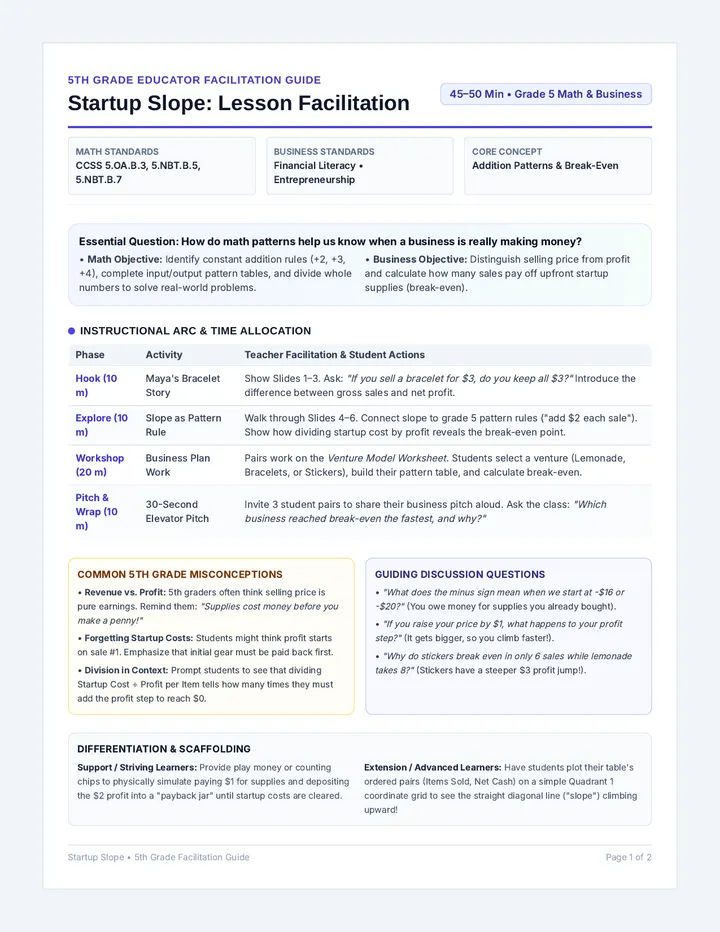
  • • "If you raise your price by $1, what happens to your profit step?" (It gets bigger, so you climb faster!).
  • • "Why do stickers break even in only 6 sales while lemonade takes 8?" (Stickers have a steeper $3 profit jump!).
  • Differentiation & Scaffolding

    Support / Striving Learners: Provide play money or counting chips to physically simulate paying $1 for supplies and depositing the $2 profit into a "payback jar" until startup costs are cleared.

    Extension / Advanced Learners: Have students plot their table's ordered pairs (Items Sold, Net Cash) on a simple Quadrant 1 coordinate grid to see the straight diagonal line ("slope") climbing upward!

    Startup Slope • 5th Grade Facilitation Guide Page 1 of 2

    Comprehensive Answer Key

    Master Solutions & Scoring Rubric

    All 3 Venture Options

    Math Breakdown for All 3 Business Options

    A. Sunshine Lemonade

    1. Profit Per Cup: $3.00 price − $1.00 supply = $2.00 profit

    2. Startup Supplies: $16.00 (pitcher & sign)

    3. Break-Even Math: $16 ÷ $2 = 8 cups

    4. Table Values (Net Cash): 0 cups: -$16
    2 cups: -$12
    4 cups: -$8
    6 cups: -$4
    8 cups: $0 (Break-Even!)
    10 cups: +$4

    5. $20 Savings Challenge: $20 ÷ $2 = 10 extra cups (18 cups total)

    B. Friendship Bracelets

    1. Profit Per Bracelet: $3.00 price − $1.00 supply = $2.00 profit

    2. Startup Supplies: $20.00 (bead organizer kit)

    3. Break-Even Math: $20 ÷ $2 = 10 bracelets

    4. Table Values (Net Cash): 0 items: -$20
    2 items: -$16
    4 items: -$12
    6 items: -$8
    8 items: -$4
    10 items: $0 (Break-Even!)

    5. $20 Savings Challenge: $20 ÷ $2 = 10 extra bracelets (20 total)

    C. Custom Stickers

    1. Profit Per Pack: $4.00 price − $1.00 supply = $3.00 profit

    2. Startup Supplies: $18.00 (paper punch & binder)

    3. Break-Even Math: $18 ÷ $3 = 6 sticker packs

    4. Table Values (Net Cash): 0 items: -$18
    2 items: -$12
    4 items: -$6
    6 items: $0 (Break-Even!)
    8 items: +$6
    10 items: +$12

    5. $20 Savings Challenge: $20 ÷ $3 = 6.67 → 7 extra packs (13 total)

    Part 1 Vocabulary Match Key

    A. Startup Cost: One-time money spent before making any sales.

    B. Profit Per Sale: Price minus supply cost (the pattern addition rule).

    C. Break-Even: The moment you owe $0 and all gear is paid off.

    Student Mastery Evaluation Rubric (4-Point Scale)

    CriteriaProficient (3–4 pts)Developing (1–2 pts)
    Unit Profit & Pattern RuleAccurately subtracts supply cost from selling price; correctly identifies the addition rule per sale.Confuses selling price with profit or makes basic subtraction errors.
    Table & Break-Even MathCorrectly fills pattern table and uses division (Startup Cost ÷ Profit) to pinpoint exact break-even units.Difficulty applying pattern rule across table or calculating the break-even milestone.
    Elevator Pitch & ReflectionCompletes pitch using accurate numbers from their plan; articulates why their business is viable.Leaves blanks unfilled or gives numbers that do not match their table calculations.

    Startup Slope • 5th Grade Master Solutions & Rubric Page 2 of 2
    You might also like

    Balance Scale Slides

    Equation Decoders

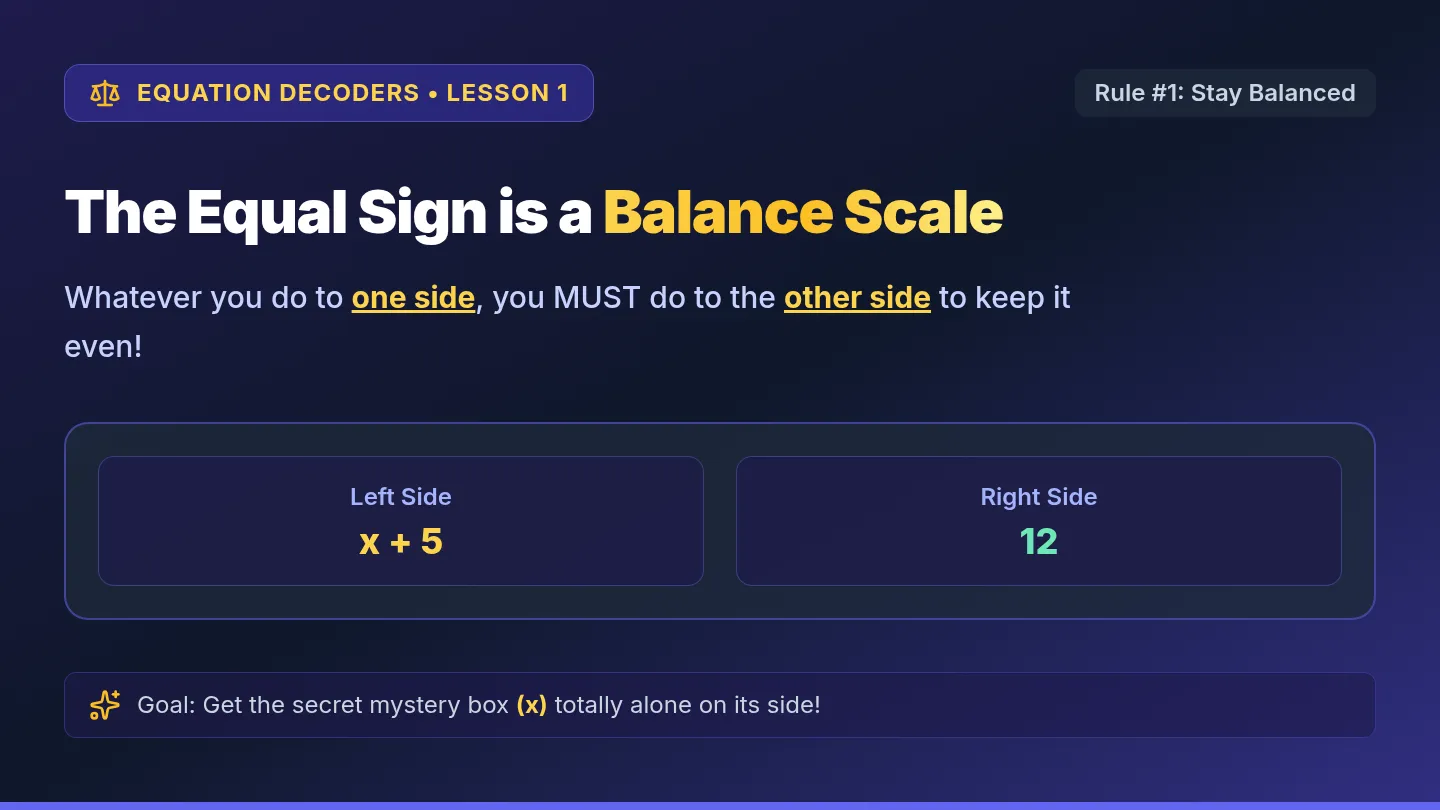
    A scaffolded multi-day sequence engineered for 8th grade students with IEPs and math anxiety, demystifying linear equations through concrete balance models, visual inverse flowcharts, and structured routines.

    DD

    Darryl Davis

    7
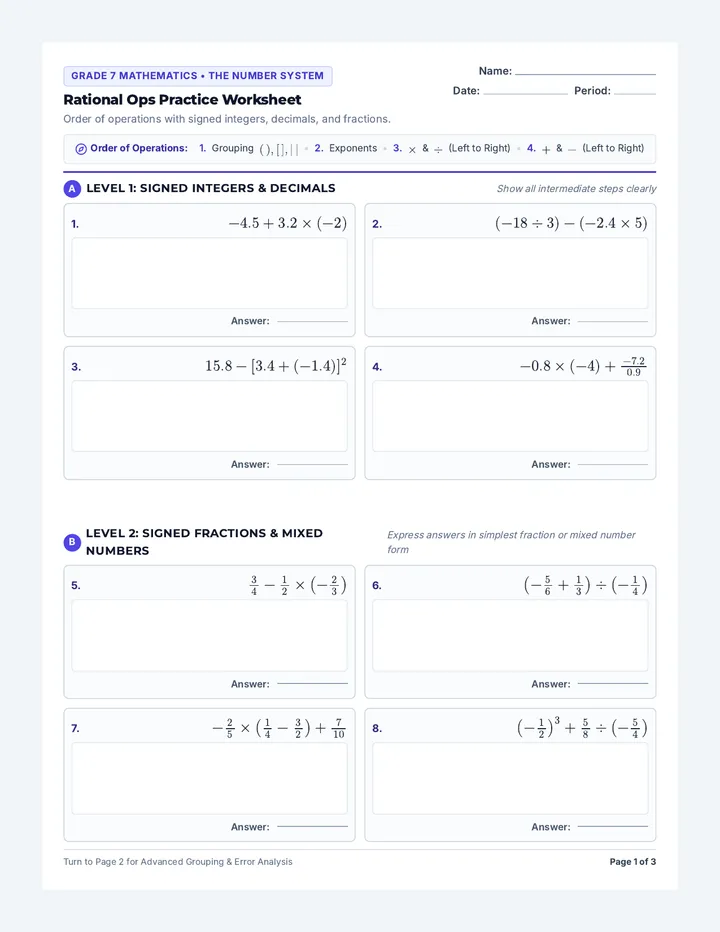
    Rational Ops Practice Worksheet

    Rational Order Operations

    A 7th-grade mathematics lesson covering the order of operations with signed integers, decimals, and fractions. Students master multi-step arithmetic, nested grouping symbols, error analysis, and authentic real-world modeling.

    CW

    Coreen Williams

    2
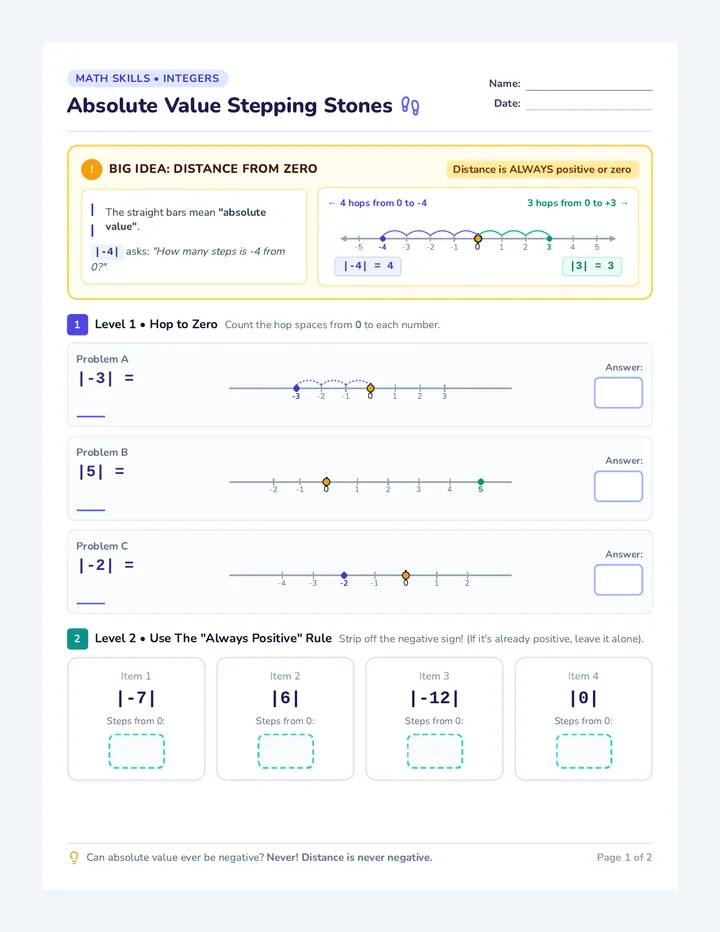
    Absolute Value Stepping Stones Worksheet

    Absolute Value Stepping Stones Worksheet

    A highly scaffolded, IEP-accessible math worksheet introducing absolute value as distance from zero. Features visual number lines with hop arcs, concrete worked examples, chunked multi-level practice, real-world context, and a student self-check.

    CS

    Courtney Scherer

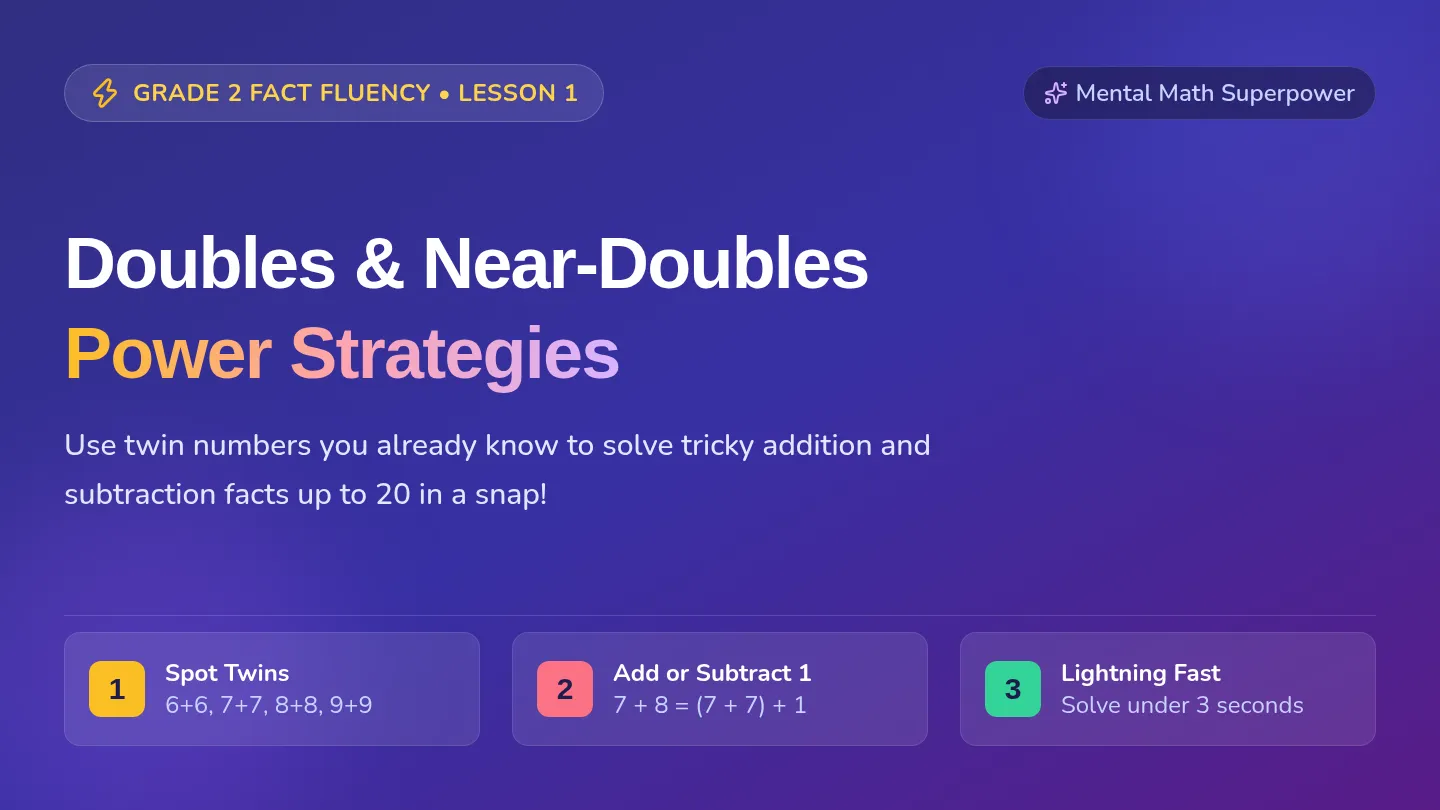
    Doubles Power Slides

    Fact Fluency Sprint

    A three-day scaffolded math sequence designed for second-grade fact fluency within 20, moving systematically through doubles and near-doubles, bridge-through-ten strategies, and mixed fluency consolidation.

    M

    mgamache

    6
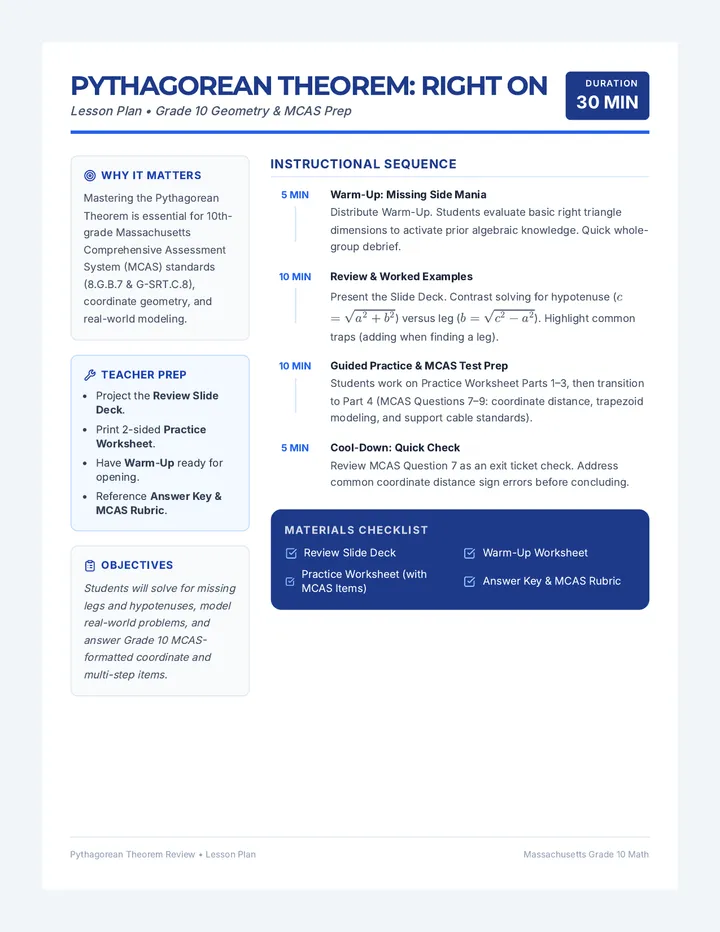
    Pythagorean Lesson Plan

    Pythagorean Theorem Right On

    A 30-minute review lesson for 10th-grade students focusing on the Pythagorean Theorem, its formula, and real-world applications. Students will practice solving for both the hypotenuse and legs of right triangles.

    MA

    Meaghan Allen

    5
    Shadow Curves Scoring Guide

    Shadow Curves Scoring Guide

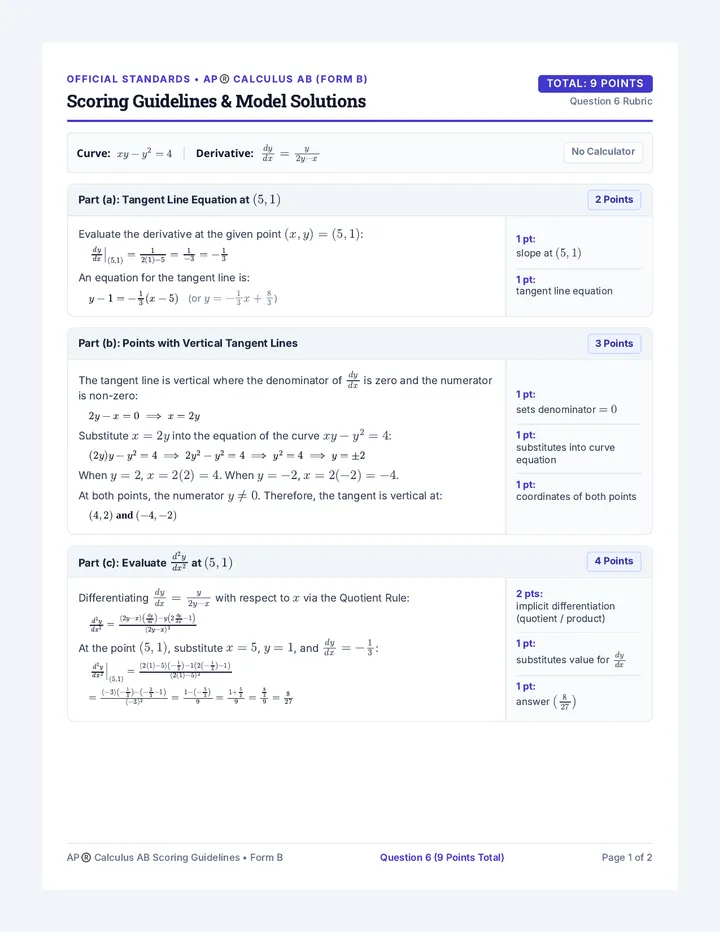
    Comprehensive 9-point College Board-aligned scoring guidelines and model solutions for the second implicit differentiation FRQ (xy - y^2 = 4), including alternative product-rule methods and reader commentary.

    MP

    Michael Paglieroni

    Starting Clues Slides

    Digit Detectives

    A foundational three-part sequence for first-grade learners to develop instant numeral identification and quantity matching for numbers 0 through 10. Through detective-themed visual slides, print-ready practice sheets, and guided teaching routines, students master numeral recognition and sequential order.

    MS

    Melissa Saunders

    9
    Reflections Coordinate Quiz

    Reflections Mastery

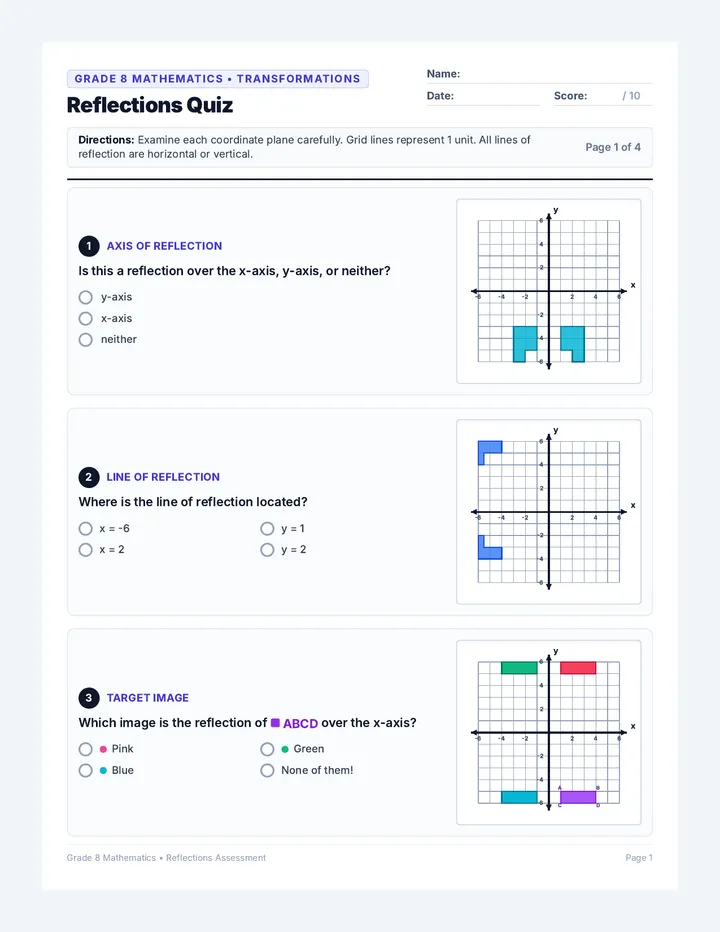
    A Grade 8 math lesson covering reflections across horizontal and vertical lines on the coordinate plane, complete with accessible quizzes in English and Spanish.

    JD

    Jenna Dzioba

    3
    Shadow Curves FRQ Worksheet

    Shadow Curves FRQ Worksheet

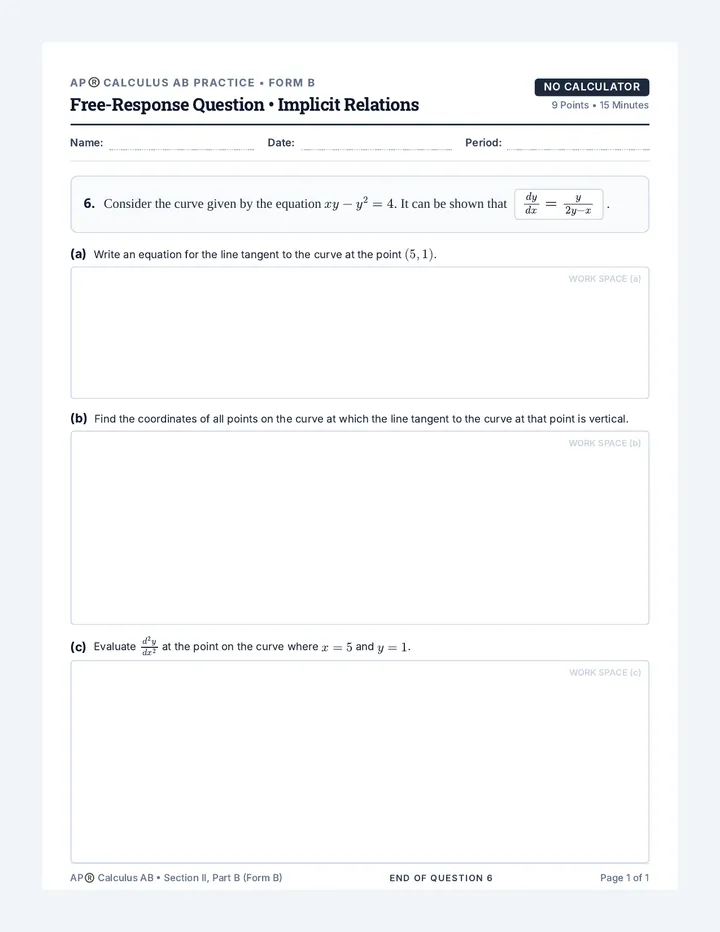
    A second authentic AP-style Free Response Question worksheet featuring the curve xy - y^2 = 4 with three analytical parts, generous student workspaces, and official exam formatting.

    MP

    Michael Paglieroni

    Tens Takeover Slides

    Math Mayhem Bootcamp

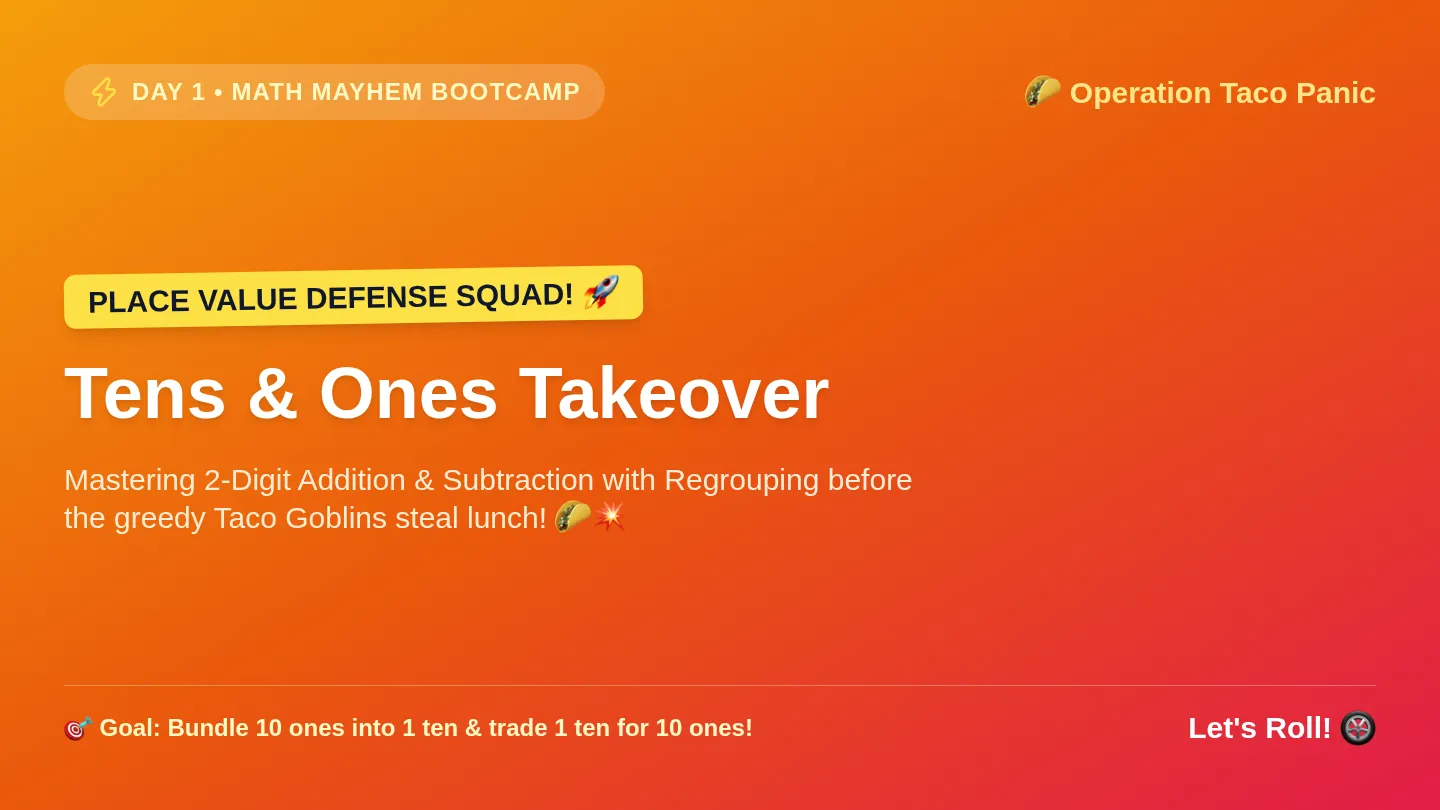
    A 3-day high-energy, humor-packed math bootcamp bridging place value regrouping within 100, expansion to 1000 and repeated addition models, and multi-digit multiplication and division strategies. Every day features scaffolded models, spiral warm-ups, funny storylines, practice problems, and exit tickets.

    LB

    Lara Becker

    10
    Implicit Curves FRQ Worksheet

    Implicit Curves Mastery

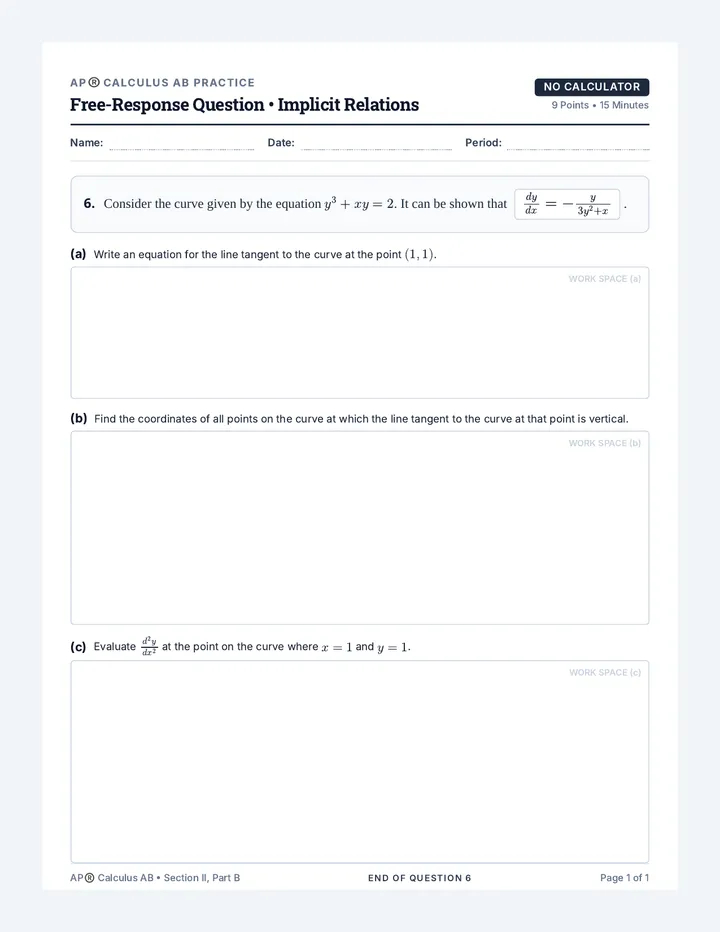
    An AP Calculus AB free-response practice set centered on implicit differentiation, tangent line equations, vertical tangents, and second derivatives. Includes an authentic exam-style student free-response question worksheet and a complete 9-point College Board-aligned scoring rubric.

    MP

    Michael Paglieroni

    4
    Startup Slope Teacher Guide

    Startup Slope Teacher Guide

    A 5th-grade teacher facilitation guide and complete master answer key for educators, featuring lesson pacing, standards alignment, differentiation strategies, and solutions for all three business ventures.

    L

    Logan-Greene