Lenny.com
Explore
Create
ActivitiesNewMathEnglish Language ArtsScience & EngineeringSocial StudiesGlobal LanguagesHealth & Physical EducationSpecial EducationCounseling & Life SkillsArts & CreativityESL
Lenny.com
Lenny.com
Explore
Create
ActivitiesNewMathEnglish Language ArtsScience & EngineeringSocial StudiesGlobal LanguagesHealth & Physical EducationSpecial EducationCounseling & Life SkillsArts & CreativityESL
Lenny.com
Lenny.com

Solutions

Lenny for EducatorsLenny for SchoolsLenny for Districts

Product

ExploreSign inCreateSupportAbout

Resources

Getting startedMTSS Acceleration Program

Newsletters

School Funding Newsletter

© 2026 Lenny Learning Inc.

TermsPrivacyAccessibility
LinkedInInstagramX
Lenny
MathNumbers & CountingCounting ObjectsNumber NamesComparing NumbersNumber OperationsCounting SequenceNumbers 0-10Place Value Understanding and SystemAdd and Subtract Within 20Addition and Subtraction ConceptsAddition and Subtraction EquationsAddition and Subtraction ProblemsFoundations for MultiplicationMultiplication and Division PropertiesMultiply and Divide Within 100Multiplication and Division ProblemsFactors and MultiplesProperties of OperationsPatterns and RelationshipsGenerate and Analyze PatternsMulti-Digit ArithmeticPlace Value OperationsMulti-Digit and Decimal OperationsNumerical ExpressionsFour Operations and PatternsFour Operations Problem SolvingMeasurement & DataMeasurable AttributesMeasuring LengthsMeasure and Estimate Lengths in Standard UnitsRelate Addition and Subtraction to LengthClassifying and Counting ObjectsTime and MoneyArea Concepts and MeasurementPerimeter and Area MeasuresAngle Concepts and MeasurementTime, Volume, and MassMeasurement Unit ConversionsGeometryIdentifying ShapesShapes and AttributesShape Attributes and ReasoningShapes and CompositionClassifying 2D FiguresGeometric Figures and RelationshipsLines, Angles, and ShapesAngle, Area, and VolumeGeometric MeasurementVolume of 3D ShapesCoordinate Plane ApplicationsTransformations in the PlaneCongruence and SimilarityUnderstand congruence in terms of rigid motionsSimilarity and TransformationsProve Theorems Involving SimilarityPythagorean TheoremTrigonometry for General TrianglesMake Geometric ConstructionsProve Geometric TheoremsTheorems About CirclesFind Arc Lengths And Areas of Sectors of CirclesVolume FormulasRelationships Between Two-Dimensional and Three-Dimensional ObjectsProve Simple Geometric Theorems AlgebraicallyTranslate Between Geometric Description and Equation for Conic SectionApply Geometric Concepts in Modeling SituationsFractions & DecimalsFractions as NumbersBuilding FractionsFraction Equivalence and OrderingAdding and Subtracting FractionsMultiplying and Dividing FractionsDividing FractionsDecimal FractionsMulti-Digit Computation and FactorsAdd, Subtract, Multiply, and Divide Rational NumbersRational Number SystemIrrational Numbers and ApproximationsRatiosRatios and ProportionsProportional RelationshipsUnit RateAlgebraAlgebraic ExpressionsGenerate Equivalent ExpressionsQuantitative RelationshipsProportional Relationships and Linear EquationsEquations and InequalitiesEquation Solving and ReasoningLinear Equations and SystemsGraph Equations and InequalitiesSystems of EquationsReal-World Algebraic ProblemsQuantitative Reasoning with UnitsExpression StructureEquivalent Expression FormsRadicals and Integer ExponentsRational ExponentsRational and Irrational NumbersPolynomial OperationsPolynomial IdentitiesPolynomial Zeros and FactorsRational ExpressionsComplex Number OperationsComplex Numbers in PolynomialsComplex Numbers on PlaneStatistics & ProbabilityRepresent and Interpret DataData DistributionsStatistical VariabilityProbability ModelsCompound Event ProbabilitiesStatistical SamplingInterpret Categorical and Quantitative DataBivariate Data PatternsInterpret Linear ModelsComparing Two PopulationsRandom Processes in StatisticsIndependence and Conditional ProbabilityExpected ValuesProbability-Based Decision MakingStatistical Inference and ConclusionsFunctionsFunction Concepts and NotationDefine and Compare FunctionsInterpret Functions in ContextAnalyze Function RepresentationsModel Relationships with FunctionsIdentify Linear vs Exponential GrowthDistinguish Between Function TypesCompare Growth RatesInterpret Function ExpressionsBuild Functions from RelationshipsConstruct and Model FunctionsTransform and Combine FunctionsModel Comparison and SelectionSolve Exponential EquationsTrigonometryTrigonometric Ratios Involving Right TrianglesTrigonometric Functions and Unit CircleModel with Trigonometric FunctionsTrigonometric IdentitiesVectors & MatricesIntroduction to Vectors and MatricesVector QuantitiesVector OperationsMatrix OperationsCalculusLimits and ContinuityDerivative Concepts and NotationDerivative Rules and TechniquesApplications of DerivativesOptimization ProblemsRelated RatesCurve Sketching and AnalysisIntegration Concepts and NotationAntiderivatives and Indefinite IntegralsDefinite Integrals and AreaFundamental Theorem of CalculusIntegration TechniquesApplications of IntegrationDifferential EquationsSequences and SeriesParametric and Polar FunctionsVector-Valued Functions

Rational Order Operations

A 7th-grade mathematics lesson covering the order of operations with signed integers, decimals, and fractions. Students master multi-step arithmetic, nested grouping symbols, error analysis, and authentic real-world modeling.

CWCoreen Williams

Rational Order Operations

A 7th-grade mathematics lesson covering the order of operations with signed integers, decimals, and fractions. Students master multi-step arithmetic, nested grouping symbols, error analysis, and authentic real-world modeling.

CWCoreen Williams

Notice the cross-cancellation of 5s in the multiplication step.

8. \(\left(-\frac{1}{2}\right)^3 + \frac{5}{8} \div \left(-\frac{5}{4}\right)\) Ans: \(-\frac{5}{8}\) (or \(-0.625\))

• Exponent: \(\left(-\frac{1}{2}\right)^3 = -\frac{1}{8}\)

• Divide: \(\frac{5}{8} \times \left(-\frac{4}{5}\right) = -\frac{4}{8} = -\frac{1}{2}\)

• Add: \(-\frac{1}{8} + \left(-\frac{4}{8}\right) = -\frac{5}{8}\)

Watch out: Odd power of negative base stays negative: \((-1/2)^3 = -1/8\).

Turn to Page 2 for Solutions to Nested Grouping, Error Analysis & Puzzles Answer Key • Page 1 of 3

Teacher Resource • Answer Key

Rational Ops Answer Key • Part 2

Solutions for Level 3 nested grouping, Jordan's error analysis, and parentheses placement.

Scoring: 9-12 (2 pts each) • 13 (4 pts) • 14 (2 pts each)

C

Level 3 Solutions: Nested Grouping & Complex Expressions

9. \(-3 \cdot [4.5 - (-\frac{3}{2})] + (-2)^3\) Ans: \(-26\)

• Inner brackets: \(4.5 - (-1.5) = 4.5 + 1.5 = 6.0\)

• Multiply: \(-3 \cdot 6.0 = -18\)

• Exponent: \((-2)^3 = -8\)

• Combine: \(-18 + (-8) = -26\)

10. \(\frac{-15.6 + 3.6}{4 - (-2)} - (-\frac{2}{3}) \times 6\) Ans: \(2\)

• Fraction bar numerator: \(-15.6 + 3.6 = -12.0\)

• Denominator: \(4 - (-2) = 6 \implies \frac{-12}{6} = -2\)

• Multiply: \((-\frac{2}{3}) \times 6 = -4\)

• Subtract: \(-2 - (-4) = -2 + 4 = 2\)

11. \(|-8.4 + 2.4| \div (-0.5)^2 + 3(-\frac{4}{5})\) Ans: \(21.6\) or \(21\frac{3}{5}\)

• Inside absolute value: \(|-6.0| = 6.0\)

• Exponent: \((-0.5)^2 = 0.25\)

• Divide: \(6.0 \div 0.25 = 24\)

• Multiply: \(3 \times (-0.8) = -2.4 \implies 24 - 2.4 = 21.6\)

12. \([(-\frac{1}{3}) \times 9 + 4.8] \div (-0.6)\) Ans: \(-3\)

• Inside brackets: \((-\frac{1}{3}) \times 9 = -3\)

• Add: \(-3 + 4.8 = 1.8\)

• Divide: \(1.8 \div (-0.6) = -3\)

D

Error Analysis Solutions & Rubric (Problem 13)

13a. Sample Student Explanation (2 pts):

"Jordan incorrectly subtracted \(12 - 4\) first. According to the order of operations, exponents and multiplication must be performed before subtraction. Jordan should have calculated \((-\frac{3}{2})^2 = \frac{9}{4}\) first, then multiplied by \(4\), and finally subtracted that from \(12\)."

13b. Correct Evaluation (2 pts): Ans: \(3\)

• Exponent: \((-\frac{3}{2})^2 = \frac{9}{4}\)

• Multiply: \(4 \times \frac{9}{4} = 9\)

• Subtract: \(12 - 9 = 3\)

E

Grouping Puzzle Solutions (Problem 14)

14a. Target: \(-18\) Verified

(-5.5 + 2.5) \(\times 4 - 6 = -18\)

Check: \((-3.0) \times 4 - 6 = -12 - 6 = -18\).

14b. Target: \(-20\) Verified

\(15 \div\) (-2.5 + 5.5) \(\times (-4) = -20\)

Check: \(15 \div 3.0 \times (-4) = 5 \times (-4) = -20\).

Turn to Page 3 for Real-World Word Problem Solutions & Scoring Rubrics Answer Key • Page 2 of 3

Teacher Resource • Answer Key

Rational Ops Answer Key • Part 3

Real-world modeling solutions, expression formulation, and full arithmetic verifications.

Scoring Rubric (4 pts each): 1 pt expression • 2 pts work • 1 pt answer & unit

15. Ocean Trench Exploration (Marine Science) Ans: \(-207.3\text{ meters}\)

Valid Expression: \(-180.5 - 6 \times 12\frac{1}{2} + 48.2\) (or \(-180.5 + 6(-12.5) + 48.2\))

Step 1: Descent product: \(6 \times 12.5 = 75\text{ m}\)

Step 2: Elevation after descent: \(-180.5 - 75 = -255.5\text{ m}\)

Step 3: Ascent addition: \(-255.5 + 48.2 = -207.3\text{ m}\)

Accept also: "207.3 meters below sea level".

16. Student Checking Account (Personal Finance) Ans: \(\$89.15\)

Valid Expression: \(52.40 - 3(14.75) + 85.50 - 4.50\)

Step 1: Total subscriptions: \(3 \times 14.75 = 44.25\)

Step 2: Balance after subscriptions: \(52.40 - 44.25 = 8.15\)

Step 3: Deposit addition: \(8.15 + 85.50 = 93.65\)

Step 4: Maintenance fee: \(93.65 - 4.50 = 89.15\)

Students must include the dollar sign (\(\$\)).

17. Polar Cold Front (Atmospheric Science) Ans: \(-11.7^\circ\text{F}\) or \(-11\frac{7}{10}^\circ\text{F}\)

Valid Expression: \(-6.5 - 4 \times 2\frac{3}{4} + 5.8\) (or \(-6.5 + 4(-2.75) + 5.8\))

Step 1: Total drop: \(4 \times 2.75 = 11.0^\circ\text{F}\) (or \(4 \times \frac{11}{4} = 11\))

Step 2: Temperature after drop: \(-6.5 - 11 = -17.5^\circ\text{F}\)

Step 3: Midday rise: \(-17.5 + 5.8 = -11.7^\circ\text{F}\)

Must include degree symbol and Fahrenheit unit (\(^\circ\text{F}\)).

18. Custom Bookcase Framing (Carpentry & Design) Ans: \(11\frac{5}{8}\text{ in}\) or \(11.625\text{ in}\)

Valid Expression: \(84 - [3(16\frac{1}{4}) + 2(11.5) + 5(\frac{1}{8})]\)

Step 1: Shelves: \(3 \times 16.25 = 48.75\text{ in}\)

Step 2: Slats: \(2 \times 11.5 = 23.0\text{ in}\); Kerf sawdust: \(5 \times 0.125 = 0.625\text{ in}\)

Step 3: Total wood used: \(48.75 + 23.0 + 0.625 = 72.375\text{ in}\) (\(72\frac{3}{8}\))

Step 4: Remaining: \(84 - 72.375 = 11.625\text{ in}\) (\(11\frac{5}{8}\text{ in}\))

Award full credit for either fraction (\(11\frac{5}{8}\text{ in}\)) or decimal (\(11.625\text{ in}\)).

Order of Operations with Rational Numbers • Teacher Reference Guide Answer Key • Page 3 of 3
You might also like

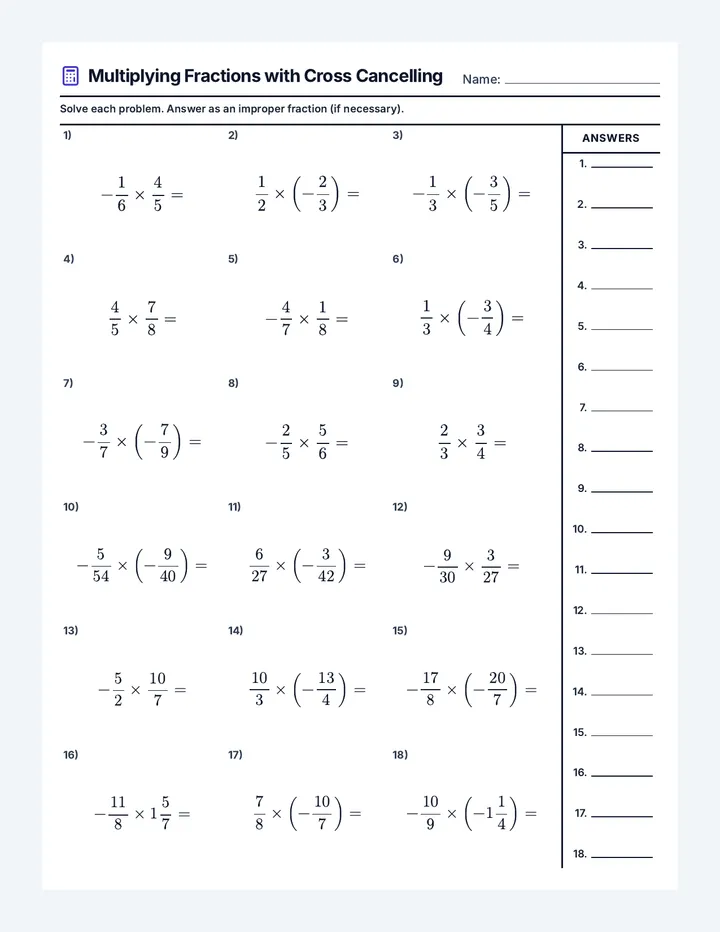
Cross Cancelling Fractions Worksheet

Fraction Operations

A comprehensive sequence covering fraction multiplication with cross-cancelling techniques and fraction division using reciprocals.

T

tsthibeault

11
Startup Slope Slides

Startup Slope

An interdisciplinary 5th-grade lesson connecting numerical patterns, coordinate graphing, and unit rate to young entrepreneurship. Students explore how a constant addition rule (slope) and startup costs help them plan a small business and reach break-even.

L

Logan-Greene

3
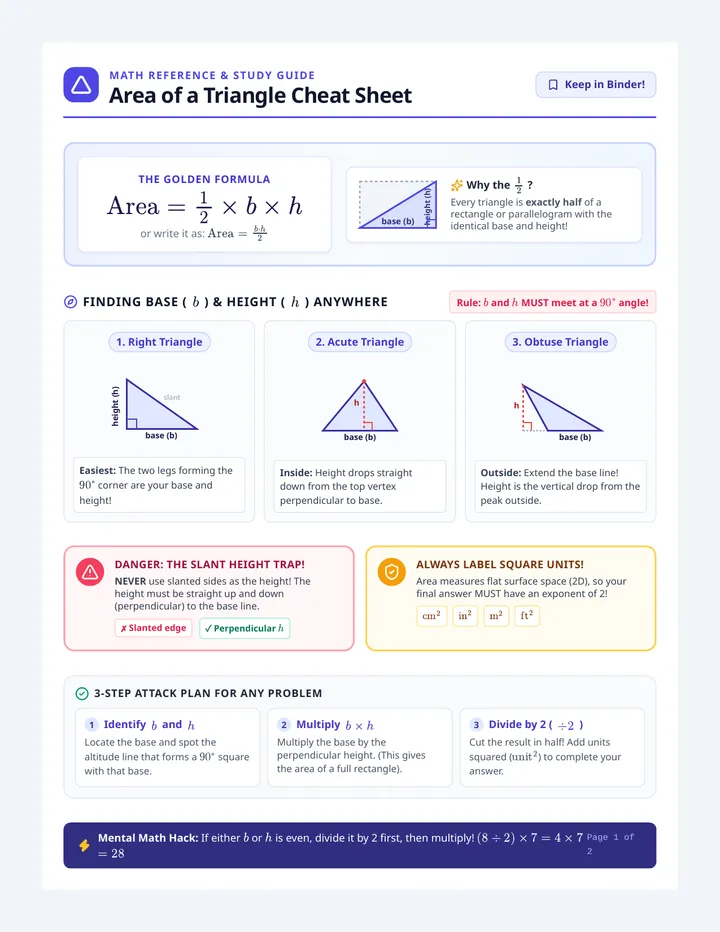
Triangle Area Cheat Sheet

Triangle Area Cheat Sheet

A student-friendly 2-page resource featuring an area of a triangle cheat sheet on page 1 and a streamlined practice sheet on page 2 with concise word problems and no squared-unit option pills.

MD

Michelle Doyle

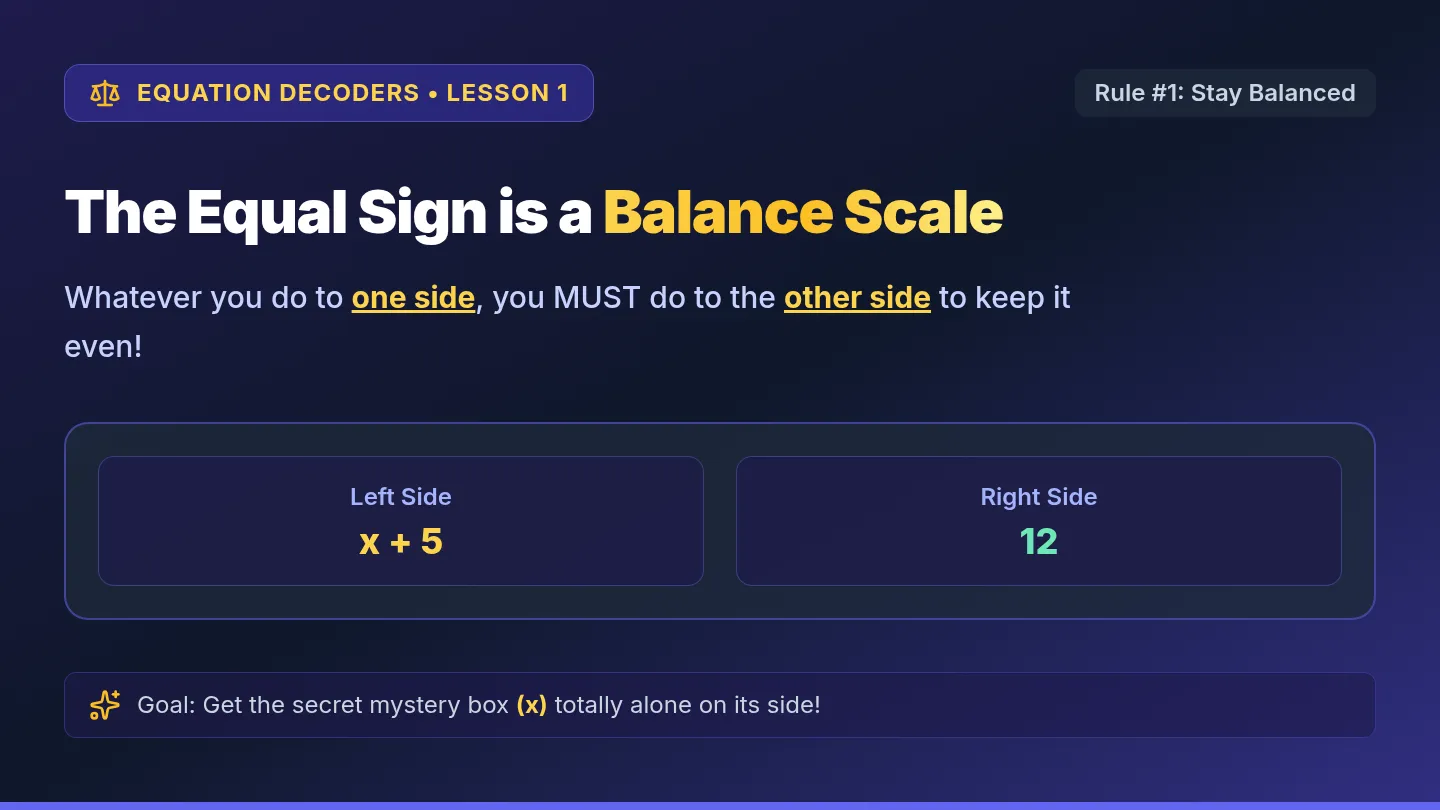
Balance Scale Slides

Equation Decoders

A scaffolded multi-day sequence engineered for 8th grade students with IEPs and math anxiety, demystifying linear equations through concrete balance models, visual inverse flowcharts, and structured routines.

DD

Darryl Davis

7
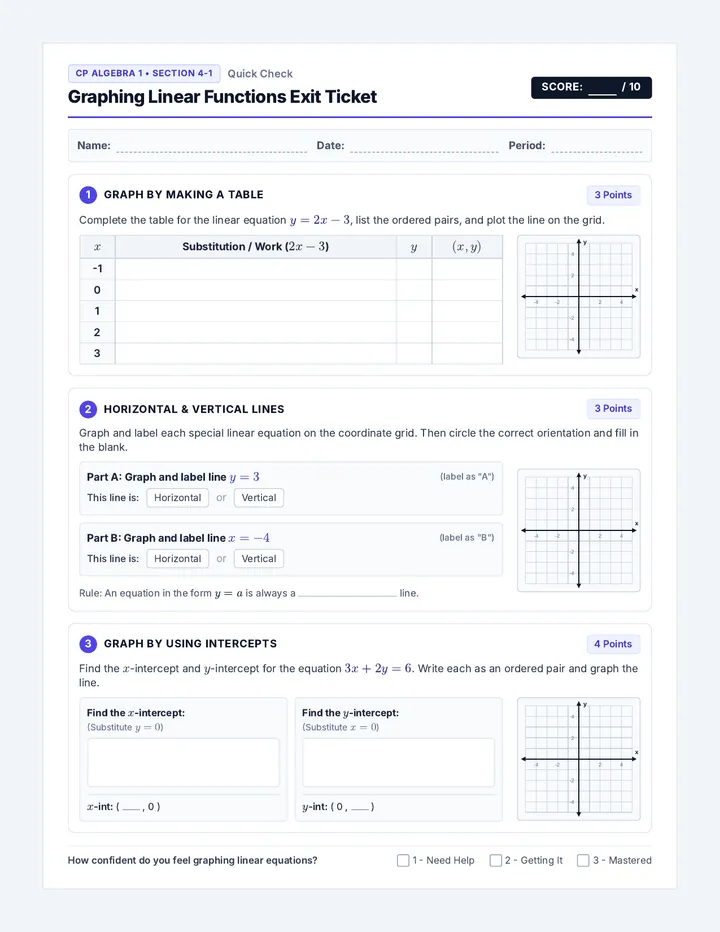
Linear Functions Exit Ticket

Graphing Linear Functions

A high school Algebra 1 lesson on graphing linear equations using tables of values, identifying horizontal and vertical special lines, and calculating x- and y-intercepts.

K

kgreene

2
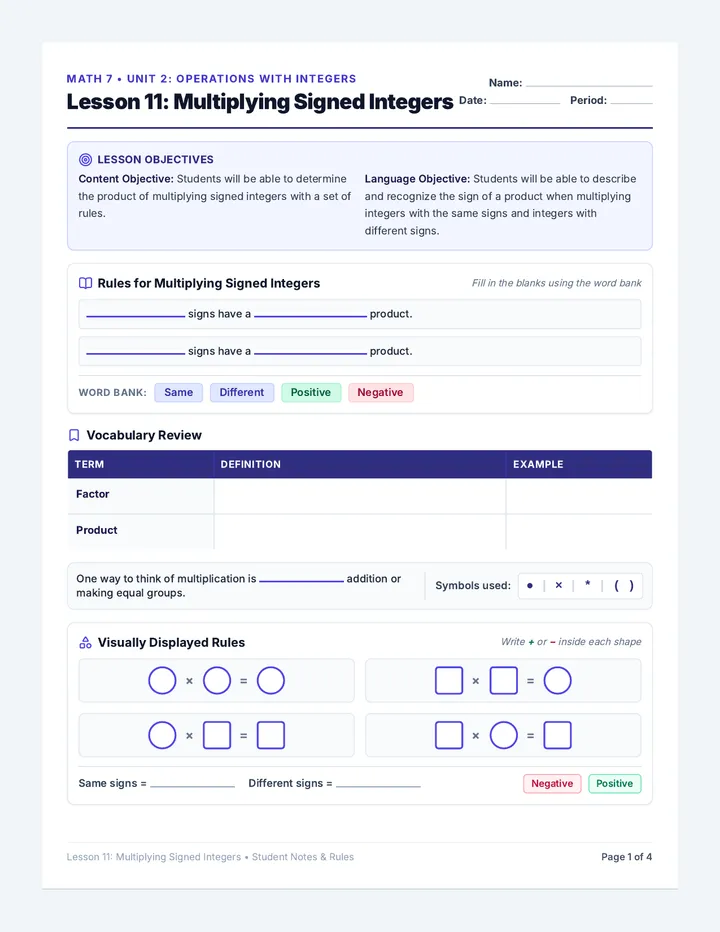
Multiplying Signed Integers Worksheet

Multiplying Signed Integers Worksheet

A comprehensive 4-page student worksheet packet for multiplying signed integers, updated with substantially enlarged, dedicated workspace and answer boxes for problems 4 through 14 on the final page.

D

dlspadaro

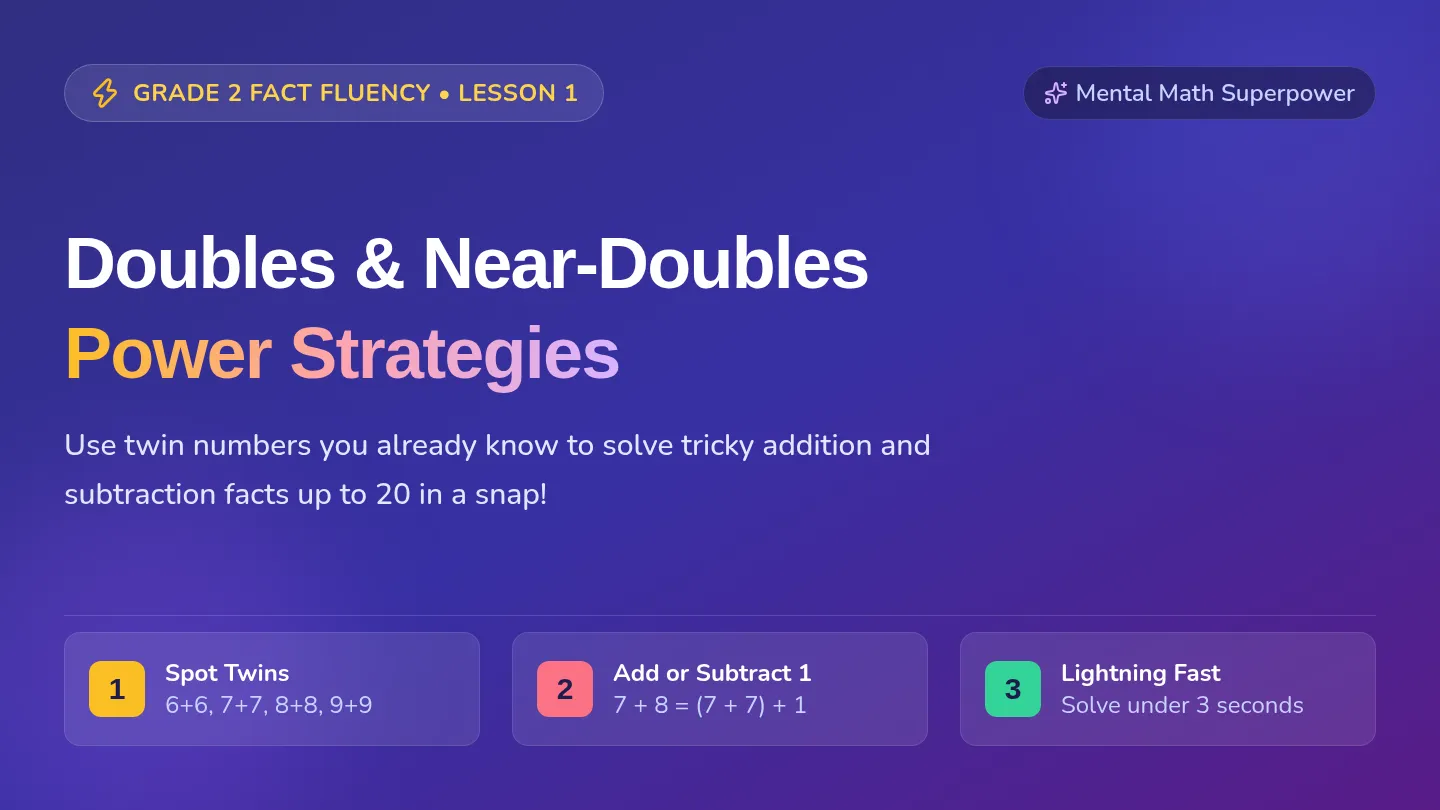
Doubles Power Slides

Fact Fluency Sprint

A three-day scaffolded math sequence designed for second-grade fact fluency within 20, moving systematically through doubles and near-doubles, bridge-through-ten strategies, and mixed fluency consolidation.

M

mgamache

6
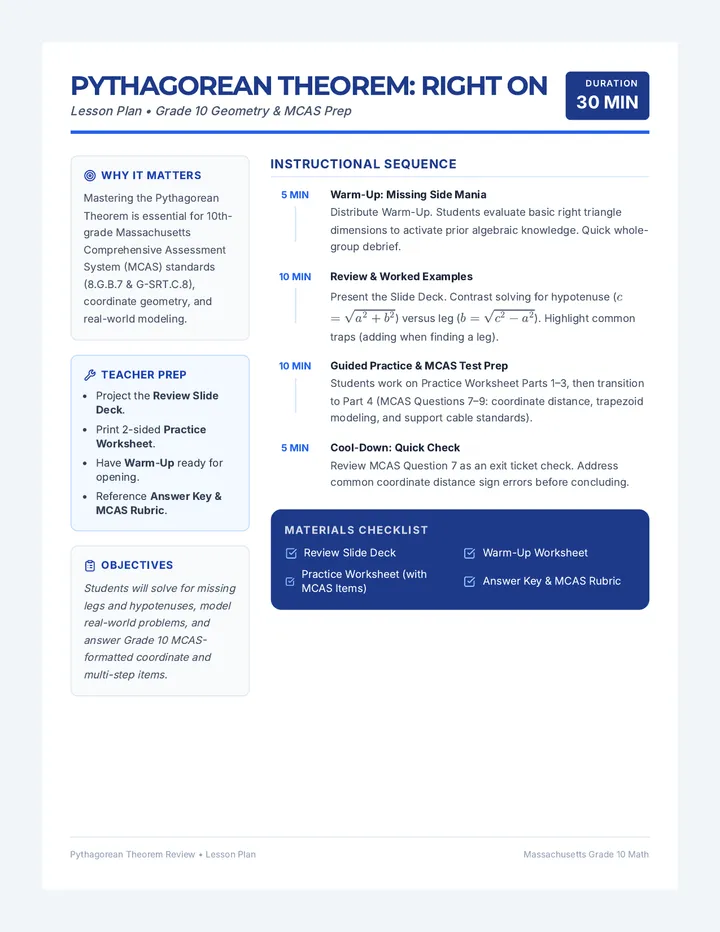
Pythagorean Lesson Plan

Pythagorean Theorem Right On

A 30-minute review lesson for 10th-grade students focusing on the Pythagorean Theorem, its formula, and real-world applications. Students will practice solving for both the hypotenuse and legs of right triangles.

MA

Meaghan Allen

5
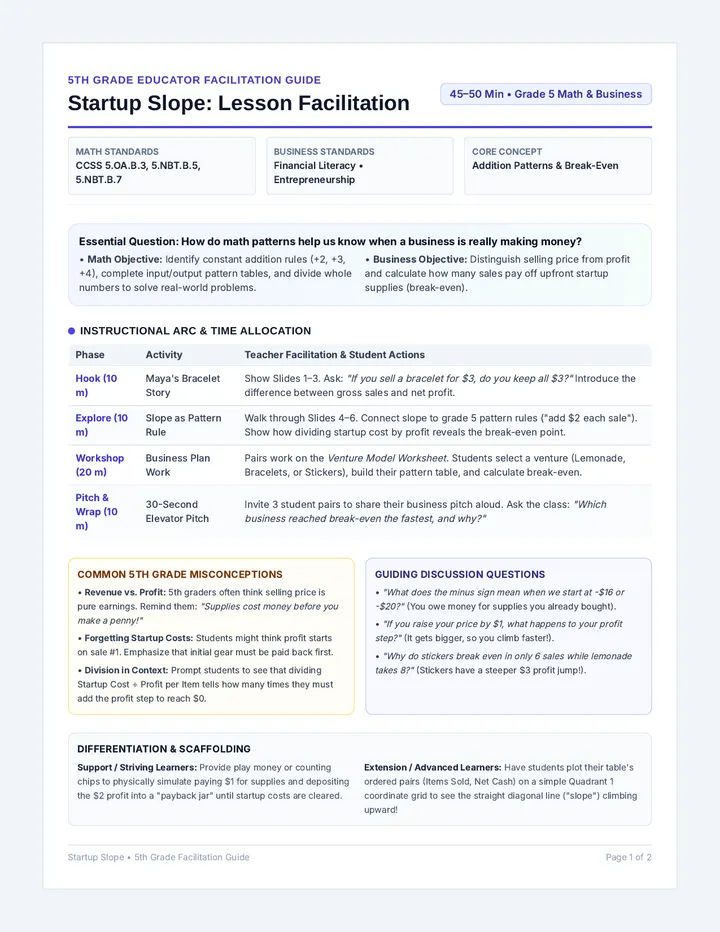
Startup Slope Teacher Guide

Startup Slope Teacher Guide

A 5th-grade teacher facilitation guide and complete master answer key for educators, featuring lesson pacing, standards alignment, differentiation strategies, and solutions for all three business ventures.

L

Logan-Greene

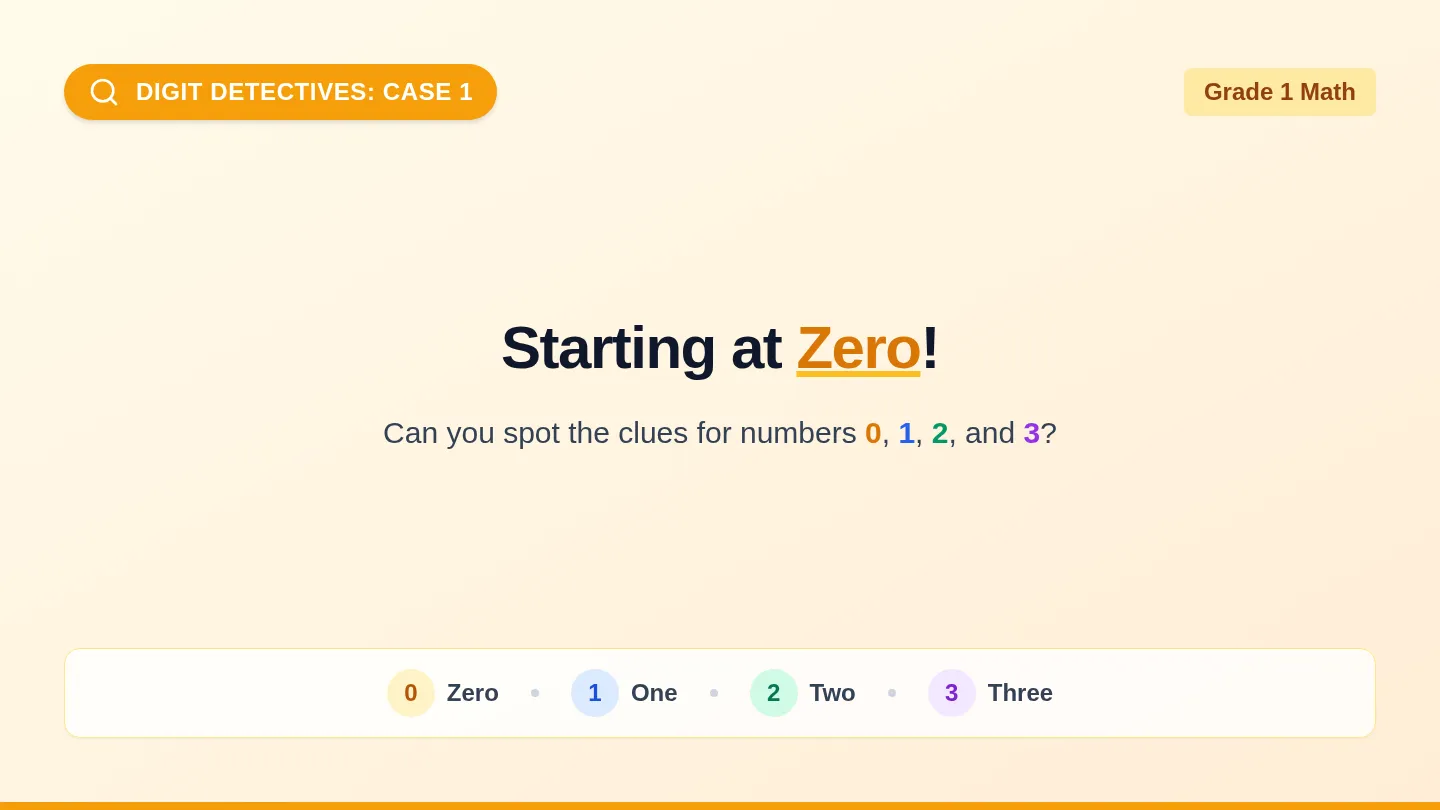
Starting Clues Slides

Digit Detectives

A foundational three-part sequence for first-grade learners to develop instant numeral identification and quantity matching for numbers 0 through 10. Through detective-themed visual slides, print-ready practice sheets, and guided teaching routines, students master numeral recognition and sequential order.

MS

Melissa Saunders

9
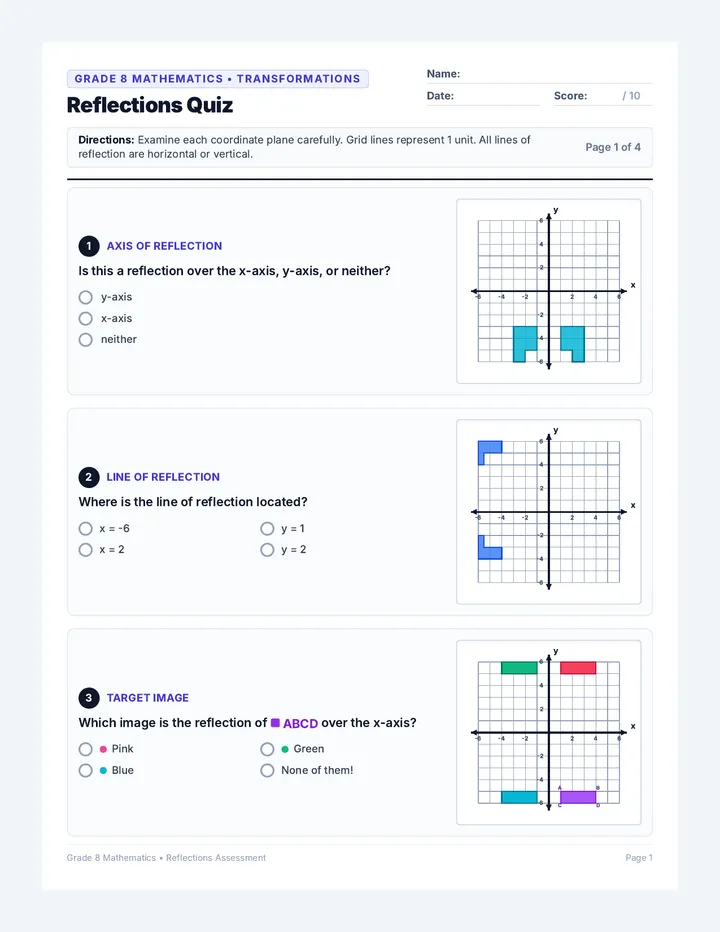
Reflections Coordinate Quiz

Reflections Mastery

A Grade 8 math lesson covering reflections across horizontal and vertical lines on the coordinate plane, complete with accessible quizzes in English and Spanish.

JD

Jenna Dzioba

3
Venture Model Worksheet

Venture Model Worksheet

A two-page printable 5th-grade financial planning activity where students calculate unit profit, complete input/output pattern tables, find their break-even milestone, and write a business pitch.

L

Logan-Greene