Implicit Curves Scoring Guide
Official Standards • AP® Calculus AB
Scoring Guidelines & Model Solutions
Total: 9 Points
Question 6 Rubric
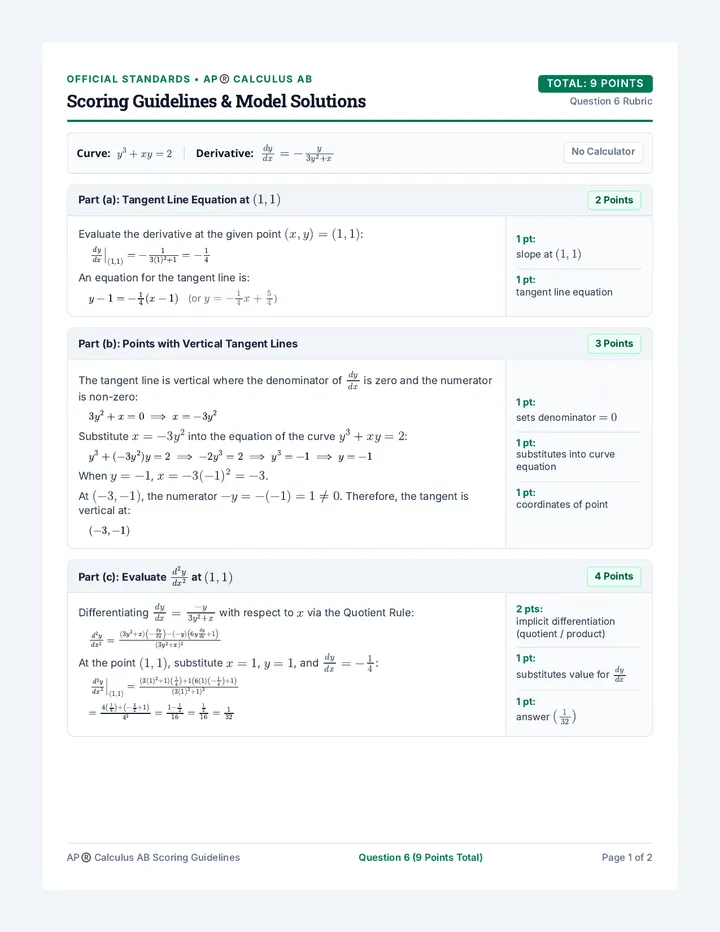
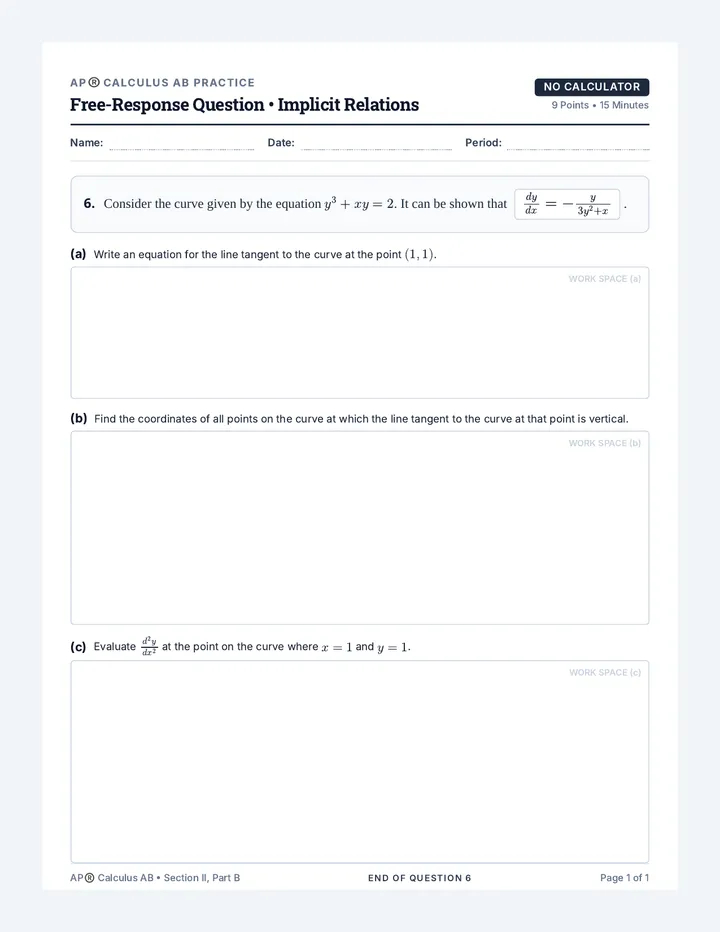
Curve: \(y^3 + xy = 2\) | Derivative: \(\frac{dy}{dx} = -\frac{y}{3y^2 + x}\)
No Calculator
Part (a): Tangent Line Equation at \((1, 1)\) 2 Points
Evaluate the derivative at the given point \((x, y) = (1, 1)\):
\(\left.\frac{dy}{dx}\right|_{(1,1)} = -\frac{1}{3(1)^2 + 1} = -\frac{1}{4}\)
An equation for the tangent line is:
\(y - 1 = -\frac{1}{4}(x - 1)\) (or \(y = -\frac{1}{4}x + \frac{5}{4}\))
1 pt: slope at \((1, 1)\)
1 pt: tangent line equation
Part (b): Points with Vertical Tangent Lines 3 Points
The tangent line is vertical where the denominator of \(\frac{dy}{dx}\) is zero and the numerator is non-zero:
\(3y^2 + x = 0 \implies x = -3y^2\)
Substitute \(x = -3y^2\) into the equation of the curve \(y^3 + xy = 2\):
\(y^3 + (-3y^2)y = 2 \implies -2y^3 = 2 \implies y^3 = -1 \implies y = -1\)
When \(y = -1\), \(x = -3(-1)^2 = -3\).
At \((-3, -1)\), the numerator \(-y = -(-1) = 1 \neq 0\). Therefore, the tangent is vertical at:
\((-3, -1)\)
1 pt: sets denominator \(= 0\)
1 pt: substitutes into curve equation
1 pt: coordinates of point
Part (c): Evaluate \(\frac{d^2y}{dx^2}\) at \((1, 1)\) 4 Points
Differentiating \(\frac{dy}{dx} = \frac{-y}{3y^2 + x}\) with respect to \(x\) via the Quotient Rule:
\(\frac{d^2y}{dx^2} = \frac{(3y^2 + x)\left(-\frac{dy}{dx}\right) - (-y)\left(6y\frac{dy}{dx} + 1\right)}{(3y^2 + x)^2}\)
At the point \((1, 1)\), substitute \(x = 1\), \(y = 1\), and \(\frac{dy}{dx} = -\frac{1}{4}\):
\(\left.\frac{d^2y}{dx^2}\right|_{(1,1)} = \frac{(3(1)^2 + 1)\left(\frac{1}{4}\right) + 1\left(6(1)\left(-\frac{1}{4}\right) + 1\right)}{(3(1)^2 + 1)^2}\)
\(= \frac{4\left(\frac{1}{4}\right) + \left(-\frac{3}{2} + 1\right)}{4^2} = \frac{1 - \frac{1}{2}}{16} = \frac{\frac{1}{2}}{16} = \frac{1}{32}\)
2 pts: implicit differentiation (quotient / product)
1 pt: substitutes value for \(\frac{dy}{dx}\)
1 pt: answer \(\left(\frac{1}{32}\right)\)
AP® Calculus AB Scoring Guidelines Question 6 (9 Points Total) Page 1 of 2
Pedagogical Guide & Reader Notes
Scoring Analysis & Alternative Methods
Teacher Reference
Alternative Method
Implicit Product Rule for Part (c)
Students may clear the denominator first by rewriting the relation as \((3y^2 + x)\frac{dy}{dx} = -y\), then differentiating implicitly with respect to \(x\):
\(\frac{d}{dx}\left[(3y^2 + x)\frac{dy}{dx}\right] = \frac{d}{dx}[-y]\)
\(\left(6y\frac{dy}{dx} + 1\right)\frac{dy}{dx} + (3y^2 + x)\frac{d^2y}{dx^2} = -\frac{dy}{dx}\)
Substitute \(x = 1\), \(y = 1\), and \(\frac{dy}{dx} = -\frac{1}{4}\):
\(\left(6(1)\left(-\frac{1}{4}\right) + 1\right)\left(-\frac{1}{4}\right) + (3(1) + 1)\frac{d^2y}{dx^2} = -\left(-\frac{1}{4}\right) \implies \left(-\frac{1}{2}\right)\left(-\frac{1}{4}\right) + 4\frac{d^2y}{dx^2} = \frac{1}{4}\)
\(\frac{1}{8} + 4\frac{d^2y}{dx^2} = \frac{1}{4} \implies 4\frac{d^2y}{dx^2} = \frac{1}{8} \implies \frac{d^2y}{dx^2} = \frac{1}{32}\)
Scoring Note: Full credit (4/4) is awarded for this method. The 2 differentiation points are earned for the product and chain rule application.
⚠️ Common Error: Part (b) Domain Check
Students frequently find \(x = -3y^2\) and stop, failing to substitute back into the original curve equation \(y^3 + xy = 2\). Remember that the question asks for the coordinates of points on the curve, requiring both \(x\) and \(y\) coordinates.
⚠️ Common Error: Part (c) Chain Rule Missing
When differentiating \(3y^2\) in the quotient rule, students often write \(6y\) instead of \(6y\frac{dy}{dx}\). This omits the implicit derivative factor and caps the score on part (c) at a maximum of 1/4 points.
College Board Grading Conventions
- • Unsimplified Answers: On AP exams, numerical answers do not have to be simplified to lowest terms. An expression such as \(\frac{4(1/4) - 1/2}{16}\) with correct values substituted earns the final answer point if not simplified or if left as a valid arithmetic expression.
- • Tangent Line Forms: Both point-slope form \(y - 1 = -\frac{1}{4}(x - 1)\) and slope-intercept form \(y = -\frac{1}{4}x + \frac{5}{4}\) earn the full point. Standard form \(x + 4y = 5\) is also acceptable.
- • Zero Denominator & Numerator: For part (b), students must ensure the numerator is non-zero (since \(\frac{0}{0}\) is indeterminate and could represent a cusp, node, or removable singularity rather than a vertical tangent). Pointing out \(-y = 1 \neq 0\) guarantees mathematical rigor.
AP® Calculus AB Scoring Guidelines Question 6 (Pedagogical Standards) Page 2 of 2