Lenny.com
Explore
Create
ActivitiesNewMathEnglish Language ArtsScience & EngineeringSocial StudiesGlobal LanguagesHealth & Physical EducationSpecial EducationCounseling & Life SkillsArts & CreativityESL
Lenny.com
Lenny.com
Explore
Create
ActivitiesNewMathEnglish Language ArtsScience & EngineeringSocial StudiesGlobal LanguagesHealth & Physical EducationSpecial EducationCounseling & Life SkillsArts & CreativityESL
Lenny.com
Lenny.com

Solutions

Lenny for EducatorsLenny for SchoolsLenny for Districts

Product

ExploreSign inCreateSupportAbout

Resources

Getting startedMTSS Acceleration Program

Newsletters

School Funding Newsletter

© 2026 Lenny Learning Inc.

TermsPrivacyAccessibility
LinkedInInstagramX
Lenny
MathNumbers & CountingCounting ObjectsNumber NamesComparing NumbersNumber OperationsCounting SequenceNumbers 0-10Place Value Understanding and SystemAdd and Subtract Within 20Addition and Subtraction ConceptsAddition and Subtraction EquationsAddition and Subtraction ProblemsFoundations for MultiplicationMultiplication and Division PropertiesMultiply and Divide Within 100Multiplication and Division ProblemsFactors and MultiplesProperties of OperationsPatterns and RelationshipsGenerate and Analyze PatternsMulti-Digit ArithmeticPlace Value OperationsMulti-Digit and Decimal OperationsNumerical ExpressionsFour Operations and PatternsFour Operations Problem SolvingMeasurement & DataMeasurable AttributesMeasuring LengthsMeasure and Estimate Lengths in Standard UnitsRelate Addition and Subtraction to LengthClassifying and Counting ObjectsTime and MoneyArea Concepts and MeasurementPerimeter and Area MeasuresAngle Concepts and MeasurementTime, Volume, and MassMeasurement Unit ConversionsGeometryIdentifying ShapesShapes and AttributesShape Attributes and ReasoningShapes and CompositionClassifying 2D FiguresGeometric Figures and RelationshipsLines, Angles, and ShapesAngle, Area, and VolumeGeometric MeasurementVolume of 3D ShapesCoordinate Plane ApplicationsTransformations in the PlaneCongruence and SimilarityUnderstand congruence in terms of rigid motionsSimilarity and TransformationsProve Theorems Involving SimilarityPythagorean TheoremTrigonometry for General TrianglesMake Geometric ConstructionsProve Geometric TheoremsTheorems About CirclesFind Arc Lengths And Areas of Sectors of CirclesVolume FormulasRelationships Between Two-Dimensional and Three-Dimensional ObjectsProve Simple Geometric Theorems AlgebraicallyTranslate Between Geometric Description and Equation for Conic SectionApply Geometric Concepts in Modeling SituationsFractions & DecimalsFractions as NumbersBuilding FractionsFraction Equivalence and OrderingAdding and Subtracting FractionsMultiplying and Dividing FractionsDividing FractionsDecimal FractionsMulti-Digit Computation and FactorsAdd, Subtract, Multiply, and Divide Rational NumbersRational Number SystemIrrational Numbers and ApproximationsRatiosRatios and ProportionsProportional RelationshipsUnit RateAlgebraAlgebraic ExpressionsGenerate Equivalent ExpressionsQuantitative RelationshipsProportional Relationships and Linear EquationsEquations and InequalitiesEquation Solving and ReasoningLinear Equations and SystemsGraph Equations and InequalitiesSystems of EquationsReal-World Algebraic ProblemsQuantitative Reasoning with UnitsExpression StructureEquivalent Expression FormsRadicals and Integer ExponentsRational ExponentsRational and Irrational NumbersPolynomial OperationsPolynomial IdentitiesPolynomial Zeros and FactorsRational ExpressionsComplex Number OperationsComplex Numbers in PolynomialsComplex Numbers on PlaneStatistics & ProbabilityRepresent and Interpret DataData DistributionsStatistical VariabilityProbability ModelsCompound Event ProbabilitiesStatistical SamplingInterpret Categorical and Quantitative DataBivariate Data PatternsInterpret Linear ModelsComparing Two PopulationsRandom Processes in StatisticsIndependence and Conditional ProbabilityExpected ValuesProbability-Based Decision MakingStatistical Inference and ConclusionsFunctionsFunction Concepts and NotationDefine and Compare FunctionsInterpret Functions in ContextAnalyze Function RepresentationsModel Relationships with FunctionsIdentify Linear vs Exponential GrowthDistinguish Between Function TypesCompare Growth RatesInterpret Function ExpressionsBuild Functions from RelationshipsConstruct and Model FunctionsTransform and Combine FunctionsModel Comparison and SelectionSolve Exponential EquationsTrigonometryTrigonometric Ratios Involving Right TrianglesTrigonometric Functions and Unit CircleModel with Trigonometric FunctionsTrigonometric IdentitiesVectors & MatricesIntroduction to Vectors and MatricesVector QuantitiesVector OperationsMatrix OperationsCalculusLimits and ContinuityDerivative Concepts and NotationDerivative Rules and TechniquesApplications of DerivativesOptimization ProblemsRelated RatesCurve Sketching and AnalysisIntegration Concepts and NotationAntiderivatives and Indefinite IntegralsDefinite Integrals and AreaFundamental Theorem of CalculusIntegration TechniquesApplications of IntegrationDifferential EquationsSequences and SeriesParametric and Polar FunctionsVector-Valued Functions

Integration Intro

Introductory unit covering definite and indefinite integrals, basic antiderivative rules, Riemann sums, properties of definite integrals, and accumulation functions.

MPMichael Paglieroni

Integration Intro

Introductory unit covering definite and indefinite integrals, basic antiderivative rules, Riemann sums, properties of definite integrals, and accumulation functions.

MPMichael Paglieroni

\(\frac{b^x}{\ln b} + C\)

14.) \(\int \frac{1}{1+x^2}\,dx\)

\(\arctan x + C\)

15.) \(\int \frac{1}{\sqrt{1-x^2}}\,dx\)

\(\arcsin x + C\)

*16.) \(\int \frac{1}{|x|\sqrt{x^2-1}}\,dx\)

\(\operatorname{arcsec} x + C\)

Key • Page 1 of 4

Multiple Choice Worked Solutions #17–21

10 Points (2 pts each)

17.) \(\int (x^3 - 6x)\,dx\) Correct: (D)

• Power Rule of Integration: \(\int x^n\,dx = \frac{x^{n+1}}{n+1} + C\) for \(n \ne -1\).

• \(\int x^3\,dx = \frac{x^4}{4}\) and \(\int 6x\,dx = 6\left(\frac{x^2}{2}\right) = 3x^2\).

• Combining terms gives \(\frac{x^4}{4} - 3x^2 + C\).

Distractor Analysis: (A) took the derivative; (B) failed to divide \(6x\) by 2; (C) divided \(x^4\) by 3.

18.) Trapezoidal Sum Approximation Correct: (B)

• Trapezoid formula for unequal subintervals: \(\text{Area}_i = \frac{R(t_{i-1}) + R(t_i)}{2} \cdot \Delta t_i\)

\([0, 3]\): \(\frac{5+9}{2}(3) = 7(3) = 21\)

\([3, 7]\): \(\frac{9+11}{2}(4) = 10(4) = 40\)

\([7, 10]\): \(\frac{11+15}{2}(3) = 13(3) = 39\)

• Total \(= 21 + 40 + 39 = 100\) gallons.

Distractor Analysis: (A) 84 is left Riemann sum; (D) 120 is right Riemann sum; (C) 112 is midpoint or arithmetic error.

19.) \(\int_4^0 \sqrt{16 - x^2}\,dx\) Correct: (A)

• \(y = \sqrt{16 - x^2}\) represents the upper semicircle of radius \(r = 4\) centered at \((0,0)\).

• On \([0, 4]\), the area represents a quarter circle: \(\frac{1}{4}\pi r^2 = \frac{1}{4}\pi(16) = 4\pi\).

• Reversing the limits switches the sign: \(\int_4^0 \sqrt{16-x^2}\,dx = -\int_0^4 \sqrt{16-x^2}\,dx = -4\pi\).

Distractor Analysis: (B) forgot the negative sign from reversed limits; (C) used semicircle instead of quarter circle.

20.) \(\int \left(e^x + \frac{4}{x}\right)\,dx\) Correct: (C)

• Sum rule: \(\int e^x\,dx + 4\int \frac{1}{x}\,dx = e^x + 4\ln|x| + C = 4\ln|x| + e^x + C\).

• Essential rule: \(\int x^{-1}\,dx = \ln|x| + C\). The absolute value bars are mandatory.

Distractor Analysis: (A) treated \(4/x\) as \(4x\); (B) swapped coefficient 4 onto \(e^x\); (D) used power rule incorrectly (\(x^0/0\)).

21.) Total Accumulation from Rate Model Correct: (D)

• By the Net Change Theorem, the definite integral of a rate of change \(r(t)\) over an interval \([a, b]\) gives the net accumulation: \(\text{Total} = \int_0^{10} r(t)\,dt\).

Distractor Analysis: (A) only gives the instantaneous rate at \(t=10\); (B) and (C) apply to the integral of the derivative \(r'(t)\), which gives change in rate rather than total emissions.

Key • Page 2 of 4

Multiple Choice Worked Solutions #22–26

10 Points (2 pts each)

22.) \(\int \frac{7}{1+x^2}\,dx\) Correct: (D)

• Constant multiple rule: \(\int \frac{7}{1+x^2}\,dx = 7 \int \frac{1}{1+x^2}\,dx = 7\arctan(x) + C\).

Distractor Analysis: (A) took derivative using quotient rule; (B) and (E) mistakenly used logarithm without recognizing inverse trig form (which would require \(2x\) in numerator).

23.) \(\int_{-3}^3 (4x + 3)\,dx\) Correct: (A)

• Method 1 (Symmetry): \(4x\) is odd over symmetric interval \([-3, 3]\), so \(\int_{-3}^3 4x\,dx = 0\). The constant \(3\) gives \(3 \times (3 - (-3)) = 3 \times 6 = 18\).

• Method 2 (FTC): \(\left[2x^2 + 3x\right]_{-3}^3 = \left(2(9) + 9\right) - \left(2(9) - 9\right) = 27 - 9 = 18\).

Distractor Analysis: (C) 0 assumes the entire integrand is odd; (B) sign error; (E) 36 doubled without subtracting.

24.) \(\int_{-2}^4 \frac{|x|}{x}\,dx\) Correct: (C)

• Definition of \(\frac{|x|}{x}\): \(-1\) for \(x < 0\) and \(+1\) for \(x > 0\) (removable discontinuity at \(x = 0\)).

• \(\int_{-2}^0 (-1)\,dx + \int_0^4 (1)\,dx = (-1)(0 - (-2)) + (1)(4 - 0) = -2 + 4 = 2\).

Distractor Analysis: (E) believes jump discontinuity prevents integration; (A) missed positive interval; (B) calculated for \([-1, 2]\).

25.) Antiderivative of \(6x^2 + \sqrt[3]{x} + \sin x\) Correct: (B)

• Rewrite with rational exponents: \(f(x) = 6x^2 + x^{1/3} + \sin x\).

• Integrate each term: \(\int 6x^2\,dx = 2x^3\); \(\int x^{1/3}\,dx = \frac{x^{4/3}}{4/3} = \frac{3\sqrt[3]{x^4}}{4}\); \(\int \sin x\,dx = -\cos x\).

• Result: \(F(x) = 2x^3 + \frac{3\sqrt[3]{x^4}}{4} - \cos x + C\).

Distractor Analysis: (A) and (C) differentiated \(6x^2\) instead of integrating; (C) had wrong sign for \(\cos x\).

26.) \(\int_0^4 |x - 1|\,dx\) Correct: (D)

• Vertex of \(V\)-shape is at \(x = 1\), splitting into two right triangles:

• On \([0, 1]\): base \(= 1\), height \(= |0 - 1| = 1 \implies \text{Area}_1 = \frac{1}{2}(1)(1) = 0.5\).

• On \([1, 4]\): base \(= 3\), height \(= |4 - 1| = 3 \implies \text{Area}_2 = \frac{1}{2}(3)(3) = 4.5\).

• Total \(= 0.5 + 4.5 = 5\).

Distractor Analysis: (A) integrated without absolute value: \([x^2/2 - x]_0^4 = 8 - 4 = 4\); (B) calculation error on triangle 2.

Key • Page 3 of 4

FRQ Scoring Rubric

Free Response: Draining Tank – 9 Points (Doubled to 18)

Calculator Permitted

Part (a): Interpretation & Right Riemann Sum 2 Points

Interpretation [1 pt]: "\(\int_{60}^{135} f(t)\,dt\) is the total volume of water in gallons pumped into the cistern from time \(t = 60\) seconds to \(t = 135\) seconds." (Must include context, units [gallons], and time interval).

Right Riemann Sum [1 pt]: \[ \begin{aligned} \int_{60}^{135} f(t)\,dt &\approx (90 - 60)f(90) + (120 - 90)f(120) + (135 - 120)f(135) \\ &= 30(0.18) + 30(0.12) + 15(0.06) = 5.4 + 3.6 + 0.9 = \mathbf{9.9\text{ gallons}} \end{aligned} \]

Part (b): Existence of Horizontal Tangent \(f'(c) = 0\) 2 Points

Continuity & Differentiability [1 pt]: State that \(f\) is differentiable on \([0, 150]\), which guarantees \(f\) is continuous on \([60, 120]\) and differentiable on \((60, 120)\).

MVT / Rolle's Justification [1 pt]: Since \(f(60) = 0.12\) and \(f(120) = 0.12\), the average rate of change is: \[\frac{f(120) - f(60)}{120 - 60} = \frac{0.12 - 0.12}{60} = 0\] By Rolle's Theorem (or the Mean Value Theorem), there must exist at least one \(c \in (60, 120)\) such that \(f'(c) = 0\).

Part (c): Integral of Model \(g(t)\) & Riemann Over/Underestimate 3 Points

Definite Integral Value [1 pt]: \[\int_0^{80} g(t)\,dt = \int_0^{80} \left(\frac{t}{400}\right) \cos\left(\left(\frac{t}{120}\right)^2\right)\,dt = 18\sin\left(\frac{4}{9}\right) \approx \mathbf{7.737\text{ gallons}}\]

Comparison & Justification [2 pts]: The value \(\int_0^{80} g(t)\,dt\) is more than the left Riemann sum approximation [1 pt].

Justification [1 pt]: On the interval \([0, 80]\), \(\left(\frac{t}{120}\right)^2 \in [0, 4/9] \subset [0, \pi/2]\), where \(g'(t) > 0\), meaning \(g(t)\) is strictly increasing. Because the function is strictly increasing, any left Riemann sum provides an underestimate, meaning the true integral is strictly greater.

Part (d): Derivative Evaluation & Physical Meaning 2 Points

Value [1 pt]: Using product and chain rules (or graphing calculator numerical derivative \(\left.\frac{d}{dt}g(t)\right|_{t=140}\)): \[g'(140) \approx \mathbf{-0.006\text{ (or } -0.00613\text{)}} \text{ gallons/second}^2\]

Contextual Interpretation [1 pt]: "At time \(t = 140\) seconds, the rate of water flow into the cistern is decreasing at a rate of \(0.006\) gallons per second per second (gal/sec\(^2\))." (Must specify decreasing or negative rate, timestamp, and correct squared units).

Key • Page 4 of 4
You might also like

Balance Scale Slides

Equation Decoders

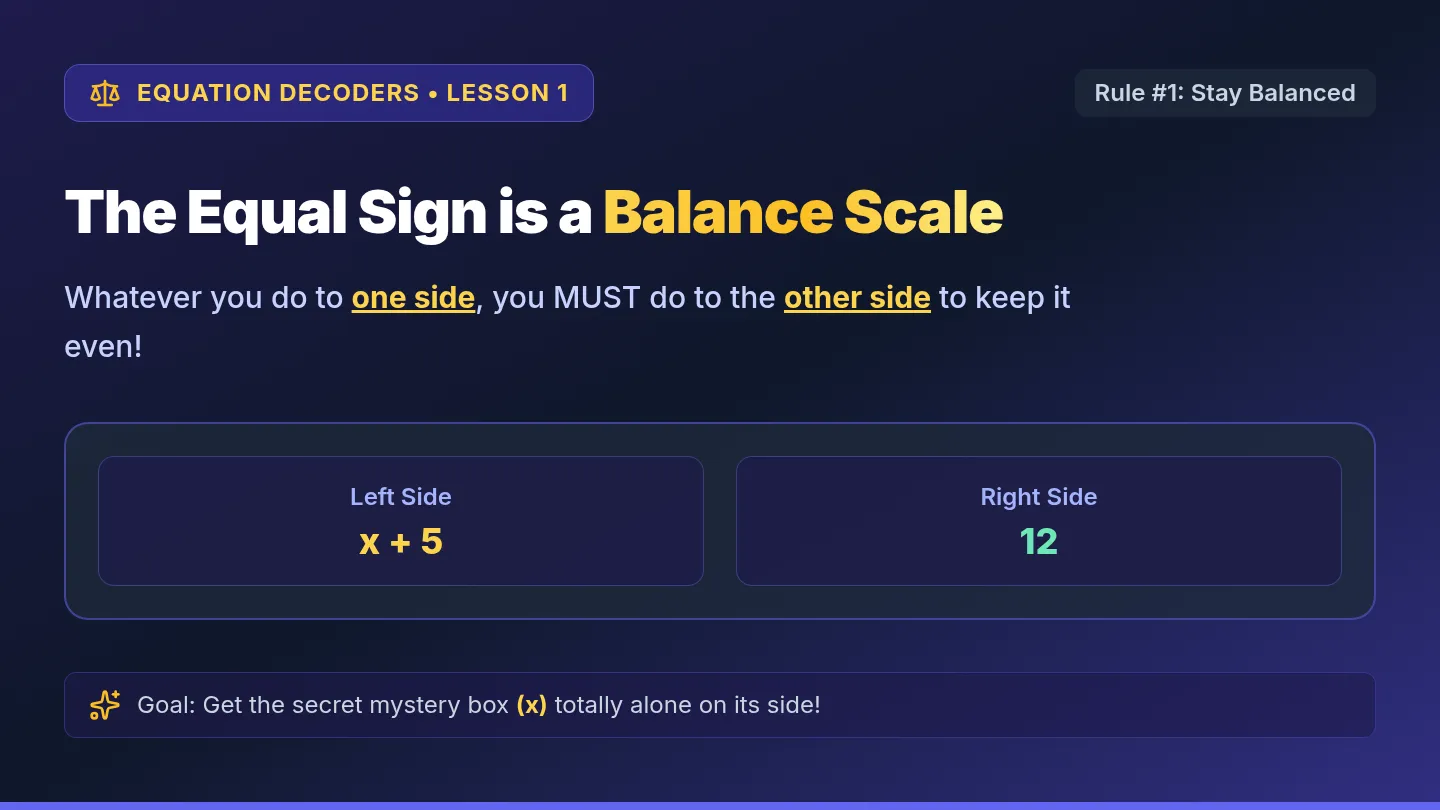
A scaffolded multi-day sequence engineered for 8th grade students with IEPs and math anxiety, demystifying linear equations through concrete balance models, visual inverse flowcharts, and structured routines.

DD

Darryl Davis

7
Variable Showdown Slides

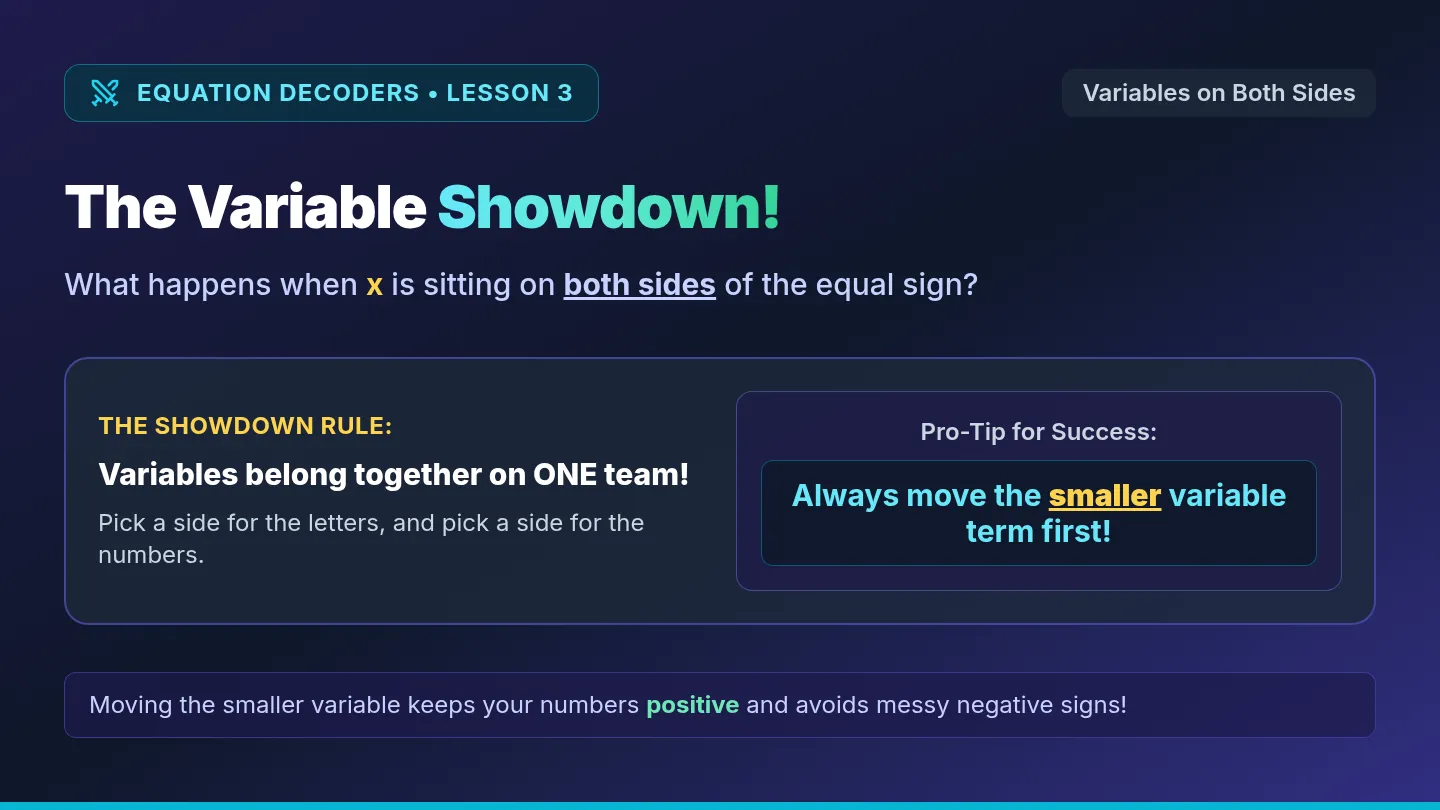
Variable Showdown

Tackles equations with like terms and variables on both sides using color-coded shapes, equal-sign fences, and confidence-building level ladders.

DD

Darryl Davis

2
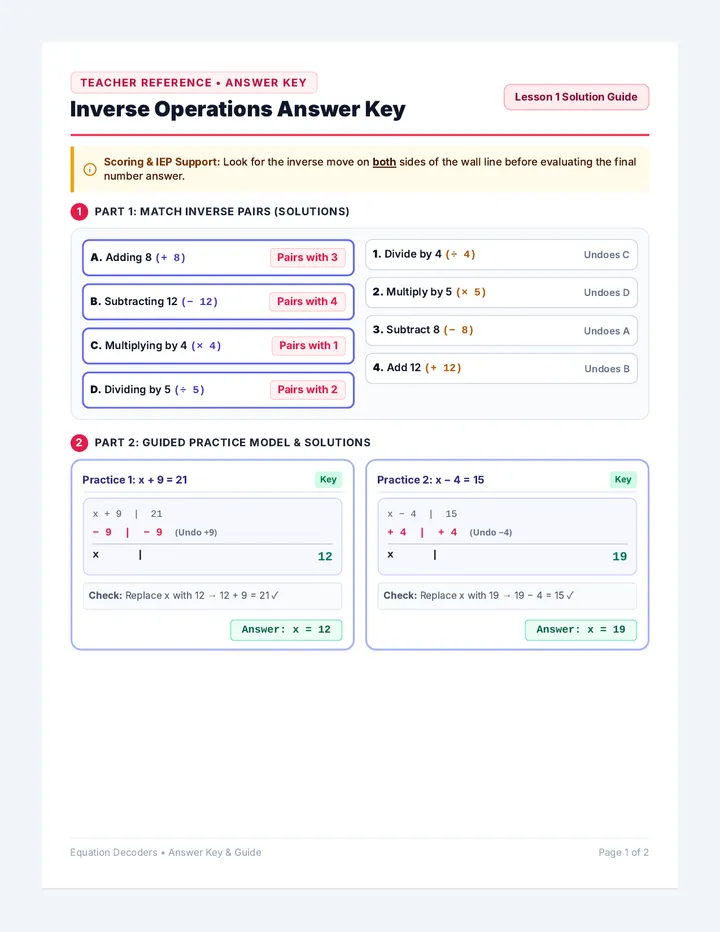
Inverse Operations Answer Key

Inverse Operations Answer Key

Complete teacher answer key for the Inverse Operations Worksheet featuring step-by-step solutions, check calculations, and IEP diagnostic intervention tips.

DD

Darryl Davis

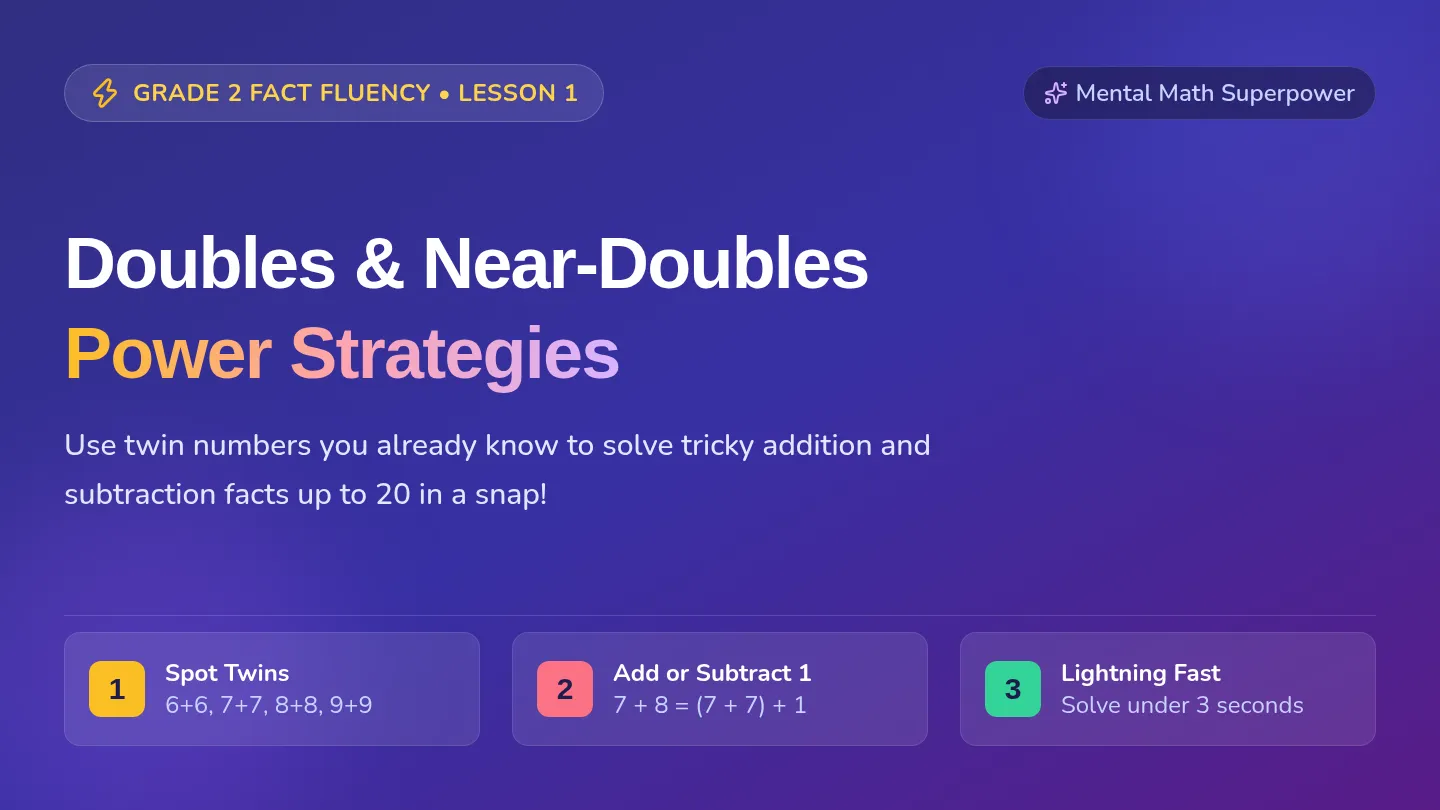
Doubles Power Slides

Fact Fluency Sprint

A three-day scaffolded math sequence designed for second-grade fact fluency within 20, moving systematically through doubles and near-doubles, bridge-through-ten strategies, and mixed fluency consolidation.

M

mgamache

6
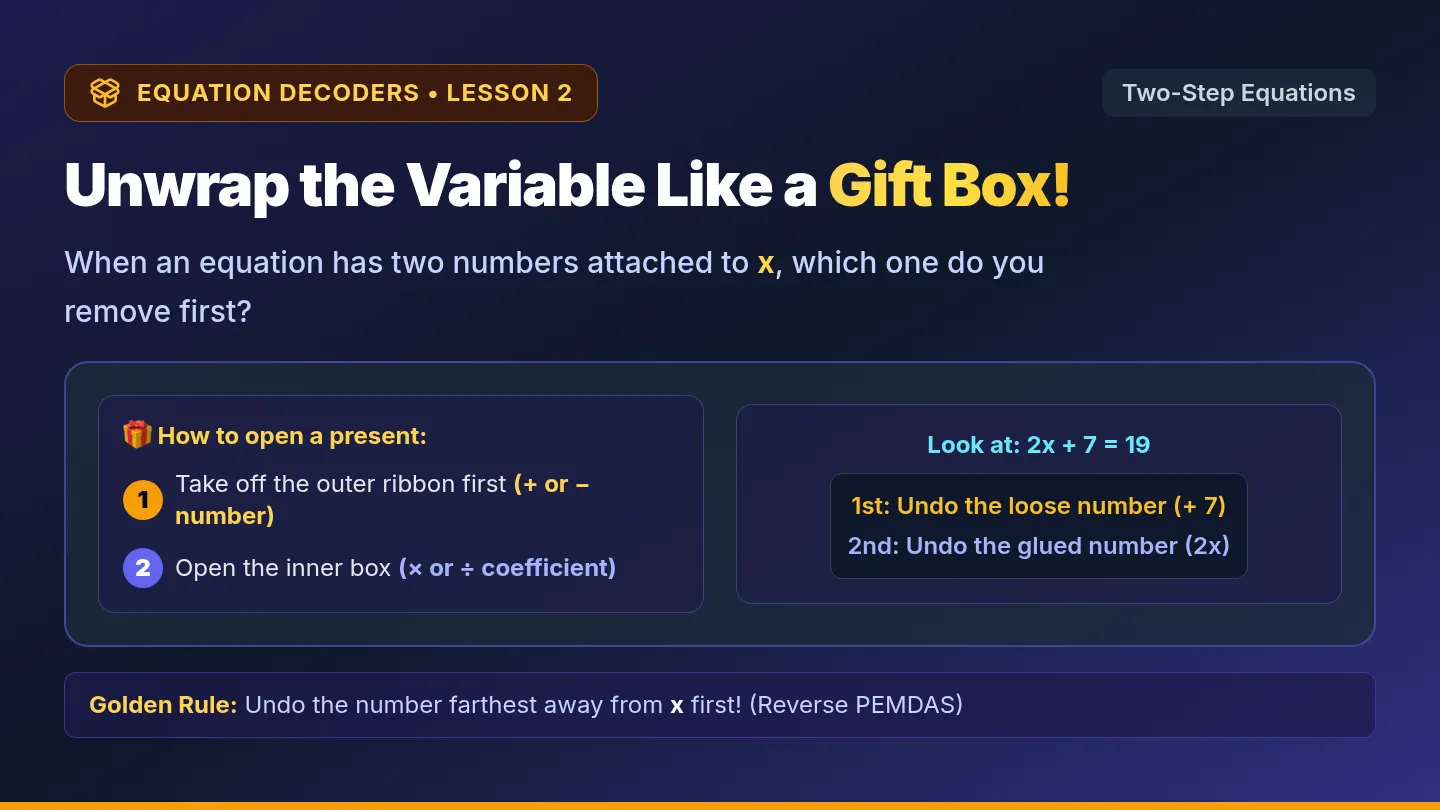
Two Step Peeler Slides

Two Step Blueprint

Guides students through two-step equations using the layer-peeling visual routine, systematically undoing addition and subtraction before multiplication and division.

DD

Darryl Davis

2
Mastery Ladder Worksheet

Mastery Ladder Worksheet

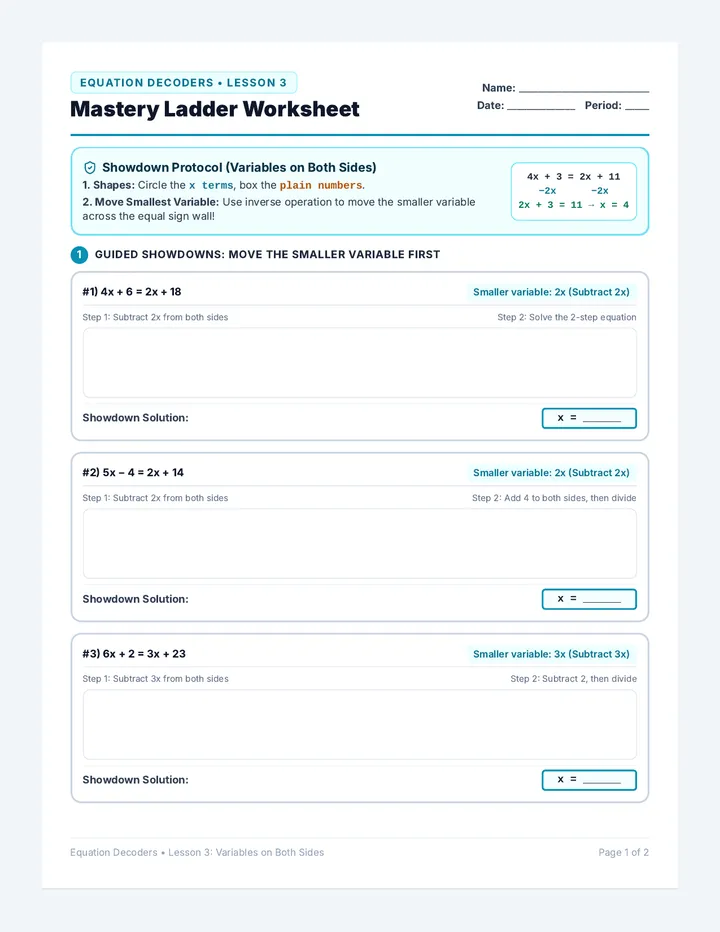
A scaffolded 2-page mastery worksheet with shape-coding organizers for variables on both sides, a tiered 4-level mastery ladder, and self-reflection rubric.

DD

Darryl Davis

Starting Clues Slides

Digit Detectives

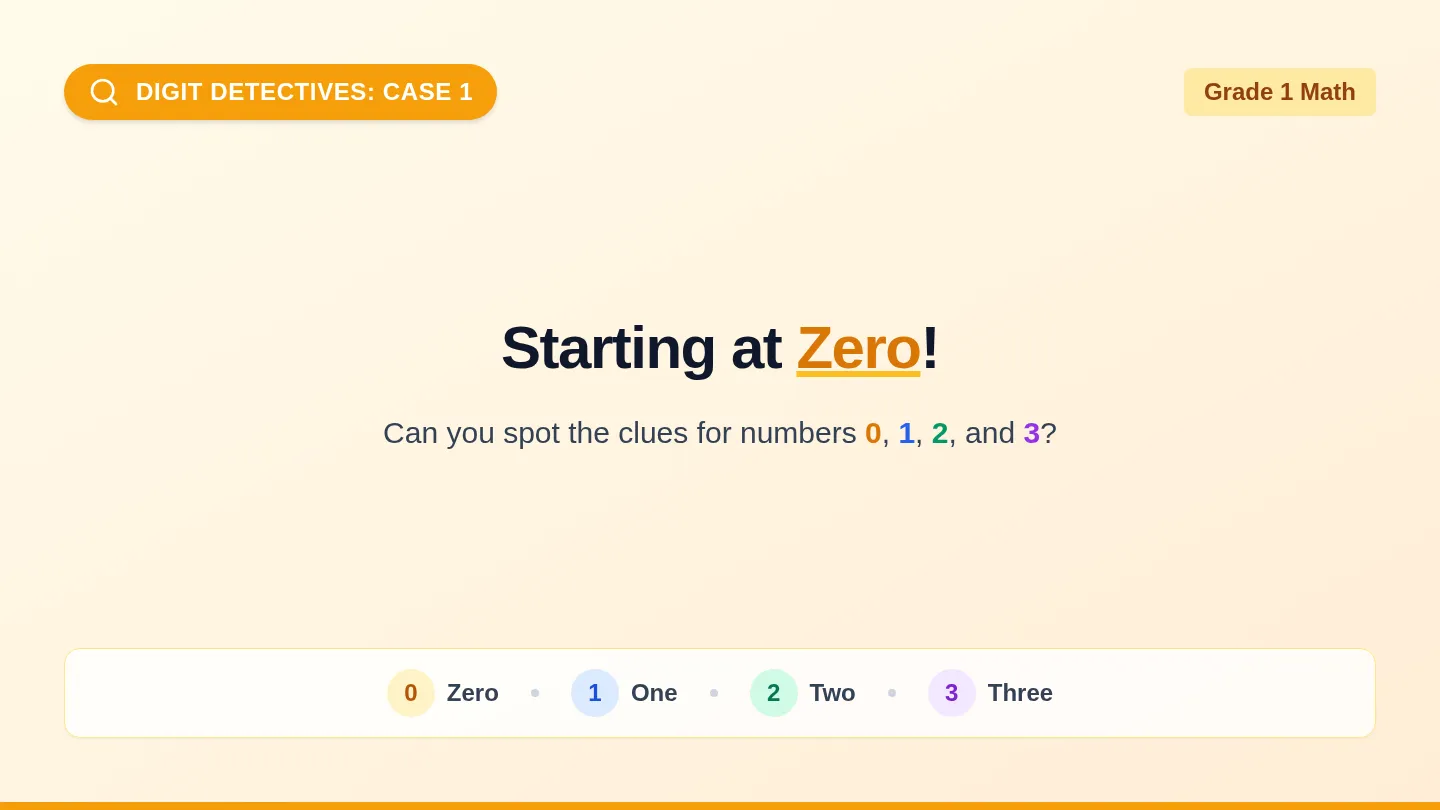
A foundational three-part sequence for first-grade learners to develop instant numeral identification and quantity matching for numbers 0 through 10. Through detective-themed visual slides, print-ready practice sheets, and guided teaching routines, students master numeral recognition and sequential order.

MS

Melissa Saunders

9
Balance Scale Slides

Inverse Magic

Introduces equations as balanced scales and establishes rock-solid fluency in isolating variables using opposite operations and color-coded undo pathways.

DD

Darryl Davis

3
Variable Showdown Slides

Variable Showdown Slides

Visual presentation slides demonstrating how to solve equations with variables on both sides using the shape-coding method and the move-the-smaller-variable strategy.

DD

Darryl Davis

Tens Takeover Slides

Math Mayhem Bootcamp

A 3-day high-energy, humor-packed math bootcamp bridging place value regrouping within 100, expansion to 1000 and repeated addition models, and multi-digit multiplication and division strategies. Every day features scaffolded models, spiral warm-ups, funny storylines, practice problems, and exit tickets.

LB

Lara Becker

10
Fact Master Slides

Fact Master Challenge

Students integrate and apply flexible mental math strategies across mixed addition and subtraction facts within 20 through timed fluency sprints, fact family triangles, and error analysis.

M

mgamache

2
Two Step Blueprint Worksheet

Two Step Blueprint Worksheet

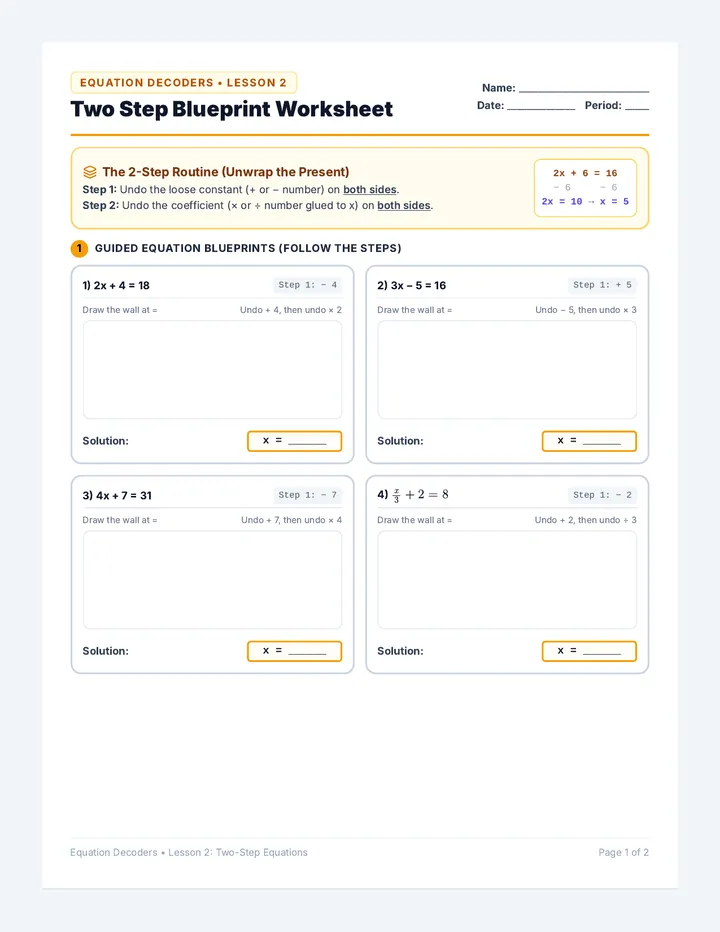
A structured 2-page student worksheet guiding 8th graders through two-step equations with explicit step checkpoints, generous handwriting frames, and error detection activities.

DD

Darryl Davis