Scalar Operations Guided Notes Finite Math Unit 3: Matrices & Systems
3-2 Notes: Scalar Operations
Name:
Date: Period:
The Elimination Connection: Scaling Before Canceling
In systems of equations, you multiply an entire equation by a constant so one variable cancels out upon addition.
Elimination Method in a 2-Equation System:
\( \begin{cases} 2x - 3y = 7 & \text{(Eq. 1)} \\ -6x + 5y = -11 & \text{(Eq. 2)} \end{cases} \)
Multiply Eq. 1 by scalar 3 : \( 6x - 9y = 21 \)
Add to Eq. 2: \( \underline{+(-6x + 5y = -11)} \)
Multiplier 3 scaled every coefficient and constant equally.
Matrix Scalar Multiplication Parallel:
\( 3 \begin{bmatrix} 2 & -3 \\ 1 & 4 \end{bmatrix} = \begin{bmatrix} 3(2) & 3(-3) \\ 3(1) & 3(4) \end{bmatrix} = \begin{bmatrix} 6 & -9 \\ 3 & 12 \end{bmatrix} \)
In matrix algebra, the single constant is called a scalar . It distributes to every entry uniformly, preserving all relationships!
1. Definition & Invariants of Scalar Multiplication
A scalar is any real number \( k \in \mathbb{R} \). If \( A \) is an \( m \times n \) matrix, then \( kA \) is the \( m \times n \) matrix formed by multiplying every entry \( a_{ij} \) by \( k \):
\( k \begin{bmatrix} a_{11} & a_{12} \\ a_{21} & a_{22} \end{bmatrix} = \begin{bmatrix} k \cdot a_{11} & k \cdot a_{12} \\ k \cdot a_{21} & k \cdot a_{22} \end{bmatrix} \)
Dimension Invariant: Does scalar multiplication change size? [ YES / NO ] Dimensions: _______
Additive Inverse: Opposite matrix with scalar \( -1 \): \( -A = (-1)A \)
Zero Matrix Property: Multiplying by scalar 0: \( 0 \cdot A = O_{m \times n} \)
2. Guided Practice: Scalar Calculations
\( A = \begin{bmatrix} 6 & -4 \\ 2 & 0 \end{bmatrix} \), \( B = \begin{bmatrix} -5 & 10 \\ 14 & -2 \end{bmatrix} \), \( C = \begin{bmatrix} 8 & -4 \\ 2 & 6 \\ -10 & 0 \end{bmatrix} \)
Example A: Compute \( -3A \)
Example B: Compute \( \frac{1}{2}B \)
Example C: Compute \( -C \) (scalar \( -1 \))
You Try 1: Compute \( 5C \)
You Try 2: Compute \( -\frac{1}{5}A \)
You Try 3: Compute \( 0 \cdot B \)
Finite Math • Lesson 3-2 Guided Notes • Page 1 of 2
Finite Math • 3-2 Notes: Operations with Matrices & Linear Combinations
Page 2 of 2
Reference Matrices for Page 2 Problems
Matrix \( A \) (\( 2 \times 2 \))
\( A = \begin{bmatrix} 6 & -4 \\ 2 & 0 \end{bmatrix} \)
Matrix \( B \) (\( 2 \times 2 \))
\( B = \begin{bmatrix} -5 & 10 \\ 14 & -2 \end{bmatrix} \)
Matrix \( C \) (\( 3 \times 2 \))
\( C = \begin{bmatrix} 8 & -4 \\ 2 & 6 \\ -10 & 0 \end{bmatrix} \)
3. Operations with Matrices & Scalars (Linear Combinations)
Order: Scale First → Add/Subtract
Problem 1: Compute \( 2A + 3B \) Scale \( A \) by 2, \( B \) by 3, then add
Problem 2: Compute \( 4B - A \) Scale \( B \) by 4, then subtract \( A \)
Problem 3: Evaluate \( 2A + C \) Dimension Compatibility Check
Can this operation be performed? Explain why or why not using matrix dimensions:
Problem 4: Compute \( 3A - 2B \) Watch signs
Problem 5: Compute \( 2(A + B) \) Parentheses first
4. Solving Matrix Equations: Isolating Variable Matrix \( X \)
Isolate matrix \( X \) using matrix subtraction and scalar multiplication, just like solving linear equations.
Example 1: Solve \( 2X + \begin{bmatrix} 4 & -6 \\ 2 & 10 \end{bmatrix} = \begin{bmatrix} 8 & 2 \\ -6 & 4 \end{bmatrix} \)
Example 2: Solve \( 3X - A = B \) (using matrices \( A, B \) from above)
Big Idea for Finite Math
Scalars allow us to scale, combine, and isolate matrices algebraically. This directly prepares us for elementary row operations (multiplying rows by scalars) in Gauss-Jordan elimination!
Lesson 3-2 • Page 2 of 2
Matrix Operations Application Worksheet Finite Math Applications Unit 3: Applied Matrix Models
Matrix Operations in Business & Logistics
Name:
Date: Period:
Applied Finite Mathematics: Modern enterprises manage production schedules and inventory distribution across branches using matrix operations. Rather than recomputing single variables, enterprise software applies scalar transformations and linear combinations across complete operational datasets.
Case 1: Multi-Store Bakery Production Scaling
Production Scaling
A bakery produces Artisan Loaves (A), Baguettes (B), and Croissants (C) across two store locations. Matrix \( P \) gives current daily output:
\( P = \begin{matrix} & \text{A} & \text{B} & \text{C} \\ \text{Downtown} \\ \text{Uptown} \end{matrix} \begin{bmatrix} 120 & 200 & 150 \\ 80 & 160 & 110 \end{bmatrix} \)
1a. Weekend Demand Spike (Scalar 1.5)
Production increases by 50% on Saturday. Compute matrix \( 1.5P \):
1b. Contextual Interpretation
Explain what \( 2P + 20 \) represents for bakery operations:
Case 2: Regional Inventory Logistics & Tournaments
Inventory Logistics
Apex Athletic manages North & South Hubs for jerseys (Small, Medium, Large). Current stock is \( S \); Monday restock is \( R \):
\( S = \begin{matrix} & \text{S} & \text{M} & \text{L} \\ \text{North} \\ \text{South} \end{matrix} \begin{bmatrix} 140 & 220 & 180 \\ 90 & 160 & 130 \end{bmatrix} \)
\( R = \begin{matrix} & \text{S} & \text{M} & \text{L} \\ \text{North} \\ \text{South} \end{matrix} \begin{bmatrix} 60 & 80 & 70 \\ 50 & 60 & 40 \end{bmatrix} \)
2a. Tournament Surge: Compute \( 1.75R \)
2b. Net Stock: \( N = S + 2R - D \)
Where \( D = \begin{bmatrix} 200 & 300 & 250 \\ 150 & 220 & 180 \end{bmatrix} \):
Finite Math • Applied Matrix Operations • Page 1 of 2
Finite Math • Applied Matrix Operations: Pricing & Inflation
Student Copy
Case 3: Production Costs & Wholesale Pricing
Cost Accounting
Timberline Roasting produces three coffee bean lines: Sunrise Light , Valley Medium , and Summit Dark . Matrix \( C \) lists the cost breakdown (in dollars per wholesale box) for Raw Beans, Eco-Packaging, and Direct Roasting Labor:
\( C = \begin{matrix} & \text{Beans} & \text{Pkg} & \text{Labor} \\ \text{Sunrise} \\ \text{Valley} \\ \text{Summit} \end{matrix} \begin{bmatrix} 18.00 & 3.00 & 5.00 \\ 16.00 & 3.00 & 4.50 \\ 20.00 & 3.50 & 6.00 \end{bmatrix} \)
3a. Supply Chain Inflation (Scalar Scaling) +8% Cost Increase
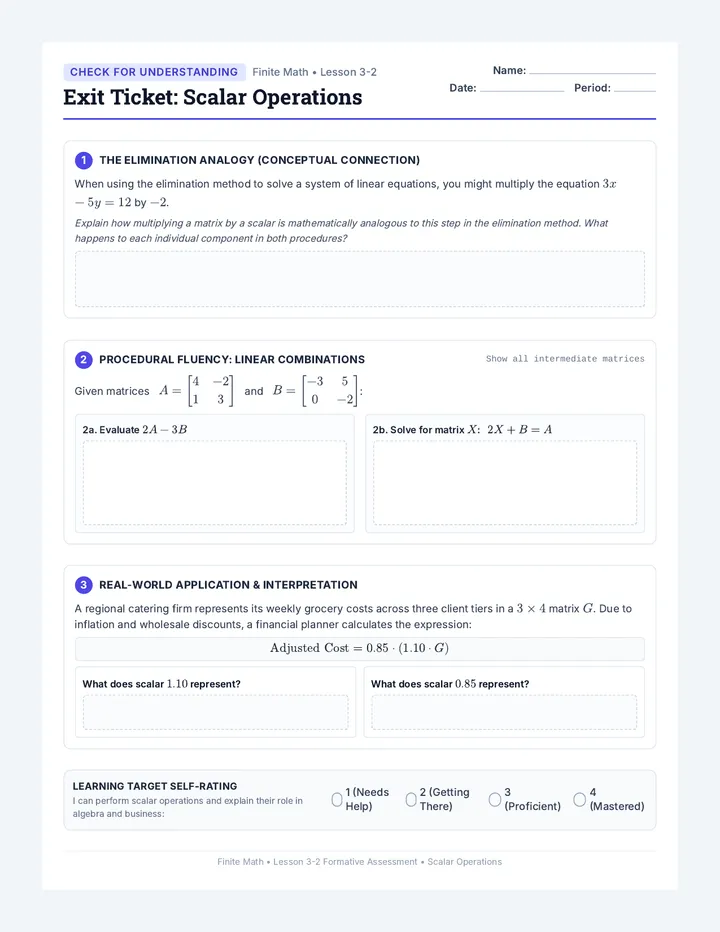
Scalar Operations Exit Ticket Check for Understanding Finite Math • Lesson 3-2
Exit Ticket: Scalar Operations
Name:
Date: Period:
1
The Elimination Analogy (Conceptual Connection)
When using the elimination method to solve a system of linear equations, you might multiply the equation \( 3x - 5y = 12 \) by \( -2 \).
Explain how multiplying a matrix by a scalar is mathematically analogous to this step in the elimination method. What happens to each individual component in both procedures?
2
Procedural Fluency: Linear Combinations
Show all intermediate matrices
Given matrices \( A = \begin{bmatrix} 4 & -2 \\ 1 & 3 \end{bmatrix} \) and \( B = \begin{bmatrix} -3 & 5 \\ 0 & -2 \end{bmatrix} \):
2a. Evaluate \( 2A - 3B \)
2b. Solve for matrix \( X \): \( 2X + B = A \)
3
Real-World Application & Interpretation
A regional catering firm represents its weekly grocery costs across three client tiers in a \( 3 \times 4 \) matrix \( G \). Due to inflation and wholesale discounts, a financial planner calculates the expression:
\( \text{Adjusted Cost} = 0.85 \cdot (1.10 \cdot G) \)
What does scalar \( 1.10 \) represent?
What does scalar \( 0.85 \) represent?
Learning Target Self-Rating
I can perform scalar operations and explain their role in algebra and business:
1 (Needs Help) 2 (Getting There) 3 (Proficient) 4 (Mastered)
Finite Math • Lesson 3-2 Formative Assessment • Scalar Operations
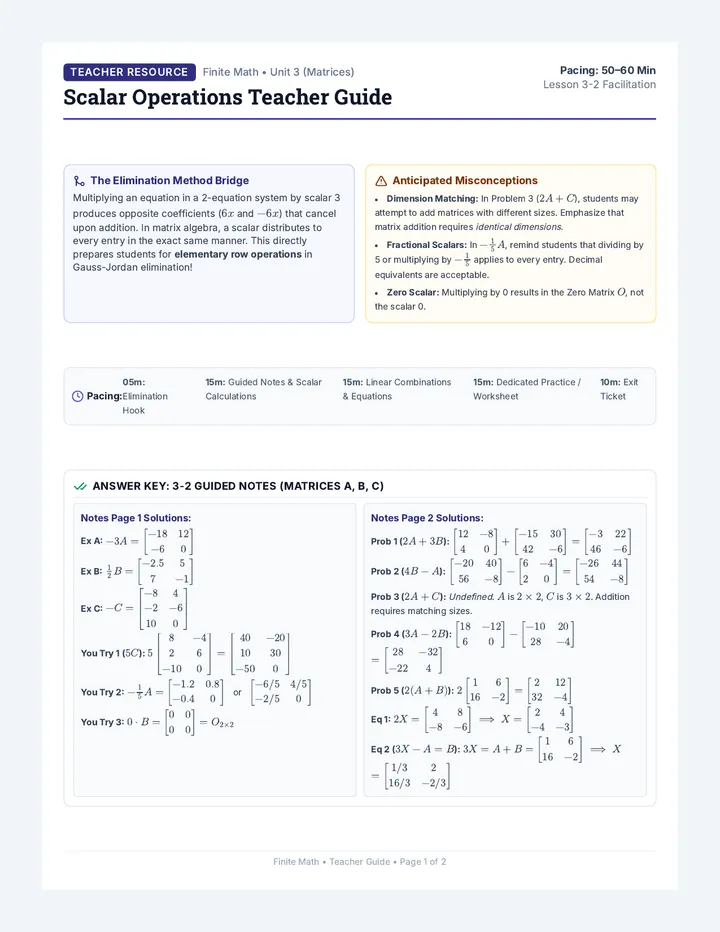
Scalar Operations Teacher Guide Teacher Resource Finite Math • Unit 3 (Matrices)
Scalar Operations Teacher Guide
Pacing: 50–60 Min
Lesson 3-2 Facilitation
The Elimination Method Bridge
Multiplying an equation in a 2-equation system by scalar 3 produces opposite coefficients (\( 6x \) and \( -6x \)) that cancel upon addition. In matrix algebra, a scalar distributes to every entry in the exact same manner. This directly prepares students for elementary row operations in Gauss-Jordan elimination!
Anticipated Misconceptions
Dimension Matching: In Problem 3 (\( 2A + C \)), students may attempt to add matrices with different sizes. Emphasize that matrix addition requires identical dimensions .Fractional Scalars: In \( -\frac{1}{5}A \), remind students that dividing by 5 or multiplying by \( -\frac{1}{5} \) applies to every entry. Decimal equivalents are acceptable.Zero Scalar: Multiplying by 0 results in the Zero Matrix \( O \), not the scalar 0.
Pacing:
05m: Elimination Hook 15m: Guided Notes & Scalar Calculations 15m: Linear Combinations & Equations 15m: Dedicated Practice / Worksheet 10m: Exit Ticket
Answer Key: 3-2 Guided Notes (Matrices A, B, C)
Notes Page 1 Solutions:
Ex A: \( -3A = \begin{bmatrix} -18 & 12 \\ -6 & 0 \end{bmatrix} \)
Ex B: \( \frac{1}{2}B = \begin{bmatrix} -2.5 & 5 \\ 7 & -1 \end{bmatrix} \)
Ex C: \( -C = \begin{bmatrix} -8 & 4 \\ -2 & -6 \\ 10 & 0 \end{bmatrix} \)
You Try 1 (\( 5C \)): \( 5\begin{bmatrix} 8 & -4 \\ 2 & 6 \\ -10 & 0 \end{bmatrix} = \begin{bmatrix} 40 & -20 \\ 10 & 30 \\ -50 & 0 \end{bmatrix} \)
You Try 2: \( -\frac{1}{5}A = \begin{bmatrix} -1.2 & 0.8 \\ -0.4 & 0 \end{bmatrix} \) or \( \begin{bmatrix} -6/5 & 4/5 \\ -2/5 & 0 \end{bmatrix} \)
You Try 3: \( 0 \cdot B = \begin{bmatrix} 0 & 0 \\ 0 & 0 \end{bmatrix} = O_{2 \times 2} \)
Notes Page 2 Solutions:
Prob 1 (\( 2A + 3B \)): \( \begin{bmatrix} 12 & -8 \\ 4 & 0 \end{bmatrix} + \begin{bmatrix} -15 & 30 \\ 42 & -6 \end{bmatrix} = \begin{bmatrix} -3 & 22 \\ 46 & -6 \end{bmatrix} \)
Prob 2 (\( 4B - A \)): \( \begin{bmatrix} -20 & 40 \\ 56 & -8 \end{bmatrix} - \begin{bmatrix} 6 & -4 \\ 2 & 0 \end{bmatrix} = \begin{bmatrix} -26 & 44 \\ 54 & -8 \end{bmatrix} \)