Lenny.com
Explore
Create
ActivitiesNewMathEnglish Language ArtsScience & EngineeringSocial StudiesGlobal LanguagesHealth & Physical EducationSpecial EducationCounseling & Life SkillsArts & CreativityESL
Lenny.com
Lenny.com
Explore
Create
ActivitiesNewMathEnglish Language ArtsScience & EngineeringSocial StudiesGlobal LanguagesHealth & Physical EducationSpecial EducationCounseling & Life SkillsArts & CreativityESL
Lenny.com
Lenny.com

Solutions

Lenny for EducatorsLenny for SchoolsLenny for Districts

Product

ExploreSign inCreateSupportAbout

Resources

Getting startedMTSS Acceleration Program

© 2026 Lenny Learning Inc.

TermsPrivacyAccessibility
LinkedInInstagramX
Lenny
MathNumbers & CountingCounting ObjectsNumber NamesComparing NumbersNumber OperationsCounting SequenceNumbers 0-10Place Value Understanding and SystemAdd and Subtract Within 20Addition and Subtraction ConceptsAddition and Subtraction EquationsAddition and Subtraction ProblemsFoundations for MultiplicationMultiplication and Division PropertiesMultiply and Divide Within 100Multiplication and Division ProblemsFactors and MultiplesProperties of OperationsPatterns and RelationshipsGenerate and Analyze PatternsMulti-Digit ArithmeticPlace Value OperationsMulti-Digit and Decimal OperationsNumerical ExpressionsFour Operations and PatternsFour Operations Problem SolvingMeasurement & DataMeasurable AttributesMeasuring LengthsMeasure and Estimate Lengths in Standard UnitsRelate Addition and Subtraction to LengthClassifying and Counting ObjectsTime and MoneyArea Concepts and MeasurementPerimeter and Area MeasuresAngle Concepts and MeasurementTime, Volume, and MassMeasurement Unit ConversionsGeometryIdentifying ShapesShapes and AttributesShape Attributes and ReasoningShapes and CompositionClassifying 2D FiguresGeometric Figures and RelationshipsLines, Angles, and ShapesAngle, Area, and VolumeGeometric MeasurementVolume of 3D ShapesCoordinate Plane ApplicationsTransformations in the PlaneCongruence and SimilarityUnderstand congruence in terms of rigid motionsSimilarity and TransformationsProve Theorems Involving SimilarityPythagorean TheoremTrigonometry for General TrianglesMake Geometric ConstructionsProve Geometric TheoremsTheorems About CirclesFind Arc Lengths And Areas of Sectors of CirclesVolume FormulasRelationships Between Two-Dimensional and Three-Dimensional ObjectsProve Simple Geometric Theorems AlgebraicallyTranslate Between Geometric Description and Equation for Conic SectionApply Geometric Concepts in Modeling SituationsFractions & DecimalsFractions as NumbersBuilding FractionsFraction Equivalence and OrderingAdding and Subtracting FractionsMultiplying and Dividing FractionsDividing FractionsDecimal FractionsMulti-Digit Computation and FactorsAdd, Subtract, Multiply, and Divide Rational NumbersRational Number SystemIrrational Numbers and ApproximationsRatiosRatios and ProportionsProportional RelationshipsUnit RateAlgebraAlgebraic ExpressionsGenerate Equivalent ExpressionsQuantitative RelationshipsProportional Relationships and Linear EquationsEquations and InequalitiesEquation Solving and ReasoningLinear Equations and SystemsGraph Equations and InequalitiesSystems of EquationsReal-World Algebraic ProblemsQuantitative Reasoning with UnitsExpression StructureEquivalent Expression FormsRadicals and Integer ExponentsRational ExponentsRational and Irrational NumbersPolynomial OperationsPolynomial IdentitiesPolynomial Zeros and FactorsRational ExpressionsComplex Number OperationsComplex Numbers in PolynomialsComplex Numbers on PlaneStatistics & ProbabilityRepresent and Interpret DataData DistributionsStatistical VariabilityProbability ModelsCompound Event ProbabilitiesStatistical SamplingInterpret Categorical and Quantitative DataBivariate Data PatternsInterpret Linear ModelsComparing Two PopulationsRandom Processes in StatisticsIndependence and Conditional ProbabilityExpected ValuesProbability-Based Decision MakingStatistical Inference and ConclusionsFunctionsFunction Concepts and NotationDefine and Compare FunctionsInterpret Functions in ContextAnalyze Function RepresentationsModel Relationships with FunctionsIdentify Linear vs Exponential GrowthDistinguish Between Function TypesCompare Growth RatesInterpret Function ExpressionsBuild Functions from RelationshipsConstruct and Model FunctionsTransform and Combine FunctionsModel Comparison and SelectionSolve Exponential EquationsTrigonometryTrigonometric Ratios Involving Right TrianglesTrigonometric Functions and Unit CircleModel with Trigonometric FunctionsTrigonometric IdentitiesVectors & MatricesIntroduction to Vectors and MatricesVector QuantitiesVector OperationsMatrix OperationsCalculusLimits and ContinuityDerivative Concepts and NotationDerivative Rules and TechniquesApplications of DerivativesOptimization ProblemsRelated RatesCurve Sketching and AnalysisIntegration Concepts and NotationAntiderivatives and Indefinite IntegralsDefinite Integrals and AreaFundamental Theorem of CalculusIntegration TechniquesApplications of IntegrationDifferential EquationsSequences and SeriesParametric and Polar FunctionsVector-Valued Functions

Probability Mastery

A comprehensive 7th-grade unit covering probability standards 7.SP.C.5 through 7.SP.C.8, including simple events, experimental probability, predictions, and compound events.

Ddlspadaro

Probability Mastery

A comprehensive 7th-grade unit covering probability standards 7.SP.C.5 through 7.SP.C.8, including simple events, experimental probability, predictions, and compound events.

Ddlspadaro
most likely

A Jar A

B Jar B

C Jar C

D Jar D

Work / Convert Ratios to Decimals or Common Denominators:

6

Mateo spun a two-color spinner 50 times during an experiment. It landed on purple 31 times and on orange 19 times. Based on his experiment, what is the experimental probability of landing on purple?

A \( 31\% \)

B \( 38\% \)

C \( 50\% \)

D \( 62\% \)

Work / Ratio to Percent Setup:

Grade 7 • Statistics & Probability Page 2 of 6 Assessment ID: 7SP-SUMM

7SP - Summative Assessment • Experimental Data & Frequency Tables

Student Name:

7

A student has a box containing an unknown number of game chips labeled 1 to 6. The student randomly drew a chip, recorded the number, and returned it to the box for a total of 100 trials.

Chip #Frequency
116
222
312
426
511
613

Based on the observed frequencies in the table, estimate the probability of selecting a chip with a 2 and a chip with an odd number.

A \( P(2) = 0.22 \)  and  \( P(\text{odd}) = 0.39 \)

B \( P(2) = 0.22 \)  and  \( P(\text{odd}) = 0.50 \)

C \( P(2) = 0.44 \)  and  \( P(\text{odd}) = 0.39 \)

D \( P(2) = 0.22 \)  and  \( P(\text{odd}) = 0.61 \)

Work / Sum of Frequencies & Decimal Conversion:

8

A math class rolled a standard number cube 40 times and recorded rolling the number 2 exactly 5 times. Which statement accurately compares their experimental probability to the theoretical probability of rolling a 2?

A Experimental is \( \frac{1}{8} \), which is less than theoretical of \( \frac{1}{6} \).

B Experimental is \( \frac{1}{6} \), which matches the theoretical probability exactly.

C Theoretical is \( \frac{5}{40} \), which proves the cube is defective.

D Experimental is \( \frac{2}{40} \), which is greater than theoretical of \( \frac{1}{4} \).

Work / Compare Experimental vs Theoretical Ratios:

9

Sophia rolls a standard number cube 12 times and rolls an even number only 2 times. What will most likely happen to the relative frequency of rolling an even number if Sophia continues rolling up to 1,200 times?

A It will stay near \( \frac{2}{12} \) because initial outcomes set a permanent trend.

B It will immediately jump to 1.00 on the next rolls to make up for missed evens.

C It will shift closer and closer to the theoretical probability of 0.50.

D It will fluctuate completely erratically without approaching any set value.

Work / Long-Run Relative Frequency Explanation:

Grade 7 • Statistics & Probability Page 3 of 6 Assessment ID: 7SP-SUMM

7SP - Summative Assessment • Making Predictions & Expected Values

Student Name:

10

At a school festival, visitors spin a wheel to win a prize.

• The probability that the wheel will stop on a section that does not result in a prize is 0.75.

• On Friday evening, students spun the wheel a total of 80 times.

Which of the following is closest to the expected number of times students did not win a prize when spinning the wheel on Friday?

A 15

B 20

C 60

D 75

Work / Expected Value Calculation (\( P \times n \)):

11

A prize wheel at a science fair has 8 equal sections. Exactly 3 of the sections award a STEM kit. If 320 participants spin the wheel during the fair, about how many winners should the organizers expect?

A 40 winners

B 80 winners

C 120 winners

D 160 winners

Work / Proportion or Expected Frequency:

12

A quality control specialist tested a random sample of 60 smartphone chargers from a factory line and found 4 defective chargers. If the factory produces 1,800 chargers each shift, predict how many will be defective.

A 80 chargers

B 120 chargers

C 150 chargers

D 240 chargers

Work / Setup Proportion (\( \frac{\text{part}}{\text{whole}} = \frac{x}{\text{total}} \)):

Grade 7 • Statistics & Probability Page 4 of 6 Assessment ID: 7SP-SUMM

7SP - Summative Assessment • Sample Predictions & Compound Events

Student Name:

13

In a random survey of 50 seventh-grade students, 18 reported that their favorite after-school activity is athletics. If there are 600 seventh graders in the entire district, how many would you predict choose athletics?

A 150 students

B 180 students

C 216 students

D 250 students

Work / Ratio & Multiplication:

14

This spinner is divided into 8 equal sections. Each section is either purple, red, or white as shown:

The arrow on the spinner will be spun 240 times. Predict the approximate number of times the arrow will stop on each color.

Purple Purple Purple Purple Purple Red Red White

A Purple: 150  •  Red: 60  •  White: 30

B Purple: 120  •  Red: 60  •  White: 60

C Purple: 150  •  Red: 45  •  White: 45

D Purple: 100  •  Red: 80  •  White: 60

Work / Fractions of 240 Spins (Purple, Red, White):

15

Liam rolls a standard 6-sided number cube and flips a fair coin. What is the probability that he rolls a number less than 3 AND the coin lands on Heads?

A \( \frac{1}{12} \)

B \( \frac{1}{6} \)

C \( \frac{1}{4} \)

D \( \frac{1}{3} \)

Work / Multiply Independent Probabilities \( P(A) \times P(B) \):

Grade 7 • Statistics & Probability Page 5 of 6 Assessment ID: 7SP-SUMM

7SP - Summative Assessment • Independent & Dependent Events

Student Name:

16

A velvet pouch contains 4 green gems and 6 clear gems. A gem is randomly chosen, recorded, and returned to the pouch. Then a second gem is chosen. What is the probability that both gems chosen are green?

A \( \frac{2}{15} \)

B \( \frac{4}{25} \)

C \( \frac{2}{5} \)

D \( \frac{8}{25} \)

Work / Independent Multiplication:

17

A box of fruit snacks has 6 cherry packs and 4 strawberry packs. Without looking, Maya grabs one pack and opens it. Then, without replacing it, her brother grabs a second pack. What is the probability that both packs grabbed are cherry?

A \( \frac{9}{25} \)

B \( \frac{1}{3} \)

C \( \frac{3}{5} \)

D \( \frac{5}{18} \)

Work / Dependent Probability (Without Replacement):

18

Which of the following scenarios describes two DEPENDENT events?

A Flipping a coin twice and landing on tails both times.

B Spinning an 8-section spinner, then rolling a 6-sided number cube.

C Drawing a ticket for 1st prize, setting it aside, and drawing another for 2nd prize.

D Drawing a colored marble from a bag, putting it back, and drawing a second marble.

Reasoning / Explain How 1st Event Affects 2nd:

19

A teacher has a basket containing 8 blue pens and 4 red pens. She randomly selects one pen to keep at her desk. Then she randomly selects a second pen for a student. What is the probability that the 1st pen is blue AND the 2nd pen is red?

A \( \frac{2}{9} \)

B \( \frac{8}{33} \)

C \( \frac{32}{121} \)

D \( \frac{5}{11} \)

Work / Multiply Fractions:

Self-Reflection & Confidence Check:

Rate mastery (1 = Need Practice, 5 = Mastered)

Simple Likelihood & Events (Q1–Q5): 1 2 3 4 5

Experimental Data & Tables (Q6–Q10): 1 2 3 4 5

Theoretical Predictions (Q11–Q15): 1 2 3 4 5

Compound Independent / Dependent (Q16–Q19): 1 2 3 4 5

Grade 7 • Statistics & Probability Page 6 of 6 Assessment ID: 7SP-SUMM

D \( \frac{3}{5} \)

Work / Dependent Probability (Without Replacement):

5

A prize jar contains 8 bronze tokens and 4 silver tokens. A teacher randomly selects one token and does not return it. She then selects a second token. What is the probability that the 1st token is bronze AND the 2nd token is silver?

A \( \frac{2}{9} \)

B \( \frac{8}{33} \)

C \( \frac{32}{121} \)

D \( \frac{4}{11} \)

Work / Multiply Successive Dependent Probabilities:

6

Spinner A has 3 equal sections labeled 1, 2, and 3. Spinner B has 4 equal sections colored Red, Blue, Green, and Yellow. What is the probability of spinning a 3 on Spinner A AND the color Red on Spinner B?

A \( \frac{1}{12} \)

B \( \frac{2}{7} \)

C \( \frac{1}{7} \)

D \( \frac{1}{4} \)

Work / Independent Spinners \( P(A) \times P(B) \):

7

A pouch contains 5 green marbles and 5 yellow marbles. A marble is drawn at random, recorded, and returned to the pouch. A second marble is then drawn. What is the probability that the 1st marble is green AND the 2nd marble is yellow?

A \( \frac{1}{5} \)

B \( \frac{5}{18} \)

C \( \frac{1}{4} \)

D \( \frac{1}{2} \)

Work / Independent Events with Replacement:

Grade 7 • Statistics & Probability Page 2 of 3 Worksheet ID: PROB-COMP

Compound Events Practice Worksheet • Cards, Manipulatives & Concept Mastery

Student Name:

8

Which of the following scenarios describes a pair of INDEPENDENT events?

A Selecting a card from a standard deck, keeping it, and selecting a second card.

B Drawing a raffle ticket from a bucket, giving it away, and drawing another ticket.

C Flipping tails on a coin, then rolling a 5 on a standard six-sided number cube.

D Choosing an apple from a bowl, eating it, and then choosing an orange from the bowl.

Reasoning / Explain Why Outcome 1 Does Not Change Outcome 2:

9

A deck of cards in a math game consists of 4 triangle cards and 6 circle cards. A player randomly draws one card and keeps it. The player then draws a second card. What is the probability that both cards drawn are triangles?

A \( \frac{2}{15} \)

B \( \frac{4}{25} \)

C \( \frac{1}{5} \)

D \( \frac{7}{19} \)

Work / Dependent Probability (Cards Kept Out):

10

A craft box contains 9 red beads and 6 gold beads. Jasmine picks one bead at random to string onto a necklace. Without replacing it, she picks a second bead. What is the probability that the first bead is gold AND the second bead is red?

A \( \frac{6}{25} \)

B \( \frac{9}{35} \)

C \( \frac{15}{29} \)

D \( \frac{3}{10} \)

Work / Multiply Fractions (\( P(\text{gold}) \times P(\text{red} \mid \text{gold}) \)):

Compound Events Quick Review:

Standard 7.SP.C.8 Mastery

• Independent (With Replacement): Denominator stays unchanged.

• Dependent (Without Replacement): Denominator decreases by 1.

Grade 7 • Statistics & Probability Page 3 of 3 Worksheet ID: PROB-COMP
You might also like

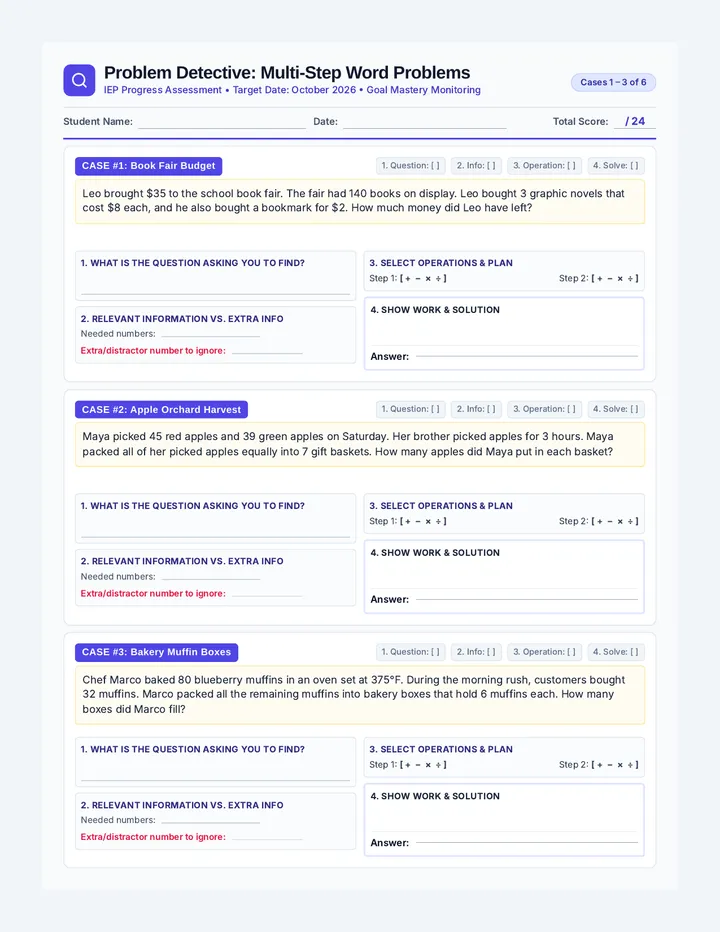
Problem Detective Assessment

Math Goal Mastery

A targeted sequence of progress monitoring assessments and evaluation guides designed to measure and document key IEP mathematics benchmarks, including multi-step word problems and multi-digit operations.

JD

Jenny Daniels

4
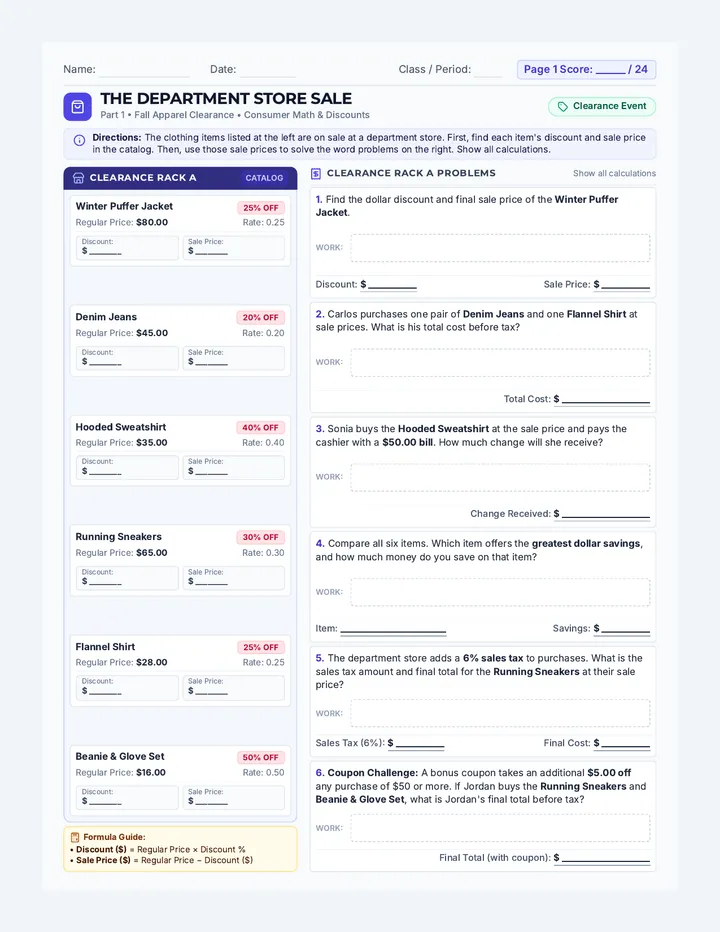
Department Store Math Worksheet

Smart Shopper Math

Students learn to calculate percentage markdowns, sale prices, sales taxes, coupons, and gift card balances through realistic department store clearance shopping scenarios.

CD

Cheri Donahoe

2
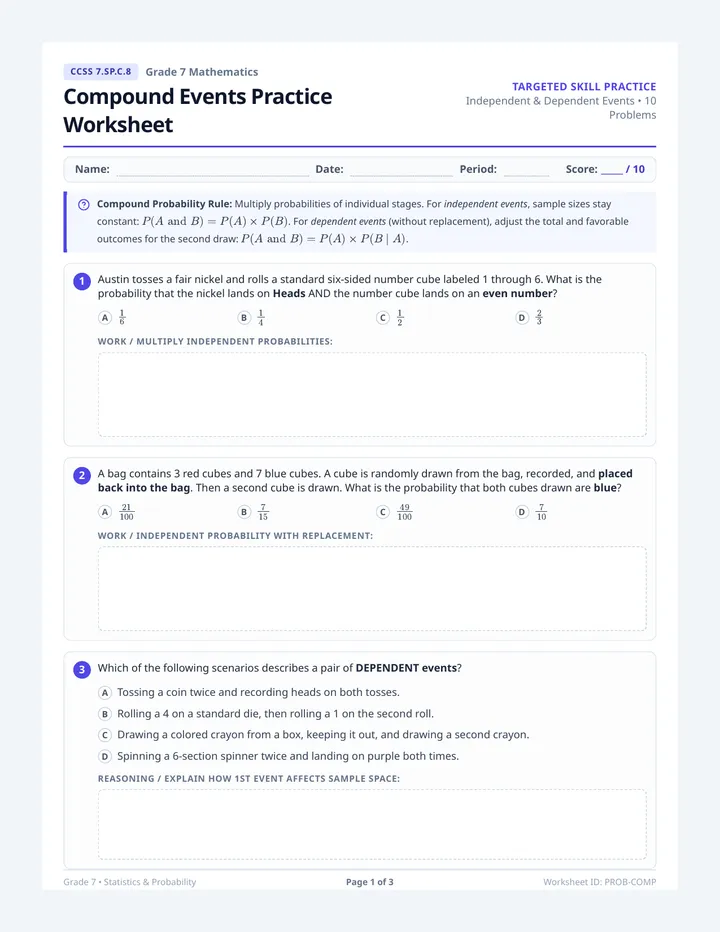
Compound Events Practice Worksheet

Compound Events Practice Worksheet

A targeted 3-page, 10-question practice worksheet focusing on independent and dependent compound probability events (CCSS 7.SP.C.8), complete with dedicated blank workspaces for calculating fractions and showing work.

D

dlspadaro

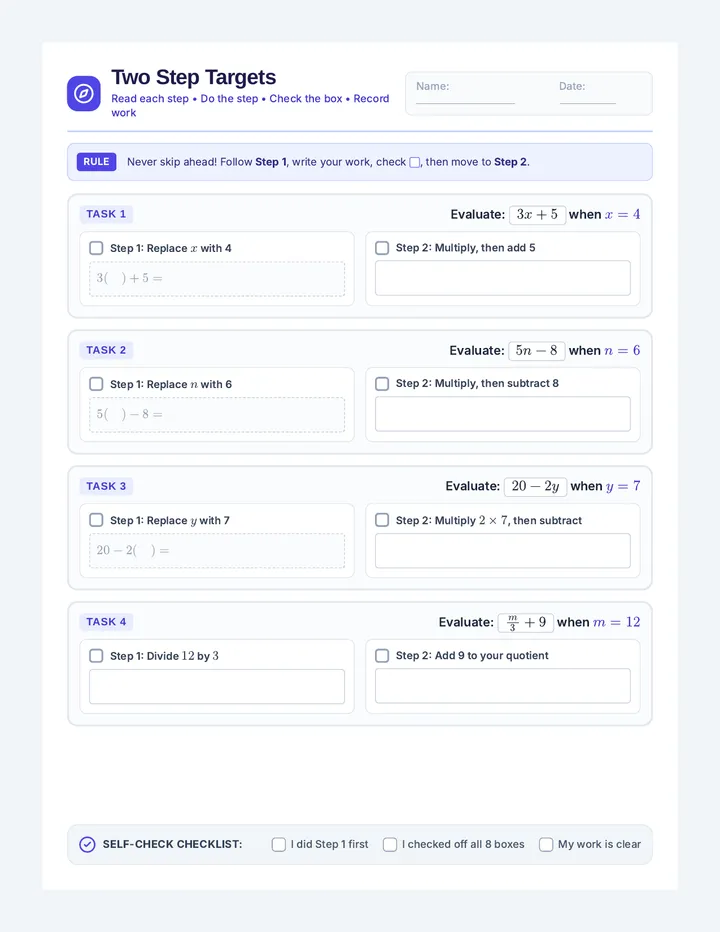
Two Step Targets Worksheet

Direction Detectives

A scaffolded 7th-grade math practice sequence designed for special education learners, focusing on breaking down multi-step tasks into clear, bite-sized directions of 2 to 4 prompts. Students follow explicit written directions, track their progress with visual step checkpoints, and record each intermediate calculation.

J

jbrower

6
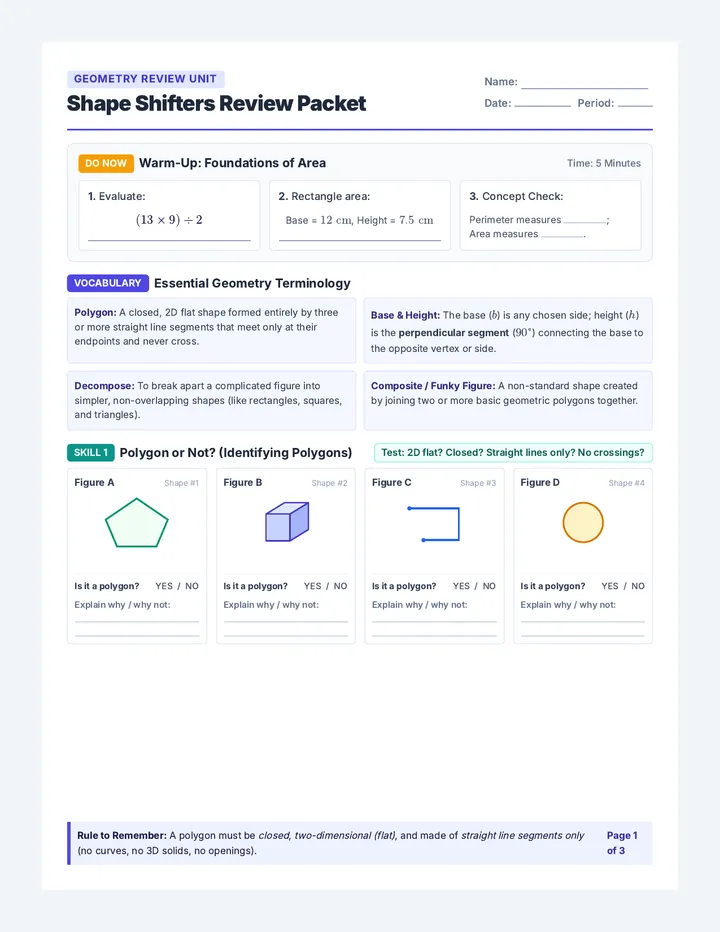
Shape Shifters Review Packet

Shape Shifters Geometry Review

A comprehensive geometry review lesson focused on classifying polygons and calculating the areas of triangles, parallelograms, trapezoids, and complex composite figures through decomposition. Includes a structured review packet with Do Now and vocabulary, an exit ticket, independent homework, and a cumulative assessment quiz with a teacher answer key.

AA

alicia accapezzato

5
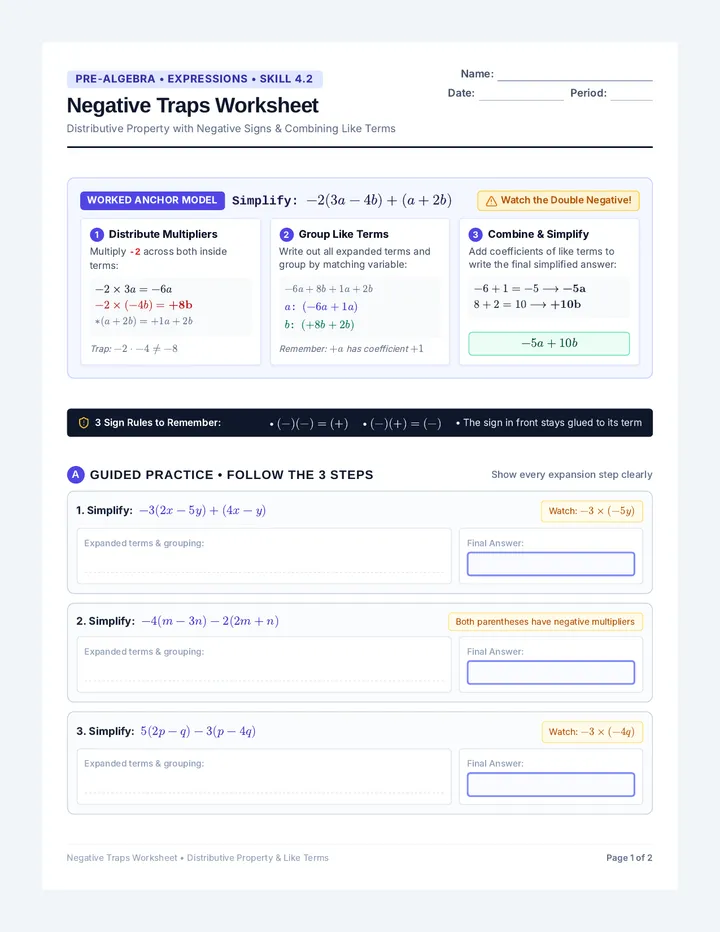
Negative Traps Worksheet

Negative Traps Worksheet

A 2-page print-ready algebra worksheet focusing on the distributive property with negative coefficients and combining like terms, centered around the model problem -2(3a-4b)+(a+2b). Includes a visual step-by-step breakdown of common negative sign traps, guided practice problems, independent practice, error analysis, and a numerical verification challenge.

Lenny Avatar
Lenny
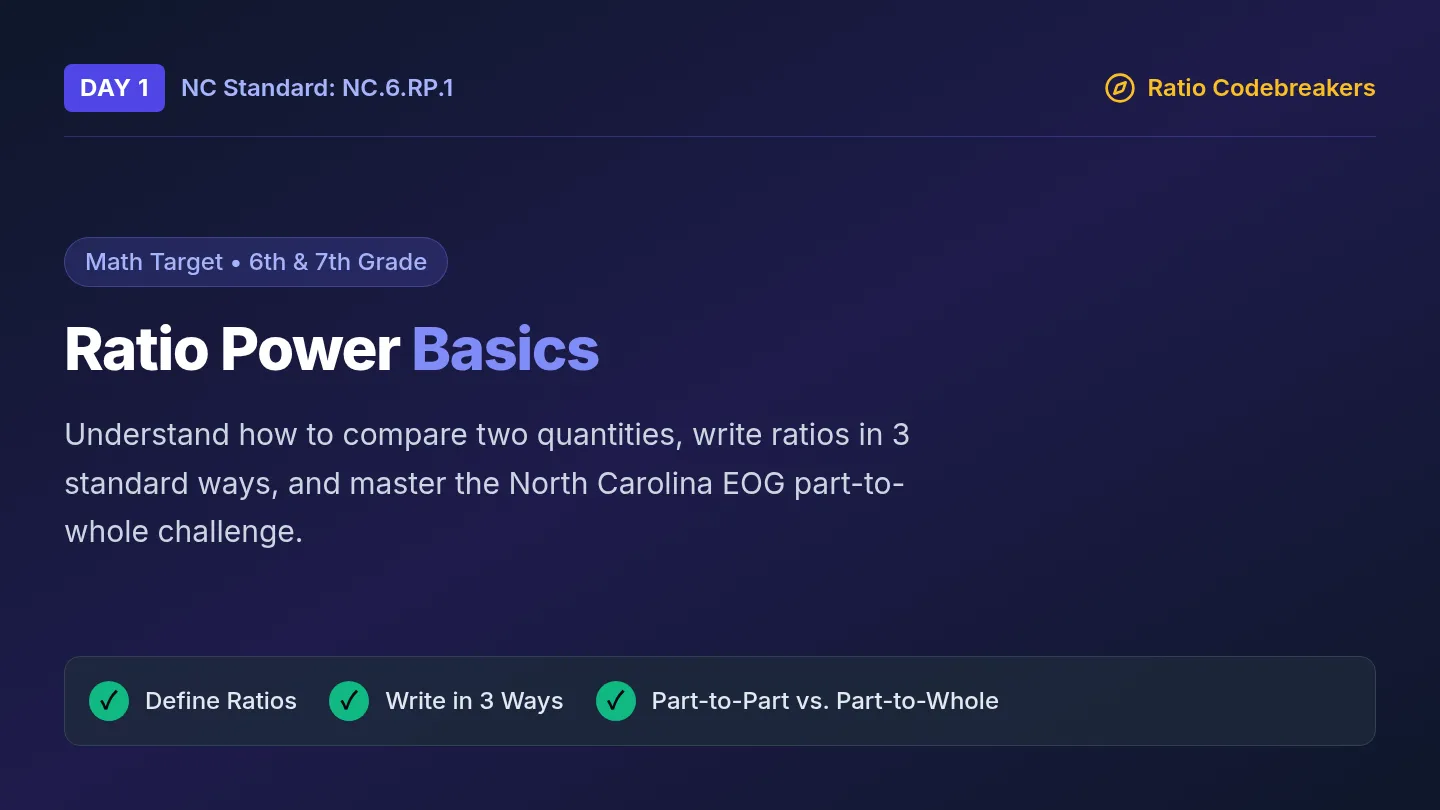
Ratio Power Slides

Ratio Launchpad

A 3-day scaffolded sequence designed for self-contained 6th and 7th grade math students preparing for North Carolina End-of-Grade (EOG) testing. The sequence develops foundational ratio reasoning through concrete visual models, structured guided practice, tape diagrams, and equivalent ratio tables.

CP

Christian Page

12
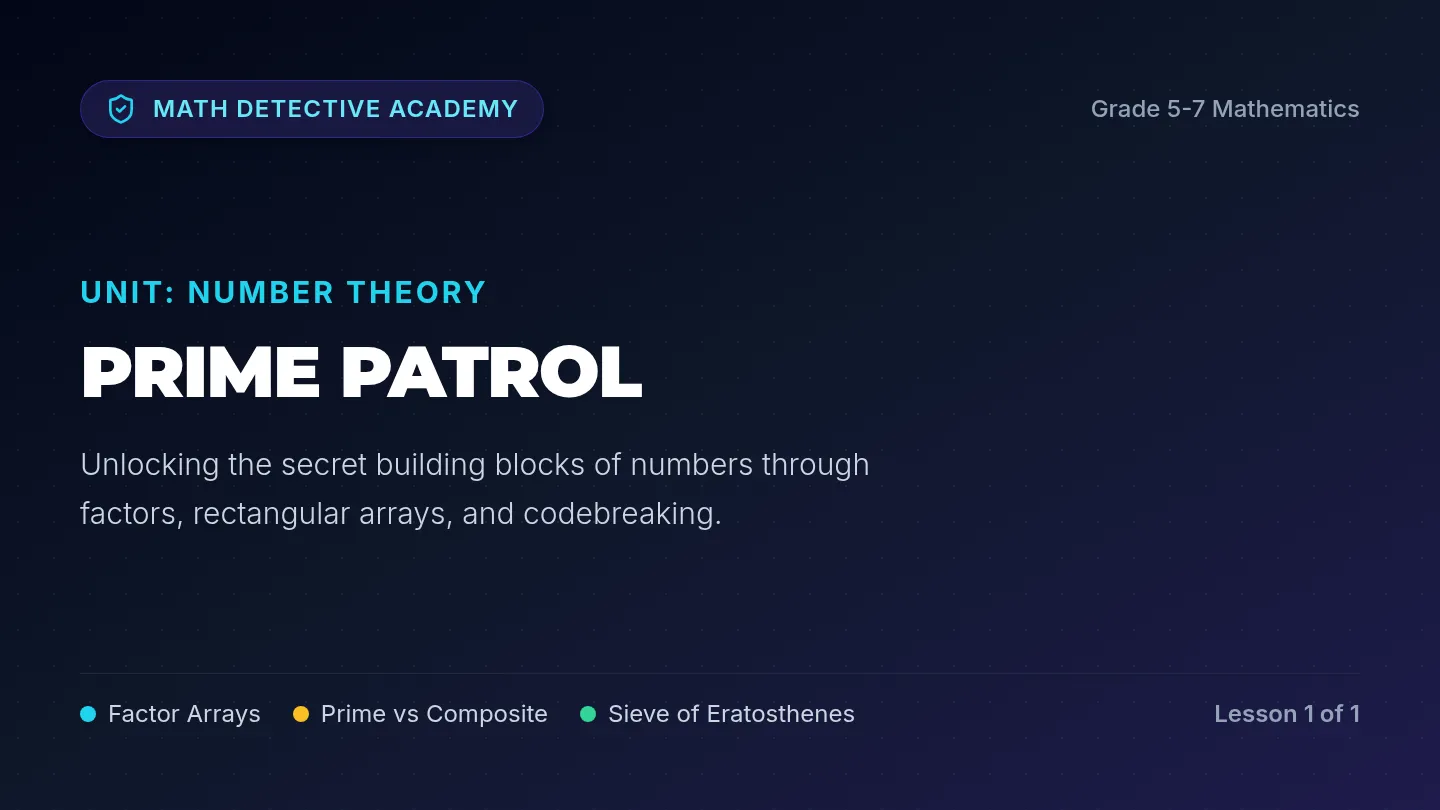
Prime Patrol Slides

Prime Patrol

An engaging upper-elementary and middle school mathematics lesson introducing prime and composite numbers through factor arrays, the Sieve of Eratosthenes, and real-world cryptographic connections. Features direct instruction slides, guided student practice, a fast formative exit ticket, and a teacher facilitation guide.

NS

Naomi Seifert

4
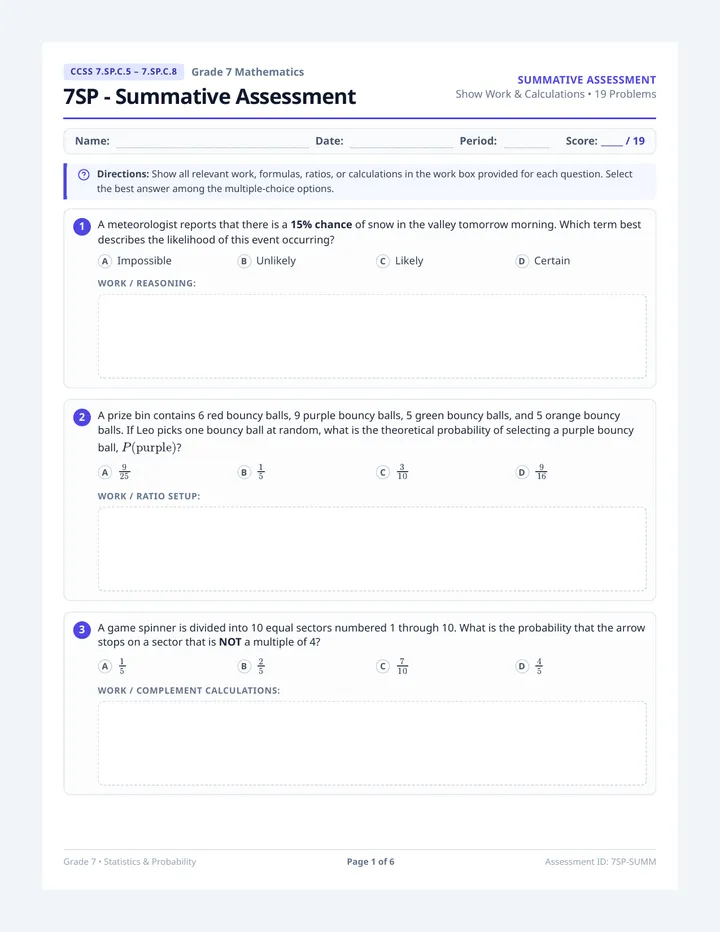
7SP - Summative Assessment

7SP - Summative Assessment

A 6-page, 19-question 7th grade math summative assessment evaluating probability standards 7.SP.C.5 through 7.SP.C.8, featuring parallel state-test items, multiple-choice questions, and dedicated workspace for calculations and ratios.

D

dlspadaro

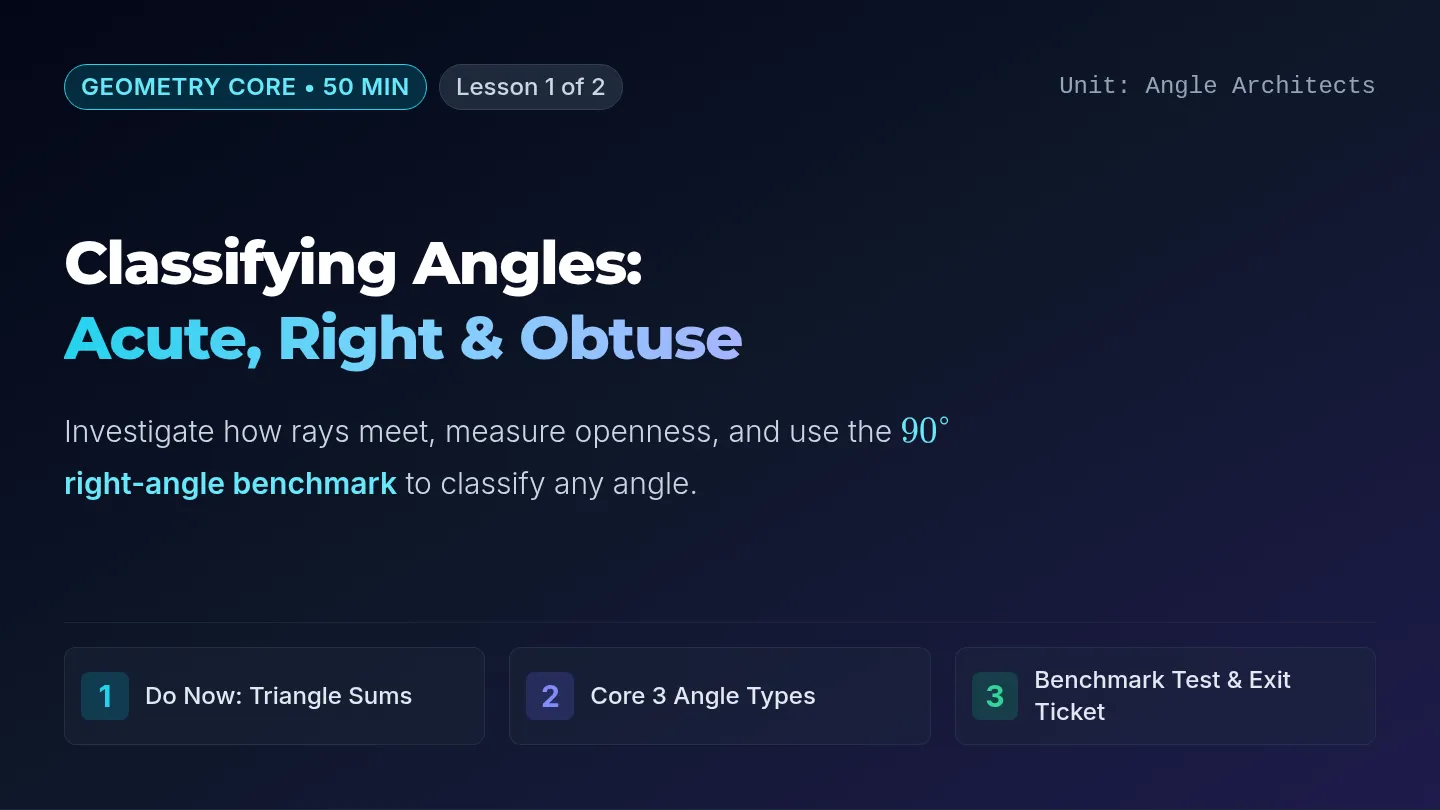
Angle Types Slides

Angle Architects

A two-part 50-minute geometry unit exploring angle classifications and angle pair relationships through rich geometric diagrams, guided algebraic problem-solving, and visual practice.

AA

alicia accapezzato

6
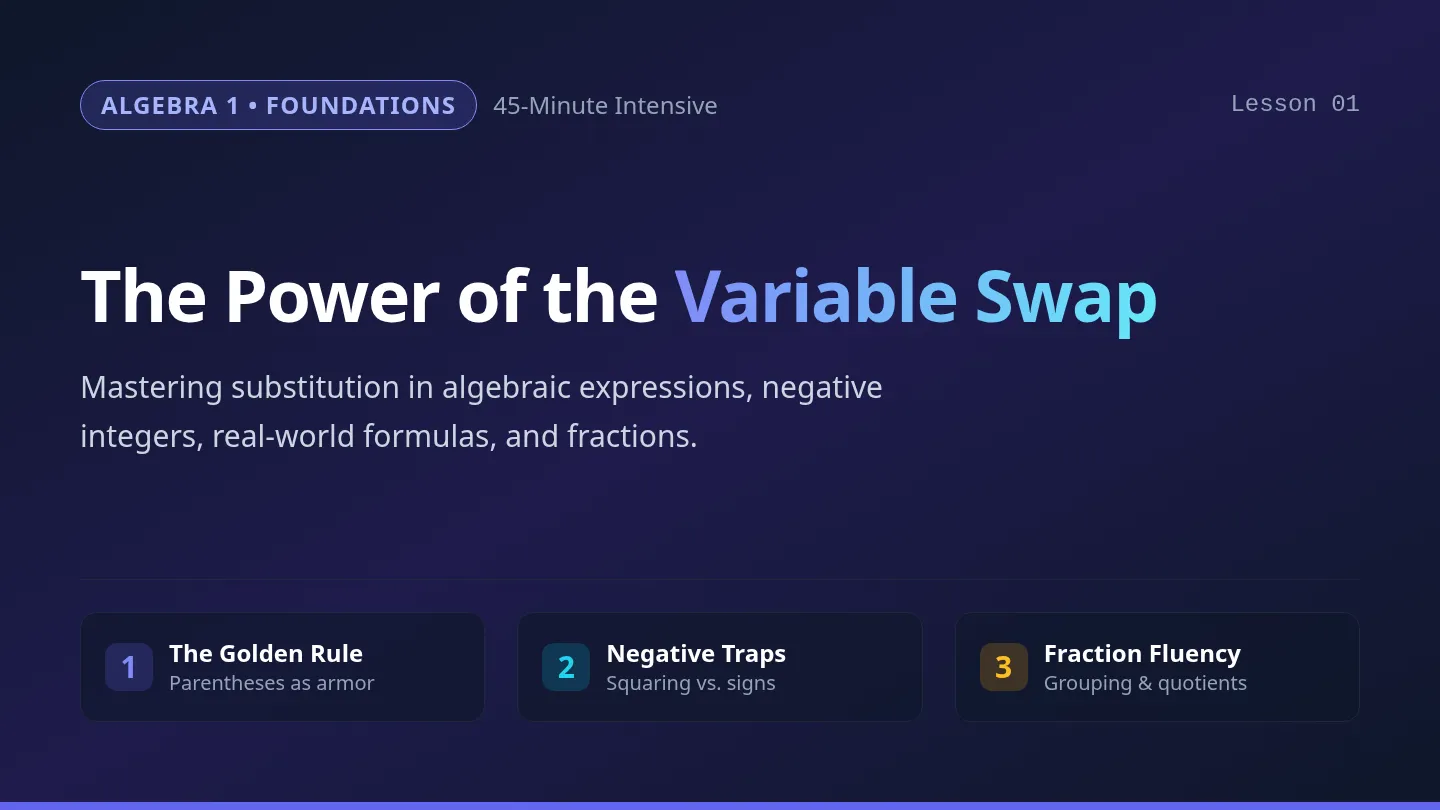
Variable Swap Slides

Substitution Mastery

A foundational 45-minute algebra lesson on variable substitution covering expressions, equations, formulas, negative numbers, and a dedicated focus on fractions.

AP

Alexis Paolini

6
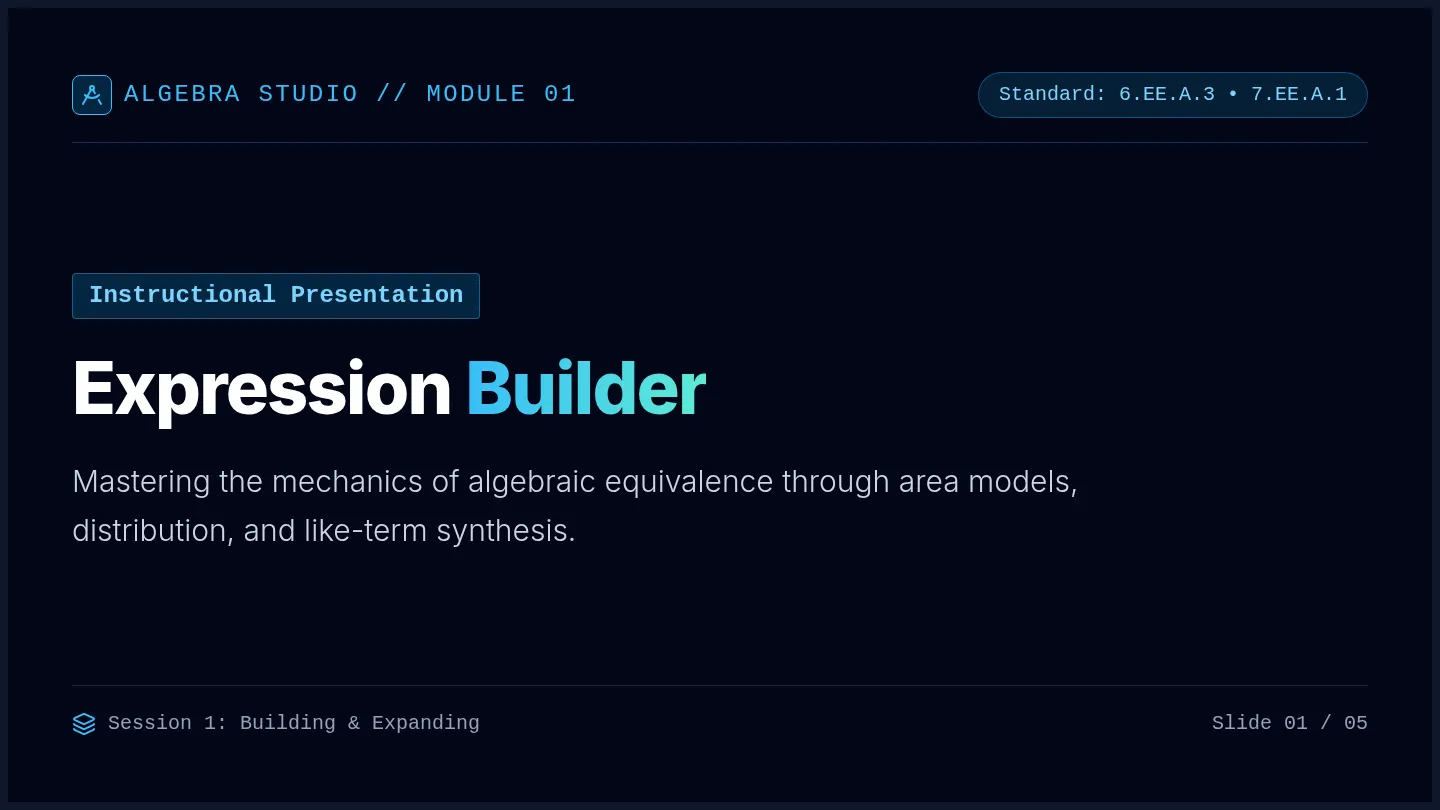
Expression Builder Slides

Expression Architects

A multi-day pre-algebra unit exploring equivalent expressions through visual area models, the distributive property, combining like terms, factoring, and substitution tests. Students learn how to transform algebraic forms and rigorously prove or disprove equivalence.

TL

Tricia Lucie

6