Prime Patrol Slides Math Detective Academy
Grade 5-7 Mathematics
Unit: Number Theory
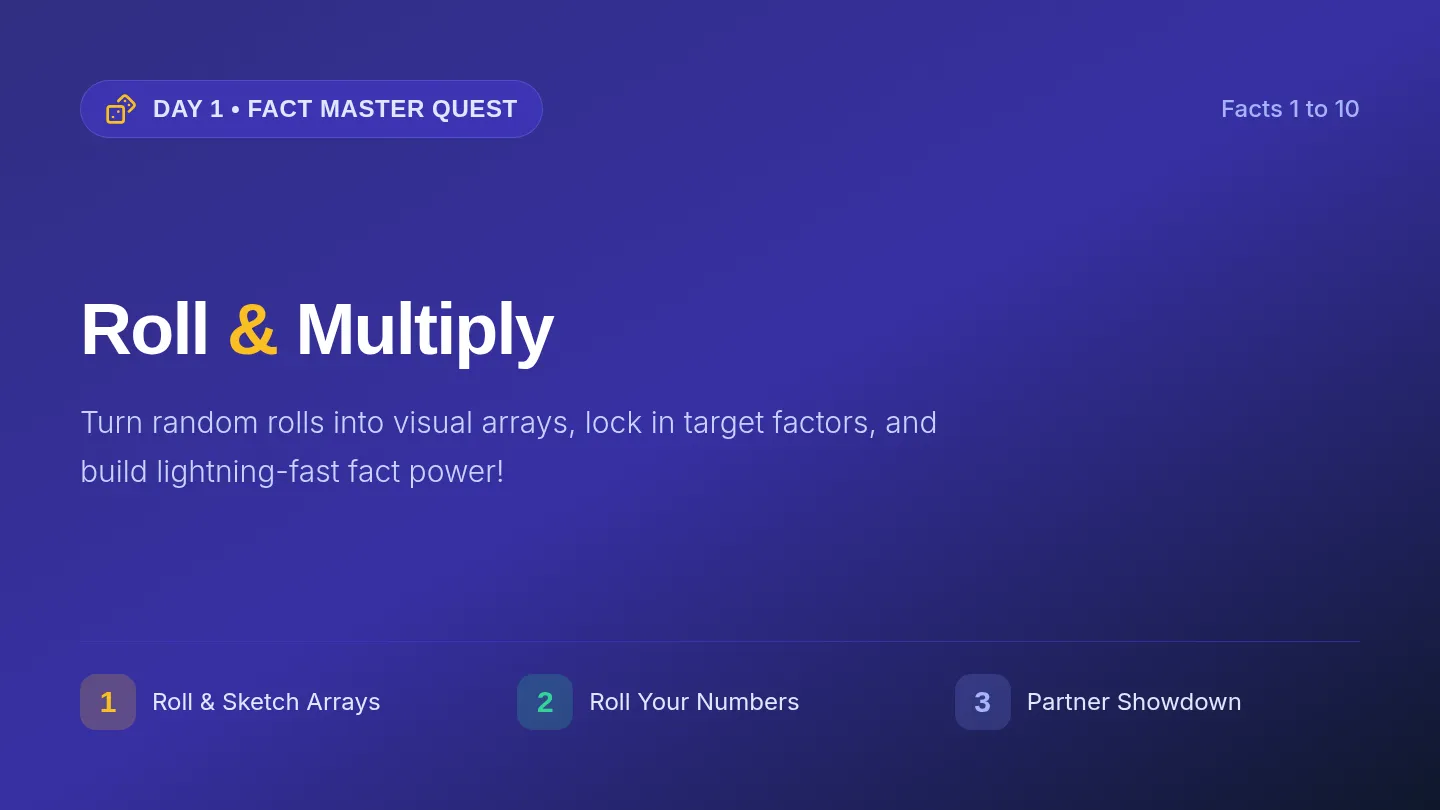
PRIME PATROL
Unlocking the secret building blocks of numbers through factors, rectangular arrays, and codebreaking.
Factor Arrays
Prime vs Composite
Sieve of Eratosthenes
Lesson 1 of 1
Investigation 1
The Rectangle Test
Can you arrange tiles into rectangles?
Number 12
Many Arrays
12 tiles can form 3 distinct rectangular arrangements:
1 × 12 array Factors: 1, 12
2 × 6 array Factors: 2, 6
3 × 4 array Factors: 3, 4
Total Factors: 6 factors (1, 2, 3, 4, 6, 12)
Number 7
Only 1 Array!
Try as you might, 7 tiles can only make a single line:
1 × 7 array Factors: 1, 7
2 × (no whole number) Does not work
3 × (no whole number) Does not work
Total Factors: Exactly 2 factors (1 and 7)
Key Idea: Factors are whole numbers that multiply together to produce another number.
Core Concept
The Golden Definitions
Memorize These Rules
Prime Number 🛡️
A whole number greater than 1 with EXACTLY two distinct positive factors: 1 and itself.
Prime Hall of Fame:
2, 3, 5, 7, 11, 13, 17, 19, 23...
Composite Number 🧱
A whole number greater than 1 that has MORE THAN two positive factors.
Composite Examples:
4, 6, 8, 9, 10, 12, 14, 15, 16...
⚠️
CRITICAL EXCEPTION: The number 1 has only ONE factor (itself). Therefore, 1 is NEITHER prime nor composite! The number 0 is also neither.
Watch Out!
Prime Misconceptions & Traps
Bust The Common Myths
MYTH #1
"All prime numbers are odd."
TRUTH:
2 is an EVEN number and is PRIME! It is the only even prime.
MYTH #2
"All odd numbers are prime."
TRUTH:
Look at 9, 15, 21, 25, 27 . They are odd, but composite because they have other factors!
MYTH #3
"1 is the smallest prime."
TRUTH:
Primes must have two distinct factors. 1 only has 1 factor. The smallest prime is 2 !
Detective Rule: Always list the factors before you classify!
Ancient Algorithm
The Sieve of Eratosthenes
Discovered c. 200 BCE in Alexandria
1
Cross out 1
1 is neither prime nor composite. Eliminate it first.
2
Circle 2, cross out its multiples
Keep 2 (prime), then cross out 4, 6, 8, 10, 12, 14, 16...
3
Circle 3, cross out its multiples
Keep 3 (prime), then cross out 6, 9, 12, 15, 18, 21...
4
Circle 5 and 7, repeat the pattern
Every remaining uncrossed number is a pure PRIME number!
First 10 Primes:
2
3
5
7
11
13
17
19
23
29
In your hands-on worksheet, you will complete your own 1–50 Sieve grid!
"Sieve" means a strainer: composite numbers fall through, while prime numbers stay behind!
Classroom Showdown
Guided Practice: Prime or Composite?
Thums Up = Prime | Fist = Composite
TARGET 1
27
Factors: 1, 3, 9, 27
COMPOSITE
TARGET 2
31
Factors: 1, 31
PRIME
TARGET 3
51
Factors: 1, 3, 17, 51
COMPOSITE
TARGET 4
47
Factors: 1, 47
PRIME
💡 Pro Tip for 51: Add the digits: \(5 + 1 = 6\). Since 6 is divisible by 3, 51 is divisible by 3 (\(3 \times 17 = 51\))!
Next Steps
Ready for the Mission
Time to Practice
Step 1: Guided Worksheet
Complete the factor arrays, factor pairs, and uncover all primes under 50 on the Sieve grid.
Step 2: Partner Check
Compare your prime list with your patrol partner. Double-check tricky numbers like 27, 39, and 49!
Step 3: Exit Ticket
Show what you know individually on the 4-question detective exit ticket before the bell rings.
Let's begin! Grab your pencils and worksheets.
Prime Patrol Worksheet PRIME PATROL: FACTOR LAB
Mission 01 • Array & Factor Investigation
Mathematics • Grade 5–7
Guided Practice
Name: ___________________________
Date: _________________
Period: _____________
PART 1
The Rectangle Test (Arrays & Factors)
How many whole-number rectangles can you build?
For each number of tiles, list all possible factor pairs, then circle whether it is Prime or Composite .
Number: 8 8 tiles
Factor pairs:
• 1 × 8
• 2 × ______
Type:
Prime Composite
Number: 11 11 tiles
Factor pairs:
• 1 × ______
• (any others?): ______
Type:
Prime Composite
Number: 16 16 tiles
Factor pairs:
• 1 × 16 • 2 × ____
• ____ × ____
Type:
Prime Composite
PART 2
Complete Factor Listing
List every factor from least to greatest
Target A: 24 Total Factors: [ ___ ]
All factors:
{ 1, _____, _____, _____, _____, _____, _____, 24 }
Type:
Prime Composite
Target B: 29 Total Factors: [ ___ ]
All factors:
{ 1, _____ }
Type:
Prime Composite
Target C: 36 Total Factors: [ ___ ]
All factors:
{ 1, _____, _____, _____, _____, _____, _____, _____, 36 }
Type:
Prime Composite
Target D: 37 Total Factors: [ ___ ]
All factors:
{ 1, _____ }
Type:
Prime Composite
PART 3
Detective Reasoning
1. Detective Case: Why is 2 the only even prime number? Explain using the definition of factors.
2. Myth Buster: Officer Alex claims, "Since 51 is an odd number, it must be prime!" Prove why Officer Alex is mistaken by finding all factors of 51.
Page 1 of 2 • Prime Patrol Student Worksheet
PRIME PATROL: THE SIEVE
Mission 02 • The Ancient Sieve of Eratosthenes
Range: 1 to 50
Discovery Grid
Prime Check Exit Ticket Prime Patrol • Exit Ticket Formative Check
Score: _____ / 4
Name: ______________________
Date: ____________
Period: _________
1. Definition Check [1 pt]
A prime number is a whole number greater than 1 that has:
• Exactly ________ positive factors:
the number ________ and ____________.
Fill in the 3 blanks above.
2. Factor & Classify [1 pt]
List all factors, then circle P (Prime) or C (Composite):
45: factors: { ______________ } P | C
43: factors: { ______________ } P | C
Show all factors for full credit.
3. The Special Case [1 pt]
Why is the number 1 neither prime nor composite?
Refer to the number of factors.
4. Mystery Code [1 pt]
"I am an odd number between 20 and 35. I am composite, and one of my factors is 7."
Mystery Number: [ ]
List its factors: ______________________
How confident do you feel with primes?
⚪ Need Help ⚪ Getting There ⚪ Mastered It!
— — — — — — — CUT HERE FOR TWO SLIPS — — — — — — —
Prime Patrol • Exit Ticket Formative Check
Score: _____ / 4
Name: ______________________
Date: ____________
Period: _________
1. Definition Check [1 pt]
A prime number is a whole number greater than 1 that has:
• Exactly ________ positive factors:
the number ________ and ____________.
Fill in the 3 blanks above.
2. Factor & Classify [1 pt]
List all factors, then circle P (Prime) or C (Composite):
45: factors: { ______________ } P | C
43: factors: { ______________ } P | C
Show all factors for full credit.
3. The Special Case [1 pt]
Why is the number 1 neither prime nor composite?
Refer to the number of factors.
4. Mystery Code [1 pt]
"I am an odd number between 20 and 35. I am composite, and one of my factors is 7."
Mystery Number: [ ]
List its factors: ______________________
How confident do you feel with primes?
Prime Patrol Teacher Guide PRIME PATROL: TEACHER GUIDE
Instructional Blueprint • Grades 5–7 Mathematics
Standards: CCSS 4.OA.B.4 • 6.NS.B.4
Total Pacing: 50–60 Min
Lesson Objectives
Students will define prime and composite numbers using factor pairs, model numbers as rectangular arrays, execute the Sieve of Eratosthenes from 1 to 50, and debunk common parity misconceptions.
Key Vocab: Factor, Factor Pair, Prime, Composite, Rectangular Array, Sieve of Eratosthenes, Multiple.
Essential Question
"Why are prime numbers considered the atomic building blocks of all integers?"
Materials: Slides, Worksheets, Color Pencils
Pacing & Instructional Delivery
08 MIN
Hook: The Tile Dilemma (Slide 1–2). Ask students: "Can you arrange 12 square desks into rectangles? What about 7 desks?" Connect the geometric impossibility of building extra rectangles for 7 directly to the algebraic definition of factors.
15 MIN
Direct Instruction: Definitions & Traps (Slides 3–5). Formalize Prime (exactly two factors) and Composite (more than two). Emphasize why 1 is neither. Introduce Eratosthenes and explain how systematic elimination eliminates composite numbers.
20 MIN
Guided & Partner Practice (Worksheet P1 & P2 + Slide 6). Students complete Part 1 (Arrays) and Part 2 (Factors), then run the Sieve on Page 2. Have students use a yellow highlighter for primes and a red pencil for multiples of composite numbers.
10 MIN
Formative Assessment: Exit Ticket & Debrief. Administer the 2-up Prime Check Exit Ticket independently. Collect before dismissal to sort students into mastery groups for Day 2 factor trees.
Critical Misconception Matrix
Myth: "1 is a prime number."
Correction: By definition, a prime number has two distinct positive factors. 1 has only one factor (itself: \(1 \times 1\)). In higher math, 1 is classified as a "unit".
Myth: "Odd means Prime."
Correction: Students frequently mistake odd numbers like 9, 15, 21, 27, 33, 35, 49, 51 for primes. Always test divisibility by 3, 5, and 7 first.
Myth: "All even numbers are composite."
Correction: 2 has exactly two factors (1 and 2), which perfectly meets the definition. 2 is the ONLY even prime number.
Myth: "Large numbers ending in 1, 7, 9 are prime."
Correction: Teach the digit-sum trick for 3 (\(5+1=6\), so 51 is \(3 \times 17\)) and check multiples of 7 (\(91 = 7 \times 13\)).