Lenny.com
Explore
Create
ActivitiesNewMathEnglish Language ArtsScience & EngineeringSocial StudiesGlobal LanguagesHealth & Physical EducationSpecial EducationCounseling & Life SkillsArts & CreativityESL
Lenny.com
Lenny.com
Explore
Create
ActivitiesNewMathEnglish Language ArtsScience & EngineeringSocial StudiesGlobal LanguagesHealth & Physical EducationSpecial EducationCounseling & Life SkillsArts & CreativityESL
Lenny.com
Lenny.com

Solutions

Lenny for EducatorsLenny for SchoolsLenny for Districts

Product

ExploreSign inCreateSupportAbout

Resources

Getting startedMTSS Acceleration Program

© 2026 Lenny Learning Inc.

TermsPrivacyAccessibility
LinkedInInstagramX
Lenny
MathNumbers & CountingCounting ObjectsNumber NamesComparing NumbersNumber OperationsCounting SequenceNumbers 0-10Place Value Understanding and SystemAdd and Subtract Within 20Addition and Subtraction ConceptsAddition and Subtraction EquationsAddition and Subtraction ProblemsFoundations for MultiplicationMultiplication and Division PropertiesMultiply and Divide Within 100Multiplication and Division ProblemsFactors and MultiplesProperties of OperationsPatterns and RelationshipsGenerate and Analyze PatternsMulti-Digit ArithmeticPlace Value OperationsMulti-Digit and Decimal OperationsNumerical ExpressionsFour Operations and PatternsFour Operations Problem SolvingMeasurement & DataMeasurable AttributesMeasuring LengthsMeasure and Estimate Lengths in Standard UnitsRelate Addition and Subtraction to LengthClassifying and Counting ObjectsTime and MoneyArea Concepts and MeasurementPerimeter and Area MeasuresAngle Concepts and MeasurementTime, Volume, and MassMeasurement Unit ConversionsGeometryIdentifying ShapesShapes and AttributesShape Attributes and ReasoningShapes and CompositionClassifying 2D FiguresGeometric Figures and RelationshipsLines, Angles, and ShapesAngle, Area, and VolumeGeometric MeasurementVolume of 3D ShapesCoordinate Plane ApplicationsTransformations in the PlaneCongruence and SimilarityUnderstand congruence in terms of rigid motionsSimilarity and TransformationsProve Theorems Involving SimilarityPythagorean TheoremTrigonometry for General TrianglesMake Geometric ConstructionsProve Geometric TheoremsTheorems About CirclesFind Arc Lengths And Areas of Sectors of CirclesVolume FormulasRelationships Between Two-Dimensional and Three-Dimensional ObjectsProve Simple Geometric Theorems AlgebraicallyTranslate Between Geometric Description and Equation for Conic SectionApply Geometric Concepts in Modeling SituationsFractions & DecimalsFractions as NumbersBuilding FractionsFraction Equivalence and OrderingAdding and Subtracting FractionsMultiplying and Dividing FractionsDividing FractionsDecimal FractionsMulti-Digit Computation and FactorsAdd, Subtract, Multiply, and Divide Rational NumbersRational Number SystemIrrational Numbers and ApproximationsRatiosRatios and ProportionsProportional RelationshipsUnit RateAlgebraAlgebraic ExpressionsGenerate Equivalent ExpressionsQuantitative RelationshipsProportional Relationships and Linear EquationsEquations and InequalitiesEquation Solving and ReasoningLinear Equations and SystemsGraph Equations and InequalitiesSystems of EquationsReal-World Algebraic ProblemsQuantitative Reasoning with UnitsExpression StructureEquivalent Expression FormsRadicals and Integer ExponentsRational ExponentsRational and Irrational NumbersPolynomial OperationsPolynomial IdentitiesPolynomial Zeros and FactorsRational ExpressionsComplex Number OperationsComplex Numbers in PolynomialsComplex Numbers on PlaneStatistics & ProbabilityRepresent and Interpret DataData DistributionsStatistical VariabilityProbability ModelsCompound Event ProbabilitiesStatistical SamplingInterpret Categorical and Quantitative DataBivariate Data PatternsInterpret Linear ModelsComparing Two PopulationsRandom Processes in StatisticsIndependence and Conditional ProbabilityExpected ValuesProbability-Based Decision MakingStatistical Inference and ConclusionsFunctionsFunction Concepts and NotationDefine and Compare FunctionsInterpret Functions in ContextAnalyze Function RepresentationsModel Relationships with FunctionsIdentify Linear vs Exponential GrowthDistinguish Between Function TypesCompare Growth RatesInterpret Function ExpressionsBuild Functions from RelationshipsConstruct and Model FunctionsTransform and Combine FunctionsModel Comparison and SelectionSolve Exponential EquationsTrigonometryTrigonometric Ratios Involving Right TrianglesTrigonometric Functions and Unit CircleModel with Trigonometric FunctionsTrigonometric IdentitiesVectors & MatricesIntroduction to Vectors and MatricesVector QuantitiesVector OperationsMatrix OperationsCalculusLimits and ContinuityDerivative Concepts and NotationDerivative Rules and TechniquesApplications of DerivativesOptimization ProblemsRelated RatesCurve Sketching and AnalysisIntegration Concepts and NotationAntiderivatives and Indefinite IntegralsDefinite Integrals and AreaFundamental Theorem of CalculusIntegration TechniquesApplications of IntegrationDifferential EquationsSequences and SeriesParametric and Polar FunctionsVector-Valued Functions

Number Shape Shifters

An arcade-themed lesson for Florida Standard MA.7.NSO.1.2 where students master converting between fractions, mixed numbers, repeating decimals, and percentages through highly engaging, differentiated practice.

GGIna

Number Shape Shifters

An arcade-themed lesson for Florida Standard MA.7.NSO.1.2 where students master converting between fractions, mixed numbers, repeating decimals, and percentages through highly engaging, differentiated practice.

GGIna

\( 0.\overline{3} \)

\( \frac{1}{2} \)

\( 0.8 \)

\( 20\% \)

\( 0.\overline{3} \)

\( \frac{1}{5} \)

\( \frac{3}{4} \)

\( \frac{1}{3} \)

\( 0.9 \)

\( 70\% \)

\( \frac{1}{10} \)

\( \frac{1}{3} \)

\( 33.\overline{3}\% \)

\( 0.\overline{3} \)

\( \frac{1}{3} \)

\( 33.\overline{3}\% \)

\( \frac{1}{3} \)

\( \frac{4}{10} \)

\( \frac{1}{4} \)

\( 25\% \)

\( 0.\overline{3} \)

\( \frac{1}{3} \)

\( 33.\overline{3}\% \)

\( 0.\overline{3} \)

\( 0.25 \)

\( \frac{1}{4} \)

\( 25\% \)

\( 0.25 \)

\( \frac{1}{4} \)

\( \frac{1}{4} \)

\( 25\% \)

\( \frac{1}{4} \)

\( 25\% \)

\( 0.25 \)

\( \frac{3}{10} \)

\( 25\% \)

\( 0.6 \)

\( 0.25 \)

\( \frac{1}{4} \)

\( 60\% \)

\( 25\% \)

\( 0.7 \)

\( \frac{2}{5} \)

\( 40\% \)

\( \frac{3}{5} \)

\( 0.6 \)

\( 60\% \)

\( \frac{3}{5} \)

\( 0.45 \)

\( \frac{9}{20} \)

\( 1.25 \)

\( 125\% \)

\( 150\% \)

\( 1.5 \)

\( 1 \frac{1}{2} \)

\( 1.1 \)

\( 1 \frac{1}{4} \)

\( 1.25 \)

Completed matching reveals the Space Invader! Page 2 of 2

Solve real-world gaming and financial calculations using equivalent rational forms.

CARDS 5 - 8

CARD 05

Power Boost

Level Up Bonus

After reaching Level 50, your character gains a permanent gold coin multiplier multiplier bonus of \( 1.45 \) for every completed battle quest.

A. Convert the multiplier \( 1.45 \) into a simplified mixed number.

B. Convert this decimal value into its equivalent percentage format.

Workspace / Answers:

A: ___________________ B: ___________________

CARD 06

Alchemy Lab

Healing Potion

An alchemist's scroll writes that a powerful health potion recipe requires exactly \( 3 \frac{2}{3} \) vials of crushed starry glowberries.

A. Write \( 3 \frac{2}{3} \) as a decimal using proper bar notation.

B. What percentage of a vial does the fraction \( \frac{2}{3} \) represent? (Round to nearest tenth of a percent.)

Workspace / Answers:

A: ___________________ B: ___________________

CARD 07

Combat Accuracy

Archery Stats

In a local castle archery tournament, your character fires 24 arrows and successfully hits exactly 18 bullseyes on target boards.

A. Express your success rate ratio as a simplified fraction.

B. Write the hit success rate as a decimal and percent.

Workspace / Answers:

A: ___________________ B: ___________________

CARD 08

Vault Codes

The Golden Lock

To open the ultimate dungeon vault, you must enter three keys in order from least to greatest:
Key X: \( \frac{9}{11} \) | Key Y: \( 0.81 \) | Key Z: \( 81.\overline{8}\% \)

A. Convert all three keys to decimals to easily compare them.

B. Write the correct ordered unlock sequence of keys.
Workspace / Answers:

A: ___________________ B: ___________________

Cut along borders to separate cards Page 2 of 2

You might also like

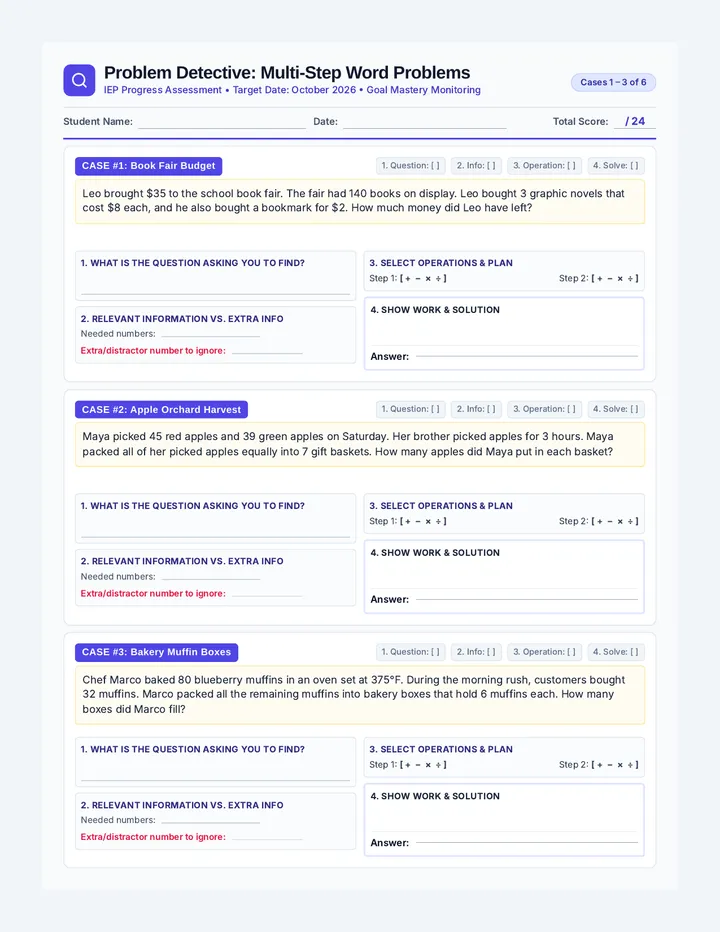
Problem Detective Assessment

Math Goal Mastery

A targeted sequence of progress monitoring assessments and evaluation guides designed to measure and document key IEP mathematics benchmarks, including multi-step word problems and multi-digit operations.

JD

Jenny Daniels

4
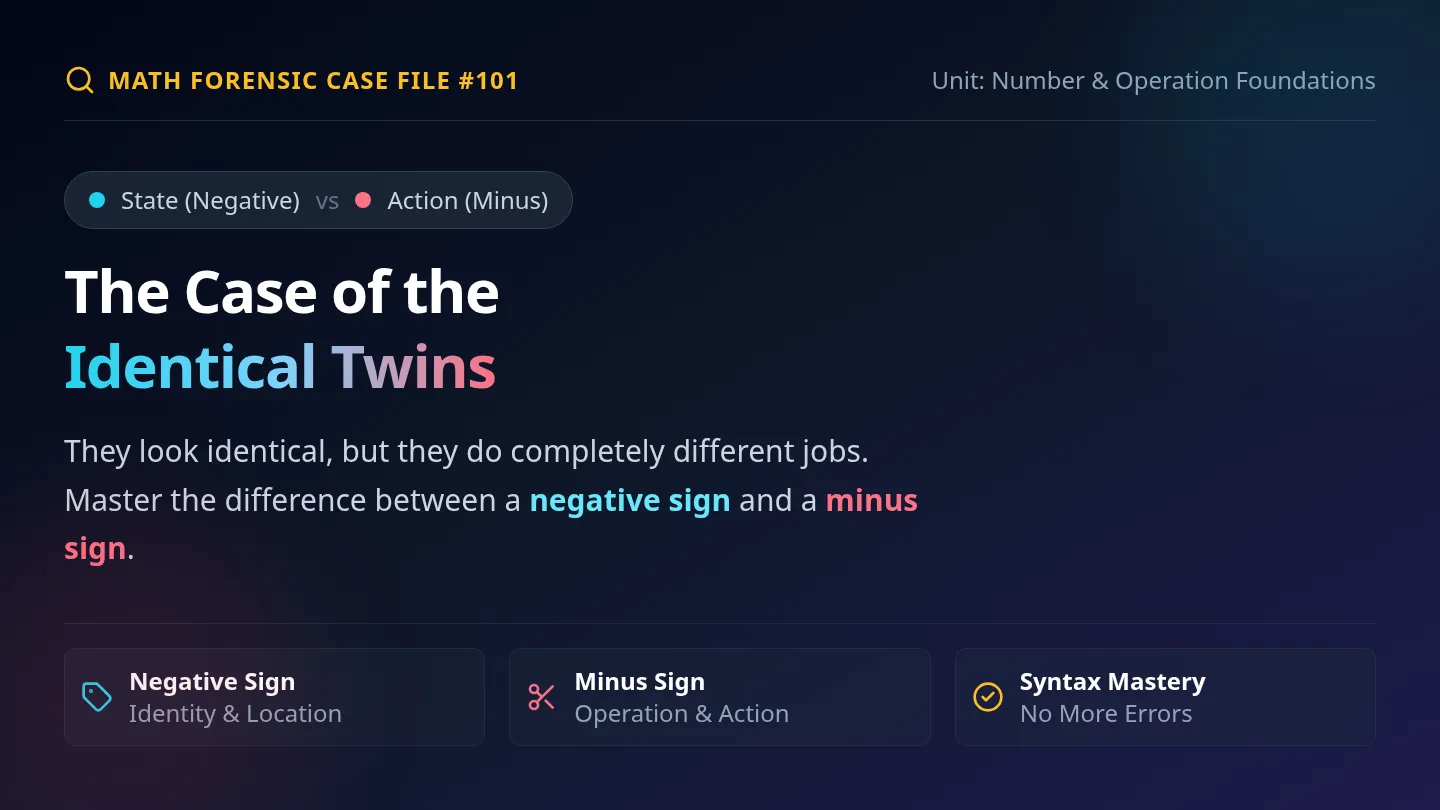
Sign Sleuths Slides

Sign Sleuths

A focused mini-unit that demystifies the difference between negative signs (numerical state) and minus signs (operational action). Students master visual identification, read-aloud conventions, calculator syntax, and algebraic expressions.

H

Harlston

4
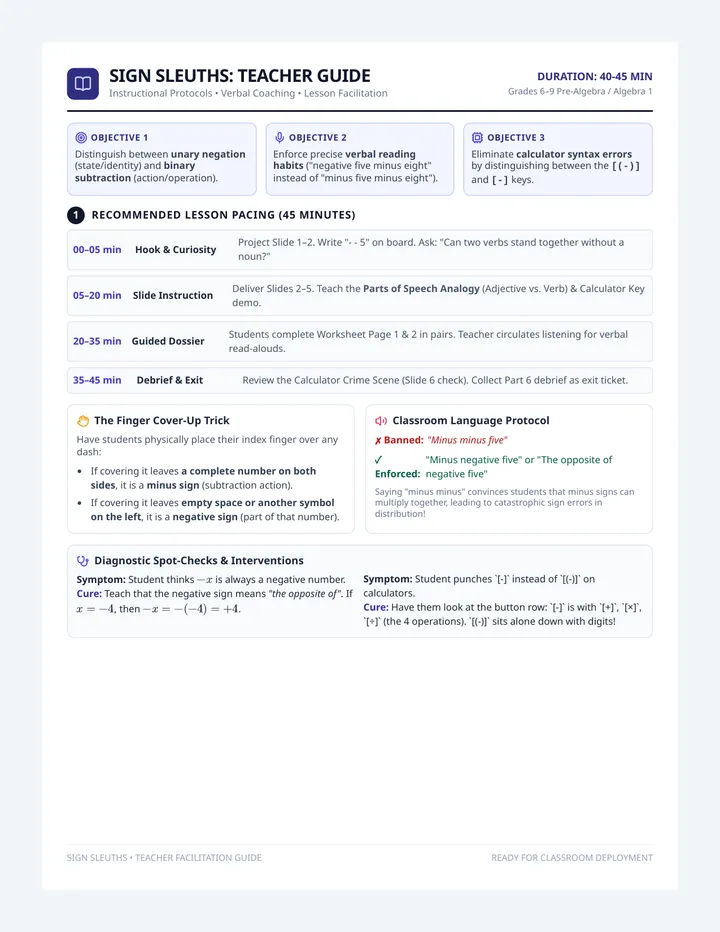
Sign Sleuths Teacher Guide

Sign Sleuths Teacher Guide

A comprehensive 1-page teacher facilitation guide featuring a 45-minute pacing blueprint, classroom dialogue scripts, tactile kinesthetic tricks, and targeted diagnostic interventions.

H

Harlston

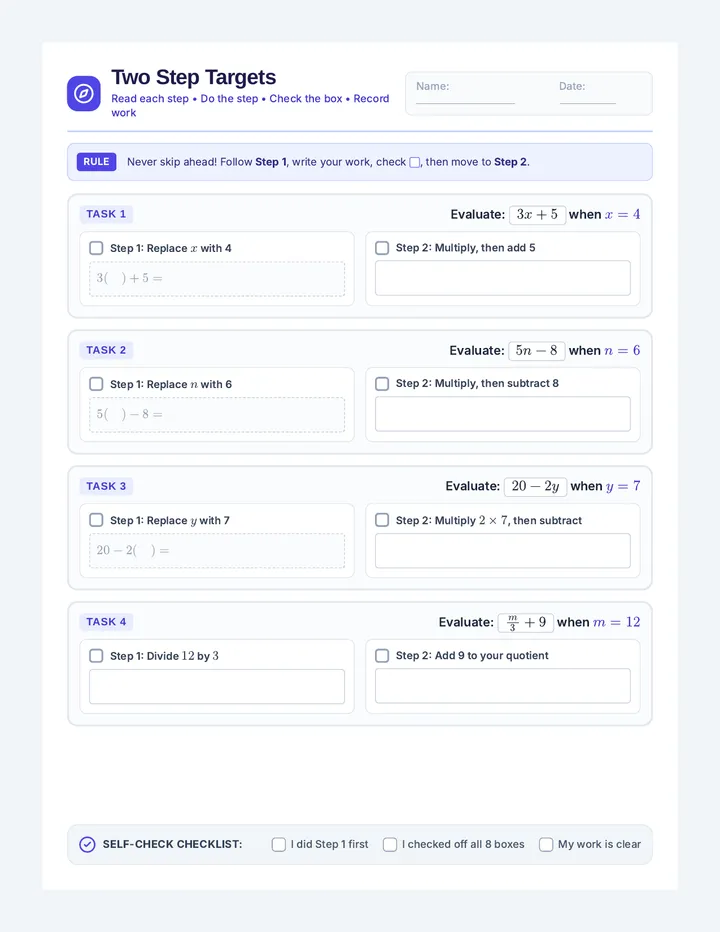
Two Step Targets Worksheet

Direction Detectives

A scaffolded 7th-grade math practice sequence designed for special education learners, focusing on breaking down multi-step tasks into clear, bite-sized directions of 2 to 4 prompts. Students follow explicit written directions, track their progress with visual step checkpoints, and record each intermediate calculation.

J

jbrower

6
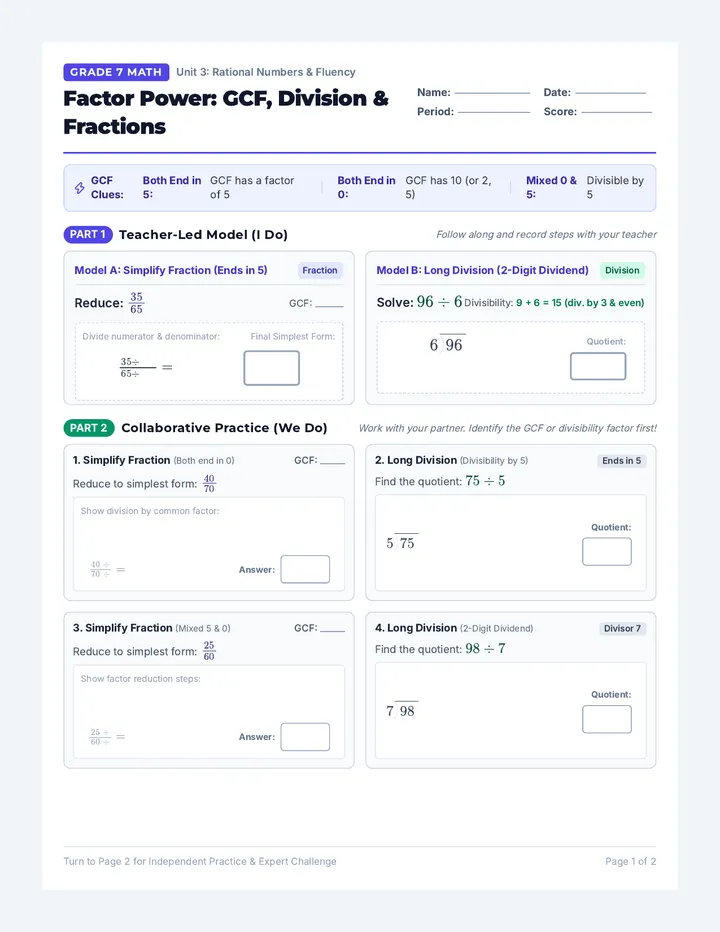
Factor Power Worksheet

Factor Power

A targeted 7th-grade mathematics lesson designed to build student fluency in identifying Greatest Common Factors (GCF) and divisibility rules, seamlessly bridging conceptual factor knowledge with long division of 2-digit numbers and fraction simplification.

CG

Connor Green

2
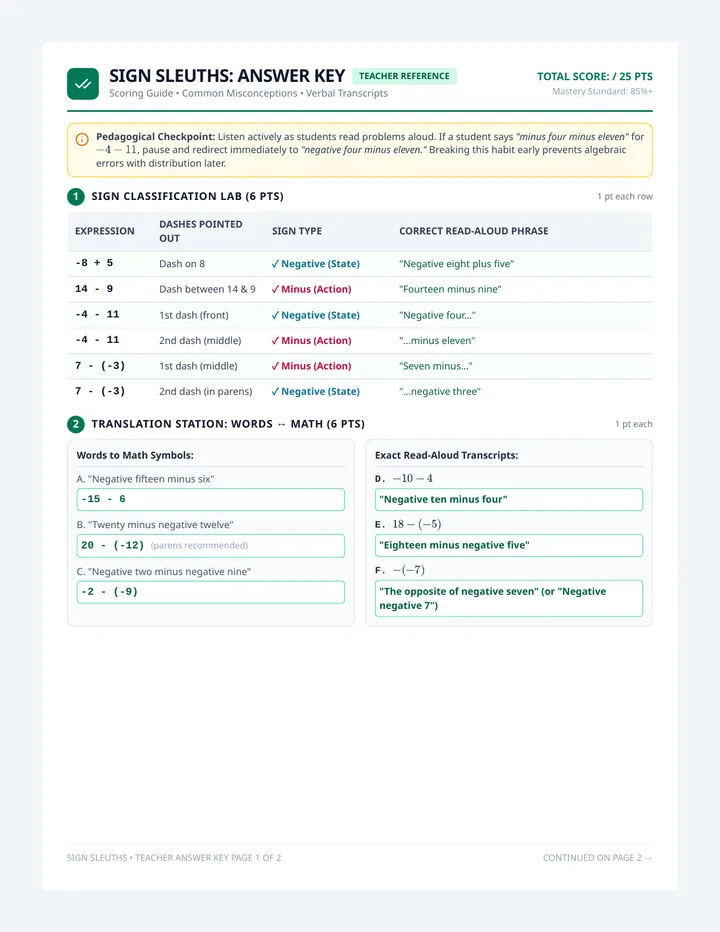
Sign Sleuths Answer Key

Sign Sleuths Answer Key

Complete 2-page answer key and grading guide providing full worked solutions, correct read-aloud transcripts, calculator debugging explanations, and teacher misconception callouts.

H

Harlston

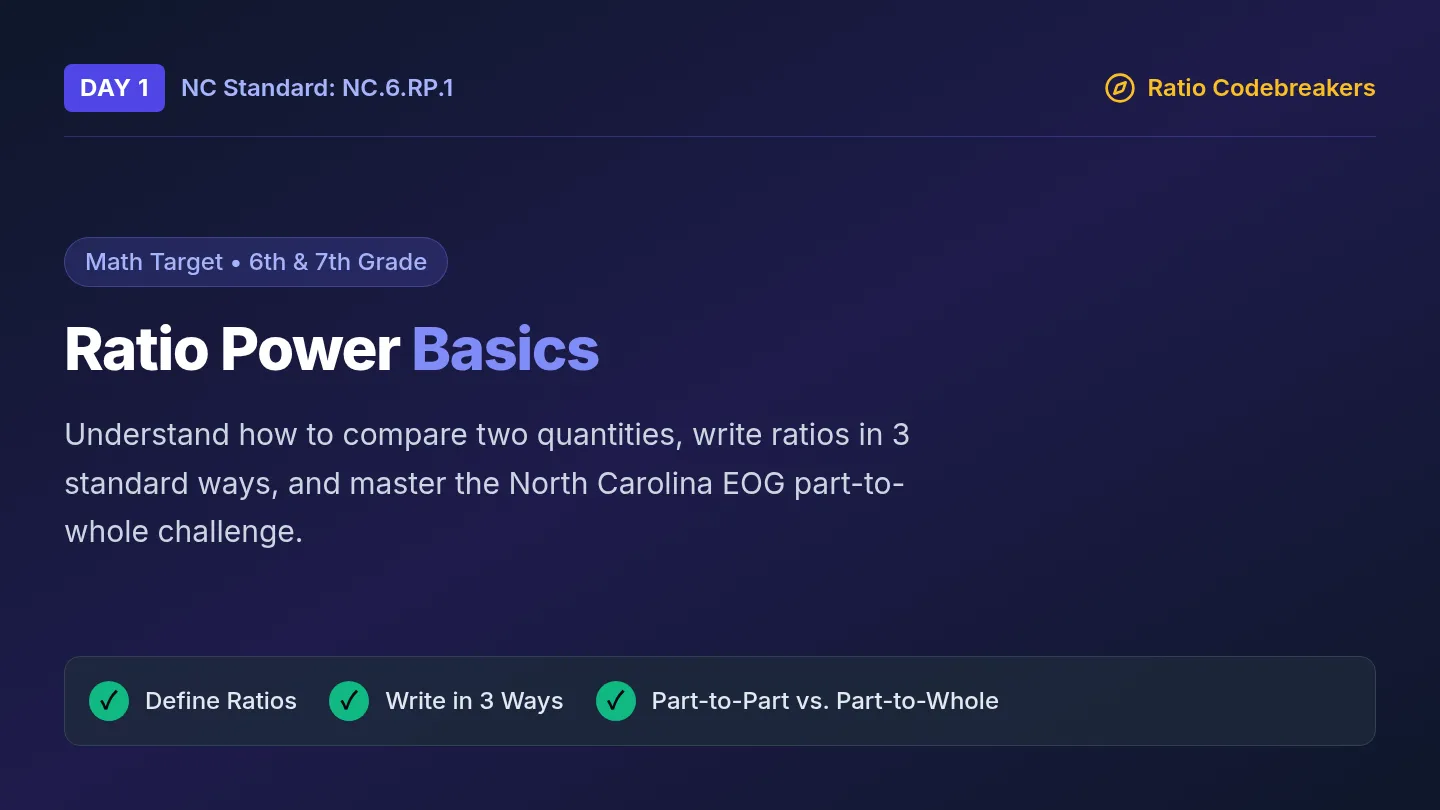
Ratio Power Slides

Ratio Launchpad

A 3-day scaffolded sequence designed for self-contained 6th and 7th grade math students preparing for North Carolina End-of-Grade (EOG) testing. The sequence develops foundational ratio reasoning through concrete visual models, structured guided practice, tape diagrams, and equivalent ratio tables.

CP

Christian Page

12
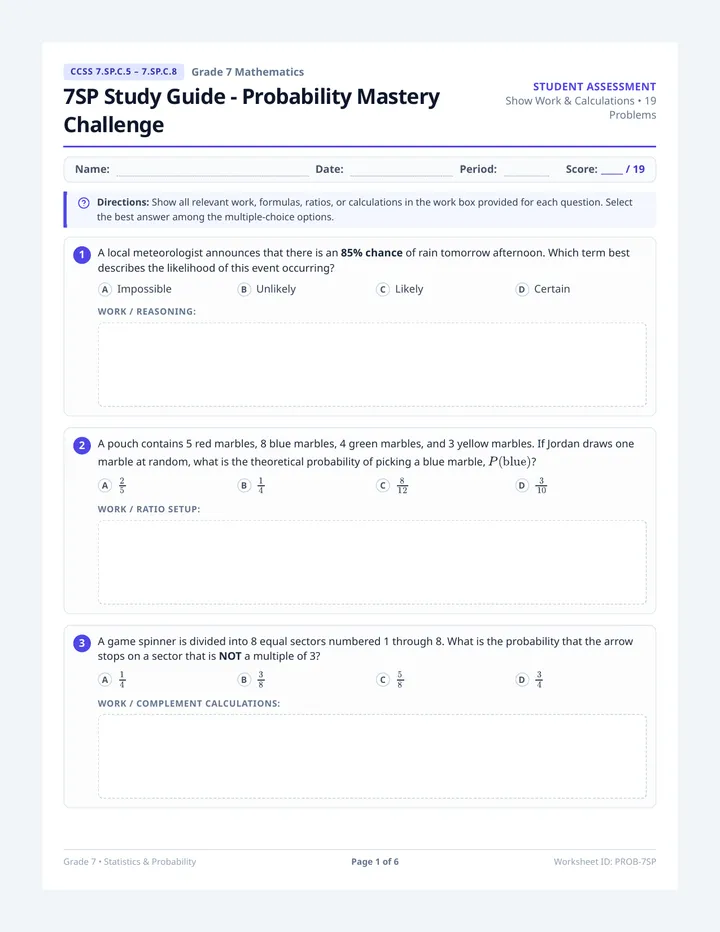
Probability Masters Worksheet

Probability Mastery

A comprehensive 7th-grade unit covering probability standards 7.SP.C.5 through 7.SP.C.8, including simple events, experimental probability, predictions, and compound events.

D

dlspadaro

3
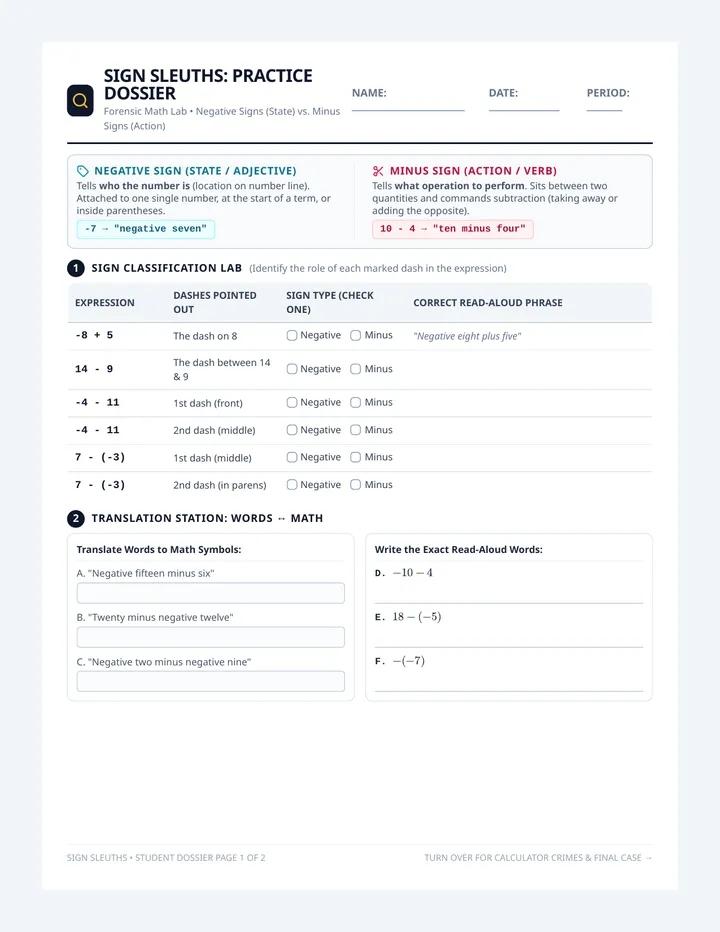
Sign Sleuths Practice Worksheet

Sign Sleuths Practice Worksheet

A 2-page guided practice worksheet featuring a visual sleuth field guide, expression sign classification tables, read-aloud translations, calculator syntax debugging, and an evaluation challenge.

H

Harlston

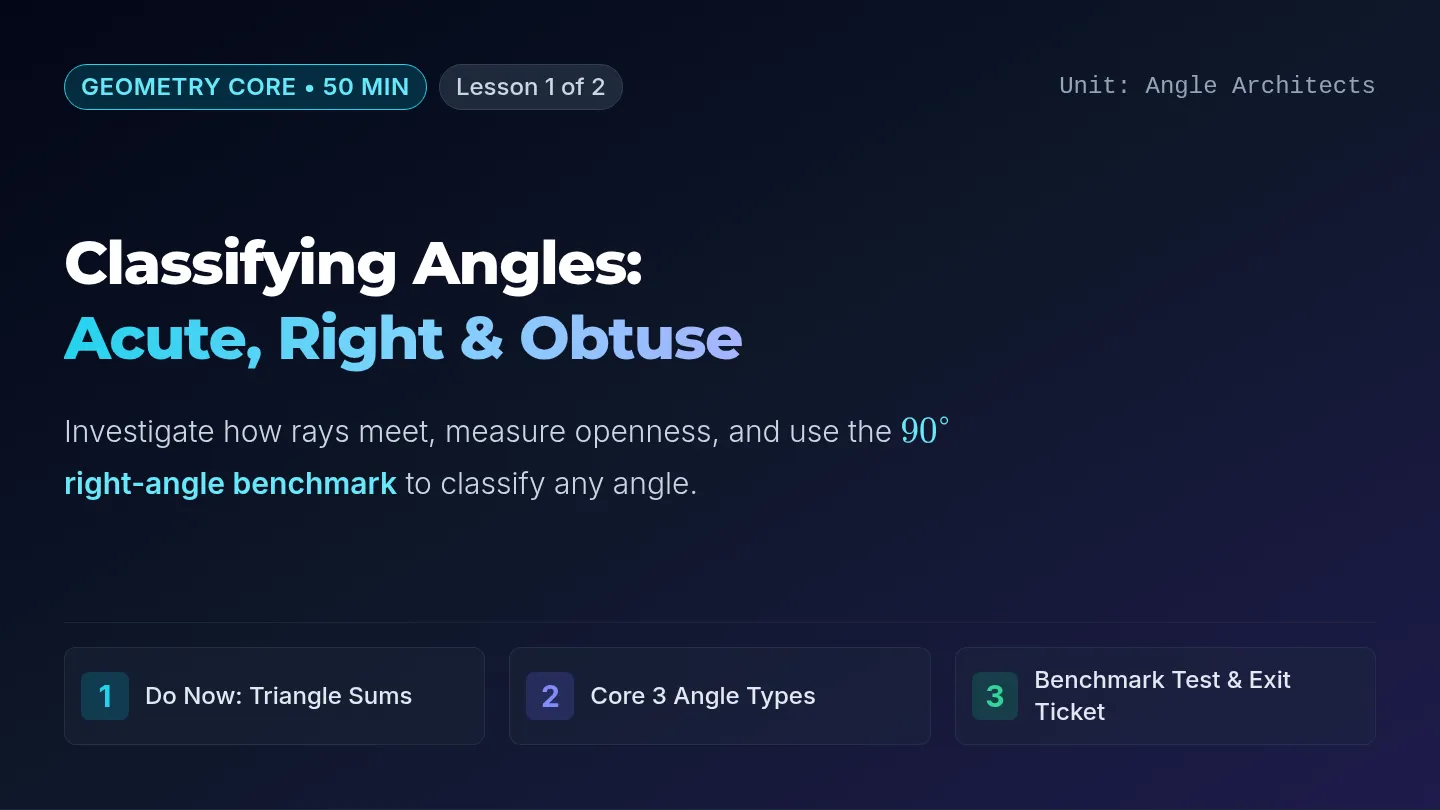
Angle Types Slides

Angle Architects

A two-part 50-minute geometry unit exploring angle classifications and angle pair relationships through rich geometric diagrams, guided algebraic problem-solving, and visual practice.

AA

alicia accapezzato

6
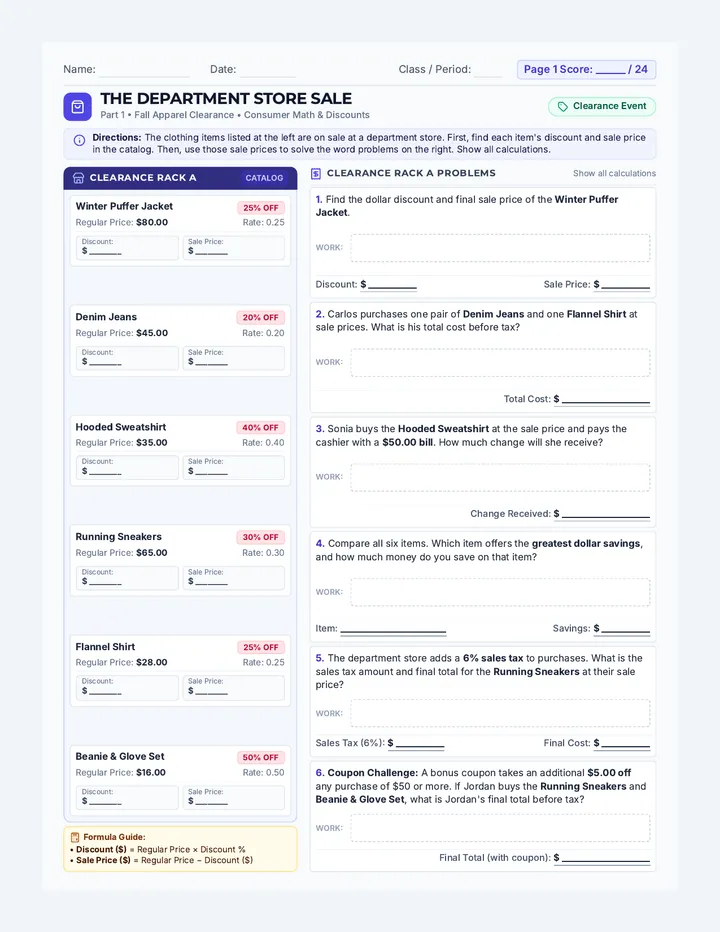
Department Store Math Worksheet

Smart Shopper Math

Students learn to calculate percentage markdowns, sale prices, sales taxes, coupons, and gift card balances through realistic department store clearance shopping scenarios.

CD

Cheri Donahoe

2
Sign Sleuths Slides

Sign Sleuths Slides

Interactive instructional slides that break down the fundamental difference between negative signs as state/identity and minus signs as operational actions. Features the calculator syntax mystery, read-aloud conventions, and visual decoding strategies.

H

Harlston