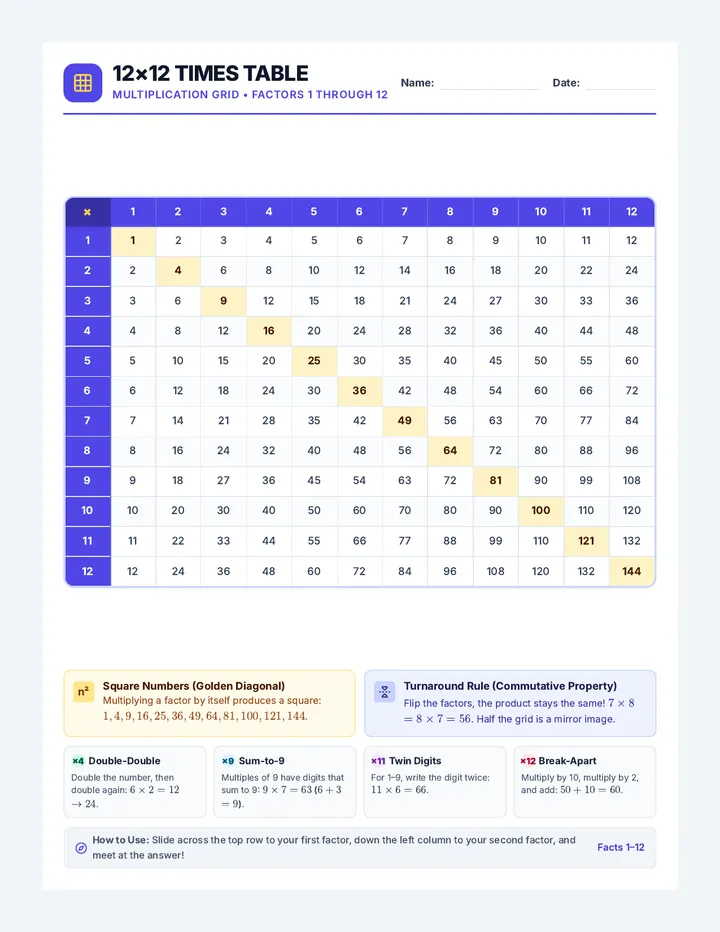
Times Table Reference Chart
MULTIPLICATION CHART
Factors 1 through 15 • Master Reference Guide
Name:
Date:
| × | 1 | 2 | 3 | 4 | 5 | 6 | 7 | 8 | 9 | 10 | 11 | 12 | 13 | 14 | 15 |
|---|
| 1 | 1 | 2 | 3 | 4 | 5 | 6 | 7 | 8 | 9 | 10 | 11 | 12 | 13 | 14 | 15 |
| 2 | 2 | 4 | 6 | 8 | 10 | 12 | 14 | 16 | 18 | 20 | 22 | 24 | 26 | 28 | 30 |
| 3 | 3 | 6 | 9 | 12 | 15 | 18 | 21 | 24 | 27 | 30 | 33 | 36 | 39 | 42 | 45 |
| 4 | 4 | 8 | 12 | 16 | 20 | 24 | 28 | 32 | 36 | 40 | 44 | 48 | 52 | 56 | 60 |
| 5 | 5 | 10 | 15 | 20 | 25 | 30 | 35 | 40 | 45 | 50 | 55 | 60 | 65 | 70 | 75 |
| 6 | 6 | 12 | 18 | 24 | 30 | 36 | 42 | 48 | 54 | 60 | 66 | 72 | 78 | 84 | 90 |
| 7 | 7 | 14 | 21 | 28 | 35 | 42 | 49 | 56 | 63 | 70 | 77 | 84 | 91 | 98 | 105 |
| 8 | 8 | 16 | 24 | 32 | 40 | 48 | 56 | 64 | 72 | 80 | 88 | 96 | 104 | 112 | 120 |
| 9 | 9 | 18 | 27 | 36 | 45 | 54 | 63 | 72 | 81 | 90 | 99 | 108 | 117 | 126 | 135 |
| 10 | 10 | 20 | 30 | 40 | 50 | 60 | 70 | 80 | 90 | 100 | 110 | 120 | 130 | 140 | 150 |
| 11 | 11 | 22 | 33 | 44 | 55 | 66 | 77 | 88 | 99 | 110 | 121 | 132 | 143 | 154 | 165 |
| 12 | 12 | 24 | 36 | 48 | 60 | 72 | 84 | 96 | 108 | 120 | 132 | 144 | 156 | 168 | 180 |
| 13 | 13 | 26 | 39 | 52 | 65 | 78 | 91 | 104 | 117 | 130 | 143 | 156 | 169 | 182 | 195 |
| 14 | 14 | 28 | 42 | 56 | 70 | 84 | 98 | 112 | 126 | 140 | 154 | 168 | 182 | 196 | 210 |
| 15 | 15 | 30 | 45 | 60 | 75 | 90 | 105 | 120 | 135 | 150 | 165 | 180 | 195 | 210 | 225 |
n² SQUARES 1, 4, 9, 16, 25, 36, 49, 64, 81, 100, 121, 144, 169, 196, 225
Diagonal Highlight
×13 Split 10 + 3
Multiply by 10, multiply by 3, then add.
13 × 7 = 70 + 21 = 91
×14 Double the 7s
Multiply by 7, then double your result.
14 × 6 = (7 × 6) × 2 = 84
×15 10× Plus Half
Multiply by 10, then add half of that amount.
15 × 8 = 80 + 40 = 120
Mirror Math: \(a \times b = b \times a\) (e.g. \(13 \times 5 = 5 \times 13 = 65\))
Ends in 0 or 5: All multiples of 15 alternate ending in 0 and 5
Even Products: Multiples of 14 are all even numbers
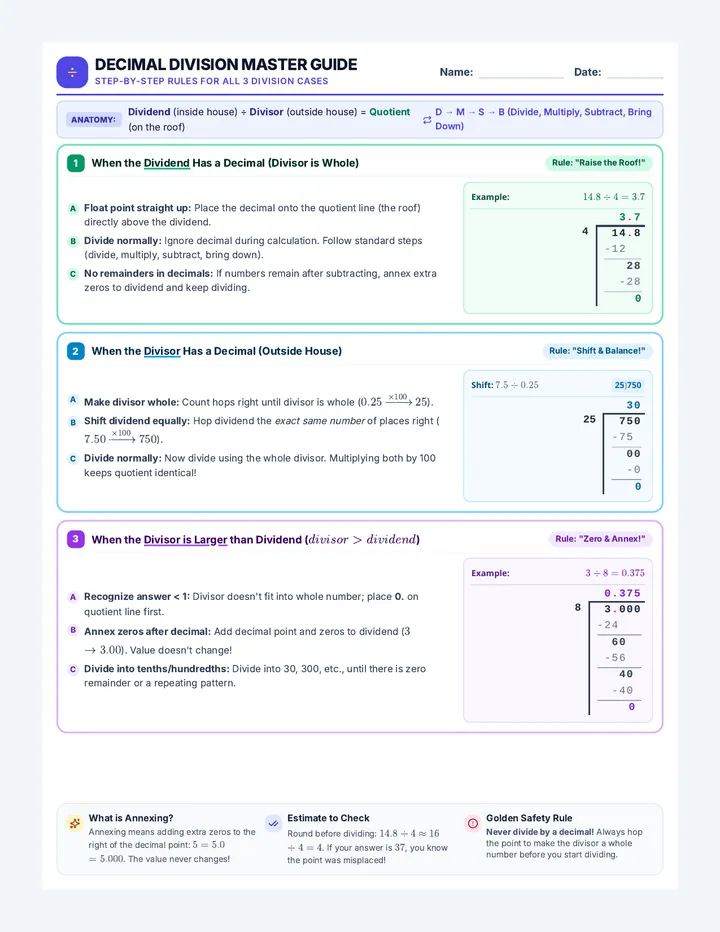
Decimal Division Reference Guide
DECIMAL DIVISION MASTER GUIDE
Step-by-Step Rules for All 3 Division Cases
Name:
Date:
Anatomy: Dividend (inside house) ÷ Divisor (outside house) = Quotient (on the roof)
D → M → S → B (Divide, Multiply, Subtract, Bring Down)
1
When the Dividend Has a Decimal (Divisor is Whole)
Rule: "Raise the Roof!"
A
Float point straight up: Place the decimal onto the quotient line (the roof) directly above the dividend.
B
Divide normally: Ignore decimal during calculation. Follow standard steps (divide, multiply, subtract, bring down).
C
No remainders in decimals: If numbers remain after subtracting, annex extra zeros to dividend and keep dividing.
Example: \(14.8 \div 4 = 3.7\)
4
3.7
14.8
-12
28
-28
0
2
When the Divisor Has a Decimal (Outside House)
Rule: "Shift & Balance!"
A
Make divisor whole: Count hops right until divisor is whole (\(0.25 \xrightarrow{\times 100} 25\)).
B
Shift dividend equally: Hop dividend the exact same number of places right (\(7.50 \xrightarrow{\times 100} 750\)).
C
Divide normally: Now divide using the whole divisor. Multiplying both by 100 keeps quotient identical!
Shift: \(7.5 \div 0.25\) 25)750
25
30
750
-75
00
-0
0
3
When the Divisor is Larger than Dividend (\(divisor > dividend\))
Rule: "Zero & Annex!"
A
Recognize answer < 1: Divisor doesn't fit into whole number; place 0. on quotient line first.
B
Annex zeros after decimal: Add decimal point and zeros to dividend (\(3 \rightarrow 3.00\)). Value doesn't change!
C
Divide into tenths/hundredths: Divide into 30, 300, etc., until there is zero remainder or a repeating pattern.
Example: \(3 \div 8 = 0.375\)
8
0.375