Lenny.com
Explore
Create
ActivitiesNewMathEnglish Language ArtsScience & EngineeringSocial StudiesGlobal LanguagesHealth & Physical EducationSpecial EducationCounseling & Life SkillsArts & CreativityESL
Lenny.com
Lenny.com
Explore
Create
ActivitiesNewMathEnglish Language ArtsScience & EngineeringSocial StudiesGlobal LanguagesHealth & Physical EducationSpecial EducationCounseling & Life SkillsArts & CreativityESL
Lenny.com
Lenny.com

Solutions

Lenny for EducatorsLenny for SchoolsLenny for Districts

Product

ExploreSign inCreateSupportAbout

Resources

Getting startedMTSS Acceleration Program

© 2026 Lenny Learning Inc.

TermsPrivacyAccessibility
LinkedInInstagramX
Lenny
MathNumbers & CountingCounting ObjectsNumber NamesComparing NumbersNumber OperationsCounting SequenceNumbers 0-10Place Value Understanding and SystemAdd and Subtract Within 20Addition and Subtraction ConceptsAddition and Subtraction EquationsAddition and Subtraction ProblemsFoundations for MultiplicationMultiplication and Division PropertiesMultiply and Divide Within 100Multiplication and Division ProblemsFactors and MultiplesProperties of OperationsPatterns and RelationshipsGenerate and Analyze PatternsMulti-Digit ArithmeticPlace Value OperationsMulti-Digit and Decimal OperationsNumerical ExpressionsFour Operations and PatternsFour Operations Problem SolvingMeasurement & DataMeasurable AttributesMeasuring LengthsMeasure and Estimate Lengths in Standard UnitsRelate Addition and Subtraction to LengthClassifying and Counting ObjectsTime and MoneyArea Concepts and MeasurementPerimeter and Area MeasuresAngle Concepts and MeasurementTime, Volume, and MassMeasurement Unit ConversionsGeometryIdentifying ShapesShapes and AttributesShape Attributes and ReasoningShapes and CompositionClassifying 2D FiguresGeometric Figures and RelationshipsLines, Angles, and ShapesAngle, Area, and VolumeGeometric MeasurementVolume of 3D ShapesCoordinate Plane ApplicationsTransformations in the PlaneCongruence and SimilarityUnderstand congruence in terms of rigid motionsSimilarity and TransformationsProve Theorems Involving SimilarityPythagorean TheoremTrigonometry for General TrianglesMake Geometric ConstructionsProve Geometric TheoremsTheorems About CirclesFind Arc Lengths And Areas of Sectors of CirclesVolume FormulasRelationships Between Two-Dimensional and Three-Dimensional ObjectsProve Simple Geometric Theorems AlgebraicallyTranslate Between Geometric Description and Equation for Conic SectionApply Geometric Concepts in Modeling SituationsFractions & DecimalsFractions as NumbersBuilding FractionsFraction Equivalence and OrderingAdding and Subtracting FractionsMultiplying and Dividing FractionsDividing FractionsDecimal FractionsMulti-Digit Computation and FactorsAdd, Subtract, Multiply, and Divide Rational NumbersRational Number SystemIrrational Numbers and ApproximationsRatiosRatios and ProportionsProportional RelationshipsUnit RateAlgebraAlgebraic ExpressionsGenerate Equivalent ExpressionsQuantitative RelationshipsProportional Relationships and Linear EquationsEquations and InequalitiesEquation Solving and ReasoningLinear Equations and SystemsGraph Equations and InequalitiesSystems of EquationsReal-World Algebraic ProblemsQuantitative Reasoning with UnitsExpression StructureEquivalent Expression FormsRadicals and Integer ExponentsRational ExponentsRational and Irrational NumbersPolynomial OperationsPolynomial IdentitiesPolynomial Zeros and FactorsRational ExpressionsComplex Number OperationsComplex Numbers in PolynomialsComplex Numbers on PlaneStatistics & ProbabilityRepresent and Interpret DataData DistributionsStatistical VariabilityProbability ModelsCompound Event ProbabilitiesStatistical SamplingInterpret Categorical and Quantitative DataBivariate Data PatternsInterpret Linear ModelsComparing Two PopulationsRandom Processes in StatisticsIndependence and Conditional ProbabilityExpected ValuesProbability-Based Decision MakingStatistical Inference and ConclusionsFunctionsFunction Concepts and NotationDefine and Compare FunctionsInterpret Functions in ContextAnalyze Function RepresentationsModel Relationships with FunctionsIdentify Linear vs Exponential GrowthDistinguish Between Function TypesCompare Growth RatesInterpret Function ExpressionsBuild Functions from RelationshipsConstruct and Model FunctionsTransform and Combine FunctionsModel Comparison and SelectionSolve Exponential EquationsTrigonometryTrigonometric Ratios Involving Right TrianglesTrigonometric Functions and Unit CircleModel with Trigonometric FunctionsTrigonometric IdentitiesVectors & MatricesIntroduction to Vectors and MatricesVector QuantitiesVector OperationsMatrix OperationsCalculusLimits and ContinuityDerivative Concepts and NotationDerivative Rules and TechniquesApplications of DerivativesOptimization ProblemsRelated RatesCurve Sketching and AnalysisIntegration Concepts and NotationAntiderivatives and Indefinite IntegralsDefinite Integrals and AreaFundamental Theorem of CalculusIntegration TechniquesApplications of IntegrationDifferential EquationsSequences and SeriesParametric and Polar FunctionsVector-Valued Functions

Math Vocab Vault

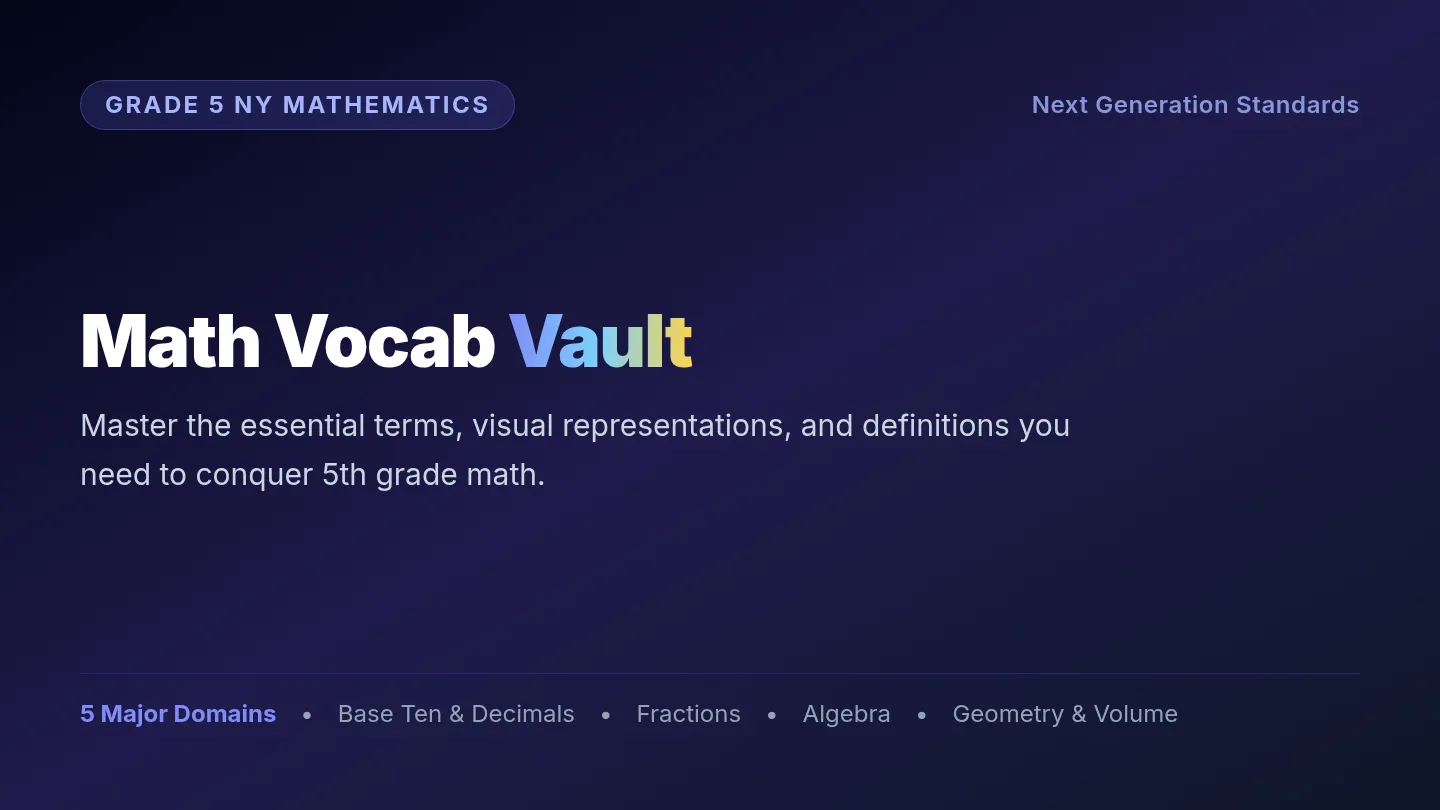
A comprehensive vocabulary mastery lesson focused on high-stakes New York State Grade 5 Next Generation Mathematics terms across all key curriculum domains. Students review essential terminology through visual slides and apply their understanding on targeted matching challenge sheets.

Cchristine.toulon

Multiplying by \(> 1\) stretches; multiplying by \(< 1\) shrinks.

A

15. Unit Fraction → Def A

Fraction with numerator 1 (\(\frac{1}{b}\)). Building block of all fractions.

F

16. Mixed Number → Def F

Whole number plus fractional part (\(3\frac{1}{2} = \frac{7}{2}\)).

E

17. Reciprocal → Def E

Multiplicative inverse: product equals 1. Inverted fraction.

4

Domain D & E: Measurement & Geometry (5.MD & 5.G)

7 Points

C

18. Volume → Def C

3D space measure: \(V = l \times w \times h\).

G

19. Cubic Unit → Def G

Cube of 1 unit side (\(\text{cm}^3, \text{in}^3\)).

A

20. Coordinate Plane → Def A

Perpendicular x-axis and y-axis grid system.

D

21. Origin → Def D

Point \((0,0)\) where x-axis and y-axis cross.

E

22. Ordered Pair → Def E

\((x, y)\): x = move right, y = move up.

B

23. Parallelogram → Def B

4-sided polygon with 2 pairs of parallel sides.

F

24. Hierarchy → Def F

Nested classification: e.g., All squares are rectangles, and all rectangles are parallelograms!

Exceeding (Level 4) 23–24 correct: Mastery of all definitions and symbolic representations.

Proficient (Level 3) 20–22 correct: Ready for NY state assessment item vocabulary.

Target Intervention < 20 correct: Review slides and concrete visual anchor charts.

NYS Next Generation Mathematics Standards — Grade 5 Key Page 2 of 2

Common Denominator

A shared multiple of denominators. You cannot add or subtract fractions until they have identical units.

\(\frac{1}{2} + \frac{1}{3} = \frac{3}{6} + \frac{2}{6} = \frac{5}{6}\)

Estimation Tool

Benchmark Fractions

Easy reference numbers (\(0, \frac{1}{4}, \frac{1}{2}, \frac{3}{4}, 1\)) used to assess reasonableness.

\(\frac{7}{8} \approx 1\)  and  \(\frac{2}{9} \approx 0 \implies \text{Sum } \approx 1\)

Unit Fraction: Any fraction with a numerator of 1 (e.g., \(\frac{1}{5}\)). Every fraction is built of unit fractions!


Domain 5.NF

Scaling: Resizing Without Calculating

Comparing the product to a factor based on multiplier size.

Factor > 1

Product Grows

Multiplying by a number greater than 1 makes the result larger.

\(5 \times 1\frac{1}{2} > 5\)

Factor = 1

Product Same

Multiplying by 1 (or \(\frac{4}{4}\)) preserves the exact same size.

\(5 \times \frac{4}{4} = 5\)

Factor < 1

Product Shrinks

Multiplying by a proper fraction makes the result smaller.

\(5 \times \frac{2}{3} < 5\)

Reciprocal: Two numbers whose product is 1 (e.g. \(\frac{3}{5} \times \frac{5}{3} = 1\)). Used in fraction division.


Domain 5.MD

Volume & 3D Space

Measuring capacity with unit cubes without gaps or overlaps.

Definition

What is Volume?

The total amount of solid 3-dimensional space contained inside a closed boundary, measured in cubic units (\(\text{cm}^3, \text{in}^3\)).

1 Cubic Unit = Cube with length, width, and height of 1 unit.

Formulas

Volume Formulas

For rectangular prisms, multiply 3 dimensions or multiply base area (\(B\)) by height:

\(V = \text{length} \times \text{width} \times \text{height}\)

\(V = \text{Base Area } (B) \times \text{height}\)

Composite Solids: Break complex shapes into non-overlapping rectangular prisms and add their volumes!


Domain 5.G

The Coordinate Plane

Navigating 2D space using intersecting perpendicular axes.

Starting Point

The Origin

Point \((0,0)\) where the x-axis and y-axis intersect.

Start here at \((0,0)\)

First Value: x

x-Coordinate

Distance traveled horizontally along the flat ground.

In \((4, 7)\) → Move 4 Right

Second Value: y

y-Coordinate

Distance traveled vertically up into the air.

In \((4, 7)\) → Move 7 Up

Memory Hook: "Walk before you fly!" (Go along the x-axis first, then fly up the y-axis).


Domain 5.G

Quadrilateral Hierarchy

Classifying 2D figures into categories and subcategories based on properties.

Quadrilateral

Any 4-sided closed 2D polygon.

Top Category

Parallelogram

2 pairs of parallel opposite sides.

Subcategory

Rectangle / Rhombus

4 right angles (rect.) OR 4 equal sides (rhombus).

Specialized

Square

Both 4 right angles AND 4 equal sides!

The Ultimate

Key NY Principle: A square is always a rectangle and a rhombus, but a rectangle is not always a square!


Mastery Ready Vocabulary Challenge

Ready for the Match Challenge?

1 Read each definition carefully before choosing.

2 Look out for key math clues like "parts of a whole" or "3D space".

3 Write each capital letter clearly in the designated answer box.

Now open your Math Vocab Match Worksheet Good luck, Math Masters!
You might also like

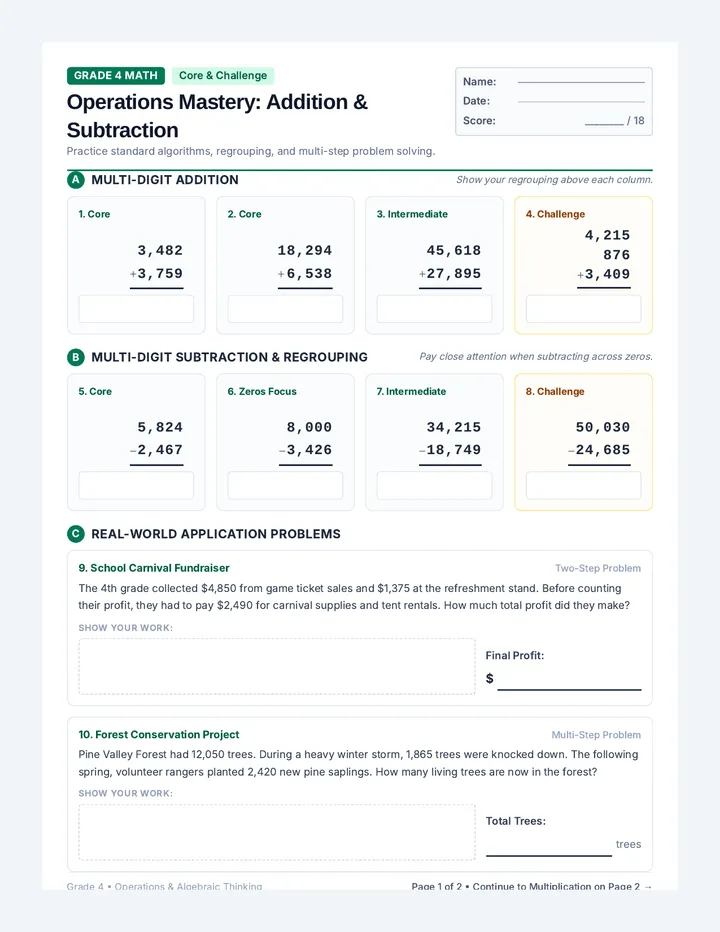
Fourth Grade Math Worksheet

Math Powerhouse

A targeted multi-grade mathematics sequence focusing on mastering whole-number operations including addition, subtraction, and multi-digit multiplication. It equips fourth and fifth-grade learners with procedural fluency, conceptual problem-solving, and rigorous challenge tasks.

T

temetropolis

4
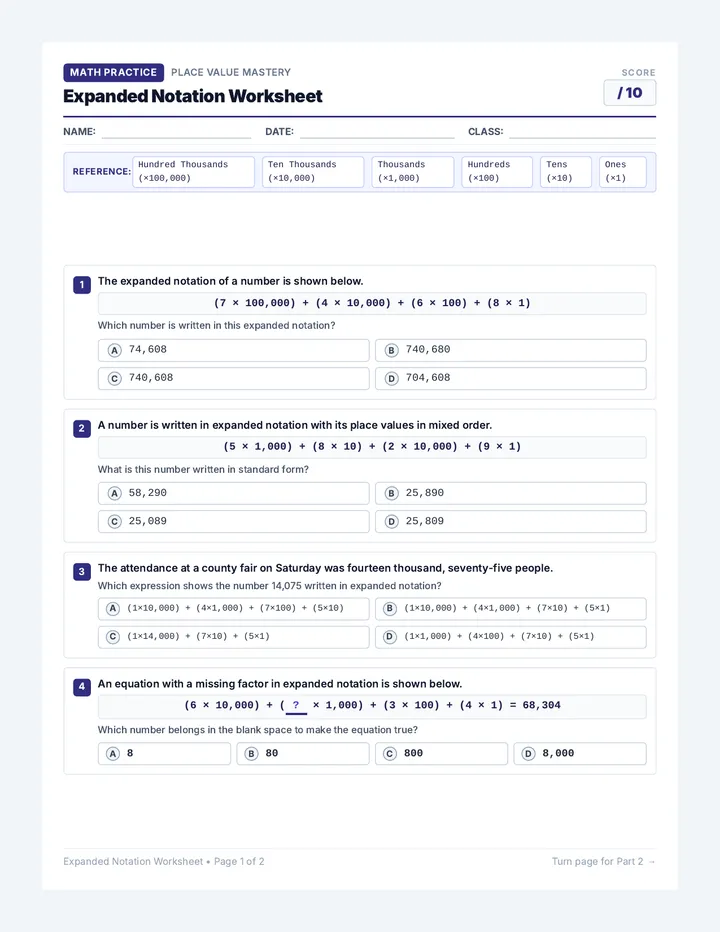
Expanded Notation Worksheet

Number Masters

A rigorous math lesson where students master expanded notation, place value relationships, and multi-digit multiplication word problem strategies.

DH

Dana Hartness

3
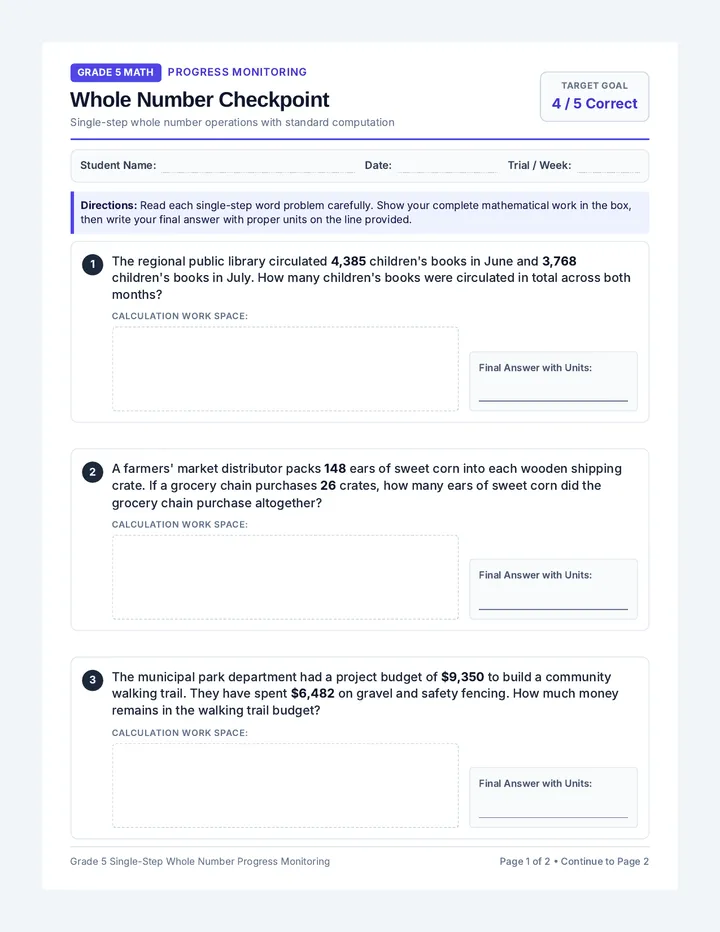
Whole Number Checkpoint Worksheet

Whole Number Checkpoint Worksheet

A 2-page Grade 5 progress monitoring worksheet featuring 5 single-step whole number word problems covering multi-digit addition, subtraction, multiplication, and division, complete with spacious student calculation work areas and a progress tracking diagnostic rubric.

SW

Stephanie Wooten

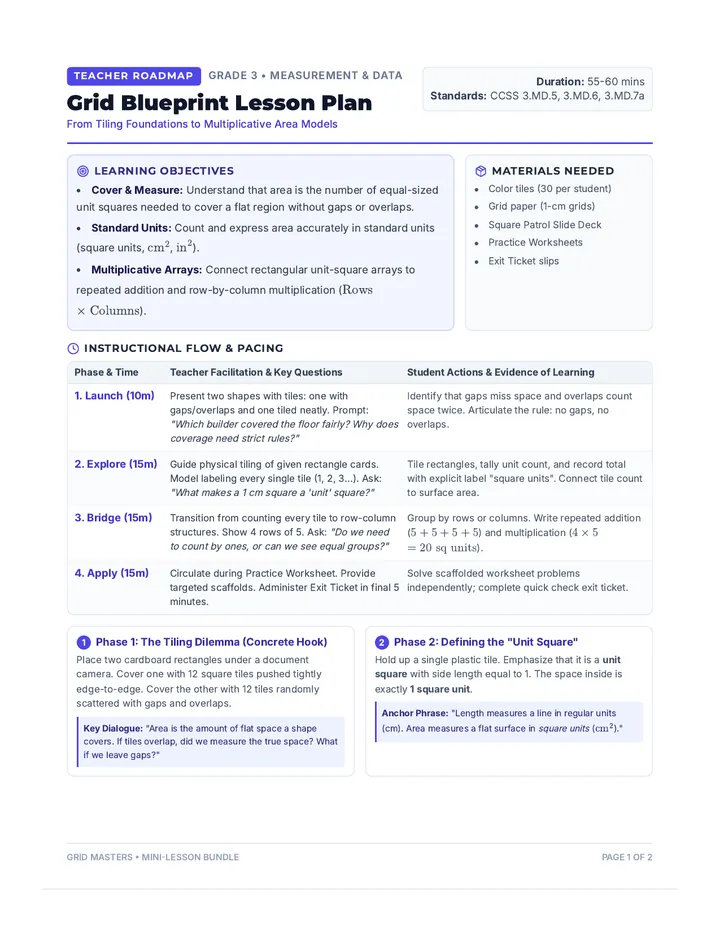
Grid Blueprint Lesson Plan

Dimension Architects

A coherent spatial measurement sequence bridging two-dimensional surface coverage to three-dimensional volume measurement. Students transition from tiling flat regions with unit squares to packing solid rectangular prisms with unit cubes, connecting spatial arrays to multiplicative formulas.

MJ

Meg Jones

8
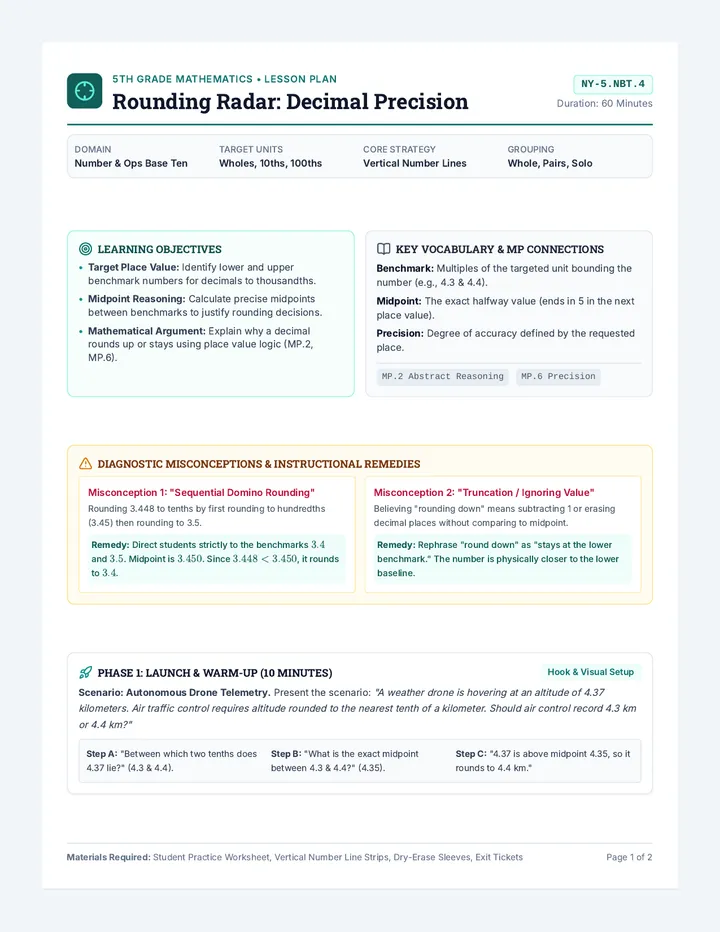
Rounding Radar Lesson Plan

Rounding Radar

A comprehensive 5th grade mathematics lesson focusing on NY-5.NBT.4, guiding students to round decimals to any place value using place value reasoning, benchmark numbers, and vertical number lines.

SM

stacy maslyn

4
Stay Behind Math Packet

Stay Behind Math Packet

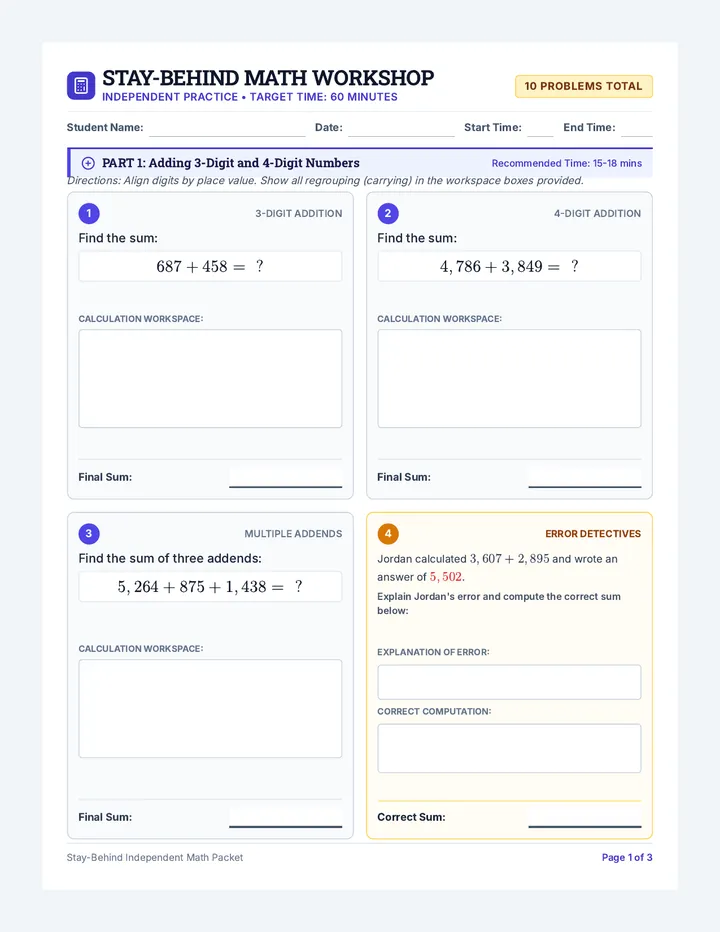
A comprehensive 3-page Stay Behind math packet designed for a focused 60-minute independent work session. Covers adding 3- and 4-digit numbers, multi-step order of operations with grouping symbols, and single-step real-world word problems with generous blank calculation spaces and a self-reflection log.

AA

alicia accapezzato

Problem Detective Assessment

Math Goal Mastery

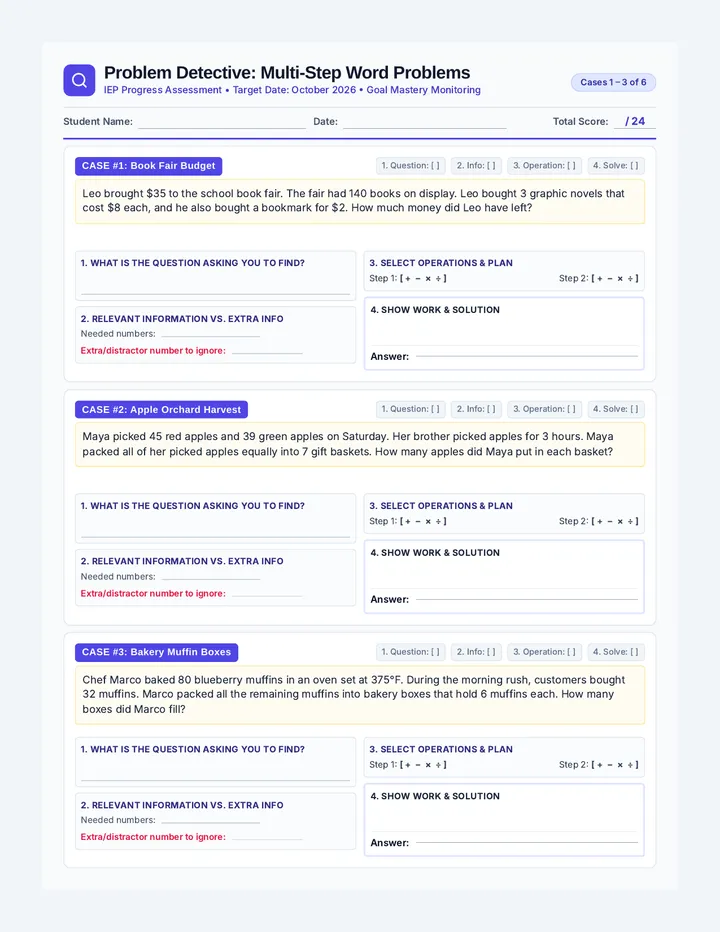
A targeted sequence of progress monitoring assessments and evaluation guides designed to measure and document key IEP mathematics benchmarks, including multi-step word problems and multi-digit operations.

JD

Jenny Daniels

4
Power Shift Slides

Power Shift Mastery

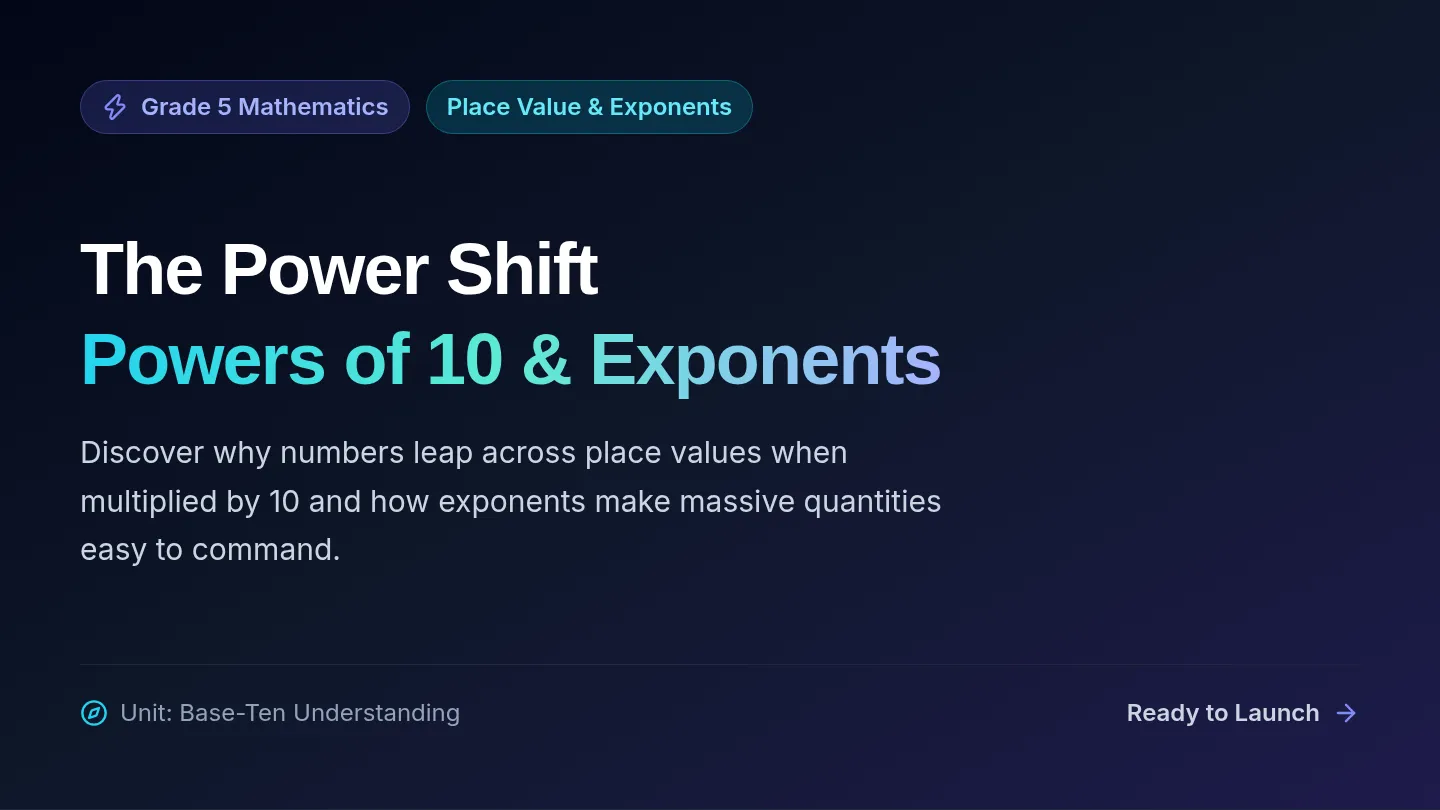
A comprehensive 5th-grade math lesson exploring powers of ten, whole-number exponents, and how place values shift during multiplication. Students learn the mechanical and conceptual basis of base-ten patterns.

SW

Stephanie Wenzler

3
Math Vocab Review Slides

Math Vocab Review Slides

A high-impact review slide deck presenting 5th grade NY math vocabulary terms with student-friendly definitions, visual models, and concrete examples across all state domains. Styled in a bold, classroom-ready presentation format.

C

christine.toulon

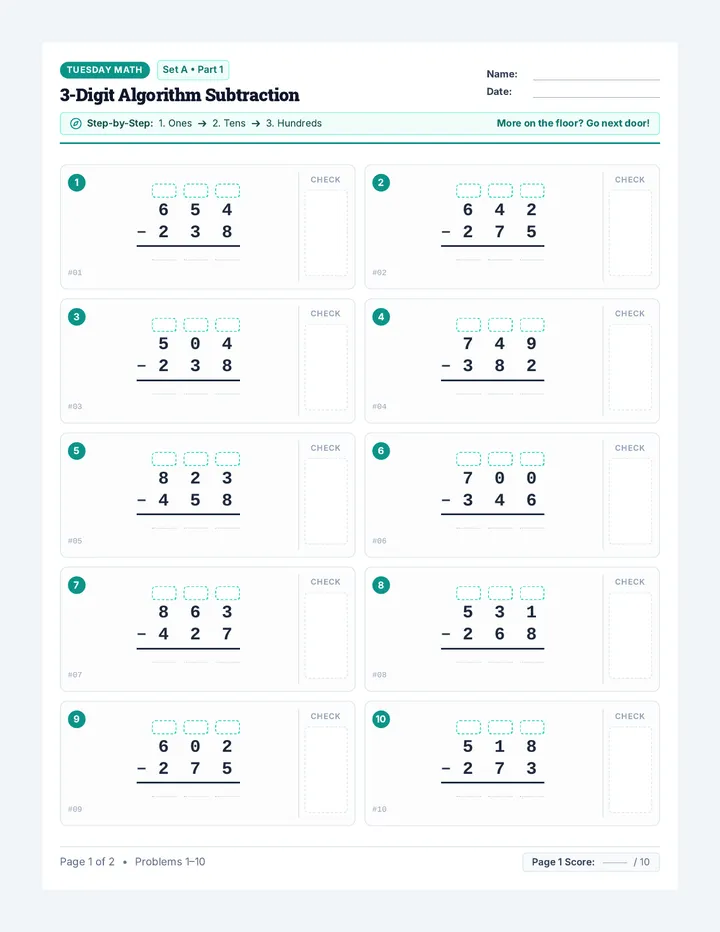
Tuesday Subtraction Packet

Subtraction Mastery

A three-day intervention sequence designed for resource math groups targeting standard algorithm subtraction with 3-digit numbers within 1,000. Features systematic, mixed practice across single regrouping, double regrouping, and borrowing across zeros for Tuesday, Wednesday, and Thursday.

QP

Quinn Pink

6
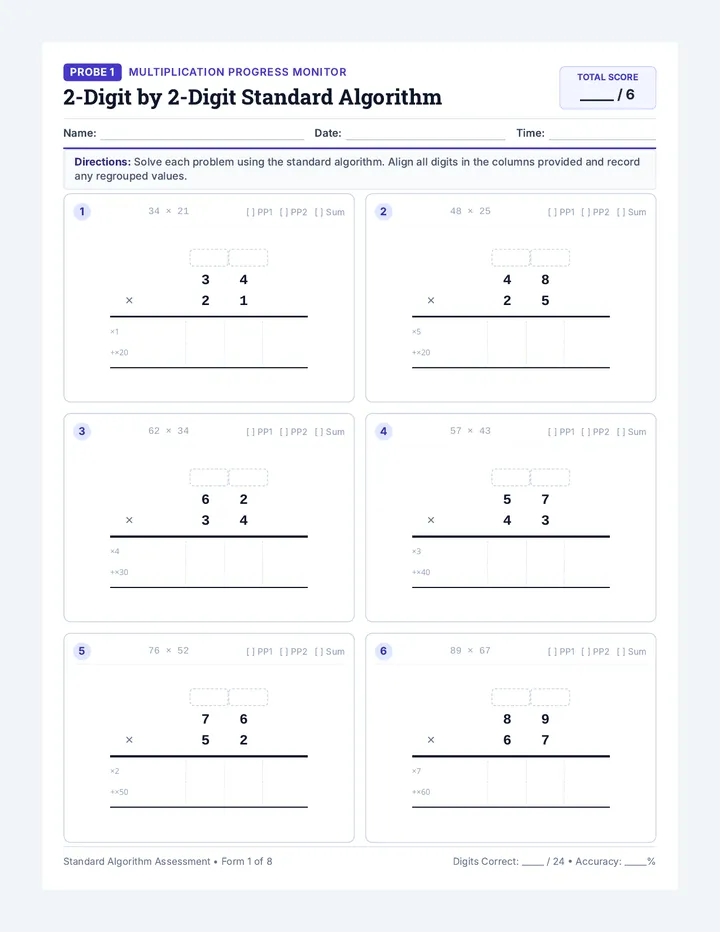
Digit Duel Progress Probes

Digit Duel Multiplication

A standardized progress monitoring toolkit designed to track student mastery of 2-digit by 2-digit multiplication using the standard algorithm. Features eight equivalent diagnostic probes with column-aligned calculation grids, paired with comprehensive scoring rubrics, an 8-probe growth chart, and step-by-step partial product answer keys.

Lenny Avatar
Lenny
2
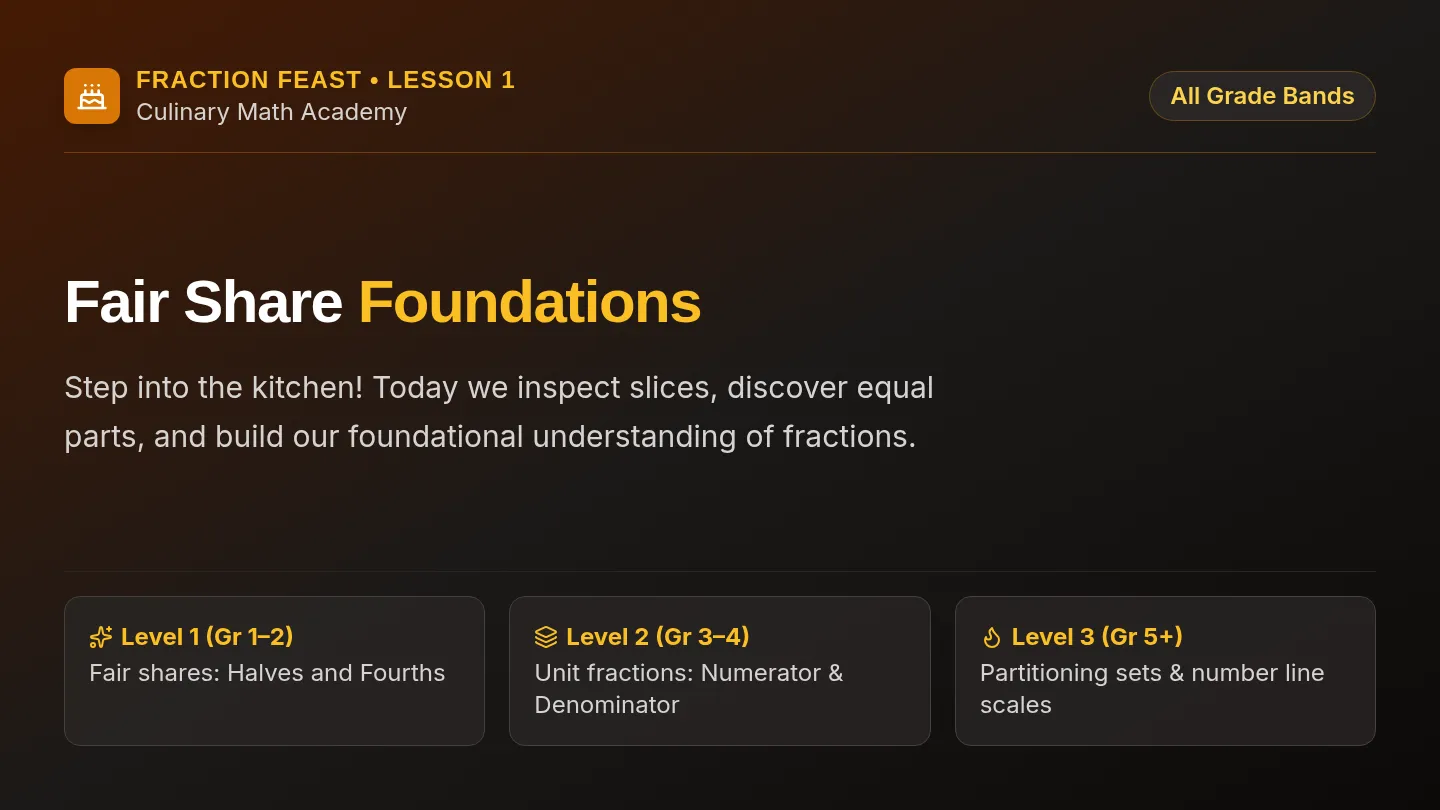
Fair Share Slides

Fraction Feast

A multi-day, tiered elementary mathematics sequence exploring fractions through culinary challenges. Spanning foundational equal sharing up through equivalent fractions and multi-step recipe scaling, the unit provides explicit differentiated pathways for early, mid, and upper elementary learners.

Lenny Avatar
Lenny
7