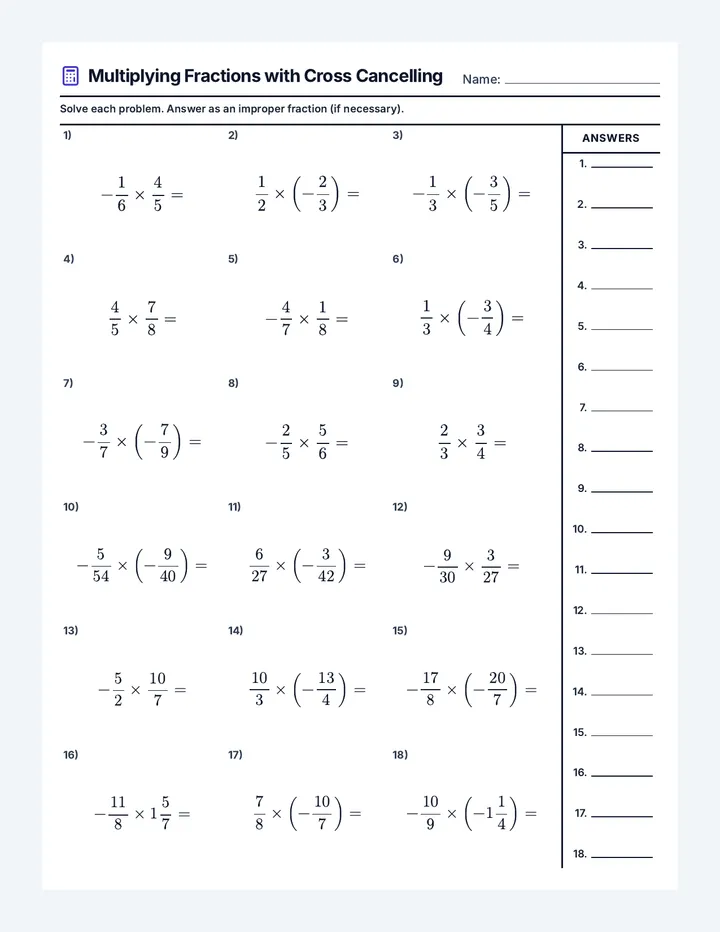
Fraction Multiplication Exemplar
Grade 6 Mathematics Unit: Multiplying Fractions
Do Now • 7 Minutes Teacher Exemplar
FRACTION MULTIPLICATION MASTERS
Part 1: Visual Area Models & Whole Numbers • Questions 1 & 2
Name: EXEMPLAR KEY (Grade 6)
Date: Complete Solutions
Team: Math Department
Learning Target: I can multiply fractions by whole numbers, proper, improper, and mixed fractions.
Core Algorithm: \(\frac{a}{b} \times \frac{c}{d} = \frac{a \times c}{b \times d}\). Multiply numerators together and denominators together, then simplify!
1. Look at the fraction area model representing \(\frac{3}{4} \times \frac{2}{5}\). Select TWO true statements.
2 Points
★ ★ ★ ★ ★ ★
\(\frac{3}{4}\) (3 of 4 columns shaded vertically)
\(\frac{2}{5}\) (2 of 5 rows shaded horizontally)
Overlap: \(3 \times 2 = 6\) parts out of 20 = \(\frac{6}{20} = \frac{3}{10}\)
[✓]
a) Overlap represents product \(\frac{3}{4} \times \frac{2}{5}\). TRUE
[ ]
d) The product is \(\frac{5}{9}\) by adding terms. FALSE: (3+2)/(4+5) misconception
[ ]
b) The model proves \(\frac{3}{4} + \frac{2}{5} = \frac{6}{20}\). FALSE: Area models multiply
[ ]
e) The total parts in the whole is 9. FALSE: 4 × 5 = 20 total parts
[✓]
c) Overlapping area is \(\frac{6}{20}\), which simplifies to \(\frac{3}{10}\). TRUE
Teacher Exemplar Justification:
• Statements (a) & (c) are TRUE: Multiplying fractions represents finding a "fraction of a fraction." The unit square is partitioned into \(4 \times 5 = 20\) equal pieces. The doubly shaded intersection contains \(3 \times 2 = 6\) pieces, giving \(\frac{6}{20}\). Dividing numerator and denominator by 2 simplifies the product to \(\frac{3}{10}\).
2. Multiply the whole number by the fraction: \(5 \times \frac{2}{3}\).
5 groups of \(\frac{2}{3}\)
Show Work (\(\frac{5}{1} \times \frac{2}{3}\)):
Step 1: Write 5 as a fraction over 1: \(\frac{5}{1} \times \frac{2}{3}\)
Step 2: Multiply numerators & denominators: \(\frac{5 \times 2}{1 \times 3} = \frac{10}{3}\)
Step 3: Convert improper to mixed: \(10 \div 3 = 3\) with remainder \(1 \rightarrow 3\frac{1}{3}\)
Final Product
Improper: \(\frac{10}{3}\)
Mixed: \(3\frac{1}{3}\)
Grade 6 Mathematics • Fraction Multiplication Page 1 • Do Now (Part 1) — Exemplar Key
Grade 6 Mathematics Do Now (Continued)
Questions 3 – 5 Teacher Exemplar
3. Multiply the proper fractions: \(\frac{3}{8} \times \frac{4}{9}\). Simplify to lowest terms.
Proper × Proper
Show Work (Try Cross-Simplifying Factors):
Method 1 (Cross-Simplifying - Recommended):
• Divide 3 and 9 by GCF 3 \(\rightarrow 3\div 3 = 1\), \(9\div 3 = 3\)
• Divide 4 and 8 by GCF 4 \(\rightarrow 4\div 4 = 1\), \(8\div 4 = 2\)
\(\frac{1}{2} \times \frac{1}{3} = \frac{1 \times 1}{2 \times 3} = \frac{1}{6}\)
Standard Method: \(\frac{3 \times 4}{8 \times 9} = \frac{12}{72} = \frac{12 \div 12}{72 \div 12} = \frac{1}{6}\)
Simplest Product
Product =
\(\frac{1}{6}\)
4. When you multiply a positive number by a proper fraction (less than 1, like \(\frac{1}{2}\) or \(\frac{3}{4}\)), is the product:
Greater than ✓ Less than Equal to
Explain Why and Give One Mathematical Example:
Explanation: A proper fraction represents a quantity less than 1 whole (a fraction of a whole). When scaling a number by a factor less than 1, you are taking only a part of the original amount rather than all of it, resulting in a strictly smaller product.
Example: \(12 \times \frac{3}{4} = \frac{36}{4} = 9\). Since \(9 < 12\), the product is less than the original number 12.
5. A pancake recipe needs \(1\frac{1}{2}\) cups of milk. Chef Leo makes 4 batches. How many total cups of milk does he need?
🥣 \(4 \times 1\frac{1}{2}\) cups
Show Work (Convert \(1\frac{1}{2}\) to an improper fraction first):
Step 1: Convert \(1\frac{1}{2}\) to improper: \(1\frac{1}{2} = \frac{(1 \times 2) + 1}{2} = \frac{3}{2}\)
Step 2: Set up whole number over 1: \(\frac{4}{1} \times \frac{3}{2}\)
Step 3: Multiply & divide: \(\frac{4 \times 3}{1 \times 2} = \frac{12}{2} = 6\)
Cross-simplifying shortcut: \(\frac{4}{1} \times \frac{3}{2} = \frac{2}{1} \times \frac{3}{1} = 6\) cups
Total Milk
6 cups
of milk needed
Grade 6 Mathematics • Fraction Multiplication Page 2 • Do Now (Part 2) — Exemplar Key
Grade 6 Mathematics Unit: Multiplying Fractions
Guided Practice • 10 Minutes Teacher Exemplar
GUIDED PRACTICE
Part 2A • Mixed Numbers & Improper Fractions • Questions 1 & 2
Golden Rule for Mixed Numbers: ALWAYS convert mixed numbers to improper fractions before multiplying!
Example: \(2\frac{1}{4} = \frac{(2 \times 4) + 1}{4} = \frac{9}{4}\). Never multiply whole numbers separately!
1. Multiply: \(2\frac{1}{4} \times \frac{2}{3}\). Which of the following choices shows the correct method and simplest answer?
a) Multiply wholes first:
\(2 \times \frac{2}{3} = \frac{4}{3} = 1\frac{1}{3}\)
✗ Misconception: Ignores the fraction 1/4
b) Convert to improper first: CORRECT ✓
\(\frac{9}{4} \times \frac{2}{3} = \frac{18}{12} = \frac{3}{2} = 1\frac{1}{2}\)
✓ Complete algorithm followed correctly
c) Add whole to fraction:
\(2 + (\frac{1}{4} \times \frac{2}{3}) = 2\frac{2}{12} = 2\frac{1}{6}\)
✗ Misconception: Did not distribute 2/3 to whole
d) Invert and multiply:
\(\frac{9}{4} \times \frac{3}{2} = \frac{27}{8} = 3\frac{3}{8}\)
✗ Misconception: Confused multiplication with division
Show Your Work and Explain Why Choice (B) is the Correct Mathematical Procedure:
Explanation: To multiply a mixed number, you must treat the whole and fractional parts as a single combined quantity. Converting \(2\frac{1}{4}\) to \(\frac{9}{4}\) expresses the full value in uniform fourths. Multiplying \(\frac{9}{4} \times \frac{2}{3} = \frac{18}{12}\). Both 18 and 12 divide by 6, yielding \(\frac{3}{2}\), which equals \(1\frac{1}{2}\).
2. Multiply the improper fractions: \(\frac{7}{2} \times \frac{6}{5}\). Convert your final product into a mixed number in simplest form.
Improper × Improper
Show Work (Multiply & Convert to Mixed):
Method 1 (Cross-Simplifying):
• Notice 6 (numerator) and 2 (denominator) share factor 2.
• \(\frac{7}{2 \div 2} \times \frac{6 \div 2}{5} = \frac{7}{1} \times \frac{3}{5} = \frac{21}{5}\)
Method 2 (Standard): \(\frac{7 \times 6}{2 \times 5} = \frac{42}{10} = \frac{42 \div 2}{10 \div 2} = \frac{21}{5}\)
Convert to Mixed: \(21 \div 5 = 4\) with remainder \(1 \rightarrow 4\frac{1}{5}\)
Final Answer
Improper: \(\frac{21}{5}\)
Mixed: \(4\frac{1}{5}\)
Grade 6 Mathematics • Fraction Multiplication Page 3 • Guided Practice (Part 1) — Exemplar Key
Grade 6 Mathematics Guided Practice • Method Showdown
Question 3 Teacher Exemplar
Method Showdown
3. Multiply two mixed numbers: \(1\frac{3}{5} \times 2\frac{1}{2}\). Solve using TWO different methods below.
⚙️ Method A: Improper Fractions
Step 1: Convert \(1\frac{3}{5} = \frac{8}{5}\) and \(2\frac{1}{2} = \frac{5}{2}\)
Show Calculation & Cross-Simplifying:
\(\frac{8}{5} \times \frac{5}{2}\)
• Cancel factor of 5: \(\frac{5}{5} = 1\)
• Simplify 8 and 2: \(\frac{8}{2} = 4\)
\(= \frac{4 \times 1}{1 \times 1} = \frac{4}{1} = 4\)
Direct: \(\frac{8 \times 5}{5 \times 2} = \frac{40}{10} = 4\)
Method A Product Product = 4
📐 Method B: Area / Partial Products
Decompose: \((1 + \frac{3}{5}) \times (2 + \frac{1}{2})\)
Calculate 4 Partial Products & Add:
1. Whole × Whole: \(1 \times 2 = 2\)
2. Whole × Frac: \(1 \times \frac{1}{2} = \frac{1}{2} = \frac{5}{10}\)
3. Frac × Whole: \(\frac{3}{5} \times 2 = \frac{6}{5} = \frac{12}{10}\)
4. Frac × Frac: \(\frac{3}{5} \times \frac{1}{2} = \frac{3}{10}\)
Sum: \(2 + \frac{5 + 12 + 3}{10} = 2 + \frac{20}{10} = 2 + 2 = 4\)
Method B Product Product = 4
Comparison Check: Both methods must equal the exact same whole number: 4
Which method do you find faster or less prone to errors? Explain why:
Exemplar Student Response: "I find Method A (Improper Fractions) much faster and less prone to errors. Once I convert both mixed numbers to \(\frac{8}{5}\) and \(\frac{5}{2}\), the numbers can be cross-simplified immediately: the 5s cancel to 1, and 8 divided by 2 is 4, taking just one quick multiplication step. In contrast, Method B requires finding 4 separate partial products, finding a common denominator (10) for three fractions, and adding them all together, which provides far more opportunities for arithmetic mistakes."
Grade 6 Mathematics • Fraction Multiplication Page 4 • Guided Practice (Part 2) — Exemplar Key
Grade 6 Mathematics Unit: Multiplying Fractions
Independent Practice • 11 Minutes Teacher Exemplar
INDEPENDENT PRACTICE
Part 3A • Solve Solo • Questions 1 to 3
Directions: Show all numerator and denominator multiplications. Simplify to lowest terms!
1. A reusable water bottle holds \(\frac{3}{4}\) liter of water. Marcus drinks 6 full bottles during soccer practice. How many liters of water did he drink in total?
💧 \(6 \times \frac{3}{4}\)
Show Work (\(\frac{6}{1} \times \frac{3}{4}\)):
• Multiply: \(\frac{6}{1} \times \frac{3}{4} = \frac{6 \times 3}{1 \times 4} = \frac{18}{4}\)
• Simplify improper fraction: \(\frac{18 \div 2}{4 \div 2} = \frac{9}{2}\)
• Convert to mixed number: \(9 \div 2 = 4\) with remainder \(1 \rightarrow 4\frac{1}{2}\) liters
Cross-simplifying: \(\frac{3}{1} \times \frac{3}{2} = \frac{9}{2} = 4\frac{1}{2}\)
Total Liters
\(4\frac{1}{2}\) liters
(or \(\frac{9}{2}\) liters)
2. Multiply: \(\frac{5}{6} \times \frac{9}{10}\). Show your cross-simplification steps before multiplying.
Proper × Proper
Show Simplification Work:
• Cross-cancel 5 and 10 by factor of 5: \(\frac{5 \div 5}{10 \div 5} = \frac{1}{2}\)
• Cross-cancel 9 and 6 by factor of 3: \(\frac{9 \div 3}{6 \div 3} = \frac{3}{2}\)
• Multiply simplified fractions: \(\frac{1 \times 3}{2 \times 2} = \frac{3}{4}\)
Check without canceling: \(\frac{5 \times 9}{6 \times 10} = \frac{45}{60} = \frac{45 \div 15}{60 \div 15} = \frac{3}{4}\)
Simplest Product
Product =
\(\frac{3}{4}\)
3. A rectangular garden plot measures \(\frac{4}{5}\) meter in length and \(\frac{2}{3}\) meter in width. Find the area of the garden in square meters (\(\text{Area} = \text{length} \times \text{width}\)).
🌿 Length = \(\frac{4}{5}\) m | Width = \(\frac{2}{3}\) m \(\text{Area} = \frac{4}{5} \times \frac{2}{3}\)
Show Work:
\(\text{Area} = \text{Length} \times \text{Width} = \frac{4}{5} \times \frac{2}{3}\)
• Multiply numerators: \(4 \times 2 = 8\)
• Multiply denominators: \(5 \times 3 = 15\)
• Result: \(\frac{8}{15}\) \(\text{m}^2\) (cannot be further simplified since \(\gcd(8,15) = 1\))
Garden Area
\(\frac{8}{15}\text{ m}^2\)
square meters
Grade 6 Mathematics • Fraction Multiplication Page 5 • Independent Practice (Part 1) — Exemplar Key
Grade 6 Mathematics Independent Practice (Continued)
Questions 4 & 5 Teacher Exemplar
4. Baker Amy makes cookies that call for \(2\frac{1}{4}\) cups of flour per batch. She makes \(3\frac{1}{3}\) batches for a bake sale. How many total cups of flour does Amy need?
Step 1: Convert to Improper
\(2\frac{1}{4} = \frac{(2 \times 4) + 1}{4} = \mathbf{\frac{9}{4}}\)
\(3\frac{1}{3} = \frac{(3 \times 3) + 1}{3} = \mathbf{\frac{10}{3}}\)
Step 2: Multiply & Simplify
\(\frac{9}{4} \times \frac{10}{3}\)
• Simplify 9 and 3 by 3: \(\frac{9}{3} = 3\), \(\frac{3}{3} = 1\)
• Simplify 10 and 4 by 2: \(\frac{10}{2} = 5\), \(\frac{4}{2} = 2\)
\(= \frac{3 \times 5}{2 \times 1} = \frac{15}{2} = 7\frac{1}{2}\) cups
Standard: \(\frac{90}{12} = \frac{15}{2} = 7\frac{1}{2}\)
Total Flour Needed:
Amy needs \(7\frac{1}{2}\) cups of flour (\(7\frac{1}{2}\) cups).
5. A carpenter has a wooden board that is 8 feet long. He cuts off \(\frac{3}{4}\) of the board to make a bookshelf. How long is the bookshelf board? How many feet are leftover?
🪵 Total Board = 8 feet
Cut Piece = \(\frac{3}{4}\) of 8 ft
Leftover Piece = \(\frac{1}{4}\) of 8 ft
Show Work (\(8 \times \frac{3}{4}\) and Remaining Length):
Part 1: Bookshelf Cut Length:
\(8 \times \frac{3}{4} = \frac{8}{1} \times \frac{3}{4} = \frac{24}{4} = 6\) feet
Cross-simplifying: \(\frac{8 \div 4}{1} \times \frac{3}{4 \div 4} = 2 \times 3 = 6\) ft
Part 2: Leftover Length:
• Method 1: \(8\text{ ft} - 6\text{ ft} = 2\text{ ft}\)
• Method 2: \(8 \times \frac{1}{4} = \frac{8}{4} = 2\text{ ft}\)
Bookshelf Piece
6 ft
Leftover Wood
2 ft
Grade 6 Mathematics • Fraction Multiplication Page 6 • Independent Practice (Part 2) — Exemplar Key
Grade 6 Mathematics Unit: Multiplying Fractions
Exit Ticket • 4 Minutes Teacher Exemplar
EXIT TICKET
Final Formative Check • Demonstrate Fraction Multiplication Mastery
Name: EXEMPLAR KEY
Date: Master Key
Team: Grade 6 Math
1. Evaluate: \(3\frac{1}{3} \times \frac{3}{5}\). Show your conversion to an improper fraction and write your final answer in simplest form.
Show Work Space:
• Convert to improper: \(3\frac{1}{3} = \frac{(3 \times 3) + 1}{3} = \frac{10}{3}\)
• Set up multiplication: \(\frac{10}{3} \times \frac{3}{5}\)
• Cross-simplify: 10 & 5 divide by 5 (\(2\) & \(1\)); 3 & 3 divide by 3 (\(1\) & \(1\))
\(= \frac{2 \times 1}{1 \times 1} = \frac{2}{1} = 2\)
Direct calculation: \(\frac{30}{15} = 2\)
Final Product
2
(in simplest form)
2. A student solved \(2\frac{1}{2} \times 1\frac{1}{4}\) by multiplying whole numbers and fractions separately:
\(2 \times 1 = 2\) and \(\frac{1}{2} \times \frac{1}{4} = \frac{1}{8}\), stating the answer is \(2\frac{1}{8}\). Explain the error and find the correct product.
Explain the Student's Error:
Key Misconception: The student failed to apply the distributive property! A mixed number is a sum (\(2 + \frac{1}{2}\)). Multiplying \((2 + \frac{1}{2})(1 + \frac{1}{4})\) requires 4 partial products. The student ignored the cross-terms \(2 \times \frac{1}{4} = \frac{1}{2}\) and \(1 \times \frac{1}{2} = \frac{1}{2}\). These missing terms add \(\frac{1}{2} + \frac{1}{2} = 1\) full unit to the answer, making \(2\frac{1}{8}\) far too small!
Show Correct Calculation (Improper Fractions):
• Convert \(2\frac{1}{2} = \frac{5}{2}\) and \(1\frac{1}{4} = \frac{5}{4}\)
• Multiply: \(\frac{5}{2} \times \frac{5}{4} = \frac{5 \times 5}{2 \times 4} = \frac{25}{8}\)
• Convert to mixed: \(25 \div 8 = 3\) with remainder \(1 \rightarrow 3\frac{1}{8}\)
Correct Product
\(3\frac{1}{8}\) or \(\frac{25}{8}\)
Self-Check: How confident are you multiplying fractions?
Not yet Almost ✓ Yes! (Mastered)
Grade 6 Mathematics • Fraction Multiplication Page 7 • Exit Ticket — Exemplar Key
Unit Rates Action Worksheet
6th
Unit Rates & Ratios in Action
Computing Unit Rates, Unit Prices & Constant Speeds
Name:
Date:
Score: / 12
Key Strategy: A unit rate is a rate per 1 unit. Divide the first quantity by the second quantity (\(\text{rate} = A \div B\)). Always remember to label your units!
1. Lin runs 5 laps around a school track in 6 minutes at a steady pace.
a) How many minutes per lap is that?
Show division:
Answer:
min / lap
b) How many laps per minute does Lin run?
Show division:
Answer:
laps / min
2. A pack of 10 rulers costs $8.49 at the school supply store.
What is the unit cost per ruler? (Round to the nearest cent if necessary.)
Show your division setup (\(\text{Total Cost} \div \text{Number of Rulers}\)):
Cost per ruler: $
Grade 6 Mathematics • Ratios, Unit Rates & Proportions Page 1 of 6
Grade 6 Unit Rates & Ratios in Action
Student Name:
Unit Prices & Recipe Ratios
3. A 16-ounce container of organic Greek yogurt costs $3.20.
What is the unit price per ounce of yogurt?
Show your calculation setup:
Unit price: $ / oz
4. A pancake recipe calls for 4 cups of flour for every 3 cups of milk.
How many cups of milk are needed for each 1 cup of flour?
Show your ratio reasoning or division setup:
Milk per cup flour: cups
Grade 6 Mathematics • Ratios, Unit Rates & Proportions Page 2 of 6
Grade 6 Unit Rates & Ratios in Action
Student Name:
Rates of Change & Constant Speeds
5. Diego typed 120 words in 3 minutes at a steady keyboarding pace.
a) Find his typing speed in words per minute:
Calculation:
Speed:
wpm
b) How many words can he type in 7 minutes?
Multiply unit rate \(\times 7\):
Total:
words
6. A hybrid car travels 186 miles on a highway using 6 gallons of gasoline.
What is the vehicle's fuel efficiency in miles per gallon (mpg)?
Show division setup (\(\text{Miles} \div \text{Gallons}\)):
Fuel efficiency: mpg
Grade 6 Mathematics • Ratios, Unit Rates & Proportions Page 3 of 6
Grade 6 Unit Rates & Ratios in Action
Student Name:
Proportions & Unit Price Comparisons
7. Elena bought 8 tickets to a school musical for a total cost of $52.00.
At this same rate per ticket, how much would 5 tickets cost?
Step 1: Find unit price per ticket • Step 2: Multiply by 5 tickets
Cost for 5 tickets: $
8. Which is the Better Buy?
Two stores offer special sales on identical spiral notebooks:
Store A 4 for $6.00
Unit price calculation:
Cost: $
/ notebook
Store B 6 for $8.40
Unit price calculation:
Cost: $
/ notebook
Which store offers the lower unit cost?
Store
Grade 6 Mathematics • Ratios, Unit Rates & Proportions Page 4 of 6
Grade 6 Unit Rates & Ratios in Action
Student Name:
Multi-Step Proportions & Rates
9. Jada mixes 2 teaspoons of honey with 5 cups of hot green tea.
To brew a large batch for a family gathering that tastes exactly the same, how many teaspoons of honey should she add to 15 cups of tea?
Show your scale factor or proportion setup:
Honey needed: tsp
10. A garden snail travels 9 inches in 12 minutes at a steady crawl.
a) How many minutes does it take to crawl 1 inch?
Show division:
Pace:
min / inch
b) How many inches does the snail crawl in 20 minutes?
Use unit rate or proportion:
Distance:
inches
Grade 6 Mathematics • Ratios, Unit Rates & Proportions Page 5 of 6
Grade 6 Unit Rates & Ratios in Action
Student Name:
Advanced Rate Problem Solving
11. An artist mixes yellow paint and blue paint in a ratio of 3 : 2 to make forest green.
If she uses 18 quarts of yellow paint, how many quarts of blue paint are needed?
Show your ratio reasoning or scale factor calculation:
Blue paint: quarts
12. Comparing Package Rates:
A 12-pack of juice boxes costs $5.40, and an 18-pack of the same juice boxes costs $7.56.
12-Pack $5.40
Unit rate work:
Cost: $
/ box
18-Pack $7.56
Unit rate work:
Cost: $
/ box
Are both packages sold at the same unit rate? (Yes / No)
Grade 6 Mathematics • Ratios, Unit Rates & Proportions Page 6 of 6