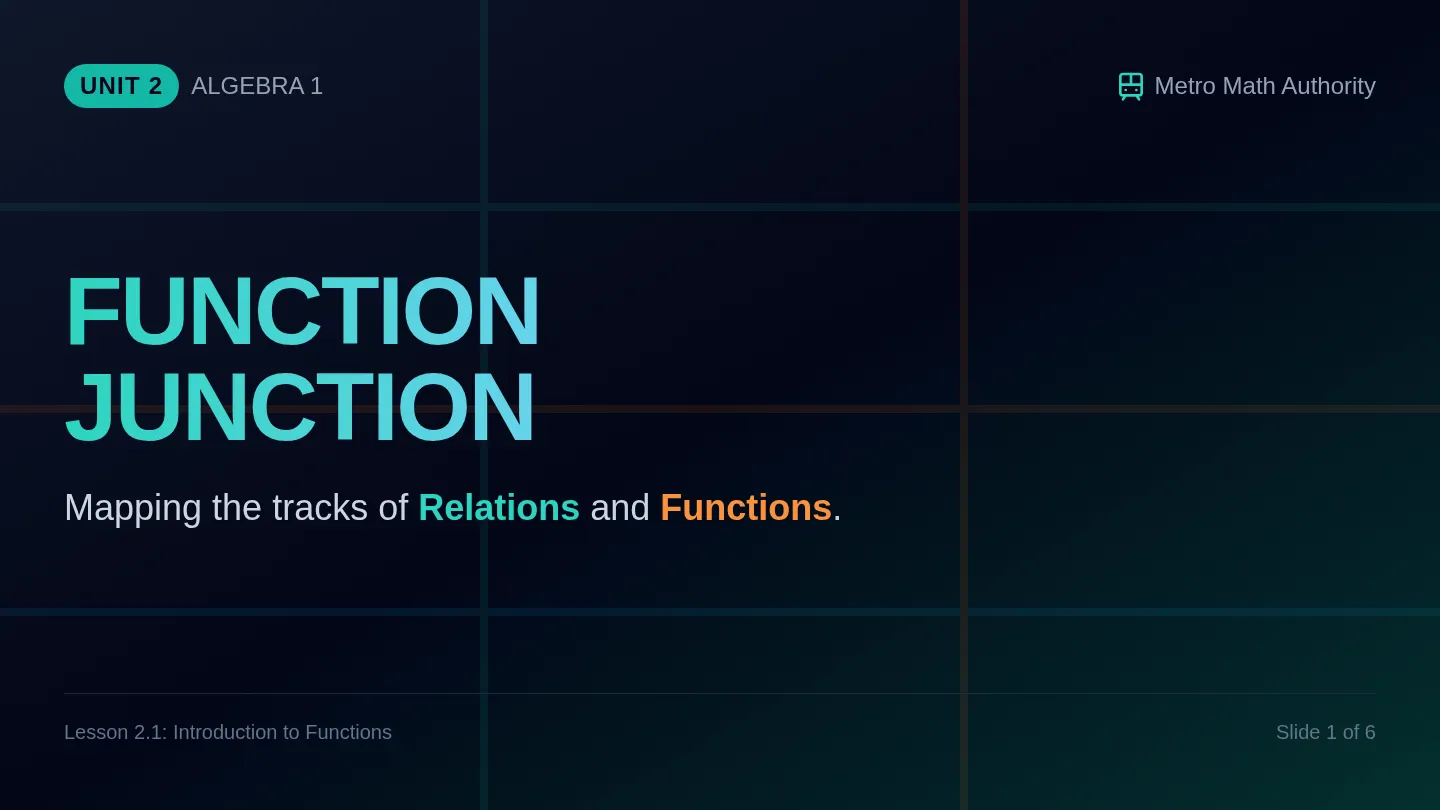
Series Spark Slides Algebra II Intervention
SERIES SUCCESS
Decoding the power of geometric growth through patterns and formulas.
CO Standard HS.A-SSE.B.4
The Growth Hook
Imagine you are offered a job for 10 days.
Option A:
$100 total for the whole job.
Option B:
1 penny on day 1, then the amount doubles every day.
Total pay for Option B:
Day 1 $0.01
Day 2 $0.02
Day 3 $0.04
... ...
Day 10 Total $10.23
Wait until Day 30... $10,737,418.23!
101
The Essentials
Sequence
A list of numbers following a specific multiplication rule.
2, 6, 18, 54, ...
\( a_1 = 2 \) \( r = 3 \)
Series
The SUM of the terms in a sequence.
2 + 6 + 18 + 54
\( S_4 = 80 \)
Building the Pattern
Let's look at the series: \( 5 + 10 + 20 + 40 + ... \)
Term (\( n \)) Sequence Term (\( a_n \)) Current Sum (\( S_n \)) 1 5 5 2 5 × 2 = 10 5 + 10 = 15 3 10 × 2 = 20 15 + 20 = 35 4 20 × 2 = 40 35 + 40 = 75
What if we need to find the sum of the first 100 terms? Adding manually is too slow!
The Algebraic Magic
1. Write the sum:
\( S_n = a_1 + a_1r + a_1r^2 + ... + a_1r^{n-1} \)
2. Multiply the whole thing by \( r \):
\( r \cdot S_n = a_1r + a_1r^2 + a_1r^3 + ... + a_1r^n \)
SHIFTED!
3. Subtract them! \( S_n - rS_n \)
Everything cancels out except the first and last terms!
\( S_n(1 - r) = a_1(1 - r^n) \)
The Series Key
\[ S_n = \frac{a_1(1-r^n)}{1-r} \]
First Term
\( a_1 \)
Common Ratio
\( r \)
Number of Terms
\( n \)
Real World Application
The Savings Challenge
You save $10 in the first month. Each month, you increase your savings by 20% (multiplying by 1.2). How much total have you saved after 12 months?
\( a_1 \)
10
\( r \)
1.2
\( n \)
12
Calculation:
\( S_{12} = \frac{10(1 - 1.2^{12})}{1 - 1.2} \)
Total Savings:
$395.81
Your Turn
Identify the parts needed for the formula in this series:
3 + 12 + 48 + 192 + ... (up to 8 terms)
First Term
?
Ratio
?
Count
?
Series Scaffolds Worksheet Series Scaffolds
Finite Geometric Series Intervention
Name:
Date:
1
The Build: Pattern Recognition
Consider the geometric sequence where each term is 3 times the previous term, starting with 4. Complete the table to find the partial sums (\(S_n\)).
Term No. (\(n\)) The Term (\(a_n\)) Sum so far (\(S_n\)) 1 4 4 2 \(4 \times 3 = 12\) \(4 + 12 = 16\) 3 4
Analyze: How much faster is the sum growing compared to the individual terms?
2
The Blueprint: Parts of the Formula
\( S_n = \frac{a_1(1-r^n)}{1-r} \)
For the series \( 5 + 10 + 20 + 40 + ... + 640 \), identify the key components needed for the formula.
First Term (\(a_1\))
Common Ratio (\(r\))
No. of Terms (\(n\))
Show your formula setup here:
3
The Mission: Application
A local theater has 20 seats in the first row. Each subsequent row increases the number of seats by 10% (a ratio of 1.1). If there are 15 rows, how many total seats are in the theater?
Identify the Parts
First row (\(a_1\)) __________
Growth Ratio (\(r\)) __________
Total Rows (\(n\)) __________
Calculation Space
Conceptual Check
Why do we use \( (1 - r) \) in the denominator? What would happen if \( r = 1 \)?
Series Success Exit Ticket Exit Ticket
ALGEBRA II
Student Name
Date
1
Consider the geometric series:
First Term (\(a_1\))
Ratio (\(r\))
Count (\(n=5\))
2
Set up the formula to find the sum of the first 5 terms (\(S_5\)). You do not need to calculate the final number.
3
Self-Check: On a scale of 1-4, how confident do you feel using the formula \( S_n = \frac{a_1(1-r^n)}{1-r} \)?
1
Lost
2
Getting it
3
Confident
4
Expert
Series Success Teacher Guide Facilitation Guide
Series Success: Geometric Intervention
Lesson ID
GS-INT-001
Learning Objective
Students will be able to derive the formula for the sum of a finite geometric series and use the formula to solve problems, including real-world applications (CO Standard HS.A-SSE.B.4).
Intervention Focus
Bridging concrete arithmetic sums to abstract algebraic formulas.
Identifying parameters (\(a_1\), \(r\), \(n\)) within verbal and numerical contexts.
Understanding the "shifting" technique used in the formula derivation.
Materials Needed
Series Spark Slides
Scaffolds Worksheet
Scientific Calculators
Instructional Flow
01
The Hook (5-7 mins)
Use Slide 2.
Present the penny-doubling problem. Ask students to guess the total after 10 days before showing the answer. Key Question: "Why did Option B grow so much faster at the end?" Focus on the concept of multiplying vs. adding.
02
Building Patterns (10 mins)
Use Slides 3-4 and Worksheet Section 1.
Have students complete the table on the worksheet. Walk around to ensure they are adding the previous sum to the new term . Misconception Alert: Students often forget to multiply by the ratio for the new term and just add the same number.
03
The Formula Magic (15 mins)
Use Slides 5-6.
This is the core of the intervention. Demonstrate the subtraction method on a whiteboard. Emphasize that multiplying by \(r\) and "shifting" the terms makes them line up perfectly to cancel out. Scaffold: Use physical sticky notes with terms written on them to show the physical "shift."
04
Application & Assessment (10-15 mins)
Use Worksheet Sections 2-4 and Exit Ticket.
Guide students through the theater problem. Let them use calculators for the \(1.1^{15}\) calculation. Conclude with the Exit Ticket to gauge individual mastery of formula setup.
Questioning for Mastery
Deepen the "r"
"If the common ratio was 0.5 instead of 2, would the sum get bigger or smaller as we add terms? Why?"
The "n" Trap
"In the theater problem, if the first row is row 1, and there are 15 rows, why is n=15? What if we started at row 5?"