Operation Recon Slides Classroom Intelligence Agency
MISSION STATUS: ACTIVE
Operation: Recon
Mastering the Grid &
the Big Seven
Welcome, Agent. Your mission today is to crack code patterns, unlock secret connections, and bridge your multiplication and division strategies.
Target Skill Set Grade 5 Bridge: Area Model & Partial Quotients
MISSION START_
Phase 1: Warm-Up
Agent Warm-Up
Mental Calculation Warm-Up
Warm up your processors. Solve these calculations mentally. Look for patterns!
SECTOR A
4 × 6 = __
4 × 60 = __
SECTOR B
7 × 8 = __
70 × 8 = __
SECTOR C
9 × 3 = __
90 × 30 = __
Ponder this: How does changing an input to a multiple of 10 change the final solution?
Learning Target: Place Value Patterns 01 / 09
Phase 2: The Core Connection
Inverse Operations
The Inverse Connection
Multiplication and division are reciprocal operations. They undo each other!
Fact Family Terminal
42
6
7
6 × 7 = 42 | 42 ÷ 6 = 7
1
Think Multiplication
When faced with a division challenge like \[ 48 \div 8 = ? \], ask yourself: "What number multiplied by 8 yields 48?"
2
Build Fact Clusters
Know your basic facts to solve larger scales. If \( 3 \times 4 = 12 \), then \( 120 \div 3 = 40 \) and \( 120 \div 40 = 3 \).
Learning Target: Inverse Relationships 02 / 09
Phase 3: Multiplication Recon
Area Model
The Area Model Strategy
Breaking factors down by place value to visualize and solve large-scale problems.
01
Expand Factors
Decompose multi-digit numbers using expanded notation.
02
Construct the Grid
Build columns and rows corresponding to the terms. Write terms along the sides to calculate individual areas.
03
Sum Partial Products
Calculate the product in each sub-grid. Finally, add all products to obtain your total value.
Learning Target: Multi-digit Multiplication Strategy 03 / 09
Phase 3: Multiplication Demonstration
Area Model Execution
MISSION TASK
Solve: 24 × 13
20
4
10
3
10 × 20 200
10 × 4 40
3 × 20 60
3 × 4 12
Summing the Pieces
Add all your sub-grid products to find your master solution:
200 (10 × 20)
+ 60 (3 × 20)
+ 40 (10 × 4)
+ 12 (3 × 4)
TOTAL: 312
Demo Code: Area Model Formulation 04 / 09
Phase 4: Division Recon
Partial Quotients
The Big Seven Strategy
Subtracting "friendly multiples" of your divisor in a single structured workspace.
01
Build the Frame
Draw your standard division bracket but extend the right-hand bar down. This forms your "Big 7" structural workspace.
02
Identify friendly chunks
Subtract easily calculated chunks of your divisor (like ×10, ×20, ×5). Keep track of each chunk along the side column.
03
Add Your Chunks
Subtract until your remaining value is smaller than your divisor. Sum your side-column chunks to get the final quotient!
Learning Target: Multi-digit Division Strategy 05 / 09
Phase 4: Division Demonstration
Partial Quotients Execution
MISSION TASK
Solve: 138 ÷ 6
6
138 20
- 120 (20 × 6)
18 3
- 18 (3 × 6)
0
How We Solved It
Step 1: The First Jump We know \( 6 \times 10 = 60 \), so \( 6 \times 20 = 120 \). Let's subtract that friendly chunk of 120 from 138. We write 20 to the right.
Step 2: The Next Jump This leaves 18. We know exactly \( 6 \times 3 = 18 \). Subtract 18. Write 3 below the 20 on the right.
Step 3: Combine Quotient Pieces Add the chunks: 20 + 3 = 23. No remainder!
Demo Code: Partial Quotient Breakdown 06 / 09
Phase 5: Deciphering Clues
Word Problems
Word Problem Reconnaissance
Identify core word actions to choose the correct math weapon.
Multiplication Clues
You know the number of groups and the size of each group . You need to calculate the unknown total .
"each" "per" "total in all" "times as many"
Division Clues
You already know the total quantity . You are looking to find how many groups or how much is in each group .
"share equally" "cut into" "split into" "how many groups"
Learning Target: Strategy Analysis 07 / 09
Phase 6: Deployment
Mission Debrief
Your Deployment Orders
The training run is complete. It is time to run your field work.
1. Guided & Independent
Open your Guided Notes packet. Let's practice these strategies together, then fly solo on the Independent Worksheet challenges.
2. The Ultimate Test
Conclude your deployment by tackling the Exit Ticket. Show off your grid models and big-seven divisions!
Deployment Authorized by Lenny 08 / 09
Operation Recon Teacher Guide SECRET // LEVEL 4
Operation Recon / Teacher Briefing
Classroom Operations Manual
TOP SECRET
REF: GR5-BRIDGE-01
Mission Objective
Bridge the learning gap for incoming fifth-grade students by reviewing foundational fourth-grade multiplication (Area Model) and division (Partial Quotients) skills. Emphasize standard notation structures, inverse relationship concepts, and real-world deciphering.
ESTIMATED RUNTIME: 60 Minutes
TARGET SKILLS: 4.NBT.5, 4.NBT.6, 4.OA.3
Pacing Guide & Scripted Prompts
0-10 MIN
Phase 1: Warm-Up & Fact Fluency
Direct students to the mental calculation grid. Lead class chant or cold-call for values of basic facts vs. multiples of ten.
CRITICAL QUESTION: "What happens to the product of 4 × 6 when we make one factor 10 times bigger (4 × 60)? How many place-value shifts occurred?"
10-20 MIN
Phase 2: Reciprocal Operations
Demonstrate the fact-family connection. Highlight that dividing is essentially finding a missing factor.
TEACHER SCRIPT: "If you forget a division answer, don't panic! Think: what multiplied by my divisor equals this total? Work backward from the facts you own."
20-35 MIN
Phase 3: The Area Model Deployment
Model \( 24 \times 13 \) step-by-step. Guide students to break numbers by place value into expanded form: \( (20 + 4) \times (10 + 3) \). Ensure kids write partial products inside the grid correctly.
MISCONCEPTION WARNING: Students often multiply \( 20 \times 10 \) incorrectly, missing an ending zero (writing 20 instead of 200). Enforce place-value count checks: "2 tens times 1 ten is 2 hundreds."
CLASSROOM OPERATIONS MANUAL // PAGE 1 GR5-BRIDGE-01
Operation Recon / Lesson Execution
Strategic Operations & Answer Keys
ANSWER KEY INCLUDED
35-45 MIN
Phase 4: Partial Quotients (The Big 7)
Model \( 138 \div 6 \). Explain that the right-hand bar acts as our chunk tracker. Emphasize "friendly multiples" like \( \times 10 \), \( \times 20 \), etc.
STRATEGY TIP: Encourage struggling students to list a "Friendly Facts Menu" on the side first (e.g., \( 6 \times 10 = 60 \), \( 6 \times 20 = 120 \), \( 6 \times 5 = 30 \)) before performing subtractions.
45-55 MIN
Phase 5: Word Problem Analysis
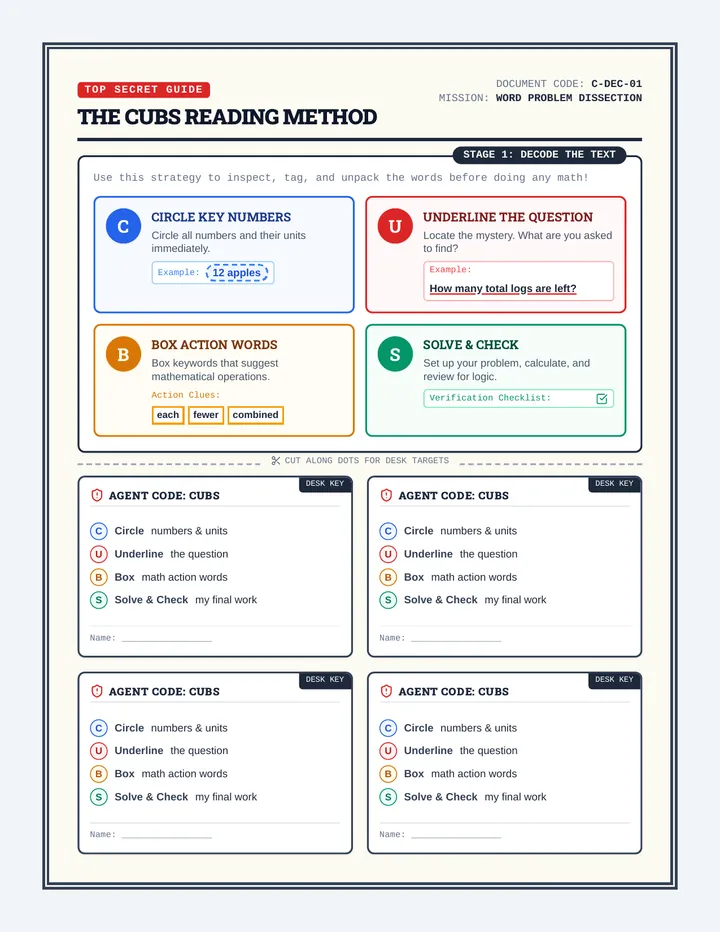
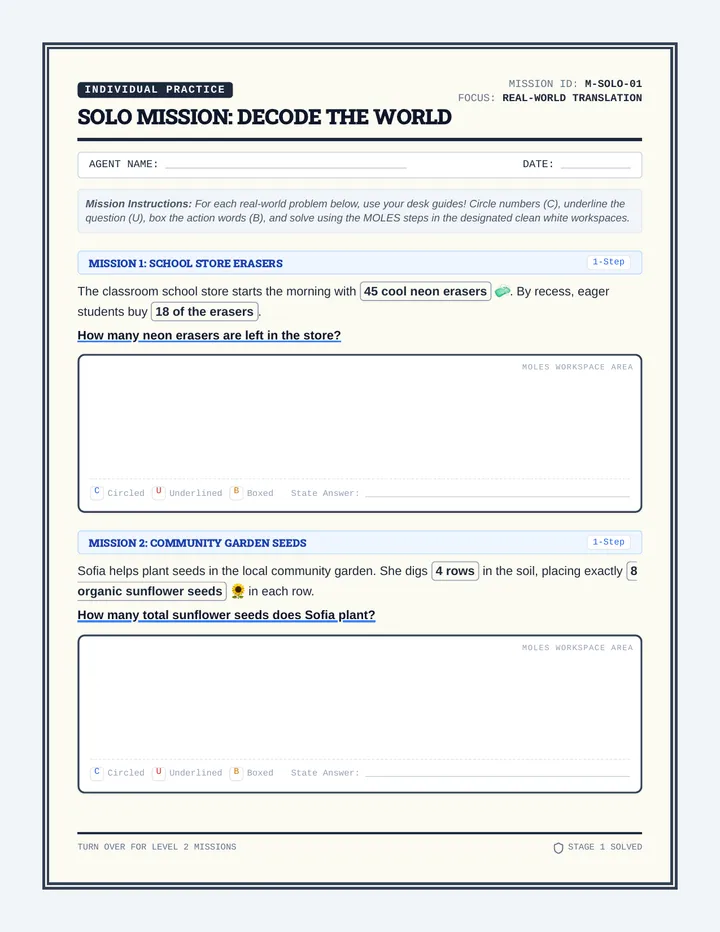
Have students circle context words in the problem. Focus on the core question: Do we know the total (Division), or are we hunting for the total (Multiplication)?
Master Answer Keys
Operation Recon Guided Notes DOC ID: REC-GNOTES-01
Classroom Intelligence Agency
Operation Recon: Guided Notes
STUDENT BRIEFING
AGENT NAME:
DATE OF ENTRY:
AGENT CODE NAME:
LEARNING TARGET
I can use multiplication and division strategies to solve problems and explain my thinking.
01 Phase 1: Warm-Up Fact Fluency
Complete the calculation sectors. Observe the pattern when multiples of ten are introduced!
SECTOR A
4 × 6 =
4 × 60 =
SECTOR B
7 × 8 =
70 × 8 =
SECTOR C
9 × 3 =
90 × 30 =
02 Phase 2: The Core Connection
Fill in the blanks to complete the rule of inverse operations:
Multiplication and division are operations. This means they can "undo" each other.
For example, if we know that: 8 × 6 = 48, then we also know that: 48 ÷ 8 = .
03 Phase 3: The Area Model Strategy
Write down the three primary steps discussed for utilizing an Area Model:
Step 1:
Expand the factors by their place value. (Example: 24 becomes ).
Step 2:
Draw a grid. Write the expanded numbers along the and .
Step 3:
Multiply inside each smaller box to get products, then them all together.
OPERATION RECON // GUIDED NOTES PAGE 1 OF 2
DOC ID: REC-GNOTES-02
Operation Recon / Phase 3 & 4 Practice
04 Area Model Practice: Solve \( 32 \times 15 \)
Decompose both factors, construct your grid inside the blank workspace, and add the partial products.
Student Workspace: Draw Area Model & Add Products
05 Phase 4: Partial Quotients Strategy
Complete the explanation of the "Big Seven" setup:
We use the Partial Quotients strategy to subtract "friendly" amounts of our divisor from our total dividend. We draw a vertical bar down the right side of the bracket, forming a "Big " . We keep track of our multiples on the side of the line, and then we them up at the end.
06 Partial Quotients Practice: Solve \( 168 \div 7 \)
Set up your Big Seven framework. Use friendly increments like \( 7 \times 10 \) or \( 7 \times 20 \) first!
Student Workspace: Set up Big 7 Bracket & Solve
OPERATION RECON // GUIDED NOTES PAGE 2 OF 2
Operation Recon Independent Worksheet DOC ID: REC-WORKSHEET-01
Classroom Intelligence Agency
Operation Recon: Independent Practice
SOLO MISSION
AGENT NAME:
DATE OF ENTRY:
AGENT CODE NAME:
01 Multiplication Hunt: Solve \( 43 \times 16 \)
STRATEGY: AREA MODEL
Decompose 43 and 16 by place value. Build your model and calculate the final product inside the workspace.
Student Workspace: Area Model construction & calculations
02 Division Hunt: Solve \( 225 \div 5 \)
STRATEGY: BIG SEVEN
Set up your Big Seven division grid below. List friendly multiples of 5 to subtract in chunks.
Student Workspace: Big Seven frame setup & calculation steps
OPERATION RECON // INDEPENDENT WORKSHEET PAGE 1 OF 2
DOC ID: REC-WORKSHEET-02
Operation Recon / Tactical Context Scenarios
03 Scenario Alpha: Radio Rations
The reconnaissance team discovered 18 dry-supply crates in Sector 4. Each individual crate contains exactly 12 packages of field rations . How many total packages of field rations did the team secure?
1. Chosen Operation
Multiplication Division
2. Deciphering Explanation (How did you know?)
3. Reasonability Check (Is your answer sensible?)
4. Operational Workspace
Solve & Show Work
04 Scenario Beta: Agent Transport
The base operations commander needs to deploy 192 field agents to remote observation outposts. If each tactical transport vehicle can carry exactly 8 agents , how many vehicles will be needed?
1. Chosen Operation
Multiplication Division
2. Deciphering Explanation (How did you know?)
3. Reasonability Check (Is your answer sensible?)
4. Operational Workspace
Solve & Show Work
MISSION DEBRIEF CHECKLIST:
[ ] Grid / Bracket Built [ ] Calculations Checked [ ] Words Decoded [ ] Strategies Explained
OPERATION RECON // INDEPENDENT WORKSHEET PAGE 2 OF 2
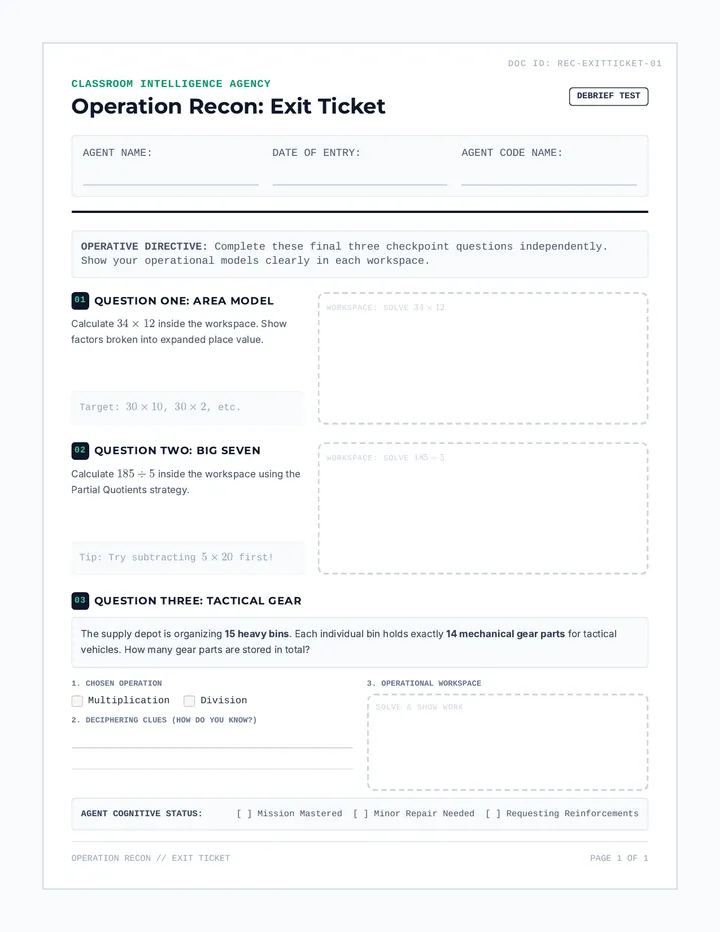
Operation Recon Exit Ticket DOC ID: REC-EXITTICKET-01
Classroom Intelligence Agency
Operation Recon: Exit Ticket
DEBRIEF TEST
AGENT NAME:
DATE OF ENTRY:
AGENT CODE NAME:
OPERATIVE DIRECTIVE: Complete these final three checkpoint questions independently. Show your operational models clearly in each workspace.
01 Question One: Area Model
Calculate \( 34 \times 12 \) inside the workspace. Show factors broken into expanded place value.
Target: \( 30 \times 10 \), \( 30 \times 2 \), etc.
Workspace: Solve \( 34 \times 12 \)
02 Question Two: Big Seven
Calculate \( 185 \div 5 \) inside the workspace using the Partial Quotients strategy.
Tip: Try subtracting \( 5 \times 20 \) first!
Workspace: Solve \( 185 \div 5 \)
03 Question Three: Tactical Gear
The supply depot is organizing 15 heavy bins . Each individual bin holds exactly 14 mechanical gear parts for tactical vehicles. How many gear parts are stored in total?
1. Chosen Operation
Multiplication Division
2. Deciphering Clues (How do you know?)
3. Operational Workspace
Solve & Show Work
AGENT COGNITIVE STATUS:
[ ] Mission Mastered [ ] Minor Repair Needed [ ] Requesting Reinforcements
OPERATION RECON // EXIT TICKET PAGE 1 OF 1