Blueprint Basics Guided Notes Blueprint Basics
Architect's Guide to Comparing Fractions
Name: ____________________________________
Date: _____________________________________
The Golden Rule
To compare two fractions, they must refer to the whole! If the "wholes" are different sizes, the comparison isn't fair.
1
Same Denominators
The bottom numbers are the same. This means the pieces are the same size . We just look at how many pieces we have!
Plan A: \(\frac{3}{8}\)
Plan B: \(\frac{5}{8}\)
\(\frac{3}{8}\)
\(\frac{5}{8}\)
2
Same Numerators
The top numbers are the same. We have the same number of pieces , but the size changes!
0
1
\(\frac{2}{3}\)
0
1
\(\frac{2}{6}\)
\(\frac{2}{3}\)
\(\frac{2}{6}\)
Blueprint Quick Check
1. Compare \(\frac{1}{4}\) and \(\frac{1}{2}\)
\(\frac{1}{4}\)
\(\frac{1}{2}\)
2. Compare \(\frac{4}{6}\) and \(\frac{2}{6}\)
0 1 \(\frac{4}{6}\)
0 1 \(\frac{2}{6}\)
\(\frac{4}{6}\)
\(\frac{2}{6}\)
Word Problem Architect
Maya and Leo are building garden beds of the same size . Maya plants carrots in \(\frac{3}{4}\) of her bed. Leo plants carrots in \(\frac{3}{8}\) of his bed. Who planted more?
Maya (\(\frac{3}{4}\))
Leo (\(\frac{3}{8}\))
Answer:
Garden Duel Task Cards 1
Area Comparison
Compare these garden beds.
\(\frac{2}{4}\)
\(\frac{3}{4}\)
\(\frac{2}{4} \quad \square \quad \frac{3}{4}\)
2
Path Comparison
Use the number lines.
\(\frac{1}{2}\)
\(\frac{1}{4}\)
\(\frac{1}{2} \quad \square \quad \frac{1}{4}\)
3
The Seed Box
Zoe has two identical seed boxes. One box is \(\frac{5}{6}\) full of sunflower seeds. The other is \(\frac{3}{6}\) full of poppy seeds.
Which box is more full?
\(\frac{5}{6} \quad \square \quad \frac{3}{6}\)
4
True or False?
"Since 8 is bigger than 2, I know that \(\frac{1}{8}\) must be bigger than \(\frac{1}{2}\)."
\(\frac{1}{2}\)
\(\frac{1}{8}\)
True or False?
5
Circular Gardens
\(\frac{1}{3}\)
\(\frac{1}{6}\)
Compare these circular flower beds.
\(\frac{1}{3} \quad \square \quad \frac{1}{6}\)
6
The Watering Can
Liam used \(\frac{4}{8}\) of his watering can. Sarah used \(\frac{7}{8}\) of her identical can.
Who used more water?
\(\frac{4}{8} \quad \square \quad \frac{7}{8}\)
7
Visual Proof
Draw same-size rectangles to compare:
\(\frac{2}{3} \quad \text{vs} \quad \frac{2}{4}\)
\(\frac{2}{3} \quad \square \quad \frac{2}{4}\)
8
Fast Finisher
\(\frac{3}{6}\)
\(\frac{3}{3}\)
\(\frac{2}{8}\)
\(\frac{5}{8}\)
Think about the size of the pieces!
Garden Duel Recording Sheet Garden Duel Recording Sheet
Name: ____________________________________
Date: _____________________________________
Visit each task card. Write your answer (\( >, <, = \) or True/False). Use the Reasoning column to explain your thinking!
Card Answer My Reasoning / Work Space 1 \(\frac{2}{4} \quad \square \quad \frac{3}{4}\) 2 \(\frac{1}{2} \quad \square \quad \frac{1}{4}\) 3 \(\frac{5}{6} \quad \square \quad \frac{3}{6}\) 4 TRUE / FALSE 5 \(\frac{1}{3} \quad \square \quad \frac{1}{6}\) 6 Sarah / Liam 7 \(\frac{2}{3} \quad \square \quad \frac{2}{4}\) 8 \(\frac{3}{6} \quad \square \quad \frac{3}{3}\)
\(\frac{2}{8} \quad \square \quad \frac{5}{8}\)
| |
Garden Master's Reflection
When two fractions have the same numerator (like \(\frac{2}{3}\) and \(\frac{2}{6}\)), why is the fraction with the smaller denominator actually the larger fraction?
Fraction Face Off Answer Key Answer Key
TEACHER RESOURCE
Fraction Face Off - All Materials
Blueprint Basics & Task Cards
Guided Notes
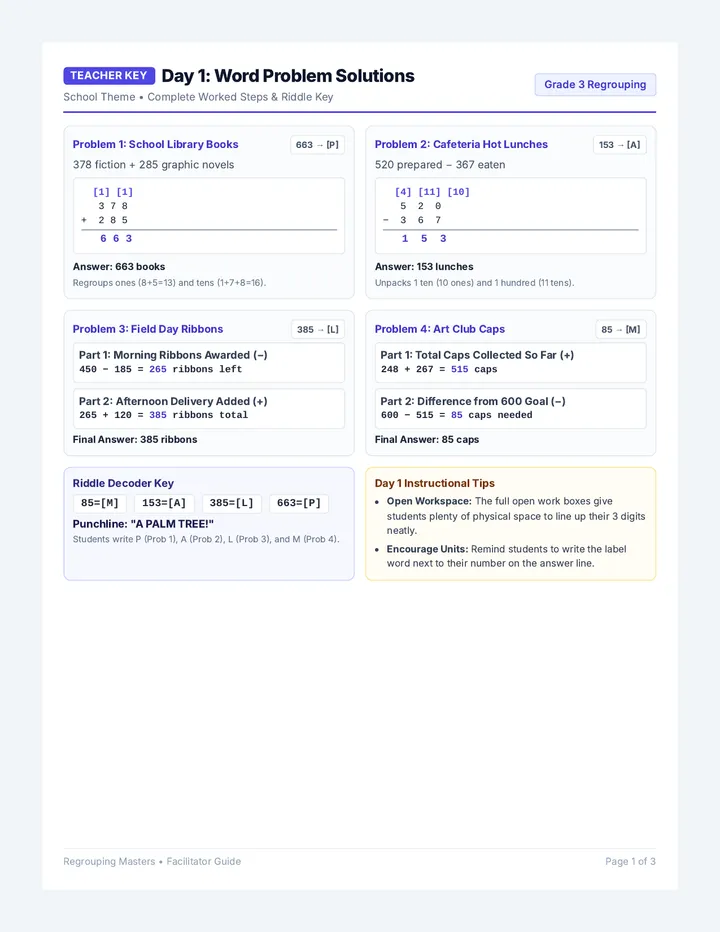
Golden Rule: SAME SIZE
Part 1 (8ths): \(\frac{3}{8} < \frac{5}{8}\)
Part 2 (3rds/6ths): \(\frac{2}{3} > \frac{2}{6}\)
Quick Check 1: \(\frac{1}{4} < \frac{1}{2}\)
Quick Check 2: \(\frac{4}{6} > \frac{2}{6}\)
Word Problem: Maya (\(\frac{3}{4} > \frac{3}{8}\))
Garden Duel Cards
1: \(<\)
2: \(>\)
3: \(>\)
4: FALSE
5: \(>\)
6: Sarah
7: \(>\)
8: \(<, <\)
Independent Practice Sheet
Greenhouse (Area)
1. \(\frac{1}{4} < \frac{3}{4}\)
2. \(\frac{4}{6} > \frac{2}{6}\)
Fence Row (Length)
A/B: \(\frac{3}{8} < \frac{3}{4}\)
C/D: \(\frac{2}{3} > \frac{2}{6}\)
Fast Planting (Symbol Challenge)
\(\frac{5}{8} < \frac{7}{8}\)
\(\frac{1}{2} > \frac{1}{6}\)
\(\frac{4}{4} > \frac{2}{4}\)
\(\frac{3}{6} < \frac{3}{3}\)
Master Gardener's Challenge
Answer: Beans
Reasoning: We compare \(\frac{2}{6}\) (corn) and \(\frac{2}{3}\) (beans). Since both fields have the same number of pieces (2), we compare piece sizes. 3rds are much larger than 6ths. Therefore, 2 large pieces (3rds) is more than 2 small pieces (6ths).
Architect's Teaching Tips
Piece Size vs. Count: Remind students that a larger denominator means a whole is cut into more pieces, which makes each individual piece smaller .Valid Comparisons: Use the "Golden Rule" to pivot back if students try to compare fractions from different-sized wholes. Comparisons are only valid if they refer to the same whole.Verbalizing Logic: For "Fast Planting," have students vocalize their reasoning: "I have 3 pieces in both, but 3rds are bigger than 6ths, so \(\frac{3}{3}\) is bigger than \(\frac{3}{6}\)."Visual Support: For students struggling with abstract reasoning, prompt them to draw quick sketches on the back of the sheet. Garden Plot Practice Sheet Garden Plot Practice
Independent Practice: Comparing Fractions
Name: ____________________________________
Date: _____________________________________
Goal: Compare fractions using visual models and symbols. Remember: Fractions can only be compared when they refer to the same size whole!
1. The Greenhouse
Shade the models to represent each fraction, then compare using \( \gt, \lt, \text{ or } = \).
\( \frac{1}{4} \)
?
\( \frac{3}{4} \)
\( \frac{4}{6} \)
?
\( \frac{2}{6} \)
2. Fence Row Measurements
Label the points on the number lines and compare.
0
1
Plot A: \( \frac{3}{8} \)
0
1
Plot B: \( \frac{3}{4} \)
\( \frac{3}{8} \quad \square \quad \frac{3}{4} \)
0
1
Plot C: \( \frac{2}{3} \)
0
1
Plot D: \( \frac{2}{6} \)
\( \frac{2}{3} \quad \square \quad \frac{2}{6} \)
3. Fast Planting Challenge
Compare using reasoning about piece sizes.
\( \frac{5}{8} \)
\( \frac{7}{8} \)
\( \frac{1}{2} \)
\( \frac{1}{6} \)
\( \frac{4}{4} \)
\( \frac{2}{4} \)
\( \frac{3}{6} \)
\( \frac{3}{3} \)
4. Master Gardener's Challenge
Farmer Green has two identical fields. He plants corn in \( \frac{2}{6} \) of the first field. He plants beans in \( \frac{2}{3} \) of the second field.
Did Farmer Green plant more corn or beans? Explain your reasoning using piece sizes.
Explain your reasoning and show work here:
Final Answer:
Garden Plot Answer Key Practice Answer Key
Garden Plot Practice
Independent Practice: Comparing Fractions
Section 1: The Greenhouse
1/4 vs 3/4
\( \frac{1}{4} \lt \frac{3}{4} \)
Why: Both wholes are cut into 4 pieces. 1 piece is less than 3 pieces.
4/6 vs 2/6
\( \frac{4}{6} \gt \frac{2}{6} \)
Why: Both wholes are cut into 6 pieces. 4 pieces is more than 2 pieces.
Section 2: Fence Row Measurements
Plot A vs Plot B
\( \frac{3}{8} \lt \frac{3}{4} \)
Reasoning: We have the same number of pieces (3). But 4ths are much larger than 8ths because the whole is cut into fewer pieces. So 3 large pieces (4ths) > 3 small pieces (8ths).
Plot C vs Plot D
\( \frac{2}{3} \gt \frac{2}{6} \)
Reasoning: Same number of pieces (2). 3rds are bigger pieces than 6ths. Covering two large distances (3rds) is more than covering two small ones (6ths).
Section 3: Fast Planting
5/8 vs 7/8
\( \lt \)
1/2 vs 1/6
\( \gt \)
4/4 vs 2/4
\( \gt \)
3/6 vs 3/3
\( \lt \)
Master Gardener's Challenge Key
Correct Choice: Beans
\( \frac{2}{3} \gt \frac{2}{6} \)
Teacher Logic: The comparison is between \( \frac{2}{6} \) (corn) and \( \frac{2}{3} \) (beans). Since the numerators are identical (2), we evaluate piece size. 3rds are significantly larger than 6ths. Therefore, having 2 of the large pieces (beans) results in a greater portion of the field being used than having 2 of the small pieces (corn).