Expression Transformers Slides Grade 7 Mathematics
60-Minute Lesson
CCSS.MATH.CONTENT.7.EE.A.1
Expression Transformers
Expanding expressions with variables & factoring expressions to rewrite and simplify linear quantities.
1
Expand (Multiply Out)
\(a(b + c) = ab + ac\)
2
Factor (Pull Out GCF)
\(ab + ac = a(b + c)\)
The Big Picture: Two Opposite Actions
Core Concept
Action 1
EXPANDING
Multiply the outside factor to every term inside the parentheses using the Distributive Property.
\(4(2x + 3) \longrightarrow 8x + 12\)
Unpacking / Removing Parentheses
Action 2
FACTORING
Find the Greatest Common Factor (GCF) of all terms and divide it out into front of parentheses.
\(8x + 12 \longrightarrow 4(2x + 3)\)
Packing Up / Inserting Parentheses
Key Takeaway: Both expressions are completely equivalent —they just wear different outfits!
Expanding: The Area Model Method
Visualizing Multiplication
Expand: \(3(2x + 5)\)
Think of the expression as the total area of a rectangle with height \(3\) and split base \((2x + 5)\).
1 Left Room: \(3 \times 2x = \mathbf{6x}\)
2 Right Room: \(3 \times 5 = \mathbf{15}\)
Total Area: \(6x + 15\)
\(2x\)
\(+5\)
\(3\)
\(3 \cdot 2x\) \(6x\)
\(3 \cdot 5\) \(15\)
Result: \(3(2x + 5) = 6x + 15\)
Every term inside the brackets gets multiplied by the outside factor!
Danger Zone: Distributing Negatives
Common Trap
COMMON STUDENT MISTAKE
Problem: \(-4(3x - 7)\)
Distributing to the first term, but forgetting the negative sign on the second term:
\(-12x - 28\)
Error: Missed \((-4) \times (-7)\)!
THE MASTER STRATEGY
Rewrite as Addition: \(-4[3x + (-7)]\)
Distribute the negative to both parts:
\((\mathbf{-4}) \times (3x) = -12x\)
\((\mathbf{-4}) \times (-7) = \mathbf{+28}\)
Correct: \(-12x + 28\)
Rule of Signs: Negative times Negative equals Positive !
Quick Check: Whiteboards Ready!
2 Minutes
Problem A
\(5(3y - 4)\)
Apply the distributive property:
Multiply \(5 \cdot 3y\)
Multiply \(5 \cdot (-4)\)
Answer Reveal: \(15y - 20\)
Problem B (Challenge)
\(-2(4m - 9)\)
Watch the negative sign carefully:
Multiply \(-2 \cdot 4m\)
Multiply \(-2 \cdot (-9)\)
Answer Reveal: \(-8m + 18\)
Give a thumbs up if you got both correct! Ready to reverse the machine?
Factoring: Finding the GCF
The Reverse Process
Target: Factor \(12x + 18\)
Factoring means writing the expression as a product of its Greatest Common Factor and what remains.
Step 1: List factors of both coefficients:
Factors of \(12\): \(1, 2, 3, \mathbf{6}, 12\)
\(\text{GCF} = 6\)
Step 2: Divide each term by the GCF:
\(12x \div 6 = 2x\) | \(18 \div 6 = 3\)
The Factored Expression
6(2x + 3)
Check by expanding: \(6 \cdot 2x + 6 \cdot 3 = 12x + 18\) ✔
Always check your factored form by distributing back mentally!
Factoring with Reverse Area Models
Inside-Out Thinking
Factor: \(15x - 20\)
The two terms are the inside areas . Your job is to find the outside dimensions!
What is the greatest shared factor of \(15x\) and \(-20\)?
\(\text{Height (GCF)} = 5\)
Top width 1: \(15x \div 5 = \mathbf{3x}\)
\(3x\)
\(-4\)
\(5\)
Area 1 \(15x\)
Area 2 \(-20\)
Factored Form: \(5(3x - 4)\)
Factoring splits an area back into width \(\times\) height!
Partner Activity: Find the Imposter!
5 Minutes
Three of these expressions are completely equivalent . One is an imposter . Which one is it?
Card A \(6(3x - 4)\)
Card B \(18x - 24\)
Card C \(2(9x - 12)\)
Card D \(3(6x - 12)\)
Discussion Prompt: Expand each card or factor to its simplest form. Why does Card D fail?
Card D expands to \(18x - 36\), whereas Cards A, B, and C all equal \(18x - 24\)!
Turn to your partner: Share your mathematical reasoning using math vocabulary!
Lesson Summary & Exit Ticket
Final 5 Min
Key Rules to Remember
Expanding: Distribute the outside factor to every term inside parentheses.Negative Signs: Pay extra attention to signs (\((-a) \times (-b) = +ab\)).Factoring: Identify the GCF of all terms and divide it out.Self-Check: Expand your factored answer to verify it equals the original!
Exit Ticket Questions
On your handout
1. Expand completely:
\(-3(5x - 8)\)
2. Factor completely using the GCF:
\(14y + 35\)
Hand your completed exit ticket to the teacher on your way out!
Great job mathematicians! You have mastered Expression Transformers!
Expression Transformers Worksheet Grade 7 Mathematics • CCSS 7.EE.A.1
Expression Transformers: Expanding & Factoring
Part 1: The Distributive Property & Area Models
Name: ______________________
Date: _________________ Per: _____
1
Visual Discovery: Area Models
Find the total area of each rectangle by multiplying the outside height by each term inside the rooms.
Model A: \(4(3x + 2)\)
\(4\)
\(3x\)
\(12x\)
\(+2\)
\(+8\)
Total Expanded Area = \(12x + 8\)
Model B: Your Turn! \(6(2y + 5)\)
\(6\)
\(2y\)
\(+5\)
Expanded Expression: ________________________
The Distributive Property Rule
To expand an expression, multiply the factor outside the parentheses by every single term inside: \(a(b + c) = a \cdot b + a \cdot c\). Warning: When the outside factor is negative, distribute the negative sign: \(-a(b - c) = -ab + ac\).
2
Expanding Practice: Show Your Steps
Multiply through completely
1. Basic Distributive Level 1
\(7(3x + 4)\)
Final Answer: ______________________
2. Subtraction Inside Level 1
\(5(4a - 6)\)
Final Answer: ______________________
3. Negative Outside Factor Level 2
\(-3(5m + 8)\)
Final Answer: ______________________
4. Negative Factor & Negative Term Level 3
\(-8(2k - 7)\)
Final Answer: ______________________
Turn page over for Factoring Expressions and the Exit Ticket →
Part 2: Factoring Linear Expressions (Reversing the Machine)
Find the Greatest Common Factor (GCF) and rewrite as a product.
Reverse Distributive
3 Steps to Factor Completely
1. Find GCF: Largest number that divides evenly into all terms.
2. Divide Out: Divide every term in the expression by the GCF.
3. Write Form: Place GCF outside parentheses: \(\text{GCF}(\text{term}_1 + \text{term}_2)\).
3
Factoring Practice: Show Your Steps
5. Factor with Common Factor Level 1
\(9x + 24\)
GCF of \(9\) and \(24\) = _______
Factored Form: ______________________
6. Subtraction & Larger Factor Level 1
\(20w - 35\)
GCF of \(20\) and \(35\) = _______
Factored Form: ______________________
7. Multi-Factor Challenge Level 2
\(16p + 40\)
GCF of \(16\) and \(40\) = _______
Factored Form: ______________________
8. Factoring Out a Negative Level 3
\(-14y - 21\)
Factor out \(-7\):
Factored Form: ______________________
Error Detective: Spot Marcus's Mistake
Marcus wrote: \(3(4x - 6) = 12x - 6\)
What error did Marcus make? Explain in words:
Exit Ticket Check
Name: _______________________________ Period: _______
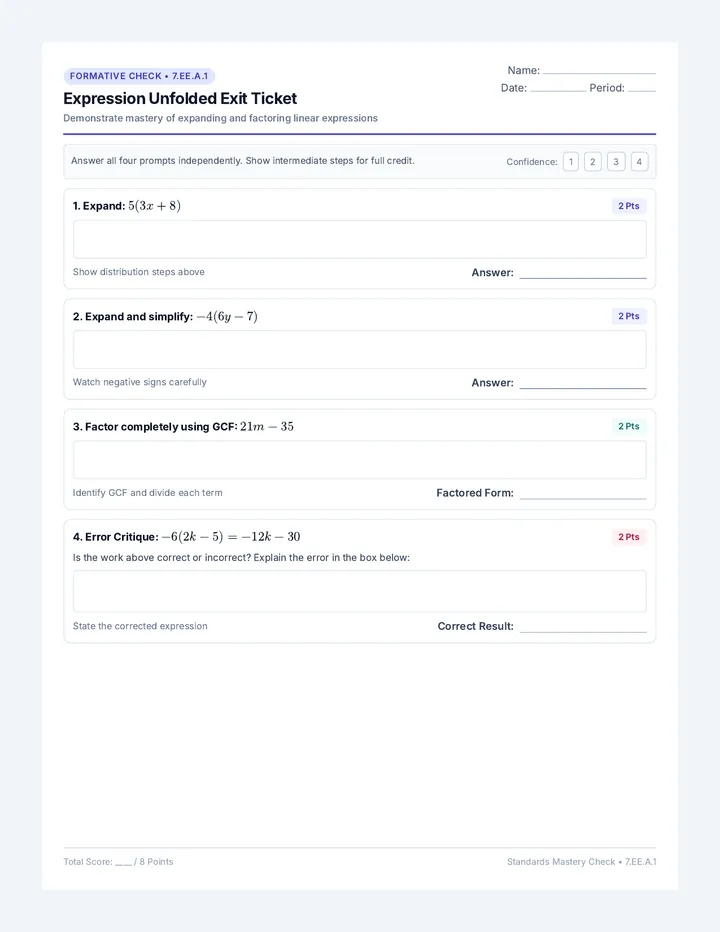
1. Expand completely:
\(-3(5x - 8)\)
Answer: _______________________
2. Factor completely using the GCF:
\(14y + 35\)
Answer: _______________________
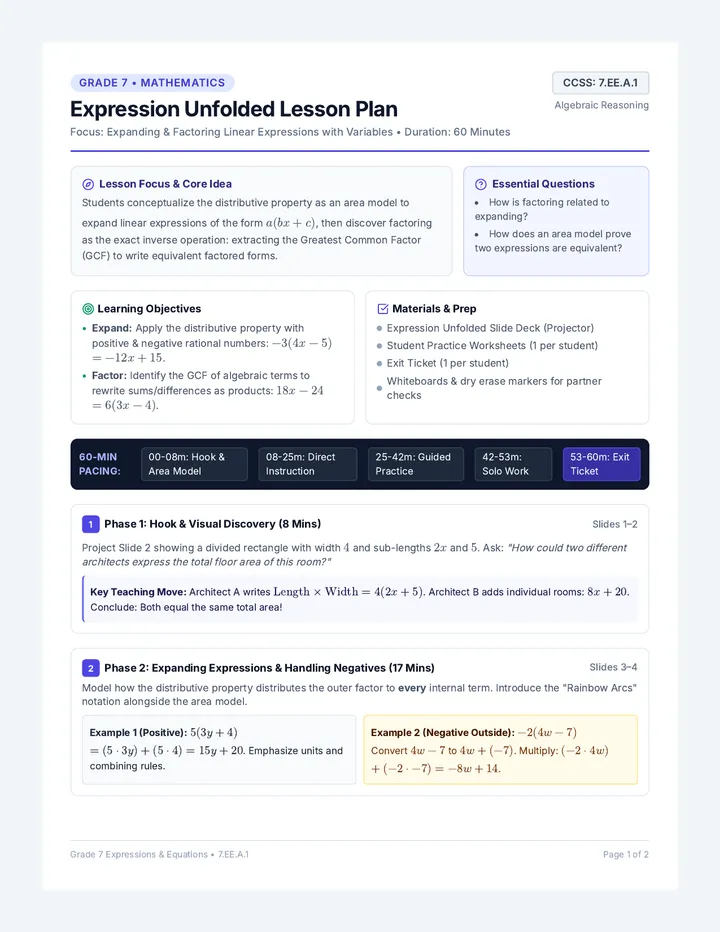
Expression Transformers Facilitation Guide Teacher Facilitation Guide & Lesson Plan
Expression Transformers: Expanding & Factoring
Grade 7 Mathematics • CCSS 7.EE.A.1 • 60-Minute Lesson Framework
60 MIN
Lesson Objectives (Students will be able to...)
Apply the distributive property to expand expressions with integer coefficients: \(a(bx + c) = abx + ac\).
Identify the GCF of two terms and factor linear expressions into product form: \(abx + ac = a(bx + c)\).
Verify expression equivalence numerically and through area models.
Essential Vocabulary
Distributive Property: Multiplying a sum by multiplying each addend.
Factor: To rewrite a sum as a product of factors.
GCF: Greatest factor shared between terms.
Suggested 60-Minute Lesson Timeline
Time
Phase
Key Teacher & Student Actions
00 - 08 min
Warm-Up & Hook
Present Slide 1–2. Direct students to Model A & B on the worksheet. Connect area of rooms to multiplication.
08 - 20 min
Direct Instruction: Expanding
Slides 3–4. Teach the distributive arrows and the negative coefficient trap. Emphasize rewriting \(-4(3x - 7)\) as addition.
20 - 30 min
Guided Practice & Whiteboards
Slide 5 quick check. Students complete Worksheet Problems 1–4. Circulate to check Level 3 negative distributions.
30 - 42 min
Direct Instruction: Factoring
Slides 6–7. Introduce factoring as "un-multiplying." Walk through finding the GCF and reverse area models.
42 - 52 min
Partner Work & Error Detective
Slide 8 "Find the Imposter." Students tackle Problems 5–8 and Section 4 Error Detective on worksheet.
52 - 60 min
Wrap-Up & Exit Ticket
Slide 9 recap. Students independently complete the bottom exit ticket and submit before passing to next class.
Top 3 Student Misconceptions
The "Halfway" Distribute: Multiplying only the first term: \(3(4x - 6) = 12x - 6\). Remind: "Both rooms must get painted!"Sign Neglect: Multiplying a negative by a subtraction: \(-8(2k - 7) = -16k - 56\). Remind: \((-8) \times (-7) = +56\).Partial Factoring: Factoring \(16p + 40\) as \(2(8p + 20)\) or \(4(4p + 10)\). Remind: Check inside: do \(4\) and \(10\) still share a factor?
High-Impact Teacher Prompts
"How can you check your factored expression without looking at an answer key?" (Expand it!)
"What happens to the sign of every term when you distribute a negative factor?" (All signs flip.)
"If you pull out a factor and the inside still has an even number, what does that tell you?" (GCF was bigger!)
Differentiation Adjustments
Intervention / Support: Provide two-color highlighters to circle the outside factor and draw arrows to both terms. Keep physical area model rectangles for all expanding problems.Extension / Advanced: Challenge students with three-term expressions: \(-4(2x - 5y + 3)\) or fractional factors: \(\frac{1}{2}(6x - 14)\).
Page 1 of 2 • Turn for Complete Solutions & Scoring Key →
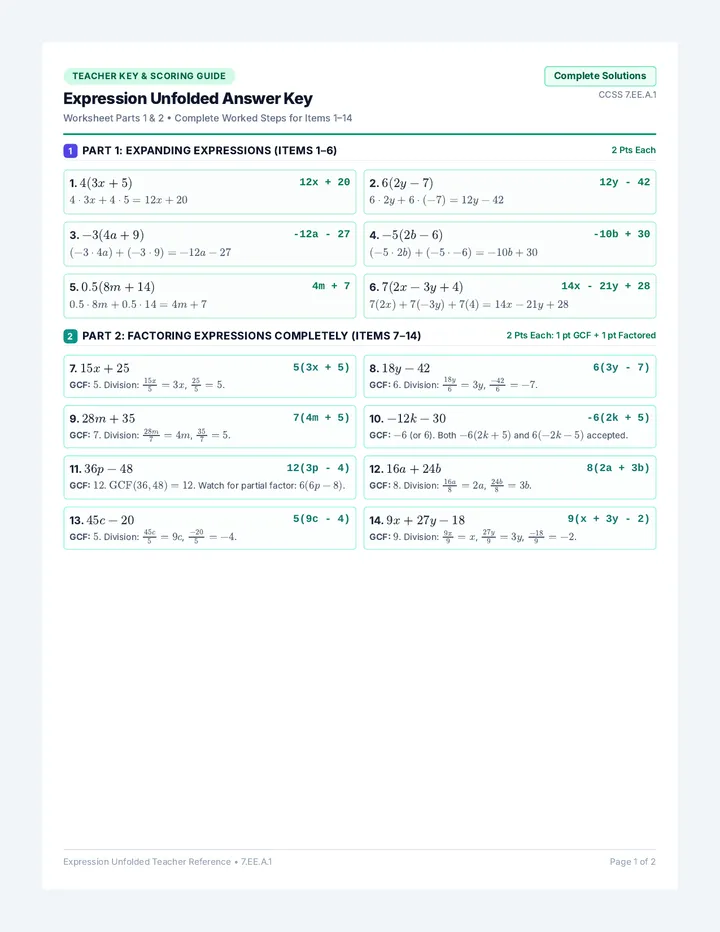
Master Answer Key
Full Solutions: Expression Transformers Worksheet
Teacher Reference Only
Part 1: Area Models & Expanding Solutions (Worksheet Page 1)
Model B: \(6(2y + 5)\)
Room 1: \(6 \cdot 2y = 12y\)
Expanded: \(12y + 30\)
1. Expand: \(7(3x + 4)\)
Steps: \(7 \cdot 3x + 7 \cdot 4\)
Answer: \(21x + 28\)
2. Expand: \(5(4a - 6)\)
Steps: \(5 \cdot 4a - 5 \cdot 6\)
Answer: \(20a - 30\)
3. Expand: \(-3(5m + 8)\)
Steps: \((-3)(5m) + (-3)(8)\)
Answer: \(-15m - 24\)
4. Expand: \(-8(2k - 7)\)
Steps: \((-8)(2k) - (-8)(7) = -16k - (-56) = -16k + 56\)
Answer: \(-16k + 56\) (Highlight: negative \(\times\) negative \(=\) positive)
Part 2: Factoring & Error Detective Solutions (Worksheet Page 2)
5. Factor: \(9x + 24\)
\(\text{GCF}(9, 24) = 3\); \(9x \div 3 = 3x\); \(24 \div 3 = 8\)
Answer: \(3(3x + 8)\)
6. Factor: \(20w - 35\)
\(\text{GCF}(20, 35) = 5\); \(20w \div 5 = 4w\); \(-35 \div 5 = -7\)
Answer: \(5(4w - 7)\)
7. Factor: \(16p + 40\)
\(\text{GCF}(16, 40) = 8\); \(16p \div 8 = 2p\); \(40 \div 8 = 5\)
Answer: \(8(2p + 5)\) (Note: \(4(4p+10)\) is only partially factored)
8. Factor: \(-14y - 21\)
Factor out \(-7\): \(-14y \div -7 = 2y\); \(-21 \div -7 = +3\)
Answer: \(-7(2y + 3)\)
Section 4: Marcus's Error Explained
Marcus only distributed the \(3\) to the first term (\(3 \cdot 4x = 12x\)) and forgot to multiply it by the second term \((-6)\). The correct expansion should be \(3 \cdot 4x - 3 \cdot 6 = \mathbf{12x - 18}\).
Exit Ticket Scoring Guide (2 Points Total) Quick 1-Minute Check
Q1: Expand \(-3(5x - 8)\)
Answer: \(-15x + 24\)
1 pt for correct sign on both terms. (Common incorrect answer: \(-15x - 24\)).
Q2: Factor \(14y + 35\)
Answer: \(7(2y + 5)\)
1 pt for identifying GCF \(= 7\) and dividing both terms accurately.
Expression Transformers • Grade 7 Algebra • Teacher Facilitation Guide & Key