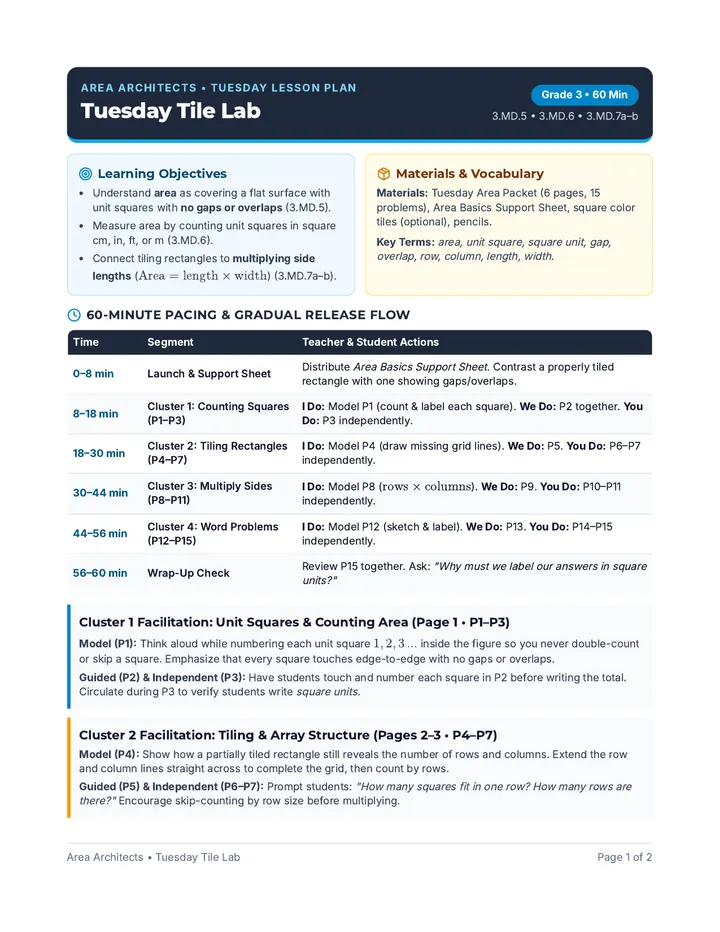
Expression Decoder Slides Grade 7 Math • 7.EE.A.2
UNIT: ALGEBRAIC THINKING
Expression Shape Shifters
How rewriting algebraic expressions in different forms reveals hidden truths about real-world quantities.
?
Essential Question: Why would a shopper write p - 0.20p while a cashier's scanner calculates 0.80p?
Equivalent Expressions in Problem Contexts
Slide 1 of 7
THE SNEAKER MYSTERY Slide 2 of 7
Maya's Receipt View
Focus on the discount
p - 0.25p
"Start with the full price p, then subtract the 25% discount (0.25p)."
Highlights the amount saved .
Cash Register Code
Focus on final cost
0.75p
"If you save 25%, you pay 75% of the original price directly in one single step."
Highlights the final portion paid .
Both expressions equal the exact same total: 1p - 0.25p = (1 - 0.25)p = 0.75p!
PERCENT INCREASE: SALES TAX & MARKUP Slide 3 of 7
A state charges 8% sales tax on item price \(p\)
How do we express the total cost at checkout?
Tape Diagram Representation:
Original Price: \(1.00p\) (100%)
Tax: \(0.08p\) (8%)
Base Item Cost Total Combined Length = \(1.08p\) (108%)
Form A: Additive (Two-Step)
\(p + 0.08p\)
Shows the base price plus the extra tax added on.
Form B: Multiplier (One-Step)
\(1.08p\)
Shows that the customer pays 108% of the original price directly.
Algebraic Bridge: \(p + 0.08p = (1 + 0.08)p = 1.08p\) using the Distributive Property!
PERCENT DECREASE: DISCOUNTS & MARKDOWNS Slide 4 of 7
A hoodie is on sale for 15% off regular price \(h\)
How do we model the discount and the sale price?
Tape Diagram Representation:
Sale Price You Pay: \(0.85h\) (85%)
15% Cut
Remaining Amount Paid = \(0.85h\) Discount = \(0.15h\)
Subtractive Form
\(h - 0.15h\)
Takes away the 15% discount amount from the full 100% price.
Complement Multiplier Form
\(0.85h\)
Multiplies by the complement percentage: \(100\% - 15\% = 85\%\).
Big Takeaway: "Decrease by \(15\%\)" means the exact same thing as "Multiply by \(0.85\)"!
GEOMETRY CONTEXT: RECTANGLE PERIMETER Slide 5 of 7
Three Ways to Write the Perimeter of a Rectangle
A garden has length \(l\) and width \(w\). What does each form highlight?
1
\(l + w + l + w\)
Walking all four sides one by one around the fence.
Perspective: Step-by-step path
2
\(2l + 2w\)
Grouping the two equal lengths together and the two equal widths together.
Perspective: Opposite sides paired
3
\(2(l + w)\)
Finding the sum of one length and one width (half perimeter), then doubling it.
Perspective: Half-perimeter doubled
Each algebraic form is equivalent, but each tells a different story about how the fence is constructed!
Notice how factoring \(2l + 2w \rightarrow 2(l + w)\) changes how we interpret the geometry!
PARTNER CHALLENGE: MATCH & INTERPRET Slide 6 of 7
What Real-World Story Does Each Expression Tell?
\(b + 0.18b = 1.18b\)
Restaurant bill \(b\) with an 18% tip
+18% Tip
\(p - 0.40p = 0.60p\)
Clearance shoes: 40% off original price
Pay 60%
\(x + 0.05x = 1.05x\)
Population or savings grew by 5%
+5% Growth
\(m - 0.05m = 0.95m\)
Store coupon gives a 5% discount
Pay 95%
Quick Discussion Prompt: Turn to your partner: Why is 1.05x an increase, but 0.95x a decrease? Where is the base \(1.00\) hidden?
Standard: 7.EE.A.2 Look for the benchmark: Is the multiplier greater or less than 1.00?
SUMMARY & BIG TAKEAWAYS Slide 7 of 7
Why Do Mathematicians Change Forms?
Expanded / Action Form
\(x + 0.08x\) or \(x - 0.20x\)
Shows the two distinct parts of the story
Highlights the exact dollar amount of the tax, tip, or discount
Great for receipts and auditing
Simplified / Multiplier Form
\(1.08x\) or \(0.80x\)
Calculates the final answer in one quick multiplication
Reveals the percentage of the original quantity you end up with
Great for mental math, algorithms, and computers
"Rewriting an expression doesn't change what it is worth—it changes what you can see!"
Ready for the Guided Practice Worksheet! Grab your pencil and ruler →
Expression Decoder Worksheet GRADE 7 MATHEMATICS • 7.EE.A.2 STUDENT ACTIVITY HANDOUT
Expression Decoder Worksheet Part 1
Rewriting expressions in different forms to reveal real-world relationships
Name:
Date:
Period:
1
Visual Anchor: The Two Faces of an Expression
Percent Increase (e.g., 6% Sales Tax)
Original: \(1.00p\) (100%)
+0.06p
• Action Form: \(p + 0.06p\) (Base price plus 6% tax)Multiplier Form: \(1.06p\) (Customer pays 106% of base)
Percent Decrease (e.g., 20% Discount)
You Pay: \(0.80d\) (80%)
-0.20d
• Action Form: \(d - 0.20d\) (Original minus 20% off)Multiplier Form: \(0.80d\) (Paying 80% remaining)
2
Complete the Expression Translation Matrix
Fill in the missing algebraic forms and explain what each form emphasizes.
Real-World Scenario
Action / Expanded Form
Single Multiplier Form
What Multiplier Tells Us
Add 7% sales tax to item cost \(c\)
\(c + 0.07c\)
\(1.07c\)
Customer pays 107% of base.
25% off coupon on shoes price \(s\)
\(s - 0.25s\)
Leave an 18% tip on dinner bill \(b\)
\(1.18b\)
Store marks up wholesale \(w\) by 40%
3
Guided Context Analysis
Problem 1: Smartphone Insurance
A phone plan's monthly rate \(m\) increases by 5% when accidental damage insurance is added.
a. Write two equivalent expressions for the new monthly payment:
Form 1:
b. How does Form 2 show that you pay more than the original rate?
Problem 2: Warehouse Clearance
A store manager writes \(0.65p\) to calculate the sale price of a coat originally priced at \(p\) dollars.
a. What percent discount is the customer receiving?
Discount percentage: %
b. Write an equivalent expression showing original price minus discount:
Unit 2: Expressions and Equations • Standard 7.EE.A.2 Page 1 of 2 • Turn over for Independent Practice
GRADE 7 MATHEMATICS • 7.EE.A.2 STUDENT ACTIVITY HANDOUT
Expression Decoder Worksheet Part 2
Independent Application, Geometry Connections, and Error Analysis
Student Name: ______________
4
Decode the Real-World Scenarios
Scenario A: The Bistro Check
Marcus has a food bill of \(f\) dollars. He must pay an 8% city tax and chooses to add a 15% server tip.
Multi-Step
1. Write an expanded expression with all 3 parts:
2. Combine like terms into a single multiplier:
3. What does your combined multiplier reveal about the total cost relative to the food bill?
Scenario B: Rectangular Dog Pen
A rectangular dog run has width \(w\). Its length is 4 feet longer than its width (\(w + 4\)).
Geometry
Form 1: All 4 Sides
\(w + (w+4) + w + (w+4)\)
Walking along each fence side.
Form 2: Pairs of Sides
\(2w + 2(w + 4)\)
Doubling width and length.
Form 3: Fully Simplified
Write form \(Aw + B\) above.
What does the constant term in Form 3 tell you about the perimeter compared to a square of width \(w\)?
5
Mathematical Critique: Whose Reasoning Makes Sense?
Two students were asked to write an expression for "the price of an item \(x\) after a 30% discount."
Leo's Expression:
\(x - 0.30\)
"I took price \(x\) and subtracted 30% written as decimal 0.30."
Chloe's Expression:
\(0.70x\)
"If you save 30%, you still pay 70% of the price, so \(0.70x\)."
Identify who is correct and explain the error in the other student's expression:
6
Synthesis: Cashier vs. Customer Perspective
A grocery scanner calculates 20% off by multiplying item price \(p\) by \(0.80p\) . However, the printed customer receipt shows \(p - 0.20p\) .
Why does the register computer prefer \(0.80p\), while the customer prefers to see \(p - 0.20p\)?
Unit 2: Expressions and Equations • Standard 7.EE.A.2 Page 2 of 2 • Expression Shape Shifters
Expression Decoder Teacher Guide GRADE 7 MATHEMATICS • DOMAIN: EXPRESSIONS & EQUATIONS TEACHER FACILITATION GUIDE
Expression Shape Shifters 7.EE.A.2
Rewriting algebraic expressions in different forms to shed light on problem context
Pacing: 50 Minutes Tier 1 Core Instruction
1
Standards & Instructional Objectives
Target Standard (CCSS 7.EE.A.2):
Understand that rewriting an expression in different forms in a problem context can shed light on the problem and how the quantities in it are related. Example: \(a + 0.05a = 1.05a\) shows that "increase by 5%" is the same as "multiply by 1.05."
Learning Targets & Success Criteria:
I can rewrite two-step percent expressions as a single product.I can explain what each term and coefficient represents in context.I can connect geometric perimeter forms to different ways of measuring.
2
Lesson Arc & Suggested Pacing (50 Minutes)
Hook (8 min)
Slides 1–2: Present Sneaker Mystery. Contrast receipt vs. scanner expressions.
Direct Model (15 min)
Slides 3–5: Tape diagrams for tax, discount, and rectangle perimeter. Distributive Property bridge.
Guided Practice (12 min)
Worksheet Page 1: Translation matrix and context analysis. Turn-and-talk check.
Apply & Debrief (15 min)
Worksheet Page 2: Error analysis & synthesis. Whole-class debrief on Slide 7.
3
Common Misconceptions & Targeted Teacher Talk Moves
Misconception 1: Subtracting Flat Dollars Instead of Percent of Variable Error: x - 0.20 instead of x - 0.20x
Teacher Talk Move: "If a $100 coat is 20% off, do you save 20 cents or 20 dollars? Where does the dollar amount come from? The discount depends on the price \(x\), so it must be \(0.20\) times \(x\)!"
Misconception 2: Confusing Multiplier with Percentage Kept vs. Removed Error: Thinking 25% off means multiplying by 0.25
Teacher Talk Move: "Multiplying by \(0.25\) calculates the savings , not the final register price! To find what you hand to the cashier, what fraction of the 100% is still left? \(100\% - 25\% = 75\%\), so you pay \(0.75p\)."
Misconception 3: Decimal Place Value Shift on Single-Digit Percents Error: Writing 5% tax as 1.5x instead of 1.05x
Teacher Talk Move: "Notice what \(1.5x\) means: that's 150%, or a 50% price hike! Remember percent means 'per hundred': \(5\% = \frac{5}{100} = 0.05\), making the total \(1.05x\)."
4
Tiered Differentiation Strategies
Support / Striving Learners
Substitute \(x = 100\) first so students test both forms numerically. Use highlighters to color-code base (blue) and change (orange).
Multilingual Learners (EL)
Provide sentence starter: "The number 1 represents ___, while the decimal represents ___." Maintain bilingual tape diagrams on anchor chart.
Extension / Advanced
Investigate successive operations: Does a 20% discount followed by 8% tax equal \(0.80(1.08p)\) or \((1.08)(0.80p)\)? Prove equality.
Unit 2: Expressions and Equations • Standard 7.EE.A.2 Page 1 of 2 • Facilitation & Standards
EXPRESSION DECODER • STANDARD 7.EE.A.2 OFFICIAL ANSWER KEY & EXEMPLAR RESPONSES
Teacher Answer Key & Scoring Rubric Complete Key
Sample student responses, algebraic rationale, and scoring criteria
EVALUATION GUIDE
2
Part 2: Translation Matrix Key
• Row 2 (25% off shoes): \(s - 0.25s\) \(0.75s\) Customer pays 75% of original price.
• Row 3 (18% dinner tip): \(b + 0.18b\) \(1.18b\) Customer pays 118% of original bill.
• Row 4 (40% markup): \(w + 0.40w\) \(1.40w\) Retail price is 140% of wholesale cost.
3
Part 3: Guided Context Analysis Key
Problem 1: Smartphone Insurance
a. Form 1: \(m + 0.05m\); Form 2: \(1.05m\)
b. In \(1.05m\), the multiplier is greater than \(1.00\), which means the cost is 105% of base \(m\), an increase of 5%.
Problem 2: Warehouse Clearance
a. Discount is 35% (because \(1.00 - 0.65 = 0.35\)).
b. Equivalent subtractive expression: \(p - 0.35p\) (original price minus 35% discount).
4
Part 4: Real-World Scenarios Key
Scenario A: The Bistro Check
1. Expanded: \(f + 0.08f + 0.15f\)
2. Combined: \(1.23f\) (since \(1 + 0.08 + 0.15 = 1.23\))
3. Insight: The total check will be exactly 123% of the food price, adding a total extra 23% for tax and tip combined.
Scenario B: Dog Pen Geometry
Form 3: \(4w + 8\)
Insight: A square of width \(w\) has perimeter \(4w\). The constant term \(+8\) reveals that extending the two lengths by 4 feet each adds exactly 8 total feet of fencing.
5
Parts 5 & 6: Error Analysis & Synthesis Exemplars
Part 5 Error Analysis: Chloe is Correct
Exemplar: "Chloe is right because saving 30% leaves 70% of the price: \(x - 0.30x = 0.70x\). Leo's expression \(x - 0.30\) subtracts a flat 30 cents ($0.30) instead of 30% of the price. You cannot combine unlike terms when one has a variable and the other doesn't."
Part 6 Synthesis: Scanner vs. Receipt
Exemplar: "The computer scanner prefers \(0.80p\) because it calculates the total in a single efficient multiplication step. The customer prefers \(p - 0.20p\) because it explicitly shows both the original price and the exact discount amount, confirming they actually received the sale discount."
Standard 7.EE.A.2 Quick Mastery Rubric:
Level 3 (Mastery): Rewrites between forms accurately and provides explicit context-based explanations for coefficients and constants.
Level 2 (Developing): Can calculate single multiplier (e.g. \(1.08p\)) but struggles to explain what the parts mean in real-world words.
Level 1 (Novice): Confuses flat constants with percent rates (\(x - 0.20\)) or misplaces decimal points (\(1.5\) for 5%). Needs Tier 2 support.
Unit 2: Expressions and Equations • Standard 7.EE.A.2 Page 2 of 2 • Answer Key & Rubric