Equation Mad Libs Worksheet
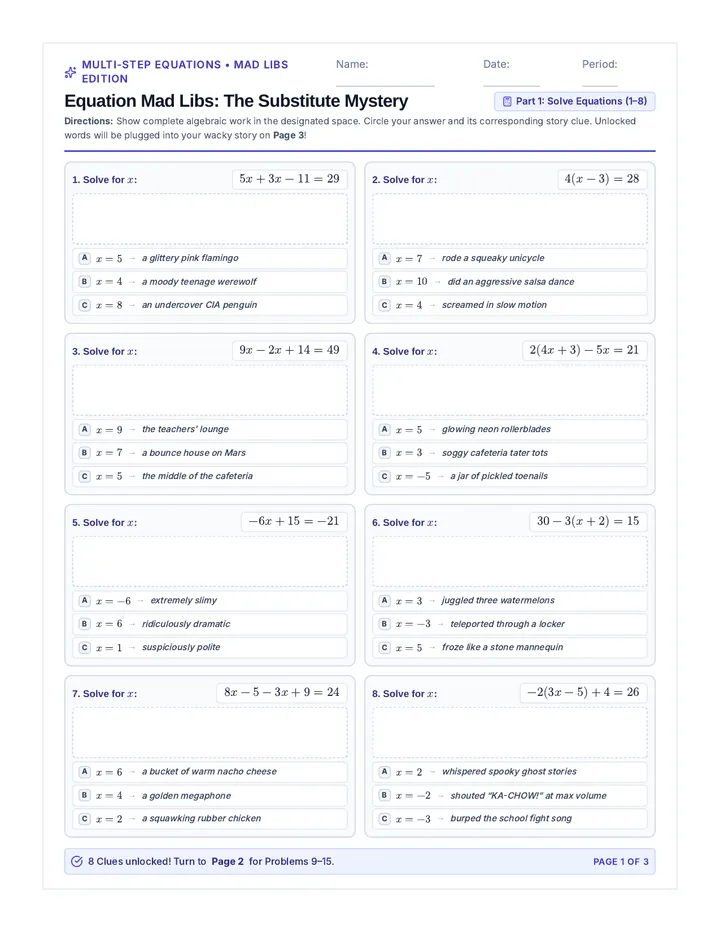
Multi-Step Equations • Mad Libs Edition
Name: Date: Period:
Equation Mad Libs: The Substitute Mystery
Part 1: Solve Equations (1–8)
Directions: Show complete algebraic work in the designated space. Circle your answer and its corresponding story clue. Unlocked words will be plugged into your wacky story on Page 3!
1. Solve for \(x\): \(5x + 3x - 11 = 29\)
A \(x = 5\) → a glittery pink flamingo
B \(x = 4\) → a moody teenage werewolf
C \(x = 8\) → an undercover CIA penguin
2. Solve for \(x\): \(4(x - 3) = 28\)
A \(x = 7\) → rode a squeaky unicycle
B \(x = 10\) → did an aggressive salsa dance
C \(x = 4\) → screamed in slow motion
3. Solve for \(x\): \(9x - 2x + 14 = 49\)
A \(x = 9\) → the teachers' lounge
B \(x = 7\) → a bounce house on Mars
C \(x = 5\) → the middle of the cafeteria
4. Solve for \(x\): \(2(4x + 3) - 5x = 21\)
A \(x = 5\) → glowing neon rollerblades
B \(x = 3\) → soggy cafeteria tater tots
C \(x = -5\) → a jar of pickled toenails
5. Solve for \(x\): \(-6x + 15 = -21\)
A \(x = -6\) → extremely slimy
B \(x = 6\) → ridiculously dramatic
C \(x = 1\) → suspiciously polite
6. Solve for \(x\): \(30 - 3(x + 2) = 15\)
A \(x = 3\) → juggled three watermelons
B \(x = -3\) → teleported through a locker
C \(x = 5\) → froze like a stone mannequin
7. Solve for \(x\): \(8x - 5 - 3x + 9 = 24\)
A \(x = 6\) → a bucket of warm nacho cheese
B \(x = 4\) → a golden megaphone
C \(x = 2\) → a squawking rubber chicken
8. Solve for \(x\): \(-2(3x - 5) + 4 = 26\)
A \(x = 2\) → whispered spooky ghost stories
B \(x = -2\) → shouted “KA-CHOW!” at max volume
C \(x = -3\) → burped the school fight song
8 Clues unlocked! Turn to Page 2 for Problems 9–15. Page 1 of 3
Special Cases • Mad Libs Edition
Name: Period:
Special Cases & Final Clues (9–15)
Part 2: Solve & Classify
9. Solve for \(x\): \(5(2x - 1) - 7 = 28\)
A \(x = 4\) → the school principal
B \(x = 3\) → a runaway cafeteria robot
C \(x = -4\) → the state arm-wrestling champ
10. Classify Equation: \(6(2x - 1) = 12x - 6\)
A One Solution → cried tears of purple glitter
B No Solution → escaped through ceiling vents
C Infinitely Many → threw confetti in everyone's hair
11. Classify Equation: \(7x + 10 = 7x - 4\)
A No Solution → a high-powered leaf blower
B One Solution → a giant pepperoni pizza
C Infinitely Many → a box of hyperactive hamsters
12. Classify Equation: \(5x - 8 = 2x + 13\)
A No Solution → blasted retro disco music
B One Solution → declared a mandatory nap time
C Infinitely Many → ordered 500 breakfast burritos
13. Classify Equation: \(4x + 9 - x = 3x + 15\)
A Infinitely Many → in an alien flying saucer
B One Solution → under a pile of algebra tests
C No Solution → on a motorized skateboard
14. Classify Equation: \(2(3x + 5) = 6x + 10\)
A Infinitely Many → a lifetime supply of spicy chips
B One Solution → weekend homework forever
C No Solution → a miniature pet velociraptor
15. Classify Equation: \(-4x + 6 = -4x - 8\)
A One Solution → never return on a Tuesday
B Infinitely Many → turn gym into a water park
C No Solution → officially adopt the school mascot
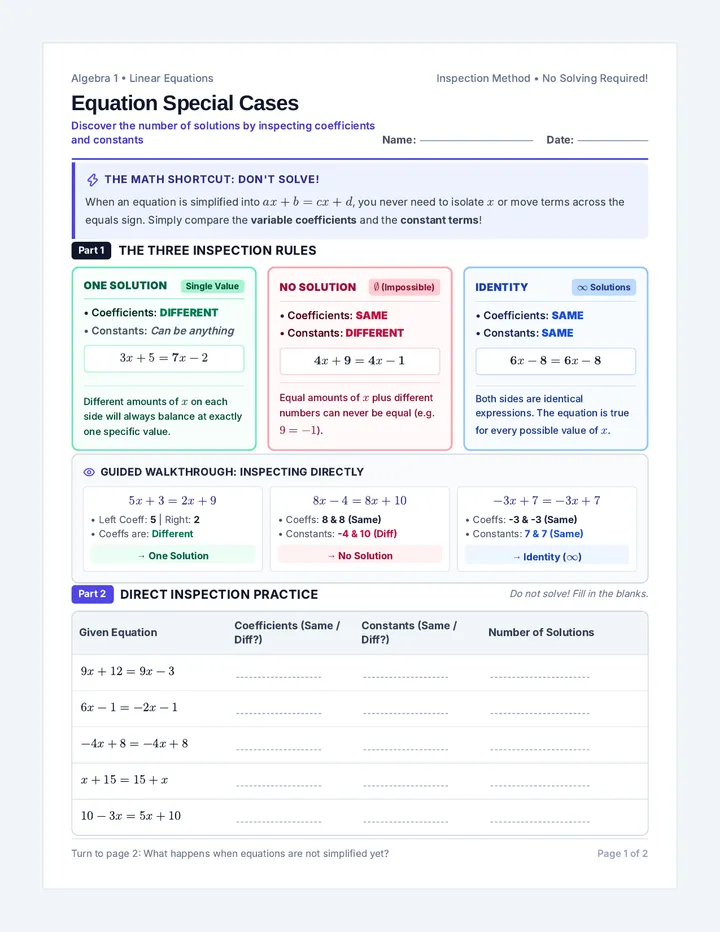
Inspector Reference Rulebook
One Solution: Different \(x\) coefficients (\(a \neq c\)). Lines intersect once.
No Solution: Same \(x\) coefficients, different constants (\(b \neq d\)). False!
Infinitely Many (Identity): Identical variables and constants (\(a=c, b=d\)).
Simplify both sides fully before classifying!
All 15 Clues Unlocked! Flip to Page 3 to reveal your crazy story! Page 2 of 3
The Big Reveal • Page 3
Name: Period:
The Unforgettable Substitute Takeover
Part 3: Read Your Masterpiece
Clue Bank (Transfer your 15 unlocked words/phrases from Pages 1 & 2):
1:
2:
3:
4:
5:
6:
7:
8:
9:
10:
11:
12:
13:
14:
15:
“The Strangest Sub Ever: A True Middle School Mystery”
Fill in each blank with your corresponding clue number!
It was an ordinary Tuesday during third period when suddenly, our substitute teacher arrived disguised as [Clue #1] . Without saying a single word of greeting to the class, they leaped to the front and immediately [Clue #2] right in [Clue #3] ! Everyone dropped their pencils in absolute disbelief.
To make matters wilder, the substitute reached into a suitcase, strapped on a pair of [Clue #4] , and looked [Clue #5] . They glided across the classroom floor, skillfully [Clue #6] , and pulled out [Clue #7] . At the top of their lungs, they [Clue #8] !
Suddenly, [Clue #9] burst through the doorway! Instead of getting upset, they smiled broadly and [Clue #10] . The substitute pulled out [Clue #11] and officially [Clue #12] !
As the afternoon bell rang, our wild sub escaped out the window [Clue #13] , leaving every single student with [Clue #14] . Before vanishing, they pledged to [Clue #15] !
Illustrate the Scene: Draw your crazy sub in action!
Sub Day Wrap-Up & Reflection:
1. Story Hilarity Rating: ☆ ☆ ☆ ☆ ☆
2. Which problem was the trickiest to solve or classify?
3. What rule tells you immediately an equation has NO solution?
Turn in all 3 pages before leaving class!
Equation Mad Libs • Algebra 1 Page 3 of 3
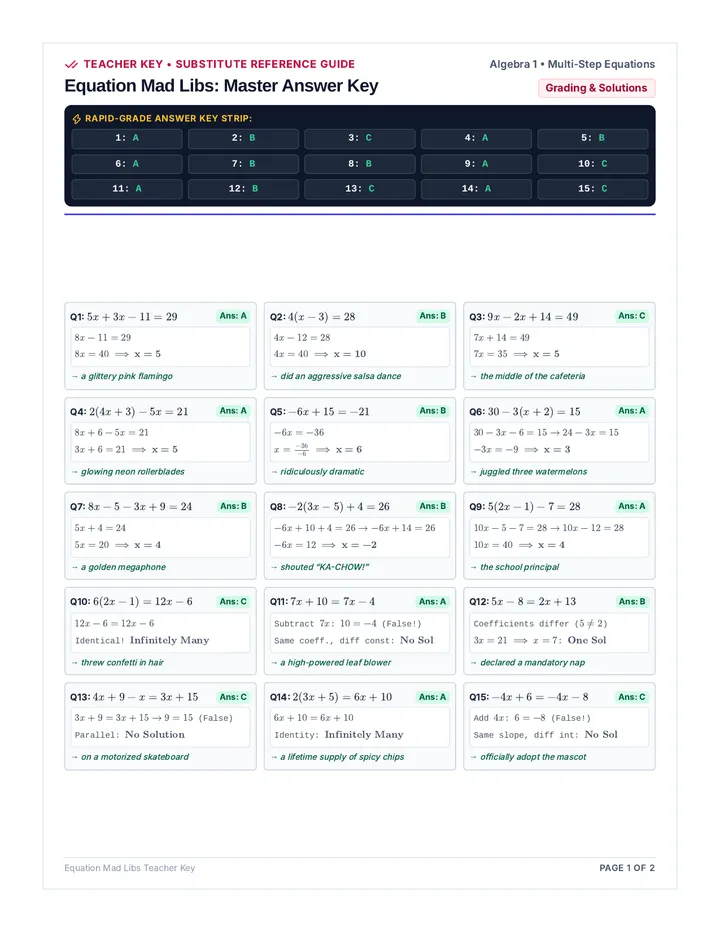
Equation Mad Libs Answer Key
Teacher Key • Substitute Reference Guide Algebra 1 • Multi-Step Equations
Equation Mad Libs: Master Answer Key
Grading & Solutions
Rapid-Grade Answer Key Strip:
1: A
2: B
3: C
4: A
5: B
6: A
7: B
8: B
9: A
10: C
11: A
12: B
13: C
14: A
15: C
Q1: \(5x + 3x - 11 = 29\) Ans: A
\(8x - 11 = 29\)
\(8x = 40 \implies \mathbf{x = 5}\)
→ a glittery pink flamingo
Q2: \(4(x - 3) = 28\) Ans: B
\(4x - 12 = 28\)
\(4x = 40 \implies \mathbf{x = 10}\)
→ did an aggressive salsa dance
Q3: \(9x - 2x + 14 = 49\) Ans: C
\(7x + 14 = 49\)
\(7x = 35 \implies \mathbf{x = 5}\)
→ the middle of the cafeteria
Q4: \(2(4x + 3) - 5x = 21\) Ans: A
\(8x + 6 - 5x = 21\)
\(3x + 6 = 21 \implies \mathbf{x = 5}\)
→ glowing neon rollerblades
Q5: \(-6x + 15 = -21\) Ans: B
\(-6x = -36\)
\(x = \frac{-36}{-6} \implies \mathbf{x = 6}\)
→ ridiculously dramatic
Q6: \(30 - 3(x + 2) = 15\) Ans: A
\(30 - 3x - 6 = 15 \rightarrow 24 - 3x = 15\)
\(-3x = -9 \implies \mathbf{x = 3}\)
→ juggled three watermelons
Q7: \(8x - 5 - 3x + 9 = 24\) Ans: B
\(5x + 4 = 24\)
\(5x = 20 \implies \mathbf{x = 4}\)
→ a golden megaphone
Q8: \(-2(3x - 5) + 4 = 26\) Ans: B
\(-6x + 10 + 4 = 26 \rightarrow -6x + 14 = 26\)
\(-6x = 12 \implies \mathbf{x = -2}\)
→ shouted “KA-CHOW!”
Q9: \(5(2x - 1) - 7 = 28\) Ans: A
\(10x - 5 - 7 = 28 \rightarrow 10x - 12 = 28\)
\(10x = 40 \implies \mathbf{x = 4}\)
→ the school principal
Q10: \(6(2x - 1) = 12x - 6\) Ans: C
\(12x - 6 = 12x - 6\)
Identical! \(\mathbf{Infinitely\ Many}\)
→ threw confetti in hair
Q11: \(7x + 10 = 7x - 4\) Ans: A
Subtract \(7x\): \(10 = -4\) (False!)
Same coeff., diff const: \(\mathbf{No\ Sol}\)