Steepness Secrets Lesson Plan 8th Grade Math • Linear Relationships
Steepness Secrets: Intro to Slope
Scaffolded 40-Minute Lesson Plan • Tier 2 / Approaching Grade Level Support
Total Duration: 40 Mins
Standards: CCSS.MATH.8.EE.B.5
Objective
Students will identify slope as \(\frac{\text{rise}}{\text{run}}\), count vertical and horizontal change on a grid, and categorize lines as positive, negative, zero, or undefined.
Materials Needed
Slope Step Slides
2-Page Guided Worksheet
Colored highlighters (2 colors)
Individual whiteboards (optional)
Key Metaphor
"The Staircase Rule" : You must stand up before you walk forward (Rise over Run). We always read graphs from left to right, like reading a sentence.
Pacing & Instructional Steps
00 - 05 min Warm-Up & Visual Hook: The Ramp Challenge
Slides 1 - 2
Teacher Action: Display Slide 2 with two ramps (Ramp A: 6 ft tall, 6 ft wide; Ramp B: 6 ft tall, 2 ft wide). Ask: "Which ramp is harder to push a heavy cart up? Why?"
Student Discussion: Turn-and-talk for 60 seconds. Students describe Ramp B as "steeper." Connect student language to math: Slope = Steepness .
Check for Understanding: Cold-call 2 students: "What makes Ramp B steeper if they both have the same height?" (Listen for: It climbs the height in a shorter distance).
05 - 15 min Direct Instruction: Rise Over Run & The 4 Slope Types
Slides 3 - 5 • Worksheet Part 1
1. The Formula: Introduce \(\text{Slope} = \frac{\text{Vertical Change}}{\text{Horizontal Change}} = \frac{\text{Rise}}{\text{Run}}\). Have students repeat: "Rise is up/down, Run is left to right!"
2. Color Coding: Instruct students to use Blue for Rise (vertical) and Green for Run (horizontal) on their guided notes.
3. The 4 Types (Mr. Slope Guy): Show lines moving left to right: Uphill = Positive (+), Downhill = Negative (−), Flat floor = Zero (0), Vertical cliff = Undefined (NO!).
Choral Response: Point to each slope type on slide; call out: "Class, as we read left to right, this line goes uphill, so the slope is...?" (Class: "POSITIVE!").
Steepness Secrets • Teacher Lesson Plan Page 1 of 2
Lesson Execution & Scaffolded Interventions
Steepness Secrets (40 Mins)
15 - 25 min Guided Practice: Counting on the Coordinate Grid
Slides 6 - 8 • Worksheet Part 2 & 3
I Do / We Do Modeling: Model finding the slope between \((1, 2)\) and \((4, 8)\). Demonstrate drawing the "slope triangle" (rise up 6 units in blue, run right 3 units in green). Show simplifying \(\frac{6}{3} = 2\).
Model a Negative Slope: Emphasize that when moving from the leftmost point down to the next point, the rise is negative: \(\frac{-3}{4}\). "Down is negative!"
Check for Understanding: Ask pairs to complete Problem 1 together. Circulate with "Stop & Check" stamp: verify the rise is on top before students simplify.
25 - 35 min Scaffolded Independent Practice & Small Group Support
Worksheet Part 4 & 5
Students work individually or in partner pairs on tiered grid exercises:
Level 1 (Direct Count): Pre-drawn triangle lines; students count grid units.Level 2 (Independent Triangle): Points plotted; students connect dots, build triangle, calculate ratio.Level 3 (Zero vs. Undefined Challenge): Distinguish horizontal flat lines from vertical cliffs.
Teacher Table: Pull 4-6 students struggling with fraction setup or negative signs for guided counting with physical finger tracing.
35 - 40 min Synthesize & Exit Ticket
Worksheet Part 6
Students independently complete the 2-question Exit Ticket. Prompt: "Can a slope be negative? How do you know just by glancing at the line from left to right?" Collect sheets at the door for immediate formative sorting.
Top Misconceptions & Fixes
1. Putting Run over Rise (\(\frac{x}{y}\)):
Correction: Chant "Elevator before hallway" or "Stand up before you walk." Have them highlight Rise in blue first.
2. Reading Right-to-Left:
Correction: Place a physical pencil on the leftmost point. Slide rightward to see if you climb up or slide down.
3. Confusing 0 and Undefined:
Correction: Zero slope is walking flat \(\frac{0}{\text{Run}} = 0\); Undefined is falling off a cliff \(\frac{\text{Rise}}{0} = \text{NO!}\).
Targeted Scaffolds (Tier 2)
Physical Tracing:
Allow students to count grid squares by drawing "steps" like stairs rather than abstract numbers.
Formula Fill-in Frames:
The worksheet provides pre-formatted fraction bars: \(\text{Slope} = \frac{\boxed{\phantom{0}}}{\boxed{\phantom{0}}}\) to eliminate layout confusion.
Extension for Early Finishers:
Ask students to draw two different lines on coordinate grids that both have a slope of \(\frac{1}{2}\) to discover parallel lines.
Steepness Secrets • Teacher Lesson Plan Page 2 of 2
Slope Step Slides 8th Grade Mathematics
Steepness Secrets
Mastering the math behind hills, ramps, and lines: What is slope and how do we measure it?
Rise Over Run Coordinate Grids
Standard: 8.EE.B.5
Hook
The Skateboard Ramp Dilemma
Turn & Talk (60 Seconds)
Ramp A (Gentle)
Horizontal Distance: 12 feet Height: 4 ft
Climbs 4 feet across a long 12-foot stretch
Ramp B (Extreme)
Distance: 4 feet Height: 4 ft
Climbs 4 feet across only 4 feet!
Which ramp is harder to skate up? In everyday words, we call it steeper . In math, we call it SLOPE !
Concept
What is Slope?
Slope is a number that describes both the steepness and the direction of a line.
RISE Vertical change (Goes UP \((+)\) or DOWN \((-)\))
RUN Horizontal change (Goes RIGHT \((+)\))
The Master Formula
\(\text{Slope} = \frac{\text{Rise}}{\text{Run}}\)
Memory Trick: "Stand up (Rise) before you run out the door (Run)!"
Golden Rule: In math, we ALWAYS read graphs from LEFT to RIGHT!
Classification
The 4 Types of Slope
Read from Left → Right
POSITIVE (+)
Climbing UP
Uphill climb
NEGATIVE (−)
Falling DOWN
Downhill slide
ZERO (0)
Flat Horizontal
Walking on flat ground
UNDEFINED
Vertical Cliff
Cannot ski or drive!
Quick Check: A horizontal sidewalk has a slope of 0 . A vertical elevator shaft is undefined !
How-To
How to Find Slope on a Grid (3 Steps)
1
Pick 2 Points
Find two points that cross the grid lines cleanly at whole numbers (crosshairs).
Start at the left point!
2
Count the RISE
Count vertical squares to reach the level of point 2.
• UP = Positive \((+)\)
• DOWN = Negative \((-)\)
Rise goes on top!
3
Count the RUN
Count horizontal squares moving right to meet the point.
Always count to the
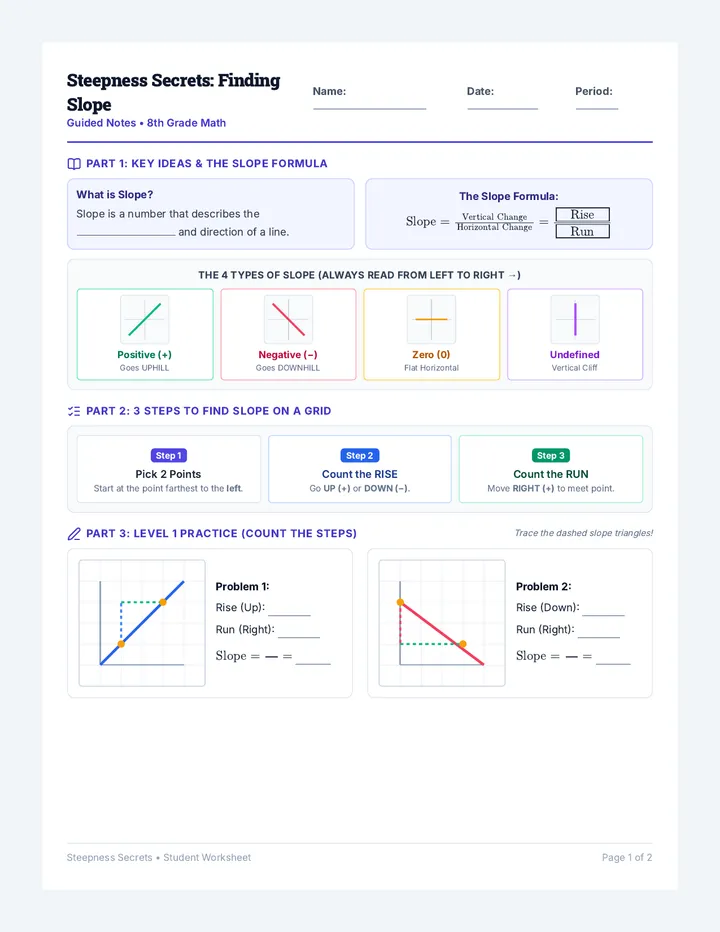
Slope Steps Worksheet Steepness Secrets: Finding Slope
Guided Notes • 8th Grade Math
Name:
Date:
Period:
Part 1: Key Ideas & The Slope Formula
What is Slope?
Slope is a number that describes the and direction of a line.
The Slope Formula:
\(\text{Slope} = \frac{\text{Vertical Change}}{\text{Horizontal Change}} = \frac{\boxed{\text{\phantom{M}Rise\phantom{M}}}}{\boxed{\text{\phantom{M}Run\phantom{M}}}}\)
The 4 Types of Slope (Always read from Left to Right →)
Positive (+) Goes UPHILL
Negative (−) Goes DOWNHILL
Zero (0) Flat Horizontal
Undefined Vertical Cliff
Part 2: 3 Steps to Find Slope on a Grid
Step 1
Pick 2 Points
Start at the point farthest to the left .
Step 2
Count the RISE
Go UP (+) or DOWN (−) .
Step 3
Count the RUN
Move RIGHT (+) to meet point.
Part 3: Level 1 Practice (Count the Steps)
Trace the dashed slope triangles!
Problem 1:
Rise (Up):
Run (Right):
\(\text{Slope} = \frac{\phantom{00}}{\phantom{00}} =\)
Problem 2:
Rise (Down):
Run (Right):
\(\text{Slope} = \frac{\phantom{00}}{\phantom{00}} =\)
Steepness Secrets • Student Worksheet Page 1 of 2
Part 4: Level 2 Independent Practice
Draw your own slope triangle between the marked points.
Rise ÷ Run
Problem 3:
Rise: Run:
\(\text{Slope} = \frac{\phantom{0}}{\phantom{0}} =\)
Problem 4:
Rise: Run:
\(\text{Slope} = \frac{\phantom{0}}{\phantom{0}} =\)
Problem 5:
Rise: Run:
\(\text{Slope} = \frac{\phantom{0}}{\phantom{0}} =\)
Part 5: Classifying Slope Types
Graph A
Graph B
Graph C
Graph D
Part 6: Steepness Showdown — Which is Steeper?
Rule: Greater distance from 0 = Steeper line!
For each pair of slopes below, circle the steeper slope and briefly write why:
Pair 1:
Slope = 5 Slope = 2
Why is it steeper?
Pair 2:
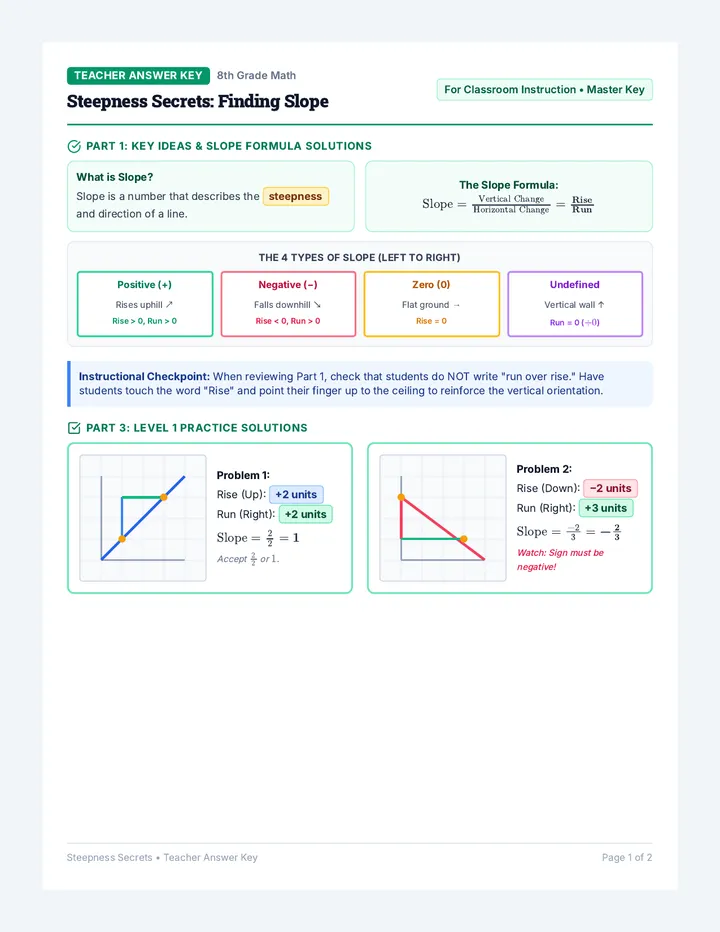
Slope Steps Answer Key Teacher Answer Key 8th Grade Math
Steepness Secrets: Finding Slope
For Classroom Instruction • Master Key
Part 1: Key Ideas & Slope Formula Solutions
What is Slope?
Slope is a number that describes the steepness and direction of a line.
The Slope Formula:
\(\text{Slope} = \frac{\text{Vertical Change}}{\text{Horizontal Change}} = \frac{\mathbf{Rise}}{\mathbf{Run}}\)
The 4 Types of Slope (Left to Right)
Positive (+) Rises uphill ↗ Rise > 0, Run > 0
Negative (−) Falls downhill ↘ Rise < 0, Run > 0
Zero (0) Flat ground → Rise = 0
Undefined Vertical wall ↑ Run = 0 (\(\div 0\))
Instructional Checkpoint: When reviewing Part 1, check that students do NOT write "run over rise." Have students touch the word "Rise" and point their finger up to the ceiling to reinforce the vertical orientation.
Part 3: Level 1 Practice Solutions
Problem 1:
Rise (Up): +2 units
Run (Right): +2 units
\(\text{Slope} = \frac{2}{2} = \mathbf{1}\)
Accept \(\frac{2}{2}\) or \(1\).
Problem 2:
Rise (Down): −2 units
Run (Right): +3 units
\(\text{Slope} = \frac{-2}{3} = \mathbf{-\frac{2}{3}}\)
Watch: Sign must be negative!
Steepness Secrets • Teacher Answer Key Page 1 of 2
Part 4 & 5: Practice & Classification Solutions
Teacher scoring guide with accepted variations.
Fully Worked Solutions
Problem 3: (Uphill)
Rise: +2 • Run: +2
\(\text{Slope} = \frac{2}{2} = \mathbf{1}\)
Climbs 1 unit up for every 1 right.
Problem 4: (Downhill)
Rise: −2 • Run: +2
\(\text{Slope} = \frac{-2}{2} = \mathbf{-1}\)
Must be negative.
Problem 5: (Gentle)
Rise: +1 • Run: +3
\(\text{Slope} = \mathbf{\frac{1}{3}}\)
Keep as simplified fraction.
Part 5: Classification Answers
Graph A Negative
Graph B Zero
Graph C Positive
Graph D Undefined
Part 6: Steepness Showdown Solutions & Explanations
Key Rule: Larger |Slope| = Steeper Line
Pair 1: Slope 5 vs. 2
Slope = 5 is steeper