Cargo Division Slides
Grade 5 Math • 5.NBT.6
Expedition Logistics Base
Division Word Problems with 2-Digit Divisors
Cargo Division Quest
Calculate cargo distribution, master multi-digit division strategies, and decode real-world remainders like chief navigators.
1. Estimate Quotients
2. Divide with Confidence
3. Interpret Remainders
The Navigator's Compass: Compatible Numbers
Step 1: Estimate First
Why Estimate?
Guard Against Errors
Before diving into complex long division, change the numbers into friendly multiples that divide mentally.
Target Problem:
\( 748 \div 24 \)
Estimation In Action
A
Round divisor to nearest 10:
\( 24 \rightarrow 20 \)
B
Find compatible dividend for 20:
\( 748 \rightarrow 800 \text{ or } 700 \)
Mental Math Check:
\( 800 \div 20 = 40 \)
Our actual quotient should be near 30 - 40!
If your final calculated answer is 300 or 3, your estimate alerts you instantly!
What Does the Remainder Mean?
Critical Thinking
1. Round Up (+1)
When everyone or everything must be included (buses, boats, shipping boxes).
Ex: 50 people, 12 per van → Need 5 vans!
2. Drop It (Quotient Only)
When the question asks for complete packages or full sets made.
Ex: 75 wheels, 16 per train → 4 full trains.
3. Remainder is the Answer
When the question asks how many are left over or unpackaged.
Ex: 75 wheels → 11 leftover wheels.
4. Express as Fraction/Decimal
When items can be cut or divided (pizza, wire, fuel, distance).
Ex: 25 liters ÷ 10 engines = 2 ½ liters each.
Always ask: “What is the question asking me to count?”
Mission 1: Solar Panel Shipment
Guided Practice
The Mission
A marine research harbor receives 864 solar panels. Technicians pack exactly 24 panels into each waterproof container. How many full containers can they pack?
Mental Estimation:
\( 864 \div 24 \approx 800 \div 20 = 40 \)
Partial Quotients Method
Step 1: Big chunk (30 × 24)
864 - 720 = 144
Chunk: 30 containers
Step 2: Remaining (6 × 24)
144 - 144 = 0
Chunk: 6 containers
Combine Quotients:
30 + 6 = 36 full containers
Remainder: 0 (No panels left behind)
Check with Estimate: 36 is very close to our estimate of 40!
Key Takeaway: When remainder is 0, the quotient directly provides the complete answer.
Mission 2: Island Transport Shuttles
Round Up Challenge
The Mission
There are 520 explorers ready to depart. Each boat can safely carry 35 passengers. How many boats are needed to transport ALL explorers?
Division Calculation:
\( 520 \div 35 = 14 \text{ R } 30 \)
Interpreting the Result
What does the 14 mean?
14 boats will be completely filled (490 people).
What does the remainder 30 mean?
30 explorers are still standing on the dock!
Final Decision: Round Up!
14 + 1 = 15 boats are needed
The 15th boat carries the remaining 30 passengers.
Crucial Question: Can we leave 30 people behind? No! Therefore, round up to 15.
The Navigator's 4-Step Solving Protocol
Strategy Blueprint
1
READ & ESTIMATE
Identify dividend and divisor. Use compatible numbers for a quick mental benchmark.
“About how big?”
2
CHOOSE STRATEGY
Use Partial Quotients (easy friendly chunks) or Standard Algorithm to find quotient & remainder.
Chunk 10s, 5s, 2s
3
INTERPRET
Re-read question carefully. Do we round up, drop it, keep remainder, or make a fraction?
Check the question goal
4
LABEL & CHECK
Write your answer with full units. Compare with your initial estimate to verify sanity.
Does it make sense?
Remember: Every number in your division has physical meaning!
Cargo Quest Worksheet Launch
Mission Active
Section A & B
Harbor Operations
Warm-up estimations and standard crate loading problems. Show all partial quotient work.
Section C
Deep-Sea Logistics
Word problems with remainders. Explicitly circle your remainder interpretation choice.
Section D
Spot the Blunder
Analyze a fellow navigator's common division mistake and write the corrected solution.
Work collaboratively with your navigation partner. Defend your remainder decisions!
Target Time: 25 Minutes
Cargo Division Worksheet
5th Grade Mathematics • Standard 5.NBT.B.6
Cargo Division Quest
Divide 2-digit and 3-digit dividends by 2-digit divisors in real-world contexts
Name:
Date:
Class:
Crew #:
Remainder Rules:
↑ Round Up: If all items/people must fit
↓ Drop It: If asking for complete sets
• Remainder Only: If asking what is left
Section A: Harbor Loading Operations • Solve & Show All Work Use Partial Quotients or Standard Algorithm
Problem 1: The Pacific Harbor freight team received a shipment of 768 crates of emergency rations. Dockworkers load exactly 24 crates onto each wooden shipping pallet. How many shipping pallets will be completely filled?
Exact / Full Sets
Show Your Work Area:
Quotient:
Remainder:
Final Labeled Answer:
Problem 2: A fleet of 475 marine researchers must be transported to coastal survey stations. Each water taxi can safely seat 18 researchers. What is the minimum number of water taxis required so that all researchers reach their station?
Round Up Context
Show Your Work Area:
Calculated Result:
Q: _____ R: _____
What does remainder represent?
Total Taxis Needed:
Cargo Division Quest • Page 1 of 2 Turn over for Deep-Sea Logistics • →
Section B: Deep-Sea Expedition Word Problems
Page 2 • Extended Workspace • Solve & Interpret
Problem 3: An exploration submarine has a spool containing 650 meters of heavy steel anchor cable. Engineers cut the cable into identical tether segments measuring exactly 45 meters each for deep-sea observation buoys.
Two-Part Problem
Show Your Work Area:
Calculated Division:
Quotient: _____ • Remainder: _____
Part A: Full Segments Made (Drop Remainder):
Part B: Cable Left Over on Spool (Remainder Only):
Problem 4: The equipment station has 540 rechargeable batteries to assemble deep-sea submersible lanterns. Each lantern requires a battery pack of exactly 16 batteries to operate. How many lanterns can be completely powered, and how many additional batteries are needed to assemble one more lantern?
Multi-Step Challenge
Show Your Work Area:
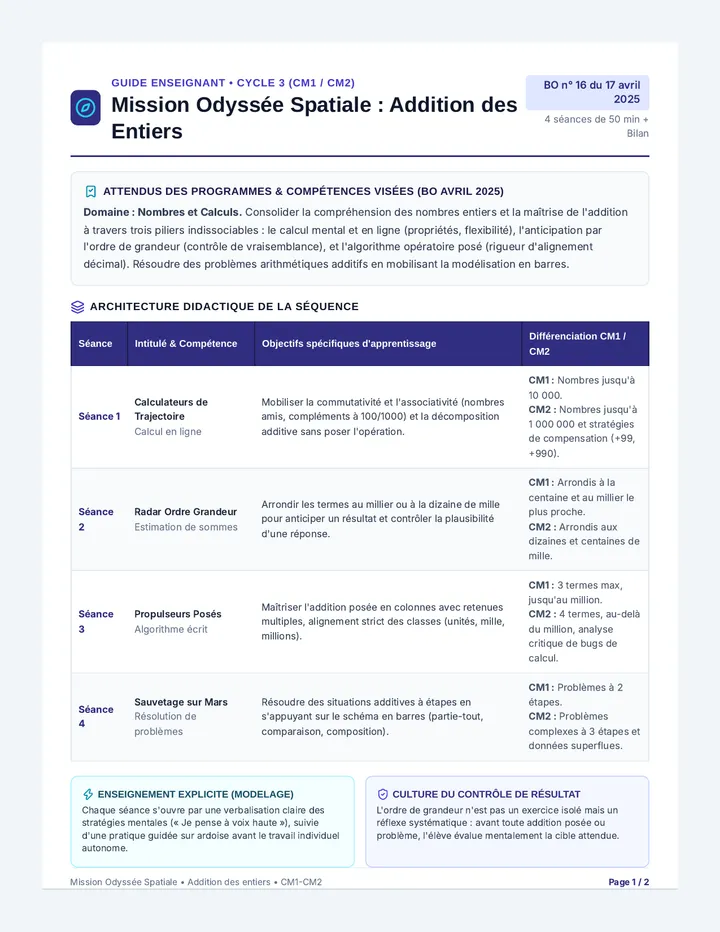
Cargo Division Teacher Guide
Educator Instructional Framework • Grade 5 Math
Cargo Division Quest • Teacher Guide
Standards: CCSS.MATH.CONTENT.5.NBT.B.6 • Mathematical Practices: MP.1, MP.2, MP.6
Teacher Master
Suggested Time: 60 Minutes
Lesson Objective:
Students will divide 2- and 3-digit whole numbers by 2-digit divisors using partial quotients or standard algorithms, assess quotient reasonableness, and accurately interpret remainders within real-world contexts.
Essential Question:
“How does the real-world situation dictate what we do with the leftover pieces (remainders) in division?”
Instructional Pacing Breakdown (60 Min)
10 Min
Hook & Context Launch (Slides 1–2): Frame division as real-world cargo logistics management. Review friendly compatible number multiples mentally to anchor student reasonableness checks before multi-step division calculations.
15 Min
Direct Instruction: Remainder Decisions (Slide 3): Introduce the 4 Remainder Rules. Have students choral-repeat the anchor questions: “Are people/items left behind?” “Do we need full sets only?”
10 Min
Guided Problem Modeling (Slides 4–5): Model Mission 1 (clean quotient, \(864 \div 24 = 36\)) and Mission 2 (boat transport where \(520 \div 35 = 14 \text{ R } 30\), requiring 15 boats). Focus on why 14 boats leave 30 people stranded.
18 Min
Collaborative Practice (Worksheet): Students partner up on Section A & B. With extended workspace boxes, students have ample room for multi-step partial quotients. Teacher circulates with targeted questioning prompts.
7 Min
Formative Assessment: Exit Ticket: Distribute the half-sheet exit tickets for independent completion to assess mastery of rounding up vs. dropping remainders before dismissal.
Diagnostic Table • Misconceptions & Real-Time Coaching
| Student Misconception | Observed Behavior | Teacher Coaching Prompt |
|---|
| Misaligned First Digit | Writing the first quotient digit above the hundreds place instead of the tens place (e.g. writing \(3\) above the 8 in \(864 \div 24\)). | “Can 24 go into 8 hundreds? No. So does 24 go into 86 tens? Where must the first digit sit?” |
| Remainder Ignorance | Reporting the whole-number quotient regardless of what the real-world situation demands (e.g., leaving 7 travelers on the dock in Problem 2). | “If you order 26 taxis, what happens to the 7 researchers left waiting? Can we leave them behind?” |